How to Teach Syllables Step by Step for Young Readers

 Discover a Free Education Video App for Kids
Pastory uses AI to personalize educational video content based on your child’s interests and personality. Safe, engaging, and built for curious young minds. Sign up now to stay updated and enjoy early access with a free trial
Teaching syllables is one of the most practical skills you can give a young reader. When children learn to break words into their sound parts, they gain a reliable tool for decoding unfamiliar vocabulary, improving spelling, and reading with greater fluency.
This guide covers practical methods, step-by-step progression, and activities for teaching syllables at home and in the classroom.
What Are Syllables and How They Work
A syllable is a single unit of sound within a word — one beat that you can hear or feel when you say it aloud. Every word is made up of at least one syllable. For example, cat has one, rab-bit has two, and hel-i-cop-ter has four. Helping children recognize these beats is the first step toward understanding how language is built.
Role of Vowel Sounds in Syllables
Every syllable in a word contains at least one vowel sound. This is the most important rule. The vowel sound — produced with an open airway and no obstruction — acts as the core of each unit. In sunshine, the two vowel sounds /ʌ/ and /aɪ/ create two parts: sun and shine. Teaching young learners to listen for vowel sounds helps them count and divide syllables more accurately.
Why Syllables Matter for Reading and Spelling
Syllable awareness supports three key literacy skills: decoding, fluency, and spelling. When students can break apart multisyllabic words into smaller chunks, long or unfamiliar vocabulary becomes far less intimidating.
Types of Syllables and Division Rules
Structured literacy instruction identifies six syllable types that help students decode and spell correctly:
- Closed — ends in a consonant; the vowel is short (cat, win)
- Open — ends in a vowel; the vowel is long (go, me, ba-by)
- Silent-e — ends in a silent e; the vowel is long (make, hope)
- Vowel team — contains two or more vowels working together (rain, eat)
- R-controlled — vowel followed by r; the sound is neither short nor long (car, bird)
- Vowel-consonant-e — found at the end of longer words (ta-ble, puz-zle)
Knowing these different types helps students predict how to pronounce vowels within an unfamiliar term, which is a significant advantage in independent reading.
Basic Syllable Division Patterns
Three primary division patterns guide students in breaking words into parts:
- VC/CV (rab-bit, bas-ket) — divide between the two consonants
- V/CV (o-pen, ba-by) — divide before the consonant, leaving an open syllable
- VC/V (cam-el, riv-er) — divide after the consonant, creating a closed syllable
These patterns give students a systematic strategy for division, reducing the need for guessing.
Step-by-Step Process for Teaching Syllables
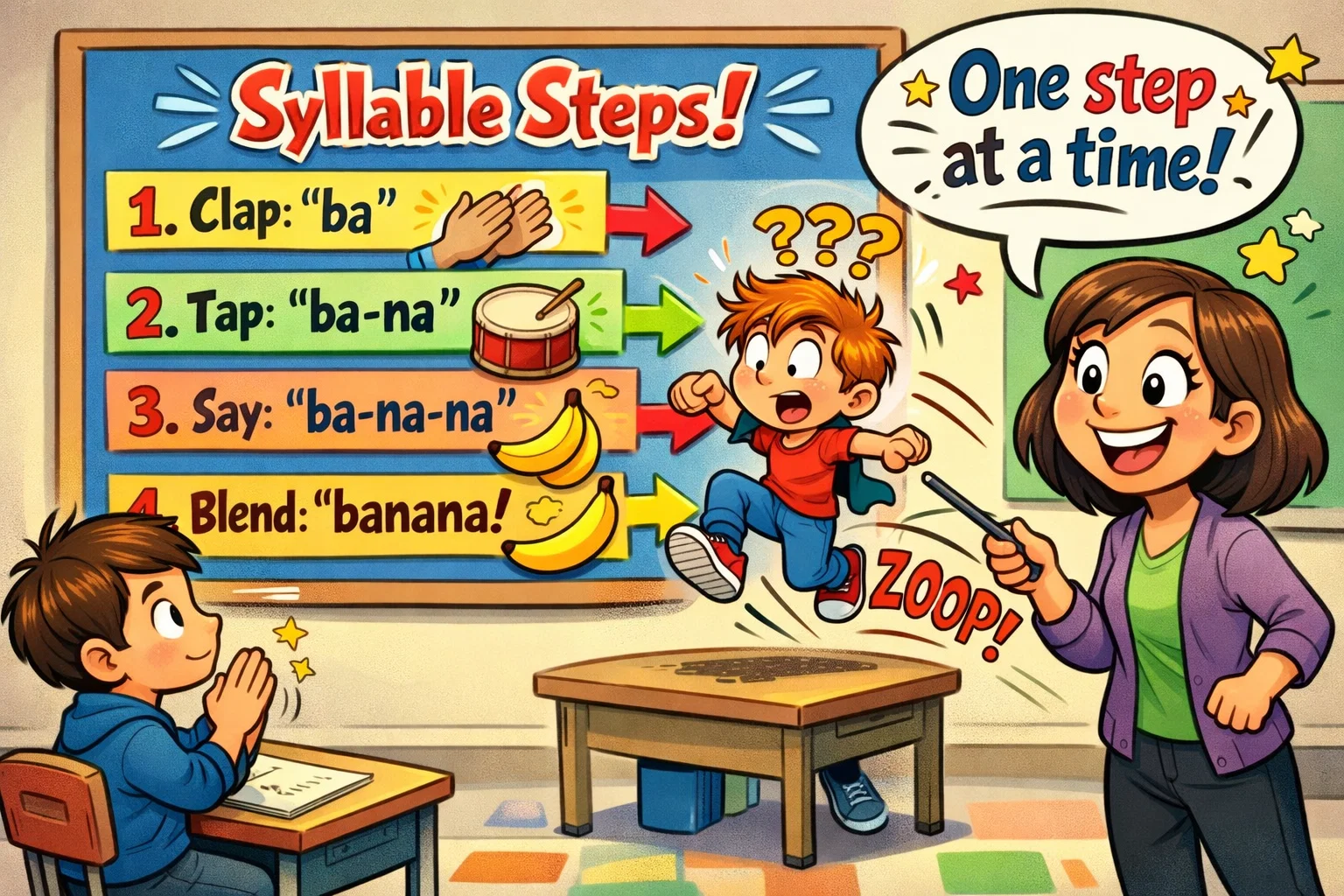
Teaching syllables works best when instruction follows a clear, predictable sequence — moving from spoken awareness to printed text, and from simple to complex. The steps below build on each other, so children develop genuine understanding rather than surface-level memorization.
Start with a Simple Explanation
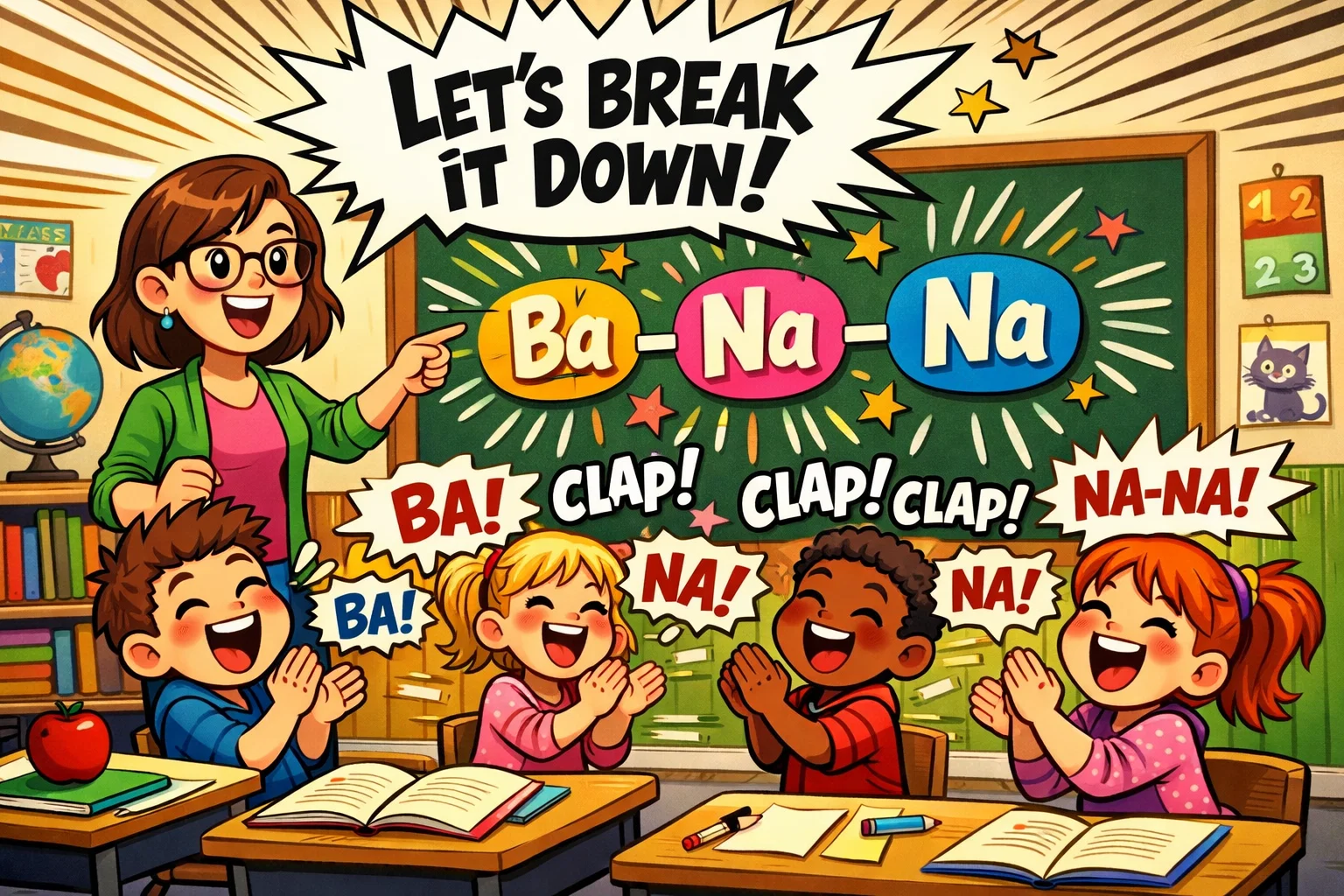
Begin by introducing syllables as “beats” in a word. Ask children to clap along as you say the word aloud: one clap for dog, two for pup-py, three for but-ter-fly. Kinesthetic methods — clapping, tapping the desk, or placing a hand under the chin to feel the jaw drop with each vowel sound — make the concept physical and memorable. This is especially effective with younger children who are still developing phonological awareness.
Demonstrate Counting Process
Use familiar names and vocabulary to demonstrate the counting process. Start with students’ own names — E-mma (two), Al-ex-an-der (four) — since personal connection increases engagement. Encourage students to say each term slowly, count the beats, and hold up a finger for each part. Counting syllables in real, known vocabulary from the start helps children understand that these units are not abstract — they exist in every spoken name and expression they already use.
Teach the Vowel Sound Rule
Once children can clap reliably, introduce the rule: every syllable has one vowel sound. Demonstrate with simple examples, showing that the number of vowel sounds equals the number of parts. For instance, stripe has one vowel sound (/aɪ/) and one syllable, even though it contains three vowel letters.
This distinction between vowel letters and vowel sounds requires phonological and phonemic awareness. It is a common stumbling point and worth addressing early and directly.
Move from Simple to Multi-Syllable Words
After students are comfortable with single-syllable vocabulary, introduce two-syllable words like basket, table, and pencil. Gradually increase to three-syllable words (umbrella, however) and then four-syllable words (information, watermelon). This gradual progression allows children to build confidence before tackling longer, more complex terms.
Introduce Segmentation
Segmentation means breaking a word apart into its component parts. Ask students to say it, then repeat it in pieces: “Say rabbit. Now say it in two parts: rab — bit.” Using blocks, tiles, or cards makes this concrete and visual. Physical manipulation helps students understand that each unit is distinct and separable.
Practice Syllable Blending
Blending is the reverse of segmentation: combining parts back into a complete word. Say them separately — win / dow — and ask students to merge them: window. This skill directly supports reading fluency, where students decode a term part by part and then blend those parts into a recognizable whole. Alternating between segmenting and blending helps solidify understanding from both directions.
Introduce Syllable Manipulation Activities
Once students can segment and blend reliably, introduce manipulation tasks: removing a part (sunshine without sun = shine), substituting one syllable for another, or adding a unit to a base form. These activities strengthen phonological flexibility — the ability to think about and adjust sounds within vocabulary — which supports both reading and spelling development.
Apply Skills in Reading and Writing Tasks
Connect syllable knowledge directly to reading and writing. During shared reading, pause at a multisyllabic word and ask students to divide it before continuing. In writing tasks, encourage children to say a term aloud in parts before spelling it out. These applied tasks transfer isolated practice into meaningful literacy work — which is where lasting learning happens.
Effective Strategies for Teaching Syllables
Multiple approaches work together to make syllable instruction stick. The strategies below combine movement, visuals, and play to give children varied, repeated exposure to the concept — because the more ways a child encounters a skill, the more deeply it takes root.
Clapping and Tapping Techniques
Kinesthetic methods are among the most accessible strategies for teaching syllables, particularly for young learners. Clapping, tapping a table, or placing a hand under the chin to feel jaw movement with each vowel sound all make the abstract concrete. These physical anchors help auditory and tactile learners access concepts that might otherwise feel invisible.
Visual Segmentation with Blocks or Cards
Providing each child with manipulative blocks or cards gives practice a visual and hands-on dimension. Students place one block per syllable as they say a term aloud, then count the blocks to confirm the number of parts. This approach works especially well in small-group instruction and pairs naturally with printed worksheets for reinforcement.
Using Poetry and Rhythm Activities
Poetry naturally draws attention to sound structure. Haikus require students to count the number of syllables per line (5–7–5), turning the exercise into a creative writing task. Chants, nursery rhymes, and limericks reinforce rhythm in an engaging, low-pressure format. Research in literacy education consistently shows that combining phonological tasks with music and movement accelerates skill development in early readers.
Games and Interactive Exercises
Syllable games make repeated practice enjoyable. Effective options include:
- Syllable sort — students sort picture cards into groups by number of beats
- Syllable hopscotch — each square represents one part; students hop and say it aloud
- Word-building races — teams race to assemble cards into complete words
- Bingo — students mark squares as the teacher calls out individual parts of the word
These activities build counting and segmentation skills while keeping energy and engagement high.
Common Mistakes When Teaching Syllables
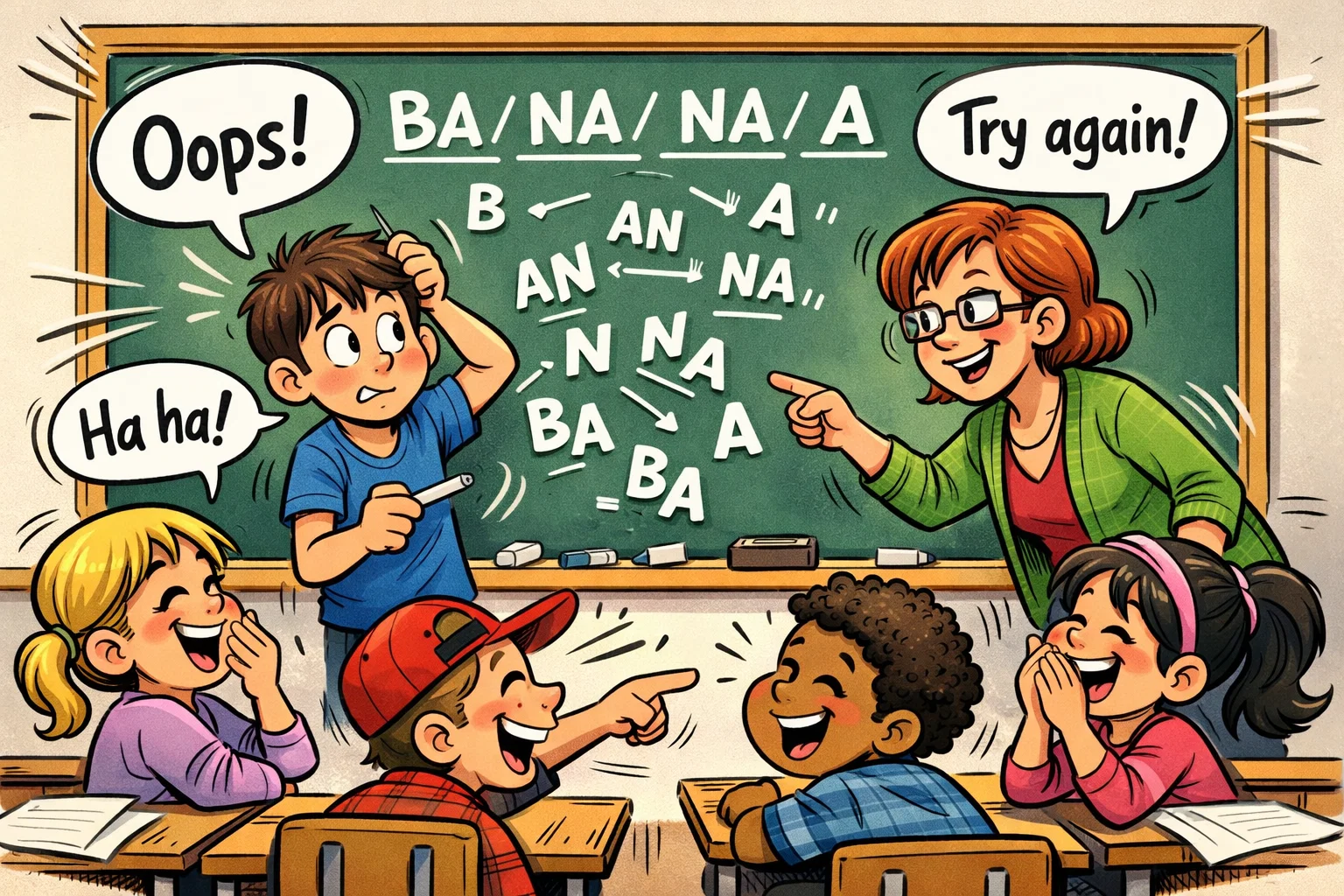
Even well-intentioned instruction can slow progress if certain missteps go unnoticed. Being aware of the most common errors helps teachers and parents adjust their approach before small gaps become bigger obstacles.
Teaching Division Rules Too Early
Introducing formal division rules before students can reliably segment and blend spoken language often creates confusion rather than clarity. Patterns like VC/CV are only useful once a child understands what a syllable is and can hear the units in speech. Premature rule instruction can cause students to apply patterns mechanically without true comprehension, which interferes with reading fluency rather than supporting it.
Ignoring Listening Skills
Instruction that jumps straight to printed text skips an essential step. Students need to develop strong auditory awareness — hearing and counting syllables in spoken vocabulary — before applying that knowledge to the page. Regular listening activities, including clapping along to spoken terms and identifying beats without print, build the phonological foundation that written tasks depend on.
Moving Too Fast to Complex Words
Rushing from two-syllable vocabulary to four-syllable words before students have consolidated earlier skills is one of the most common pacing errors. A child who can correctly segment pencil may not yet be ready for understanding. Checking for accuracy before increasing complexity ensures that skills build on a stable foundation rather than a shaky one.
Conclusion
Teaching syllables is not a single lesson — it is a progression that unfolds over several years of literacy development. Beginning with spoken sound awareness in preschool and kindergarten, moving through segmentation and blending in first grade, and advancing to types and division rules in second and third grade gives children a structured, developmentally appropriate pathway to reading success.
Consistent practice, kinesthetic activities, and direct connections to real reading and writing tasks are the keys to making instruction stick. When children learn to break vocabulary apart confidently, they gain independence as readers and writers that serves them well beyond the early grades.
Frequently Asked Questions
How do you teach syllables to Grade 1 students?
Start with segmentation and blending using two-syllable words students already know. Use manipulatives like blocks or tiles alongside clapping activities. Introduce closed and open types with decodable vocabulary, and keep sessions short — 10 to 15 minutes — and hands-on.
What is the correct order to teach syllable types?
Begin with closed syllables, then open, followed by silent-e, vowel team, r-controlled, and finally consonant-le. This sequence moves from the most common and rule-consistent patterns to those requiring more contextual judgment.
When should you start teaching syllables?
Basic oral awareness — clapping beats in spoken words — is appropriate from age 3 to 4. Formal instruction connecting syllables to printed text typically begins in kindergarten or early first grade, once foundational phonological awareness skills are in place.
Why are syllables important for kids?
Syllables give children a reliable strategy for reading and spelling vocabulary they have never encountered before. By breaking a long term into manageable parts, children reduce cognitive load, improve decoding accuracy, and build the reading fluency that supports comprehension across all subject areas.
Take a short quiz to find out what your everyday choices say about your parenting style
When your child is curious about something new, what’s your instinct?
Take a short quiz to find out what your everyday choices say about your parenting style
“Can I download this app?” What happens next?
Take a short quiz to find out what your everyday choices say about your parenting style
When it comes to rules at home, which sounds most like you?
Take a short quiz to find out what your everyday choices say about your parenting style
If you could give your child one life skill today, what would you pick?
Take a short quiz to find out what your everyday choices say about your parenting style
Your child gets to choose what to watch. What would your ideal setup look like?
Take a short quiz to find out what your everyday choices say about your parenting style
Pick your parenting superpower ✨