How to Teach Parts of Speech: 15 Fun Ways for Kids & Classroom

 Discover a Free Education Video App for Kids
Pastory uses AI to personalize educational video content based on your child’s interests and personality. Safe, engaging, and built for curious young minds. Sign up now to stay updated and enjoy early access with a free trial
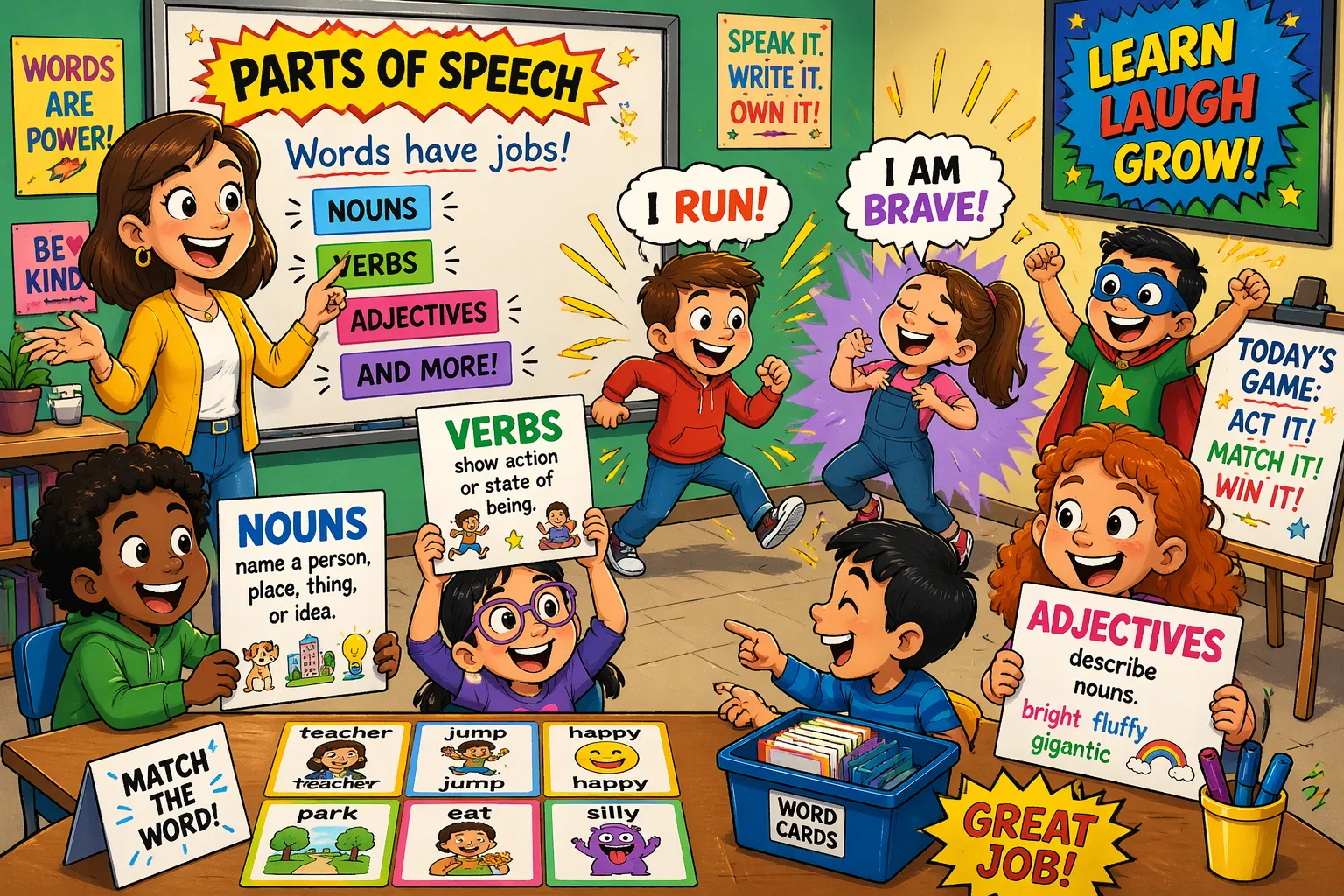
Parts of speech are the building blocks of every sentence. Teaching them well gives students the tools to read with more comprehension, write with more precision, and communicate with greater confidence.
Whether you are working with early elementary learners or helping older students sharpen their grammar skills, this guide covers everything you need — from the 8 types of parts of speech to the best order to introduce them, plus 15 practical, engaging activities you can use right away.
8 Parts of Speech: Quick Reference Guide
Before diving into teaching strategies, it helps to have a clear overview of all eight parts of speech. Each one plays a specific role within a sentence, and together they make up the grammar framework students need to master.
Nouns – People, Places, Things, and Ideas
A noun names a person, place, thing, or idea. This is usually the easiest part of speech for young learners to grasp because it connects directly to the world around them. Start with common nouns like dog, school, and apple, then introduce proper nouns like London or Maria. Pointing to objects in the classroom is one of the most natural and effective ways to make nouns concrete for beginners.
Pronouns – Words That Replace Nouns
Pronouns stand in for nouns to avoid repetition. Instead of saying “Maria said Maria wants Maria’s toy,” students learn to say “She wants her toy.” Subject pronouns (I, you, he, she, they), object pronouns (me, him, her, us, them), and possessive pronouns (my, your, his, her) are the most common starting points. Once students master nouns, this is a natural next step.
Verbs – Action Words and States of Being
Every grammatically complete sentence needs a verb. Action verbs (run, jump, write) show what someone does, while linking verbs (am, is, are, was, were) connect a subject to a description. It is also worth introducing helping verbs (have, will, can) once students feel comfortable with the basics. Verbs are central to sentence structure, which makes them one of the first parts of speech to teach.
Adjectives – Words That Describe Nouns
Adjectives answer questions like “What kind?”, “Which one?”, and “How many?” They modify nouns and make writing more specific and vivid. Descriptive adjectives (big, red, happy), quantitative adjectives (some, many, few), and demonstrative adjectives (this, that, those) are all worth covering. A simple activity like changing “The dog ran” to “The big, brown dog ran” helps students see how adjectives add detail and depth.
Adverbs – Words That Modify Verbs, Adjectives, or Other Adverbs
Adverbs describe how, when, where, or to what degree something happens. Many adverbs end in -ly (quickly, softly, carefully), though there are important exceptions like fast and well. Adverbs can modify verbs (“She ran quickly”), adjectives (“very tall”), or even another adverb (“quite slowly”). Teaching students to ask “How did the action happen?” is a reliable method for spotting adverbs within a sentence.
Prepositions – Words That Show Relationships
Prepositions show the relationship between a noun or pronoun and another word in a sentence. Common examples include in, on, at, under, between, and with. They form prepositional phrases that tell us where, when, or how something relates to something else — for example, “The book is on the table.” Prepositions can be tricky for young learners, so visual aids and movement activities work especially well here.
Conjunctions – Words That Connect Ideas
Conjunctions join words, phrases, or clauses together. Coordinating conjunctions — often remembered with the acronym FANBOYS (for, and, nor, but, or, yet, so) — connect equal parts. Subordinating conjunctions (because, although, while, since) introduce dependent clauses. Teaching conjunctions helps students write more complex, varied sentences and move beyond short, choppy statements.
Interjections – Words That Express Strong Emotion
Interjections express sudden emotion and often stand alone. Words like Wow!, Oops!, Hurray!, and Oh no! are common examples. They are usually followed by an exclamation mark and are not grammatically connected to the rest of the sentence. Interjections are among the most fun parts of speech to teach because they are expressive, memorable, and immediately relatable to children.
Best Order to Teach Parts of Speech
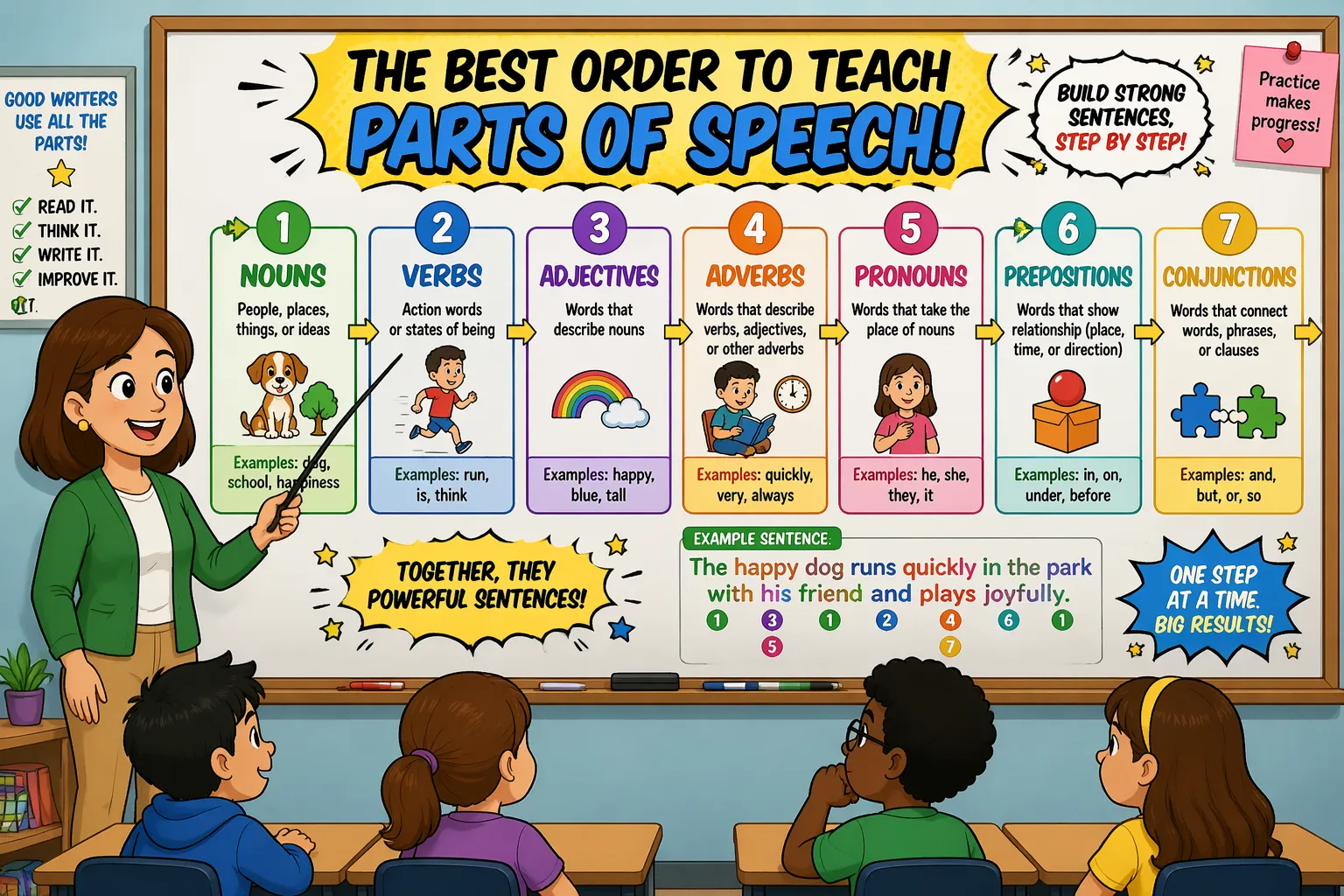
Introducing all eight parts of speech at once can overwhelm students and lead to confusion. A logical, step-by-step sequence — moving from the most essential to the most nuanced — allows students to build on what they have already mastered before adding new vocabulary.
Start with Nouns and Verbs
Every sentence has a subject and a predicate, which means every sentence needs at least one noun and one verb. Teaching these two first gives students the foundation to construct simple, complete sentences like “The cat sleeps” or “Birds fly.” Once they can reliably identify nouns and verbs in a sentence, they are ready to expand.
Add Adjectives and Adverbs Next
After students are comfortable building basic sentences, introduce adjectives and adverbs to help them elaborate. A sentence like “The dog ran” becomes “The small, spotted dog ran quickly.” This progression makes the value of describing words immediately clear and gives students new vocabulary to apply in their own writing.
Introduce Pronouns for Sentence Variety
Once students overuse nouns — a common pattern in early writing — it is time to teach pronouns. Replacing repeated nouns with pronouns improves flow and teaches students how different parts of speech interact. This is a great point to include short editing exercises where students revise a paragraph to reduce noun repetition.
Teach Prepositions and Conjunctions for Complex Sentences
Prepositions and conjunctions help students move from simple to compound and complex sentences. Instead of “I like cats. I like dogs.” students learn to write “I like cats and dogs” or “I like cats, but I also like dogs.” Prepositional phrases add location and context. These two parts of speech are essential for grammatically varied writing.
End with Interjections
Interjections are low-frequency compared to the other parts of speech, but they are high-engagement — especially for younger learners. Save them for last as a fun, rewarding lesson. Role-play activities and expressive writing tasks are perfect for introducing interjections once students have a solid handle on the rest of the eight parts of speech.
15 Fun Ways to Teach Parts of Speech
Grammar doesn’t have to be boring. The activities below are designed to keep students engaged while reinforcing their knowledge of each part of speech. Mix and match them to suit your classroom routine or home learning sessions.
1. Sorting Worksheets by Word Category
Give students a list of words and ask them to sort each one into a column for nouns, verbs, adjectives, and so on. Cut-and-paste versions work especially well for younger learners. Include an answer key so students can self-check, which builds confidence and independence.
2. Color-by-Part of Speech
Assign a color to each part of speech — for example, nouns in blue, verbs in red, adjectives in green. Students then color-code words in a sentence or short paragraph. This coloring sheet approach is visually engaging and helps students see patterns in how different parts of speech appear within a sentence.
3. Preposition Matching Game
Create cards with prepositions (under, above, beside, between) paired with illustrations showing the positional relationship. Students match each preposition to the correct image. This is particularly helpful for visual learners and reinforces how prepositions describe location and relationship within a sentence.
4. Mad Libs for Grammar Practice
Mad Libs are a tried-and-true way to make grammar fun and engaging. One student calls out words by category (noun, verb, adjective) without seeing the story. Another student fills in the blanks. Reading the resulting silly sentences aloud creates laughter and — more importantly — a memorable lesson in how each part of speech functions.
5. Flashcard Quiz Race
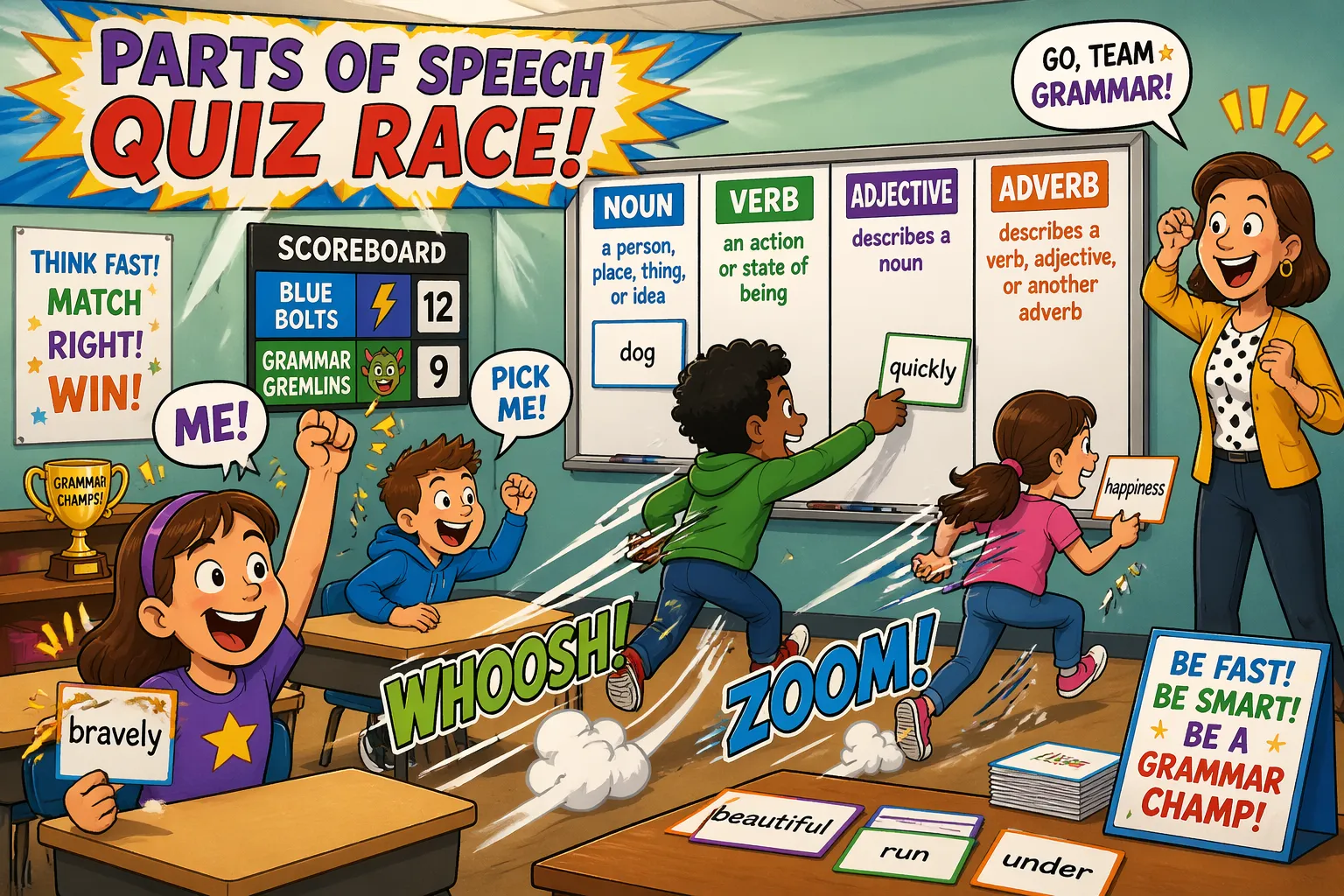
Write a word on one side of a flashcard and its part of speech on the other. Split the class into teams and hold a race to see who can correctly identify the most cards. This quick review activity works well as a warm-up or end-of-lesson check and can also be assigned as morning work.
6. Interjection Role-Play Scenes
Give students a scenario — winning a game, dropping something, seeing a surprise — and ask them to respond using only interjections. This activity encourages expressive speaking, reinforces the emotional nature of interjections, and gets students out of their seats. It also works well as a whole group activity to energize the classroom.
7. Word Search with Grammar Clues
Design a word search where each hidden word is listed next to a grammar clue rather than the word itself. For example, “an action word” points to a verb, and “a describing word” points to an adjective. Students find the word and label its part of speech, adding an extra layer of challenge.
8. Fill-in-the-Blank Sentences
Provide sentences with labeled blanks — (adjective), (adverb), (noun) — and allow multiple correct answers. This format encourages creativity while reinforcing the correct part of speech for each slot. It is a flexible activity that works for independent practice, pairs, or small groups.
9. Sentence Construction Challenge
Give students a set of word cards from different grammatical categories and challenge them to build a grammatically correct sentence using all of them. This hands-on task develops both grammar knowledge and critical thinking. It works especially well in small groups where students can discuss and negotiate word order together.
10. Pronoun Substitution Drill
Write sentences with repeated nouns and ask students to rewrite them using pronouns. For example, “Maria told Maria’s friend that Maria was late” becomes “She told her friend that she was late.” This drill reinforces both pronoun use and the relationship between nouns and pronouns within a sentence.
11. Conjunction Connectors Game
Give students two short sentences on cards and a set of conjunction cards. Students must match the two sentences to a conjunction that connects them logically. For example, “I was tired” + “so” + “I went to bed.” This activity teaches students to choose the correct part of speech for meaning, not just grammar.
12. Grammar Anchor Charts and Posters
Create bright, clear posters for each part of speech — including a definition, examples, and a visual cue — and hang them at eye level in the classroom. These serve as permanent reference tools that students can check during writing tasks. Anchor charts are especially valuable for visual learners and those who need extra support.
13. Verb Charades with Adverb Modifiers
A student acts out a verb (sleep, eat, dance) and others guess it. Then another student adds an adverb (sleep peacefully, eat quickly, dance wildly) and acts it out again. This active game is incredibly engaging and makes the relationship between verbs and adverbs feel intuitive rather than abstract.
14. Parts of Speech Bingo
Create bingo cards filled with example words. Call out a definition (“a person, place, or thing”) or a sentence (“Circle the verb in ‘The cat jumped’”) instead of the word itself. Students cover the matching word on their card. This format works well as a whole group review activity before a quiz or test.
15. Color-Coded Sentence Building with Word Cards
Print word cards color-coded by part of speech — nouns in one color, verbs in another, adjectives in a third. Students arrange the cards on a desk to form sentences, then write them down. This is a highly tactile activity that helps students see how parts of speech fit together to create grammatically correct writing.
Activity Duration Guide
- 5-minute warm-ups: Flashcard Quiz Race, Pronoun Substitution Drill
- 10-15 minute activities: Sorting Worksheets, Fill-in-the-Blank Sentences, Word Search with Grammar Clues
- 20-30 minute lessons: Color-by-Part of Speech, Mad Libs, Conjunction Connectors Game, Parts of Speech Bingo
- Full period or station rotations: Sentence Construction Challenge, Verb Charades with Adverb Modifiers, Interjection Role-Play Scenes, Color-Coded Sentence Building
Practice Activities to Reinforce Parts of Speech
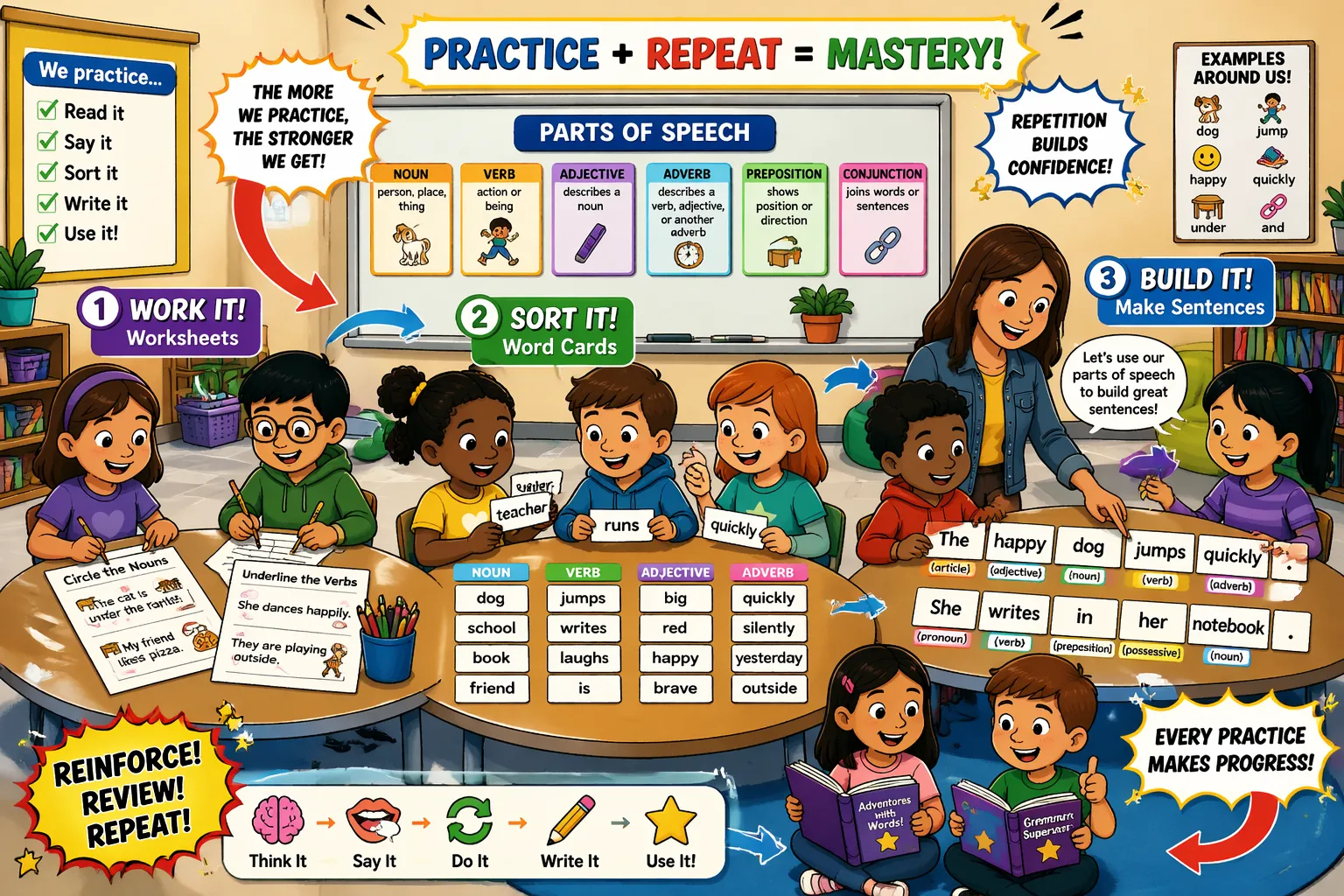
Identifying parts of speech once is not enough. Students need repeated, varied exposure before the concepts truly stick. The following activities are designed for ongoing reinforcement without becoming repetitive or dull.
No-Prep Daily Review Sheets
A five-minute worksheet at the start of each lesson can do a great deal over time. Use a consistent format — circle the nouns, underline the verbs, box the adjectives — so students spend mental energy on grammar rather than instructions. These daily warm-ups build automaticity and make reviewing parts of speech a natural part of every lesson.
Grammar Games for Small Groups
Set up grammar stations around the classroom: a card-matching station for nouns and verbs, a board game where landing on a space requires naming a part of speech, or a toss-a-ball game where the catcher must identify the part of speech of a word you call out. Small group formats allow for immediate peer feedback and keep every student actively involved.
Interactive Slides and Digital Practice
Google Slides and other interactive slide tools can be used to create drag-and-drop grammar activities, color-coding exercises, and multiple-choice quizzes. Digital tools like Boom Cards provide instant correct-or-incorrect feedback, which is especially useful for self-paced practice in Google Classroom or at home. These formats are particularly motivating for students who respond well to screens.
Integrate Parts of Speech into Writing
The ultimate goal of teaching grammar is not just identification — it is application. When students actively use their knowledge of parts of speech in their own writing, the learning becomes truly embedded. The strategies below help bridge the gap between grammar lessons and real writing tasks.
Build a Personal Parts of Speech Vocabulary List
Have each student maintain a notebook with a dedicated page for each part of speech. Whenever they encounter a new word during reading or writing, they add it to the correct category. Reviewing these lists weekly helps students expand their vocabulary and reinforces correct classification. This habit also encourages students to think about new words in grammatical terms from the start.
Use a Writing Checklist with Grammar Focus
Give students a grammar-focused checklist to use during the editing stage of writing. For example: “I used at least two adjectives. I varied my sentence length using conjunctions. I checked my verbs for consistent tense.” This approach helps students apply what they have learned in a practical, meaningful context and makes grammar feel purposeful rather than abstract.
Peer Editing for Parts of Speech Variety
Partner students for a focused peer editing session. One student reads a paragraph aloud while the other listens for variety in parts of speech. They then suggest one specific improvement — for example, “Your verbs are all simple past tense — could you add an adverb to show how the action happened?” This kind of collaborative grammar review builds both writing skills and vocabulary awareness.
Start Teaching Parts of Speech This Week
Teaching parts of speech is most effective when it is consistent, varied, and connected to real language use. You do not need to try fifteen activities at once. Instead, pick three that suit your students and your schedule — for example, color-by-part-of-speech for visual learners, Mad Libs for group engagement, and a daily fill-in-the-blank warm-up for ongoing practice.
As students grow more confident identifying and using each part of speech, gradually introduce more complex activities. Connect grammar lessons to reading and writing tasks as often as possible so students see the real purpose behind the rules. When children start noticing nouns and verbs in books they are reading or recognizing conjunctions in their own sentences, you will know the foundation is truly in place.
With patience, creativity, and the right mix of activities, teaching grammar becomes less about rules to memorize and more about language to explore.
Frequently Asked Questions
What Is the Easiest Part of Speech to Teach First?
Nouns are generally the easiest part of speech to introduce, especially for young children who already recognize people, places, and things in their everyday world. Start with objects in the room (desk, window, pencil) or familiar names (teacher, friend, dog). Once students can reliably identify common and proper nouns, move on to verbs. Nouns and verbs together form the core of every sentence, which makes them the natural starting point for any grammar sequence.
How Do You Teach Parts of Speech in a Fun Way?
The most effective grammar lessons combine movement, creativity, and interaction. Activities like verb charades, Mad Libs, parts of speech bingo, and color-coded sentence building keep students engaged while reinforcing the correct use of each grammatical category. For digital learners, interactive slides and self-checking apps add variety. The key is to avoid relying solely on worksheets — mix formats, use games, and give students opportunities to create and discuss, not just identify and label.
In What Order Should the 8 Parts of Speech Be Taught?
A reliable teaching sequence begins with the most structurally essential parts of speech — nouns and verbs as the core of every sentence — then moves to adjectives and adverbs for description, followed by pronouns for variety, prepositions for context, conjunctions for complex sentences, and finally interjections for expressive personality. Teachers should avoid introducing all eight categories at once, ensuring students feel confident with nouns and verbs before adding adjectives, and secure with the first four before moving to prepositions or conjunctions.
How Do You Identify Parts of Speech in a Sentence?
Teach students a step-by-step method for analyzing any sentence. First, find the verb by asking “What is the action or state of being?” Next, find the noun by asking “Who or what is doing it?” Then look for adjectives (“What kind? Which one?”), adverbs (“How? When? Where?”), prepositions (position words), and conjunctions (connecting words). Practicing with short, simple sentences first — then building up to more complex ones — helps students develop a reliable and transferable skill.
What Resources Help Struggling Students with Parts of Speech?
For students who struggle with grammar, the most effective approach combines multisensory resources like color-coded anchor charts, cut-and-paste sorting worksheets, interactive digital tools with instant feedback, sentence frames with labeled blanks, and small group sessions focused on only one or two parts of speech at a time. The most important principle for struggling learners is to avoid rushing, since students who have not yet mastered nouns and verbs will struggle with every subsequent part of speech.

Take a short quiz to find out what your everyday choices say about your parenting style
When your child is curious about something new, what’s your instinct?
Take a short quiz to find out what your everyday choices say about your parenting style
“Can I download this app?” What happens next?
Take a short quiz to find out what your everyday choices say about your parenting style
When it comes to rules at home, which sounds most like you?
Take a short quiz to find out what your everyday choices say about your parenting style
If you could give your child one life skill today, what would you pick?
Take a short quiz to find out what your everyday choices say about your parenting style
Your child gets to choose what to watch. What would your ideal setup look like?
Take a short quiz to find out what your everyday choices say about your parenting style
Pick your parenting superpower ✨