How to Teach Number Sense: Strategies, Activities, and Skills by Age

 Discover a Free Education Video App for Kids
Pastory uses AI to personalize educational video content based on your child’s interests and personality. Safe, engaging, and built for curious young minds. Sign up now to stay updated and enjoy early access with a free trial
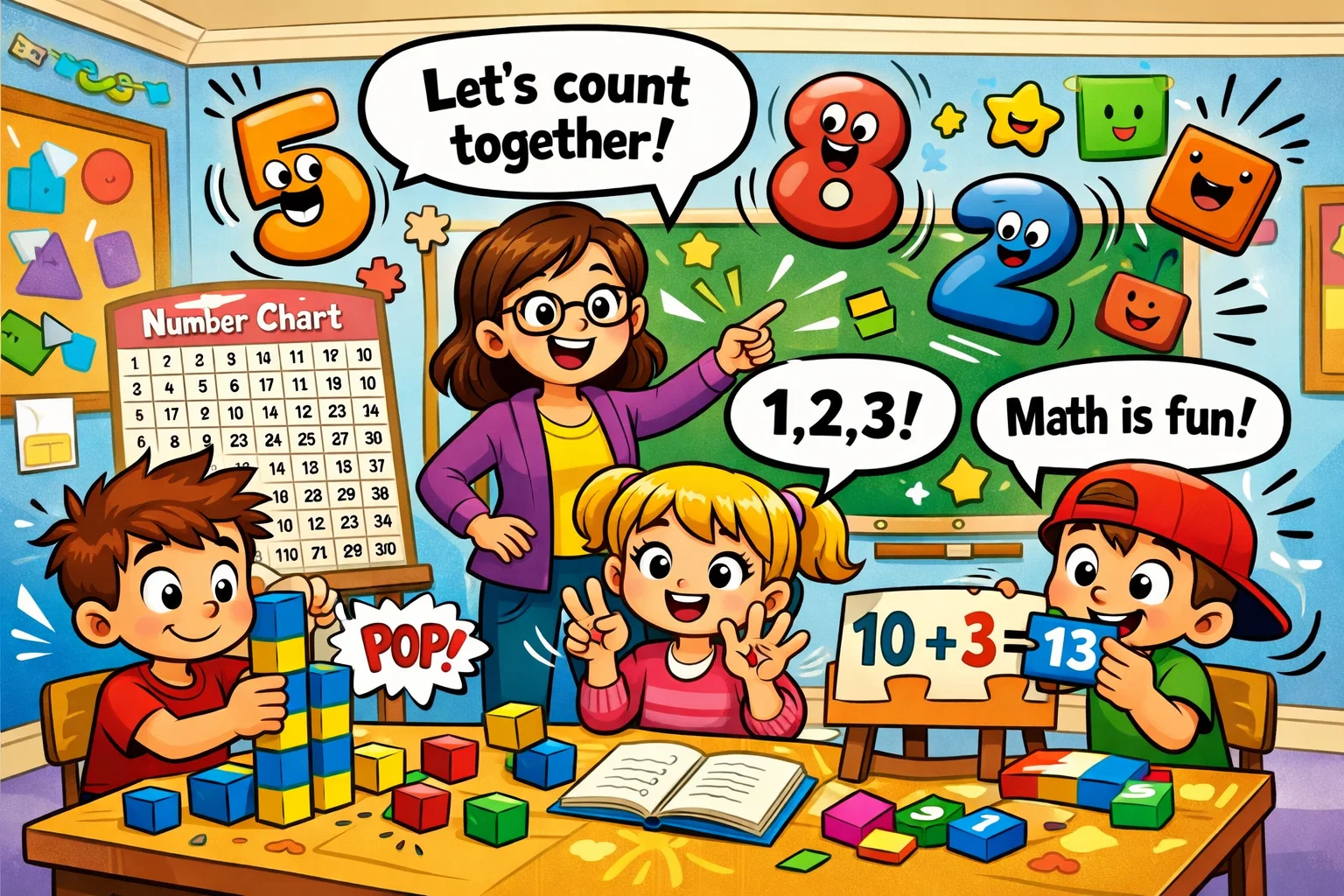
Knowing how to teach number sense gives children a lasting foundation for math — not just memorizing facts, but understanding how numbers work, relate to each other, and can be used to solve real problems. Number sense builds gradually from the preschool years through early elementary school and can be supported both at home and in the classroom.
This guide covers the core skills that make up number sense, how they develop by age, practical teaching strategies, hands-on activities, and ways to assess and track a child’s progress over time.
Key Takeaways
- Number sense is a child’s flexible understanding of how numbers work, relate, and can be applied to solve problems.
- Core skills include number recognition, counting, quantity comparison, estimation, place value, and flexible thinking.
- Number sense develops in stages from preschool through later elementary, so teaching strategies should match a child’s age and readiness.
- Everyday activities such as counting objects, estimation games, and sorting build number sense naturally alongside structured practice.
- Progress can be tracked through informal observation and structured tools, with targeted support available for children who are struggling.
What Is Number Sense and Why It Matters
Number sense is a person’s natural ability to understand and work with numbers. In simple terms, it means:
- Knowing what they represent (like “5” means five objects)
- Comparing them (which is bigger or smaller)
- Seeing patterns and relationships
- Solving basic math problems in flexible ways
It forms the conceptual framework that supports all future math learning. When kids develop these skills early, they become more confident and capable in tackling both simple and complex math concepts later on.
Research shows that early numeracy skills strongly predict later achievement in elementary math and beyond. Students with a solid foundation transition more easily into advanced topics like place value, fractions, and algebra.
On the other hand, poor numeracy can lead to ongoing struggles with basic operations, including addition and subtraction, and difficulty understanding numerical relationships. This can affect overall success in math and confidence in a math class.
Core Components of Number Sense Skills
To effectively teach number sense, it’s important to understand the key areas that make up these foundational skills.
Number Recognition and Symbol Awareness
Recognition is the ability to connect numerals with quantities. For example, a youngster understands that “5” represents a specific group of objects. Using tools like a number card, learners can match symbols to real-world quantities and strengthen their understanding.
Counting and Number Sequences
Kids learn to count by progressing from memorization to meaningful counting. They begin to say the values while pointing to each object, developing one-to-one correspondence. Practicing sequences—forward and backward—helps them understand the structure of the number system.
Quantity and Magnitude Comparison
This skill allows students to compare groups and determine which has more or fewer items. Understanding magnitude helps them solve math problems and interpret data later in their learning journey.
Number Relationships and Connections
Understanding numerical relationships is central to strong math foundations. For example, recognizing that 8 can be broken into 5 and 3 builds a foundation for number bonds and mental math strategies.
Estimation and Approximation
Estimation helps learners make reasonable guesses about quantities. This supports real-world problem-solving and improves performance in complex math.
Spatial Awareness and Visual Models
Using tools like a number line or ten frames helps students visualize. These visual aids allow learners to see how figures relate spatially and conceptually.
Flexible Thinking in Calculations
A student who can adjust strategies—for example, solving 9 + 6 by making 10 first—demonstrates strong numeracy. This flexibility is essential for mastering math operations.
How Number Sense Develops Over Time
Numeracy develops gradually, progressing through stages as children grow.
Preschool Stage (Ages 2–5)
At this stage, children begin learning numeracy through play and exploration. They:
- Count small groups of objects
- Recognize basic numerals
- Compare quantities using “more” and “less”
- Sort items by size or quantity
Activities like counting snacks or arranging toys are effective hands-on activities that help children understand numbers.
Early Elementary (Ages 5–7)
Children expand their skills to include:
- Addition and subtraction
- Understanding sequences
- Using a number line
- Exploring numerical relationships
These skills are reinforced through structured math lessons and daily routines.
Later Elementary (Ages 7–10)
At this level, students:
- Work with multi-digit numbers
- Use mental math strategies
- Solve more complex math problems
- Analyze numerical patterns
Their students’ number sense becomes more flexible and abstract, supporting advanced math learning.
Strategies to Teach Number Sense
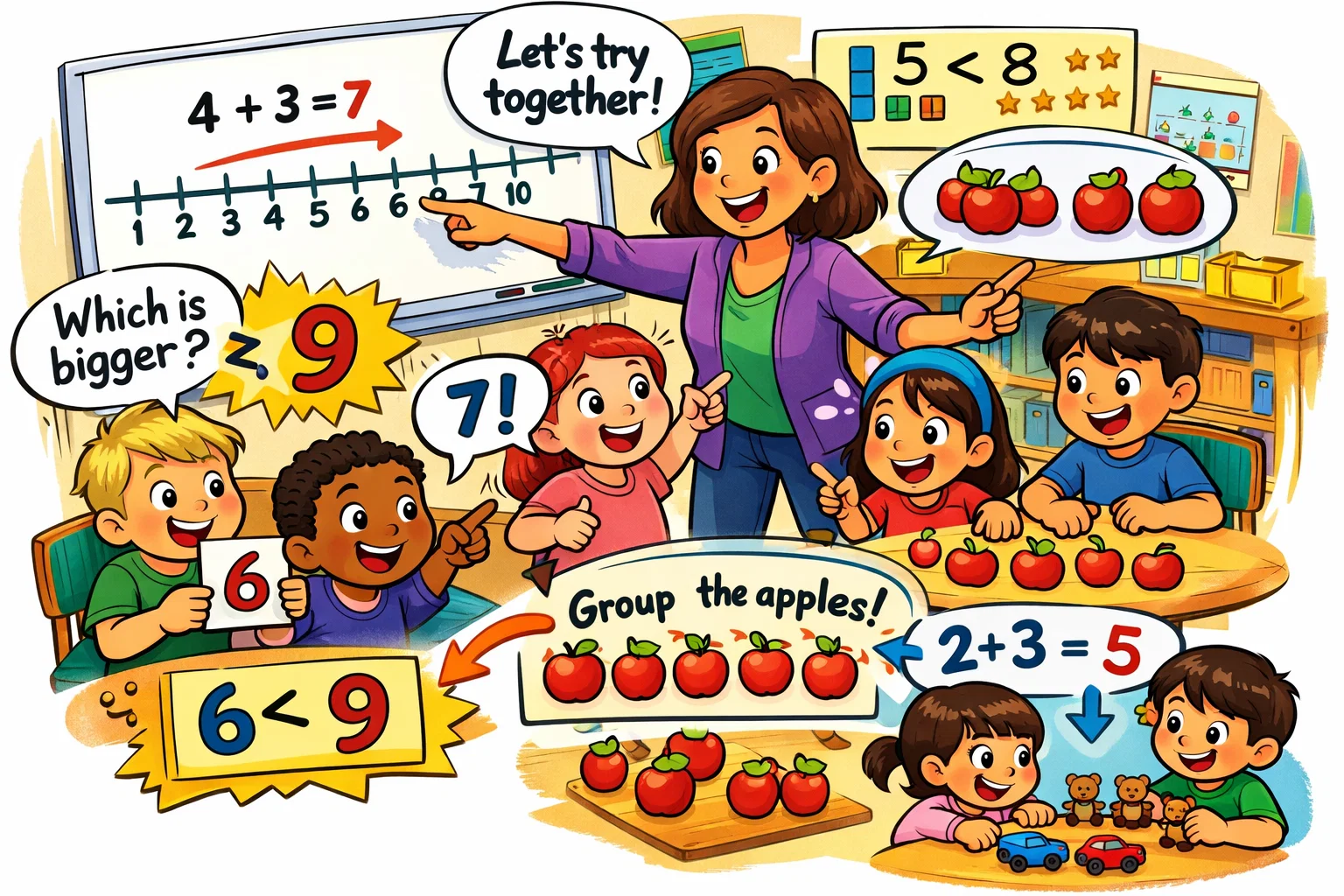
Teaching number sense is not about drilling facts or memorizing sequences. It is about helping children build a genuine, flexible understanding of how numbers work. The most effective approach moves from concrete, hands-on experiences toward more abstract thinking — a progression that mirrors how young minds naturally develop mathematical understanding.
Below are proven strategies educators and parents can use to develop strong numeracy skills in children.
Start with Number Recognition
Before children can work with numbers, they need to recognize what they look like and what they represent. Number recognition is the ability to connect a written numeral — say, the symbol “7” — with a real quantity of objects.
Flashcards are one of the most straightforward tools for this. Show a card with the number “4,” then ask the child to place four blocks, four raisins, or four small toys on the table. The key is to make the connection physical and visible. When a child can see, touch, and count the objects that match the symbol, the numeral stops being an abstract mark and becomes meaningful.
Real-world examples deepen this further. Point to numbers in the environment — a house number on a door, the number of candles on a birthday cake, or the floor buttons in an elevator. Asking “How many do you see?” turns everyday moments into quiet, effective learning opportunities.
Practice Meaningful Counting
There is a difference between reciting numbers and truly counting. Many young children can rattle off “one, two, three, four, five” without understanding that each word corresponds to exactly one object. Meaningful counting fixes this gap.
The method is simple: ask children to physically move an object as they say each number. Counting five apples means touching and sliding each apple to the side as they go — one apple per number word. This builds one-to-one correspondence, the foundational understanding that each object gets exactly one count.
Take it further by varying what gets counted. Count steps going up the stairs. Count the number of spoons on the table. Count how many children are sitting in a circle. The more contexts a child encounters counting, the more deeply they internalize what numbers actually mean.
Use Visual Models
Abstract ideas become accessible when children can see them. Visual models like number lines, ten frames, and base-10 blocks are among the most powerful tools in early math education — not because they are complicated, but because they make invisible relationships visible.
A number line, for example, shows children that numbers have order and direction. Placing a counter on “3” and then moving it forward two spaces to land on “5” makes addition a spatial, intuitive act rather than a symbol-manipulation rule. Ten frames — grids with two rows of five boxes — help children see how numbers relate to 10. Filling in 7 dots on a ten frame immediately shows that 7 is three away from 10, planting an early seed for mental math strategies.
Blocks and cubes allow children to physically build and break apart numbers. Making a tower of 9 cubes and then snapping off 4 makes subtraction concrete before it ever becomes a written equation.
Build Sequences
Understanding that numbers form an ordered, predictable sequence is essential to numeracy. Children who grasp this can reason about which number comes next, which comes before, and what belongs in a gap.
Practice counting forward from different starting points — not just from 1. Ask: “Can you count starting from 6?” Then practice counting backward: “Start at 10 and count down to 1.” Finally, introduce missing-number tasks: “3, 4, __, 6 — what goes in the blank?”
These exercises teach children that the number system has a logical structure. Once they understand that structure, they can navigate it flexibly rather than depending on always starting from the beginning.
Introduce Skip Counting and Patterns
Skip counting — counting by 2s, 5s, and 10s — is often introduced as a fun rhythmic activity, but its mathematical value goes far deeper. Recognizing that 2, 4, 6, 8, 10 follows a consistent rule lays the conceptual groundwork for multiplication long before the term is ever introduced.
Use a hundreds chart and color in every second number. Ask children what they notice. The colored squares form a pattern — a visual, repeatable structure. Then try it with every fifth number, or every tenth. Children begin to see that multiplication is really organized, repeated skip counting, which makes the concept far less intimidating when they encounter it formally.
Clapping rhythms, hopping on a number line, or grouping objects into pairs are all physical ways to experience skip counting that make the pattern memorable and engaging.
Develop Place Value Understanding
Place value — the idea that the position of a digit determines its value — is one of the most important and often misunderstood concepts in early math. A child who does not truly understand place value will struggle with multi-digit addition, subtraction, and eventually decimals.
Grouping activities make place value tangible. Give a child 24 small objects — pennies, buttons, or cubes — and ask them to organize the objects into groups of ten. They will form two groups of ten and have four left over. Now show them how “24” is written: two tens and four ones. The written numeral maps directly onto what they just built with their hands.
This same principle can be extended using base-10 blocks, where flat ten-sticks and individual unit cubes make the structure of numbers physically apparent. A child who has built 47 with four ten-sticks and seven unit cubes has a much stronger understanding of what “47” means than a child who has only ever written it on paper.
Encourage Flexible Thinking
Strong number sense is ultimately about flexibility — the ability to approach a problem from multiple angles and choose the most efficient path. A child who can only solve 8 + 5 by counting on their fingers one by one has a weaker foundation than a child who thinks: “8 needs 2 more to make 10, so I’ll take 2 from 5 and add the remaining 3, which gives me 13.”
The best way to develop this flexibility is to ask children to explain their thinking out loud. After solving a problem, ask: “How did you figure that out? Is there another way you could do it?” This kind of metacognitive reflection — thinking about thinking — deepens understanding and encourages children to treat math as a reasoning process rather than a set of procedures to follow.
Discussion in class, partner work, and open-ended problem-solving tasks all support flexible thinking. When children hear how their peers approached the same problem differently, they expand their own mental toolkit.
Activities to Build Number Sense
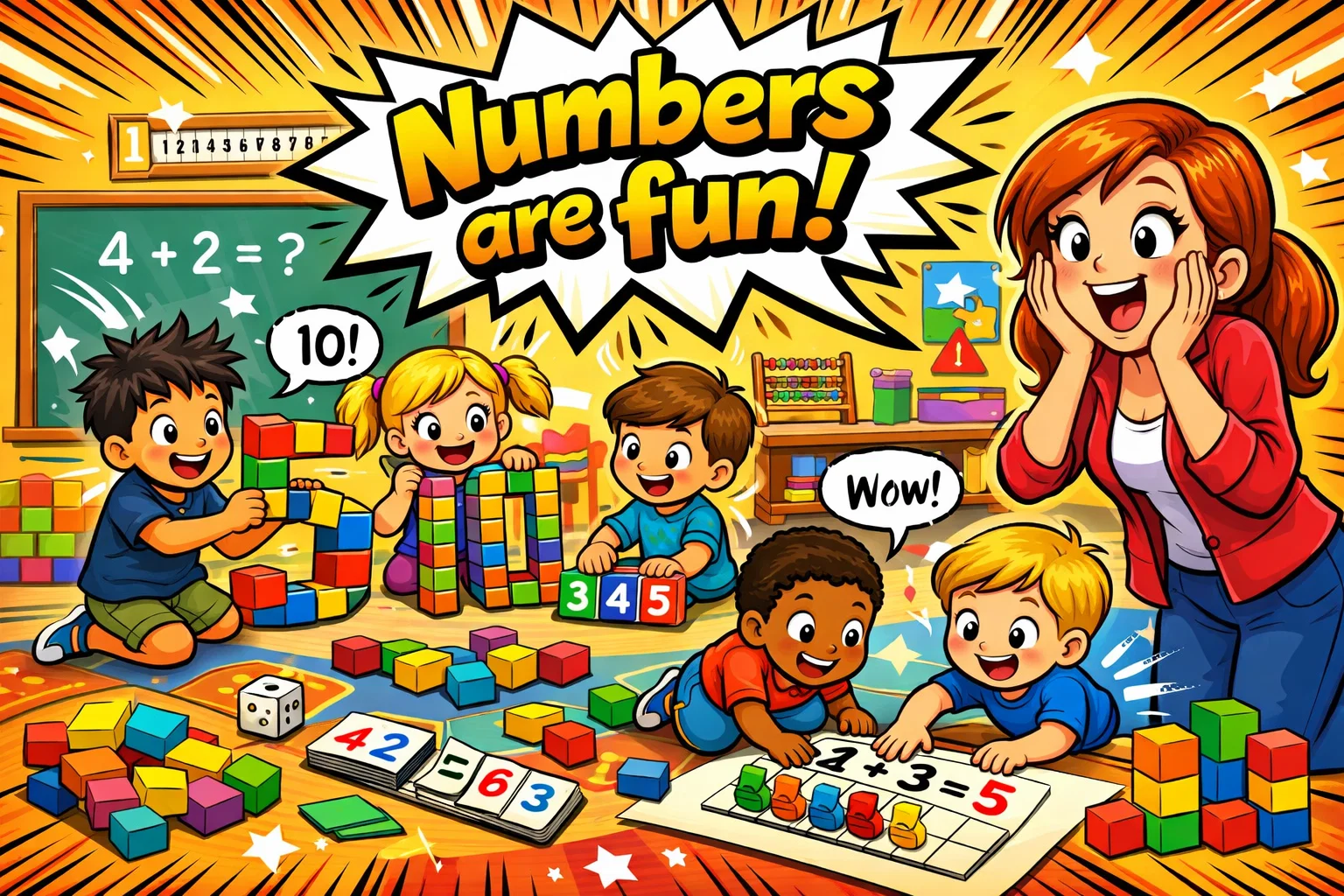
Strategies provide direction, but activities are where real learning takes hold. Engaging, hands-on experiences help children internalize numeracy in ways that worksheets alone cannot achieve. The activities below are designed to be genuinely enjoyable while building essential skills.
Counting with Everyday Objects
The kitchen, living room, and backyard are full of natural counting material. Ask a child to count the number of forks when setting the table, how many apples are in the fruit bowl, or how many steps from the door to the couch. These moments are brief, low-pressure, and highly effective.
Grouping adds a layer of complexity: “Can you put the toy cars into groups of three? How many groups did you make?” Comparing follows naturally: “Who has more — you or your sister?” Using everyday objects ensures that children see numbers as tools for understanding the world around them, not just symbols on a page.
Matching Games
Matching games train recognition and build the crucial link between numeral and quantity. A basic version uses two sets of cards: one set shows numerals (1, 2, 3…) and another shows pictures of objects in corresponding quantities (one star, two stars, three stars). Children flip cards face-down and find matching pairs.
More advanced versions can include multiple representations: the numeral “6,” a picture of six dots, the word “six,” and a dice face showing six. Matching across formats strengthens the understanding that the same quantity can be expressed in many ways.
Board Games and Dice Activities
Classic board games like Snakes and Ladders do significant mathematical work behind the scenes. Rolling a die, counting the dots, and moving that many spaces forward connects number recognition, counting, and spatial reasoning in a single, motivating action.
Dice games can also be adapted for specific skills. Roll two dice and add the numbers together. Roll one die and count backward from that number. Use a large foam die and have children hop that many steps along a taped number line on the floor. The element of chance makes these activities exciting and keeps children coming back for more practice.
Estimation Games
Estimation is a skill that rarely gets enough attention, yet it is essential for real-world numeracy. Fill a clear jar with a small number of objects — marbles, buttons, or beans — and ask children to guess how many are inside without counting.
After they record their estimates, count together to check. The goal is not to guess exactly right but to make a reasonable, thoughtful guess. Over time, children develop better numerical intuition and learn to anchor their estimates using benchmarks: “It looks like more than 10 but fewer than 20.”
Number Storytelling
Math and narrative are a surprisingly natural pairing for young children. Create simple, imaginative stories that embed addition and subtraction naturally: “There were six birds sitting on a fence. Three more flew over and joined them. How many birds are there now?”
Children can act out the story with toys, draw a picture to illustrate it, or simply visualize it in their heads. Storytelling removes the cold, abstract quality that written number sentences can have and replaces it with something warm, concrete, and memorable. It also helps children understand that math problems describe real situations — a perspective that serves them well for years ahead.
Sorting and Grouping
Sorting might seem too simple to count as math, but it builds foundational logical thinking. Ask children to sort a mixed pile of objects — buttons of different sizes and colors, mixed coins, or a collection of toys — into groups by a rule they choose themselves.
Once grouped, comparison follows naturally: “Which group has the most? Which has the fewest? How many more red buttons are there than blue ones?” These questions develop quantitative reasoning without ever feeling like a formal math lesson.
Number of the Week
This simple recurring activity builds deep familiarity with individual numbers. Choose one number — say, 7 — and spend the whole week exploring it in different ways. Here are some of the things children can do with their number of the week:
- Represent it in different ways: draw seven dots, use tally marks, write the numeral, show it on a ten frame
- Break it apart: 7 can be 5 + 2, or 6 + 1, or 4 + 3 — discovering all the combinations builds number bond fluency
- Find it in the world: count seven stairs, spot the 7 on signs or packaging, bring in seven of something from home
By the end of the week, that number feels familiar and three-dimensional rather than flat and forgettable. Repeated over a school year, this routine builds a rich, textured understanding of numbers that supports everything from basic arithmetic to early algebra.
Assessing and Tracking Number Sense Progress
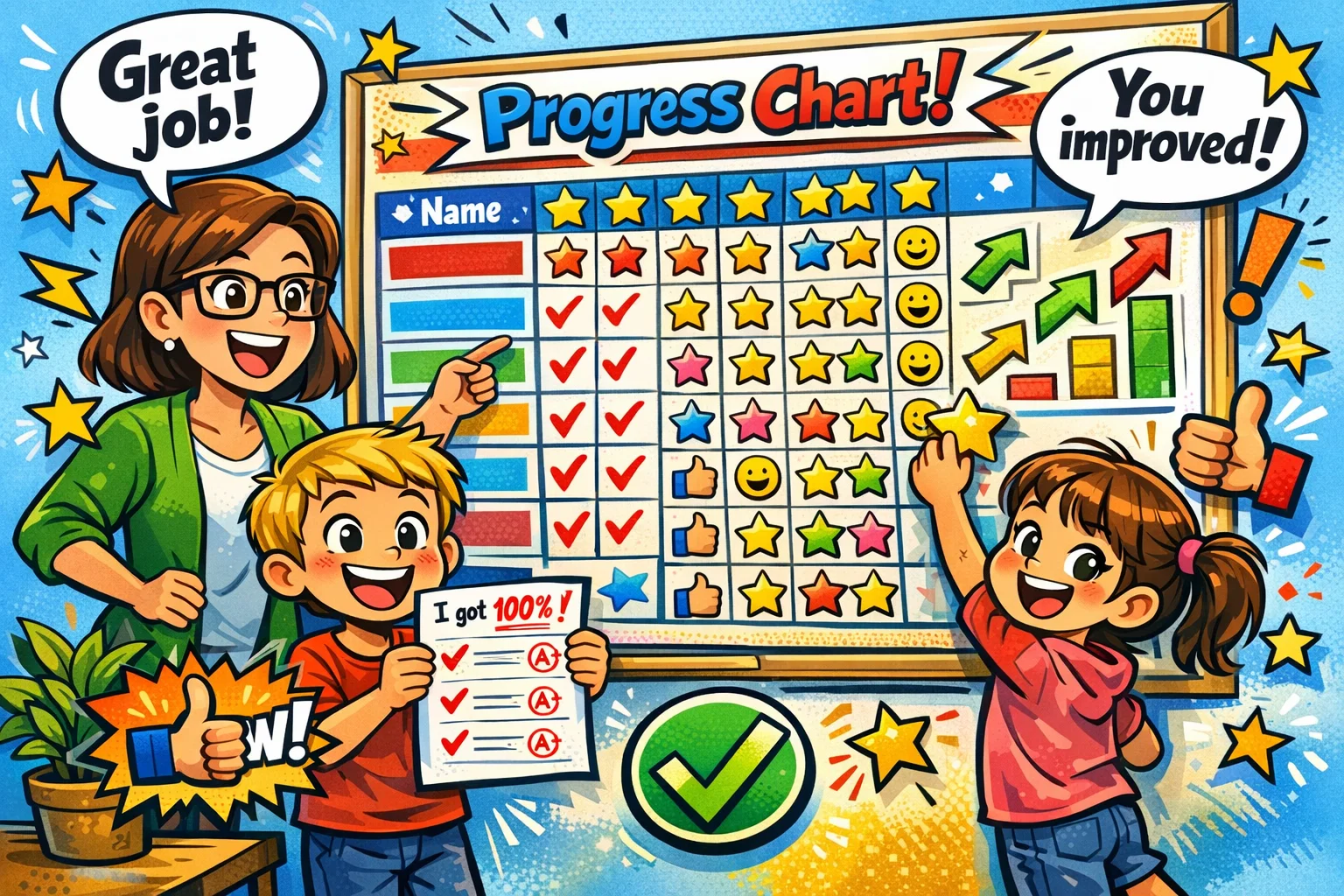
Monitoring progress is essential to develop numeracy and ensure children build a strong number sense over time. Effective assessment combines observation, structured tools, and consistent tracking.
Informal Assessment Methods
Observation and questioning are simple yet powerful ways to evaluate number sense skills. Ask a child to explain how they solved a problem or demonstrate their thinking during a counting task. For example, when a child solves 5 + 3 by counting on instead of starting from 1, they show growing mental math ability and a deeper understanding. These insights help educators and parents help children understand key math concepts.
Structured Evaluation Tools
Standardized tools and curriculum-based assessments provide clearer data on students’ number sense. Short quizzes and worksheets can reveal gaps in recognition, comparison, or place value. Many math curriculum programs include checkpoints that align with grade-level expectations, helping students strengthen essential math skills.
Monitoring Growth Over Time
Tracking progress regularly is key to improving number sense in children. Record performance every few weeks to see how accuracy and flexibility develop. Use notes, work samples, or photos of hands-on activities to capture growth. This approach gives a fuller picture of learning and supports long-term success in math.
Supporting Children Who Are Struggling
If a child is struggling, it’s important to return to basics. Focus on:
- Small groups of objects
- Simple counting tasks
- Concrete hands-on activities
Children with poor number sense benefit from repeated, meaningful experiences. Gradually increase complexity as confidence grows.
In some cases, persistent difficulty may indicate a learning challenge. Early support is key to helping children become confident in math.
Conclusion and Next Steps for Teaching Number Sense
In summary, number sense refers to a deep, flexible understanding of numbers and their relationships. It is not a single skill but a combination of abilities that grow over time.
To teach number sense effectively:
- Use simple activities and real-world examples
- Incorporate daily routines
- Focus on understanding rather than memorization
- Provide opportunities for exploration and discussion
When educators and parents work together to build numeracy, children gain the tools they need for success in math and beyond. By consistently engaging in meaningful experiences, children develop number sense, strengthen their math skills, and become confident learners.
Frequently Asked Questions
What's the Best Age to Start Teaching Number Sense?
Earlier than most people think. Babies as young as 6 months show a basic awareness of quantity, and by age 2–3, kids are ready to engage with simple counting and comparison activities. That said, intentional, structured instruction tends to be most effective starting around age 3 or 4.
My Child Is Struggling with Numbers — Where Do I Start?
Go back to basics, and don’t rush. Young learners who find numbers difficult often need more time with concrete, physical materials before they’re ready to work with symbols on a page. Start with quantities they can touch and move — small groups of toys, counting steps, sorting objects by size.
What Are the Best Tools and Resources for Teaching Number Sense?
A mix of physical and digital tools tends to work best. On the hands-on side, ten frames, base-10 blocks, and number cards are among the most versatile and research-supported materials. For digital practice, apps like Math Shelf and DreamBox offer adaptive exercises that adjust to each learner’s current level.
How Long Does It Actually Take to Develop Number Sense?
Numeracy builds gradually over years of varied, consistent experience with numbers. Most kids develop the core foundations (counting, comparing, basic relationships) somewhere between ages 3 and 7. More advanced skills like flexible mental math, place value reasoning, and estimation continue to develop well into age 10 and beyond.

Take a short quiz to find out what your everyday choices say about your parenting style
When your child is curious about something new, what’s your instinct?
Take a short quiz to find out what your everyday choices say about your parenting style
“Can I download this app?” What happens next?
Take a short quiz to find out what your everyday choices say about your parenting style
When it comes to rules at home, which sounds most like you?
Take a short quiz to find out what your everyday choices say about your parenting style
If you could give your child one life skill today, what would you pick?
Take a short quiz to find out what your everyday choices say about your parenting style
Your child gets to choose what to watch. What would your ideal setup look like?
Take a short quiz to find out what your everyday choices say about your parenting style
Pick your parenting superpower ✨