
11 Steps to Teach Division to Kids: Strategies for Every Grade

 Discover a Free Education Video App for Kids
Pastory uses AI to personalize educational video content based on your child’s interests and personality. Safe, engaging, and built for curious young minds. Sign up now to stay updated and enjoy early access with a free trial
Teaching division to kids is more straightforward when you build from what they already understand. This guide walks through 11 structured steps for how to teach division to kids — starting with equal sharing and moving through basic facts, remainders, long division, and decimals — with strategies suited to different grade levels and learning paces.
Whether you are a parent supporting homework or a teacher planning lessons, each step is designed to reduce confusion and build genuine confidence with division before advancing to the next concept.
Key Takeaways
- This guide covers 11 steps for teaching division, from equal sharing to checking answers with multiplication.
- Start with concrete sharing concepts before introducing division symbols and formal vocabulary.
- Connecting division to multiplication early helps kids build fact fluency and verify their own work.
- Long division and decimals are introduced gradually, with remainders covered as a dedicated step.
- Grade-level strategies are included for K–2, 3rd grade, and upper elementary learners.
Easy Steps to Teach Division to Kids
Teaching this operation is not about memorizing formulas — it’s about building understanding gradually, moving from hands-on experience to written math problems. Here’s a logical sequence you can follow to help kids develop a solid foundation in division and sharpen their overall math skills.
1. Introduce Division as Sharing Equally
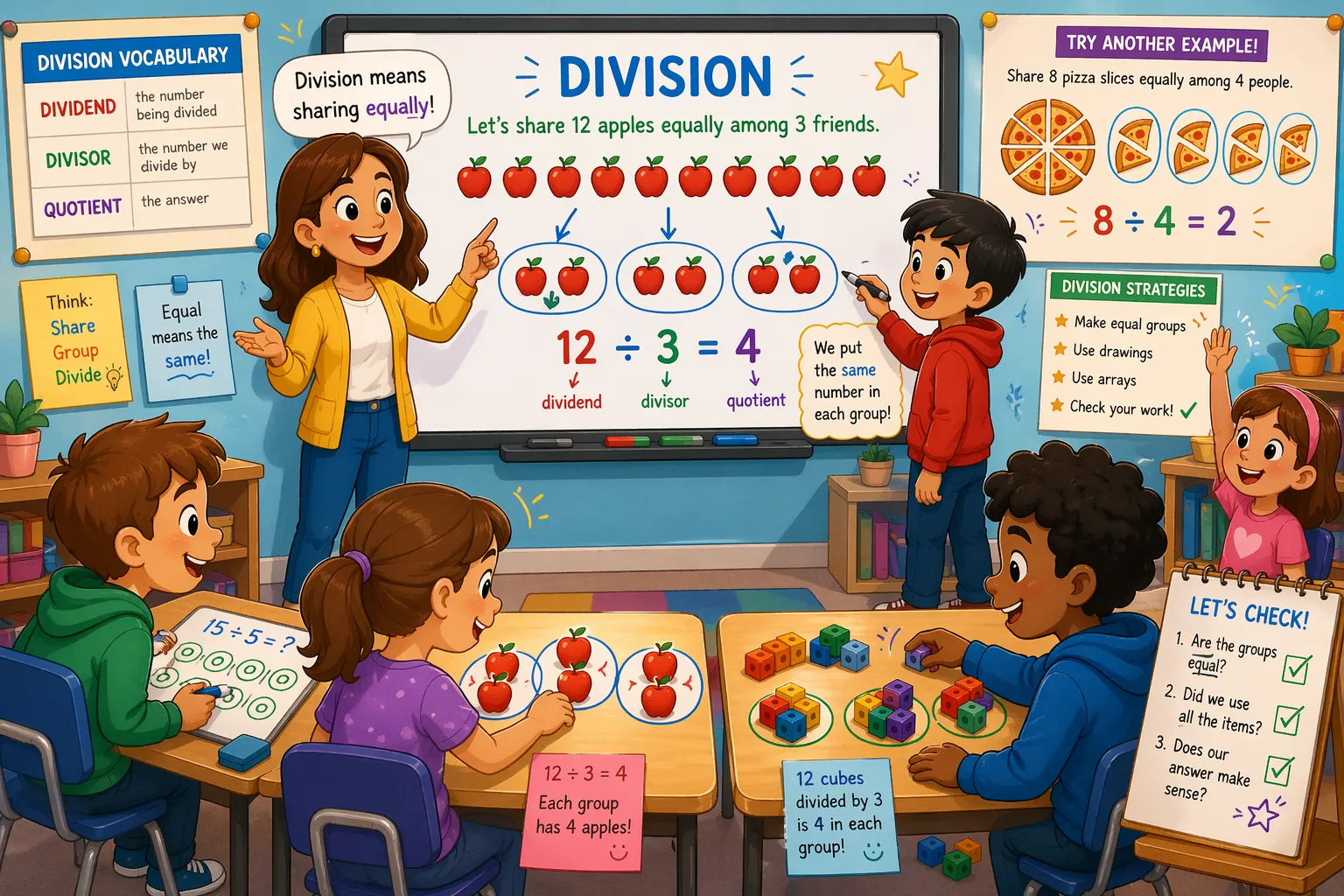
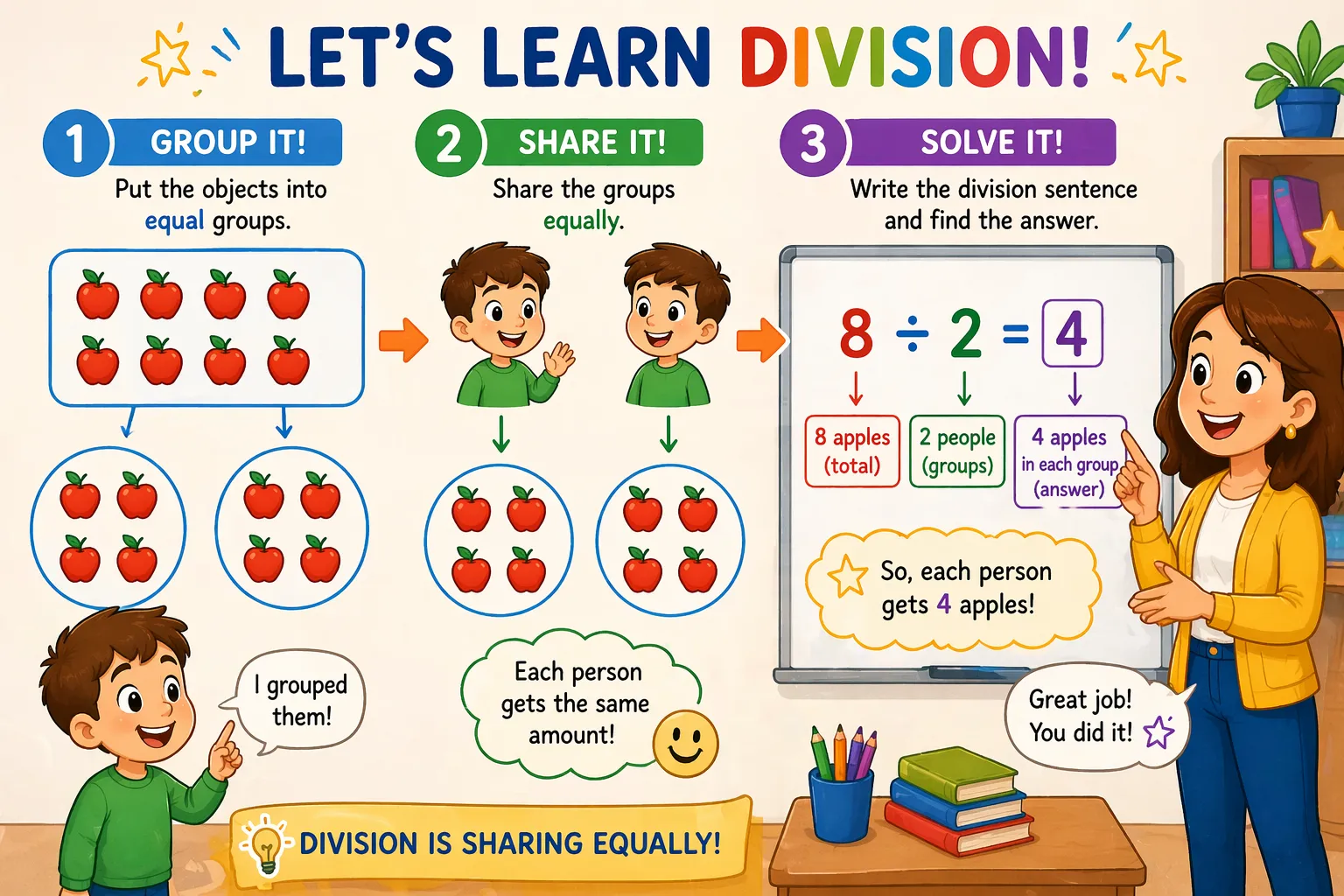
The most natural starting point is sharing. Ask your child: “If you have 12 cookies and 4 friends, how many does each friend get?” Let them physically distribute objects — candies, buttons, or small toys — into equal groups. This approach makes the concept feel familiar rather than abstract, and it helps kids grasp the core idea that dividing means splitting something into equal parts.
2. Teach Basic Division Vocabulary
Before working with symbols, kids need the right words. Introduce the three parts of a division equation:
- Dividend — the total number being divided (e.g., 12 in 12 ÷ 3)
- Divisor — the number you’re dividing by (e.g., 3)
- Quotient — the answer (e.g., 4)
A helpful mnemonic for long division steps is “Does McDonald’s Serve Burgers?” — standing for Divide, Multiply, Subtract, Bring down. Simple memory tools like this help students recall the process when working independently.
3. Connect Division to Multiplication
One of the most effective ways to teach this concept is to show how multiplication and division are related. Use fact families to illustrate: if 3 × 4 = 12, then 12 ÷ 3 = 4 and 12 ÷ 4 = 3. Triangle flashcards with all three numbers work well here. Missing factor problems — such as “___ × 4 = 12” — help kids see that these are inverse operations, each one undoing the other. Understanding that multiplication and division are related is one of the most powerful insights in early math.
4. Practice Division Without Remainders First
Start with clean problems where the answer is a whole number — for example, 8 ÷ 2 or 9 ÷ 3. Use arrays (rows and columns of dots) and number lines to help students visualize equal groups. Division worksheets with picture-based grouping exercises are especially useful at this stage. When a child understands exact division confidently, they’re ready to move forward.
5. Move to Division With Remainders
Once basic division feels natural, introduce the idea of “leftovers.” For example: 13 ÷ 4 = 3 with 1 left over (written as 3 r1). Use a story to make it concrete: “13 cookies shared among 4 friends — each gets 3, and 1 cookie is left.” Teach children to always check that the remainder is smaller than the divisor. If it isn’t, they need to go back and adjust their quotient.
6. Introduce Long Division Step by Step
Long division is where many kids hit a wall, but breaking it into four clear steps makes it manageable:
- Divide — how many times does the divisor fit into the first digit(s)?
- Multiply — write the product below
- Subtract — find the difference
- Bring down — move the next digit down and repeat
Start with two-digit dividends divided by one-digit divisors (e.g., 48 ÷ 3). Using graph paper helps students keep digits aligned, which is one of the most common sources of error in these kinds of problems.
7. Practice Long Division With Remainders
Extend the long division process to problems that don’t divide evenly, such as 49 ÷ 3 = 16 r1. Teach children to check their work by multiplying the quotient by the divisor and adding the remainder — the result should equal the original dividend. This inverse check builds both confidence and accuracy when solving a division problem.
8. Divide by Multi-Digit Divisors
Once students are comfortable with single-digit divisors, introduce problems with divisors like 12, 15, or 25. Encourage estimation first: “How many 25s fit into 150?” Rounding and mental math help kids make an educated first guess before working through the full calculation. Real-world examples — like dividing $100 among 25 people — help make multi-digit work feel meaningful and grounded.
9. Introduce Dividing Decimals (For Advanced Learners)
For children in upper elementary who are ready for more, introduce decimal work using money. For example, $5.40 ÷ 3 = $1.80. When the divisor is itself a decimal, teach the rule of moving the decimal point in both numbers to make the divisor a whole number first. Keeping examples tied to real-life contexts — like splitting a bill — makes the concept far less abstract.
10. Solve Division Word Problems
Word problems help students apply what they’ve learned to real situations. Teach kids to look for keywords that signal they need to divide:
- “each,” “per,” and “equally” suggest equal sharing
- “how many groups” points to a grouping problem
- “split between” or “divided into” are direct cues to divide
Encourage drawing models or writing out the equation before solving. Multi-step division word problems also build critical thinking skills that carry into higher math.
11. Check Division Work Using Multiplication
Always encourage students to verify their answers using the inverse operation. For exact problems: quotient × divisor = dividend. For problems with remainders: (quotient × divisor) + remainder = dividend. Making this a consistent habit helps catch errors and reinforces the relationship between multiplication and division in a practical, meaningful way.
Typical Difficulties Kids Face When Learning Division
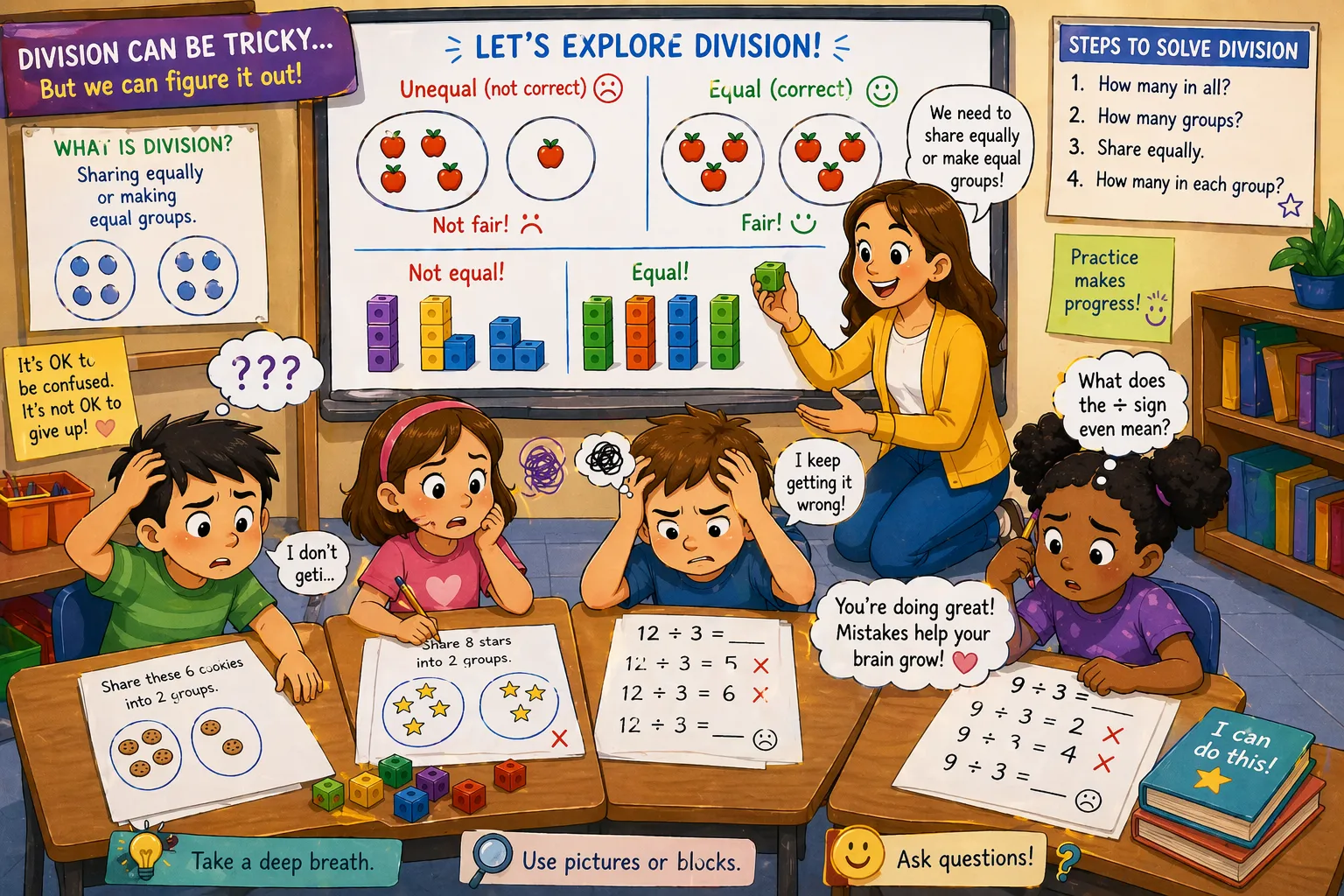
Even with strong instruction, most children hit a few predictable stumbling blocks. Understanding why these difficulties occur makes it easier to address them effectively.
Difficulty 1 — Confusing Divisor and Dividend
A common error is writing 12 ÷ 3 as 3 ÷ 12. This happens because children aren’t yet sure which number “goes inside” the problem. A helpful fix is to teach the phrase “divide INTO”: “How many groups of 3 fit INTO 12?” Using cups and counters physically — where kids fill each cup with the divisor amount — reinforces the correct direction of the operation before they move on to written equations.
Difficulty 2 — Forgetting to Check Remainders
Children sometimes stop too early, leaving a remainder that’s larger than the divisor. Establish a simple rule: “The remainder must always be smaller than the divisor.” Use error analysis as a teaching tool — show an incorrect example like 15 ÷ 4 = 2 r7 and ask, “What’s wrong here? Can we do better?” This kind of reasoning helps students develop self-checking habits.
Difficulty 3 — Losing Place Value in Long Division
Misaligned digits are one of the most frustrating sources of mistakes in multi-step problems. When a student writes quotient digits in the wrong column, the entire calculation falls apart. Graph paper is one of the simplest fixes — each digit gets its own box. Color-coded place value mats can also help students see where each digit belongs and develop more careful, organized working habits.
Division Strategies That Work
Different strategies work for different learners. Offering multiple approaches helps every child find a method that matches how they think.
Using Manipulatives and Visual Models
Hands-on materials are particularly valuable for visual and tactile learners. Effective manipulatives include counters, base-ten blocks, egg cartons, and linking cubes. Arrays — arrangements of objects in rows and columns — are especially powerful because they help kids see and touch the structure of the math. The goal is to move gradually from concrete objects to drawings (pictorial) and finally to written equations (abstract).
Teaching Division as Repeated Subtraction
This operation can also be understood as asking: “How many times can you subtract 3 from 12?” This repeated subtraction approach works well on a number line — children make backward jumps of the divisor until they reach zero. It reinforces the idea of how many times one number fits into another, and it connects naturally to multiplication as repeated addition.
Using Area Models for Division
The area model is a visual strategy that breaks the dividend into friendlier parts. For 48 ÷ 3, a child might split 48 into 30 + 18, divide each part by 3 (getting 10 and 6), then add the results to get 16. This approach helps students who struggle with the standard algorithm because it makes the logic visible. Comparing the area model side-by-side with long division helps students understand why the steps work, not just how to follow them.
Building Division Fact Fluency
Fluency with these facts — recalling answers within about 3 seconds — reduces the cognitive load when tackling more complex problems. Short daily practice sessions of 5 minutes are more effective than occasional long drills. Games that reinforce this include Division Bingo, Fact Family Triangle card games, and online timed quizzes. Since division facts are tied directly to multiplication facts, focusing on the inverse relationship is the fastest route to fluency.
Division Methods by Grade Level
The right approach depends heavily on a child’s age and prior math experience. Here’s how to tailor instruction across the elementary years.
Division for Primary Grades (K–2)
At this stage, everything should be concrete — no symbols, no algorithms. Use real objects and simple stories: “A bear has 6 berries to share with a friend. How many does each get?” Keep numbers small (10 or under) and focus entirely on equal sharing with physical items. The goal here is building intuition, not procedure.
Division for 3rd Grade
Third grade is when children are usually introduced to the ÷ symbol, fact families, and simple remainders. Focus on divisors 1 through 10, using arrays and number lines. Assessment works well through “draw a picture” problems, which reveal whether a child truly understands the concept. Avoid long division until students have solidly mastered basic division facts — rushing this transition is one of the most common mistakes in 3rd grade math instruction.
Division for Upper Elementary (4th–5th Grade)
Fourth and fifth grade students are ready for long division with up to four-digit dividends, multi-digit divisors, and decimals. At this level, interpreting remainders becomes important — sometimes a remainder means rounding up, sometimes dropping it, and sometimes it becomes a fraction, depending on context. Real-world projects, like planning a pizza party on a fixed budget, help students apply the skill meaningfully and build a deep understanding of when and how to use it.
Next Steps After Teaching Division
Once a child has a confident grasp of this skill, the path forward opens into some of the most important areas of elementary math. Timed fact practice helps build fluency for more advanced work.
From there, the concept connects directly to fractions (splitting a whole into equal parts), ratio and proportion, and eventually pre-algebra ideas like solving for a missing dividend. Applied math — calculating change, splitting costs, measuring ingredients — gives children ongoing, real-world reasons to keep practicing what they’ve learned and ensure those math skills stay sharp.
Frequently Asked Questions About Teaching Division
How Do You Teach Division Creatively?
Some of the best ways to make this concept engaging involve everyday contexts. Cooking works particularly well — cutting a pizza or scaling a recipe builds intuition for equal parts. LEGO towers, treasure hunts with math clues, and board games like Remainder Road also make the learning feel like play. Short songs or rhymes about the steps of long division can help auditory learners retain the process.
How Do You Explain Simple Division to a Child?
Start with a sentence, not a symbol. “Division is sharing things fairly” is a strong opening. Always frame simple problems as: “You have ___ items and ___ friends — how many does each friend get?” This anchors the abstract concept in something emotionally and practically real for the child before introducing any written equation.
What Are the 3 Main Rules of Division?
Three fundamental rules every child should understand:
- You cannot divide by zero — it is undefined and has no answer
- The remainder must always be smaller than the divisor — if it isn’t, the quotient needs adjusting
- Division is the inverse of multiplication — every division fact corresponds to a multiplication fact
What If My Child Cries Over Division?
First, put the worksheets away. Emotional distress around math is a signal to slow down and return to concrete materials. Go back to manipulatives and use word problems centered around your child’s specific interests — dinosaurs, soccer, whatever they love. Keep sessions short (around 10 minutes) and celebrate small wins genuinely. If frustration persists despite patient, consistent support, it may be worth speaking with a teacher or educational specialist to rule out any underlying learning challenges.

Take a short quiz to find out what your everyday choices say about your parenting style
When your child is curious about something new, what’s your instinct?
Take a short quiz to find out what your everyday choices say about your parenting style
“Can I download this app?” What happens next?
Take a short quiz to find out what your everyday choices say about your parenting style
When it comes to rules at home, which sounds most like you?
Take a short quiz to find out what your everyday choices say about your parenting style
If you could give your child one life skill today, what would you pick?
Take a short quiz to find out what your everyday choices say about your parenting style
Your child gets to choose what to watch. What would your ideal setup look like?
Take a short quiz to find out what your everyday choices say about your parenting style
Pick your parenting superpower ✨



