20 Indoor Games for Kids at Home

 Discover a Free Education Video App for Kids
Pastory uses AI to personalize educational video content based on your child’s interests and personality. Safe, engaging, and built for curious young minds. Sign up now to stay updated and enjoy early access with a free trial

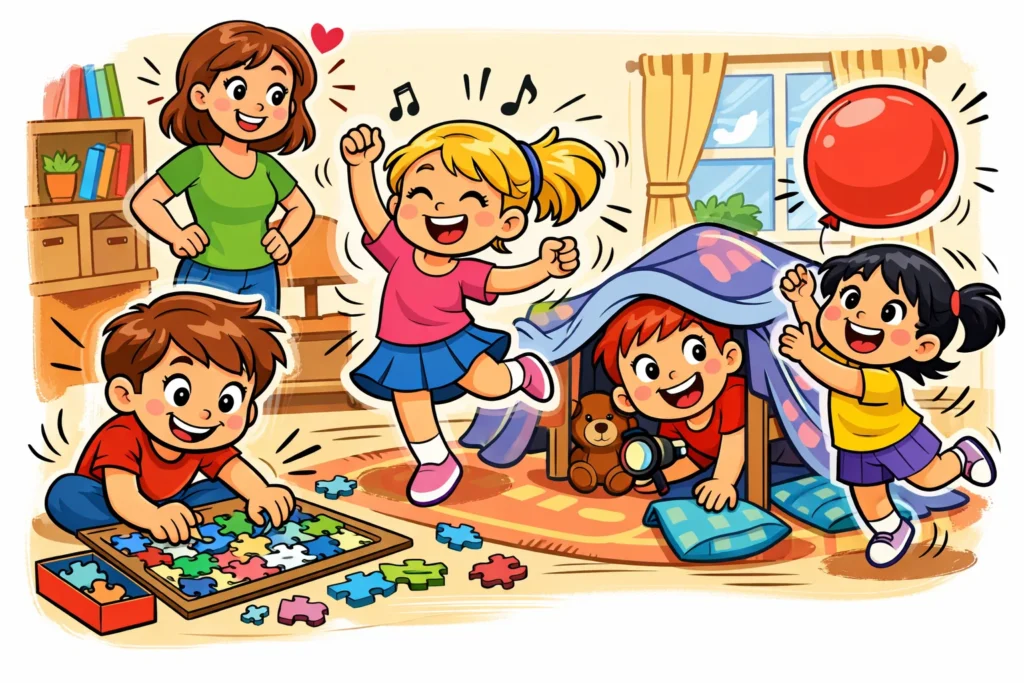
Finding ways to entertain children when you are stuck indoors can be a challenge for any parent or caregiver. Whether it is a rainy day, a cold winter afternoon, or simply a weekend where you need to keep kids engaged without relying on screens, having a toolkit of indoor activities is essential. This guide provides twenty fun indoor games that require minimal preparation, use everyday items, and support your child’s physical and cognitive development. From active challenges to imaginative play, these activities are designed to spark creativity and help kids burn off energy, no matter the weather.
Active Indoor Games
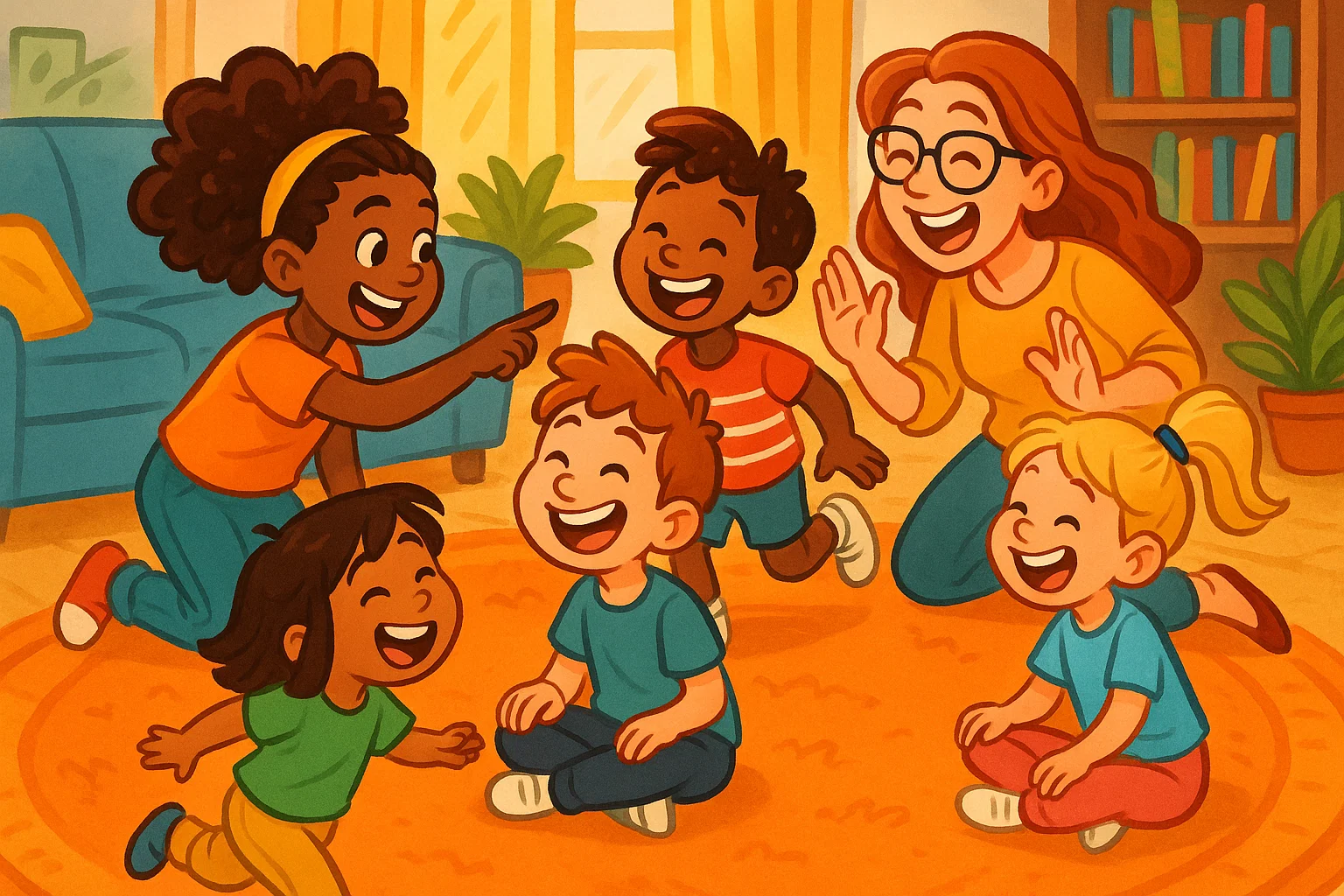
Physical movement is crucial for child development, even when stuck inside. These games help improve balance and coordination while ensuring children stay physically active.
- Obstacle Course: Use pillows and chairs to create a living room challenge.
- Relay Races: Compete in teams or against the clock using socks or spoons.
- Dance Party: Turn up the music and dance to use up energy and boost everyone’s mood.
- Balloon Volleyball: A safe way to play ball indoors without breaking valuables.
- Animal Walks: Mimic the movements of creatures like crabs or bears.
- Paper Plate Skating: Glide across carpets using paper plates as skates.
Creative Indoor Games
Imaginative play allows kids’ imaginations to run wild, fostering emotional intelligence and problem-solving skills.
- Put on a Show: Create a stage for puppets, magic, or talent displays.
- Make a Movie: Use a smartphone to film a scripted toy adventure.
- Indoor Camping Trip: Set up a blanket fort and tell stories by flashlight.
- Giant Floor Game: Use painter’s tape to create a life-sized board game.
Low-Prep Indoor Games
When you need to keep kids entertained quickly, these easy activities use items you likely already have at home, such as paper, tape, cups, and cardboard.
- Scavenger Hunt: A classic search for items based on colors or clues.
- Classic Childhood Games: Timeless favorites like Hide and Seek or Simon Says.
- Tag Team Puzzles: A collaborative way to solve jigsaws.
- Masking Tape Car Track: Build a temporary city on your floor.
Indoor Games by Age
Every developmental stage requires a different approach to play.
- Ages 3–5: Focus on fine motor skills and simple instructions.
- Ages 6–8: Introduce more complex rules and physical challenges.
- Ages 9–12: Focus on strategy, creativity, and independent projects.
Keep Kids Engaged at Home
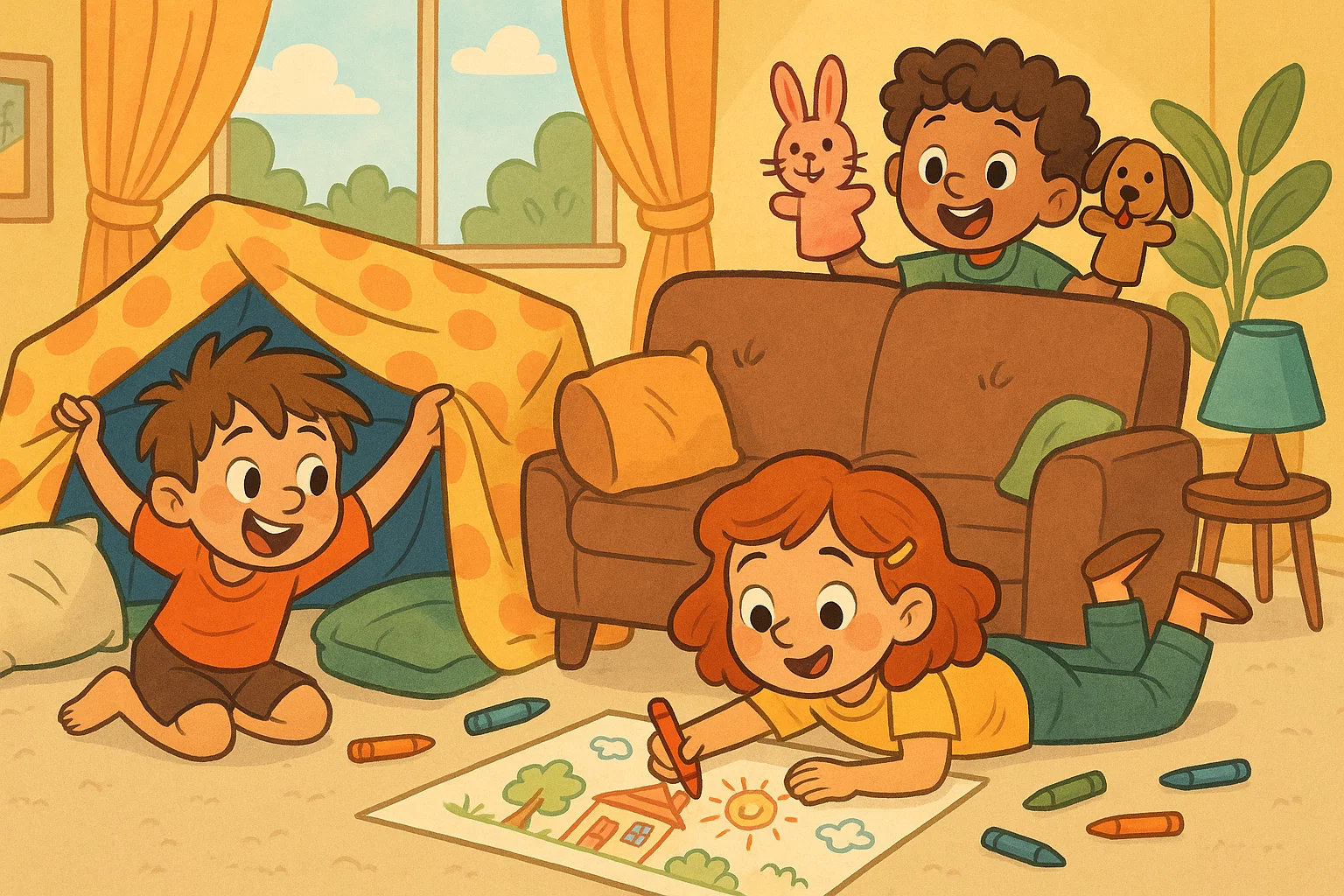
Choosing the right indoor activities for kids means balancing their energy levels with the space you have available. Physical activity indoors not only supports motor-skill development but can also help regulate behavior. Play is also essential for social-emotional and cognitive development. To help your child get the most out of their time indoors, consider their play preferences – some children prefer the quiet focus of a science experiment, while others need to jump and run.
How to Match Games to Age and Energy
Matching the game to the child’s developmental stage ensures they remain interested without becoming frustrated. Little ones (toddlers) benefit from sensory play and simple indoor games that involve basic shapes and colors. Preschoolers thrive on imaginative scenarios, while school-age kids love competition and clear rules. If energy levels are high, prioritize games like jumping jacks or balloon volleyball; if the mood is calmer, opt for a quiet activity such as reading or making salt dough.
How to Use Household Items
You do not need a special kit to enjoy these games and activities. Most of the best indoor games rely on everyday items found in your pantry or craft drawer.
- Cardboard boxes can become forts, cars, or spaceships.
- Painter’s tape creates tracks, mazes, and boundaries without damaging floors.
- Socks can be rolled into “snowballs” for a safe indoor toss.
- Plastic cups are perfect for building towers or relay race markers.
How to Keep Play Safe Indoors
Safety is the priority when kids take their play into the living room. Creating ‘yes spaces’ – areas where children can move freely without constantly hearing ‘no’ – can help reduce accidents.
- Clear the Floor: Remove breakables and rug-tripping hazards.
- Surface Check: Ensure the area is not slippery; use socks with grips or bare feet.
- Noise Control: If you live in an apartment, use soft materials like a foam ball to keep noise levels down for neighbors.
1. Scavenger Hunt
A scavenger hunt is a high-engagement activity that can be adapted for any home size. It encourages observational skills and can be educational if you use paper to list items by their starting letter or color.
Setup and Materials
To start, you only need a list of items and a basket. You can create a themed list, such as “Nature Indoors” or “Rainbow Hunt.” For a screen-free experience, draw the items by hand so even pre-readers can participate. A timer can be added for older children to increase the excitement.
Variations by Age
- Toddlers: Ask them to find “something red” or “something soft.” This builds vocabulary and sensory awareness.
- School-age kids: Use riddles instead of direct names (e.g., ‘I have hands but no arms’ for a clock). This supports critical thinking and literacy.
2. Treasure Hunt With Clues
Unlike a scavenger hunt, a treasure hunt around the house follows a linear path where one clue leads to the next, ending in a “treasure.” This game provides great indoor entertainment that can last for an hour or more.
How to Create Clues
Clues should be tailored to your child’s reading level. For younger kids, use pictures of the next location (e.g., a photo of the fridge). For older kids, use word scrambles or math problems. The treasure at the end doesn’t have to be expensive; a new book or a healthy snack can make a perfect reward.
How to Turn the Hunt Into a Themed Game
Enhance the experience by adding a narrative. Tell a story about a lost pirate hoard or a detective case. Using props and costumes, such as a cardboard pirate hat or a magnifying glass, helps bring the story to life.
3. Obstacle Course
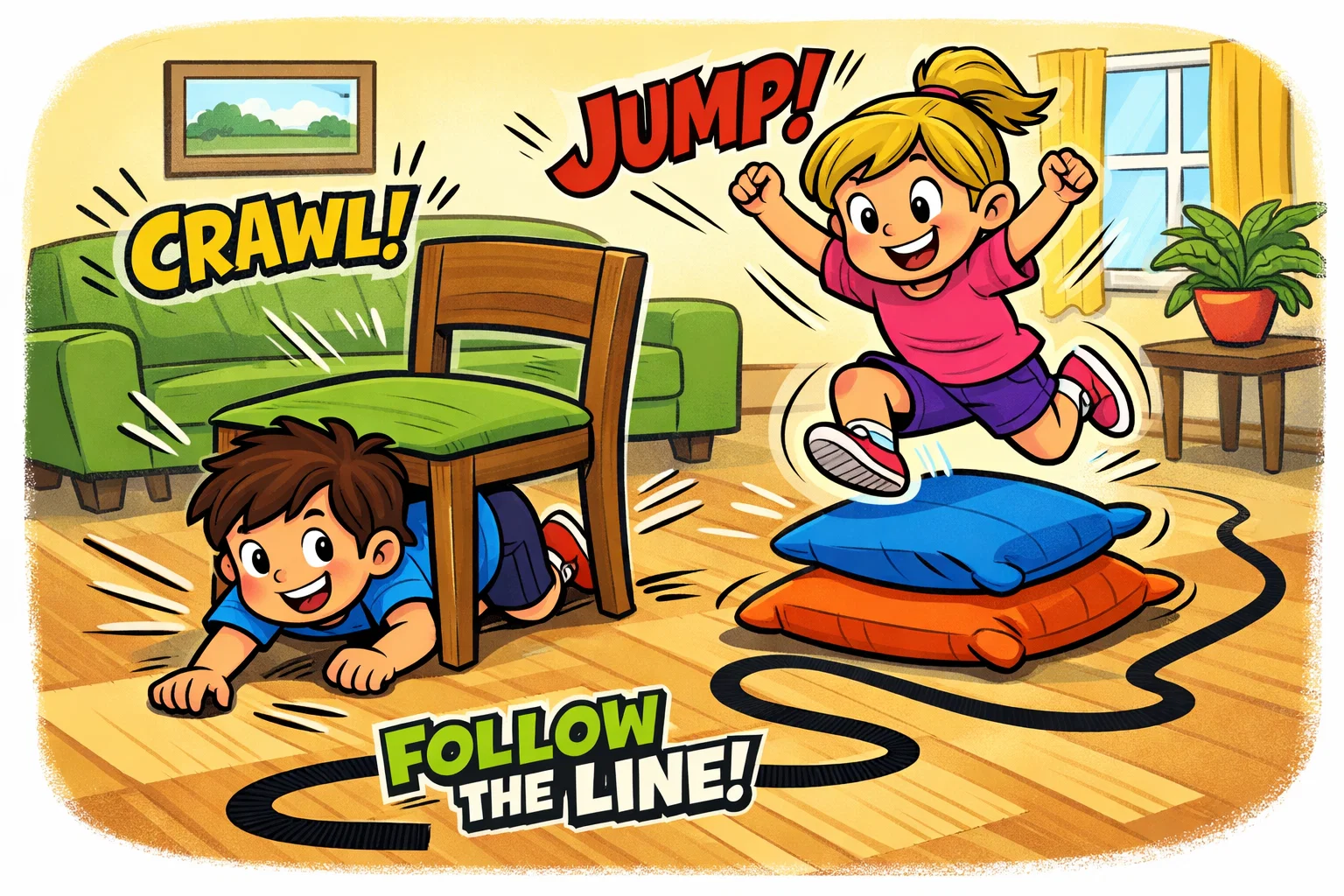
An obstacle course is the ultimate way to stay physically active when kids are stuck inside. It targets balance and coordination by requiring children to move their bodies in various ways.
Course Ideas for Small Spaces
Even in a small apartment, you can create a challenging path. Have kids crawl under a row of chairs (the “tunnel”), jump over a line of painter’s tape (the “river”), and do five jumping jacks at a specific station. This helps you make the most of a small space.
Skill Goals and Safety Tips
- Goal: To complete the course without touching the “lava” (the floor outside the tape).
- Safety: Ensure all furniture used for climbing is stable. Use pillows to cushion any areas where jumping occurs.
4. Relay Races
Relay races are excellent indoor games and activities for siblings. They promote taking turns and teamwork. If you have an only child, they can race against a stopwatch to “beat their personal best.”
Relay Ideas With Household Items
- Spoon Race: Balance a small foam ball or an egg on a spoon while walking.
- Sock Toss: Run to a basket, drop in a pair of socks, and run back.
- Crab Walk Relay: Move from one side of the room to the other while walking on their hands and feet in a crab position.
How to Adapt Relay for One Child
For a single child, set up three different “stations.” At station one, they must bowl over plastic bottles; at station two, they make paper planes; at station three, they perform a physical task. Time the entire circuit to keep them motivated.
5. Dance Party
A dance party can help kids meet their daily physical-activity goals while staying indoors. It is a fun way to improve cardiovascular health while indoors.
Dance Game Formats
- Freeze Dance: Stop the music at random intervals; anyone caught moving is “out” (or must do a silly task).
- Copy Dance: One person performs a move, and the others must mimic it perfectly.
- Animal Dance: Call out an animal, and everyone must dance like that creature.
How to Add Learning Elements
Incorporate skills while having fun by asking kids to dance out the shapes of letters or numbers. You can also use music to teach rhythm – clapping out beats helps with mathematical pattern recognition in early childhood.
6. Balloon Volleyball
Balloon volleyball is a favorite indoor game because it allows for high-energy play with very little risk to the furniture. A balloon moves slowly, giving little ones enough time to react and develop hand-eye coordination.
How to Set Up a Court at Home
Use a piece of painter’s tape on the floor to mark the center line, or tie a piece of string between two chairs to act as the ‘net.’ Define the boundaries clearly. You can play standing up or “sit-down volleyball” to keep the energy contained.
Ways to Make Game Harder or Easier
- Easier: Allow the balloon to touch the floor once before it’s “out.”
- Harder: Introduce a second balloon or require players to only use their heads or elbows to keep it in the air.
7. Animal Walks
Animal walks are a form of “heavy work,” which pediatric occupational therapists recommend for sensory regulation. These movements provide input to the muscles and joints, helping kids feel grounded and calm.
Animal Moves to Try
| Animal | Movement Description | Benefit |
| Bear Walk | Hands and feet on floor, hips high | Upper body strength |
| Crab Walk | Sitting on floor, lift hips, move on hands/feet | Core stability |
| Frog Jump | Squatting low and jumping forward | Explosive leg power |
| Snake Crawl | Tummy on the floor, using arms to pull | Coordination |
How to Turn Walks Into Challenge
Create a “zoo race” where kids must navigate a path using only specific animal movements. You can also play “Animal Charades,” where others must guess the animal based on the walk.
8. Friendly Fitness Competitions
Friendly fitness challenges can help instill a love of movement. The goal is to keep it lighthearted so children don’t feel discouraged by the “competition” aspect.
Fitness Challenges Kids Enjoy
- Plank Challenge: See who can hold a plank position the longest.
- Wall Sits: Lean against a wall in a sitting position and time it.
- Star Jumps: Count how many star jumps can be done in 60 seconds.
How to Keep Competition Positive
Focus on “Personal Bests” (PBs) rather than beating others. Keep a chart on the fridge so kids can track their progress over the course of the week.
9. Action Storytime
Action storytime combines literacy with movement. Instead of sitting still, the child becomes part of the narrative. This is one of the best indoor activities for children who have lots of energy and struggle to sit still through a story.
How to Build Story With Actions
Choose a book and assign movements to recurring words. For example, every time the word “forest” is mentioned, everyone must stand tall like a tree. If a character “runs,” the kids must run in place.
Best Story Themes for Home Play
Themes like “Jungle Adventure” or “Space Mission” work best because they naturally involve diverse movements like climbing, floating, and hiding.
10. Classic Childhood Games
Classic childhood games are timeless for a reason: they require no equipment and are easy to explain. They are the backbone of indoor games for kids.
Indoor Versions of Classic Games
- Hide and Seek: A staple of at-home play. Ensure “off-limit” areas are defined.
- Simon Says: Excellent for practicing listening skills and following directions.
- Charades: Use themes like “favorite movies” or “animals” to keep it simple.
How to Modernize Classic Games
Add a playful twist by using a timer or giving the person who is caught a silly challenge, such as hopping on one foot or making an animal sound.
11. Giant Floor Game
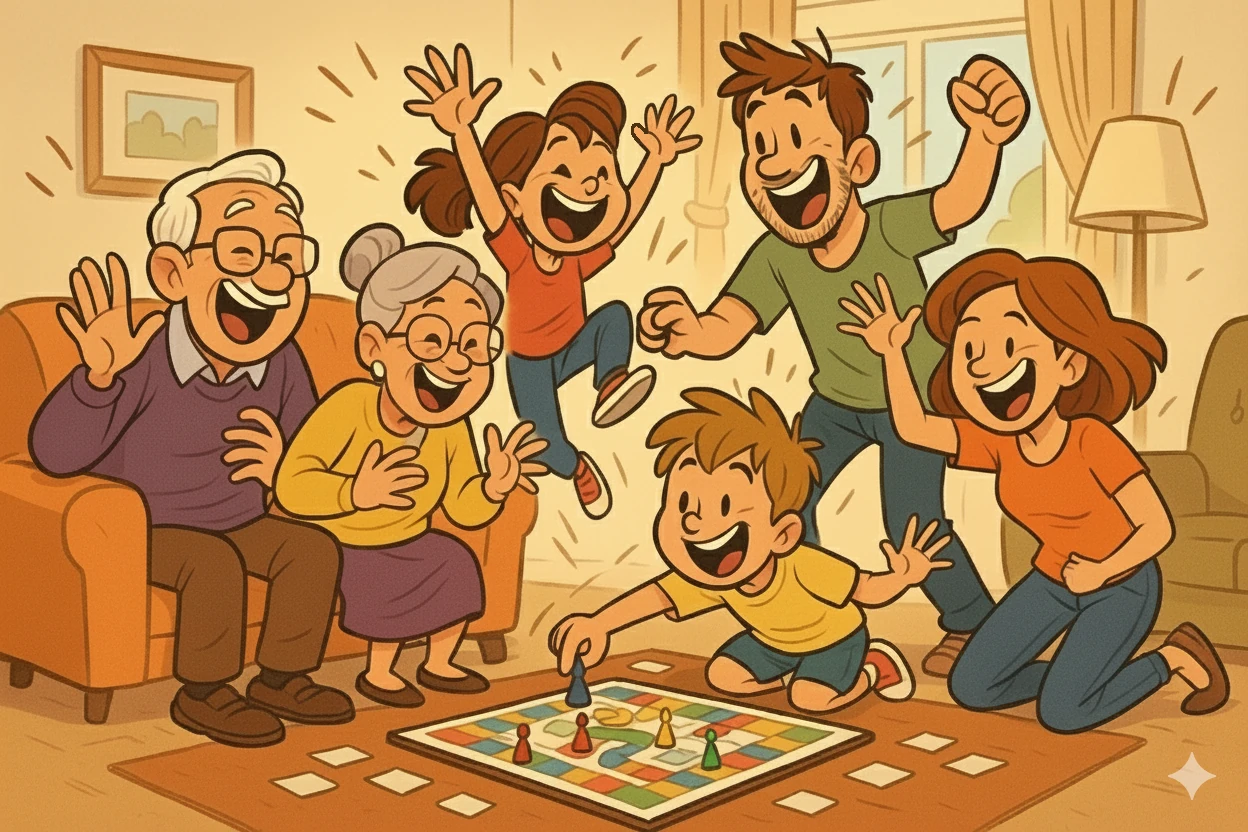
A giant floor game turns your hallway into a board game. This is a great indoor project that involves both art and physical play.
How to Build a Board on the Floor
Use painter’s tape to create square tiles on the floor. In each square, place a piece of construction paper with a number or a task (e.g., “Sing a song” or “Go back 2 spaces”). Use a plush toy as the “player piece.”
Theme Ideas for Floor Game
- Math Mission: Each square has a simple sum to solve.
- Alphabet Trail: Kids must say a word starting with the letter they land on.
12. Masking Tape Car Track
For children who love vehicles, a masking tape car track provides hours of imaginative play. It is a low-cost way to transform a room.
Track Layout Ideas
Use tape to create roads that go over “bridges” (pillows) and through “tunnels” (cardboard boxes). You can even tape a “parking garage” on a low shelf.
Ways to Turn Track Into Game
Give the child “missions.” For example, “The blue car needs to deliver a block to the kitchen.” This encourages narrative thinking and fine motor skills.
13. Lego Marble Maze
A Lego marble maze is a fantastic way to help your child develop engineering and physics skills. It requires focus and a steady hand.
How to Build Maze Fast
Using a large Lego baseplate, have your child build “walls” using standard bricks. Leave a path wide enough for a marble to roll through. Ensure there is a clear “Start” and “Finish.”
How to Add Challenge Levels
Include “dead ends” or “traps” where the marble can get stuck. You can even tilt the baseplate to use gravity, helping children explore basic ideas about slopes and motion.
14. Build a Blanket Fort
Building a den (or fort) is a rite of passage. It provides a sense of security and a private space for little ones to relax or play.
Best Materials for Building a Den
- Blankets and Sheets: Lightweight materials are easier to secure.
- Clips or Pegs: Use clothespins to attach blankets to chairs.
- Cushions: For a comfortable floor.
Games to Play Inside the Den
Once the fort is built, it can serve as a ‘base’ for a treasure hunt or a cozy spot for reading by flashlight.
15. Ninja Laser Maze
The ninja laser maze is a high-energy game that feels like a spy movie. It tests balance and coordination and is visually very exciting for kids.
How to Set Up Laser Maze
In a hallway, zigzag red string or crepe paper between the walls at different heights and angles. Use painter’s tape to secure the ends.
Mission Variations
The goal is to get from one end to the other without touching the “lasers.” To make it harder, have the kids carry a ‘top-secret’ item, such as a ball balanced on a spoon, through the maze.
16. Tag Team Puzzles
Puzzles are often a solo activity, but tag-team puzzles turn them into a collaborative indoor game.
How to Turn Puzzle Into Team Game
Spread the puzzle pieces in one room and the assembly board in another. Kids must run to grab one piece at a time and bring it back to the “base” to fit it in.
Best Puzzle Formats for Different Ages
For younger children, use large floor puzzles with 24 pieces. For older kids, a 100- to 300-piece jigsaw offers more of a challenge.
17. Paper Plate Skating
Paper plate skating is a fun way to get kids moving and strengthen their leg muscles. It works best on carpeted surfaces.
How to Play Safely
Have the child place one foot on each of the paper plates. They must keep their feet in contact with the plates while “skating” across the room. Ensure they stay away from stairs or sharp corners.
Fun Skating Challenges
Set up a “slalom” using plastic cups that the kids must skate around without knocking over.
18. Put on a Show
Encouraging kids to put on a show boosts confidence and public speaking skills.
Show Ideas Kids Love
- Puppet Show: Use socks or make paper finger puppets.
- Magic Show: Learn simple card tricks or “disappearing” coin acts.
- Talent Show: Let each family member perform their best skill.
How to Keep Prep Simple
Use a cardboard box as a stage. Don’t worry about scripts; come up with a story on the fly to encourage improvisation.
19. Make a Movie
In the digital age, learning to make a movie is a creative outlet that teaches sequencing and storytelling.
Movie Themes for Kids
A toy story in which their action figures come to life is always a hit. Alternatively, a “Nature Documentary” about the family pet can be hilarious.
How to Structure Movie Game
- Plan: Write a three-scene script.
- Film: Use a phone or tablet.
- Screen: Watch the final product together as a family with popcorn.
20. Indoor Camping Trip
An indoor camping trip is a multi-hour activity that can even turn into a sleepover in the living room.
Camping Setup at Home
Set up your den or a real pop-up tent. Use a string of fairy lights to simulate stars. Serve “camping snacks” like trail mix or sandwiches.
Camping Games and Activities
Tell “campfire stories” using a flashlight. You can also try a ‘star hunt’ at home by cutting star shapes out of construction paper and hiding them around the room for the kids to find.
Indoor Games by Age
| Age Group | Recommended Activities | Focus Skill |
| 3–5 Years | Animal Walks, Scavenger Hunt (Pictures), Den Building | Sensory & Motor Skills |
| 6–8 Years | Obstacle Course, Balloon Volleyball, Car Tracks | Coordination & Rules |
| 9–12 Years | Treasure Hunt (Riddles), Make a Movie, Lego Maze | Strategy & Creativity |
Indoor Games for Ages 3–5
At this age, fine motor skills and gross motor development are key. Simple activities like making salt dough or doing crafts with googly eyes are excellent choices. For movement, focus on “follow the leader” styles where the instructions are clear and the stakes are low.
Indoor Games for Ages 6–8
Children in this age group are starting to enjoy more structured indoor games and activities. They can handle more complex “missions” in a scavenger hunt and love the physical challenge of a ninja laser maze. They are also old enough to take turns effectively in relay races.
Indoor Games for Ages 9–12
Pre-teens need autonomy. They will likely enjoy projects that involve technology, such as making a movie, or complex builds like the Lego marble maze. They are also more competitive, which makes friendly fitness challenges a great way to keep them active without making the activities feel too childish.
By choosing from these activity ideas, you can ensure that your time indoors is productive, educational, and, most importantly, fun. Whether you are using paper plates to skate or cardboard boxes to build a castle, the goal is to keep those imaginations running wild and those bodies moving.
Take a short quiz to find out what your everyday choices say about your parenting style
When your child is curious about something new, what’s your instinct?
Take a short quiz to find out what your everyday choices say about your parenting style
“Can I download this app?” What happens next?
Take a short quiz to find out what your everyday choices say about your parenting style
When it comes to rules at home, which sounds most like you?
Take a short quiz to find out what your everyday choices say about your parenting style
If you could give your child one life skill today, what would you pick?
Take a short quiz to find out what your everyday choices say about your parenting style
Your child gets to choose what to watch. What would your ideal setup look like?
Take a short quiz to find out what your everyday choices say about your parenting style
Pick your parenting superpower ✨