Best Games for 2-Year-Olds: Sensory, Movement and First-Game Picks

 Discover a Free Education Video App for Kids
Pastory uses AI to personalize educational video content based on your child’s interests and personality. Safe, engaging, and built for curious young minds. Sign up now to stay updated and enjoy early access with a free trial
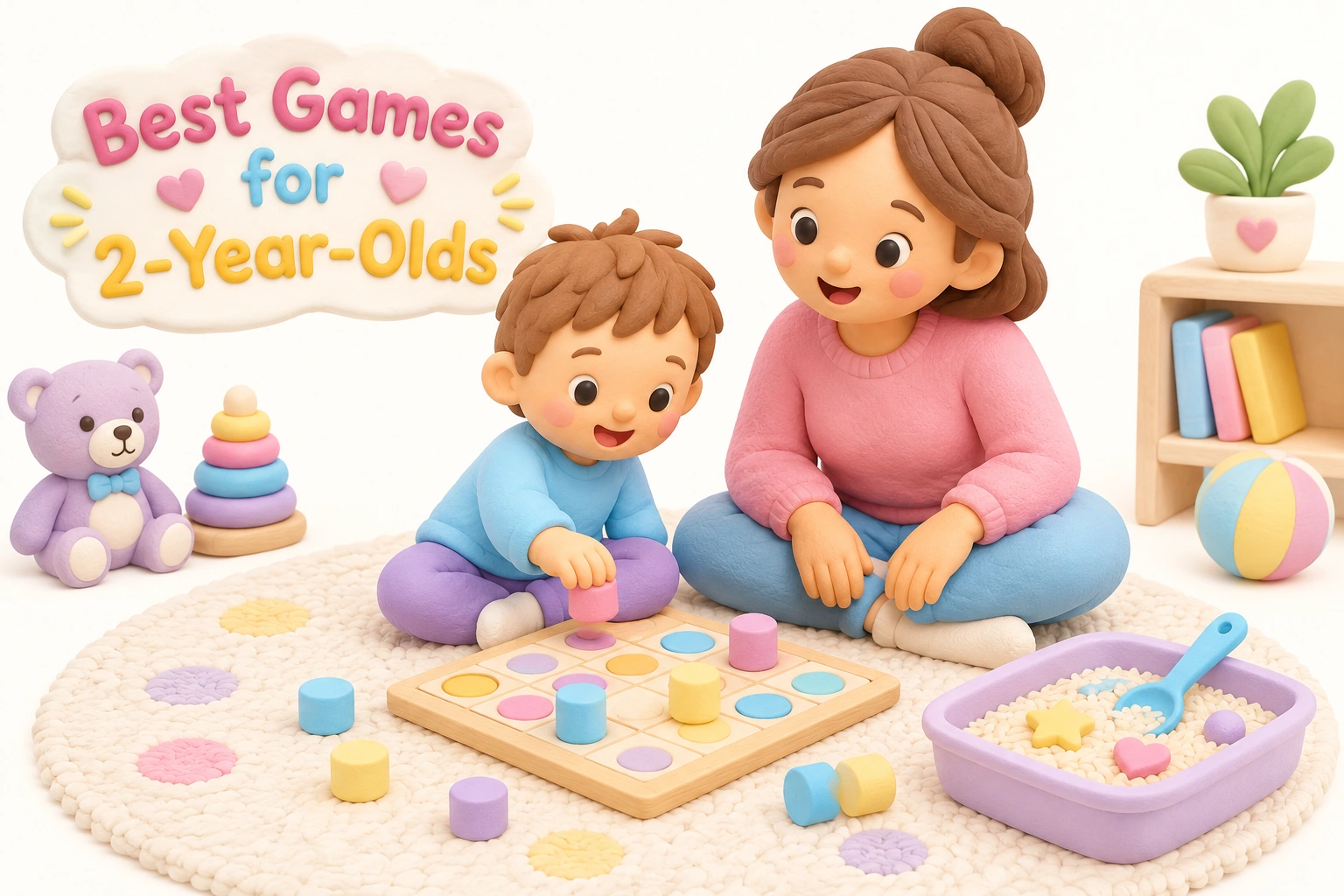
Finding the right games for 2-year-olds means balancing what a toddler can actually do with what will stretch them just enough to stay engaged. At this age, children are building color recognition, beginning to understand cause and effect, and developing the earliest sense of turn-taking — but their attention span typically runs only four to six minutes per activity. The good news is that the best toddler games are simple, short, and surprisingly powerful for early brain development. This guide covers sensory activities, gross motor games, and first board game picks, with developmental context to help you choose what suits your child right now.
Key Takeaways
- Two-year-olds have an average attention span of four to six minutes, so the best games last five to fifteen minutes and involve one or two simple rules.
- Sensory play, movement games, and cooperative toddler board games each target different developmental domains and work best when rotated rather than relied on exclusively.
- Cooperative games — where everyone works together rather than competing — are strongly preferred at age two because toddlers are not yet developmentally ready to handle losing gracefully.
- Play-based learning at this age builds neural connections across motor, cognitive, and social-emotional domains simultaneously.
- Screen-free play remains the gold standard for toddlers; the activities in this guide require no devices and can be adapted for rainy days indoors.
Why Games Matter for 2-Year-Old Development
At age two, the brain is forming neural connections at a remarkable rate. Every time a toddler pours rice from one container to another, crawls through a blanket tunnel, or places a chunky wooden piece on a game board, a new pathway is being reinforced. Play-based learning is not simply a way to keep children busy — it is the primary mechanism through which toddlers build cognitive, physical, and social-emotional skills simultaneously. According to UNICEF’s developmental milestones guidance, two-year-olds are typically working on two-step instructions, early problem-solving, shape recognition, and the very beginning of make-believe play. Games that gently target these emerging abilities can support developmental milestones without pressure or formal instruction.
One important developmental note: two-year-olds are asserting independence strongly and are not yet neurologically equipped to regulate the frustration of losing. This is not a behavioral problem — it reflects the still-maturing prefrontal cortex, which governs emotional regulation. This is precisely why cooperative play structures, where the group works toward a shared goal, are far more appropriate than competitive formats at this age. Choosing a cooperative toddler game over a winner-takes-all format is a developmentally informed decision, not just a kindness.
What to Look for in Games for 2-Year-Olds
Before buying or setting up any game, a few practical criteria make the difference between an activity a toddler will engage with and one that ends in tears after ninety seconds.
- Short play sessions: Aim for five to fifteen minutes. Games that drag on longer than a toddler’s attention span create frustration rather than fun.
- One or two rules maximum: Two-year-olds can follow simple instructions but are not yet ready for multi-step rule sets.
- Chunky, safe pieces: Chunky wooden pieces are ideal — large enough to avoid choking hazards, durable enough to survive enthusiastic handling, and satisfying to touch and manipulate.
- Color matching as a core mechanic: Color recognition is a key developmental milestone at this age, making color matching games naturally engaging and appropriately challenging.
- Cooperative structure: Look for games where players work together rather than against each other.
- Durable materials: Wood is preferred over thin cardboard for pieces that will be dropped, chewed, and stacked.
- Price range: Quality toddler board games typically fall between $15 and $35. Higher price does not always mean better developmental fit.
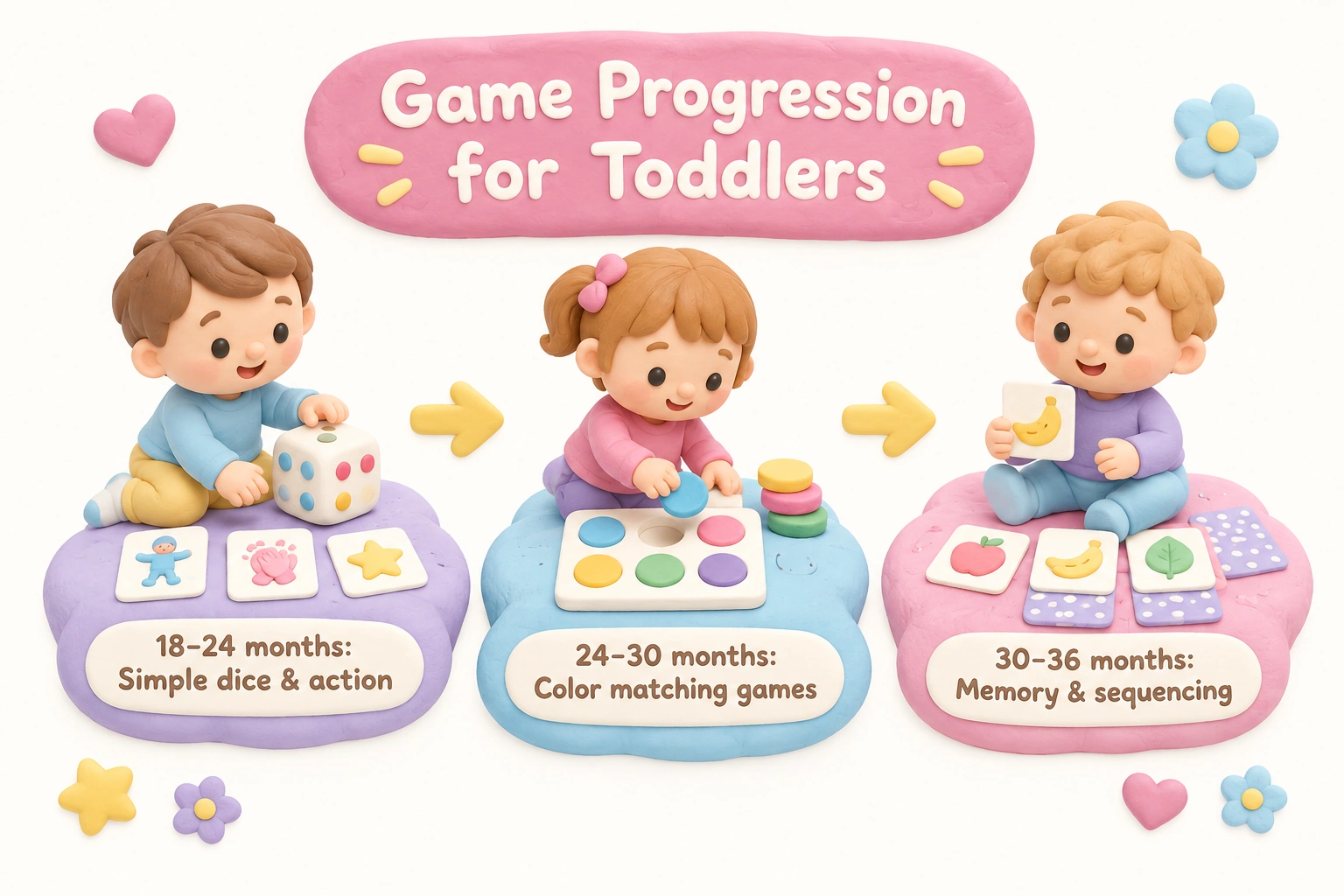
A useful developmental progression to keep in mind: a newly-turned two-year-old (around 18–24 months) will do best with the simplest dice-and-action formats, while a child closer to two-and-a-half (24–30 months) can manage slightly more complex matching tasks, and a child approaching three (30–36 months) may be ready for games with a small element of memory or sequencing.
Best First Board Games for 2-Year-Olds
The first board game for 2-year-olds should feel more like a shared ritual than a competition. The games below are consistently recommended by parents and early childhood educators for their simplicity, cooperative structure, and developmental appropriateness.
HABA My Very First Games: First Orchard
First Orchard by HABA is widely regarded as the best first board game for toddlers and is frequently the first recommendation from occupational therapists and early childhood educators. Players work together to harvest fruit from the orchard before a raven reaches it, rolling a large color die and matching the result to the corresponding fruit. The cooperative structure means no one loses individually, the chunky wooden pieces are satisfying to handle, and the color matching mechanic directly supports color recognition. Play time is typically five to ten minutes, which aligns well with a two-year-old’s attention span. The game is suitable from around 24 months onward.
Roll & Play by ThinkFun
Roll & Play is designed specifically for children as young as 18 months and is an excellent bridge game for toddlers on the younger end of the two-year range. A child rolls a large plush cube, identifies the color that lands face up, and draws a matching card that prompts a simple action — making an animal sound, showing an emotion, or doing a movement. This format builds cause and effect understanding, early emotional recognition, and gross motor skills simultaneously. The absence of a board means setup is minimal and the game can be played anywhere.
Peaceable Kingdom: Monkey Around
Monkey Around is a cooperative toddler game from Peaceable Kingdom that uses movement as its core mechanic. Players spin a spinner and then perform a physical action together — hopping, balancing, or stretching. Because the game involves the whole body, it supports gross motor skills and vestibular development while also introducing the concept of taking turns in a low-stakes, playful context. The game works well for groups of two to four players and is appropriate from around 24 months.
Peaceable Kingdom: Acorn Soup
Acorn Soup invites toddlers to collect ingredients and make pretend soup together, supporting early pretend play and categorization skills. The game involves simple matching and collecting mechanics that are well within a two-year-old’s cognitive reach. The tactile appeal of the wooden acorn pieces adds a sensory dimension, and the cooperative format keeps the mood collaborative rather than competitive.
Ravensburger: Hop, Waddle, Stomp!
This game combines animal-themed movement with simple matching, asking players to move like different animals as they progress around the board. It bridges the gap between movement games and tabletop games, making it a useful option for toddlers who struggle to sit still for a traditional board game format. The animal walks involved — waddling, stomping, hopping — also directly support gross motor development and body awareness.
| Game | Type | Best Age | Play Time | Primary Skill | Cooperative? |
|---|---|---|---|---|---|
| First Orchard (HABA) | Board game | 24–36 months | 5–10 min | Color matching | Yes |
| Roll & Play (ThinkFun) | Card + dice | 18–36 months | 5–10 min | Cause and effect, emotions | Yes |
| Monkey Around (Peaceable Kingdom) | Movement game | 24–36 months | 10–15 min | Gross motor, turn-taking | Yes |
| Acorn Soup (Peaceable Kingdom) | Matching game | 24–36 months | 5–10 min | Pretend play, categorization | Yes |
| Hop, Waddle, Stomp! (Ravensburger) | Movement board game | 24–36 months | 10–15 min | Gross motor, matching | Yes |
Sensory Games and Activities for 2-Year-Olds
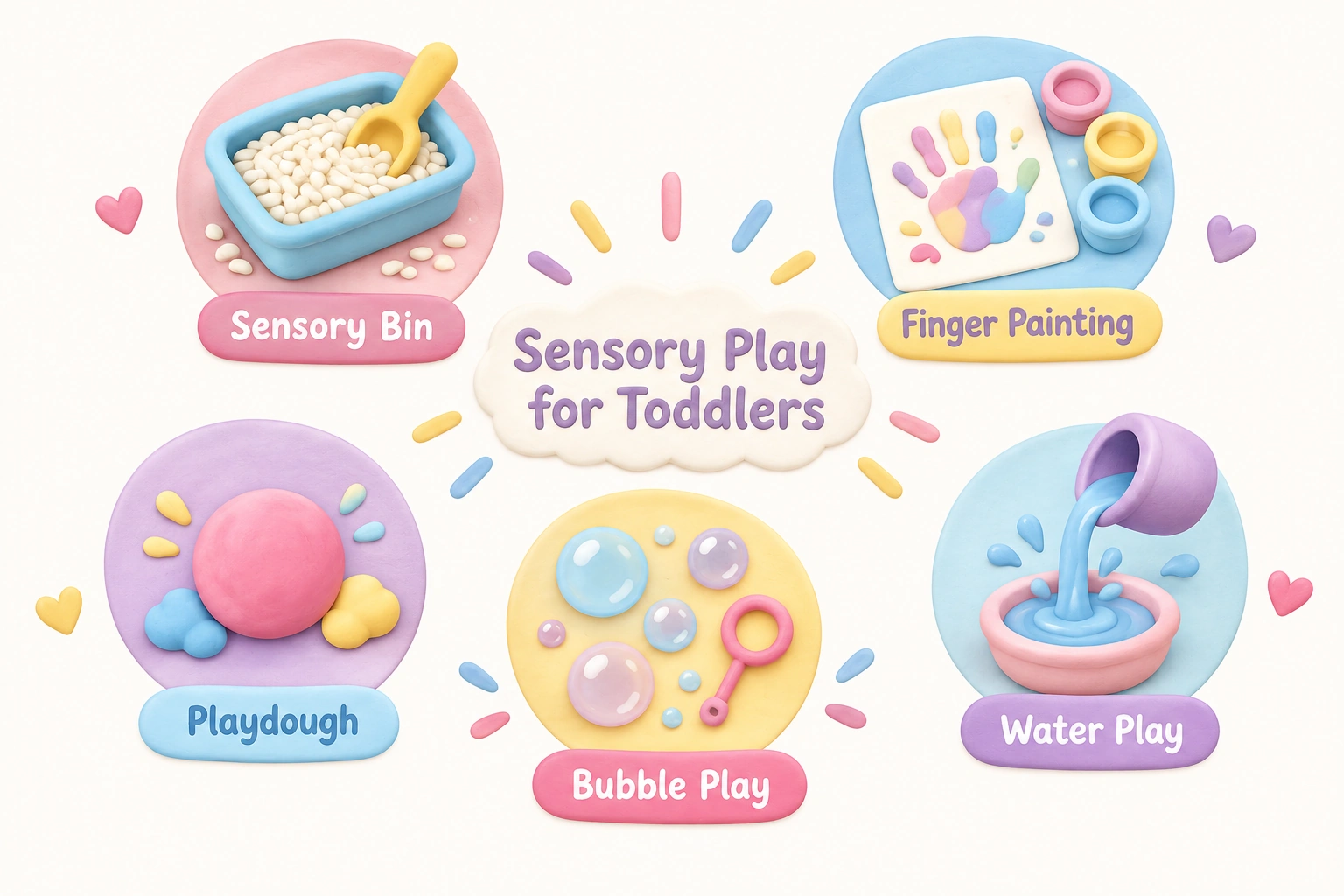
Sensory play is one of the most developmentally rich categories of activity for toddlers. When a two-year-old plunges their hands into a sensory bin filled with dried rice or explores the texture of playdough, they are activating multiple neural pathways at once — tactile, visual, proprioceptive, and sometimes auditory. Research cited by the Children’s Hospital of Richmond suggests that sensory experiences in early childhood support brain organization, language development, and emotional regulation. Sensory activities are also among the most accessible and low-cost options available to parents.
How to Set Up a Sensory Bin
A sensory bin is simply a shallow container filled with a base material and a few simple tools. Here is a practical setup guide:
- Choose a container: A plastic storage bin, a baking tray, or a large salad bowl all work well. Shallow is better than deep for toddlers.
- Select a base material: Dried rice, dried pasta, dried lentils, kinetic sand, cotton balls, or water are all suitable. Avoid small beads or anything that poses a choking risk if your child still mouths objects.
- Add simple tools: Spoons, cups, funnels, small containers, and tongs encourage pouring, filling, and transferring — all of which build fine motor development and hand-eye coordination.
- Supervise throughout: Always stay present during sensory bin play. Even food-safe materials can be a hazard if consumed in large quantities.
- Plan for cleanup: Place a sheet or mat under the bin to catch spills. A small dustpan nearby makes cleanup faster.
Rotating the base material every few days keeps the activity fresh and introduces new textures. Water play with pouring and filling is particularly effective for cause and effect understanding — toddlers quickly learn that a full cup poured into a funnel produces a predictable result, which is a foundational cognitive concept.
Other Sensory Activities Worth Trying
Beyond sensory bins, a range of tactile and multi-sensory activities support toddler development without requiring any special equipment. Finger painting with washable paint builds fine motor skills and introduces color mixing in a hands-on way. Playdough and oobleck (a simple mixture of cornstarch and water) offer resistance-based tactile feedback that supports proprioception — the body’s sense of its own position and force. Bubble play encourages visual tracking and cause and effect reasoning as toddlers learn that blowing harder produces more bubbles. Even a simple texture walk — placing different materials such as bubble wrap, a towel, and a smooth tray on the floor for a toddler to step across barefoot — activates the vestibular sense and body awareness.
Movement Games for 2-Year-Olds
Gross motor skills are developing rapidly at age two, and movement games are one of the most effective ways to support this growth while also building attention, emotional regulation, and early social skills. The best movement games for toddlers require no equipment, can be played indoors on a rainy day, and naturally incorporate turn-taking and listening skills.
Classic Movement Games
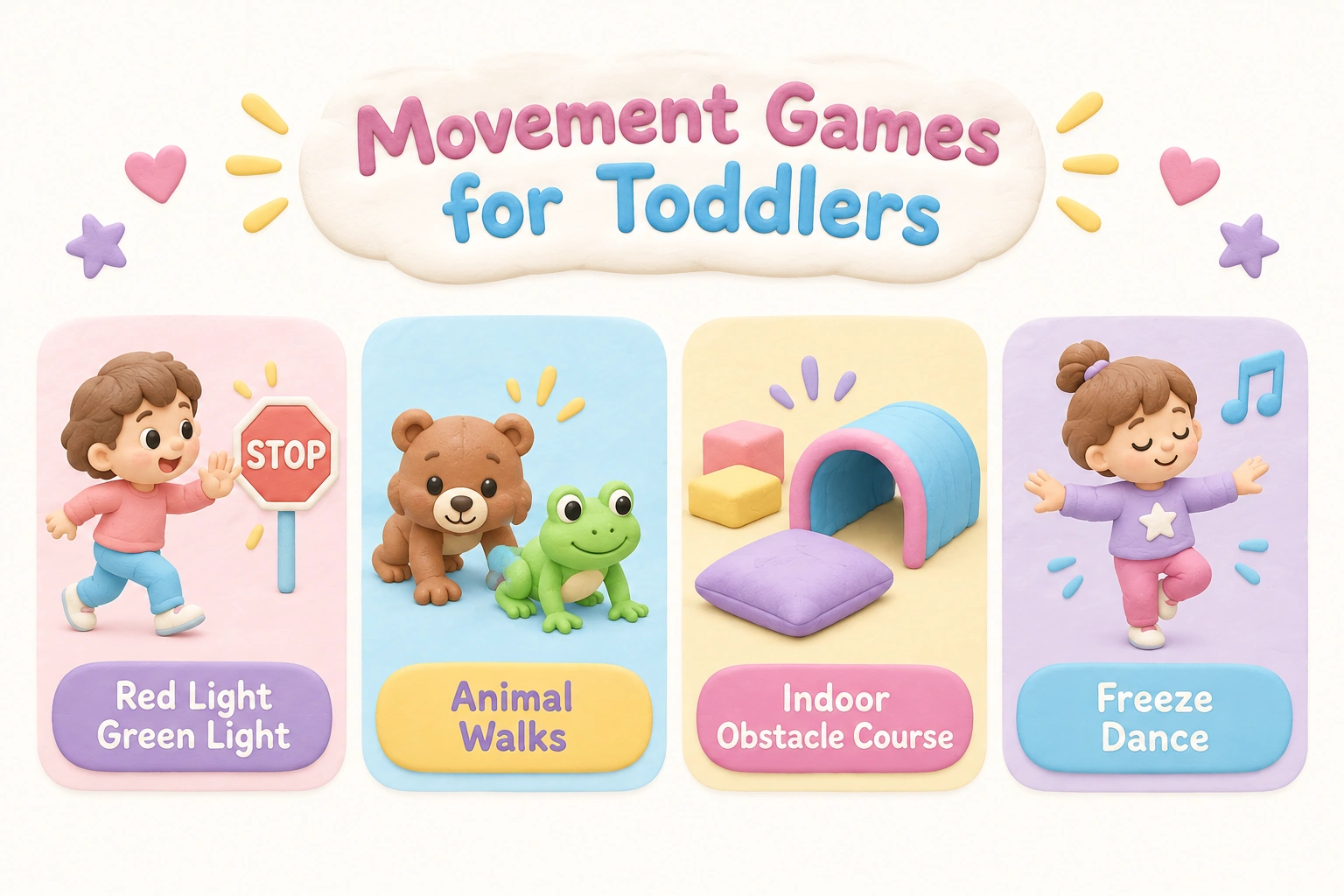
Red Light, Green Light is a perennial favourite for good reason. It builds impulse control, listening skills, and body awareness simultaneously. A two-year-old version can be simplified to just two commands — go and stop — with the caregiver acting as the signal. Simon Says works similarly, encouraging toddlers to listen carefully before acting, which supports the development of working memory and self-regulation. Follow the Leader is perhaps the most accessible of all: the adult leads a sequence of movements and the toddler copies, building imitation skills and gross motor coordination without any competitive element.
Animal Walks
Animal walks are a favourite tool of occupational therapists for building gross motor skills and body awareness in toddlers. A bear crawl (hands and feet on the floor, bottom in the air) strengthens the shoulders and core. A frog jump builds leg strength and coordination. A crab walk (sitting position, hands and feet on the floor, bottom lifted) challenges balance and upper body strength. A duck waddle develops hip stability. These can be strung together into a simple animal walk circuit that keeps a two-year-old engaged for ten to fifteen minutes.
Indoor Obstacle Course
An indoor obstacle course is one of the most versatile rainy-day activities for toddlers. Using couch cushions as stepping stones, a strip of painter’s tape on the floor as a balance beam, a blanket draped over two chairs as a tunnel, and a small pile of pillows to climb over, a caregiver can create a circuit that challenges balance, coordination, and spatial awareness. The course can be completed as a cooperative activity — adult and toddler going through together — or the toddler can repeat it independently while the adult cheers. Changing the layout every few sessions maintains novelty and keeps the challenge appropriate.
Freeze Dance and Balloon Games
Freeze dance combines music, movement, and impulse control in a format that two-year-olds find genuinely exciting. When the music stops, everyone freezes — a simple rule that even the youngest toddlers can grasp. Balloon tapping (keeping a balloon in the air without letting it touch the floor) builds hand-eye coordination and visual tracking while keeping energy levels high in a safe, contained way. Both activities work well indoors and require minimal setup.
How to Play Games With a 2-Year-Old: Parent Participation Tips
The way a caregiver engages during play matters as much as the game itself. Two-year-olds learn primarily through imitation and narration — they watch what adults do and absorb the language used to describe it. Getting down to floor level signals to a toddler that the adult is genuinely present and engaged, which increases the child’s own engagement. Narrating actions as they happen — saying “you’re pouring the rice into the cup” or “now it’s my turn to roll” — builds vocabulary and models the language of turn-taking and cooperation.
Following the child’s lead is equally important. If a toddler decides that the game pieces are better used as pretend food than as game tokens, this is not a failure — it is developmentally appropriate make-believe play emerging naturally. Gently redirecting back to the game after a few minutes of imaginative play is usually more effective than insisting on strict rule-following. Short play sessions of five to fifteen minutes, ended while the child is still engaged rather than after frustration sets in, tend to build positive associations with games that make future sessions easier.
Screen-Free Play: Why It Matters at Age Two
The American Academy of Pediatrics recommends limiting or avoiding screen use for children under 18 months (except video calls) and keeping screen time minimal and high-quality for children aged 18 months to two years, with co-viewing strongly encouraged. For two-year-olds, screen-free play remains the most developmentally rich option because it requires active physical engagement, real-time social interaction, and genuine problem-solving — none of which passive screen consumption can replicate. The sensory, movement, and board game activities described in this guide are all screen-free by design, making them a natural complement to any family’s approach to managing digital media.
This does not mean that all digital content is harmful for two-year-olds, but it does mean that the developmental benefits of hands-on play — building neural connections through touch, movement, and face-to-face interaction — are difficult to replicate on a screen. When families are looking for engaging, developmentally appropriate activities, screen-free games offer a reliable and evidence-supported alternative.
Frequently Asked Questions
What is the best first board game for a 2-year-old?
HABA My Very First Games: First Orchard is the most consistently recommended first board game for two-year-olds. It is cooperative, uses color matching as its core mechanic, has chunky wooden pieces, and plays in five to ten minutes — all of which align well with a two-year-old’s developmental stage and attention span.
Should games for 2-year-olds be cooperative or competitive?
Cooperative games are strongly preferred at age two. Toddlers are not yet neurologically ready to handle losing gracefully — this is a developmental reality, not a character flaw. Cooperative formats, where everyone works toward a shared goal, remove the frustration of losing while still building turn-taking and social skills.
How long should a 2-year-old play one game?
A two-year-old’s attention span is typically four to six minutes per activity. Games lasting five to fifteen minutes are ideal. Ending a session while the child is still engaged — rather than waiting for frustration — helps build positive associations with games over time.
Are sensory bins safe for 2-year-olds?
Sensory bins are generally safe for two-year-olds when supervised. Choose base materials that are large enough not to pose a choking hazard, and always stay present during play. If your child still mouths objects regularly, opt for larger materials such as cotton balls or water play rather than small dried grains.
What movement games can I play indoors with a 2-year-old?
Red Light, Green Light, Simon Says, Follow the Leader, animal walks (bear crawl, frog jump, duck waddle), freeze dance, and an indoor obstacle course made from cushions and painter’s tape are all effective indoor movement games that require no special equipment and support gross motor development.
When should I introduce a 2-year-old to board games?
Most children are ready for the simplest board game formats — large dice, color matching, cooperative play — from around 18 to 24 months. A child closer to two-and-a-half can typically manage slightly more complex matching or memory tasks. Following the child’s interest and attention rather than a strict age cutoff is the most reliable guide.
Do games for 2-year-olds need to be educational?
All play is educational at age two. Games do not need to be marketed as educational to support development — any activity that involves problem-solving, movement, sensory exploration, or social interaction is building skills. The most important factor is that the activity is engaging, age-appropriate, and involves a present, responsive caregiver.
Choosing Games That Grow With Your 2-Year-Old
The best games for 2-year-olds are not necessarily the most elaborate or expensive — they are the ones that meet a child where they are developmentally while offering just enough novelty to hold their attention. A sensory bin filled with dried pasta, a round of animal walks across the living room floor, and a cooperative game of First Orchard can collectively cover sensory development, gross motor skills, fine motor development, color matching, turn-taking, and emotional regulation in a single afternoon — all without a screen in sight.
As your child moves through the two-year range, you will notice their attention span lengthening, their ability to follow two-step instructions improving, and their interest in pretend play deepening. These shifts are natural cues to introduce slightly more complex games — adding a memory element, a second rule, or a new sensory material. The developmental progression from Roll & Play at 18 to 24 months, to First Orchard at 24 to 30 months, to games with simple memory or sequencing elements at 30 to 36 months, offers a practical roadmap without being prescriptive. Every child develops at their own pace, and the most valuable thing any game can offer at this age is a reason for a caregiver and toddler to play together.
Take a short quiz to find out what your everyday choices say about your parenting style
When your child is curious about something new, what’s your instinct?
Take a short quiz to find out what your everyday choices say about your parenting style
“Can I download this app?” What happens next?
Take a short quiz to find out what your everyday choices say about your parenting style
When it comes to rules at home, which sounds most like you?
Take a short quiz to find out what your everyday choices say about your parenting style
If you could give your child one life skill today, what would you pick?
Take a short quiz to find out what your everyday choices say about your parenting style
Your child gets to choose what to watch. What would your ideal setup look like?
Take a short quiz to find out what your everyday choices say about your parenting style
Pick your parenting superpower ✨