Best Games for 1-Year-Olds: Simple Parent-Led Play Ideas

 Discover a Free Education Video App for Kids
Pastory uses AI to personalize educational video content based on your child’s interests and personality. Safe, engaging, and built for curious young minds. Sign up now to stay updated and enjoy early access with a free trial
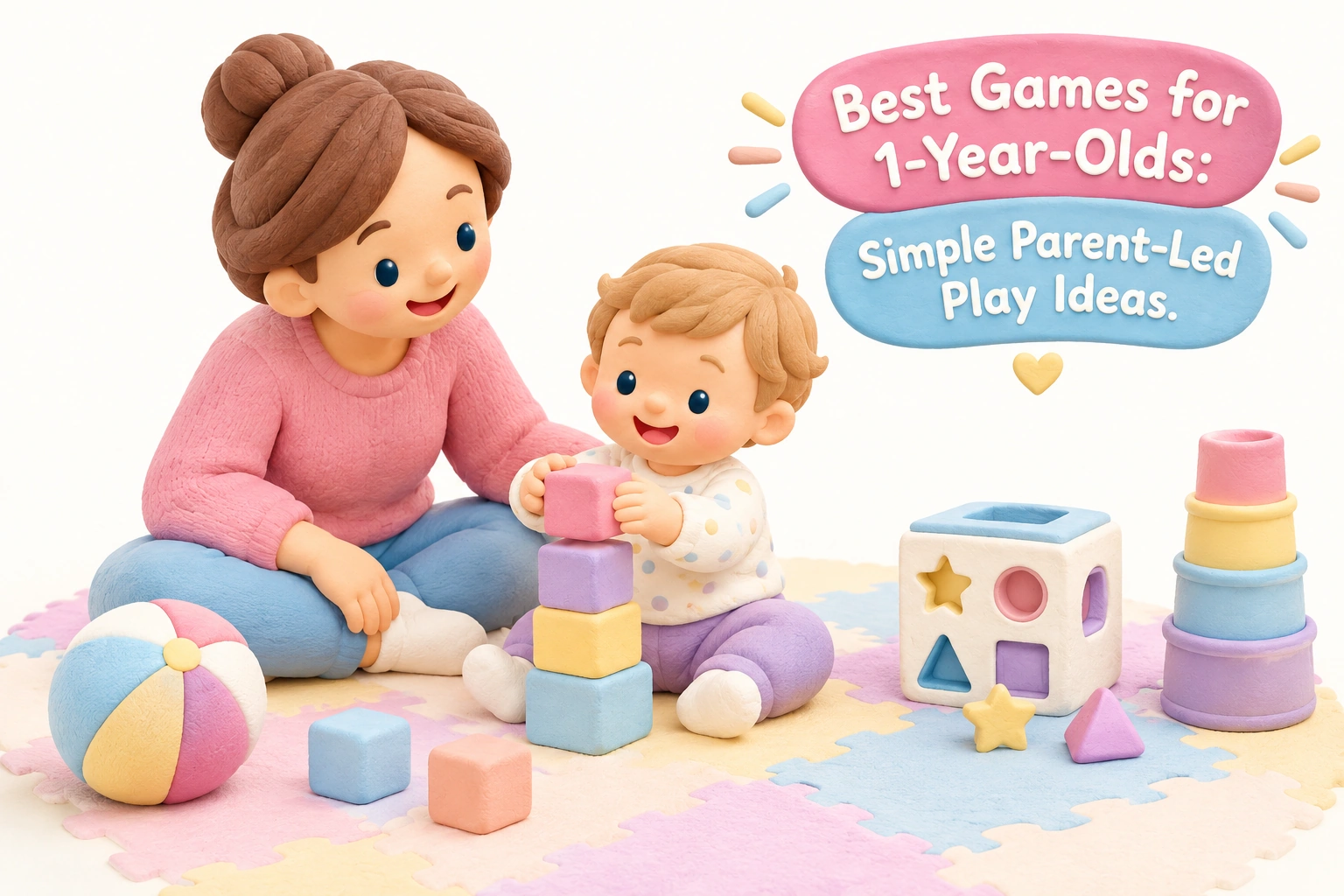
The first year of life ends with a child who is curious, mobile, and hungry for interaction — and the second year builds on that foundation at a remarkable pace. Games for 1-year-olds don’t need to be elaborate or expensive. What matters most is that a caregiver is present, engaged, and responsive. This guide covers practical, research-informed play ideas organized by developmental skill, with notes on why each game works, how to lead it, and which activities suit different stages within the 12 to 24 months window.
Key Takeaways
- Parent-led play is one of the most powerful tools for supporting cognitive development, language, and emotional bonding during the second year of life.
- Games don’t need to be complex — many of the most developmentally valuable activities are no-prep games that use everyday household objects.
- Repetition is a feature, not a flaw: 1-year-olds learn through repeated exposure to the same games, sounds, and routines.
- Different games target different skills — fine motor skills, gross motor skills, sensory exploration, receptive language, and object permanence all benefit from specific types of play.
- Safety awareness matters: always check for choking hazards and supervise closely, especially during sensory and small-object play.
Why Play Matters So Much at This Age
Between 12 and 24 months, children undergo some of the most rapid developmental changes of their lives. According to developmental milestone frameworks from organizations such as the CDC and UNICEF, a typical 1-year-old is learning to walk independently, developing a pincer grasp, beginning to imitate gestures and words, and starting to understand simple instructions. Play is not a break from development at this age — it is the primary vehicle through which development happens.
Caregiver involvement amplifies these benefits significantly. When a parent narrates what is happening during play, responds to a child’s attempts, and models new actions, the child’s brain receives richer input than during solo exploration alone. Zero to Three, a leading early childhood organization, emphasizes that back-and-forth interaction — sometimes called serve-and-return — is central to healthy brain architecture in the toddler years. Parent-led play creates exactly this kind of responsive exchange.
It is also worth noting that 1-year-olds learn through repetition. Playing the same game five or ten times in a row is not a sign of boredom — it is how toddlers consolidate new skills. Parents who understand this are less likely to rush on to the next activity before the child has fully absorbed the current one.
Classic Games That Never Get Old
Some of the most developmentally valuable games for 1-year-olds require no materials at all. These no-prep games have been played across cultures for generations, and developmental research helps explain why they work so well.
Peek-a-Boo
Peek-a-boo is far more than a simple amusement. It directly supports object permanence — the understanding that people and objects continue to exist even when they are out of sight. At around 8 to 12 months, most children begin to grasp this concept, and the 12 to 18 month period is when it becomes firmly established. Each time a caregiver hides their face and reappears, the child’s brain practices holding a mental representation of the hidden person. The delight a toddler shows at the reappearance reflects genuine cognitive work, not just social excitement. To play: cover your face with your hands or a cloth, pause briefly, then reveal yourself with an enthusiastic expression. Gradually extend the pause as the child’s anticipation grows.
Pat-a-Cake
Pat-a-cake (also called patty-cake) is listed as a developmental milestone activity by the CDC for children around 12 months. It supports imitation play, hand-eye coordination, rhythm awareness, and early receptive language — the ability to understand words and phrases before being able to produce them. The repetitive clapping pattern also builds bilateral coordination, meaning the ability to use both hands together. To play: sit facing your child, clap your hands together while saying the rhyme, and gently guide the child’s hands through the motions. Most children begin copying the clapping independently between 12 and 15 months.
Simplified Hide and Seek
A toddler-friendly version of hide and seek reinforces object permanence and builds early problem-solving skills. Unlike the adult version, this game works best when the hiding is obvious — a toy placed under a cloth, behind a cushion, or inside a box. Ask the child “Where did it go?” and watch them search. This simple question-and-answer structure also supports receptive language development. Between 18 and 24 months, children can begin hiding objects themselves and enjoy the turn-taking element of the game.
Fine Motor Games: Building Hand Skills
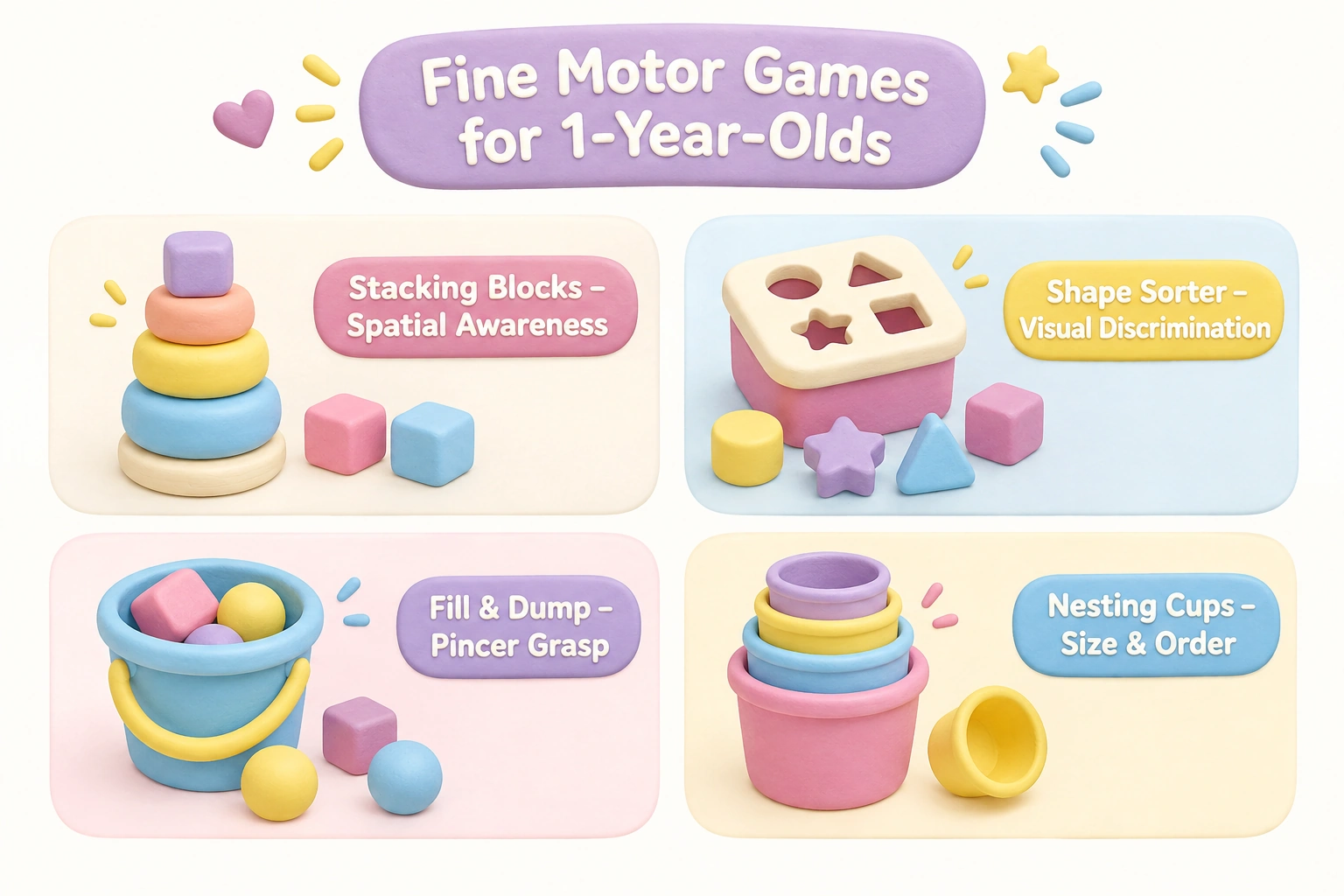
Fine motor skills — the small, precise movements of the hands and fingers — develop rapidly during the second year. Games that challenge a child to pick up, place, sort, or manipulate objects help build the finger dexterity and hand-eye coordination that will later support drawing, self-feeding, and eventually writing.
Stacking Blocks
Stacking and building blocks is one of the most versatile fine motor activities for this age group. A child who can stack two blocks at 12 months may be able to stack four to six by 18 months and up to eight or more by 24 months. The game also introduces early spatial awareness and cause and effect — the child quickly learns that an uneven stack will topple. Parents can extend the game by narrating: “One block, two blocks — uh oh, it fell!” This language input supports vocabulary development alongside the physical skill. Soft foam blocks are safest for younger toddlers; wooden unit blocks suit children who are past the mouthing stage.
Shape Sorter
A shape sorter challenges a child to match a three-dimensional object to a corresponding hole — a task that requires visual discrimination, spatial reasoning, and fine motor control simultaneously. Most children begin to succeed with simple two- or three-shape sorters between 15 and 18 months, though earlier exposure is valuable even if the child needs significant help. The parent’s role is to model the action, name the shapes, and celebrate attempts rather than rushing to correct errors. Choosing a shape sorter with large, easy-to-grip pieces reduces frustration for younger toddlers.
Fill and Dump
Fill and dump is exactly what it sounds like: filling a container with objects and then emptying it out. This seemingly simple activity is deeply satisfying to toddlers and supports the pincer grasp, cause and effect understanding, and early concepts of quantity and containment. Use a plastic container and safe household items such as large wooden pegs, soft balls, or fabric squares. The parent can narrate: “In it goes — now let’s dump it out!” Avoid small objects that present a choking hazard. This is an ideal no-prep game that can be set up in seconds using items already in the home.
Nesting Cups
Nesting cups — sets of cups that stack inside one another in size order — offer a rich cognitive and fine motor challenge. Children first enjoy simply stacking them into a tower, then gradually discover that they fit inside each other. This introduces early concepts of size, order, and spatial relationships. Between 18 and 24 months, many children begin to nest them in the correct sequence with some trial and error. Parents can support this by naming sizes: “big cup, little cup” — building vocabulary alongside the physical play.
Gross Motor Games: Getting the Body Moving
Gross motor skills involve the large muscle groups used for walking, climbing, throwing, and balancing. Between 12 and 24 months, most children transition from cruising along furniture to walking independently, and then begin to run, climb, and kick. Games that encourage movement support this progression while also building body awareness and coordination.
Ball Play
Rolling a soft ball back and forth between caregiver and child is one of the earliest turn-taking games available to toddlers. It builds gross motor coordination, introduces the social concept of taking turns, and creates a natural opportunity for language: “Your turn — roll it to me!” Between 18 and 24 months, children can begin to kick a stationary ball and attempt to throw overhand. Use a soft, lightweight ball appropriate for indoor play. Ball play also supports hand-eye coordination as the child learns to track a moving object and respond to it.
Dancing and Music Play
Dancing to music combines gross motor movement with rhythm awareness, emotional expression, and social bonding. Toddlers respond strongly to music from very early in life, and by 12 to 18 months most children will sway, bounce, or clap in response to a beat. Parents can hold the child and sway together, or encourage independent movement by dancing alongside them. Singing nursery rhymes during movement adds a language layer — the repetitive, melodic structure of nursery rhymes supports early vocabulary and phonological awareness. Making music with simple instruments such as a drum made from an upturned pot or a shaker made from a sealed container with dried pasta inside adds a cause and effect dimension.
Push and Pull Toys
Push and pull toys — wheeled toys that a child pushes ahead of them or pulls behind on a string — support the transition from supported walking to confident independent walking. They provide a sense of control and agency, which is important for a child who is still building balance and coordination. Between 12 and 15 months, a push toy can give a newly walking child extra confidence. By 18 months, most children enjoy pulling a toy behind them as they walk, which requires them to look back and adjust their path — a more complex coordination challenge.
Tunnel Play
Crawling through a fabric play tunnel supports gross motor development, spatial awareness, and a sense of adventure. Even children who are already walking often enjoy returning to crawling in a tunnel context. Parents can encourage the child by calling from the other end, playing peek-a-boo at the entrance, or rolling a ball through for the child to chase. Tunnel play also supports problem-solving as the child figures out how to navigate the enclosed space.
Sensory Games: Exploring the World Through Touch and Texture
Sensory exploration is a core learning mode for toddlers. Children at this age gather information about the world primarily through their senses, and games that offer varied textures, temperatures, sounds, and materials support cognitive development, attention, and early scientific thinking.
Sensory Bin
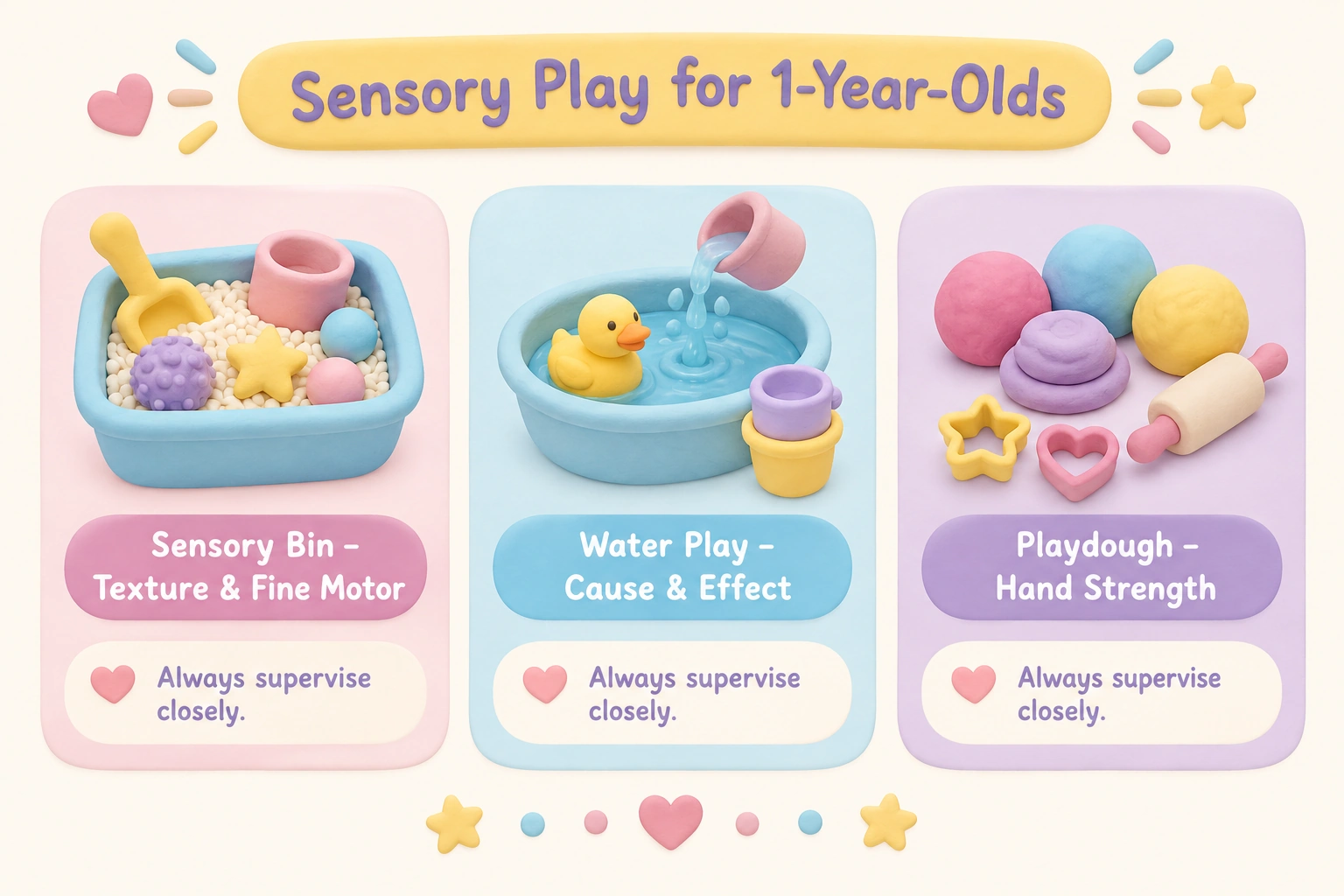
A sensory bin is a shallow container filled with a safe material for the child to explore with their hands. Suitable fillings for 1-year-olds include cooked pasta, water beads (only for children past the mouthing stage and with close supervision), dried large beans, or shredded paper. Add scoops, cups, and small toys to extend the play. A sensory bin supports fine motor skills, sensory exploration, and early scientific concepts such as volume and texture. Always supervise closely and choose fillings appropriate to the child’s developmental stage and mouthing behavior.
Water Play
Water play is one of the most universally engaging sensory activities for toddlers. A shallow basin of water with cups, spoons, and small waterproof toys provides rich sensory input and introduces early concepts of volume, flow, and cause and effect. Children learn that pouring water from a cup makes a sound, that splashing creates a reaction, and that some objects float while others sink. Water play can be done at bath time, at a low table outdoors, or in a kitchen sink with supervision. Keep water shallow and never leave a child unattended near water.
Playdough Exploration
Playdough — whether commercial or homemade — offers a rich fine motor and sensory experience. Squeezing, rolling, poking, and flattening playdough builds hand strength and finger dexterity. For children between 18 and 24 months, a parent can model simple shapes and encourage imitation. Homemade playdough made from flour, salt, water, and food coloring is a safe option for children who still mouth objects, though supervision is always recommended. The open-ended nature of playdough play also supports early pretend play as children begin to assign meaning to the shapes they create.
Cognitive and Language Games: Building Thinking and Communication
Cognitive development during the second year includes rapid growth in memory, attention, problem-solving, and early logical thinking. Language development is equally dramatic — most children move from a few words at 12 months to two-word combinations by 24 months. Games that involve naming, pointing, imitating, and responding to language support both domains simultaneously.
Discovery Box
A discovery box — sometimes called a mystery box — is a container filled with interesting everyday objects for the child to explore. Choose items with varied textures, weights, and sounds: a wooden spoon, a soft cloth, a small sealed bottle with rice inside, a smooth stone. The parent can name each object as the child picks it up, describe its properties, and model simple actions. This game builds receptive language, attention, and early categorization skills. It is also an excellent no-prep game that can be refreshed regularly with new objects to maintain interest.
Puppet Play and Toy Telephone
Simple puppet play — using a sock puppet or a stuffed animal as a character — introduces children to the idea that objects can represent other things, which is a foundational step toward pretend play and symbolic thinking. A toy telephone (or a real one that is no longer in use) encourages imitation of adult communication behavior, which supports both language development and social understanding. Between 18 and 24 months, many children begin to hold brief “conversations” with a puppet or toy, which reflects growing language and imaginative capacity.
Imitation Games
Imitation play is one of the most powerful learning mechanisms available to toddlers. When a parent claps, waves, or makes a funny face and the child copies, both social bonding and cognitive development are occurring simultaneously. Parents can extend this by imitating the child’s actions first — this reversal teaches the child that their own actions have an effect on others, which supports early social awareness and turn-taking. Simple imitation games can be played anywhere and require no materials, making them ideal no-prep games for moments between other activities.
Adapting Games to Your Child’s Mood and Stage
Not every game suits every moment. A tired or overstimulated toddler will benefit more from slow, calm activities — gentle swaying to music, quiet sensory exploration, or a simple peek-a-boo — than from energetic gross motor play. Conversely, a well-rested child with high energy may find fine motor activities frustrating if they need to move first. Matching the game to the child’s current state is a practical skill that develops with observation over time.
It is also worth distinguishing between the early and later parts of the 12 to 24 months range. A 12 to 15 month old is typically just beginning to walk, has a limited attention span, and benefits most from simple, repetitive games with clear cause and effect. A child between 18 and 24 months has a longer attention span, more developed language, and can engage with slightly more complex games involving turn-taking, early pretend play, and two-step instructions. Adjusting expectations and game complexity to match the child’s actual stage — rather than their calendar age alone — leads to more successful and enjoyable play sessions.
Safety Considerations for Play at This Age
Safety is a non-negotiable part of play planning for 1-year-olds. Children at this age still explore objects by mouthing them, which means any game involving small objects requires close supervision. As a general guideline, any object small enough to fit through a toilet paper roll presents a potential choking hazard and should be kept away from children under three years old. This applies to sensory bin fillings, puzzle pieces, small blocks, and toy accessories.
Water play should always be supervised directly, with water kept shallow. Playdough and sensory materials should be non-toxic and, where possible, edible-safe for children who still mouth objects. Outdoor play on grass or soft surfaces reduces injury risk during the frequent falls that accompany early walking. When in doubt about the safety of a material or toy, consult the manufacturer’s age guidance and your child’s pediatrician.
How Games Evolve from 12 to 24 Months
One of the most useful things a parent can understand is that the same game can grow with the child. Peek-a-boo at 12 months is a simple face-hiding game; by 18 months, the child can hide their own face; by 24 months, they can hide behind furniture and wait to be found. Stacking blocks at 12 months involves two or three blocks with significant adult help; by 24 months, the child builds independently and may begin to create structures with intention. Shape sorters that require adult guidance at 14 months may be completed independently by 20 months.
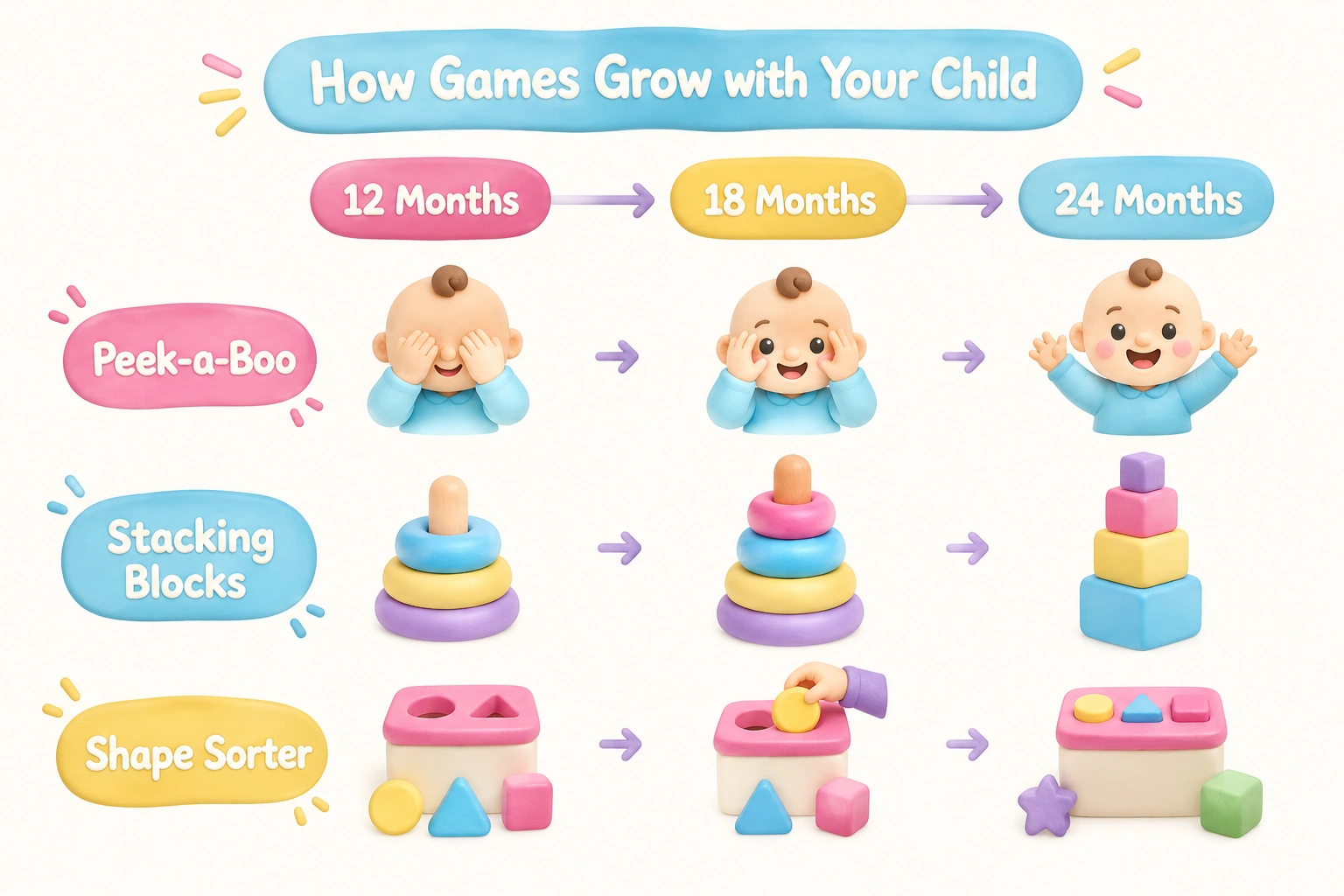
This progression means that parents do not need a constantly expanding library of new games. A small set of well-chosen, open-ended activities — blocks, a ball, a sensory bin, a few classic rhymes — can provide months of developmentally appropriate challenge simply by adjusting how the parent participates and what level of independence is expected. Parallel play, where the child plays alongside the parent rather than in direct interaction, also becomes more common toward the end of the second year, and this shift is a healthy sign of growing independence rather than a signal to introduce more complex games.
Frequently Asked Questions
How long should I play with my 1-year-old at a time?
Toddlers between 12 and 24 months typically have attention spans of around two to five minutes for a single activity, though this varies by child and game type. Short, frequent play sessions throughout the day are more effective than one long session. Following the child’s lead — stopping when they lose interest and returning when they re-engage — is generally more productive than trying to extend a session beyond the child’s natural attention window.
Do I need to buy special toys for these games?
Many of the most developmentally valuable games for 1-year-olds use everyday household objects. A plastic container and some large wooden pegs, a soft ball, a cloth for peek-a-boo, or a pot and wooden spoon for music play are all that is needed for hours of meaningful play. Purpose-built toys such as shape sorters and stacking blocks are useful but not essential, particularly in the early months of the second year.
Is it normal for my child to want to play the same game over and over?
Yes, and it is developmentally beneficial. Repetition is how toddlers consolidate new skills and build confidence. Each time a child plays the same game, they are reinforcing neural pathways and often adding a small new element — a slightly longer pause in peek-a-boo, a taller block tower, a new word heard during fill and dump. Parents who understand this are better able to stay patient and engaged during repeated play rather than feeling the need to constantly introduce novelty.
What if my child doesn’t seem interested in the games I try?
Interest varies by temperament, mood, and developmental readiness. If a child consistently shows no interest in a particular game, it may simply not match their current stage or sensory preferences. Try a different category — a child who resists fine motor games may be more engaged by gross motor or music play. It is also worth checking whether the child is tired, hungry, or overstimulated, as these states significantly reduce engagement with any activity.
When should pretend play start appearing?
Early pretend play — such as pretending to drink from an empty cup or feeding a stuffed animal — typically begins to emerge between 12 and 18 months and becomes more elaborate between 18 and 24 months. It is a significant cognitive milestone, reflecting the child’s growing ability to use symbols and represent one thing with another. Parents can encourage it by modeling simple pretend actions during play without requiring the child to imitate immediately.
Are screen-based games appropriate for 1-year-olds?
Major health organizations, including the American Academy of Pediatrics, generally recommend avoiding screen-based entertainment for children under 18 months, with the exception of video calls with family members. For children between 18 and 24 months, limited, high-quality, co-viewed content may be introduced, but it should not replace the hands-on, caregiver-led play described in this article. Physical, interactive play provides sensory, motor, and social input that screen-based activities cannot replicate at this developmental stage.
Choosing the Right Games for Your 1-Year-Old
The best games for 1-year-olds share a few common qualities: they are simple enough to engage a short attention span, open-ended enough to grow with the child, and structured around caregiver interaction rather than passive entertainment. They do not require expensive equipment, dedicated play spaces, or elaborate preparation. What they do require is a present, responsive adult who narrates, models, responds, and — crucially — follows the child’s lead.
If you are just starting to build a play routine with your toddler, begin with two or three games from different categories — perhaps peek-a-boo for cognitive development, ball rolling for gross motor skills, and a simple fill and dump activity for fine motor practice. Observe which activities generate the most engagement and build from there. As your child moves through the 12 to 24 months range, you will naturally notice when they are ready for slightly more complex challenges, and the games described here can evolve alongside them. The goal is not to cover every developmental domain in every session, but to make play a consistent, joyful, and responsive part of daily life.

Take a short quiz to find out what your everyday choices say about your parenting style
When your child is curious about something new, what’s your instinct?
Take a short quiz to find out what your everyday choices say about your parenting style
“Can I download this app?” What happens next?
Take a short quiz to find out what your everyday choices say about your parenting style
When it comes to rules at home, which sounds most like you?
Take a short quiz to find out what your everyday choices say about your parenting style
If you could give your child one life skill today, what would you pick?
Take a short quiz to find out what your everyday choices say about your parenting style
Your child gets to choose what to watch. What would your ideal setup look like?
Take a short quiz to find out what your everyday choices say about your parenting style
Pick your parenting superpower ✨