Best Card Games for 7-Year-Olds: Rules and Replay Value

 Discover a Free Education Video App for Kids
Pastory uses AI to personalize educational video content based on your child’s interests and personality. Safe, engaging, and built for curious young minds. Sign up now to stay updated and enjoy early access with a free trial
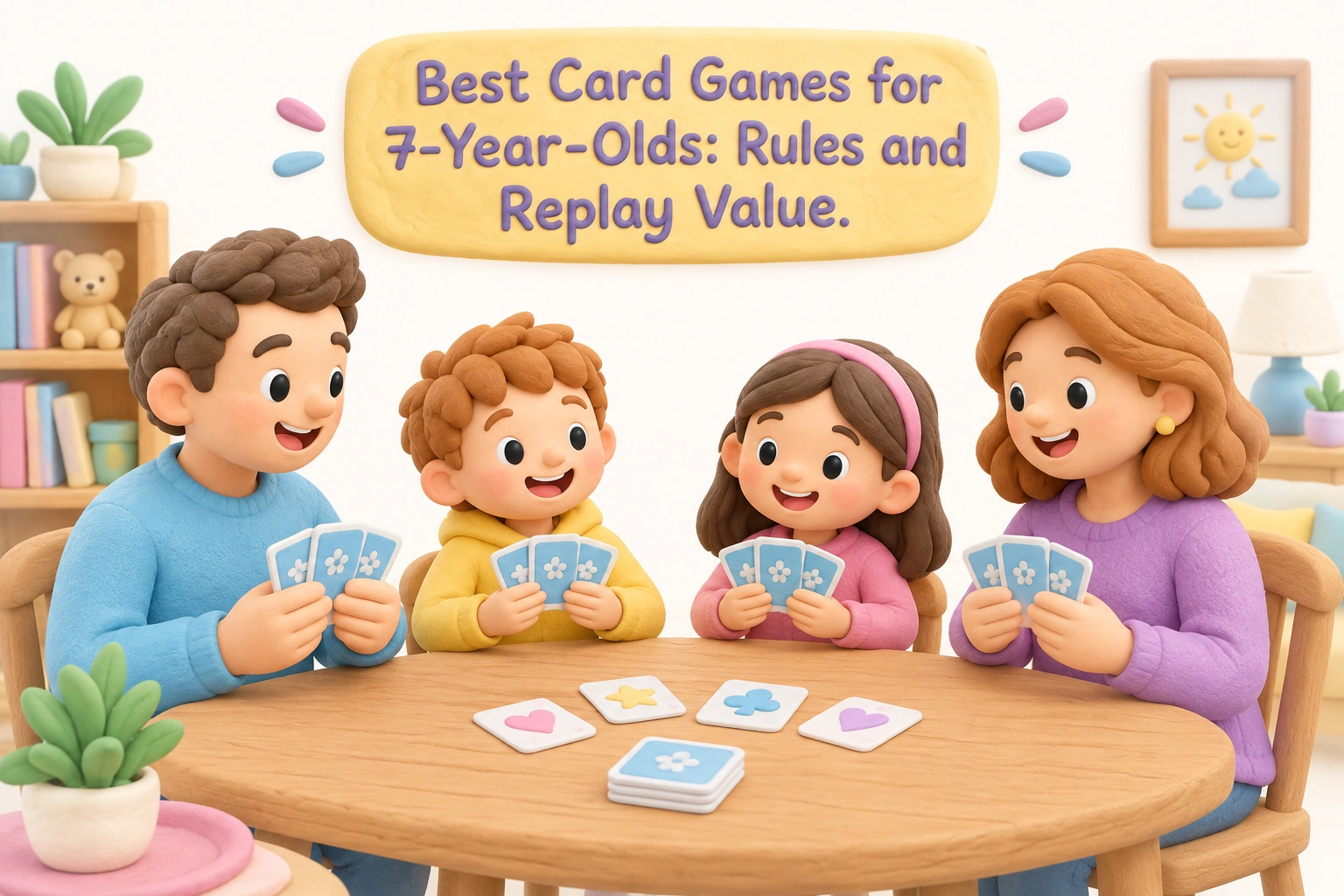
Seven is a sweet spot for card games. Children this age can follow multi-step rules, manage a hand of cards without peeking, and handle the emotional ups and downs of winning and losing — most of the time. Whether you are planning a family game night, looking for a screen-free activity, or searching for a gift that will actually get used, the right card game can deliver hours of genuine fun while quietly building skills in number recognition, strategic thinking, memory, and turn-taking. This guide covers the best card games for 7-year-olds, with simplified rules, honest replay value notes, and practical tips for choosing the right game for your child.
Key Takeaways
- Card games for ages 7 and up develop cognitive skills including working memory, pattern recognition, and basic strategic thinking through repeated, enjoyable play.
- Games with quick rounds and easy-to-learn rules tend to have the highest replay value for this age group — children want to play again immediately after finishing.
- A standard 52-card deck unlocks a wide range of free classic games; specialty boxed games add variety and often level the playing field between children and adults.
- Cooperative play options exist and are worth considering for children who find competitive games frustrating or for families who prefer collaborative experiences.
- Managing game length matters: shorter sessions that end positively are more developmentally productive than long games that end in tears or disengagement.
Why Card Games Support Development at Age 7
At age seven, most children are in the early concrete operational stage of cognitive development, meaning they can think logically about objects and events they can see and manipulate. Card games sit neatly in this zone. Holding a hand of cards, deciding which to play, and anticipating what opponents might do next all engage working memory, attention, and rudimentary probability awareness — without any screen required. Research in developmental psychology consistently links structured game play to improvements in executive function skills such as impulse control, flexible thinking, and planning, though outcomes vary considerably by child and context.
Fine motor skills also get a quiet workout. Shuffling, dealing, and fanning cards in one hand requires the kind of precise finger coordination that supports handwriting development. Even the social dimension of card play — waiting for your turn, accepting a loss gracefully, and celebrating an opponent’s good move — contributes to emotional regulation and sportsmanship in ways that are difficult to replicate through solo digital activities. Card games are not a developmental cure-all, but as a regular family activity they offer a genuinely rich mix of cognitive and social engagement.
Classic Card Games Using a Standard 52-Card Deck
The most accessible starting point for most families is a standard 52-card deck already sitting in a drawer. The games below require no purchase beyond that deck and offer strong replay value because the shuffled deck produces a different game every time.
Go Fish
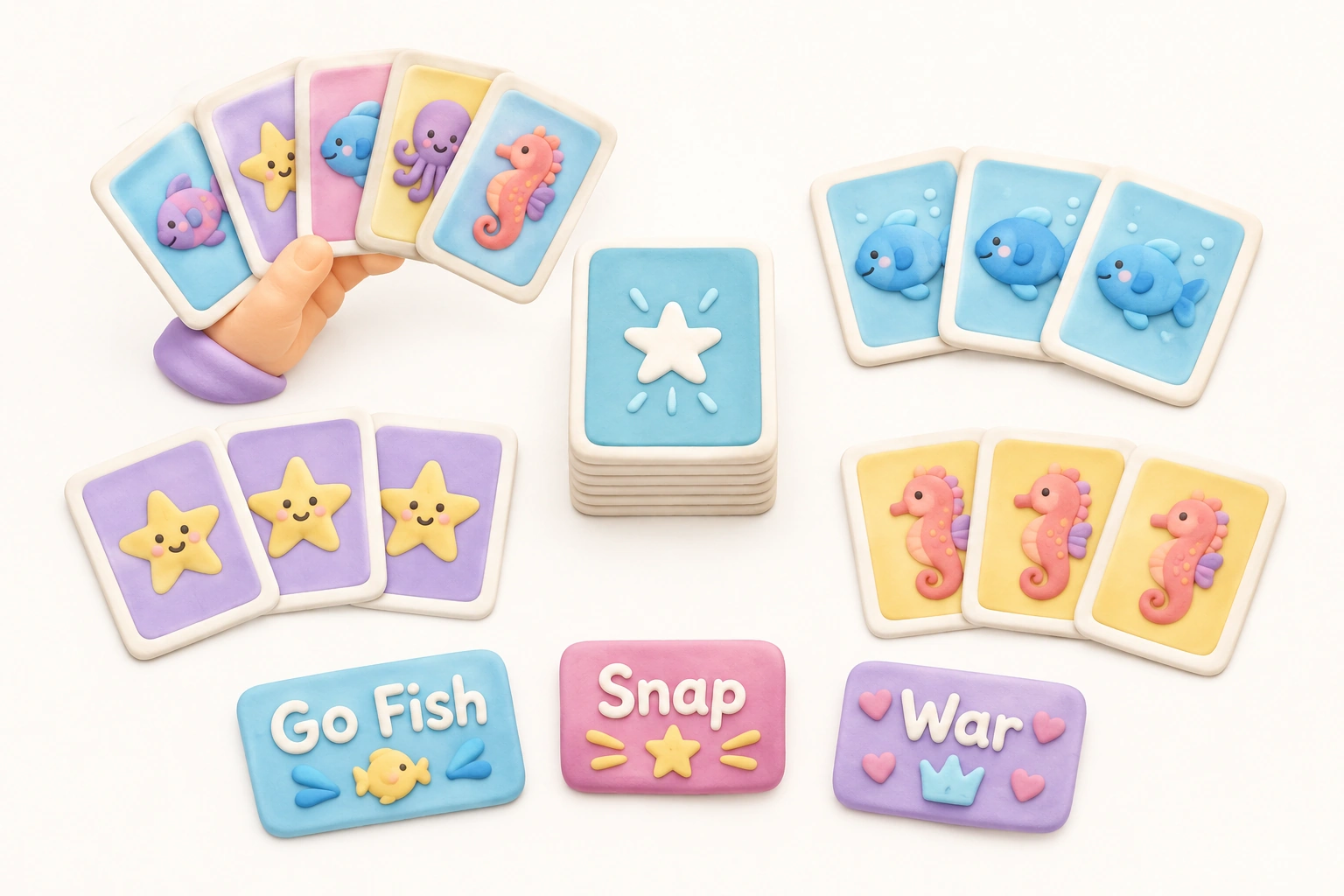
Go Fish is often the first card game children learn, and at age seven it remains genuinely enjoyable rather than babyish. Players ask opponents for specific cards to complete sets of four matching ranks. If the opponent does not have the requested card, they say “Go Fish” and the asking player draws from the central pile. The player who completes the most sets wins. Number of players: 2–6. Game time: 10–20 minutes. Replay value: Moderate — the rules are simple enough that children can play independently, but the game offers limited strategic depth as children grow. A useful house rule for extending challenge: require players to ask for a card by both rank and suit, adding a memory layer.
Crazy Eights
Crazy Eights is a shedding game — the goal is to get rid of all your cards before opponents do. Players match the top card of the discard pile by either suit or number. Eights are wild cards that let the player change the suit in play. The first player to empty their hand wins. Number of players: 2–7. Game time: 15–25 minutes. Replay value: High for this age group. The wild card mechanic introduces a small but satisfying strategic decision on every turn. Note that with six or seven players, wait times between turns can become long enough that younger or less patient children lose focus — three to four players is the sweet spot.
War
War is the simplest competitive card game in existence: each player flips the top card of their deck simultaneously, and the higher card wins both. Ties trigger a “war” where three cards are placed face-down and a fourth is flipped to decide the winner. The player who collects all 52 cards wins. Number of players: 2. Game time: 20–45 minutes (or longer). Replay value: Low to moderate — the game is entirely luck-based, which means children cannot improve through practice. A practical house rule that significantly improves the experience: play to 15 wins rather than until one player holds the entire deck. This keeps the game to a manageable length and ends on a clear, satisfying moment rather than a slow grind.
Snap and Slapjack
Both games are fast-paced card games built around speed and hand-eye coordination. In Snap, players take turns flipping cards onto a central pile; when two consecutive cards match, the first player to shout “Snap!” and slap the pile wins all the cards. Slapjack works similarly but players slap only when a Jack appears. Number of players: 2–6. Game time: 10–15 minutes. Replay value: High for high-energy children. These games are excellent for burning off restless energy and work well as a warm-up before a longer game. They are less suitable for children who become easily overwhelmed by noise and physical competition.
Rummy (Simplified)
A simplified version of Rummy — sometimes called Basic Rummy — is an excellent transition game for seven-year-olds who have mastered Go Fish and are ready for more strategic thinking. Players draw and discard cards, trying to form sets (three or four cards of the same rank) or runs (three or more consecutive cards of the same suit). The first player to form their entire hand into valid groups wins. Number of players: 2–4. Game time: 20–35 minutes. Replay value: High and growing — as children develop, they naturally begin to think further ahead, making the game more rewarding over time. This is one of the best beginner progression games for children moving beyond purely luck-based play.
Specialty Boxed Card Games for Ages 7 and Up
Boxed card games designed specifically for ages 7 and up often include mechanics that level the playing field between children and adults, making them genuinely enjoyable for the whole family rather than something adults merely tolerate. The games below are among the most consistently recommended for this age group.
UNO
UNO is arguably the most widely played specialty card game for families worldwide. It is a shedding game in which players match cards by color or number and use action cards — Skip, Reverse, Draw Two, and Wild — to disrupt opponents. The first player to empty their hand wins the round; points are scored based on cards remaining in opponents’ hands. Number of players: 2–10. Game time: 20–45 minutes. Replay value: Very high. The combination of color matching, number recognition, and action card strategy keeps the game fresh across hundreds of plays. UNO is officially rated for ages 7 and up, and the skill level scales naturally — younger children focus on matching, while older players begin to think strategically about when to play action cards. For large groups, consider playing individual rounds rather than full scoring games to maintain energy and focus.
Skip-Bo
Skip-Bo is a sequencing card game in which players build ascending piles from 1 to 12 using cards from their personal stockpile, hand, and shared building piles. The first player to empty their stockpile wins. Number of players: 2–6. Game time: 20–40 minutes. Replay value: High. Skip-Bo is particularly well suited to children who benefit from clear, predictable structure — the sequential number building provides a satisfying visual and cognitive pattern. It is frequently recommended as an educational card game for children with ADHD or autism because the rules are consistent and the goal is always visible. The game also builds number recognition and basic sequencing skills in a genuinely playful context.
Sleeping Queens
Sleeping Queens is a fantasy-themed card game in which players use number cards, action cards, and special cards to wake sleeping queens and protect them from knights and potions. Players who collect the most queens — or reach a target point total — win. Number of players: 2–5. Game time: 20–30 minutes. Replay value: High. Sleeping Queens is a strong choice for children who enjoy imaginative themes alongside their card play. It also incorporates basic addition — players can discard number cards that add up to another card in their hand, which introduces a gentle math element without feeling like homework. The game is genuinely enjoyable for adults, making it one of the better options for mixed-age family game night.
Sushi Go!
Sushi Go! uses a card drafting mechanic: players simultaneously choose one card from their hand, pass the remaining cards to the next player, and score points based on the combinations they collect across three rounds. Number of players: 2–5. Game time: 15–20 minutes. Replay value: Very high. The simultaneous drafting mechanic means there is almost no downtime — every player is always engaged. Sushi Go! is one of the best examples of a game that genuinely flattens the skill gap between a seven-year-old and an adult, because the scoring combinations are simple enough for children to grasp but varied enough to reward strategic thinking over time. Quick rounds make it easy to play two or three games in a single sitting.
Taco Cat Goat Cheese Pizza
Taco Cat Goat Cheese Pizza is a fast-paced card game built around pattern recognition and reaction speed. Players take turns placing cards face-up while saying the next word in the sequence “taco, cat, goat, cheese, pizza.” When the spoken word matches the card played, everyone slaps the pile — the last player to slap takes all the cards. Special cards trigger physical actions before the slap. Number of players: 2–8. Game time: 10–20 minutes. Replay value: Very high for high-energy groups. This game is an excellent choice for parties or large family gatherings. It requires no reading ability and almost no setup, making it one of the most accessible educational card games for mixed-age groups.
Rat-a-Tat Cat
Rat-a-Tat Cat is a memory and deduction game in which players try to have the lowest total score by swapping high-value cards in their hand for lower ones, using special power cards to peek at their own cards or swap with opponents. Players cannot look at their cards freely — they must remember what they have seen. Number of players: 2–6. Game time: 15–25 minutes. Replay value: High. Rat-a-Tat Cat is one of the best card games for building working memory and deduction skills in a genuinely fun context. The hidden information mechanic creates real tension and encourages children to concentrate and remember — skills that transfer directly to classroom learning.
Classic vs. Boxed Card Games: A Quick Comparison
| Feature | Classic (Standard Deck) | Specialty Boxed Games |
|---|---|---|
| Cost | Free (deck already owned) | Typically £8–£20 / $10–$25 |
| Number of games available | Dozens from one deck | One game per box |
| Setup time | Minimal | Minimal to moderate |
| Adult enjoyment | Variable | Generally higher |
| Skill leveling (child vs. adult) | Adults often have clear advantage | Many designed to level the field |
| Educational design | Incidental | Often intentional |
| Portability | Very high | Moderate |
| Best for | Everyday play, travel, beginners | Family game night, gifts, variety |
Skills Card Games Build at Age 7
Card games are not purely recreational — they engage a meaningful range of developmental domains simultaneously. Number recognition is reinforced every time a child reads a card value, matches suits, or sequences numbers in Skip-Bo or Rummy. Working memory is exercised whenever a child must remember which cards have been played, what opponents asked for in Go Fish, or which of their own hidden cards in Rat-a-Tat Cat carries a high penalty. Turn-taking habits are practiced in every game, building the patience and self-regulation that support classroom participation.
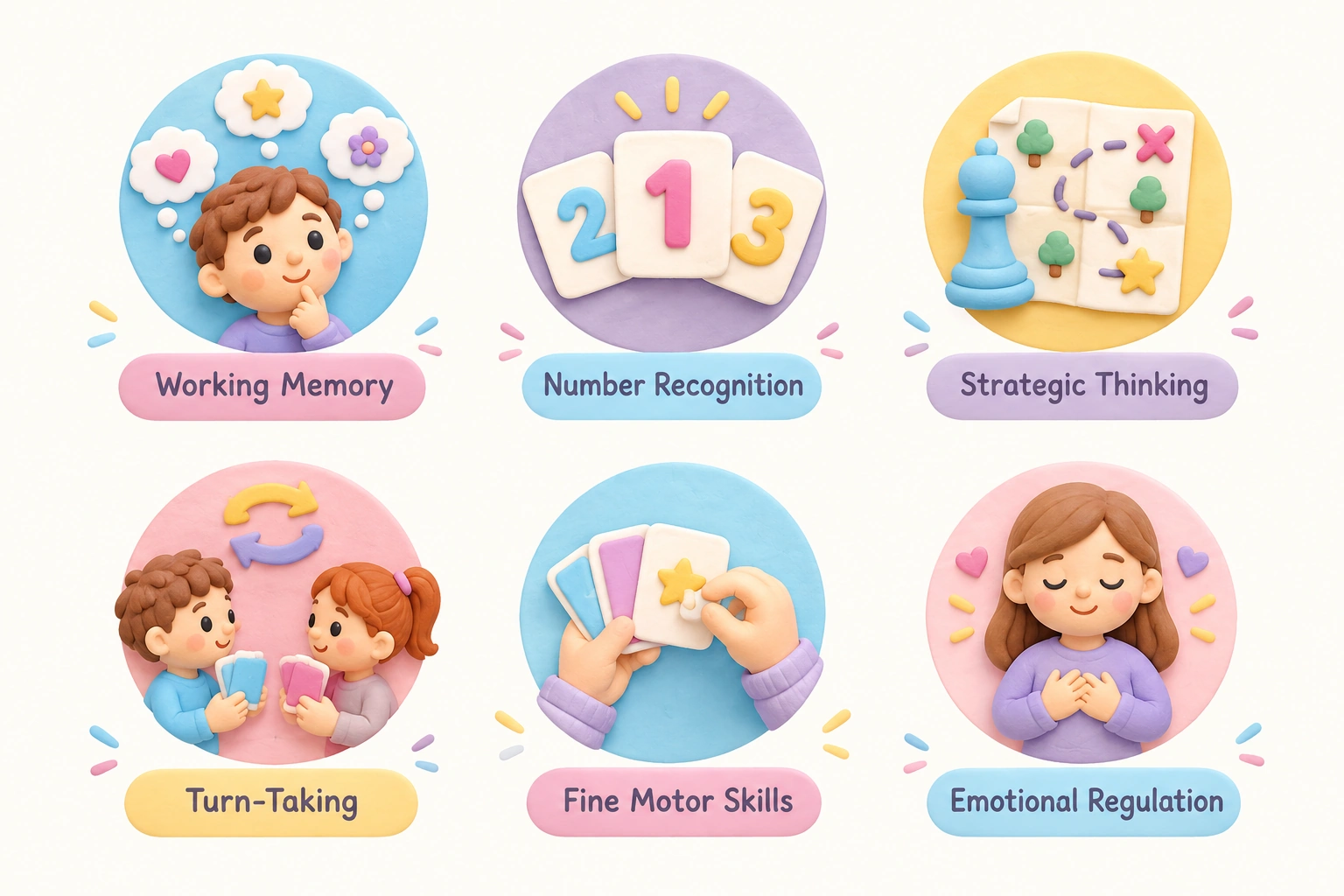
Strategic thinking develops gradually through repeated play. A seven-year-old playing UNO for the first time focuses on matching colors and numbers; after a dozen games, the same child begins to hold back a Wild card for a critical moment or deliberately change the suit to one an opponent cannot match. This progression from rule-following to genuine strategy is a meaningful cognitive milestone. Fine motor skills — shuffling, dealing, and holding a fan of cards — also improve with practice, supporting the hand strength and coordination needed for writing tasks.
Social and emotional development benefits are equally real. Cooperative play options aside, most card games involve healthy competition, which means children regularly experience both winning and losing in a low-stakes environment. Handled well by caregivers, these moments build resilience, sportsmanship, and the ability to regulate disappointment — skills that are difficult to teach directly but emerge naturally through repeated game play.
Managing Game Length and Energy for 7-Year-Olds
One of the most practical pieces of advice for family card game sessions is to prioritize ending on a positive note over completing a full game. A seven-year-old who finishes a short, enjoyable round of Sushi Go! will almost always ask to play again. A child who sits through a 45-minute War game that ends in frustration may resist card games for weeks. Quick rounds are not a compromise — they are a feature, and games designed around them (Sushi Go!, Taco Cat Goat Cheese Pizza, Snap) tend to have the highest replay value precisely because children can experience a complete, satisfying arc in under 20 minutes.
When playing longer games like Phase 10 or a full scoring session of UNO, consider setting a natural stopping point in advance — for example, playing three rounds rather than to a target score. This gives children a predictable endpoint and reduces the likelihood of fatigue-driven meltdowns. House rules that shorten games, such as playing War to 15 wins rather than until one player holds the full deck, are a legitimate and widely used tool for matching game length to a child’s attention span without abandoning the game entirely.
Cooperative Card Games for 7-Year-Olds
Not every child thrives in competitive play, and not every family wants game night to involve winners and losers. Cooperative play options in the card game world are less common than competitive ones, but they exist and are worth seeking out. In cooperative card games, all players work together toward a shared goal rather than against each other. This format can be particularly valuable for children who become easily dysregulated by losing, for siblings with a significant age gap, or for families who simply prefer collaborative experiences.
While dedicated cooperative card games for this age group are a smaller category than competitive ones, some competitive games can be adapted. Playing UNO cooperatively — where all players work together to empty their hands before a shared draw pile runs out — is a simple house rule variant that preserves the game’s mechanics while removing the competitive element. Sleeping Queens can similarly be played as a team game with minor rule adjustments. Asking children to help design cooperative variants is itself a valuable creative and rule-comprehension exercise.
Tips for Teaching Card Games to 7-Year-Olds
The way a game is introduced significantly affects whether a child engages with it long-term. A few practical approaches tend to work well at this age. First, play an open-hand practice round before the first real game — lay all cards face-up on the table and walk through a few turns together so the child can see the decision-making process without the pressure of hidden information. Second, keep the first session short and end it while the child is still enjoying themselves, even if the game is not finished. Third, let the child deal and shuffle from the beginning; the physical involvement builds ownership and fine motor skills simultaneously.
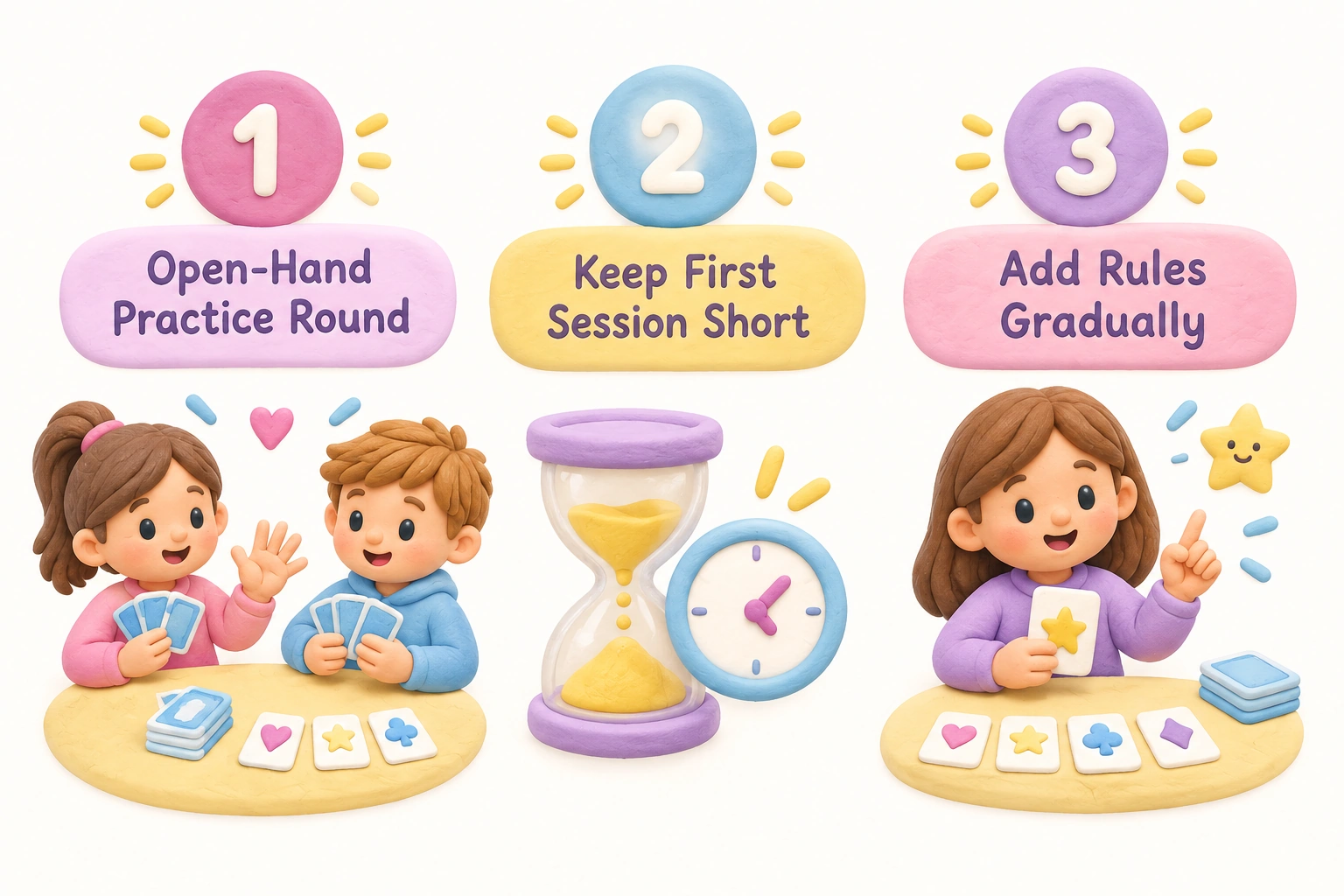
When introducing a new game, focus on the core objective first and introduce special cards or advanced rules in subsequent sessions. UNO, for example, is perfectly playable without the Draw Four card in the first few games — adding it once the basic matching mechanic is comfortable prevents rule overload. This beginner progression approach — starting with the simplest version of a game and layering complexity gradually — is more effective than presenting all rules at once and tends to produce children who genuinely understand and enjoy the game rather than simply tolerating it.
Frequently Asked Questions
What is the best card game for a 7-year-old who has never played before?
Go Fish or Crazy Eights are the most reliable starting points because they use a standard 52-card deck, have easy-to-learn rules, and can be explained in under two minutes. Once a child is comfortable with these, UNO or Sleeping Queens make excellent next steps into specialty boxed games.
How many players do most card games for 7-year-olds support?
Most classic card games support 2–6 players, and many specialty games support 2–5. Games like Taco Cat Goat Cheese Pizza and UNO can accommodate larger groups, though with six or more players, wait times between turns increase and younger children may lose focus. Three to four players is generally the most engaging range for this age group.
Are card games genuinely educational, or is that just marketing?
Card games do support real developmental skills — number recognition, working memory, turn-taking, pattern recognition, and basic strategic thinking — but the degree of benefit depends on the child’s engagement, the caregiver’s involvement, and how regularly the games are played. They are not a substitute for structured learning, but they are a meaningful complement to it, particularly for building social and emotional skills in a low-pressure context.
Which card games work well for children with ADHD or autism?
Skip-Bo is frequently recommended for children with ADHD or autism because its sequential number-building mechanic is predictable, the goal is always visible, and rounds can be kept short. Rat-a-Tat Cat and Sleeping Queens also work well because they have clear, consistent rules and relatively short play times. Card holders designed for small hands can help children who find it physically difficult to hold a fan of cards, reducing frustration and improving focus on the game itself.
How long should a card game session be for a 7-year-old?
Most seven-year-olds sustain focused card game engagement for 20–30 minutes before attention begins to wane. Games with quick rounds — under 20 minutes — are ideal because they allow multiple complete games in a single session. If playing a longer game, build in a natural stopping point in advance rather than pushing through to the end when a child is clearly fatigued.
Can card games replace screen time?
Card games are an excellent screen-free activity and can serve as a meaningful alternative to passive screen consumption, particularly during family time. They should not be framed as a punishment or replacement but as a genuinely enjoyable option alongside other activities. The social interaction, cognitive engagement, and physical card-handling involved in card games offer developmental benefits that passive screen time does not replicate.
Choosing the Right Card Game for Your Child and Family
The best card game for a seven-year-old is ultimately the one that gets played repeatedly and ends with someone asking for another round. For families new to card games, starting with a standard 52-card deck and mastering Go Fish, Crazy Eights, and a simplified Rummy gives children a strong foundation without any additional cost. When the family is ready for something new, UNO and Sleeping Queens are the most reliably enjoyable boxed games for this age group, offering genuine replay value and enough strategic thinking to remain interesting as children grow.
Consider your child’s temperament and play style when choosing. High-energy children who love physical reactions will gravitate toward Snap, Slapjack, and Taco Cat Goat Cheese Pizza. Children who prefer quieter, more thoughtful play will enjoy Rat-a-Tat Cat, Sleeping Queens, or Sushi Go!. Families who want cooperative play can adapt several competitive games with simple house rules or look for explicitly cooperative options. And for children who find competitive games emotionally challenging, keeping sessions short, celebrating effort rather than outcomes, and choosing games with a strong luck element — so no single player dominates consistently — can make the experience positive for everyone at the table.

Take a short quiz to find out what your everyday choices say about your parenting style
When your child is curious about something new, what’s your instinct?
Take a short quiz to find out what your everyday choices say about your parenting style
“Can I download this app?” What happens next?
Take a short quiz to find out what your everyday choices say about your parenting style
When it comes to rules at home, which sounds most like you?
Take a short quiz to find out what your everyday choices say about your parenting style
If you could give your child one life skill today, what would you pick?
Take a short quiz to find out what your everyday choices say about your parenting style
Your child gets to choose what to watch. What would your ideal setup look like?
Take a short quiz to find out what your everyday choices say about your parenting style
Pick your parenting superpower ✨