Best Puzzle Games for 5-Year-Olds: Digital and Physical Picks

 Discover a Free Education Video App for Kids
Pastory uses AI to personalize educational video content based on your child’s interests and personality. Safe, engaging, and built for curious young minds. Sign up now to stay updated and enjoy early access with a free trial
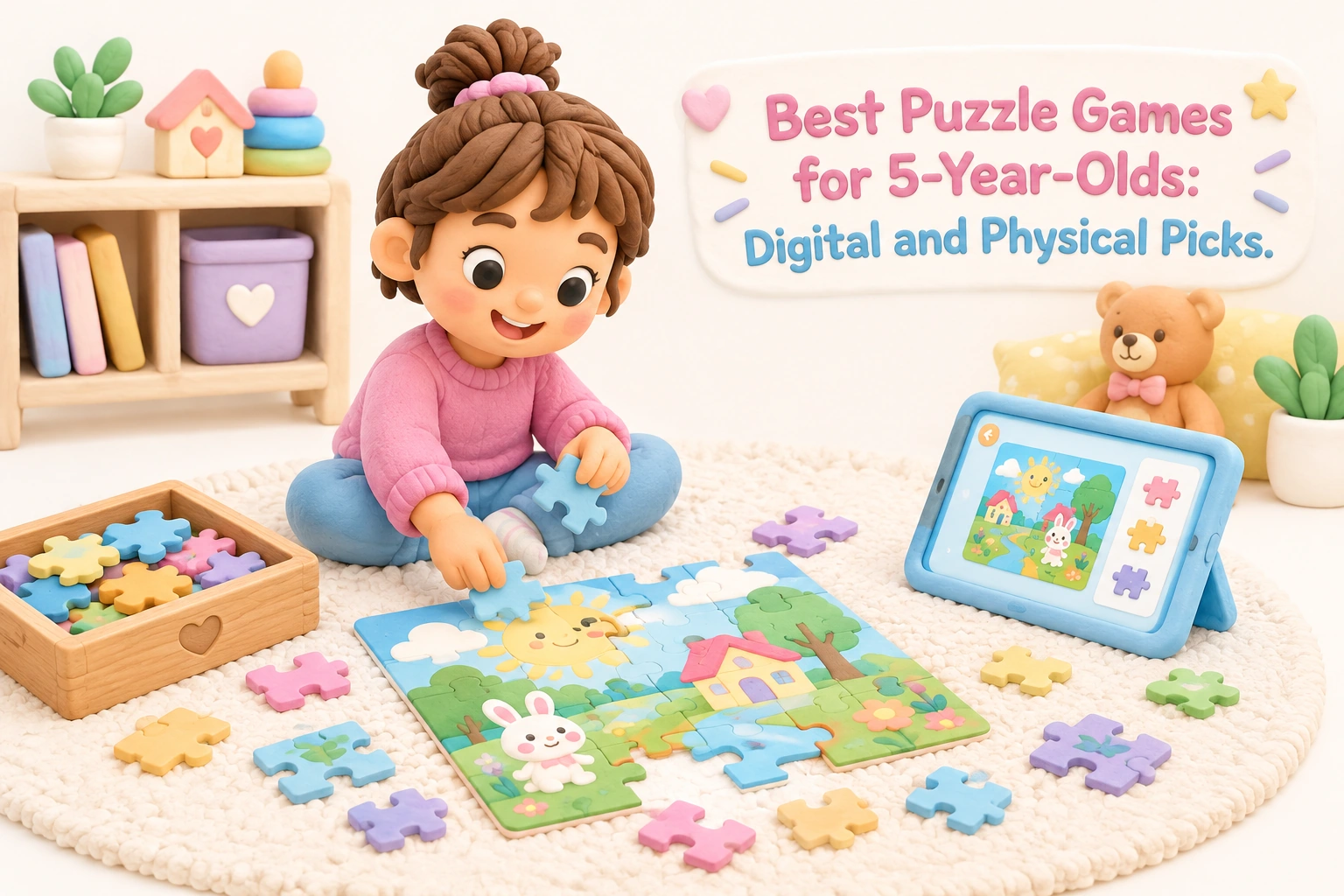
At age five, children are at a particularly receptive stage for puzzle play. Their fine motor skills are developing rapidly, their attention span is lengthening, and they are beginning to apply early logical thinking to everyday challenges. Choosing the right puzzle — whether a tactile jigsaw spread across the living room floor or a carefully selected puzzle app on a tablet — can meaningfully support cognitive development, spatial reasoning, and school readiness. This guide covers the most useful physical and digital puzzle options for five-year-olds, explains what developmental benefits to realistically expect, and helps parents make informed choices based on their child’s stage and interests.
Key Takeaways
- A piece count of 24 to 60 pieces is generally age-appropriate for most five-year-olds, though individual readiness varies.
- Physical puzzles support fine motor skills and hand-eye coordination in ways that digital formats currently cannot fully replicate.
- Quality puzzle apps can offer adjustable difficulty levels and ad-free environments, but should be used within recommended daily screen time limits.
- Parental involvement during puzzle play — sometimes called scaffolding — amplifies the developmental benefit regardless of format.
- Balancing screen-free play with thoughtfully chosen digital puzzle games gives children the broadest range of cognitive and physical benefits.
Why Puzzles Matter at Age Five
Five-year-olds are transitioning from parallel play toward more goal-directed, independent activity. Puzzle play sits at the intersection of several developmental domains at once. Physically, manipulating puzzle pieces builds fine motor skills and hand-eye coordination as children pinch, rotate, and place pieces with increasing precision. Cognitively, puzzles require spatial reasoning — the ability to mentally rotate shapes and anticipate how pieces fit together — a skill that research consistently links to later mathematics and STEM performance. Emotionally, completing a puzzle builds patience, perseverance, and a genuine sense of achievement that supports self-confidence.
Puzzle play also engages working memory and early executive function. A child must hold a mental image of the target picture, plan a sequence of moves, and self-correct when a piece does not fit. These are the same cognitive processes that underpin school readiness, making puzzles one of the more evidence-supported forms of educational play for this age group. The developmental benefits are not guaranteed for every child and will depend on the child’s individual temperament, the quality of the puzzle, and how much a caregiver participates in the activity.
How Many Pieces Are Right for a Five-Year-Old?
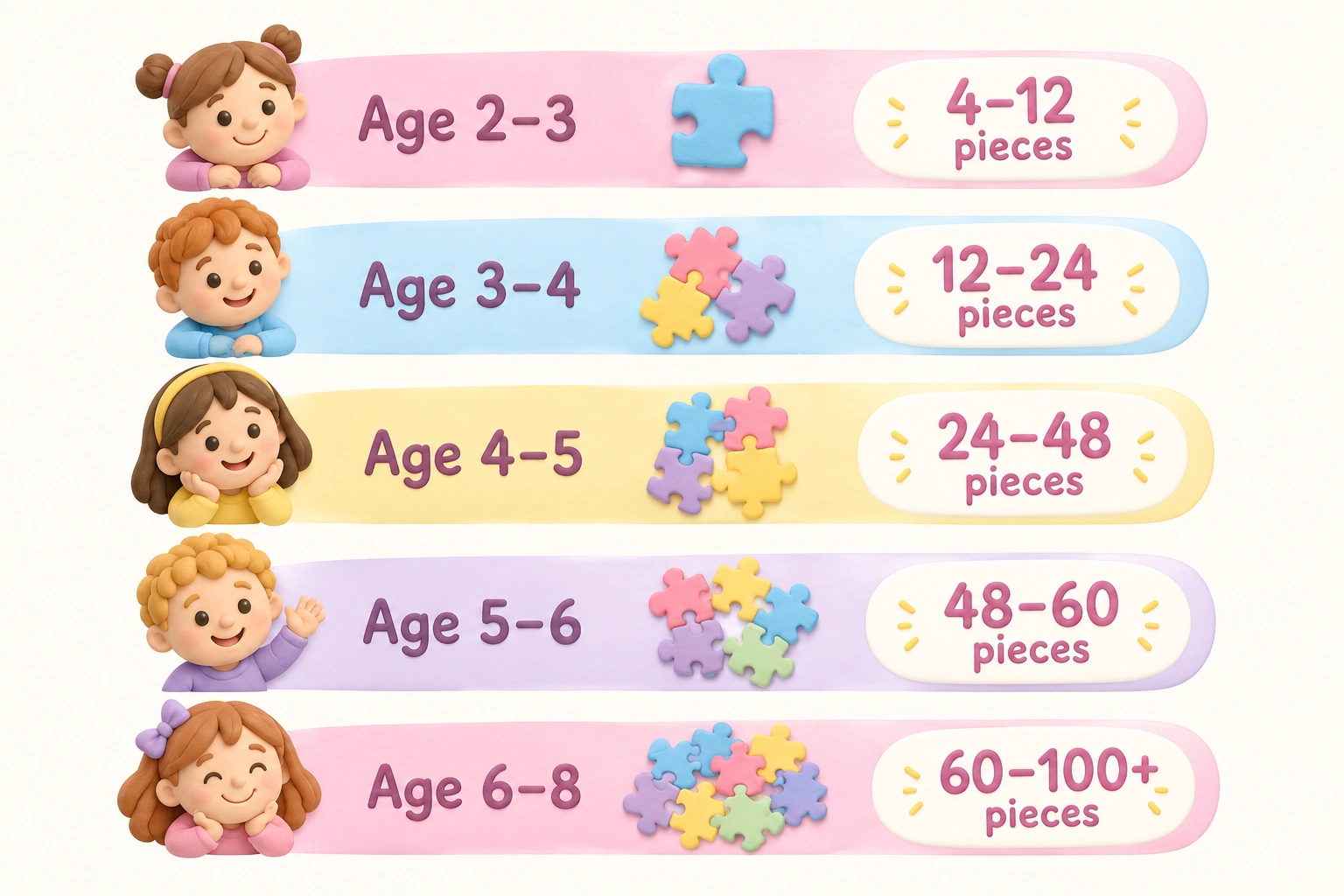
Piece count is one of the most practical decisions a parent faces when selecting an age-appropriate puzzle. Most child development guidance and puzzle manufacturers converge on a range of 24 to 60 pieces as suitable for the majority of five-year-olds. Below 24 pieces, puzzles may feel too simple and fail to sustain a child’s attention span. Above 60 pieces, the task can become frustrating rather than rewarding, particularly for children who are newer to puzzle play or who have shorter concentration windows.
A five-year-old’s attention span for a focused task typically falls somewhere between 10 and 25 minutes, which aligns well with the time needed to complete a 24–48 piece puzzle in a single sitting. Children who have been doing puzzles regularly since age three or four may be ready to attempt 60-piece jigsaws, while children encountering puzzles for the first time at five may benefit from starting at 24 pieces and progressing gradually. Signs that a child is ready to move up in difficulty include completing their current puzzle quickly without frustration, asking for a harder one, or showing boredom with familiar puzzles.
| Age | Suggested Piece Count | Typical Format |
|---|---|---|
| 2–3 years | 4–12 pieces | Wooden peg puzzle, knob puzzle |
| 3–4 years | 12–24 pieces | Simple jigsaw, shape puzzle |
| 4–5 years | 24–48 pieces | Jigsaw puzzle, floor puzzle |
| 5–6 years | 48–60 pieces | Floor puzzle, themed jigsaw |
| 6–8 years | 60–100+ pieces | Standard jigsaw, map puzzle |
Types of Physical Puzzles Worth Considering
Physical puzzles come in a wider variety of formats than many parents realize, and different types target slightly different developmental skills. Understanding the options helps parents match a puzzle to their child’s current interests and developmental needs.
Floor Puzzles
Floor puzzles are large-format jigsaw puzzles, typically containing 40 to 60 pieces, designed to be assembled on the ground. Their oversized pieces are easier for small hands to handle, and the large finished image — often a world map, animal scene, or favourite character — provides strong visual motivation. Floor puzzles naturally encourage children to move their whole body as they search for pieces, adding a mild physical dimension to the cognitive task. Brands such as Melissa & Doug and Ravensburger produce well-regarded floor puzzles in this piece range, with thick, durable pieces and non-toxic inks.
Wooden Peg Puzzles and Montessori-Style Puzzles
Although wooden peg puzzles are most commonly associated with toddlers, Montessori-style tactile puzzles designed for five-year-olds offer a more sophisticated version of the same concept. These puzzles often feature self-correcting shapes, geography outlines, or layered designs that require children to sequence pieces in a specific order. The tactile feedback of smooth, solid wood pieces is something digital formats cannot replicate, and the Montessori philosophy behind many of these designs emphasizes independent discovery over adult instruction. HABA and similar manufacturers produce wooden puzzle sets that remain engaging for children at the upper end of the preschool range.
Themed Jigsaw Puzzles
Themed jigsaw puzzles — featuring dinosaurs, space, animals, vehicles, maps, or fantasy characters — are particularly effective at sustaining a five-year-old’s motivation through a longer puzzle session. When a child is genuinely interested in the subject matter, they are more likely to persist through difficulty and to talk about what they see, which supports language development alongside the cognitive benefits of puzzle-solving. Ravensburger’s 60-piece children’s jigsaws and Mudpuppy’s glow-in-the-dark puzzle sets are examples of themed options that combine appropriate piece counts with high-quality materials.
Logic and Sequencing Puzzles
Logic puzzles such as SmartGames Castle Logix or Rush Hour Jr. (recommended from age five) introduce a different kind of problem-solving challenge. Rather than assembling a picture, children must arrange pieces or vehicles according to spatial rules, working through progressively harder challenges. These puzzles are particularly well-suited to children who have already mastered standard jigsaws and are ready for a more abstract cognitive challenge. They support executive function and early logical reasoning in ways that picture-assembly puzzles do not.
Map and Geography Puzzles
Map puzzles — such as The Learning Journey’s Lift & Learn USA Map — introduce geographic concepts while maintaining the core puzzle-solving challenge. At age five, children are not expected to memorize state names, but the repeated handling of shaped pieces corresponding to real places builds early spatial and geographic awareness. These puzzles also tend to have built-in educational prompts beneath each piece, adding a language and knowledge layer to the activity.
Digital Puzzle Games: What to Look For
Digital puzzle apps can be a reasonable complement to physical puzzle play, particularly during travel, quiet time, or situations where physical puzzles are impractical. However, not all puzzle apps are equally well-designed for five-year-olds, and the quality of the digital experience varies considerably. Parents evaluating a puzzle app should consider several specific criteria before allowing independent use.
The most important feature to look for is an ad-free puzzle app environment. Many free puzzle apps for children are funded by advertising, which can expose five-year-olds to inappropriate content, encourage impulsive in-app purchases, or simply interrupt the focused cognitive state that makes puzzle play beneficial. A genuinely ad-free experience, with no in-app purchase prompts visible to the child, is a meaningful quality signal. Parental controls that allow caregivers to set time limits, restrict content, or monitor usage are a further indicator of a responsibly designed product.
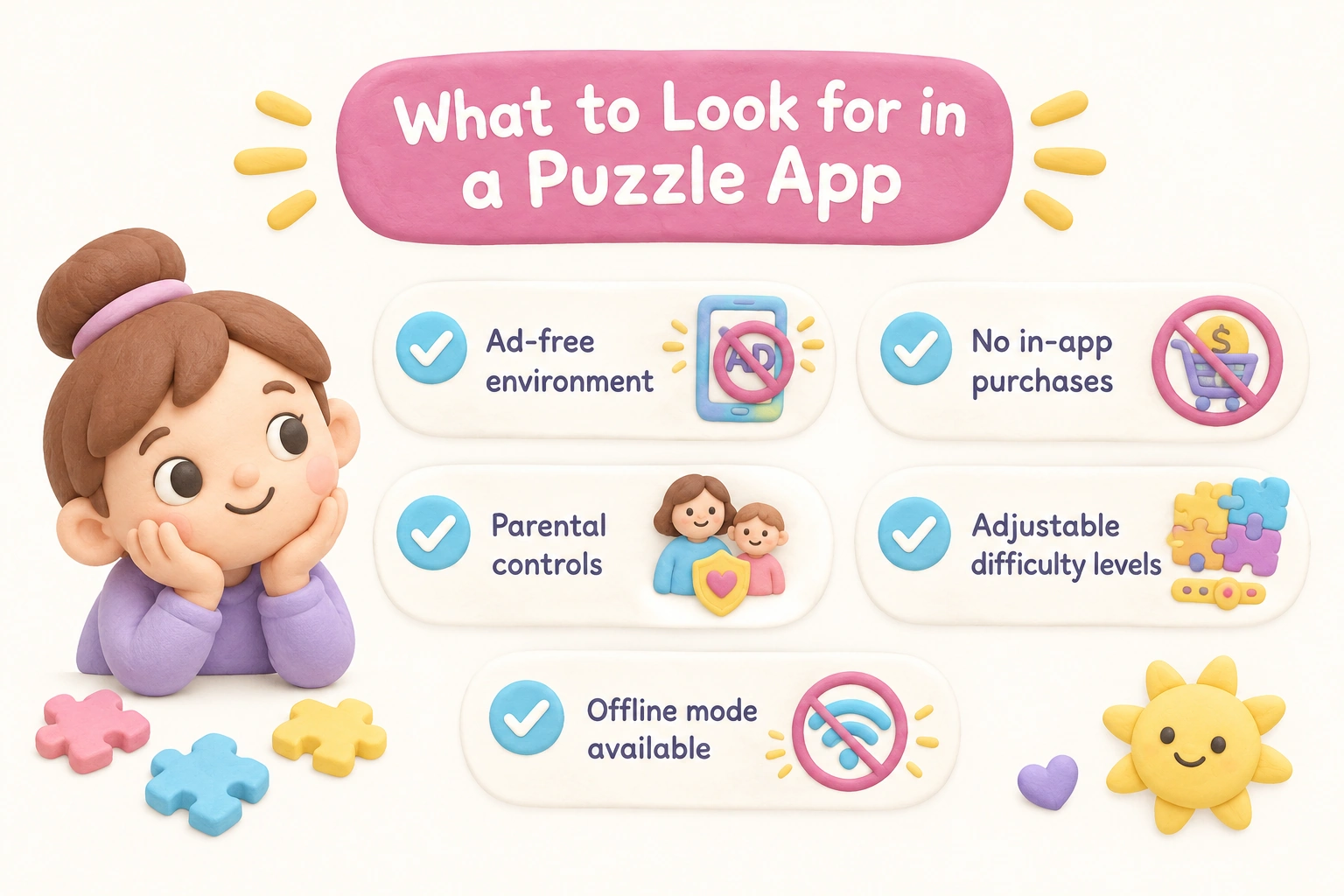
Drag-and-drop mechanics are the standard interaction model for digital jigsaw puzzles, and the quality of this mechanic matters. Pieces that snap satisfyingly into place, rotate smoothly, and respond accurately to touch input make the experience more rewarding and more closely approximate the spatial reasoning challenge of physical puzzles. Apps that offer adjustable difficulty levels — allowing a child to start with 6 pieces and progress to 24 or more — are better suited to the wide range of ability within the five-year-old age group. Offline availability is a practical consideration for families who want to use apps during car journeys or in areas without reliable internet access.
Recommended Digital Puzzle Apps for Five-Year-Olds
The following apps are frequently cited by parents and educators as offering a thoughtful digital puzzle experience for children around age five. These descriptions are based on publicly available feature information; parents should review current app store listings and privacy policies before downloading, as app content and terms can change.
Super Puzzle Kids Jigsaw Game
Available on both iOS and Android, Super Puzzle Kids offers over 140 puzzle images with adjustable piece counts, making it suitable for a wide range of ability within the preschool and early primary age group. The app is designed for children from age four upward and uses simple drag-and-drop mechanics with clear visual feedback. Parents report that the interface is intuitive enough for five-year-olds to navigate independently after a brief introduction.
PuzzleBuddy
PuzzleBuddy is an iOS app designed specifically with young children in mind, offering puzzles ranging from 6 to 24 pieces. Its ad-free environment and straightforward design make it one of the more parent-recommended options for children at the younger end of the five-year-old range. The limited piece count ceiling means children who are ready for more complex challenges may outgrow it relatively quickly.
KidloLand Puzzle Games for Kids
KidloLand offers over 80 puzzle activities aimed at children aged two to five, with a variety of themes including animals, vehicles, and everyday objects. The app is available offline, which makes it practical for travel. Its design is colourful and child-friendly, though parents should verify the current subscription model and ad status before use, as these details can change with app updates.
LogicLike: Brain Teaser Games
For five-year-olds who are ready for something beyond picture assembly, LogicLike introduces simple logic puzzles, pattern recognition tasks, and sequencing challenges within a structured progression. This type of educational puzzle game begins to develop the early reasoning skills associated with mathematical thinking and executive function. It is better suited to children who have already developed comfort with standard jigsaw formats and are looking for a new kind of cognitive challenge.
Physical vs. Digital Puzzles: A Side-by-Side Comparison
| Feature | Physical Puzzles | Digital Puzzle Apps |
|---|---|---|
| Fine motor development | Strong — pinching, rotating, placing pieces | Limited — touch gestures are less demanding |
| Spatial reasoning | Strong — full 3D manipulation | Moderate — 2D drag-and-drop |
| Portability | Moderate — pieces can be lost | High — device-based, offline options available |
| Screen time | None — supports screen-free play | Counts toward daily screen time limits |
| Replayability | Moderate — same puzzle repeated | High — many puzzles in one app |
| Cost | £8–£30+ per puzzle | Free to £5/month subscription |
| Safety considerations | Non-toxic materials, smooth edges | Ad-free status, parental controls needed |
| Caregiver involvement | Natural co-play opportunity | Easier for independent use |
| Tactile feedback | Full tactile experience | None |
Balancing Screen Time with Puzzle Play
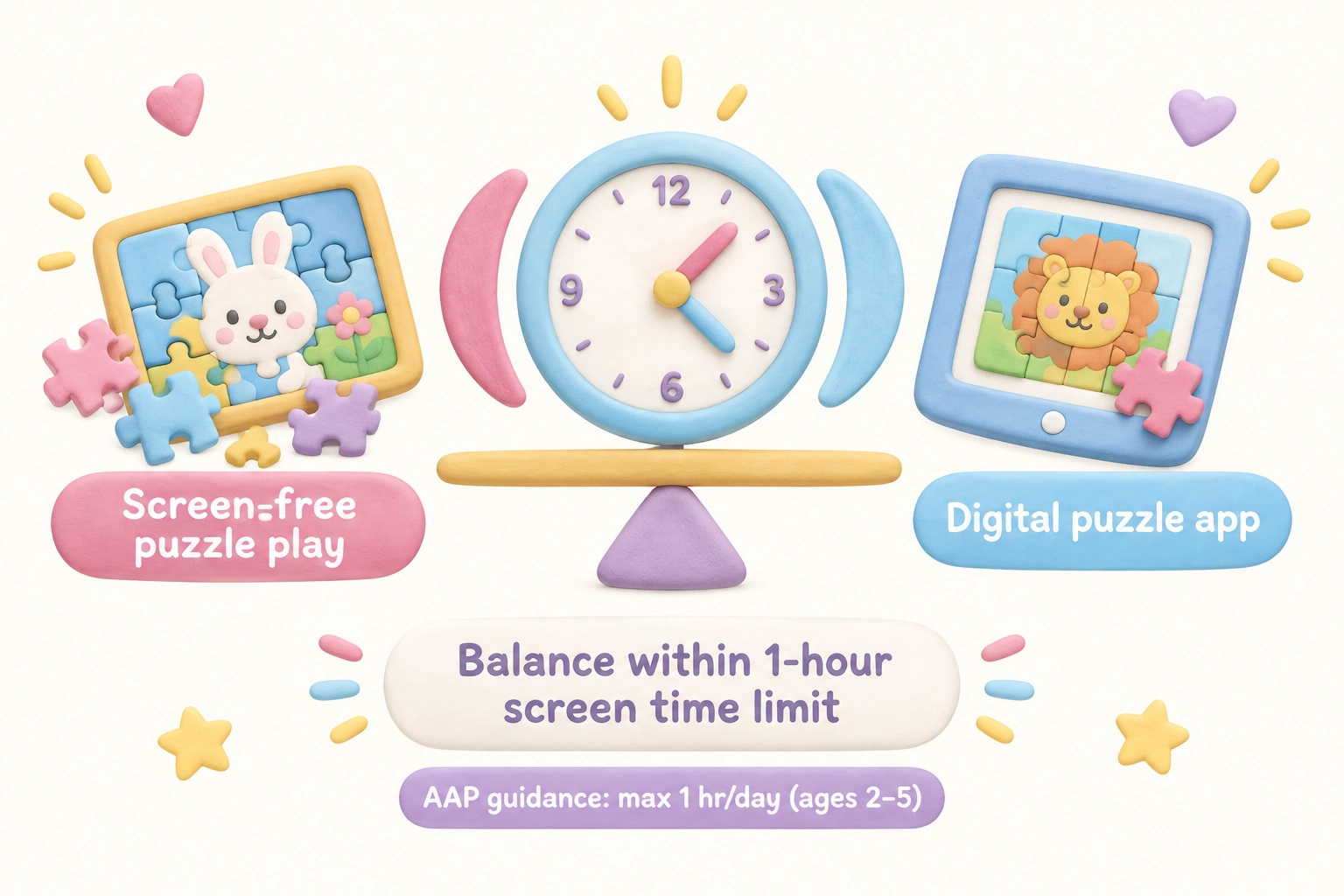
The American Academy of Pediatrics (AAP) recommends that children aged two to five have no more than one hour of high-quality screen time per day, with parental co-viewing encouraged where possible. For children who have just turned five, this guidance remains relevant, and digital puzzle apps should be counted within that daily limit rather than treated as an exception because they are educational in nature. The cognitive benefits of digital puzzle play are real but do not outweigh the broader developmental value of screen-free play, physical activity, and face-to-face interaction.
A practical approach for most families is to treat digital puzzle apps as a complement to physical puzzles rather than a replacement. A child might spend 20–30 minutes with a physical floor puzzle in the morning and use a puzzle app for 15–20 minutes during a car journey, keeping total screen time well within recommended limits while still benefiting from both formats. When a caregiver sits alongside a child during a digital puzzle session — asking questions, narrating the child’s thinking, and celebrating progress — the educational value of the experience increases meaningfully.
How to Support Puzzle Play at Home
Research on parental scaffolding consistently shows that children learn more effectively when a caregiver participates actively rather than simply observing. For puzzle play, this does not mean solving the puzzle for the child. Instead, useful scaffolding involves asking open questions such as “What colour are you looking for?” or “Does that piece have a straight edge?”, pointing to a relevant area of the puzzle without placing the piece, and acknowledging effort rather than only the finished result. This kind of involvement supports language development, emotional regulation, and persistence alongside the cognitive benefits of the puzzle itself.
When introducing puzzles to a five-year-old who is new to the activity, starting with a familiar image — a favourite animal, a character they love, or a scene from a book they know — reduces the cognitive load and increases motivation. Completing the border first is a strategy that many children find helpful, as it creates a clear framework before the more complex interior work begins. As a child’s confidence grows, gradually increasing the piece count and introducing less familiar themes keeps the challenge appropriately stimulating without becoming discouraging.
Choosing Puzzles by Theme and Interest
Grouping puzzle choices by a child’s specific interests is one of the most effective ways to sustain engagement and extend the time a five-year-old is willing to spend on a puzzle. Children who are passionate about dinosaurs will persist through a more challenging puzzle if the finished image rewards their interest. Similarly, a child fascinated by space may be motivated by a solar system round puzzle in a way that a generic landscape image would not achieve. Common themes that work well for this age group include animals and wildlife, vehicles and transport, maps and geography, fantasy characters, and underwater scenes.
Themed puzzles also create natural opportunities for conversation and language development. As a child assembles a puzzle featuring ocean animals, a caregiver can introduce vocabulary, ask questions about what the child sees, and connect the puzzle image to books, documentaries, or real-world experiences. This kind of cross-context learning deepens the educational value of the activity beyond the puzzle-solving task itself.
Frequently Asked Questions
How many pieces should a puzzle for a 5-year-old have?
Most five-year-olds are ready for puzzles with 24 to 60 pieces. Children who are new to puzzles or who have shorter concentration windows may find 24–36 pieces more manageable, while children with more puzzle experience may be ready for 48–60 pieces. Individual readiness varies, and it is always better to start slightly easier and progress than to introduce a puzzle that causes frustration.
Are puzzle apps safe for 5-year-olds?
Puzzle apps can be appropriate for five-year-olds when they are genuinely ad-free, do not include in-app purchase prompts visible to children, and offer parental controls. Parents should review the app’s privacy policy, check whether it collects data from children, and verify that the content is age-appropriate before allowing independent use. Digital puzzle time should count toward the daily screen time limit recommended by paediatric health organisations.
How long should a 5-year-old spend on a puzzle?
A five-year-old’s focused attention span for a single task is typically between 10 and 25 minutes. A puzzle session of this length is generally appropriate. If a child is deeply engaged and wants to continue, there is no need to interrupt them, but puzzle play should be balanced with physical activity, creative play, and social interaction throughout the day.
Do puzzles help with school readiness?
Puzzle play may support several skills associated with school readiness, including spatial reasoning, working memory, early problem-solving, and the ability to persist through a challenging task. These are not guaranteed outcomes, and the degree of benefit will depend on the child’s engagement, the quality of the puzzle, and whether a caregiver participates. Puzzles are one useful tool among many for supporting cognitive development in the preschool years.
What is the difference between a floor puzzle and a regular jigsaw for a 5-year-old?
A floor puzzle is a large-format jigsaw designed to be assembled on the ground, with oversized pieces that are easier for small hands to handle. They typically contain 40 to 60 pieces and produce a large finished image. Standard jigsaw puzzles for this age group are smaller in format but may have a similar piece count. Floor puzzles are particularly good for children who find small pieces fiddly or who enjoy the physical experience of moving around while they work.
Can puzzles help with fine motor skills?
Physical puzzles can support fine motor skill development because they require children to use a precise pincer grip to pick up, rotate, and place pieces. This kind of hand activity strengthens the small muscles of the hand and improves hand-eye coordination over time. Digital puzzle apps involve touch gestures that are less physically demanding and are unlikely to provide the same level of fine motor benefit.
What should I look for in a puzzle app for a 5-year-old?
Look for apps that are genuinely ad-free, do not prompt children to make purchases, offer adjustable difficulty levels, and are available offline. Responsive drag-and-drop mechanics, a variety of themes, and a clear, uncluttered interface are also positive indicators. Reading recent parent reviews alongside the app store description gives a more accurate picture of the actual experience than marketing materials alone.
Choosing the Right Puzzle Format for Your Child
Physical puzzles and digital puzzle apps are not competing options — they address overlapping but distinct developmental needs. Physical puzzles, particularly wooden jigsaw puzzles and floor puzzles in the 24 to 60 piece range, offer the strongest support for fine motor skills, hand-eye coordination, and the full spatial reasoning challenge of three-dimensional piece manipulation. They also create natural opportunities for screen-free play and caregiver co-engagement. For most five-year-olds, physical puzzles should form the foundation of puzzle play.
Digital puzzle apps are a practical complement, particularly for travel or situations where physical puzzles are impractical. When chosen carefully — prioritising ad-free environments, parental controls, and adjustable difficulty levels — they can extend a child’s puzzle experience and introduce logic and pattern recognition challenges that go beyond picture assembly. The key is to treat them as one element within a broader play diet rather than a primary activity, and to keep digital puzzle time within the daily screen time guidance appropriate for this age group.
Every five-year-old is different. A child who is highly motivated by a particular theme, who has a longer attention span, or who has been doing puzzles since toddlerhood will engage differently from a child who is encountering puzzles for the first time. Starting with an age-appropriate puzzle that matches your child’s current ability and genuine interests, sitting alongside them for at least part of the session, and gradually increasing the challenge as their confidence grows is the approach most likely to make puzzle play a rewarding and developmentally useful part of their daily routine.

Take a short quiz to find out what your everyday choices say about your parenting style
When your child is curious about something new, what’s your instinct?
Take a short quiz to find out what your everyday choices say about your parenting style
“Can I download this app?” What happens next?
Take a short quiz to find out what your everyday choices say about your parenting style
When it comes to rules at home, which sounds most like you?
Take a short quiz to find out what your everyday choices say about your parenting style
If you could give your child one life skill today, what would you pick?
Take a short quiz to find out what your everyday choices say about your parenting style
Your child gets to choose what to watch. What would your ideal setup look like?
Take a short quiz to find out what your everyday choices say about your parenting style
Pick your parenting superpower ✨