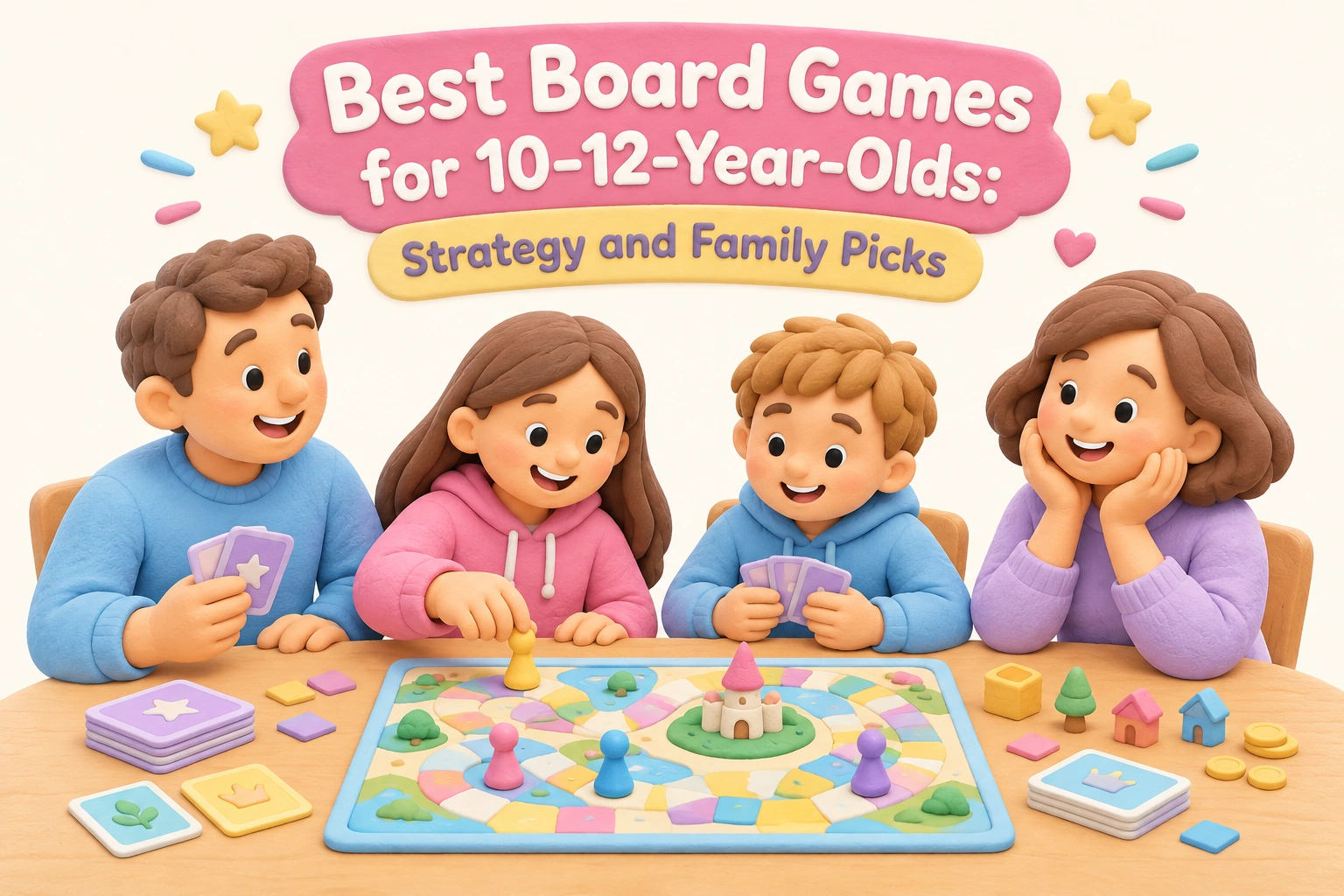
Best Board Games for 10–12-Year-Olds: Strategy and Family Picks

 Discover a Free Education Video App for Kids
Pastory uses AI to personalize educational video content based on your child’s interests and personality. Safe, engaging, and built for curious young minds. Sign up now to stay updated and enjoy early access with a free trial
Children aged 10 to 12 are at a fascinating developmental crossroads: their reasoning skills are sharpening, their tolerance for complexity is growing, and they are increasingly motivated by challenge and mastery rather than simple luck. This makes the tween years one of the best windows to introduce genuinely engaging board games — ones that reward strategic thinking, encourage negotiation, and hold up across dozens of plays. This guide covers the strongest picks across strategy, cooperative, and family categories, explains what makes each game developmentally well-suited to this age group, and helps you match the right game to your child’s temperament, your household’s player count, and the time you actually have available.
Key Takeaways
- Tweens aged 10–12 are developmentally ready for games with genuine strategic depth, resource management, and multi-step planning — not just luck-based mechanics.
- Cooperative board games can be especially valuable for conflict-averse children or mixed-age family groups, while competitive games tend to suit same-age peer groups well.
- Playtime matters: a 20–45 minute game suits weeknight play, while 60–90 minute games are better reserved for weekend family game nights or sleepovers.
- The best games for this age are easy to learn but offer enough depth to remain interesting after many plays — a quality often described as “easy to learn, hard to master.”
- Research suggests board games may support visuospatial reasoning, mathematical thinking, and social skills in children, though outcomes vary by child and context.
Why This Age Group Needs Games That Feel Grown-Up
Between ages 10 and 12, children enter what developmental psychologists describe as the late concrete operational stage, transitioning toward formal operational thinking. In practical terms, this means they can hold multiple variables in mind simultaneously, reason about hypothetical outcomes, and begin to think several moves ahead. Games that fail to engage these emerging capacities — overly simple games driven purely by dice rolls or card draws — are quickly perceived as boring or childish, which is a real concern for tweens who are acutely sensitive to being talked down to.
At the same time, games that are too complex can create frustration before the fun begins. The sweet spot for ages 10 and up is a game with a clear, learnable ruleset that reveals deeper layers of strategy only after a few plays. This is the essence of what board game enthusiasts call a gateway game: a title accessible enough for newcomers but rich enough to sustain long-term interest. Games like Catan and Ticket to Ride have earned their reputations precisely because they sit in this zone.
There is also a social dimension worth noting. Tweens are navigating increasingly complex peer relationships, and board games provide a structured, screen-free context for practising negotiation skills, reading social cues, managing wins and losses gracefully, and collaborating under pressure. These are not trivial benefits. Research published in peer-reviewed journals has found associations between regular board game play in children and improvements in visuospatial memory, numerical reasoning, and social problem-solving, though the strength of these effects varies and more longitudinal research is needed.
Gateway Games: The Best Starting Point for Ages 10–11
If a child is new to modern board games, gateway games are the ideal entry point. These titles introduce core mechanics — resource management, route-building, tile-placement — without overwhelming new players with lengthy rulebooks.
Catan (6th Edition)
Catan remains one of the most widely recommended gateway games for tweens. Players collect and trade resources — wood, brick, wheat, ore, and sheep — to build roads, settlements, and cities on a modular board that changes with every game. The negotiation skills required to trade effectively make Catan particularly valuable for this age group, and the randomized board ensures strong replayability. Playtime runs approximately 60–90 minutes, making it better suited to a weekend family game night than a school night. Player count is 3–4 (or up to 6 with an expansion). The Catan expansions, particularly Seafarers and Cities and Knights, are worth considering once the base game feels familiar — typically after five or more plays.
Ticket to Ride
Ticket to Ride is frequently cited as the safest family gift for households new to modern board games. Players collect coloured train cards and use them to claim railway routes across a map, completing destination tickets for points. The route-building mechanic is intuitive, the rules take about 15 minutes to learn, and the game plays in 45–75 minutes with 2–5 players. Ticket to Ride develops pattern recognition, forward planning, and mild risk assessment — players must decide whether to pursue ambitious long routes or play it safe with shorter connections. The Europe and Rails and Sails editions offer meaningful variety once the original map is well-known.
Azul
Azul is a tile-placement game that won the prestigious Spiel des Jahres award, the most recognised prize in board gaming. Players draft coloured tiles from a central market and arrange them on personal boards to score points. The rules are simple enough to explain in under ten minutes, but the spatial reasoning and forward-planning required to score efficiently give Azul genuine strategic depth. It plays in 30–45 minutes with 2–4 players, making it one of the more flexible options for weeknight play. Azul is particularly well-suited to children who enjoy visual and spatial challenges.
Deeper Strategy Games: Strong Picks for Ages 11–12
Children at the upper end of this age range — particularly those who have already played gateway games — are often ready for titles with more complex decision trees and longer playtimes.
Splendor
Splendor is an engine-building card game in which players collect gem tokens to purchase development cards, which in turn generate permanent gem income for future purchases. The core loop is elegant, but the strategic depth emerges from timing decisions: when to collect tokens, when to reserve a card, and how to block opponents. Splendor plays in 30–60 minutes with 2–4 players and is widely praised for being easy to learn, hard to master. It is an excellent choice for children who enjoy optimisation puzzles and quiet, focused play.
7 Wonders Duel
Designed specifically for two players, 7 Wonders Duel is one of the strongest options for a parent-child pair or two siblings. Players draft cards from a shared tableau to develop their civilisation across three ages, competing across military, scientific, and cultural dimensions. The game plays in approximately 30 minutes and rewards deductive reasoning and adaptive planning. It is more complex than the gateway games listed above and works best for children who have already developed comfort with multi-step strategic thinking.
Carcassonne
Carcassonne is a classic tile-placement game in which players draw and place landscape tiles to build cities, roads, and farms, then deploy followers (called meeples) to score points. Like Azul, it won the Spiel des Jahres award and has remained a family favourite for decades. The rules are accessible, but scoring decisions — particularly around when to commit followers and when to hold back — introduce meaningful strategic tension. Carcassonne plays in 30–45 minutes with 2–5 players and has an extensive range of expansions for families who want to add variety over time.
Cooperative Board Games: When Working Together Matters
Cooperative gameplay removes the competitive element entirely: all players work as a team against the game itself. This format is particularly well-suited to mixed-age family groups, to children who find losing to a sibling or parent discouraging, and to households where conflict around winning and losing is a recurring issue. Cooperative games also tend to generate more discussion and shared problem-solving than competitive ones, which can make them especially rich for developing communication skills.
Pandemic
Pandemic is the benchmark cooperative board game for this age group. Players take on specialist roles — medic, scientist, researcher — and work together to contain and cure four diseases spreading across a global map. The game demands collective resource management, forward planning, and clear communication. It plays in 45–60 minutes with 2–4 players and is rated for ages 8 and up, though the strategic complexity is genuinely engaging for 10–12 year olds. One important consideration: Pandemic can feel intense for anxiety-prone children, given its theme of global disease outbreaks.
Forbidden Island
Forbidden Island is often recommended as a gentler introduction to cooperative gameplay before Pandemic. Players work together to collect four treasures from a sinking island before it disappears beneath the water. The mechanics are simpler than Pandemic, the playtime is shorter (approximately 30 minutes), and the visual design is appealing. It works well with 2–4 players and is a strong choice for families with a mix of ages, including younger siblings who might join a 10–12 year old.
The Crew: Quest for Planet Nine
The Crew is a cooperative trick-taking card game — a format familiar from games like Hearts or Spades — in which players complete a series of increasingly difficult missions by communicating under strict constraints. It plays in 20–30 minutes per mission with 2–5 players and is notable for its scalability: the 50 missions range from very simple to genuinely challenging, meaning the game grows with the players. The Crew is an excellent weeknight option and one of the few cooperative games that works well with just two players.
Social Deduction and Party Games: Best for Groups
When the player count rises — a group of friends, a family gathering, a sleepover — social deduction and party games come into their own. These games prioritise communication, lateral thinking, and group energy over deep strategy.
Codenames
Codenames is a social deduction game in which two teams compete to identify their agents on a grid of word cards, guided by one-word clues from their spymasters. It rewards vocabulary, lateral thinking, and the ability to find unexpected connections between words. Codenames plays in 15–30 minutes with 4–8 players and is one of the most consistently recommended party games for tweens and adults alike. It is also available in a pictures variant for households with younger children.
Hues and Cues
Hues and Cues is a colour-guessing game in which players give one- or two-word clues to guide others toward a specific shade on a large colour grid. It is fast, accessible, and generates genuine laughter — a strong choice for mixed-age groups or as a warm-up game before a longer session. Playtime is approximately 30 minutes with 3–10 players.
Telestrations
Telestrations combines drawing and guessing in a telephone-style chain: players sketch a word, pass their sketchbook, and the next player guesses what was drawn — then the next player draws that guess, and so on. The results are reliably funny and the game requires no artistic skill. It plays in 30 minutes with 4–8 players and is one of the most reliably crowd-pleasing options for a mixed group of tweens and adults.
Competitive vs. Cooperative: Which Is Better for Tweens?
Neither format is universally better — the right choice depends on the child and the context. Competitive games tend to work well when children are playing with same-age peers, when the group has a similar skill level, and when the child in question handles losing constructively. The negotiation and rivalry in games like Catan can be genuinely motivating for competitive children and can help develop resilience around winning and losing.
Cooperative games are often the stronger choice for family game nights that include adults and children of different ages, for children who become distressed when they lose, or for households where sibling rivalry makes competitive play tense rather than fun. The shared goal in cooperative gameplay also tends to generate more conversation and collaborative problem-solving, which has its own developmental value. Many families find it useful to keep a mix of both formats available and to choose based on who is playing rather than defaulting to one type.
Playtime Guidance: Matching Games to Real-Life Contexts
One of the most practical factors in choosing a board game is how long it actually takes to play — and whether that fits the time available. Most articles list playtimes without connecting them to real-life scenarios, which leaves parents guessing.
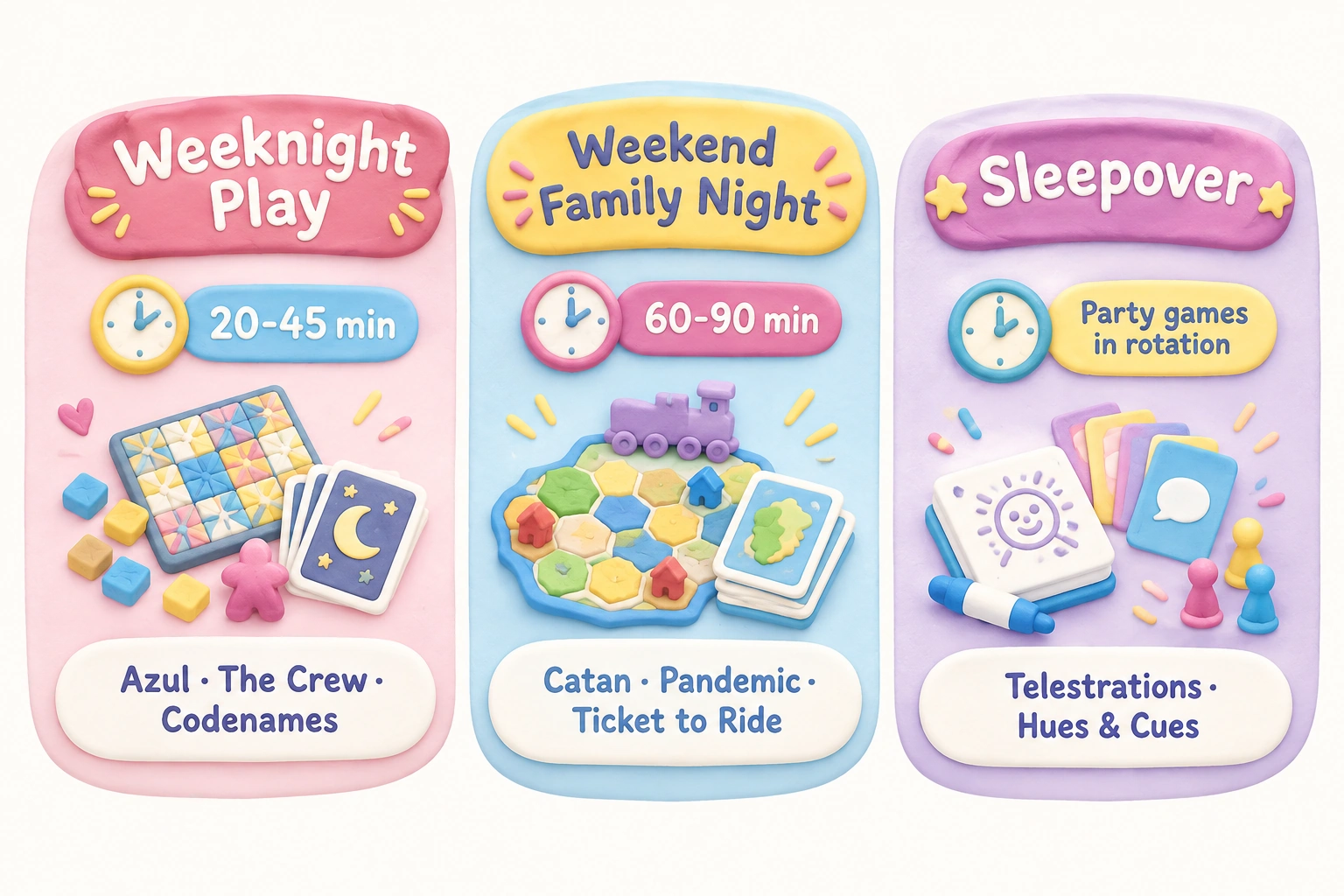
- Weeknight play (20–45 minutes): Azul, The Crew, Forbidden Island, Codenames, Hues and Cues, Splendor. These games can be set up, played, and packed away within a school-night window without feeling rushed.
- Weekend family game night (60–90 minutes): Catan, Ticket to Ride, Pandemic, Carcassonne. These games benefit from a relaxed time frame and work best when there is no pressure to finish quickly.
- Sleepover or extended session: Quick party games like Telestrations, Codenames, and Hues and Cues work well in rotation. Alternatively, a longer game like Catan can anchor the evening.
Two-Player and Solo Options
Most board game recommendations focus on groups of three or more, but many households need games that work for just two players — a parent and child, or two siblings. The following games are particularly strong in two-player configurations: 7 Wonders Duel (designed exclusively for two), Azul, Carcassonne, Splendor, The Crew, and Ticket to Ride. Pandemic also plays well with two, though the difficulty increases. For solo play, Pandemic and Forbidden Island both support a single-player mode in which one person manages all roles — a useful option for a child who wants to play independently.
Games They May Have Outgrown
Understanding what to avoid is as useful as knowing what to recommend. Games designed for younger children — Candy Land, Chutes and Ladders, Hi Ho Cherry-O — rely almost entirely on luck with no meaningful decisions for the player to make. Most 10–12 year olds will find these unstimulating within a few minutes. Similarly, the standard editions of Monopoly and Game of Life, while nostalgic, tend to run very long (often two hours or more) with significant luck variance and limited strategic depth, which can frustrate tweens who are capable of more complex thinking. This does not mean classic games have no place — Clue (Cluedo), Scrabble, and Battleship all retain genuine appeal at this age — but it is worth being selective.
Budget Guide: What to Expect at Each Price Point
Board game prices vary considerably, and knowing what to expect at each tier helps with gift-buying decisions.
- Under £20 / $20: Card games and smaller-box titles — Codenames, The Crew, Hues and Cues, Taco Cat Goat Cheese Pizza, Flip 7. These are excellent stocking fillers or add-ons and often have the highest plays-per-pound value.
- £20–£40 / $20–$40: The majority of the games in this guide fall here — Azul, Splendor, Forbidden Island, Carcassonne, Ticket to Ride, Pandemic. This is the most productive price range for quality and replayability.
- £40+ / $40+: Catan, 7 Wonders Duel, and larger editions of Ticket to Ride. These are justified by their longevity — families often play these games for years — but represent a larger initial investment.
How to Choose the Right Game for Your Child
Beyond age range and playtime, a few additional factors are worth considering when selecting a board game for a 10–12 year old.
- Temperament: Competitive children who enjoy rivalry tend to thrive with Catan or Ticket to Ride. Thoughtful, puzzle-oriented children often prefer Azul or Splendor. Social, talkative children gravitate toward Codenames or Telestrations.
- Experience level: A child new to modern board games benefits most from a true gateway game. A child who already plays Catan regularly may be ready for Splendor, 7 Wonders Duel, or Pandemic.
- Player count flexibility: If the game will mostly be played with the family, prioritise titles that work well across a range of player counts (2–5). If it is primarily for friend groups, games that scale to 6–8 players are more practical.
- Cooperative vs. competitive: Consider the social dynamics of the household. A cooperative game removes the risk of one child dominating every session, which can be important in mixed-age families.
- Replayability: Games with modular boards (Catan, Carcassonne) or large card pools (Splendor, The Crew’s 50 missions) tend to stay fresh longer than games with a fixed setup.
Frequently Asked Questions
What is a gateway game and why does it matter for tweens?
A gateway game is a board game designed to introduce players to modern game mechanics — resource management, tile-placement, route-building — without requiring a long rulebook or prior experience. For tweens, gateway games are important because they provide a bridge between simple childhood games and more complex strategy titles. Catan, Ticket to Ride, and Azul are the most widely recommended gateway games for the 10–12 age range.
What is the best board game for a tween who hates losing?
Cooperative games are the most practical solution here. In Pandemic, Forbidden Island, or The Crew, all players win or lose together, which removes the sting of being beaten by a sibling or parent. These games still provide genuine challenge and strategic depth, so the child does not feel patronised — they simply channel their competitive energy toward beating the game rather than each other.
How long should a board game session be for a 10–12 year old?
Most children in this age range can sustain focused engagement for 45–75 minutes comfortably. On school nights, games in the 20–45 minute range are more practical. On weekends or during holidays, 60–90 minute games are appropriate. Avoid games that regularly run over 90 minutes unless the child has demonstrated sustained interest in longer sessions.
Are there good board games for just two players in this age group?
Yes. 7 Wonders Duel is designed specifically for two players and is one of the strongest two-player strategy games available. Azul, Splendor, Carcassonne, and Ticket to Ride all play well with two. The Crew works with two players and is a particularly good weeknight option for a parent and child.
Do board games actually have educational benefits for children?
Research suggests that regular board game play may support visuospatial reasoning, numerical thinking, and social problem-solving in children. A peer-reviewed study found associations between board game play and improvements in visuospatial memory and mathematical skills in school-age children. However, outcomes vary by child, game type, and context, and board games should be understood as one valuable activity among many rather than a guaranteed educational intervention.
When should I consider buying expansions for Catan or Ticket to Ride?
Expansions are worth considering once the base game has been played enough to feel familiar — typically after five to ten sessions. For Catan, the Seafarers expansion adds new map configurations and ship-building mechanics that meaningfully extend the game’s lifespan. For Ticket to Ride, the Europe map introduces tunnels and ferries that add strategic variety. Neither expansion is necessary early on; the base games offer strong replayability on their own.
Choosing the Right Game for Your Family’s Game Night
The best board game for a 10–12 year old is ultimately the one that matches the child’s temperament, the household’s available time, and the group’s experience level. For families new to modern board games, Ticket to Ride or Azul offer the most accessible entry point with genuine staying power. For households ready to step up in complexity, Catan and Pandemic are the most consistently rewarding choices. For groups that want fast, social fun, Codenames and Telestrations rarely disappoint.
What unites all the strongest picks in this guide is a quality that matters deeply to tweens: they feel like real games, not children’s games. They offer genuine decisions, meaningful challenge, and the satisfaction of improving with practice. That combination — strategic depth wrapped in accessible rules — is what makes a board game worth returning to, and what makes family game night something children in this age group actually look forward to rather than tolerate.

Take a short quiz to find out what your everyday choices say about your parenting style
When your child is curious about something new, what’s your instinct?
Take a short quiz to find out what your everyday choices say about your parenting style
“Can I download this app?” What happens next?
Take a short quiz to find out what your everyday choices say about your parenting style
When it comes to rules at home, which sounds most like you?
Take a short quiz to find out what your everyday choices say about your parenting style
If you could give your child one life skill today, what would you pick?
Take a short quiz to find out what your everyday choices say about your parenting style
Your child gets to choose what to watch. What would your ideal setup look like?
Take a short quiz to find out what your everyday choices say about your parenting style
Pick your parenting superpower ✨