80 Best G Words for Kids with Meanings and Examples

 Discover a Free Education Video App for Kids
Pastory uses AI to personalize educational video content based on your child’s interests and personality. Safe, engaging, and built for curious young minds. Sign up now to stay updated and enjoy early access with a free trial
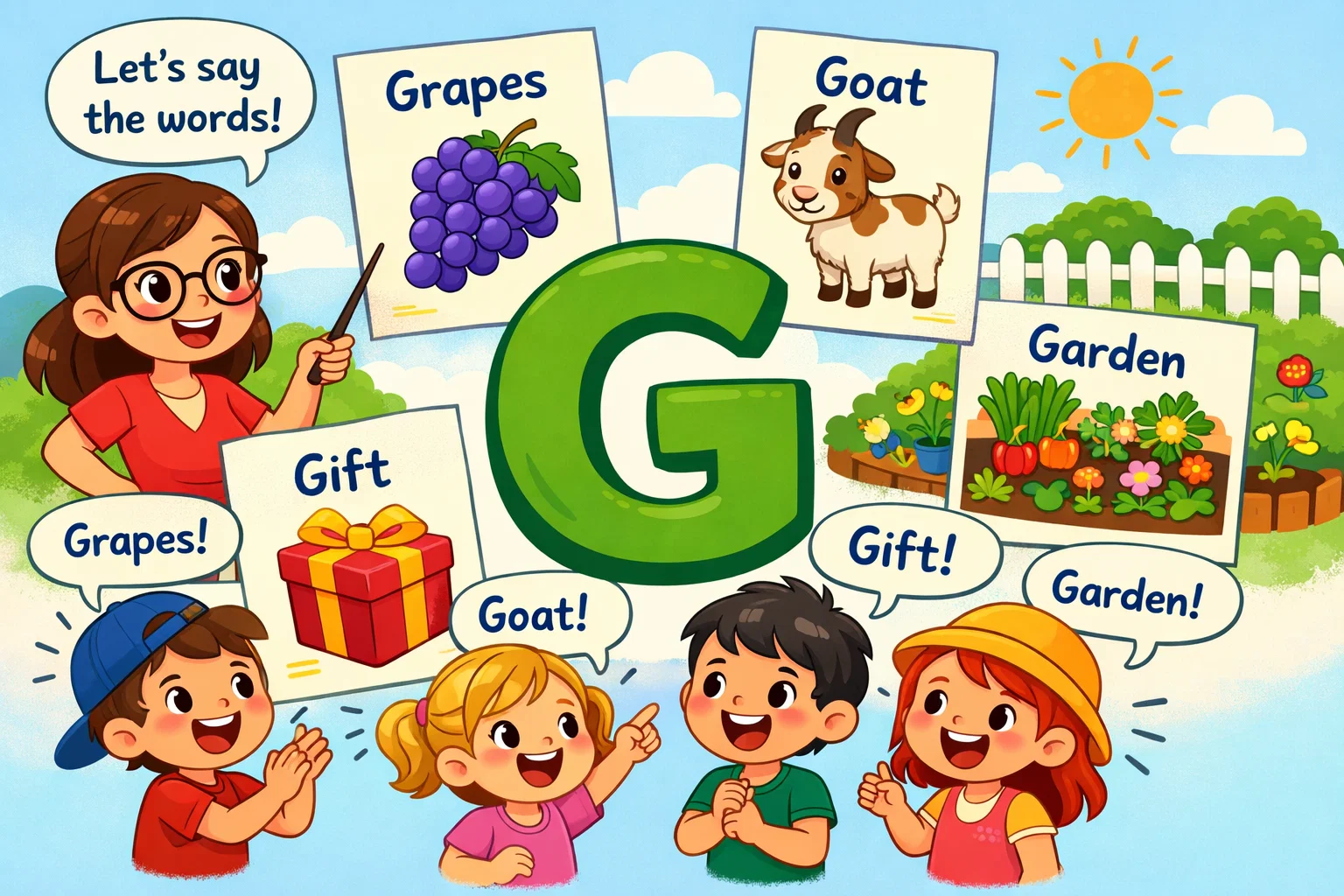
Building a strong literacy foundation starts with exploring the alphabet one letter at a time. The letter G is especially useful for young learners because it introduces two common sounds and many familiar words. Research on early literacy shows that phonological and phonemic awareness are strong predictors of later reading success.
This guide includes a carefully selected list of 80 G words for kids. You will find simple definitions, natural usage examples, and spelling tips designed to help your child master this consonant sound. Whether you are looking for printable Letter G worksheets or interactive games, this resource offers practical tools to engage preschoolers and kindergarteners alike. By the end of this article, you will have a clear set of activities to introduce the letter G through crafts, vocabulary cards, and reading practice for young learners.
80 Words That Start with G for Kids
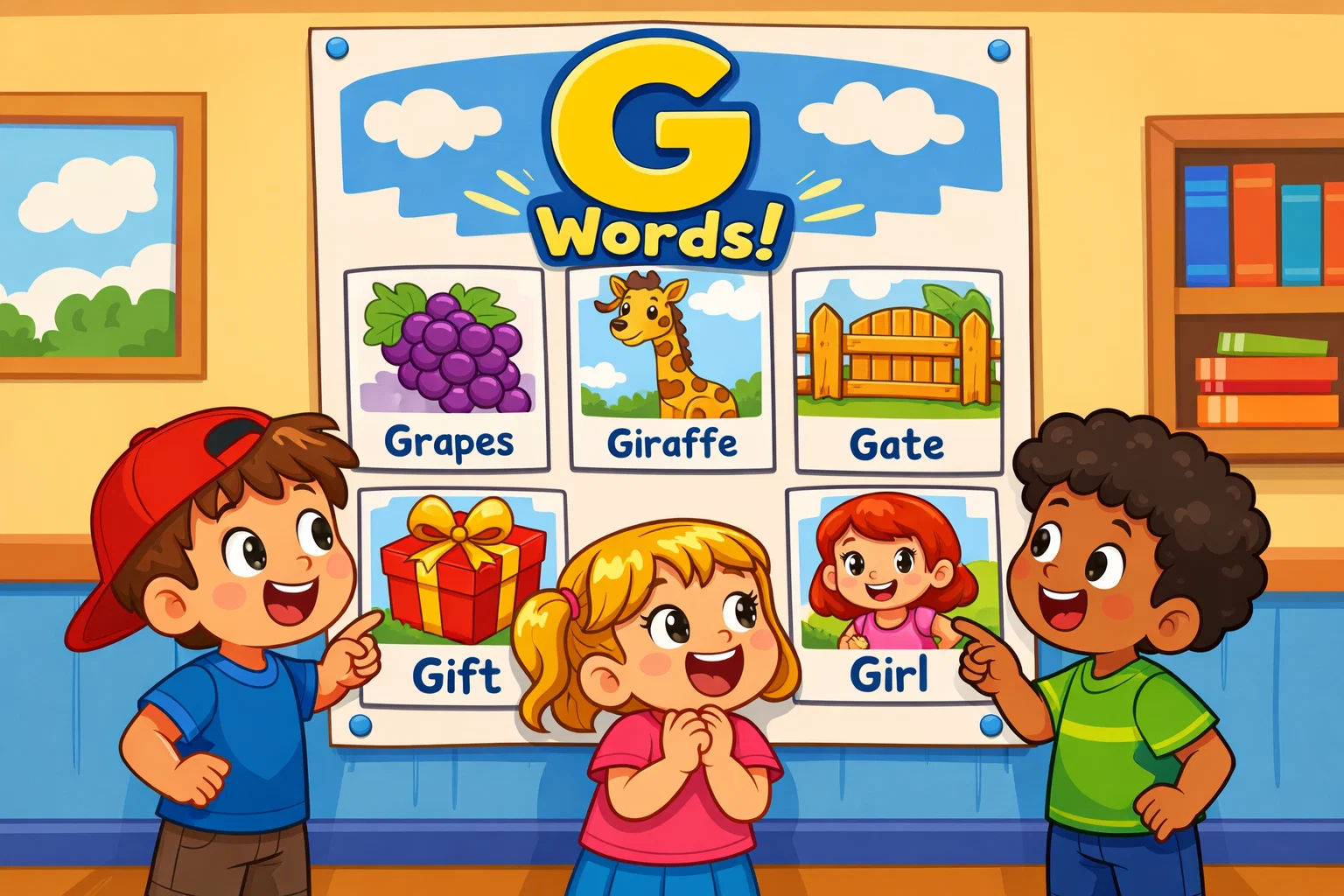
Expanding a child’s vocabulary is most effective when words are paired with context. The table below gives children a clear list of G words connected to familiar people, places, animals, and objects.
| Word | Simple Meaning | Contextual Sentence | Pronunciation |
| Gate | A door in a fence | Please close the gate so the dog stays inside. | /ɡeɪt/ |
| Garden | A place where plants grow | We plant seeds in the garden every spring. | /ˈɡɑːr.dən/ |
| Goat | An animal with horns | The goat likes to eat green grass in the field. | /ɡoʊt/ |
| Gift | Something you give someone | I have a special gift for your birthday. | /ɡɪft/ |
| Gold | A shiny yellow metal | The king wore a heavy gold crown. | /ɡoʊld/ |
| Gum | Something chewy for bubbles | I like to blow big pink gum bubbles. | /ɡʌm/ |
| Glove | Clothing for your hand | Wear a glove on each hand to stay warm. | /ɡlʌv/ |
| Guitar | A musical instrument | My brother plays the guitar in a band. | /ɡɪˈtɑːr/ |
| Goose | A large water bird | The white goose swam across the pond. | /ɡuːs/ |
| Grape | A small, round fruit | I ate a sweet purple grape for my snack. | /ɡreɪp/ |
10 Easy Letter G vocabulary for Preschoolers
For preschoolers, focus on words that are concrete and easy to pronounce. Visual support and short, easy-to-say words are especially helpful at this stage of language development.
- Go: To move or leave (Green means go).
- Get: To receive or pick up (Can you get your shoes from the rug?).
- Gap: A space between things (There is a small gap in the fence).
- Gas: Fuel for a car (The car needs gas to drive to the store).
- Gum: A chewy treat (Don’t swallow your gum).
- Giant: A very big person or thing (The giant pumpkin was hard to lift).
- Gel: A thick, clear liquid (Put some gel in your hair to make it stay).
- Goal: Something you try to reach or score (She kicked the ball into the goal).
- Gag: A funny joke (That was a silly gag that made me laugh).
- Germ: A tiny thing that can make you sick (Wash your hands to get rid of germs).
10 G vocabulary for Kindergarten
Kindergarteners are ready for slightly longer words that appear frequently in their classroom environment. This supports letter recognition and broader literacy skills.
- Girl: A female child (The girl is jumping rope on the playground).
- Game: Something you play for fun (Let’s play a board game tonight).
- Give: To hand something to someone (Please give me a high-five).
- Glad: Feeling happy (I am glad you came to my party).
- Grin: A wide smile (He has a big grin on his face).
- Grow: To get bigger (Sunlight helps the flowers grow).
- Good: Something that is nice or right (You did a very good job on your art).
- Golf: A sport with a ball and club (My grandpa likes to play golf).
- Gulp: To swallow quickly (Take a big gulp of cold water).
- Gown: A long, fancy dress (The queen wore a beautiful blue gown).
10 Short G Words for Early Readers
Early readers benefit from consonant sound patterns that are easy to decode. These words help children begin working on phonics by focusing on three- and four-letter patterns.
- Got: Past tense of get (I got a new sticker today).
- Grip: To hold tightly (Grip the rope with both hands).
- Gush: To flow out fast (Water began to gush from the hose).
- Gale: A very strong wind (The gale blew the leaves off the trees).
- Gulp: To drink fast (He took a gulp of milk).
- Gaze: To look steadily (I like to gaze at the stars at night).
- Gear: A part of a machine (The bicycle gear helps the wheels turn).
- Glow: To shine softly (Fireflies glow in the dark).
- Grit: Tiny pieces of sand (The grit from the beach was in my shoes).
- Grub: A small insect larva (The bird found a grub in the dirt).
10 Animal G Words
Animals are a favorite topic for young learners. Teaching animal G words helps children connect the letter G to creatures they may see at home, on a farm, or in a zoo.
- Giraffe: A tall animal with a long neck (A giraffe can reach the highest leaves).
- Gorilla: A large, strong ape (The gorilla ate a banana in the jungle).
- Goat: A farm animal that climbs (The goat jumped onto the big rock).
- Goose: A bird that lives near water (A goose likes to honk loudly).
- Gopher: A small animal that digs holes (The gopher popped its head out of the ground).
- Gull: A bird found near the ocean (The gull flew over the waves).
- Guppy: A tiny, colorful fish (I have an orange guppy in my fish tank).
- Gecko: A small lizard (The gecko climbed up the glass wall).
- Gazelle: A fast animal with long legs (The gazelle ran quickly across the grassland).
- Grizzly: A large type of brown bear (The grizzly bear caught a fish).
10 Food G Words
Using food g words makes literacy relatable. These items are common in a child’s vocabulary and are easy to identify in a kitchen setting.
- Grape: A small, sweet fruit (Green grapes are a great snack).
- Garlic: A plant used for flavor (Pizza tastes better with a little garlic).
- Ginger: A spicy root (We make cookies with ginger during the holidays).
- Guava: A tropical fruit (The guava juice was pink and sweet).
- Gravy: A sauce for potatoes (Pour some gravy over the turkey).
- Grain: Seeds such as wheat or rice (Bread is made from grain).
- Gelato: Italian ice cream (I want a scoop of chocolate gelato).
- Gourd: A vegetable like a pumpkin (We used a dried gourd as a decoration).
- Gherkin: A small pickle (I like a crunchy gherkin with my sandwich).
- Grits: A breakfast food from corn (They serve warm grits with butter).
10 Object G Words
Object g words are things children can touch and see. This builds letter recognition through physical interaction with their environment.
- Glass: A clear container for drinks (Fill the glass with apple juice).
- Glove: A hand covering (I lost my left glove in the snow).
- Guitar: A stringed instrument (She practiced the guitar every day).
- Glue: A sticky liquid for crafts (Use the glue to stick the paper together).
- Gift: A present (Open your gift after we eat cake).
- Gem: A small, shiny stone (The gem sparkled in the light).
- Globe: A round map (We found Africa on the globe).
- Goggles: Eye protection (Wear your goggles when you swim underwater).
- Gear: A moving part in a machine (The watch has many tiny gears inside).
- Grill: A tool for cooking (Dad is cooking burgers on the grill).
10 Nature and Place G Words
Exploring nature and place g words helps children understand geography and the environment. These terms expand their language development beyond the home.
- Garden: A place for plants (The garden is full of red tomatoes).
- Grass: Green ground cover (The grass feels soft on my bare feet).
- Ground: The earth’s surface (I sat on the ground to tie my shoe).
- Grove: A group of trees (We walked through an orange grove).
- Glacier: A huge river of ice (A glacier moves very slowly).
- Gulf: A part of the ocean (The gulf has very warm water).
- Garage: A place for cars (The car is parked inside the garage).
- Gym: A place for sports (We have PE class in the gym).
- Galaxy: A system of stars (Our galaxy is called the Milky Way).
- Gully: A small valley (Rainwater ran down into the gully).
10 Positive, Descriptive and Action G Words
Adding positive, descriptive, and action G words helps children express feelings and actions, which supports language development and emotional awareness.
- Great: Very good (You did a great job on your homework).
- Gentle: Soft and kind (Be gentle when you pet the puppy).
- Glowing: Shining brightly (The moon was glowing in the sky).
- Grab: To take quickly (Grab your backpack so we aren’t late).
- Glide: To move smoothly (The ice skaters glide across the rink).
- Giggle: A silly laugh (The funny movie made the kids giggle).
- Grand: Very large or fancy (The hotel had a grand staircase).
- Grateful: Feeling thankful (I am grateful for my nice friends).
- Green: A color (The green frog sat on a lily pad).
- Golden: Shiny yellow (The sun has a golden light).
G Word Lists by Sound, Length and Skill Level
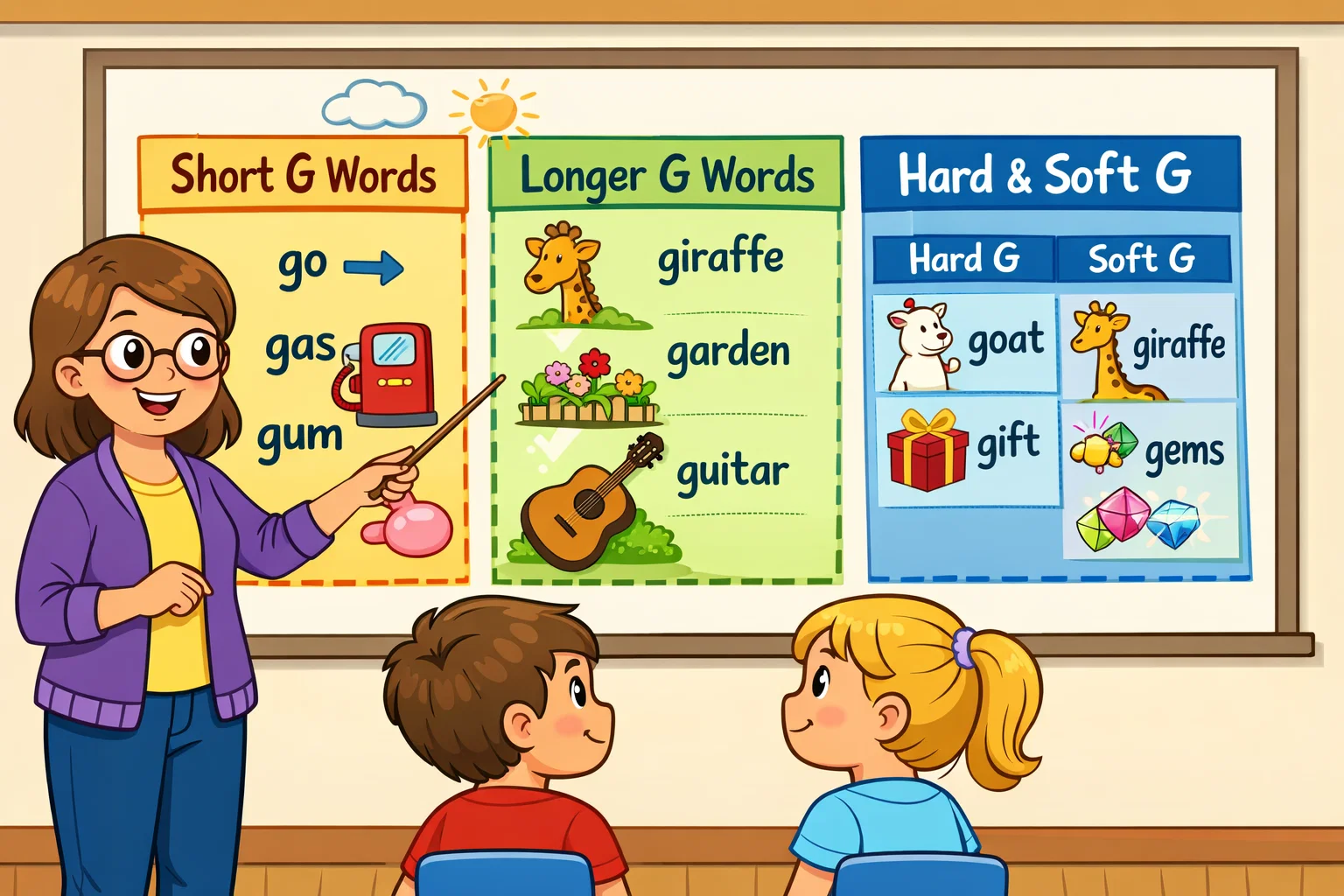
Phonics instruction is most effective when it is systematic. Breaking down G words by sound, length, and difficulty helps young learners focus on specific reading skills.
3-Letter G Words
These are perfect for first reading practice and spelling tests for young learners.
- Gum
- Gap
- Gas
- Got
- Gel
4-Letter and 5-Letter G Words
Words of this length are appropriate for kindergarteners and first graders who are moving beyond basic phonics.
- Gate
- Gift
- Gold
- Grass
- Grape
- Glass
Hard G Words
The hard G sound is made at the back of the mouth. It is the primary consonant sound children learn first.
- Garden
- Goose
- Game
- Guitar
- Golf
Soft G Words: giraffe, ginger, giant, gem, and gym
The soft G sound is pronounced like /j/. This can be a tricky concept, so use clear examples such as giraffe and ginger. It often appears before e, i, or y, although there are many exceptions.
G Words for Speech Practice
For kids working on articulation, certain words are better for practicing the “G” sound. For articulation practice, start with short, familiar words such as go, game, gum, and giggle, and follow any individualized guidance from a speech-language pathologist.
G Word Reading and Speaking Practice
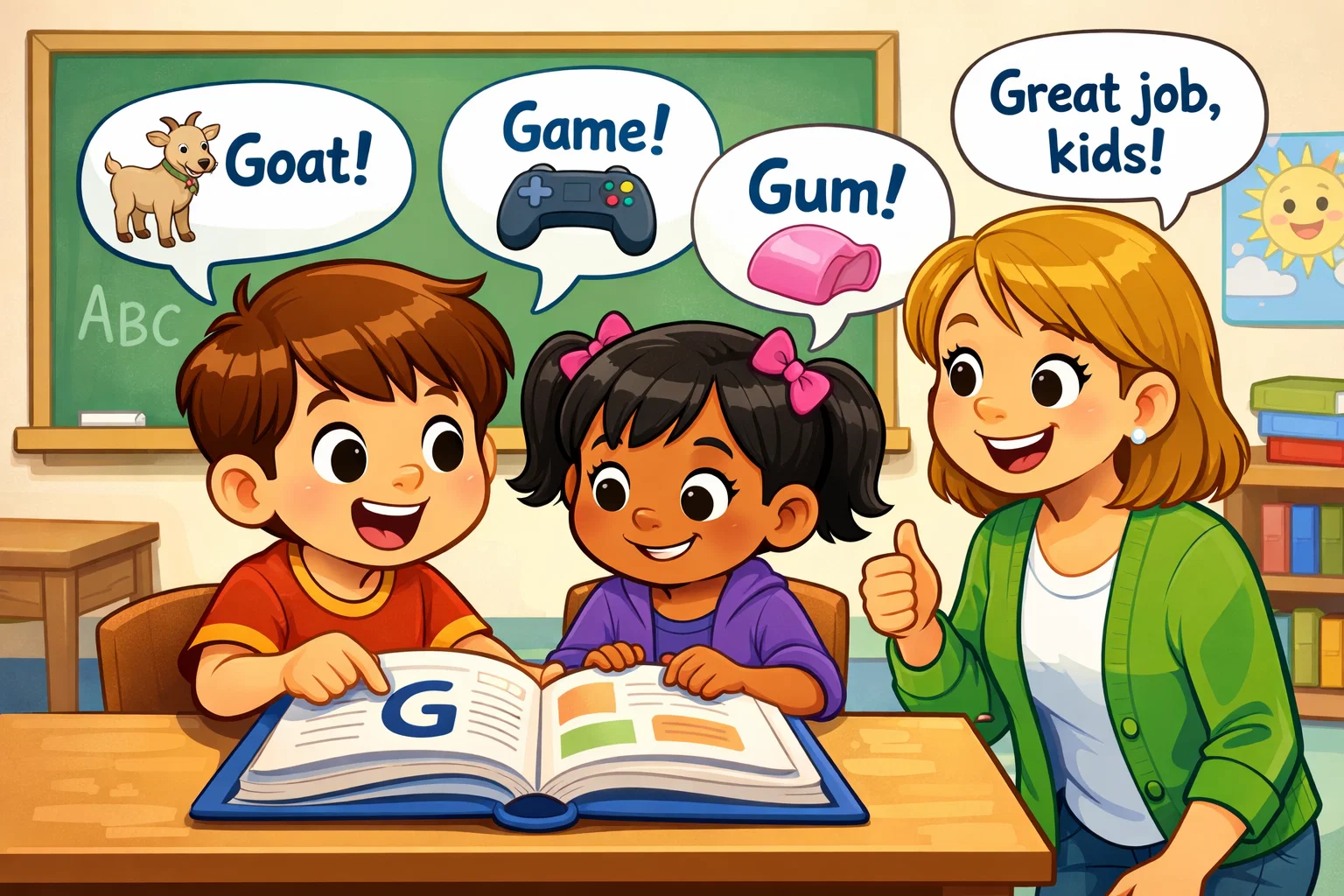
To help your child move from letter recognition toward fluent reading, practice these words aloud regularly.
Short Phrases with G Words
Rhythmic phrases help with language development:
- Green grass.
- Good girl.
- Gold gift.
- Great game.
Short Sentences with G Words
Building sentences connects vocabulary to real-life actions:
- The goat ate the grass.
- I have a gift in the garage.
- She put glue on the guitar.
Mini Story with G Words
“Gus the Goat lived in a grand garden. One day, Gus found a gold gift near the gate. He was glad and began to giggle. He ate a grape and sat on the grass.”
Read-Aloud Practice with G Words
When practicing words aloud, use the “Echo Reading” method. Read a word like gorilla and have the child repeat it back to you. This builds confidence and helps children hear the correct pronunciation patterns.
Activities for Learning G Words
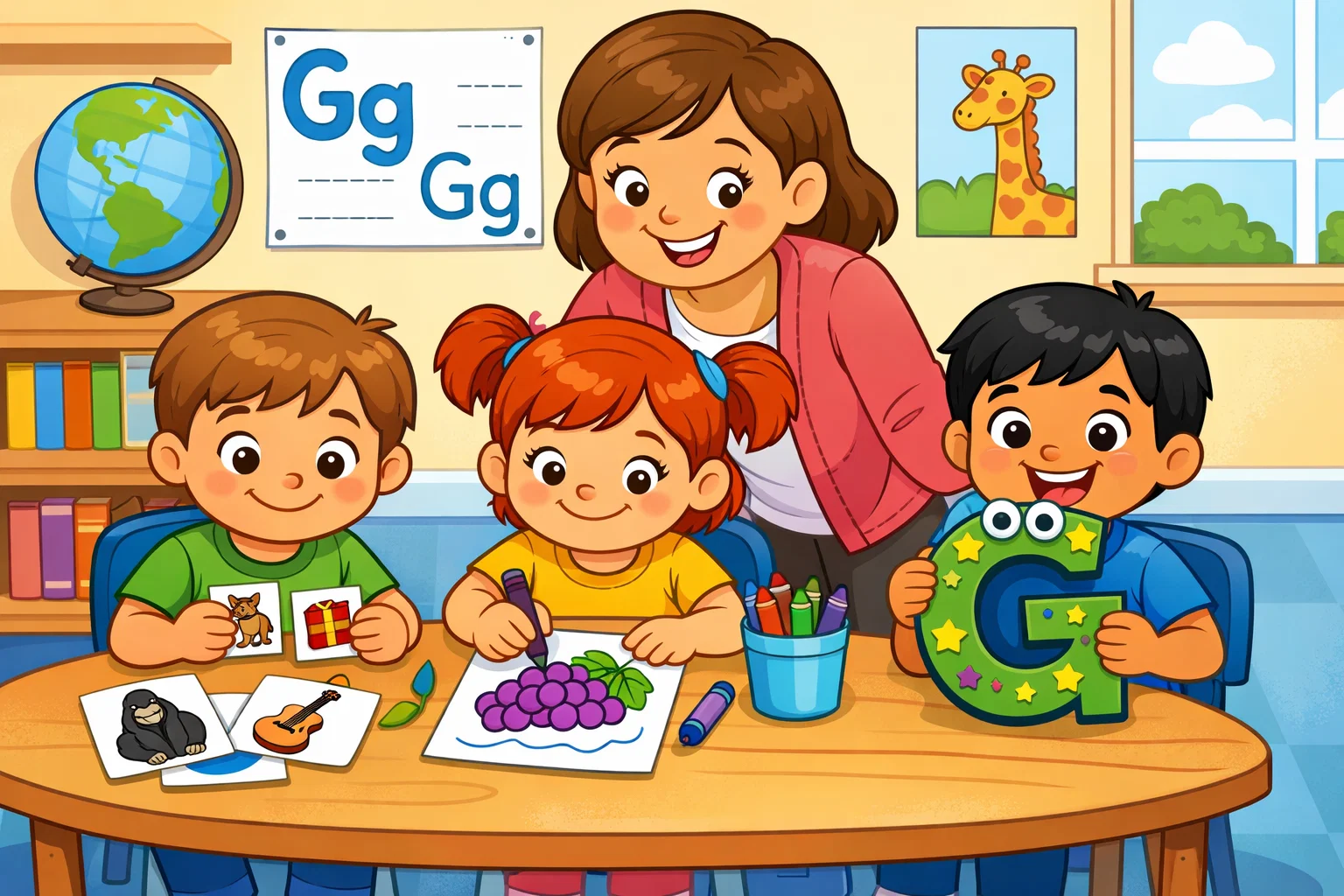
Active engagement is the best way to ensure children learn. These games and activities can be done indoors or outdoors.
Letter Games and Prewriting Activities
A “G Scavenger Hunt” is a fantastic way to engage a learner. Have them find a glove, glue, or a guitar pick. For writing, use printable letter g worksheets to help them master the curves of the uppercase and lowercase G.
Crafts and DIY Projects
Creative projects reinforce memory. Make a “G is for Grapes” craft by gluing purple paper circles onto a large G. You can also make a “Glitter G” using glue and gold glitter to create a decoration for the fridge.
Alphabet Box and Sensory Bin Ideas
Fill a sensory bin with items that begin with the letter G. Use green shredded paper, plastic gorillas, and golf balls. This tactile experience helps kindergarten kids associate the sound with physical objects.
Reading and Singing with G Words
Singing simple songs or chants like “G says guh, G says guh, G is for Goat” helps with phonemic awareness. This auditory repetition is a key part of early literacy skills.
Digital Learning Practice
Many apps provide interactive games in which kids can click on G words and pictures. These digital tools often use colorful animations to improve recognition speed and keep children motivated.
Tips for Teaching G Words
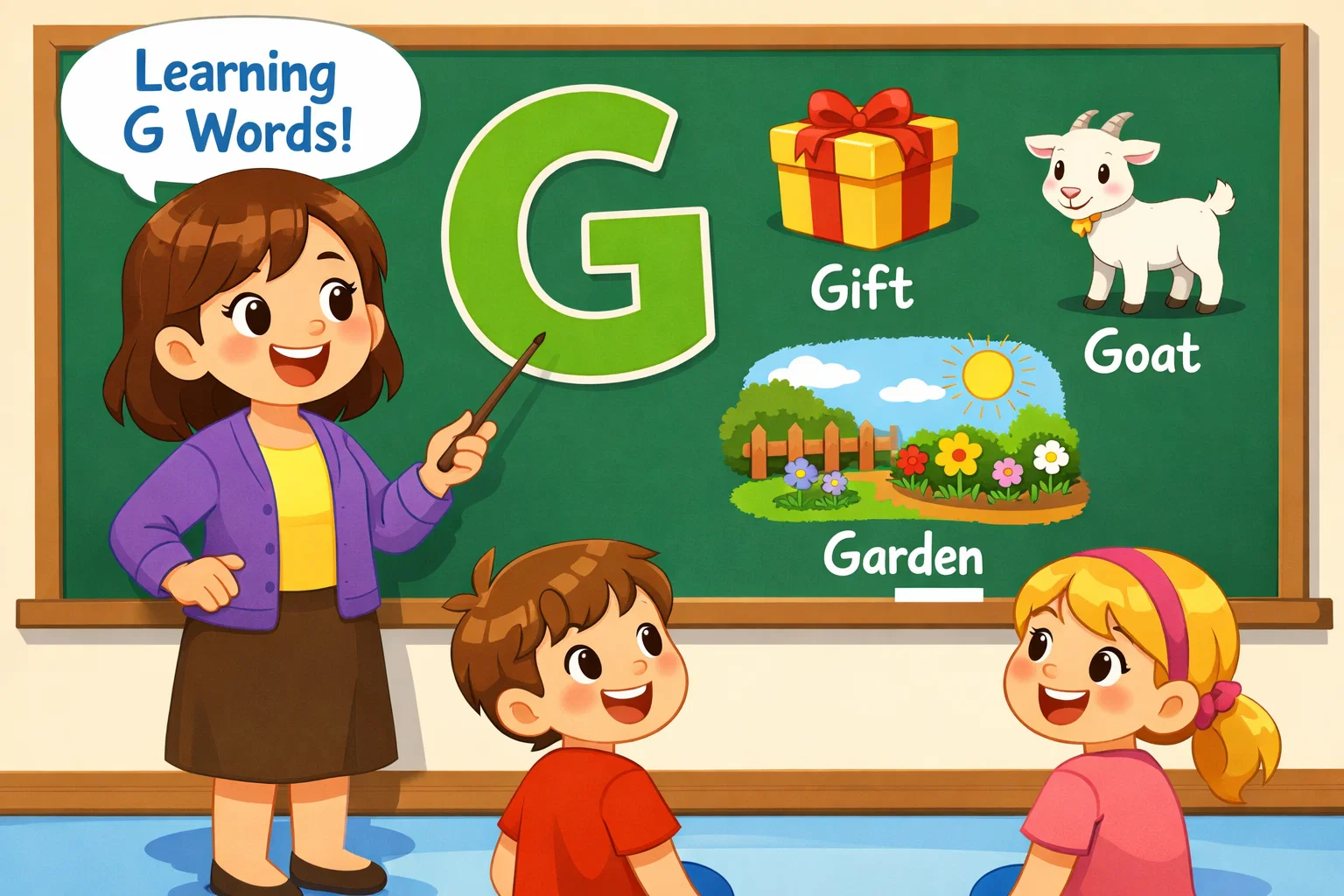
Teaching the letter g can be tricky because of its dual sounds. Use these expert tips to make it easier.
How to Teach G Sound First
Always start with the hard g sound (as in gate). It is the most common version and provides a solid foundation before moving to the more complex soft g.
How to Explain Hard G and Soft G
Explain that G is a “copycat” letter. Usually, it says /g/, but in some words before e, i, or y it can sound like /j/, as in giraffe or ginger. Use the word list to show examples of both.
How to Use Pictures for Faster Recall
Clear, bold pictures can make vocabulary practice more engaging and easier to follow. Using clear, bold pictures alongside the vocabulary helps children “anchor” the word in their long-term memory.
How to Practice G Words at Home
Integrate learning into daily life. When in the garden, point out the grass. When in the kitchen, point out the garlic. This real-world application is the most effective way to help your child learn.
Common Mistakes to Avoid
Avoid teaching silent G words, such as gnat or gnome, too early, as they can confuse beginning learners. Focus on consistent sounds first to build confidence in their spelling and reading abilities.
More Word Lists and Printable Activities
To continue the literacy journey, explore these additional resources:
- Letter A-Z Word Lists for Kids: Systematic guides for every letter.
- Seasonal Word Lists: Find themed words for holidays like Christmas or Easter.
- Animal, Food and Object Vocabulary Lists: Deep dives into specific categories.
- Kindergarten Phonics Printables: Worksheets for beginning and ending sounds.
Conclusion
Mastering words that start with g is a major milestone for preschoolers and kindergarteners. By using a mix of g word lists, sensory play, and consistent practice, you can help your child build a robust vocabulary.
Key Takeaways from the G Word List
The letter g offers a rich variety of sounds and meanings. Using age-appropriate lists ensures that children are not overwhelmed while still expanding their literacy skills.
Best Ways to Use This List with Kids
Take it slow. Focus on 5–10 words a week, use them in daily conversation, and reinforce them with fun games and activities.
Frequently Asked Questions
What are easy G words for kids?
Easy words include Go, Got, Gum, and Gas. These are short and use the hard g sound.
What are common things that start with G?
Common items include Gate, Garden, Glass, Glove, and Gift.
How do I teach G words with pictures?
Pair the word with a clear image, say the word aloud, and have the child repeat it while looking at the picture to create a mental link.
How are hard G and soft G different?
The hard G sounds like /g/ in goat, while the soft G sounds like /j/ in giraffe. A soft G often appears before e, i, or y, although there are exceptions.
Take a short quiz to find out what your everyday choices say about your parenting style
When your child is curious about something new, what’s your instinct?
Take a short quiz to find out what your everyday choices say about your parenting style
“Can I download this app?” What happens next?
Take a short quiz to find out what your everyday choices say about your parenting style
When it comes to rules at home, which sounds most like you?
Take a short quiz to find out what your everyday choices say about your parenting style
If you could give your child one life skill today, what would you pick?
Take a short quiz to find out what your everyday choices say about your parenting style
Your child gets to choose what to watch. What would your ideal setup look like?
Take a short quiz to find out what your everyday choices say about your parenting style
Pick your parenting superpower ✨