
100 Funny D Words for Kids, with Meanings and Examples

 Discover a Free Education Video App for Kids
Pastory uses AI to personalize educational video content based on your child’s interests and personality. Safe, engaging, and built for curious young minds. Sign up now to stay updated and enjoy early access with a free trial
Building a robust vocabulary doesn’t have to feel like a chore for young learners. In fact, focusing on funny words that start with D is a fantastic way to engage a child’s natural curiosity and sense of humor. This guide provides a curated list of whimsical, silly, and descriptive terms that are suitable for classroom activities, bedtime stories, and everyday play. Exploring words like these helps children realize that language is a tool for joy, not just a set of rules to follow.
Research suggests that playful language learning can improve word recognition and long-term retention. When children encounter funny words, the positive emotions linked to playful learning can help new vocabulary stick more effectively. By exploring these words that start with the letter D, children can expand their language skills while developing a positive attitude toward school and reading.
List of 100 Funny Words That Start With D
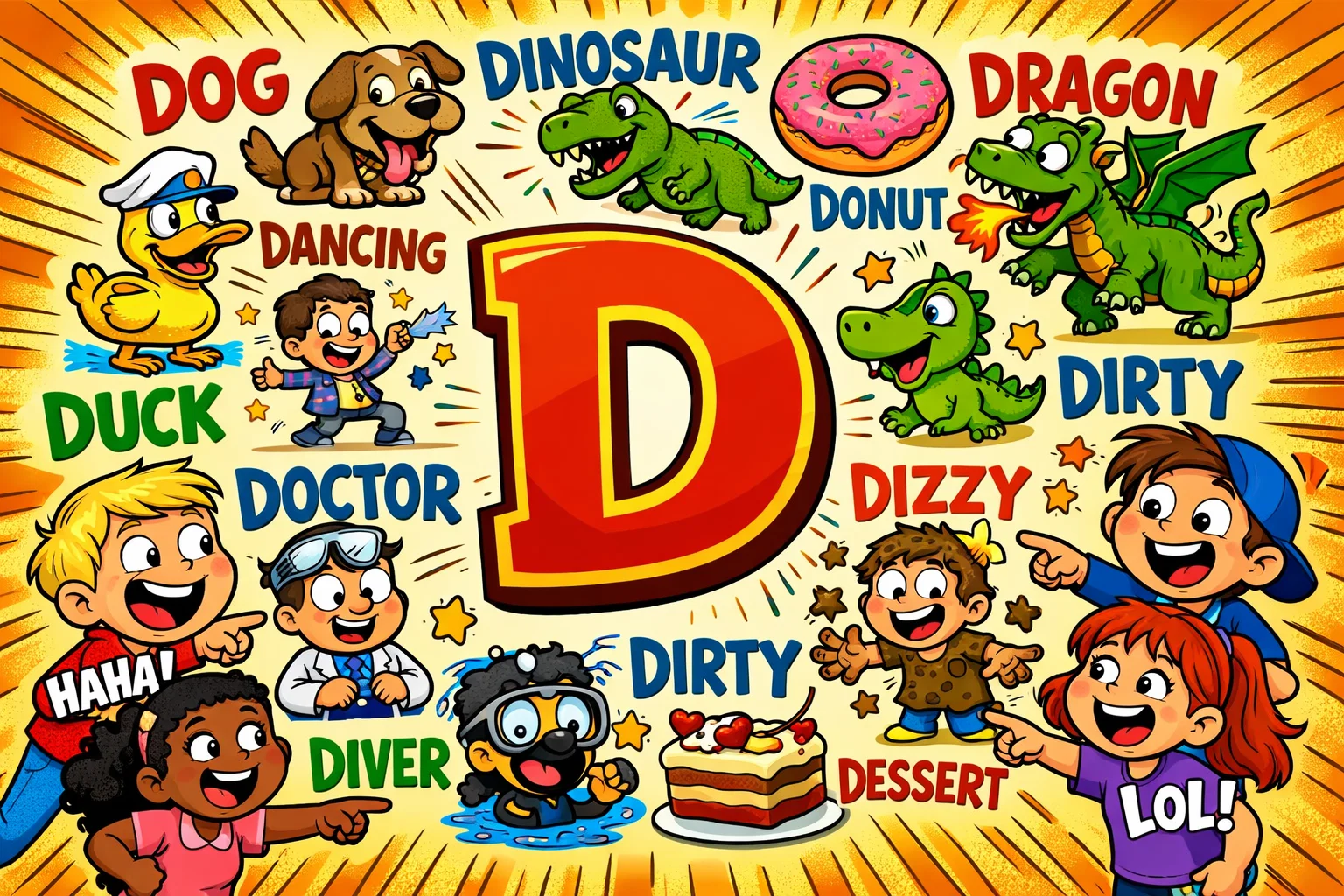
Expanding a child’s vocabulary with funny words is a great way to encourage creativity. The following list features D words chosen for their playful sounds, vivid meanings, and kid-friendly appeal.
Funny D Words
- Dabble: To splash around in water or try something just for fun. Context: “I like to dabble in finger painting on Saturdays.”
- Doodle: A silly little drawing you make when you are thinking. Context: “My notebook is full of doodles of flowers and suns.”
- Dizzy: Feeling like the whole world is spinning around. Context: “Spinning in circles made me feel very dizzy!”
- Dainty: Something very small, pretty, and delicate. Context: “The fairy sat on a dainty little mushroom.”
- Dazzle: To shine so brightly that it’s hard to look away. Context: “Your glittery shoes really dazzle in the sun!”
- Dimple: A tiny little dent in someone’s cheek when they smile. Context: “Baby Leo has a cute dimple when he giggles.”
- Dino: Short for dinosaur; a fun, kid-friendly way to talk about giant prehistoric animals. Context: “I have a green dino toy with big teeth.”
- Dapper: Looking very neat, clean, and fancy. Context: “The penguin looked dapper in his black and white feathers.”
- Dash: To run very, very fast. Context: “I had to dash to the kitchen when I smelled cookies!”
- Dawn: The very first light of the morning. Context: “The birds start singing at dawn.”
- Daze: To feel confused or sleepy, like you’re in a dream. Context: “The bright lights left the cat in a happy daze.”
- Dear: Someone you love very much. Context: “You are a very dear friend to me.”
- Deck: A pack of cards or the floor of a ship. Context: “Let’s play a game with this deck of cards.”
- Deep: Going far down, like the bottom of the ocean. Context: “The whale lives in the deep blue sea.”
- Deer: A fast animal with antlers that lives in the woods. Context: “A brown deer jumped over the fence.”
- Dent: A little hollow place where something got bumped. Context: “Oh no, there is a tiny dent in my toy car!”
- Desk: A table where you do your schoolwork. Context: “I keep my crayons inside my desk.”
- Dew: Tiny water drops on the grass in the morning. Context: “The morning dew made my shoes a little wet.”
- Dice: Small cubes with dots used for playing games. Context: “Roll the dice to see how many spaces to move.”
- Dig: To make a hole in the ground. Context: “The dog likes to dig for bones in the yard.”
- Dill: A green herb that makes pickles taste yummy. Context: “I love the smell of fresh dill in the kitchen.”
- Dine: A fancy way to say “eat dinner.” Context: “Tonight, we shall dine on yummy pizza!”
- Ding: The sound a little bell makes. Context: “The microwave went ding when the popcorn was ready.”
- Dip: To put something quickly into a liquid. Context: “I like to dip my apple slices in caramel.”
- Dirt: The brown stuff on the ground where plants grow. Context: “Playing in the dirt is the best part of gardening.”
- Dillydally: To waste time or move very slowly. Context: “Don’t dillydally, or we will miss the bus!”
- Discombobulate: A big word that means to confuse someone. Context: “The zig-zag puzzle might discombobulate you!”
- Doodlebug: A nickname for a small insect or a cute kid. Context: “Come here, little doodlebug, it’s time for lunch.”
- Doohickey: A word for a small gadget when you forget its name. Context: “Can you hand me that silver doohickey on the table?”
- Dotty: Someone who is a little bit silly or eccentric. Context: “The dotty old owl kept wearing his hat sideways.”
- Drab: Something that looks a bit dull or gray. Context: “The rainy day felt a little drab until we found our yellow boots.”
- Drench: To get completely soaked with water. Context: “The big splash will drench everyone at the pool!”
- Dribble: To let liquid fall in small drops. Context: “Be careful not to dribble milk on your shirt.”
- Drift: To float slowly through the air or water. Context: “Watch the clouds drift across the blue sky.”
- Droll: Something that is funny in a quiet or unusual way. Context: “The puppet had a very droll way of telling jokes.”
- Droop: To hang down loosely. Context: “The flowers began to droop because they needed water.”
- Drum: To tap on something to make a rhythm. Context: “I like to drum on the table with my fingers.”
- Duck: A bird that quacks and swims. Context: “The yellow duck went for a swim in the pond.”
- Dud: Something that doesn’t work the way it should. Context: “This old flashlight is a dud; it won’t turn on.”
- Duel: A friendly contest between two people. Context: “Let’s have a thumb-wrestling duel!”
- Duet: When two people sing or play music together. Context: “The sisters sang a beautiful duet at the show.”
- Dull: Something that isn’t sharp or isn’t exciting. Context: “A dull pencil is hard to draw with.”
- Duly: Doing something at the right time. Context: “The king was duly impressed by the knight’s bravery.”
- Dumbfound: To make someone so surprised they can’t speak. Context: “The magic trick will dumbfound the whole audience.”
- Dump: To drop everything out at once. Context: “It’s time to dump the toy box and start building!”
- Dune: A big hill made of sand. Context: “We rolled all the way down the giant sand dune.”
- Dungarees: Another word for sturdy blue jeans. Context: “I wore my favorite dungarees to play at the park.”
- Dunk: To push something under water or milk. Context: “It’s fun to dunk cookies into a cold glass of milk.”
- Duo: A pair of two people or things. Context: “Batman and Robin are a famous crime-fighting duo.”
- Dusk: The time of day just before it gets dark. Context: “We have to come inside when dusk turns into night.”
- Daffy: Someone who acts very silly or “wacky.” Context: “The daffy bird kept trying to fly backward.”
- Daggle: To get something messy by dragging it in mud. Context: “Don’t daggle your long scarf in the puddles!”
- Dander: Tiny bits of skin from pets, or a word used in the phrase “get your dander up,” which means to get annoyed. Context: “The cat’s dander makes me sneeze sometimes.”
- Dank: Something that feels unpleasantly damp and cold. Context: “The old cave felt very dank and mysterious.”
- Dapple: To mark something with spots or patches of light. Context: “The sunlight began to dapple the forest floor.”
- Daredevil: Someone who loves doing brave, scary stunts. Context: “The circus daredevil jumped through a hoop of fire!”
- Darkling: Something that happens in the dark or as it gets dark. Context: “The darkling woods looked mysterious at dusk.”
- Dastardly: Acting in a mean or sneaky way. Context: “The dastardly villain tried to steal the golden key.”
- Dawdle: To move slowly because you don’t want to go. Context: “If you dawdle, we won’t have time for the swings.”
- Deadpan: Saying something funny while keeping a very serious face. Context: “He told a deadpan joke that made everyone giggle.”
- Debunk: To show that an idea is actually false. Context: “Science helps us debunk myths about monsters.”
- Decoy: A fake object used to trick something or someone. Context: “The wooden duck was a decoy to attract real birds.”
- Decrepit: Something that is very old and falling apart. Context: “The decrepit old shed was covered in ivy.”
- Deft: Being very quick and skillful with your hands. Context: “The magician was very deft with his card tricks.”
- Defunct: Something that no longer exists or works. Context: “That old toy store is now defunct.”
- Delectable: Something that tastes absolutely wonderful. Context: “The chocolate cake was simply delectable!”
- Delirious: Being so excited or tired that you feel crazy. Context: “We were delirious with joy when we won the game.”
- Deluge: A very heavy rain or a huge flood of things. Context: “A deluge of water fell from the sky during the storm.”
- Delve: To dig deep into something, like a box or a book. Context: “Let’s delve into this book to find the secret.”
- Demure: Someone who is shy, quiet, and polite. Context: “The demure kitten hid behind the sofa.”
- Denizen: A person or animal that lives in a specific place. Context: “The shark is a denizen of the deep ocean.”
- Deploy: To move something into a position where it can be used. Context: “The firefighters began to deploy the long hose.”
- Derby: A type of hat or a fast-paced race. Context: “He wore a black derby hat to the party.”
- Derring-do: Brave and exciting actions. Context: “The knight’s tales of derring-do were very exciting.”
- Doughy: Soft and pale, like bread dough before it’s baked. Context: “The bread dough felt soft and doughy in my hands.”
- Desperado: A bold outlaw or someone doing something risky. Context: “The little cat acted like a desperado chasing the laser.”
- Detached: Not joined to something else; standing alone. Context: “The garage is detached from the main house.”
- Devour: To eat something very quickly because you are hungry. Context: “The hungry puppy will devour his dinner in seconds.”
- Diabolical: Something very clever but also a little bit mean. Context: “The squirrel had a diabolical plan to steal the birdseed.”
- Dictate: To say words out loud for someone else to write. Context: “I will dictate the story while you draw the pictures.”
- Diddle: To cheat or waste time on small things. Context: “Don’t diddle around; we need to finish our chores!”
- Diffident: Being shy and not very confident. Context: “The diffident boy whispered his answer to the teacher.”
- Diffuse: To spread something out over a large area. Context: “The smell of baking bread began to diffuse through the house.”
- Dignity: Being calm, serious, and respectful. Context: “The queen walked with great dignity across the room.”
- Dilapidated: Something that is old and in very bad condition. Context: “The dilapidated fence needed a new coat of paint.”
- Diligent: Working very hard and carefully. Context: “The diligent bee collected nectar from every flower.”
- Din: A very loud and unpleasant noise. Context: “The din of the drums made it hard to hear.”
- Dingy: Looking dirty, dull, or not bright. Context: “The basement was a bit dingy before we turned on the lights.”
- Dinkum: An Australian word that means “true” or “honest.” Context: “That’s a fair dinkum answer.”
- Dinky: Something that is small and perhaps not very good. Context: “The toy car looked dinky next to the big truck.”
- Diorama: A small 3D model of a scene inside a box. Context: “I made a rainforest diorama for my school project.”
- Dire: Something very serious or very bad. Context: “The lost cat was in dire need of a warm home.”
- Dirge: A slow, sad song. Context: “The wind made a sound like a lonely dirge in the trees.”
- Disarray: A state of being messy or disorganized. Context: “My bedroom was in total disarray after the playdate.”
- Discern: To see or recognize something clearly. Context: “It was hard to discern the path in the thick fog.”
- Disclose: To share a secret or make something known. Context: “I’ll disclose the location of the hidden treasure after the game.”
- Discord: A lack of agreement or a harsh sound in music. Context: “The broken piano produced a lot of discord.”
- Discreet: Being very careful about what one says or does. Context: “She was very discreet when hiding the surprise gift.”
- Disdain: A feeling that someone or something is not good enough. Context: “The cat looked at the dog with great disdain.”
- Donnybrook: A loud, wild argument or scene. Context: “The playground turned into a playful donnybrook during recess.”
Selecting a few favorite words that start with the letter D is a great way to make writing more dynamic. Try picking one “word of the day” to express how you feel!
Funny Adjectives That Start With D
Adjectives that start with D are a great way to describe the world with flair. Using descriptive words helps children move beyond basic labels like “good” or “bad.” Research in early childhood language development suggests that a diverse vocabulary is a strong predictor of later reading comprehension and academic success.
Silly-Sounding D Adjectives
Some D words sound funny simply because of the way they feel and sound when you say them. These funny words often have repeated consonants or unique vowel sounds that make them fun to say.
- Daffy: Sounds bouncy and light, perfect for a silly pet.
- Dinky: Short and sharp, ideal for describing something surprisingly small.
- Dizzy: The double ‘z’ creates a buzzing sound that mimics the feeling of spinning.
- Droll: A round, slow word that sounds like a quiet chuckle.
D Adjectives for People and Pets
When you want to describe someone or a furry friend, these descriptive words that start with D add a touch of personality:
- Dashing: Use this for a pet that runs fast or looks very handsome. “The dashing dog chased the ball.”
- Dippy: A kind way to describe someone acting a little silly. “Don’t be dippy; put your shoes on the right feet!”
- Docile: Describes a pet that is very calm and easy to lead. “The docile rabbit sat still in my lap.”
D Adjectives for Stories and Jokes
In creative writing, vivid adjectives make a story come alive. They prevent a lack of detail and keep the reader interested. By choosing vivid D adjectives, a young author can quickly build tension or humor.
- Dreadful: Perfect for a “scary” monster that is actually just funny.
- Dazzling: Used to describe something that is shiny or impressive.
- Diabolical: Great for a cartoon villain with a silly, complicated plan.
Kind Words
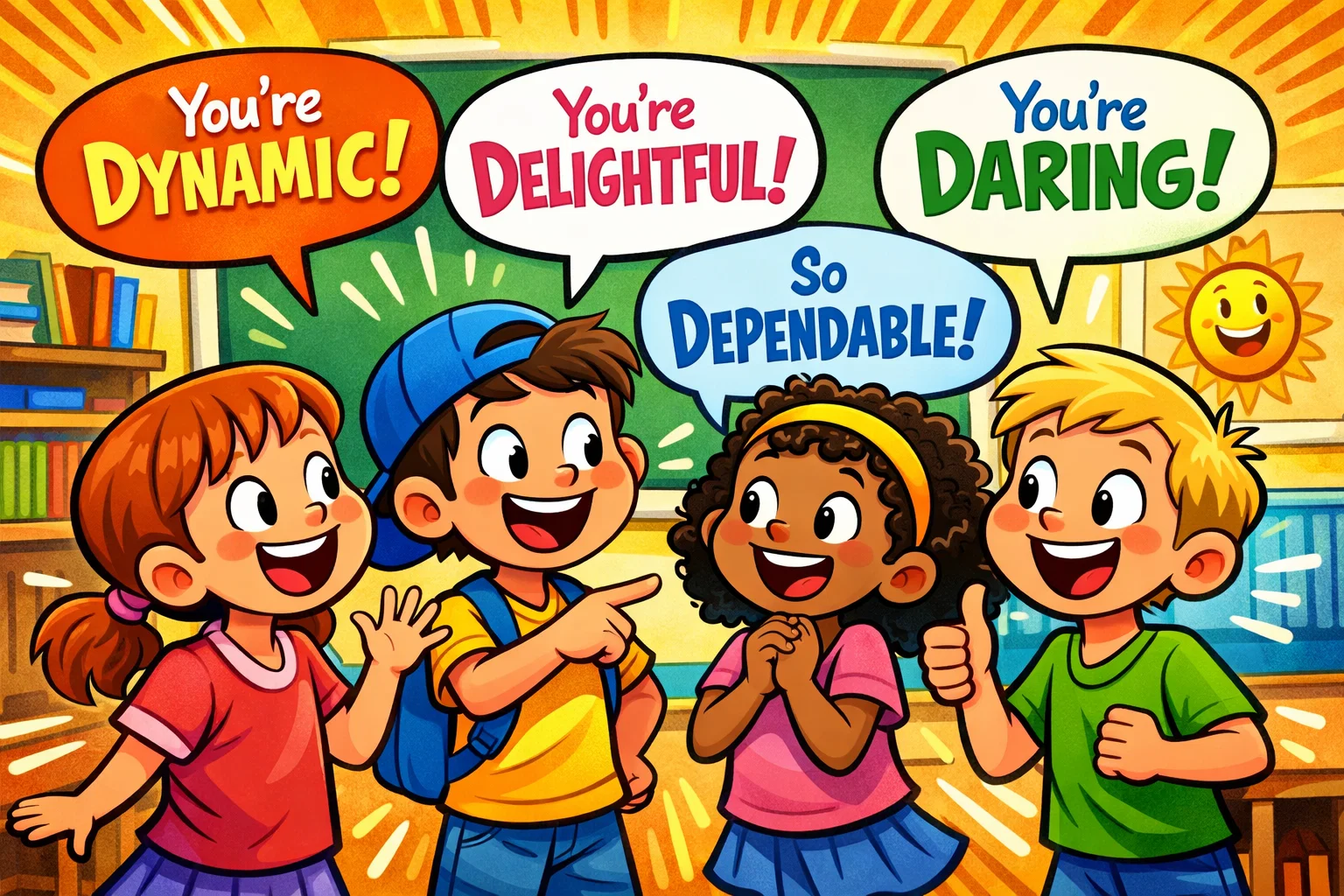
Teaching children positive words is essential for building emotional intelligence. Using kind words helps kids express empathy and maintain a positive mindset during social interactions. This is particularly important for school-aged children as they begin to navigate complex peer groups.
Gentle D Words for Classmates
Encouraging children to use positive words that start with D can improve the atmosphere in a classroom. Promoting a list of kind terms helps foster a supportive environment.
- Daring: Complimenting a friend for trying a new, difficult task.
- Dedicated: Noticing when a classmate works hard on a drawing.
- Dependable: Thanking a friend for always being there to help.
Sweet D Words for Family
At home, words beginning with D can strengthen family bonds. Choosing vivid and warm language makes daily chores and interactions feel more special.
- Darling: A classic term of affection for a sibling or parent.
- Delightful: Using this to describe a fun afternoon spent together.
- Doting: Describing how a parent or grandparent cares for a child.
Kind D Words for Daily Speech
Incorporating these terms into regular conversations is a great way to practice language skills. It teaches children that vocabulary isn’t just for school; it’s for expressing love and respect.
- Decent: “That was a very decent thing you did by sharing your toy.”
- Dignified: “You were very dignified even when you lost the game.”
- Dutiful: “Thank you for being dutiful and cleaning up your room.”
Descriptive Words
To truly describe something well, children need a list of D words that cover physical attributes and feelings. Using a dictionary or a list like this helps them find the exact word they need for descriptive writing assignments.
| Category | D Word | Simple Definition |
| Look/Size | Diminutive | Extremely small or tiny. |
| Look/Size | Dusky | Somewhat dark in color. |
| Movement | Dart | To move suddenly and rapidly. |
| Movement | Dandle | To move a baby up and down playfully. |
| Feeling | Delighted | Feeling very pleased or happy. |
| Feeling | Despondent | Feeling very sad or without hope. |
Using adjectives like these allows a child to describe the world more precisely, moving beyond vague but easy-to-understand words like “big” or “small.”
Compliments Starting With D
Giving compliments is a great way to practice using the letter D in a constructive way. Positive words can boost a child’s confidence and help them make friends. Words are a great way to show others that we care about their hard work.
Praise for Kids’ Effort
- Dazzling: “Your performance in the school play was absolutely dazzling!”
- Determined: “I love how determined you were to finish that puzzle.”
- Distinctive: “Your drawing style is so distinctive and unique!”
Compliments for Friends
- Dashing: “You look so dashing in your new school outfit!”
- Dearest: “You are my dearest friend in the whole world.”
- Dynamic: “I love your dynamic energy when we play tag!”
Compliments for School Work
- Detailed: “This is a very detailed report on frogs!”
- Diligent: “You have been very diligent with your reading practice this week.”
- Definite: “You gave a very definite and correct answer in class today.”
Positive Words
This list of words focuses on the bright side of life. Positive words that start with D encourage children to look for the good in situations and in themselves.
Cheerful D Words
- Dreamy: Something that feels like a wonderful dream.
- Dazzling: Bright and full of light.
- Dancing: Full of movement and life.
- Daydream: Imagining happy things while you are awake.
Brave D Words
- Defiant: Standing up for what is right, even if it’s hard.
- Dauntless: Fearless and very brave.
- Decisive: Being able to make a choice quickly and firmly.
- Doughty: An old word for being very brave and strong.
Creative D Words
- Design: To plan and make something new.
- Devise: To come up with a clever plan or invention.
- Draft: To start writing or drawing a new idea.
- Develop: To grow and make an idea even better.
Unusual Funny Words
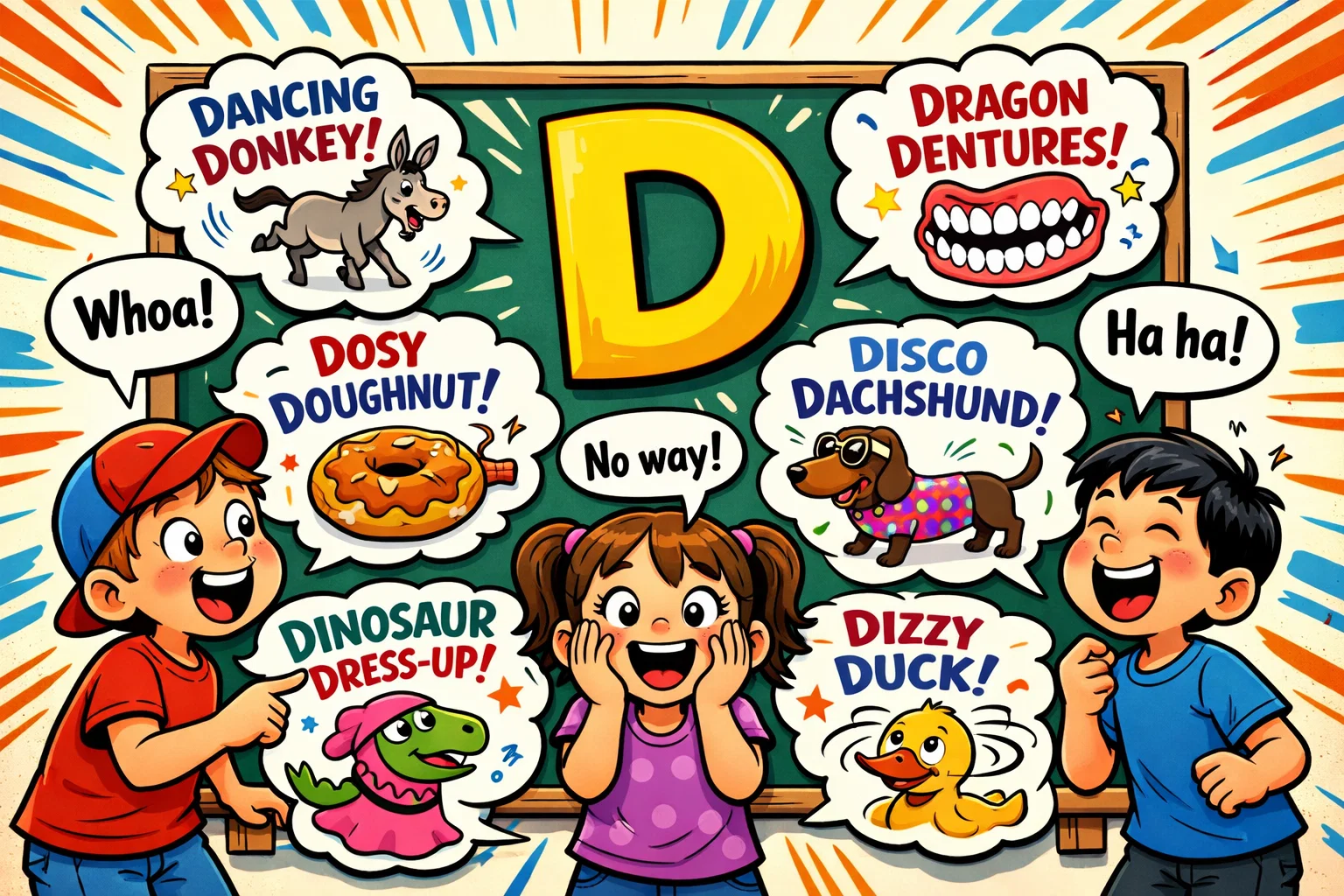
Sometimes, the coolest words that start with D are the ones we don’t hear every day. These unusual words and obscure words add a layer of mystery and fun to a child’s vocabulary.
Words with Funny Sound
- Dunderhead: A very old, silly way to call someone a “blockhead” (use only in play!).
- Doodad: Similar to a doohickey, it’s a small object whose name you can’t remember.
- Dingle: A small, deep, wooded valley. It sounds like a little bell!
- Doozy: Something that is extra special, big, or unusual.
Old-Fashioned Funny D Words
- Draggle-tailed: An old term for someone whose clothes are wet and messy from the rain.
- Dastardly: Acting in a sneaky or mean way, like a classic cartoon villain.
- Dilly: An old-fashioned way to say something is remarkable or excellent.
Funny D Words Kids Love to Say
Kids often enjoy words with repetitive sounds or “plosive” consonants (like ‘d’, ‘p’, or ‘b’).
- Dillydally
- Doodlebug
- Donnybrook * Dibble (To make small holes for seeds in a garden).
Funny D Words to Describe People
When writing stories or playing pretend, kids need words to describe their characters. Here’s a list of playful terms for personalities.
For Goofy Characters
- Dithering: Someone who can’t make up their mind and moves around nervously.
- Dotty: A character who is a bit confused but very kind.
- Dizzy: Someone who is always spinning around or acting scatterbrained.
D Words for Playful Nicknames
- Doodlebug: A sweet name for a younger sibling.
- Dimples: For someone who smiles a lot.
- Duckie: A classic, gentle nickname.
D Words for Story Heroes
- Doughty: A hero who never gives up.
- Daring: A hero who takes big risks.
- Debonair: A hero who is very smooth and charming.
Easy Funny D Words for Younger Kids
For preschoolers and first graders, it helps to use words that are easy to read and say. This list of D words focuses on beginner vocabulary.
D Words for Beginners
- Dog: Our favorite four-legged friend.
- Dot: A tiny round mark.
- Dad: A very important person in the family!
- Dig: What you do with a shovel in the sand.
Easy-to-Pronounce Funny D Words
- Dino (Die-no)
- Dash (D-ash)
- Dunk (D-unk)
- Drum (D-rum)
First Funny D Words for Preschool and Grade 1
Teaching these words that start with D is a great way to build a strong vocabulary foundation.
- Doll: A favorite toy for playing house.
- Duck: A bird that says “quack!”
- Dish: Where we put our yummy snacks.
- Door: What we open to go outside and play.
D Words Kids Should Avoid in Jokes
While many funny words are great, some negative adjectives or negative words starting with D can hurt feelings. It is important to teach children that humorous language should never be used to be mean. This section helps children recognize words that might hurt someone’s feelings.
| Word to Avoid | Why it might hurt | Better Friendly Alternative |
| Dopey | Can make someone feel unintelligent. | Dilly or Silly |
| Dreadful | When used to describe a person’s work. | Developing or Difficult |
| Daft | Can be used to mock someone’s ideas. | Different or Daring |
| Dorky | Might make a friend feel uncool. | Distinctive or Detailed |
Funny-Sounding Words That Can Hurt Feelings
Sometimes a word sounds funny to us but can feel hurtful or mean to the person we are talking to. Ugly words like “dummy” should be replaced with kinder choices.
Better Friendly Alternatives
Instead of using a word that might bother a friend, try using the word “different” or “dynamic.” This shows creativity and kindness at the same time.
Funny D Words in Sentences
To make this list of words even more useful, let’s see how they work in real life! Words that start with ‘D’ are most effective when they are part of a vivid sentence.
Short Example Sentences
- The dazzling sun made the lake sparkle.
- Please don’t dillydally on your way to the car!
- I love to doodle on the edges of my homework.
- The little dino had tiny arms and a big smile.
- Watch the dog dig a deep hole for his bone.
Mini Jokes with D Words
- Question: Why did the duck cross the road?
- Answer: To prove he wasn’t a chicken!
- Question: What do you call a dinosaur that is a light sleeper?
- Answer: A Dino-snore!
Writing Prompts with Funny D Words
- “One day, a dapper dragon decided to dabble in baking cupcakes…”
- “The dizzy doodlebug found a dazzling diamond in the dirt…”
- “If I could design a dynamic robot, it would look like…”
Summary of D Words for Kids
Mastering words starting with the letter D is a journey of creativity and vocabulary growth. Whether you are looking for positive D words or funny words to make kids laugh, this list gives young learners plenty of playful vocabulary to explore. Remember that using words is a great way to express yourself and show the world your dynamic personality! By avoiding negative adjectives and focusing on kind words, kids can use their new vocabulary to build a better, more delightful world.
Frequently Asked Questions
Which funny D words are easiest for young kids?
Words like Dino, Dot, Dig, and Dash are easiest because they are short (3-4 letters) and follow simple phonetic patterns. These are great for word recognition in preschool. They are easy to understand and fun to say for those just starting to read.
How can kids learn funny D words faster?
One of the best ways to learn them is through games. Create “D-word flashcards,” play “I Spy” looking for items that start with D, or challenge them to write a “D-only” sentence. Consistent speaking practice makes the vocabulary stick. Reading from a dictionary together can also be a great way to discover unusual words.
Why do some D words sound funny?
Many funny-sounding words use punchy consonants, repeated sounds, or onomatopoeia, as in words like “ding.” The “D” sound is made by touching the tongue to the ridge just behind the top teeth, which gives it a clear, punchy feel that many children enjoy. This can make D words especially satisfying for young speakers to say.
Can funny D words help with vocabulary?
Yes! Research suggests that emotional valence – how a word makes us feel – can affect how well we remember it. Because funny words create a positive emotional response, children are more likely to remember and use the word correctly in the future. Over time, this can strengthen children’s descriptive language and overall communication skills.

Take a short quiz to find out what your everyday choices say about your parenting style
When your child is curious about something new, what’s your instinct?
Take a short quiz to find out what your everyday choices say about your parenting style
“Can I download this app?” What happens next?
Take a short quiz to find out what your everyday choices say about your parenting style
When it comes to rules at home, which sounds most like you?
Take a short quiz to find out what your everyday choices say about your parenting style
If you could give your child one life skill today, what would you pick?
Take a short quiz to find out what your everyday choices say about your parenting style
Your child gets to choose what to watch. What would your ideal setup look like?
Take a short quiz to find out what your everyday choices say about your parenting style
Pick your parenting superpower ✨



