Fun Facts for Preschoolers: 120+ Easy, Silly, Amazing Discoveries

 Discover a Free Education Video App for Kids
Pastory uses AI to personalize educational video content based on your child’s interests and personality. Safe, engaging, and built for curious young minds. Sign up now to stay updated and enjoy early access with a free trial
Educational snippets for young children are a powerful tool for cognitive development. For kids aged 3 to 5, the world is full of wonder, and micro-learning through fun facts builds vocabulary, encourages critical thinking, and strengthens the bond between caregiver and child.
This guide offers a collection of short, safe, and easy-to-visualize facts designed to spark curiosity. Whether for a car ride, classroom circle time, or bedtime, these snippets are tailored to engage young learners without overwhelming them. The 100+ facts are organized into categories, making it easy to explore your child’s interests, from animals to the solar system to the human body.
How to Use Fun Facts With Preschoolers
Using interesting facts with children under five requires a specific teaching approach. At this age, children learn best through repetition and context. Meaningful learning occurs when new information is connected to a child’s personal experiences.
Fact of the Day Routine
Establishing a daily routine provides a predictable structure that preschoolers crave. You can introduce one random fun fact during breakfast or while putting on shoes for school. Use the “1-1-1 Formula”: Provide 1 simple statement, ask 1 open-ended question, and encourage 1 repetition from the child to solidify the memory. This practice enhances “working memory,” a crucial executive function.
Bedtime and Circle Time Prompts
During ‘Circle Time’ in the classroom or ‘Bedtime Ritual’ at home, use these details to transition into a calm state. Start with a prompt like, “Did you know that an elephant can’t jump?” This encourages the child to visualize the animal and engage their imagination. Follow up with, “Can you imagine a big elephant trying to hop like a bunny?” to spark a giggle and lower stress levels before sleep or focused activity.
Repeat and Ask Method
Preschoolers thrive on the ‘Repeat and Ask’ method. After sharing a science fun facts piece, ask the child to tell it back to you in their own words. This practice builds “expressive language” skills and vocabulary. If you share that a giraffe has a purple tongue, ask, “What color would your tongue be if you ate purple lollipops all day?” to make the information relatable and fun.
Random Fun Facts for Preschoolers
Random facts are excellent “brain breaks” because they are surprising and easy to digest. For a 3-year-old, a detail about a banana being a berry is just as exciting as a story about a space station.
Silly Everyday Fun Facts
- Bananas grow pointing toward the sun, which is why they have a curved shape.
- A banana is technically a berry, but a strawberry is not! Botanists define berries as fruits that come from one ovary.
- You cannot burp in space because there is no gravity to separate gas from food in an astronaut’s stomach.
- Bubbles are always round because they are trying to take up the least amount of space possible due to surface tension.
- A sponge can hold more cold water than hot water, which is a fun experiment for bath time.
- The equator is the warmest part of the Earth because it stays closest to the sun year-round.
Wow Facts Kids Repeat Fast
- A shrimp has its heart located in its head, protected by a thick shell.
- Otters hold hands when they sleep so they don’t float away from each other in the water.
- The world record for the tallest bubble ever blown is taller than a two-story house.
- A snail can sleep for up to three years if it needs to stay moist and safe.
- A mouse can fit through a hole as small as a ballpoint pen because their skeletons are very flexible.
- Your feather pillow might contain thousands of soft down feathers from ducks or geese.
One-Line Facts for Quick Reading
- Wombat poop is shaped like a perfect cube to stop it from rolling away!
- A mouse uses its long tail to help it keep its balance when climbing.
- Clouds look light, but a large cloud can weigh as much as 100 elephants.
- Apples float in water because they are 25% air, acting like tiny boats.
- A giraffe needs to sleep for only about 30 minutes a day.
- An octopus can squeeze through any hole larger than its hard beak.
Animal Fun Facts for Preschoolers
Animals are a primary interest for young children because they represent “living entities” with distinct personalities. Learning animal facts for kids helps develop empathy and categorization skills.
Farm Animal Facts
- Cows have “best friends” and get stressed if they are separated from them for too long.
- Pigs are very clean animals and actually prefer to keep their sleeping areas tidy and away from their bathroom.
- Chickens can recognize over 100 different faces of their friends and even human caregivers.
- A sheep’s wool never stops growing, so they need a “haircut” once a year to stay cool and healthy.
- Horses can sleep both standing up and lying down, thanks to a special leg locking mechanism.
Wild Animal Facts
- An elephant is the only mammal on earth that cannot jump because their leg bones all point downwards.
- A giraffe has the same number of neck bones as a human (seven), but theirs are much bigger and stronger!
- Sloths are so slow that green plants called algae sometimes grow on their fur, helping them hide in the trees.
- A lion’s roar can be heard from five miles away, which is like hearing a sound from across the whole town.
- Kangaroos use their big tails like a third leg to help them stand still and balance.
Pet Animal Facts
- Dogs have a sense of smell that is 10,000 to 100,000 times stronger than yours, allowing them to “see” with their noses.
- Cats use their whiskers to feel if they can fit through a small opening without getting stuck.
- Rabbits perform a “binky”—a happy twist and hop—when they are feeling very joyful and safe.
- Goldfish can actually remember things for months, proving they are much smarter than people once thought.
- Hamsters have pouches in their cheeks that can stretch to hold a large amount of food.
Ocean Animal Facts
- An octopus has three hearts and blue blood; two hearts pump blood to the gills and one to the body.
- A shark does not have any bones; its skeleton is made of flexible stuff called cartilage, just like the tip of your nose.
- Dolphins give each other “names” by using unique whistles to call their friends across the waves.
- The blue whale is the largest animal on earth, and its heart is as big as a small car.
- A starfish (sea star) does not have a brain or blood, but it can grow back a lost arm!
Insect Fun Facts for Preschoolers
Insects provide a wonderful opportunity for “Backyard Science.” Teaching animal fun facts about bugs encourages children to explore their immediate environment with curiosity rather than fear.
Backyard Bug Facts
- Ants don’t have lungs; they breathe through tiny holes called spiracles, located all over their bodies.
- A ladybug can eat up to 5,000 bugs in its lifetime, helping farmers keep their vegetables safe.
- Earthworms have five hearts to help them wiggle through the dense dirt in your garden.
- Snails leave a trail of slime to help them slide over sharp rocks or twigs without getting hurt.
- Bees have five eyes—two large ones on the sides and three tiny ones on the top of their heads.
Flying Bug Facts
- A butterfly tastes its food using its feet, which have special sensors to find sweet nectar.
- Bees do a special “waggle dance” to tell their hive friends exactly where to find the best flowers.
- Dragonflies can fly in any direction—up, down, sideways, and even backward like a tiny helicopter.
- Houseflies always hum in the musical key of F when they fly around the room.
- Moths are like “night butterflies” and often use the moon to help them navigate.
Tiny Body Surprises
- A caterpillar has 12 tiny eyes, but it still can’t see very well, relying mostly on its feelers.
- Spiders are not insects; they are arachnids because they have eight legs instead of six.
- A grasshopper has its ears on its tummy, just behind where its back legs attach.
- Fireflies use their glowing light to “talk” to each other in the dark, like a biological flashlight.
- Some insects can walk on water because they are so light they don’t break the “skin” of the water.
Dinosaur Fun Facts for Preschoolers
Dinosaur themes are a staple of preschool education because they combine “big” concepts with historical mystery. Using comparisons to modern objects helps children grasp the massive scale of these creatures.
Big Dino Facts
- The Brachiosaurus had a neck so long it could peek into a four-story window to find the tastiest leaves.
- The Argentinosaurus was as heavy as 15 elephants standing on top of each other, making it a true giant.
- A T-Rex had a tail that acted like a giant balance beam so it wouldn’t fall over while running after its dinner.
- Dinosaur footprints can be as big as a child’s bathtub; scientists use these to guess how fast they walked.
- Most of the biggest dinosaurs were “herbivores,” which means they only ate plants and trees.
Dino Eggs and Teeth
- Some dinosaur eggs were as small as a tennis ball, while others were as big as a football.
- A T-Rex tooth was about the size of a large, pointy banana, perfect for its role as a hunter.
- Triceratops had up to 800 teeth in its mouth at one time, allowing it to crunch through tough, woody plants.
- Baby dinosaurs grew very fast, sometimes becoming ten times bigger in just one year of life.
- Some dinosaurs, like the Hadrosaur, had over 1,000 teeth that were replaced constantly.
Fast Dino Facts
- The Velociraptor was about the size of a large turkey and was a very fast runner with sharp claws.
- The Struthiomimus could run as fast as a car driving through your neighborhood (about 50 miles per hour).
- Many dinosaurs had feathers just like modern birds to keep them warm and help them display colors.
- Dinosaurs lived on Earth for over 160 million years, which is much longer than humans have been here!
- The word “Dinosaur” actually means “Terrible Lizard,” though we now know they are more related to birds.
Space Fun Facts for Preschoolers
Learning about the solar system helps children understand their place in a much larger world. For preschoolers, focus on the “Big Three”: the Sun, the Moon, and the Stars.
Sun, Moon, and Stars
- The Sun is actually a giant star, and it is so big that one million Earths could fit inside it.
- The Moon does not make its own light; it acts like a giant mirror reflecting the Sun’s light back to Earth.
- The Sun is the center of our solar system, and every planet must orbit around the sun to stay in place.
- There are more stars in the galaxy than there are grains of sand on all the beaches on Earth.
- Night happens when our part of the Earth turns away from the Sun to look out at the dark space.
Planet Facts Kids Notice Fast
- Saturn has beautiful rings made of billions of pieces of ice and dust, some as small as a grain of sugar.
- Mars is known as the “Red Planet” because its dirt is rusty, just like an old nail left in the rain.
- Jupiter is a “Gas Giant,” meaning you couldn’t stand on it because there is no solid ground to walk on.
- Neptune is a very windy planet where the wind blows much faster than any storm on Earth.
- Venus is the hottest planet in our solar system, even though it isn’t the closest one to the Sun.
Astronaut and Rocket Facts
- An astronaut has to wear a pressurized suit because there is no air to breathe in the vacuum of space.
- In space, there is no gravity, so an astronaut can float through their space station like a superhero.
- Footprints left on the Moon will stay there for million years because there is no wind or rain to blow them away.
- Rockets have to go very fast to escape Earth’s gravity—about 25,000 miles per hour to reach orbit.
- Astronauts eat special “space food” that doesn’t make crumbs, because crumbs would float into their eyes!
Earth and Science Fun Facts
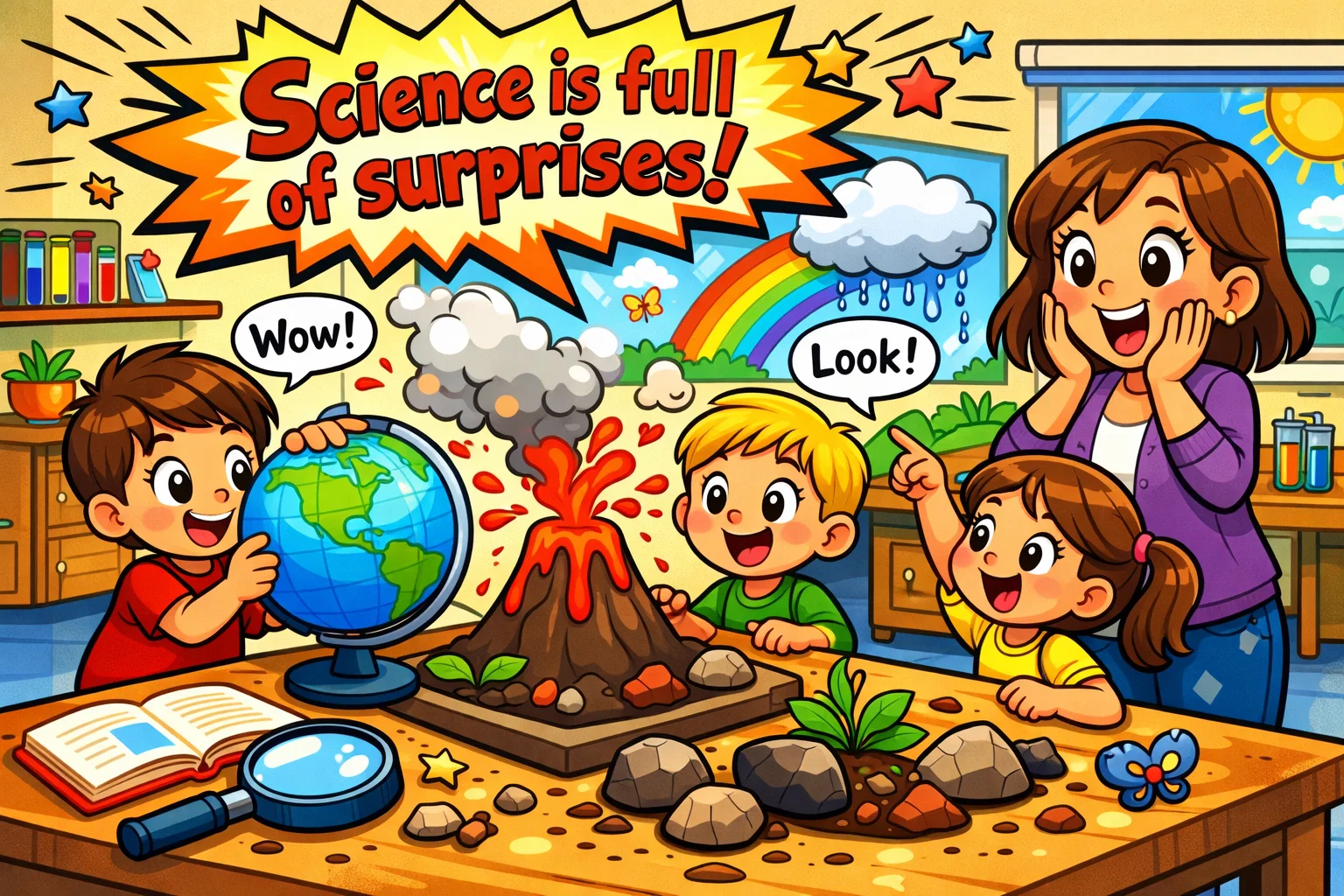
Science fun facts for this age group should focus on observable weather and nature. This supports the “Scientific Inquiry” strand of educational frameworks for early years.
Rain, Cloud, and Weather Facts
- A rainbow only appears when there is both sunshine and rain at the exact same time behind you.
- Clouds are made up of billions of tiny water droplets or ice crystals floating together in the sky.
- Lightning is a giant spark of electricity that is five times hotter than the surface of the sun.
- Every single snowflake has a unique shape, meaning no two snowflakes have ever been exactly the same.
- Thunder is the sound made by the air expanding very quickly when lightning passes through it.
Water, Ice, and Snow Facts
- Ice floats on water because it is actually lighter and less dense than the liquid water beneath it.
- Water can be a liquid (to drink), a solid (ice), or a gas (steam from a hot cocoa).
- Most of the Earth is covered by the ocean, which holds 97% of all the water on our entire planet.
- The deepest part of the ocean is so dark that no sunlight can ever reach the bottom, and it is very cold.
- Sound travels much faster through water than it does through the air we breathe.
Plants, Rocks, and Volcanoes
- A volcano is a mountain that opens downward to a pool of molten rock (lava) below the Earth’s surface.
- Plants “eat” sunlight to make their own food through a process called photosynthesis, which also makes oxygen for us.
- Some rocks are so light that they can float on water; these are called pumice rocks and come from volcanoes.
- The Equator is an imaginary line around the middle of the Earth where it is warm and sunny all year.
- Trees are the longest-living things on Earth; some have been growing for over 4,000 years!
Human Body Fun Facts
Preschoolers are often fascinated by their own bodies. Teaching human body details promotes “Body Awareness” and healthy lifestyle habits.
Bones, Heart, and Brain
- A human baby is born with about 300 bones, but as they grow, some bones join together, leaving adults with only 206.
- Your heart is a muscle that pumps blood around your body about 100,000 times every single day without resting.
- Your brain is the “boss” of your body and even stays active and “cleans” itself while you are fast asleep.
- The smallest bone in your body is inside your ear (the stirrup) and is smaller than a single grain of rice.
- Your bones are four times stronger than concrete, even though they are much lighter.
Five Senses Facts
- Your nose can remember 50,000 different scents, like chocolate, fresh flowers, or even smelly old socks.
- Your ears never stop hearing, even when you sleep; your brain just “mutes” the sounds so you don’t wake up.
- Your tongue is covered in tiny bumps called taste buds that help you tell if a banana is sweet or if a lemon is sour.
- Your skin is the largest organ you have, and it protects everything inside you from germs and the sun.
- Your eyes can see about 10 million different colors, which is why the world looks so bright!
Sleep, Growth, and Movement
- You are a tiny bit taller in the morning than you are at night because your spine gets squished during the day.
- Most people blink about 20 times every minute to keep their eyes clean, moist, and healthy.
- Your hair and fingernails are made of the same stuff as a bird’s feather or a rhino’s horn (it’s called keratin).
- Sneezes can travel at 100 miles per hour—that’s why we always cover our mouths with our elbows!
- Your body has about 600 muscles that help you run, jump, smile, and even stand still.
Food Fun Facts
Food fun facts can help “picky eaters” become more interested in trying new things by turning mealtime into a learning experience.
Fruit and Vegetable Facts
- A strawberry is the only fruit that wears its seeds on the outside—there are about 200 seeds on each one!
- Apples give you more energy than a sugary snack because they have healthy natural sugars and fiber.
- Carrots were originally purple, not orange, a long time ago before farmers changed how they grew.
- A watermelon is 92% water, which is why it is so crunchy and refreshing on a hot summer day.
- Broccoli is actually a bunch of tiny un-opened flowers that we eat before they bloom.
Snack and Sweet Facts
- Frank Epperson, a high school student, invented the ice pop by accident in 1905 when he left a drink outside.
- Honey is the only food that never goes bad; explorers found 3,000-year-old honey that was still perfectly safe to eat!
- It takes about 700 peanuts to make one 18-ounce jar of peanut butter—that’s a lot of nuts!
- Popcorn kernels have a tiny drop of water inside that turns to steam and “pops” when it gets hot enough.
- Chocolate was once used as money a long time ago in Central America.
Funny Kitchen Facts
| Food Item | Surprise Detail |
| Banana | Glows blue under a special “black light” when it’s perfectly ripe. |
| Bread | The holes in bread are made by tiny living things called yeast breathing out gas. |
| Milk | Can be turned into a “plastic” stone using just warm milk and vinegar. |
| Ice Cream | A “Brain Freeze” happens when something cold touches the roof of your mouth too fast. |
Color Fun Facts
Colors are one of the first abstract concepts preschoolers master. These items link color to science and the natural world.
- Pink doesn’t actually have a “spot” on the rainbow; our brains make it up by mixing red and violet light together.
- Flamingos are born gray, but they turn pink because they eat so many pink shrimp and algae.
- Bulls cannot actually see the color red; they are attracted to the movement of the matador’s cape, not the shade.
- The color blue is the rarest color in nature; very few plants or animals are truly blue—they usually use tricks of light.
- Your eyes see the grass as green because the grass absorbs all colors except green, which it reflects back to you.
Place and Geography Fun Facts
Using a globe or map while sharing geography information helps children build “Spatial Awareness” and a sense of scale.
- The Earth is a giant ball called a “sphere,” and a globe is a small model that shows where we live.
- The Sahara Desert is so big that it is almost the same size as the entire United States of America.
- Mount Everest is the highest mountain on Earth, and its top is so high it touches the clouds where the air is thin.
- Russia is the largest country in the world; it is so big that it has 11 different time zones happening at once!
- Most of the Earth’s “fresh water” (the kind we can drink) is frozen inside big blocks of ice called glaciers.
History Fun Facts
For a preschooler, “History” is simply “a long time ago.” Focus on inventions and lifestyles that differ from their own modern experience.
- Before the ice pop was invented, people used to store ice in deep “ice houses” in the ground to keep food cold.
- The first wheels were made of solid stone and were very heavy; they were used for pottery before they were used for carts.
- The Great Pyramids in Egypt were built over 4,000 years ago as giant tombs for kings, using massive stone blocks.
- Castles had “moats” (water around them) not just for protection, but to act as a very old-fashioned trash system.
- A long time ago, people used to write on clay tablets or animal skins instead of paper.
Sports Fun Facts
Sports entries encourage physical activity and help children understand the “rules of the game” and sportsmanship.
- The first basketball games were played using a peach basket as the hoop, and you had to poke the ball out after every score!
- A golf ball has about 300 to 500 “dimples” (tiny holes) to help it fly much farther through the air.
- In the ancient Olympics, athletes used to win olive branch crowns instead of gold medals.
- Soccer is the most popular sport in the world, played by millions of people in almost every single country.
- Baseball was once played with a ball made of old rubber shoes and yarn.
Math Fun Facts
Early math is about patterns and counting. These items make numbers feel like a game rather than a chore.
- The number 4 is the only number in the English language that has the same number of letters as its name.
- A honeycomb is made of hexagons (six-sided shapes) because that is the strongest and most space-saving way to store honey.
- If you could fold a piece of paper in half 42 times, it would be thick enough to reach the Moon!
- A circle is the only shape with no corners and no ends—it just goes on forever in a perfect loop.
- Bees are actually very good at math; they can count up to four and understand the concept of “zero.”
FAQ About Fun Facts for Preschoolers
What are the best fun facts for preschoolers?
The best entries for this age group are visual and relatable. Focus on animal facts for kids, the human body, and food facts. These topics allow children to use their senses to understand the information quickly.
What kind of information can you teach age 3 to 5?
Stick to details that are “Safe and Positive.” Avoid scary or complex topics. Use comparisons that involve “Big vs. Small” or “Fast vs. Slow,” as these are concepts preschoolers are already learning in their daily play.
How many amazing facts should preschoolers hear at once?
To avoid cognitive overload, limit sharing to 3–5 snippets in one sitting. For best results, use a daily “knowledge nugget” approach to build a long-term habit of curiosity and learning.
Take a short quiz to find out what your everyday choices say about your parenting style
When your child is curious about something new, what’s your instinct?
Take a short quiz to find out what your everyday choices say about your parenting style
“Can I download this app?” What happens next?
Take a short quiz to find out what your everyday choices say about your parenting style
When it comes to rules at home, which sounds most like you?
Take a short quiz to find out what your everyday choices say about your parenting style
If you could give your child one life skill today, what would you pick?
Take a short quiz to find out what your everyday choices say about your parenting style
Your child gets to choose what to watch. What would your ideal setup look like?
Take a short quiz to find out what your everyday choices say about your parenting style
Pick your parenting superpower ✨