101 Fun Facts for Kids: Random Facts for 11 Year Olds

 Discover a Free Education Video App for Kids
Pastory uses AI to personalize educational video content based on your child’s interests and personality. Safe, engaging, and built for curious young minds. Sign up now to stay updated and enjoy early access with a free trial
Welcome to this collection of 101 fun facts designed for curious 11-year-olds. At this age, many children begin moving from concrete thinking toward more abstract reasoning. A mix of animal, science, and history facts can help satisfy their growing curiosity and sense of independence. This guide bridges playful learning and academic curiosity.
Quick Overview

This article offers a wide range of facts designed to entertain and educate middle-school-age readers. At this age, curiosity-led learning can help children build problem-solving skills, confidence, and resilience. Each section includes short, stand-alone facts that kids can easily read, remember, and share at home or in class.
The content is written clearly, checked for accuracy, and supported with concrete details where helpful. We aim to spark their curiosity by connecting everyday objects, like broccoli or ketchup, to their fascinating historical or scientific origins. By the end of this article, readers will have a fun bank of facts to use in conversations, quizzes, and school projects.
Best age fit
This collection is aimed at tweens, especially 11-year-olds. Around this age, many children enjoy facts that challenge their logic and expand what they know about the world. These facts are complex enough to respect their growing intelligence while remaining fun and accessible.
Topics covered
This article covers a wide range of topics to suit different interests and learning styles. We cover:
- Space (including Jupiter, Saturn, and Neptune)
- Biology (the human body, sharks, and elephants)
- History (Ancient Egypt and the Victorian era)
- Earth Sciences (volcanoes, tornadoes, and geography)
- Culture (sports, food, and inventions)
How to use facts in school talks
Sharing a surprising fact can be a simple way to build confidence in public speaking. A simple structure is “Hook, Point, Close”: start with a surprising fact, explain the main idea, and end by inviting questions. This structure turns trivia into a useful tool for classroom participation and discussion.
Random Fun Facts for 11 Year Olds
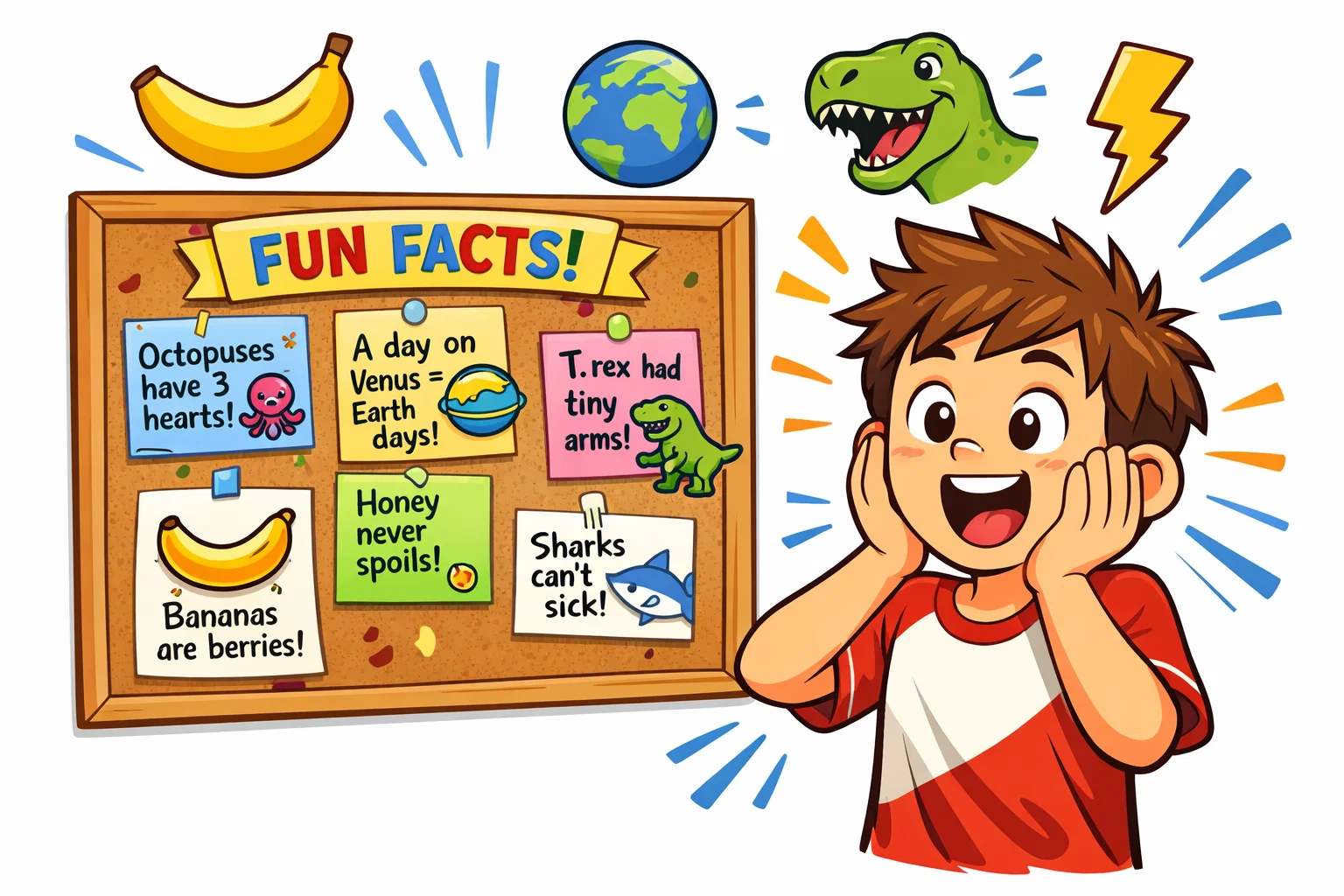
- The ice pop was invented by an 11-year-old boy named Frank Epperson in 1905 when he left a mixture of soda powder and water outside on a freezing night.
- In the 1830s, some doctors promoted tomato ketchup as a remedy for digestive problems, and tomato-based pills were later sold as medicine.
- A cloud can weigh more than 1 million pounds, which is equivalent to the weight of the world’s largest passenger jet.
- People can spend a surprising amount of time waiting at red lights over a lifetime, although the exact total varies widely by driver and location.
- Bubble wrap was originally intended to be a type of 3D wallpaper before its inventors realized it was better for packaging.
- The term “robot” dates back to a 1920 play by Karel Čapek, where it was derived from the Czech word for “forced labor.”
- Vending machines were first created in Ancient Egypt to dispense holy water in exchange for a bronze coin.
- Sloths can take up to 30 days to fully digest a single leaf, making their metabolic rate one of the slowest in the animal kingdom.
- The Eiffel Tower can grow about six inches taller in summer because iron expands in high temperatures.
- A bolt of lightning contains enough energy to toast 100,000 slices of bread in a fraction of a second.
Science Fun Facts for 11 Year Olds

- Sound travels at approximately 767 miles per hour in the air, but it moves four times faster through water.
- The Earth’s atmosphere is held in place by gravity and is composed of 78% nitrogen and 21% oxygen.
- Diamond rain occurs on planets like Neptune and Uranus because of the extreme atmospheric pressure compressing carbon.
- Glass is actually a “disordered solid” or “amorphous solid” because its atoms are not arranged in a perfect crystal pattern.
- A tornado can have internal wind speeds exceeding 300 miles per hour, which is faster than a Formula 1 racing car.
- Water is the only substance on Earth that naturally exists in three states: solid, liquid, and gas.
- Light from the Sun takes exactly 8 minutes and 20 seconds to reach our planet, traveling at 186,282 miles per second.
- The Earth’s core is as hot as the surface of the sun, reaching temperatures of about 10,000°F (5,500°C).
- Oxygen in its liquid and solid states actually appears pale blue, though it is colorless as a gas.
- Static electricity can jump from your finger at 30,000 volts, yet it has very little current, which is why it doesn’t hurt significantly.
Animal Fun Facts for 11 Year Olds
- The African Elephant has a sense of smell so powerful it can detect water from up to 12 miles away.
- The Jaguar possesses a bite force of 1,500 PSI, allowing it to bite through turtle shells and alligator skin.
- Dolphins give themselves unique names that are expressed through specific “signature whistles” to identify one another.
- A shark does not have a single bone in its body; its entire skeleton is made of flexible cartilage.
- The Blue Whale has a heart so large that a human child could swim through its primary arteries.
- Honeybees can flap their wings 200 times per second, which creates the “buzzing” sound that kids love to mimic.
- The Brazilian wandering spider is one of the most venomous spiders in the world, and compounds in its venom are being studied for possible medical uses.
- Octopuses have three hearts and blue blood, which helps them survive in the cold, low-oxygen environment of the deep ocean.
- A group of owls is officially called a “parliament,” reflecting their traditional reputation for wisdom and gravity.
- Kangaroos cannot walk backward because their large, muscular tails and long feet are designed only for forward momentum.
Space Fun Facts for 11 Year Olds
- Jupiter is the fastest-spinning planet in the solar system, completing a full rotation on its axis in less than 10 hours.
- Saturn is less dense than water, meaning if you had a bathtub large enough, the planet would actually float.
- The Moon has only a very thin exosphere, so the footprints left by astronauts could remain undisturbed for millions of years.
- Mars is home to Olympus Mons, which is the largest volcano in our solar system at 13.6 miles high.
- The Sun accounts for 99.86% of the total mass in our solar system, holding everything in orbit with its gravity.
- Venus is the hottest planet in the solar system, with surface temperatures reaching 864°F due to a thick greenhouse atmosphere.
- Asteroid belts contain millions of rocky fragments, but they are so spread out that a spaceship rarely hits one.
- Pluto was reclassified as a “dwarf planet” in 2006 because it has not cleared its neighboring region of other objects.
- Uranus was the first planet discovered with a telescope, found by William Herschel in 1781.
- Neutron stars are so dense that a single teaspoon of their material would weigh 6 billion tons.
Dinosaur Fun Facts for 11 Year Olds
- The Argentinosaurus is currently recognized as the largest dinosaur ever discovered, reaching lengths of up to 115 feet.
- The T-Rex had serrated teeth that were the size and shape of bananas, designed to crunch through bone.
- Stegosaurus had a brain the size of a walnut, despite its body weighing more than five tons.
- The word “Dinosaur” was coined in 1842 and literally translates to “Terrible Lizard” in Ancient Greek.
- Velociraptors were actually the size of turkeys and were likely covered in feathers, unlike their movie depictions.
- Dinosaur species existed on Earth for about 165 million years, while humans have only been around for about 300,000 years.
- Modern birds are technically considered “avian dinosaurs” because they evolved directly from small, feathered theropods.
- Coprolite is the scientific name for fossilized dinosaur poop, which helps scientists learn what animals like the Triceratops ate.
- Spinosaurus is one of the best-known semi-aquatic dinosaurs and may have been larger than T. rex.
- Ankylosaurus acted like a living tank, with bony armor plates and a club-like tail for defense against predators.
Ocean Facts for 11 Year Olds
- The Pacific Ocean is the largest and deepest ocean, covering more area than all of Earth’s landmasses combined.
- The Mariana Trench is 36,070 feet deep; if you dropped Mount Everest into it, the peak would still be a mile underwater.
- The Great Barrier Reef is the world’s largest coral reef system and can be seen from space under the right conditions.
- Seahorses are the only fish species where the male carries the eggs and gives birth to the offspring.
- The Arctic Ocean is covered by a layer of sea ice that expands and shrinks with the seasons, acting as the Earth’s air conditioner.
- Hydrothermal vents on the ocean floor release water that is 750°F, yet unique life forms thrive in these lightless depths.
- Plastic takes about 450 years to decompose in the ocean, highlighting the importance of environmental conservation.
- Jellyfish are made of 95% water and have survived for 500 million years without a brain, heart, or lungs.
- Tides are caused mainly by the gravitational pull of the Moon and the Sun, while tsunamis are usually caused by underwater earthquakes or volcanic activity.
- Giant Squids have eyes the size of basketballs to help them see in the dark, murky depths of the deep sea.
Human Body Fun Facts for 11 Year Olds
- The human skeleton is made of 206 bones, but babies are born with about 300 bones that fuse together as they grow.
- Your brain generates enough electricity to power a small LED light bulb using only chemical signals and neurons.
- Skin is the largest organ in the human body and completely replaces itself every 27 to 30 days.
- Fingerprints are completely unique to every individual, and even identical twins have different patterns.
- The small intestine is about 20 feet long, which is roughly three times the height of a tall adult.
- Human teeth are the only part of the body that cannot repair themselves because they are not made of living tissue.
- The human sense of smell can distinguish an enormous number of scents, and smells are especially powerful at triggering memories.
- Sneezes can travel at speeds of up to 100 miles per hour, sending thousands of droplets into the air.
- Blood makes up about 8% of your total body weight and contains iron, which is the same metal found in asteroids.
- Eyelashes have a lifespan of about 150 days before they fall out and are replaced by new ones.
Food Fun Facts for 11 Year Olds

- Honey can last for an extremely long time when stored properly, and sealed jars of ancient honey have famously been found in Egyptian tombs.
- Broccoli contains more protein per calorie than steak, though you would have to eat a lot more of it to match the weight.
- Apples float in water because they are composed of 25% air, making them less dense than the liquid they are in.
- One of the hottest chili peppers in the world, the Carolina Reaper, is so spicy that it can cause an intense burning sensation.
- Carrots were originally purple or yellow before Dutch farmers in the 17th century bred them to be orange.
- A strawberry is not technically a berry, but a banana, pumpkin, and watermelon actually are.
- Chocolate was used as currency by the Aztecs, who valued the cocoa bean more than gold.
- Potato chips were invented by accident in 1853 when a chef tried to annoy a customer who complained his fries were too thick.
- Nutmeg is a hallucinogen if eaten in very large quantities, which is why it is used only in tiny pinches for cooking.
- In 2015, astronauts on the International Space Station became the first people to eat lettuce grown in space.
Weird History Fun Facts for 11 Year Olds

- itive precursor to modern penicillin.
- The Victorian era saw people wearing jewelry made from the hair of their deceased loved ones as a sign of respect.
- Beethoven used to count exactly 60 coffee beans for every cup he drank to ensure the perfect level of caffeine.
- The Great Emu War of 1932 involved the Australian military trying – and failing – to cull emus with machine guns.
- Abraham Lincoln is in the Wrestling Hall of Fame because he only lost one match out of approximately 300.
- Pyramids were not built by slaves, but by paid laborers who took great pride in their architectural work.
- The 16th century saw the invention of the first pocket watch, though it was very inaccurate and only had one hand.
- Knights in the Middle Ages wore armor that weighed about 50 pounds, which is less than what modern firefighters carry.
- Ice cream was first made in China around 200 BC using a mixture of milk, rice, and snow.
- The shortest war in history lasted only 38 minutes between Britain and Zanzibar in 1896.
Sports and Geography Fun Facts
- The Olympic flag’s five rings represent the five inhabited continents, linked together in friendship.
- The Grand Canyon is about 277 miles long, more than a mile deep, and up to 18 miles wide.
- Mount Everest continues to rise by a few millimeters a year because of tectonic activity.
- You weigh slightly less at the equator because Earth’s rotation reduces your effective weight there, and the planet bulges outward at the equator.
- Basketball was originally played with a soccer ball and peach baskets before modern equipment was invented.
- Russia has a larger surface area than the entire dwarf planet of Pluto.
- Golf balls have dimples because they create turbulence that reduces drag, allowing the ball to fly further.
- Thousands of years ago, the Sahara was much greener, with lakes, grasslands, and some wooded areas before the climate shifted.
- Tennis strings were historically made from the intestines of cows and sheep before synthetic materials were created.
- Iceland is famous for having no native mosquitoes, likely because its freeze-thaw cycles create an unstable environment for them.
- No bridges cross the Amazon River’s main channel, largely because much of it runs through rainforest regions with few roads and limited need for crossings.
Fun Facts for 11 Year Olds FAQs
Why do 11 year olds like fun facts?
Many children this age enjoy fun facts because they like learning surprising things they can share with friends and adults. Knowing unusual facts can make them feel confident and engaged in conversation. This interest in fun facts is a normal part of growing curiosity and independenc
How many fun facts should one article include?
For a comprehensive “deep dive,” a list of 70 to 110 facts is ideal. This quantity provides enough variety to ensure every child finds a topic that resonates with their personal interests. It also gives readers enough variety to find topics that match their interests.
What makes fun facts memorable?
Facts are easiest to remember when they use a clear, concrete comparison. For example, saying a whale’s heart is “as big as a car” is more memorable than giving its weight in pounds. Kid-friendly comparisons help readers picture the information and remember it longer.

Take a short quiz to find out what your everyday choices say about your parenting style
When your child is curious about something new, what’s your instinct?
Take a short quiz to find out what your everyday choices say about your parenting style
“Can I download this app?” What happens next?
Take a short quiz to find out what your everyday choices say about your parenting style
When it comes to rules at home, which sounds most like you?
Take a short quiz to find out what your everyday choices say about your parenting style
If you could give your child one life skill today, what would you pick?
Take a short quiz to find out what your everyday choices say about your parenting style
Your child gets to choose what to watch. What would your ideal setup look like?
Take a short quiz to find out what your everyday choices say about your parenting style
Pick your parenting superpower ✨