
Fun Facts for 10-Year-Olds: 90+ Science, Animal, Space, History & Food Facts

 Discover a Free Education Video App for Kids
Pastory uses AI to personalize educational video content based on your child’s interests and personality. Safe, engaging, and built for curious young minds. Sign up now to stay updated and enjoy early access with a free trial
Welcome to the ultimate collection of fun facts for kids, specifically curated for curious ten-year-olds. At this age, children start thinking in more complex ways, moving from simple “what” questions to deeper “how” and “why” questions. This guide is designed to spark curiosity, support school projects with reliable information, and provide plenty of entertainment for family road trips or classroom icebreakers.
Our selection covers a vast range of topics, from the depths of the solar system to the mysteries of the human body. Whether you are looking for animal facts for kids to share at lunch or science fun facts to impress a teacher, these snippets of knowledge are structured to be easy to read and even easier to remember. Let’s dive into the world of the unexpected and the amazing!
Quick Overview

This comprehensive guide contains over 150 random fun facts for kids categorized by subject to help parents, teachers, and students find exactly what they need. We have included amazing facts about planets, great white sharks, and even the history of ketchup. Each fact has been selected and checked for age-appropriate clarity and accuracy, and the list is presented in a format that supports the developing reading skills of 10-year-olds.
Why Fun Facts Work for 10-Year-Olds
By age ten, the human brain undergoes a significant “pruning” process where it strengthens frequently used neural pathways. Providing a wide array of interesting facts acts as a mental spark, encouraging divergent thinking and curiosity. Research suggests that curiosity can improve attention and memory, which is one reason memorable “wow” facts work so well for this age group.
How to Use This List at Home, School, Road Trips
This list functions as a versatile tool for various settings:
- Family Trivia: Use the category headings below to host a nightly quiz.
- Classroom Icebreakers: Teachers can use one “Fact of the Day” to inspire discussion.
- Reading Practice: The short, punchy paragraphs are perfect for independent reading.
- Travel Entertainment: Keep kids engaged during long drives by challenging them to find the “weirdest” fact in a specific category.
Fact Categories in This Guide

| Category | Primary Focus | Best For |
| Random & Weird | Surprising, cross-discipline facts | Instant engagement |
| Science & Nature | Biology, physics, and weather | School reports & STEM |
| Space | Planets, stars, and NASA | Visual learners |
| Animals | Habitats, predators, and pets | Animal lovers |
| Human Body | Anatomy and health | Biology interest |
| History & Geography | Ancient civilizations and maps | Social studies |
Fun Facts for Kids

If you are looking for a quick hit of knowledge, this section features the “greatest hits” of our collection. These are the facts that kids love because they are high-impact and easy to share immediately.
Best Quick-Read Facts
- Ketchup was sold as medicine in the 1830s. Dr. John Cook Bennett claimed it could treat indigestion and jaundice before it became a popular condiment.
- The Eiffel Tower can be 15 cm taller during the summer. This happens because the iron expands when the temperature rises, a process called thermal expansion.
- Alaska is the only state in the United States that can be typed on one row of a traditional QWERTY keyboard.
Most Surprising Facts
- A spark of static electricity can measure up to 3,000 volts, but it doesn’t hurt because the current is extremely low.
- There is even a Guinness World Record for the loudest burp: 112.4 decibels, roughly as loud as a rock concert or a chainsaw heard from a few feet away.
- A shrimp’s heart is located in its head, proving that nature often puts vital organs in the most unexpected places.
School-Share Facts
- An inventor named Frank Epperson invented the ice pop by accident in 1905 when he left a mixture of powdered soda and water outside overnight with a stirring stick in it.
- The first modern flush toilet was described in 1596 by Sir John Harington, long before the Victorian era, although ancient civilizations such as the Egyptians also developed early plumbing systems.
- A bolt of lightning is five times hotter than the surface of the sun, reaching temperatures of roughly 30,000°C.
Facts Kids Remember Fast
- Venus is the hottest planet in our solar system, even though Mercury is closer to the sun, because its thick atmosphere traps heat.
- The human body is made up of about 50% to 60% water in adulthood.
- Sharks can go through as many as 30,000 teeth in a lifetime because they constantly replace them while hunting prey.
Random Fun Facts
These random facts are designed to spark curiosity by highlighting the weird and wonderful side of the world around us.
Silly Facts Kids Want to Repeat
- Wombat poop is cube-shaped. This prevents the droppings from rolling away, allowing the mammal to mark its territory effectively on flat rocks.
- Most vivid dreams happen during REM sleep, while snoring is more closely linked to partially blocked airflow during sleep.
- Dolphins give each other names. They use unique “signature whistles” to identify and call out to specific members of their pod.
Weird Facts That Sound Fake
- Oxford University is older than the Aztec Empire. Teaching at Oxford started in 1096, while the Aztec civilization began around 1325.
- A cloud can weigh more than a million pounds, even though it looks light and fluffy. While it looks fluffy, it is actually made of tons of water droplets spread over a huge area.
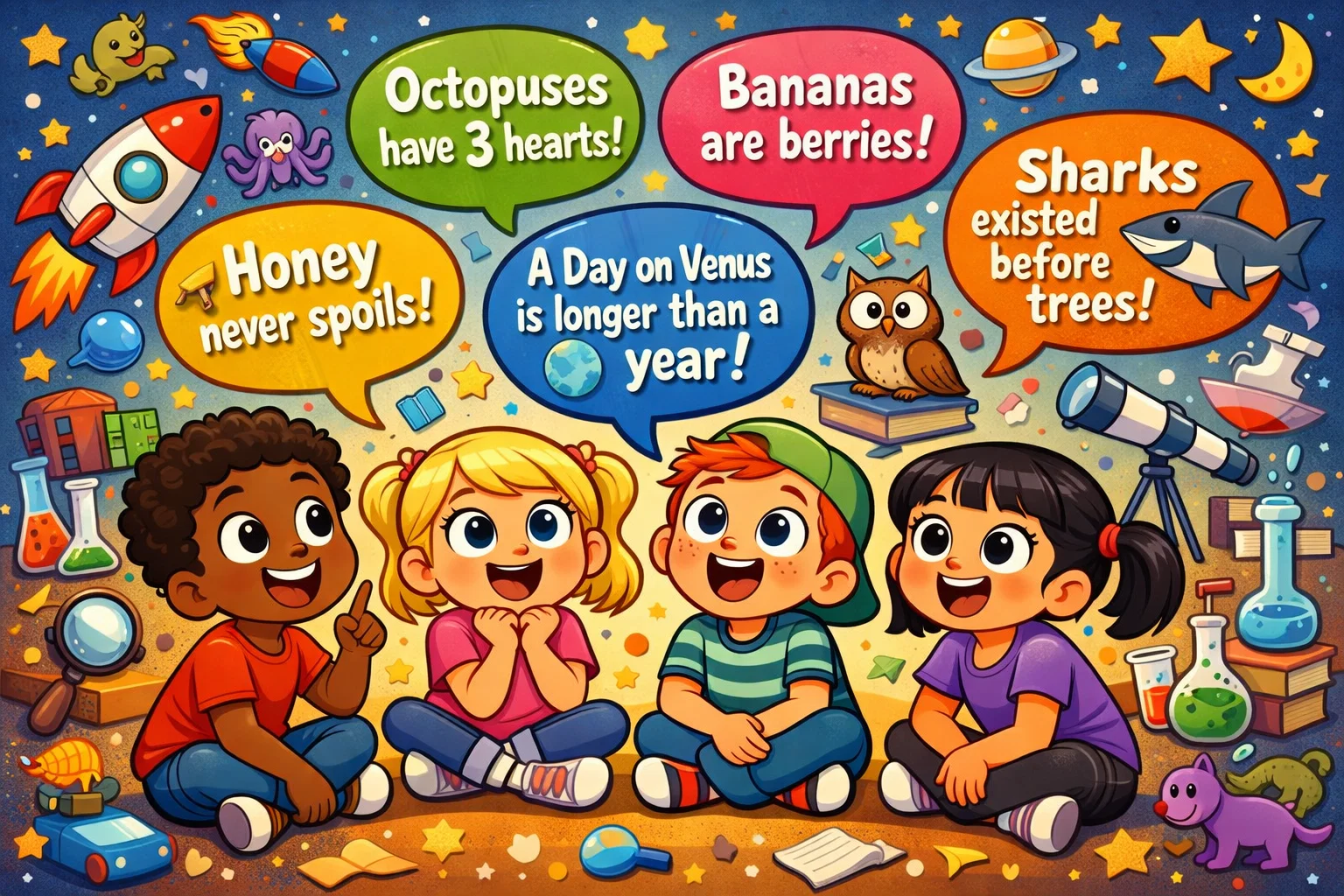
- Bananas are berries, but strawberries are not. In botanical terms, a berry must come from a single ovary and have seeds on the inside.
Fast One-Sentence Facts
- The Equator passes through 13 different countries.
- A slug has four noses, which are actually sensory tentacles.
- Honey never spoils; archaeologists have found 3,000-year-old honey that is still edible.
- Outer space begins about 62 miles (100 kilometers) above Earth.
Conversation-Starter Facts
- If you could drive straight upward at 60 miles per hour, you would reach the edge of space in just over an hour.
- Octopuses have three hearts and blue blood. Two hearts pump blood to the gills, while the third circulates it to the rest of the body.
- The human eye can distinguish about 10 million different colors, but the brain cannot always remember every specific shade.
Science Facts
Understanding the world through science facts for kids helps develop critical thinking. These facts focus on Earth’s mechanics and basic physics.
Earth & Science
- Gravity on Earth isn’t perfectly even. Because the planet isn’t a perfect sphere, you actually weigh slightly less at the Equator than at the poles.
- A volcano called Olympus Mons on Mars is three times taller than Mount Everest. This suggests that Mars’ crust doesn’t move like Earth’s plate tectonics.
- Bacteria are everywhere; there are more bacteria in your mouth right now than there are people on the entire planet.
Math
- In some scientific and technical contexts, “jiffy” has been used as the name of a very short unit of time, but its exact meaning depends on the field.
- The number 40 is the only number that has its letters in alphabetical order (F-O-R-T-Y).
- If you multiply 111,111,111 by 111,111,111, you get 12,345,678,987,654,321.
Tornado Facts
- Tornadoes can have wind speeds exceeding 300 miles per hour. These are classified as EF5 tornadoes on the Enhanced Fujita Scale.
- A waterspout is a spinning column of air over water. Some waterspouts are tornadoes, while others form more gently over warm water.
- Most tornadoes in the Northern Hemisphere spin counterclockwise, but it is more accurate to link that to the rotation of the parent storm than to say the Coriolis effect directly spins each tornado.
Everyday Science Facts Kids Notice
- Sound travels four times faster through water than through air. This is why you can sometimes hear a boat engine from very far away when underwater.
- Glass is actually a “disordered solid,” not a slow-moving liquid. The myth that old windows are thicker at the bottom is due to how they were manufactured, not gravity.
- Rain itself does not have much of a smell, but the scent we notice after rain is often called petrichor and comes from plant oils, compounds released by soil microbes, and sometimes ozone.
Space Fun Facts for 10-Year-Olds
Space is the ultimate frontier for curiosity. These science fun facts about the galaxy provide a sense of scale for the solar system.
Planets
- Jupiter is so large that all the other planets in our solar system could fit inside it. Its huge gravity also influences the paths of asteroids and comets.
- One day on Venus is longer than one year on Venus. It takes 243 Earth days to rotate once, but only 225 Earth days to orbit around the sun.
- Saturn’s rings are not solid. They are made of billions of pieces of ice, dust, and rocks, some as small as a grain of sand and others as large as a house.
Moon, Sun, and Stars
- The Sun accounts for 99.86% of the total mass in our solar system. It is so big that about 1.3 million Earths could fit inside it.
- Moon footprints will last for millions of years. Because there is no wind or water on the Moon to erode them, the Apollo astronauts’ tracks are still there today.
- Neutron stars are so dense that a single teaspoon of their material would weigh about a billion tons.
Astronaut, Rocket, and Space Mission Facts
- Astronauts grow taller in space. Without the constant pull of gravity compressing their spines, they can expand by up to 2 inches (5 cm).
- The International Space Station (ISS) travels at 17,500 miles per hour. This means astronauts see 16 sunrises and sunsets every single day.
- Spacesuits are incredibly complex life-support systems designed to keep astronauts alive during spacewalks.
Weird Space Records
| Record Holder | Fact | Value |
| Hottest Place | Core of the Sun | 15 million °C |
| Coldest Planet | Uranus | -224 °C |
| Fastest Planet | Mercury | 107,000 mph orbit |
| Longest Canyon | Valles Marineris (Mars) | 2,500 miles long |
Animal Fun Facts for 10 Year Olds

Animal fun facts are a staple of childhood learning. These insights focus on unique biological traits and behaviors.
Wild Animals
- Cheetahs are the fastest land animals, reaching 70 miles per hour in just three seconds. However, they can only maintain this speed for about 30 seconds.
- Elephants are famous for being unable to jump because they always keep at least one foot on the ground. Their bone structure and heavy weight make it physically impossible to get all four feet off the ground at once.
- Polar bears have black skin. Their fur is actually transparent and hollow, reflecting light to appear white, which helps them blend into the snow.
Cats
- Cats use their whiskers to determine if they can fit through a tight space. If the whiskers touch the sides, the cat knows its body is too wide to pass.
- A house cat’s genome is 95.6% identical to a tiger’s. They share many behaviors, such as scent marking and pouncing.
- Cats have 32 muscles in each ear, allowing them to rotate their ears 180 degrees to pinpoint the exact location of a sound.
Lions
- Lions are the only social cats. They live in groups called “prides,” which can include up to 40 individuals, usually led by a few dominant males.
- A lion’s roar can be heard from 5 miles away. This is used to communicate with the pride and warn rivals to stay away from their territory.
- Female lions do most of the hunting. While the females provide the food, the males are responsible for protecting the pride’s territory.
Insects
- Ants don’t have lungs. They breathe through tiny holes all over their bodies called spiracles.
- A honeybee must visit 2 million flowers to make just one pound of honey. During its life, a single bee will only produce about 1/12th of a teaspoon of honey.
- Dragonflies are extremely successful predators and can catch most of the prey they target.
Ocean Facts
More than 80% of the ocean remains unmapped, unobserved, and unexplored, making it full of mysteries scientists are still trying to understand.
Sharks
- Great white sharks have an excellent sense of smell, and they also use electroreception to detect the tiny electrical signals produced by prey.
- Sharks have been around for more than 400 million years. They existed before trees and even before many dinosaurs.
- Greenland sharks can live for over 400 years, making them the longest-living vertebrates on the planet.
Deep Ocean Facts
- The Mariana Trench is the deepest part of the ocean, reaching about 7 miles (11,000 meters) down. If you dropped Mount Everest into it, the peak would still be over a mile underwater.
- Giant squids have eyes the size of dinner plates. This allows them to see in the pitch-black depths where they hunt.
- Pressure at the bottom of the ocean is equivalent to having an elephant stand on your thumb.
Sea Creature Facts
- Octopuses can regrow lost arms, although full regrowth usually takes much longer than a few weeks.
- Seahorses are among the few animals in which the male carries the developing young and gives birth.
- Blue whales are the largest animals to have ever lived – even bigger than the largest dinosaur. Their tongue alone weighs as much as an elephant.
Human Body Facts
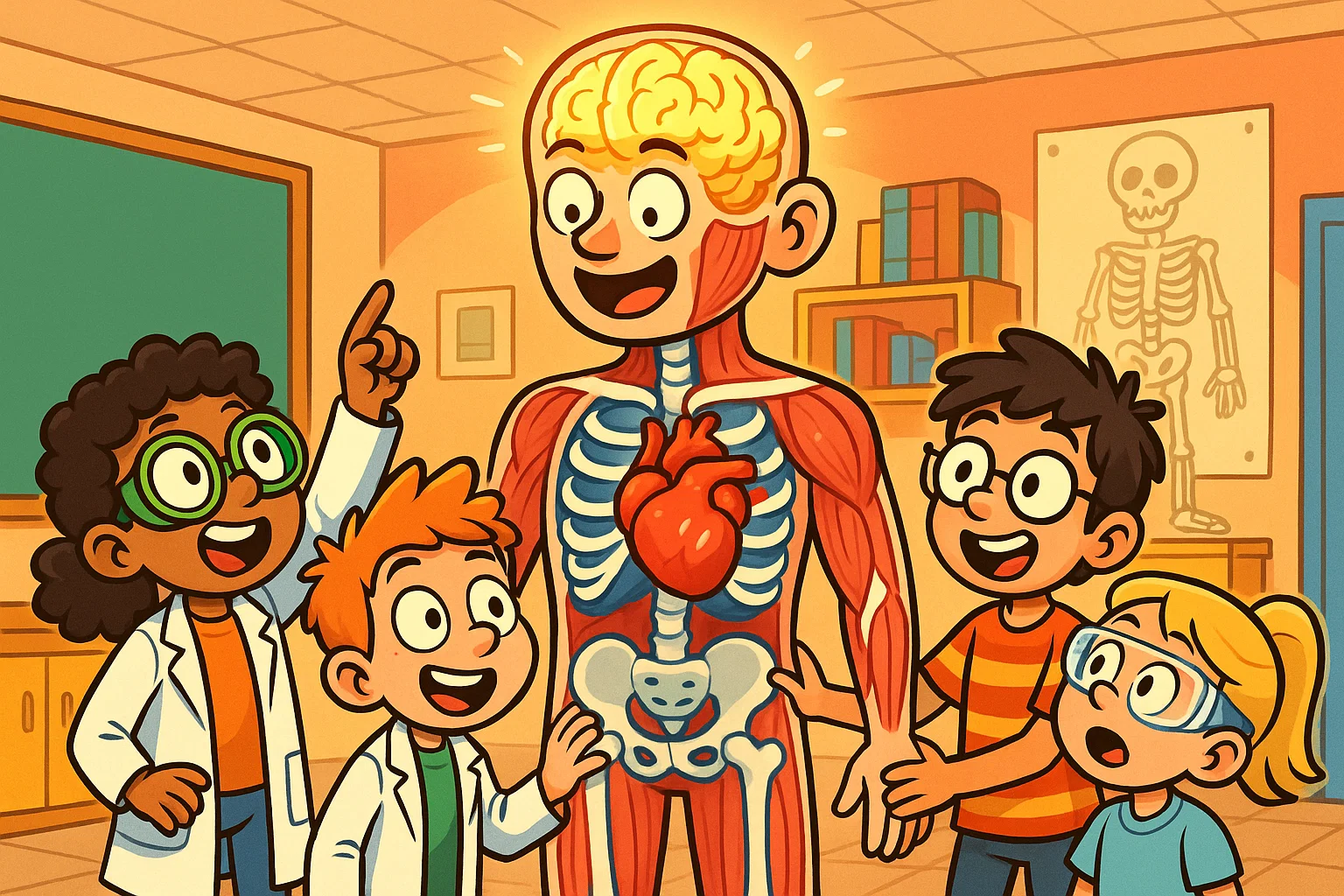
The human body is a biological masterpiece. These human body fun facts explain how we function.
Brain, Senses, Nerve Facts
- The brain uses about 20% of the body’s energy, even though it makes up only a small part of the body’s weight.
- Taste bud cells are replaced regularly, which is one reason your sense of taste can change over time. Your body is constantly replacing them, which is why your food preferences might change as you get older.
- Nerve impulses travel to and from the brain at speeds of up to 170 miles per hour.
Bones, Muscles, Teeth Facts
- Babies are born with 300 bones, but adults only have 206. As you grow, many bones fuse together to form stronger structures.
- Your teeth are the only part of the human body that cannot heal themselves. This is because they are made of enamel, which is not living tissue.
- The femur (thigh bone) is the strongest bone in the human body.
Left-Handed Facts for 10-Year-Olds
- About 10% of the world’s population is left-handed.
- Left-handed people may have an advantage in some interactive sports, such as tennis or boxing, partly because opponents face them less often.
- Many famous people have been left-handed, including Leonardo da Vinci.
Food Facts
Food science is full of random fun facts that change how we look at our dinner plates.
Snacks, Candy, and Desserts
- Cotton candy was co-invented by a dentist. William Morrison helped create the machine-spun sugar treat in 1897.
- White chocolate is chocolate made with cocoa butter, sugar, and milk, but it does not contain cocoa solids.
- Some luxury pizzas have sold for thousands of dollars, but record prices change over time.
Kitchen Science
- Apples float in water because they are 25% air. This makes them perfect for the game of bobbing for apples.
- Popcorn explodes because each kernel contains a tiny droplet of water inside a circle of soft starch. When heated, the water turns to steam and bursts the hull.
- Onions make you cry because they release a gas called propanethial S-oxide, which reacts with the water in your eyes to form a mild acid.
History Facts
History is more than dates; it is a collection of interesting facts about how people lived.
Weird History Facts
- In the Victorian era, people used to take photos with their dead relatives as a way to remember them, which sounds creepy today but was normal then.
- Ancient Egyptians used slabs of stone as pillows. They were carved to fit the head and neck to keep the head elevated.
- Official records mention only a small number of deaths in the Great Fire of London, but historians believe the true toll may have been much higher.
Invention, Discovery Facts
- The Slinky was invented by engineer Richard James while he was working on springs designed to help keep equipment steady on ships.
- Post-it Notes grew out of an adhesive that was unusual because it stuck lightly and could be removed without damaging paper.
- The trivium was a core part of medieval education, focusing on grammar, logic, and rhetoric.
Dinosaur Facts
Dinosaurs captured the world millions of years ago, and they continue to inspire kids today.
Giant Dinosaur Facts
- Argentinosaurus was one of the largest land animals ever discovered. It was roughly 100 feet long – about the length of three school buses parked end-to-end.
- A T-Rex tooth could be up to 12 inches long (including the root), which is about the size of a standard ruler.
- Brachiosaurus had an extremely long neck that helped it reach leaves high in trees.
Dinosaur Myths Kids Hear Often
| Myth | Fact |
| All dinosaurs were huge | Some, like the Compsognathus, were only the size of a chicken. |
| Dinosaurs were scaly like lizards | Many, including the Velociraptor, were actually covered in feathers. |
| They all lived together | Stegosaurus and T-Rex lived 80 million years apart. |
FAQs
What fun facts do 10 year olds like most?
Ten-year-olds generally gravitate toward animal facts, space records, and “gross” but safe human body facts. They enjoy knowledge that allows them to impress their peers or challenge adults.
How many fun facts should one article include?
There is no perfect number, but a strong resource should include enough variety to match different interests and reading levels. This variety ensures that children with different interests – whether in geography, sports, or science – find something that sparks their curiosity.
How can parents use fun facts for learning?
Parents can use these facts to build critical thinking by asking follow-up questions. For example, “If Venus is hotter than Mercury despite being further away, what does that tell us about atmospheres?”
Are fun facts good for school projects?
Yes. They can work as excellent “hooks” for presentations. Starting a report with a random fun fact captures the audience’s attention and establishes the student’s authority on the topic.

Take a short quiz to find out what your everyday choices say about your parenting style
When your child is curious about something new, what’s your instinct?
Take a short quiz to find out what your everyday choices say about your parenting style
“Can I download this app?” What happens next?
Take a short quiz to find out what your everyday choices say about your parenting style
When it comes to rules at home, which sounds most like you?
Take a short quiz to find out what your everyday choices say about your parenting style
If you could give your child one life skill today, what would you pick?
Take a short quiz to find out what your everyday choices say about your parenting style
Your child gets to choose what to watch. What would your ideal setup look like?
Take a short quiz to find out what your everyday choices say about your parenting style
Pick your parenting superpower ✨



