Easy Multiplication Tricks for Large Numbers That Save Time

 Discover a Free Education Video App for Kids
Pastory uses AI to personalize educational video content based on your child’s interests and personality. Safe, engaging, and built for curious young minds. Sign up now to stay updated and enjoy early access with a free trial
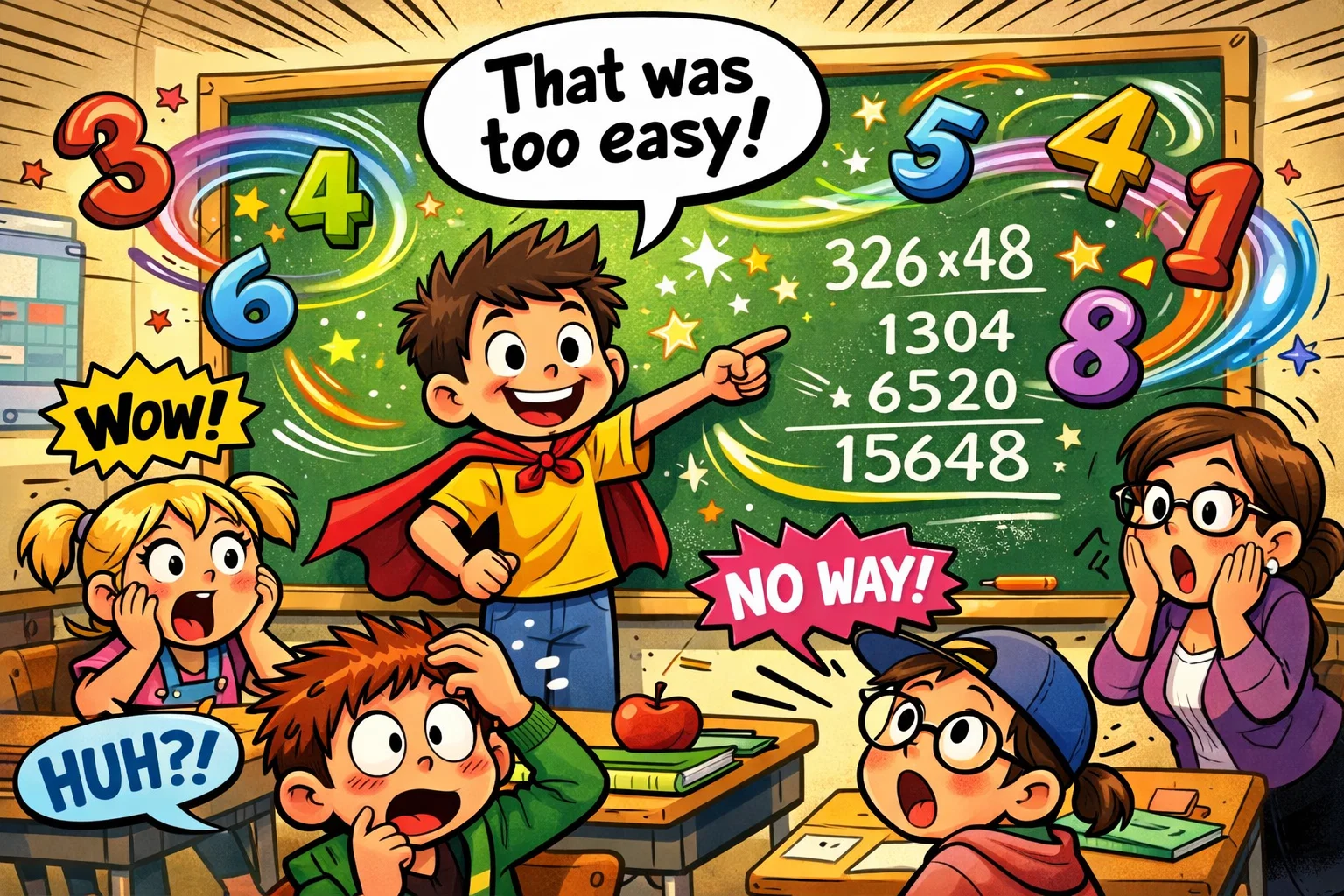
Multiplying large numbers doesn’t have to mean reaching for a calculator. Whether you’re helping a child prepare for a math exam, building mental math confidence, or just trying to calculate faster in daily life, the right multiplication tricks can make a real difference.
This guide walks through easy, proven strategies — from single-digit shortcuts to powerful techniques for multiplying large numbers — so learners of any age can solve problems faster and with greater accuracy.
Quick Multiplication Tricks for Single-Digit and Base Numbers
Mastering small-number shortcuts is the foundation for multiplying large numbers efficiently. Once a learner understands why these tricks work — not just how — the same logic scales naturally to bigger calculations.
Multiply by 9 Using the Add and Subtract Method
The ×9 trick works by using ×10 as a stepping stone. To multiply any number by 9, first multiply it by 10, then subtract the original number. For example, 9 × 7 = (10 × 7) − 7 = 70 − 7 = 63. This approach scales directly to large numbers: 9 × 84 = (10 × 84) − 84 = 840 − 84 = 756. The subtraction is almost always simpler than direct multiplication.
Double-Double Method for Multiplying by 4
Multiplying by 4 is the same as doubling a number twice. To calculate 4 × 36: double 36 to get 72, then double 72 to get 144. This method works well for large numbers too — 4 × 213 = double 213 (426), double again (852). Step-by-step doubling is easier than traditional digit multiplication.
Multiply by 5 Using the Divide-by-2 Strategy
To multiply any number by 5, divide the number by 2 and multiply by 10. For even numbers: 5 × 48 = 48 ÷ 2 × 10 = 240. For odd numbers, drop the 0.5 and add a 5 at the end: 5 × 37 = (37 ÷ 2 = 18.5) → 185. This trick turns multiplication into division, which many learners find easier.
Multiply by 8 Using Repeated Doubling
Multiplying by 8 uses three rounds of doubling. To find 8 × 23: double 23 = 46, double again = 92, double once more = 184. Repeated doubling is one of the fastest mental math strategies for multiplying large numbers, and it trains the brain to process numbers in structured steps.
Multiply by 6 Using the Add-Half Method
To multiply by 6, multiply the number by 5 (using the ÷2 × 10 trick), then add the number itself. Example: 6 × 14 = (5 × 14) + 14 = 70 + 14 = 84. This combines two simple operations and avoids carrying digits — one of the most common sources of errors in mental math.
Multiply by 10 and Adjust Technique
Multiplying by 10 simply shifts all digits one place to the left and adds a zero. To multiply by 9 or 11 using this approach, multiply by 10 first, then subtract or add the original number. For instance: 11 × 47 = (10 × 47) + 47 = 470 + 47 = 517. This “multiply by 10 and adjust” method is one of the most versatile tricks for nearby numbers.
Finger and Visual Multiplication Techniques
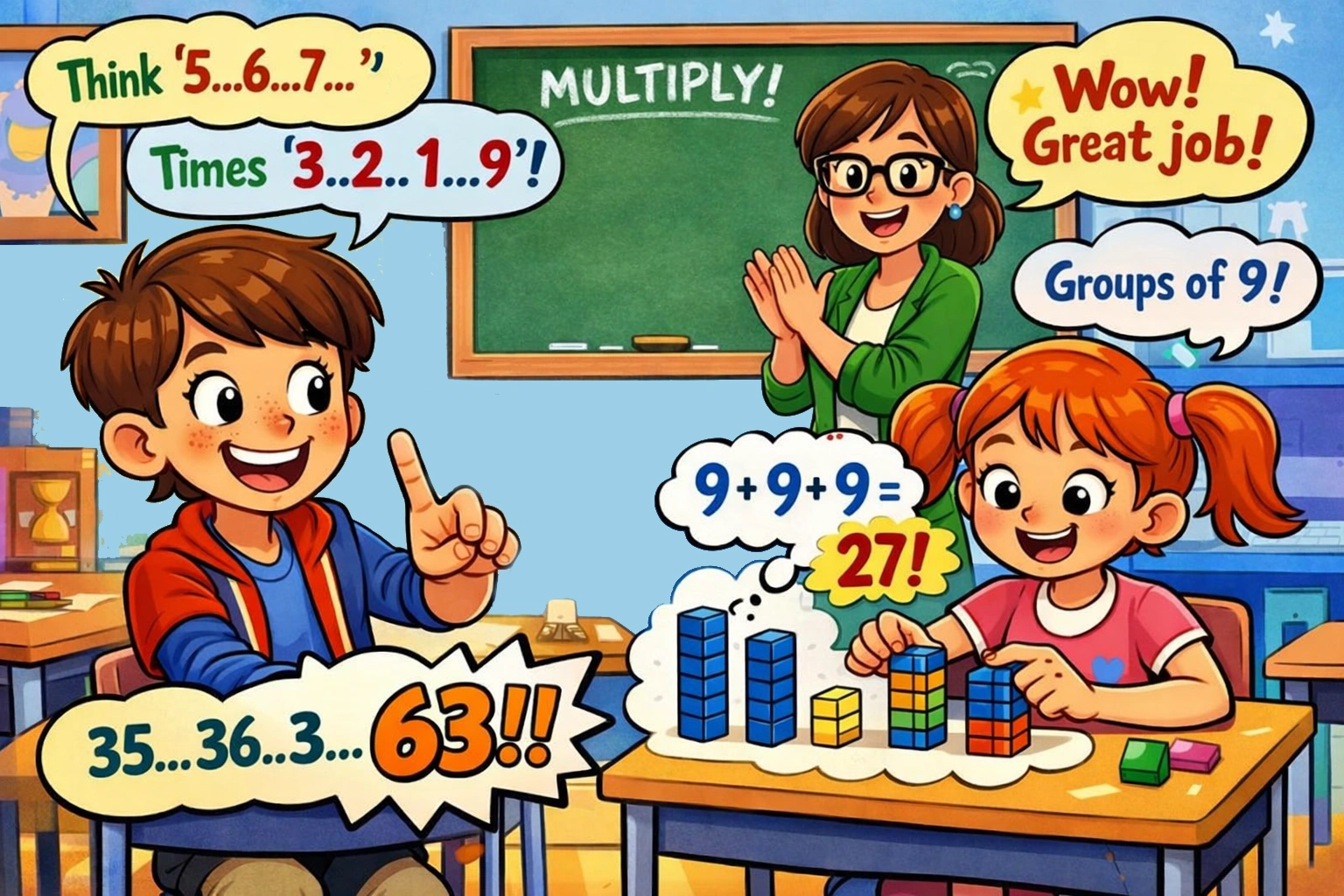
Tactile and visual methods are especially useful for younger learners and those who benefit from hands-on learning. These techniques build pattern recognition, which is a core skill in mathematics.
Finger Trick for the Multiplication Table of 9
Hold both hands flat with fingers spread. To calculate 9 × 4, fold down the 4th finger from the left. The fingers to the left of the folded finger represent tens (3), and those to the right represent ones (6), giving 36. This visual pattern makes the 9 times table accessible without memorization.
Finger Method for Numbers 6 to 10
This tactile method assigns values 6–10 to the fingers on each hand (thumbs = 6, pinkies = 10, working inward). To multiply two numbers, touch the corresponding fingers together and count: the touching fingers and those above them count as tens, while the remaining fingers on each hand are multiplied together for the ones digit. This method is slower but effective for visual learners building confidence.
Visual Patterns for the Table of 7
The 7 times table is notoriously tricky, but visual chunking helps. The sequence 7, 14, 21, 28, 35, 42, 49, 56, 63, 70 follows a pattern in the ones digit: 7, 4, 1, 8, 5, 2, 9, 6, 3, 0 — counting down by 3. Recognizing this repeating pattern helps learners recall or reconstruct answers without full memorization.
Using Patterns to Memorize Multiplication Tables Faster
Pattern-based learning reduces cognitive load significantly. Studies in math education consistently show that students who understand the structure of multiplication tables — such as the symmetry around the 5s and 10s — retain facts longer than those who rely on rote repetition alone. Spotting patterns in tens digits, ones digits, and skip-counting sequences gives learners a mental framework that scales to larger numbers.
Easy Tricks for Multiplying Two-Digit Numbers
Two-digit multiplication is where mental math starts to feel genuinely useful — and where the right strategy makes a visible difference in speed and confidence.
Rounding to the Nearest 10 and Adjusting the Difference
To multiply 18 × 6, round 18 up to 20: 20 × 6 = 120, then subtract the extra (2 × 6 = 12): 120 − 12 = 108. This rounding-and-adjustment method keeps calculations in manageable ranges and works especially well when one number is close to a multiple of 10.
Using Factors to Simplify Multiplication
Some two-digit numbers break down into convenient factors. Example: 25 × 16 = 25 × 4 × 4 = 100 × 4 = 400. Recognizing that 25 × 4 = 100 is a powerful shortcut: any multiplication involving 25 can be reframed as dividing by 4 and multiplying by 100. This approach dramatically simplifies what looks like complex multiplication.
Split and Multiply Method for Large Numbers
The split method applies the distributive property: break one number into its tens and ones, multiply each part separately, then add the results. For 34 × 7: (30 × 7) + (4 × 7) = 210 + 28 = 238. This is the foundation of long multiplication, presented in a way that keeps each step manageable.
Multiply by 11 Using the Digit Insertion Trick
To multiply any two-digit number by 11, add the two digits together and insert the sum between them. For 11 × 35: 3 + 5 = 8, insert between: 385. If the sum exceeds 9 (e.g., 11 × 78: 7 + 8 = 15), carry the 1 into the hundreds place: 858. This trick is fast, reliable, and easy to remember.
Distributive Property for Faster Calculations
The distributive property — multiplying each part of a number separately — is one of the most broadly useful tools in mathematics. For example, 47 × 8 = (40 × 8) + (7 × 8) = 320 + 56 = 376. Teaching learners to see numbers as composites of tens and ones helps them multiply large numbers without writing anything down.
Powerful Tricks for Multiplying Three-Digit Numbers
Three-digit multiplication can feel daunting, but structured techniques make it far more manageable.
Cross Multiplication Method for Three-Digit Numbers
The vertical and crosswise method (used in Vedic mathematics) organizes multiplication into columns. Begin by multiplying the ones digits, then cross-multiply the tens and ones, then multiply the hundreds. Each column is calculated separately and added together, reducing the risk of place value errors. This method is particularly effective for learners comfortable with two-digit multiplication.
Rounding to 1000 and Adjusting the Result
For numbers close to 1000, rounding simplifies the calculation significantly. To multiply 998 × 7: treat it as (1000 × 7) − (2 × 7) = 7000 − 14 = 6986. This base-number approach keeps arithmetic clean and reduces the number of steps required.
Breaking Numbers into Parts for Easier Calculation
Splitting a three-digit number into hundreds, tens, and ones allows learners to multiply each component and add the results. For 312 × 4: (300 × 4) + (10 × 4) + (2 × 4) = 1200 + 40 + 8 = 1248. This step-by-step approach mirrors long multiplication but organizes each step mentally.
Multiply by 101 Using Pattern Recognition
Any number multiplied by 101 simply repeats itself: 45 × 101 = 4545, and 312 × 101 = 31512. This pattern recognition trick works because 101 = 100 + 1, so the distributive property produces two copies of the original number placed in different positions.
Multiply Identical Numbers Quickly Using Squaring Shortcuts
Squaring numbers near a base is faster with a specific trick. For 95²: distance from 100 is 5. Subtract that distance from the number: 95 − 5 = 90. Multiply by 100: 9000. Add the square of the distance: 5² = 25. Final answer: 9025. This approach works for any number near a round base and builds into more advanced algebra naturally.
Best Tricks for Multiplying Large Numbers Quickly
This is where the techniques above come together. These high-efficiency strategies are the core toolkit for multiplying large numbers without a calculator.
Base Method for Numbers Near 100 or 1000
The base method is one of the most powerful tricks for large-number multiplication. To multiply 97 × 96: both numbers are close to 100. Find each number’s difference from 100 (3 and 4). Cross-add: 97 − 4 = 93 (or 96 − 3 = 93). Multiply the differences: 3 × 4 = 12. Final answer: 9312. This technique scales to numbers near 1000 with the same logic.
Multiply Large Numbers by 25 Using the Division Trick
To multiply any number by 25, divide the number by 4 and multiply by 100. Example: 25 × 348 = 348 ÷ 4 × 100 = 87 × 100 = 8700. If the number isn’t divisible by 4, apply the division to the nearest factor first. This approach converts multiplication into simpler division.
Multiply Large Numbers by 9 Using the Subtraction Method
The ×9 trick scales directly to large numbers. To find 9 × 4,750: multiply by 10 (47,500) and subtract the original (4,750): 47,500 − 4,750 = 42,750. This two-step subtraction is nearly always faster than traditional digit multiplication for large numbers.
Handling Multiplication When Numbers Differ Greatly in Size
When one number is significantly larger than the other, break the larger number into convenient parts. For 12 × 3,456: calculate 10 × 3,456 = 34,560, then 2 × 3,456 = 6,912, and add: 34,560 + 6,912 = 41,472. This decomposition method keeps each step well within mental math range.
Using Approximation for Faster Large Calculations
For estimates and real-world calculations, rounding both numbers before multiplying — then adjusting — provides a fast, accurate result. Multiply 187 × 412 ≈ 200 × 400 = 80,000, then correct for the rounding. Approximation is a legitimate and widely used mathematical strategy, particularly valuable in timed tests and practical situations.
Mental Math Strategies to Multiply Faster Without a Calculator
Beyond individual tricks, developing overall mental math ability requires cognitive strategies that build speed and reduce errors over time.
Chunking Numbers for Easier Processing
Chunking means grouping digits into meaningful units to reduce working memory load. Instead of processing 4,872 as four separate digits, a skilled mental math practitioner sees “48 hundreds and 72.” Cognitive science research shows that chunking is one of the most effective techniques for handling complex information efficiently.
Pattern Recognition in Multiplication
Recognizing recurring patterns — such as the digit cycles in the 9 times table or the symmetry in the multiplication table — allows learners to reconstruct facts rather than retrieve them from memory. Pattern recognition is a transferable skill that supports not just multiplication, but algebra, geometry, and data analysis.
Converting Complex Problems into Simple Steps
Every large multiplication problem can be reduced to a series of smaller, manageable calculations. Training learners to pause before calculating — to identify the simplest path — builds mathematical reasoning alongside computation speed. Ask: “Can I round this? Can I split it? Can I use a known fact?”
Practicing Mental Calculation Daily
Short, consistent practice produces better results than occasional long sessions. A daily routine of 5–10 mental multiplication problems — ideally varied in difficulty — builds fluency over weeks and months. Flashcard apps, number puzzles, and real-life estimation (grocery totals, distances, time calculations) all reinforce mental math in context.
Common Mistakes in Large Number Multiplication and How to Avoid Them
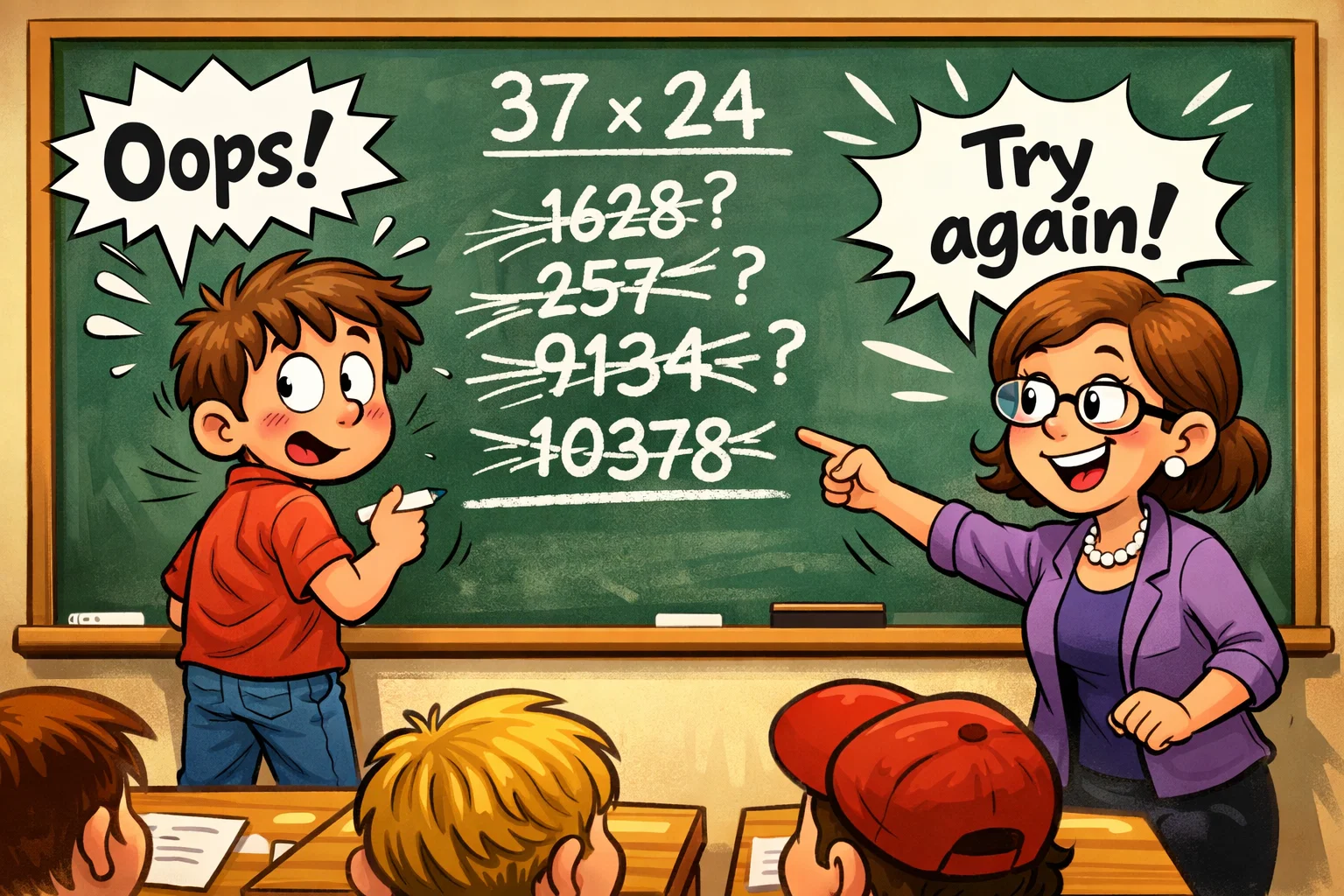
Knowing where mistakes happen is just as important as learning fast multiplication tricks. Small errors can cancel out even the smartest shortcuts, so building good habits makes a big difference.
Errors in Rounding and Adjustment
One of the most frequent issues appears when using rounding techniques. If you round 38 up to 40 to make multiplication easier, you must correct the result afterward by subtracting the extra amount. Skipping this final adjustment leads to incorrect answers. A simple way to avoid this is to note the adjustment before starting the calculation.
Misplacing Digits in Mental Math
Place value mistakes are very common in mental calculations, especially when dealing with multiple steps. A digit placed in the wrong position (tens instead of hundreds) changes the entire result. To reduce this risk, it helps to say results mentally or out loud (e.g., “3 hundreds”) and work from left to right whenever possible.
Overcomplicating Simple Multiplication Problems
Not every multiplication requires a complex trick. In many cases, especially when one number is small or already rounded, a direct approach is faster and more reliable. The key is choosing the simplest method rather than forcing an advanced technique.
Key Tips to Avoid Mistakes
- Always account for adjustments after rounding numbers
- Keep track of place values during each step
- Break calculations into smaller, manageable parts
- Double-check results using a quick estimation
- Choose the simplest method instead of the most complex one
Conclusion: Master Fast Multiplication with Simple Tricks
Multiplication tricks for large numbers are not shortcuts that bypass understanding — they are understanding, expressed in practical form. Each technique in this guide is grounded in mathematical properties: the distributive law, place value, factor pairs, and base systems. When learners internalize these patterns, they develop flexible, confident mathematical thinking that serves them well beyond any single exam or calculation.
Start with the tricks that feel most natural, practice them consistently in real-world contexts, and gradually expand the toolkit. Whether the goal is helping a child build number confidence or sharpening your own mental math, these strategies make large-number multiplication genuinely manageable.
FAQs About Easy Multiplication Tricks for Large Numbers
How Do You Multiply Large Numbers Quickly in Your Head?
The most effective approach is to break the large number into parts — hundreds, tens, and ones — multiply each part separately, and add the results. Alternatively, if one number is close to a round base like 100 or 1000, the base method offers a fast two-step calculation.
What Is the Fastest Multiplication Trick for Big Numbers?
For numbers near 100, the base method is widely considered the fastest universal trick: find each number’s distance from the base, cross-add and multiply the differences. For numbers involving 25, the divide-by-4-and-multiply-by-100 approach is consistently the quickest route.
Can Mental Math Replace a Calculator for Multiplication?
Mental math is practical and reliable for numbers up to three or four digits, especially when estimation is acceptable. For very large or precise calculations — such as those involving six or more digits — a calculator remains the more accurate tool. Mental math and calculators serve complementary roles rather than competing ones.
How Do You Practice Multiplication Tricks Effectively?
Practice works best when it’s varied, daily, and tied to real contexts. Start with one trick at a time, apply it to 10–15 problems before moving on, and mix in estimation tasks alongside exact calculations. Timed drills help build speed, but accuracy should always come first.
Are Multiplication Tricks Useful for Exams?
Yes — particularly for standardized tests and timed math assessments where calculator use is restricted. Tricks like the ×11 digit insertion method, the ×25 division shortcut, and the base method for numbers near 100 are fast enough to provide a genuine time advantage. Practicing these under timed conditions before an exam ensures they’re accessible under pressure.

Take a short quiz to find out what your everyday choices say about your parenting style
When your child is curious about something new, what’s your instinct?
Take a short quiz to find out what your everyday choices say about your parenting style
“Can I download this app?” What happens next?
Take a short quiz to find out what your everyday choices say about your parenting style
When it comes to rules at home, which sounds most like you?
Take a short quiz to find out what your everyday choices say about your parenting style
If you could give your child one life skill today, what would you pick?
Take a short quiz to find out what your everyday choices say about your parenting style
Your child gets to choose what to watch. What would your ideal setup look like?
Take a short quiz to find out what your everyday choices say about your parenting style
Pick your parenting superpower ✨