15 Activities for Teaching Common and Proper Nouns: A Complete Guide

 Discover a Free Education Video App for Kids
Pastory uses AI to personalize educational video content based on your child’s interests and personality. Safe, engaging, and built for curious young minds. Sign up now to stay updated and enjoy early access with a free trial
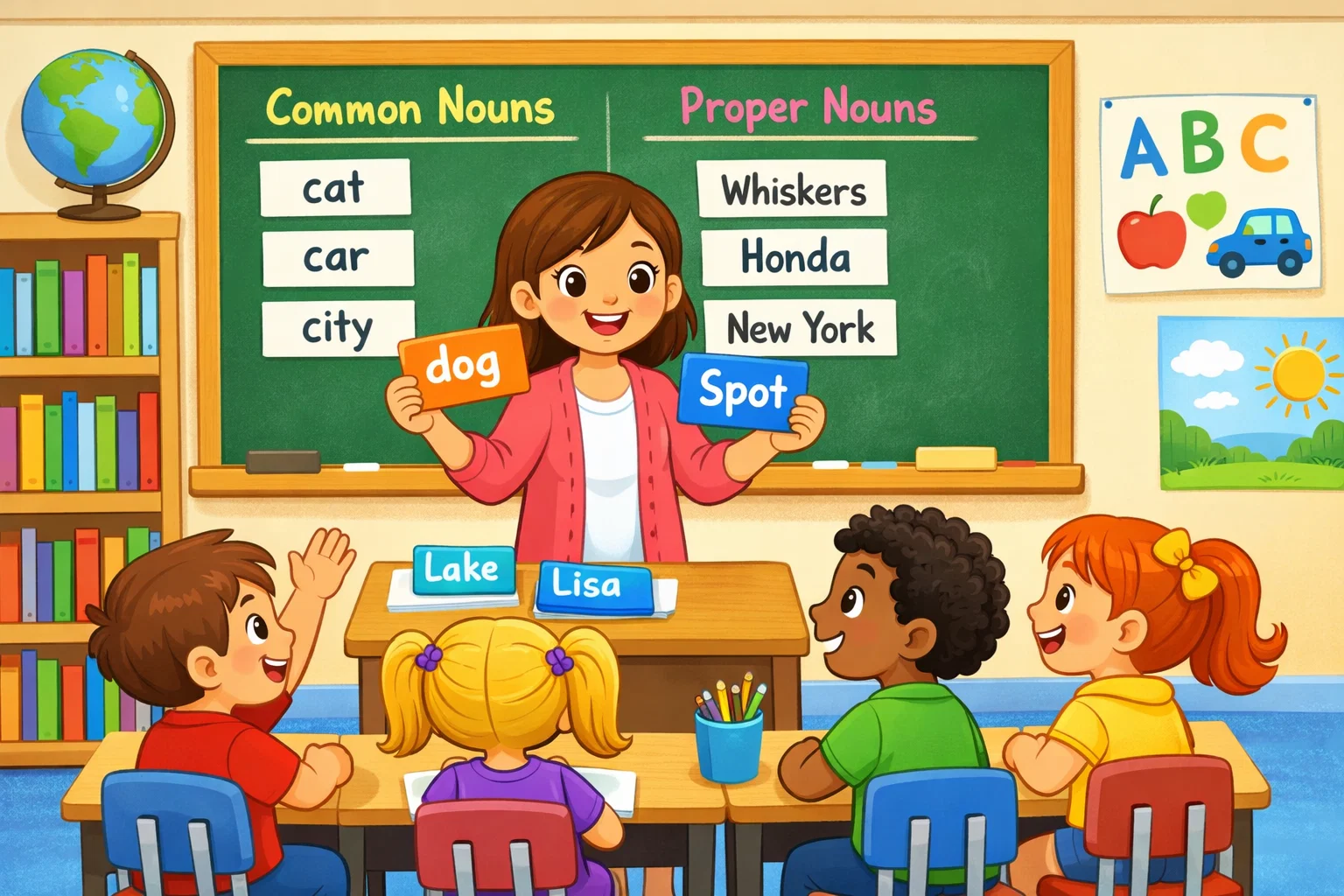
Educators and parents frequently look for structured, engaging ways to teach the difference between general and specific names in English. This article provides 15 practical activities for classroom instruction, homework, learning centers, small groups, and one-on-one practice to help students master these essential grammar concepts. Common nouns represent general categories for people, places, or things, while proper nouns represent specific entities and always require capital letters. The following sections offer clear definitions, identification tips, interactive activities, quiz ideas, and FAQs to support your teaching goals.
Lesson Details
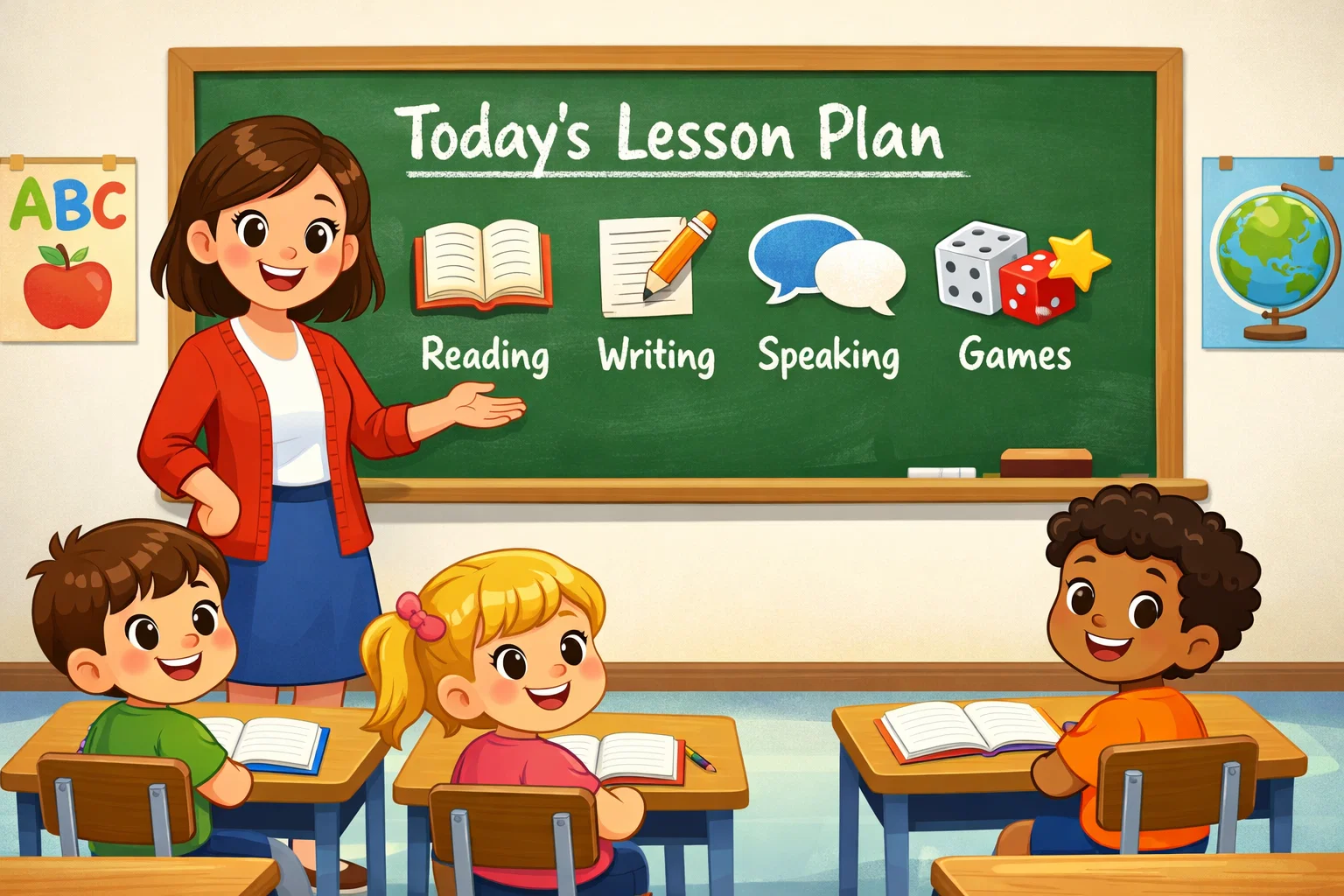
This section provides a practical framework for implementing these grammatical concepts effectively. Whether you are using a standard curriculum or creating custom lesson plans, this guide helps teachers, tutors, and parents create a structured learning environment.
| Feature | Target Audience / Specification |
| Grade Level | Grades K–3 |
| Primary Skills | Grammar identification, capitalization, sentence construction |
| Required Materials | Word cards, whiteboards, printable exercises, markers |
| Activity Format | Individual, pair, or small-group instruction |
Key Learning Points
After completing these activities, students will be able to:
- Distinguish between the two types of nouns with high accuracy.
- Apply correct capitalization rules to specific names.
- Identify both categories in simple and moderately complex sentences.
- Use these word types effectively in both speaking and writing tasks.
Keywords
- Common Noun: A general name for a person, place, or thing.
- Proper Noun: A specific, official name that requires a capital letter.
- Capital Letter: The uppercase form used to mark the start of a proper name.
- Sentence: A complete grammatical unit that can include both types of naming words.
- Sorting: The act of grouping items into specific categories.
- Grammar games: Interactive activities that make grammar practice more engaging.
- English resources: Instructional materials, often in PDF format, used to support learning.
Common Misconceptions
- Overcapitalization: Students often assume that important-looking words should be capitalized.
- Category confusion: Learners may misidentify words like “school” or “city” as specific names even when they are not part of one.
- Holiday Oversight: Students often fail to capitalize months, days of the week, or holidays.
- Wrong: “I saw a teacher named Mr. smith.” / Correct: “I saw a teacher named Mr. Smith.”
Equipment
Prepare these materials to support learning: word cards, mini whiteboards, markers, a printable worksheet, scissors, glue, dice, and bingo cards. Many hands-on activities require minimal prep, while others work best with preprinted materials.
15 Common Noun and Proper Noun Activities
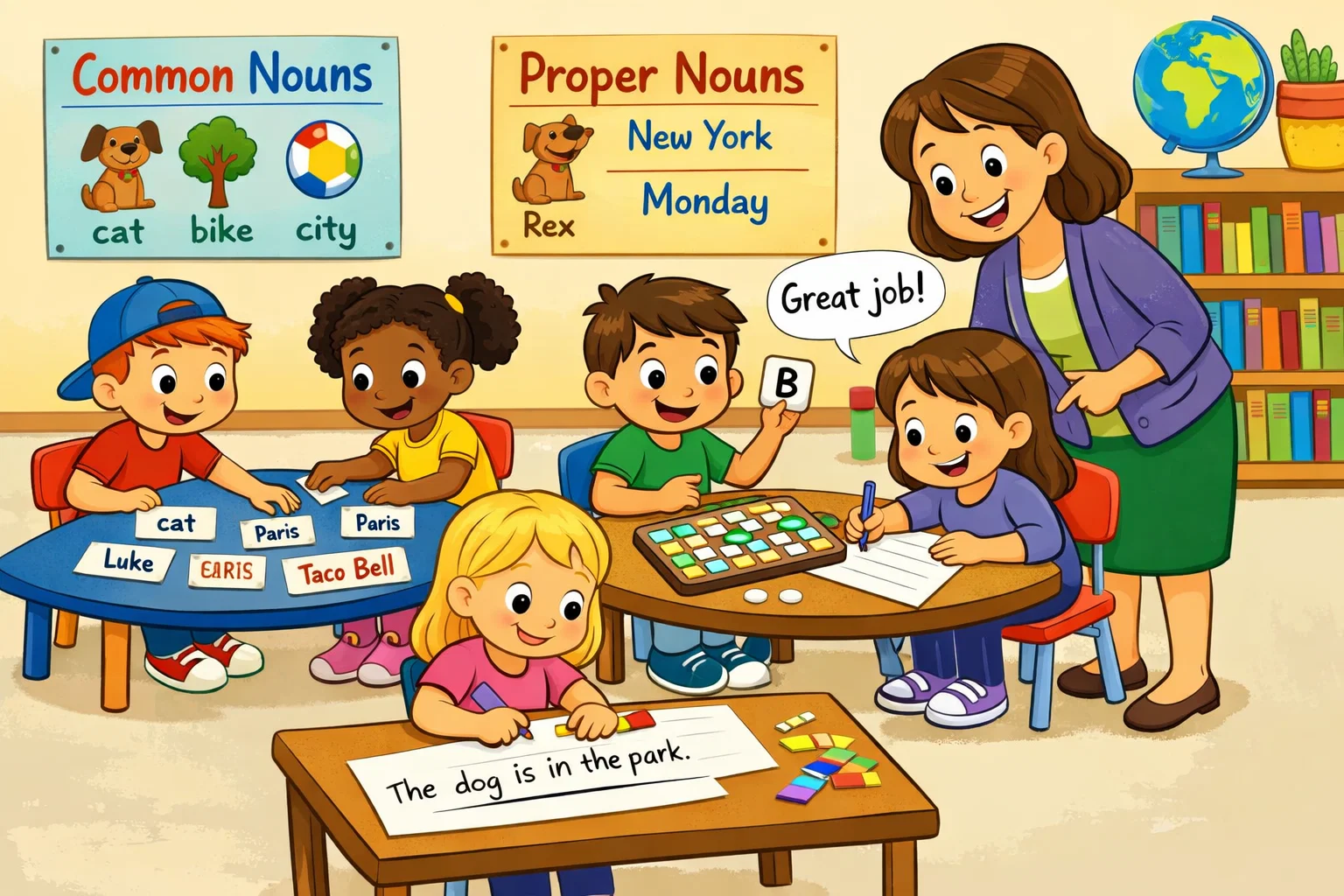
These activities offer effective ways to practice this grammar skill in a variety of settings. These tasks are designed to make grammar practice playful, effective, and engaging.
1. Common Noun and Proper Noun Sorting
Students sort common nouns and proper nouns into two columns.
- Skills: Categorization.
- Best for: Centers.
- Variation: Use mixed categories like brands versus general objects.
2. Common Noun Matching
Students match each general word to a corresponding specific name (city → London).
- Skills: Association.
- Best for: Pairs.
- Variation: Use picture cards for visual learners.
3. Sentence Construction Challenge
Students assemble sentence parts to include both types of terms.
- Skills: Sentence building.
- Best for: Group work.
- Variation: Time the students to see who finishes fastest.
4. Noun Unscramble
Students unscramble letters to find a word, then classify it.
- Skills: Spelling and sorting.
- Best for: Individual work.
- Variation: Use secret codes for the words.
5. Noun Pictionary
One student draws a word, and the team identifies the type.
- Skills: Recognition.
- Best for: Whole class.
- Variation: Increase difficulty with abstract ideas like “happiness.”
6. Proper Noun Guessing
The teacher gives clues for specific entities like holidays or cities.
- Skills: Comprehension.
- Best for: Whole class.
- Variation: Students create their own clues for peers.
7. Noun Art Gallery
Students create posters with their favorite words.
- Skills: Creative expression.
- Best for: Wall display.
- Variation: Host a “gallery walk” to review peer work.
8. Noun Bingo
Students play bingo using a grid of various terms.
- Skills: Recognition.
- Best for: Small groups.
- Variation: Call out only the proper names.
9. Noun Flip Book
Students create a booklet defining both types with examples.
- Skills: Organization.
- Best for: Revision.
- Variation: Add a page for “trick” words.
10. Common Noun Charades
Students act out a word, and others guess the type.
- Skills: Movement and identification.
- Best for: Active learners.
- Variation: Include brands for proper names.
11. Story Creation
Students write a short story using a mix of general and specific names.
- Skills: Writing accuracy.
- Best for: Advanced learners.
- Variation: Provide a checklist for self-editing.
12. Classroom Scavenger Hunt
Students look for examples of both categories on labels, posters, name tags, and classroom signs around the room.
- Skills: Observation.
- Best for: Movement-based learning.
- Variation: Search through books for examples.
13. Sentence Puzzles
Cut sentences into pieces; students reassemble and color-code the terms.
- Skills: Mechanics.
- Best for: Station work.
- Variation: Use highlighter tape for quick identification.
14. Answering Questions with Proper Nouns
Students answer questions like “What is your favorite holiday?” using complete sentences.
- Skills: Speaking and writing.
- Best for: One-on-one.
- Variation: Use a digital prompt system.
15. Common and Proper Noun Review
Give students a category and ask them to provide both a general word and a specific name.
- Skills: Synthesis.
- Best for: Final review.
- Variation: Use a random category spinner.
Assessment and Exit Quiz
Prior Knowledge Starter Quiz
Use 4–6 quick questions to gauge current understanding, such as identifying the capitalized term in a list or picking the correct definition.
6 Quick Practice Questions
- Is “dog” general or specific?
- Capitalize the word “paris.”
- Does “Wednesday” need a capital letter?
- Find the specific name in this list: book, desk, London.
- Create a sentence with one of each type.
- Is “car” a general word or a specific name?
Exit Quiz
Conduct a 4–6 question check after activities to ensure students identify concepts correctly.
Feedback and Reinforcement
Provide immediate feedback through color-coding, pair checks, or mini-reteaching sessions. Teachers should communicate with parents to help students maintain consistent practice at home.
What Common Nouns Are
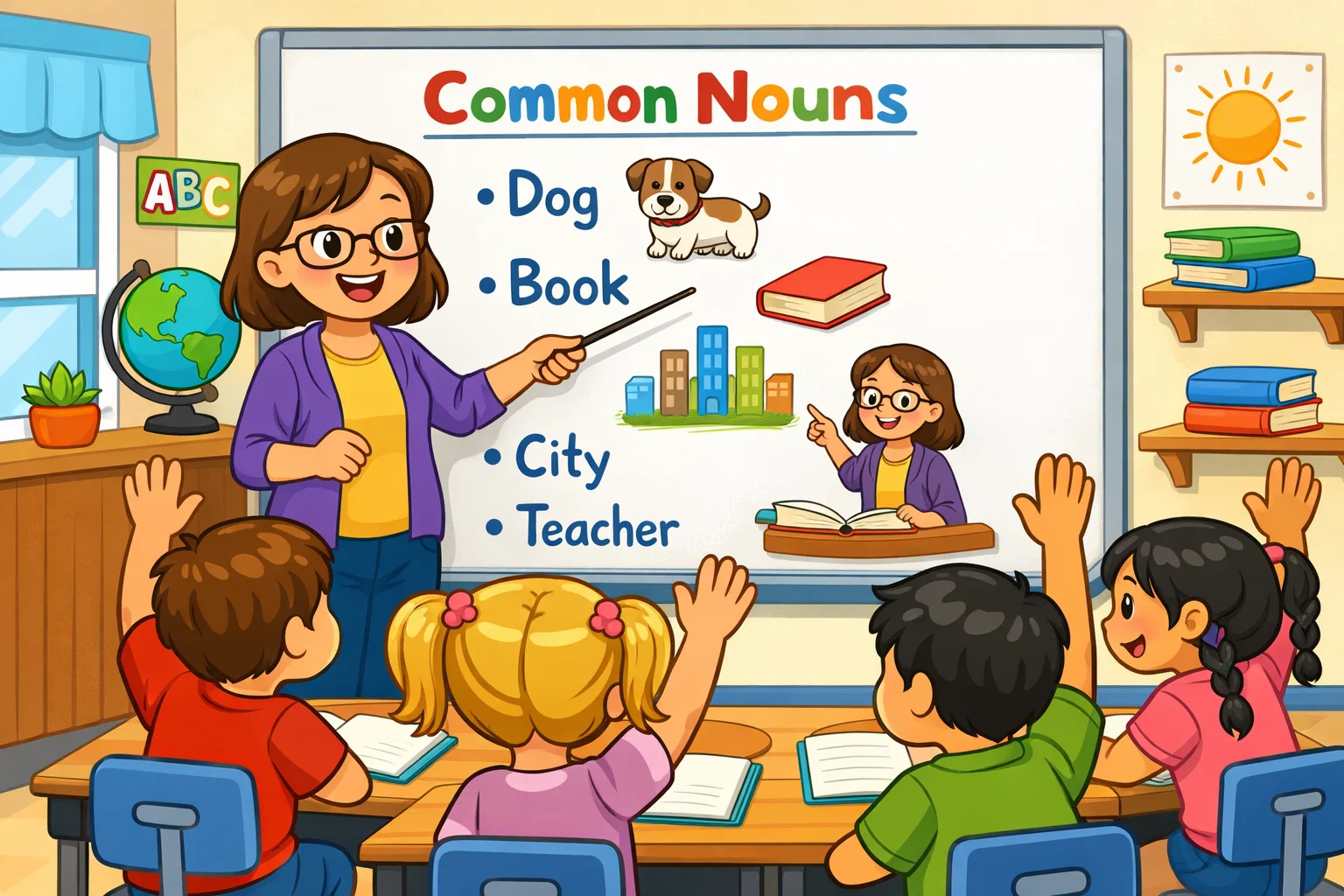
Common nouns form a basic part of vocabulary because they provide general names for the world around students. These words name any member of a group without identifying a specific individual.
Definition
A common noun is a general name for a person, place, animal, or thing. In simple terms, this kind of word names a general person, place, animal, or thing rather than a specific one. Common nouns refer to general items like “teacher” or “city.”
Examples
- Person: doctor, sister, student, chef
- Place: park, library, store, kitchen
- Thing: book, pencil, table, computer
- Animal: cat, elephant, bird, shark
- Idea: love, happiness, peace, dream
Common Nouns in Sentences
- The teacher reads a book.
- A dog ran to the park.
- The student’s book sits on the table.
- Every doctor works at a hospital.
- A small bird sat on the chair.
What Proper Nouns Are
Proper nouns identify specific people, places, things, or titles. They name a specific person, place, thing, or title and are always capitalized.
Proper Noun Definition
A proper name identifies a particular person, place, thing, or title. This type contrasts with the general nature of common nouns by pinpointing exactly who or what is being discussed.
Proper Noun Examples
- People: Sarah, David, Mr. Jones
- Places: London, France, Mars, the Amazon River
- Time/Holiday: Monday, January, Christmas
- Brands/Titles: Disney, Nike, Harry Potter and the Sorcerer’s Stone
Capitalization Rules
Proper nouns require capital letters in standard written English.
| Type | Example |
| Names of People | Albert Einstein |
| Cities / Countries | Tokyo / Japan |
| Days / Months | Friday / October |
| Holidays | Thanksgiving |
| Brands | Apple |
Common Nouns vs Proper Nouns
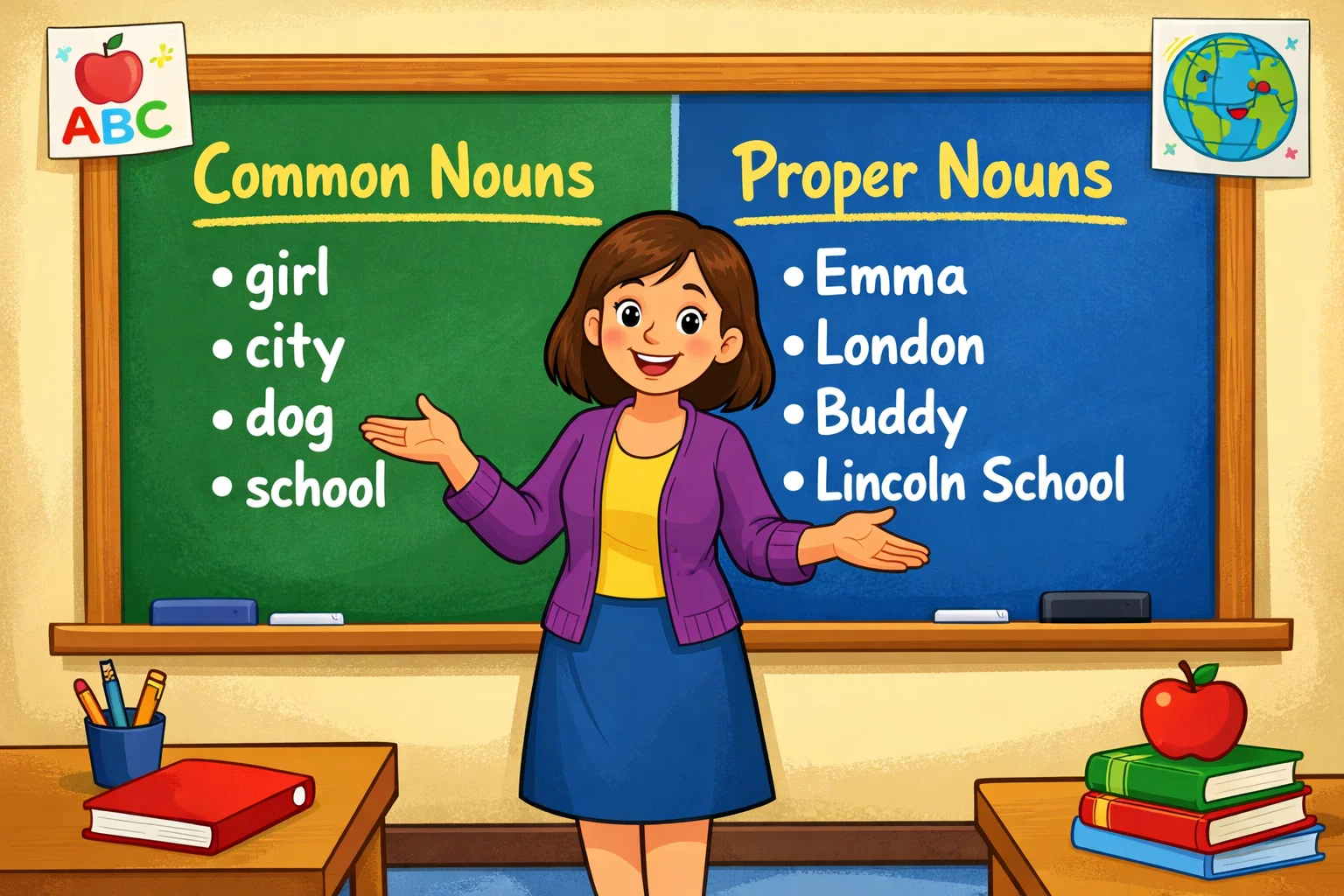
Understanding the distinction between these two categories is vital for developing strong reading and writing abilities. To tell them apart, students need to decide whether a word names a general category or something specific.
Key Differences
| Criterion | Common | Proper |
| Meaning | General | Specific |
| Capitalization | Only at sentence start | Always |
| Examples | city, boy, store | Paris, Liam, Target |
Common Noun Sentences
- The cat plays with a toy. (General animal and object.)
- A girl walked to school. (General person and location.)
Proper Noun Sentences
- Luna plays with Barbie. (Specific pet name and brand.)
- Emma walked to Lincoln Elementary. (Specific person and institution.)
Common Noun to Proper Noun Pairs
- teacher → Mr. Brown
- city → Paris
- school → Greenfield School
- river → Nile
Why Common and Proper Nouns Matter in Reading and Writing
The ability to categorize words helps students interpret texts more accurately and express their ideas more clearly in writing. This knowledge improves overall language accuracy.
Reading Benefits
Proper nouns help readers quickly identify key people, locations, and titles within a text. Recognizing these specific terms helps students follow the meaning of a story more easily.
Writing Benefits
Using correct capitalization and accurate word choice improves clarity and makes writing look polished. Naming a specific place gives the reader a clearer mental image than using a generic term, which strengthens descriptive writing.
Grammar Confidence
Mastering these categories builds a bridge to more advanced grammar topics. Students who understand these basics usually find it easier to work with pronouns, adjectives, capitalization, and punctuation in later grades. Keep reading to learn how to apply this knowledge in your classroom.
How to Identify Common and Proper Nouns in Sentences
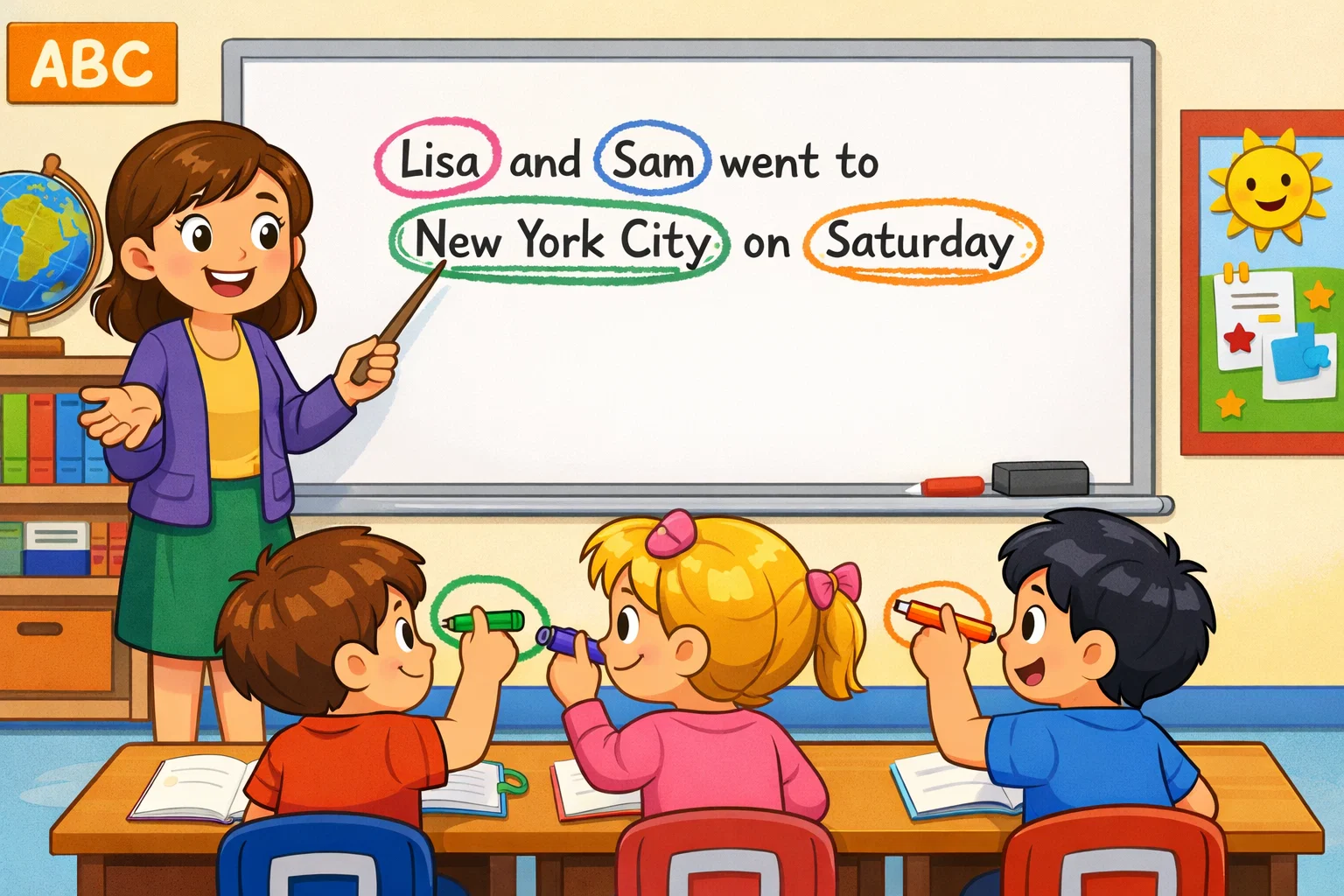
Identifying these word types becomes easier when students follow a simple step-by-step process. Teachers often use worksheets, sentence analysis, and short practice tasks to reinforce the concept.
Person, Place, Thing, Idea Clues
The first step is to ask whether the word names a person, place, animal, thing, or idea. Ask, “Does this word name a general category, or does it name someone or something specific?”
Capital Letter Signals
Although capital letters are a strong clue, students should check whether the word is capitalized only because it appears at the beginning of a sentence. A general word can be capitalized when it begins a sentence, which is a frequent source of confusion.
Context Clues
Context often defines whether a term is general or specific. For example, “river” is general, but “the Mississippi River” is specific. Teachers can provide a list of words or use sentences with missing nouns and ask students to identify the correct category.
Quick Identification Checklist
- Is the word a name of a specific entity?
- Does it refer to a general category or to something specific?
- Is it currently capitalized?
- If the capital letter were removed, would the word still refer to a specific name?
Worksheet, Lesson Slides, and Lesson Video
Worksheet
An effective printable includes sorting, fill-in-the-blank, and sentence-correction exercises to provide variety for different learning levels. This serves as a common and proper nouns worksheet for targeted practice.
Lesson Slides
Slides should follow a logical flow: definition, comparison table, guided practice, independent task, and final review.
Lesson Video
A video should feature a clear explanation, pause-and-think questions, and a short quiz to reinforce concepts. This is an engaging way to support visual learners.
Answer Key
Always include an answer key for every worksheet and quiz to assist parents, tutors, and substitute teachers in checking student work.
Conclusion
Mastering these grammar categories requires repeated practice through sorting, sentence work, games, and quick assessments. By implementing these 15 activities and utilizing structured practice materials, educators help students understand the building blocks of language.
Key Takeaways
- The primary difference lies in specificity.
- Capitalization is mandatory for proper terms.
- Context clues help determine word type.
- Activity-based learning increases retention.
Next Practice Steps
- Select three activities to perform this week.
- Print or create a worksheet for independent practice.
- Conduct a starter quiz to identify areas for support.
FAQs
How to Modify Activities for Different Learning Levels
Use fewer words or picture support for simpler needs, while offering sentence-writing tasks and category expansion for more advanced learners.
Online Resources for Further Learning
Search for printable grammar centers, digital sorting games, and interactive quiz platforms. A large bundle of resources can make preparation easier.
How Parents Can Support Learning at Home
Engage in a “word hunt” at home, play naming games, or practice spotting specific names while reading bedtime stories. Read stories that include a mix of both types of nouns to prompt discussion.
Common Mistakes Kids Make
Frequent errors include missing capital letters on days/months, confusing titles with common labels, and failing to recognize when a common term starts a sentence.
Best Grade Levels for Activities
These activities are most effective for kindergarten through 3rd grade, though they are also useful for ESL learners of all ages who are learning English and need foundational grammar support.
Take a short quiz to find out what your everyday choices say about your parenting style
When your child is curious about something new, what’s your instinct?
Take a short quiz to find out what your everyday choices say about your parenting style
“Can I download this app?” What happens next?
Take a short quiz to find out what your everyday choices say about your parenting style
When it comes to rules at home, which sounds most like you?
Take a short quiz to find out what your everyday choices say about your parenting style
If you could give your child one life skill today, what would you pick?
Take a short quiz to find out what your everyday choices say about your parenting style
Your child gets to choose what to watch. What would your ideal setup look like?
Take a short quiz to find out what your everyday choices say about your parenting style
Pick your parenting superpower ✨