Adjectives for Kids: Types, Examples, Lists and Fun Activities

 Discover a Free Education Video App for Kids
Pastory uses AI to personalize educational video content based on your child’s interests and personality. Safe, engaging, and built for curious young minds. Sign up now to stay updated and enjoy early access with a free trial
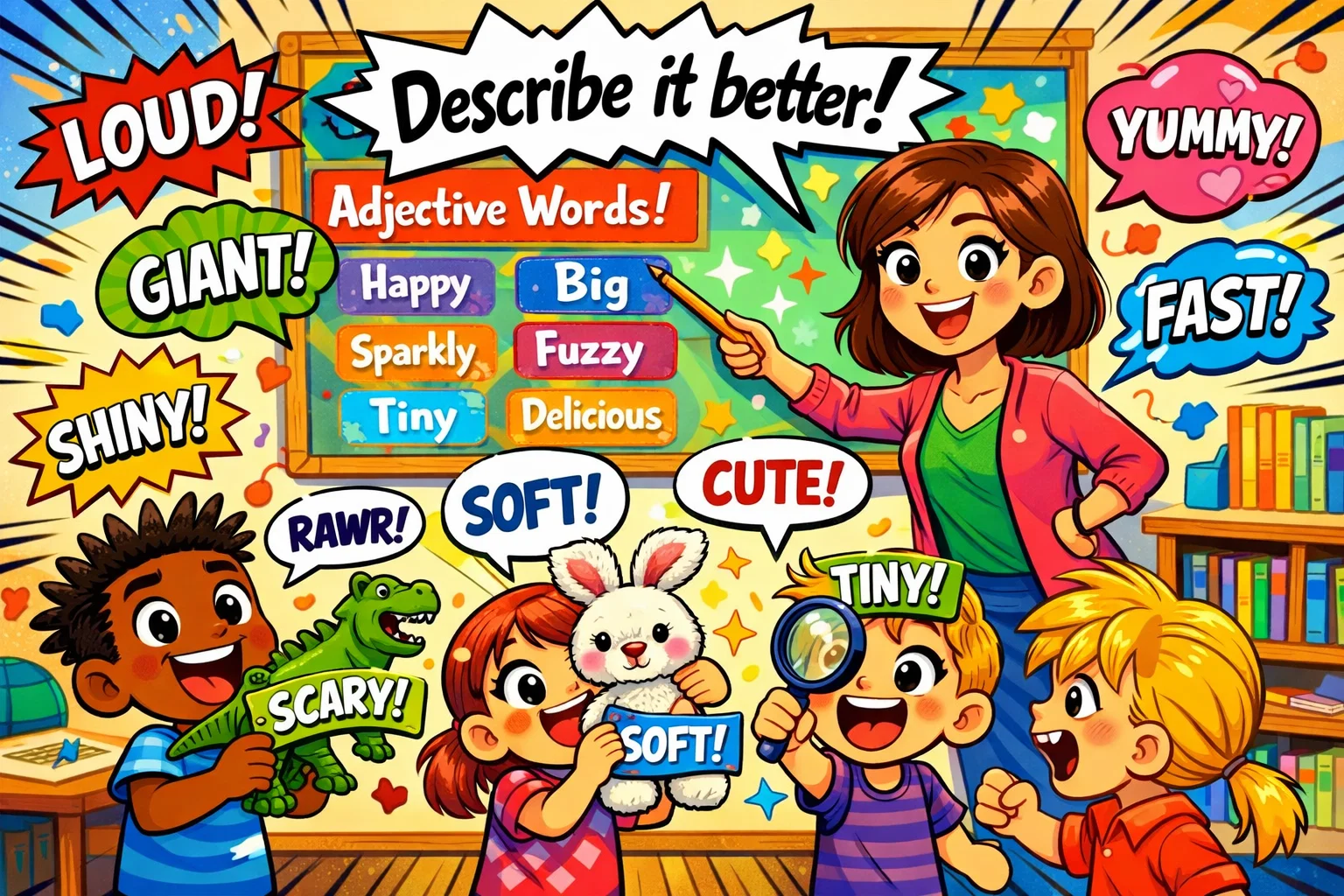
Learning about describing words opens up a whole new world of language for children. This guide covers everything parents and teachers need to know — from a simple definition and a list of adjectives for kids, to types, examples, age-based learning stages, and fun activities that make practice feel like play. Whether you’re building early language skills or expanding a child’s vocabulary in 4th or 5th grade, this adjectives list has something for every learner.
What Are Adjectives
Adjectives are words that describe nouns — the people, places, and things we talk and write about every day. When a child says “I want the red apple” or “the big dog scared me,” the words “red” and “big” are adjectives. They add detail, color, and meaning to sentences, helping kids express themselves more clearly and creatively.
Understanding how these words work is a foundational step in language development. Research in early childhood literacy suggests that children who learn to use adjectives early tend to develop stronger reading comprehension and writing skills over time.
Simple Definition of Adjectives for Kids
An adjective is a word that tells us more about a noun. It answers questions like: What kind? How many? Which one? For example, in “a fluffy cat,” the word “fluffy” describes what the cat is like. Describing words help us paint a picture instead of just naming things.
A simple way to explain this to little ones: “These are adjectives. They help us say what something looks like, feels like, sounds like, or how many there are.”
Examples of Adjectives in Sentences
Descriptive words appear naturally in everyday speech and writing. Here are some easy examples children can relate to:
- “She has a tiny kitten.”
- “We ate a delicious pizza.”
- “He wore a bright yellow hat.”
- “There were three butterflies in the garden.”
- “This is my favorite book.”
In each sentence, the adjective comes before the noun it modifies, which is the most common pattern in English.
Types of Adjectives for Kids
There are several different categories, each serving a specific purpose in language. Introducing kids to these groups helps them use descriptive words more intentionally and understand more expressive writing.
Descriptive
Descriptive adjectives capture the qualities of a person, place, or thing — such as color, size, shape, or texture. Words like “tall,” “round,” “soft,” “green,” and “noisy” all fall into this category. These are the most common ones kids encounter in early childhood and are a great place to start learning.
Possessive
Possessive adjectives show ownership and always appear before a noun. The main possessive forms in English are: my, your, his, her, its, our, their. For example: “This is my backpack” or “Where is her pencil?” These words help children talk about belongings and relationships clearly.
Demonstrative
Demonstrative adjectives point to specific nouns and include this, that, these, and those. “This” and “these” refer to things nearby; “that” and “those” refer to things farther away. For example: “These shoes are too tight” or “That cloud looks like a rabbit.”
Number
Number adjectives describe quantity or order. They answer the question “how many?” or “in what order?” — for example, “two cookies,” “five fingers,” or “first place.” Children often encounter them naturally when counting or following instructions.
Quantitative
Quantitative adjectives describe an approximate amount rather than an exact number. Words like some, many, few, several, much, and little are common examples. For example: “She has many friends” or “He ate a little soup.” These are useful for helping kids describe things without always using numbers.
Interrogative
Interrogative adjectives are question words used before nouns: which, what, and whose. For example: “Which color do you like?” or “Whose bag is this?” These words help children form questions and practice language skills through conversation.
Emphasizing
Emphasizing adjectives add extra stress or focus to a noun. The most common are own and very — for example, “She did it with her own hands” or “That was the very last piece.” While less common in early learning, they add flavor to sentences and support more expressive writing in 5th and 6th grade.
Adjectives List for Kids
Having a handy reference list makes it easier to introduce new adjectives gradually. Here is a focused list organized by category for simple, practical use.
- Size: big, small, tiny, huge, tall, short, long, wide, narrow, little
- Color: red, blue, green, yellow, purple, orange, pink, brown, black, white
- Shape: round, square, flat, pointy, oval, curved, straight, crooked
- Texture and Touch: soft, rough, smooth, bumpy, fluffy, sticky, slippery, wet, dry, fuzzy
- Taste and Smell: sweet, sour, salty, spicy, bitter, delicious, fresh, fruity, yummy, stinky
- Sound: loud, quiet, noisy, squeaky, silent, creaky, shrill, soft
- Feelings and Emotions: happy, sad, angry, scared, excited, nervous, proud, surprised, tired, brave, silly, calm, cheerful, grumpy, lonely
- Personality and Character: kind, funny, clever, curious, shy, friendly, polite, gentle, naughty, patient
- Weather and Nature: sunny, cloudy, rainy, windy, cold, warm, hot, stormy, icy, foggy
- Number and Quantity: one, two, many, few, some, several, both, all, enough, no
Comparative and Superlative Forms
| Base | Comparative | Superlative |
| Big | Bigger | Biggest |
| Fast | Faster | Fastest |
| Tall | Taller | Tallest |
| Happy | Happier | Happiest |
| Loud | Louder | Loudest |
| Kind | Kinder | Kindest |
Comparative forms are used to compare two things (“This book is longer”), while superlatives describe the most extreme version (“That was the funniest joke”). Children typically begin using comparative forms naturally around age 4 to 5.
Fun Adjective Activities and Games for Kids
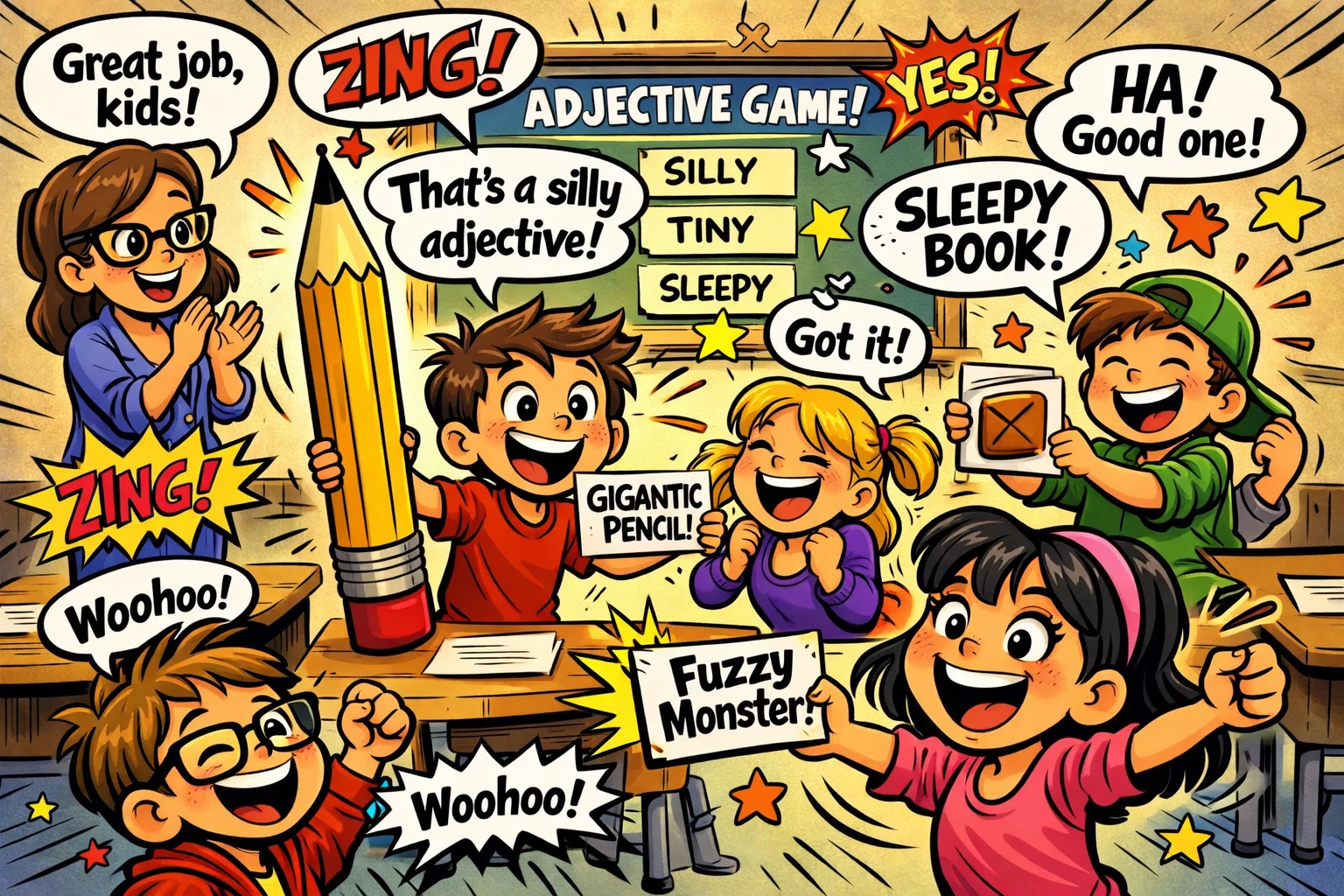
Games and activities are among the most effective ways to reinforce descriptive language learning. Play-based practice helps kids use new words in context, which deepens understanding and makes vocabulary stick. Here are some interactive ideas that work well both at home and in the classroom.
Adjective I Spy Game
Play the classic “I spy with my little eye” game using describing words instead of letters. One player says, “I spy with my little eye something round and red.” Other players look around and guess the object. This game encourages kids to observe their environment and describe things naturally.
Descriptive Drawing Activity
Read out a sentence containing several adjectives — for example, “a tiny, purple house with a round, yellow door” — and ask children to draw exactly what they hear. Comparing drawings afterward shows how these words create specific mental pictures and helps kids understand more descriptive language.
Adjective Pictionary
In this fun game, one player draws a word (like “fluffy” or “enormous”) while others guess it. Since adjectives capture qualities rather than objects, this encourages creative thinking and deepens understanding of what each word actually means.
Adjective Charades
Players act out a describing word — such as “tired,” “tiny,” or “excited” — while teammates guess the word. This activity works especially well for emotional and behavioral vocabulary, helping kids connect words to real experiences and feelings.
Sorting Game
Write a list of words on cards and ask children to sort them into categories: size, color, shape, texture, feeling. This reinforces the concept of different word types while building classification skills. It works particularly well as a classroom lesson plan for early elementary students.
Memory Game
Create pairs of cards — one with an adjective (e.g., “spiky”) and one with a matching image (e.g., a cactus). Players flip cards face-down and take turns finding matching pairs. This strengthens vocabulary recall and helps kids connect words to objects using visuals.
Adjective Scavenger Hunt
Give children a list of describing words and ask them to find matching objects in the room or outdoors. For example, find something “smooth,” something “heavy,” and something “striped.” Scavenger hunts make learning active and connect vocabulary to the real environment.
Show and Tell
Ask each child to bring in an object and describe it using at least three words before the group guesses what it is. For example: “It’s small, round, and bouncy.” This builds confidence in speaking and encourages children to describe people, objects, and experiences in detail.
Adjective Story Game
Sit in a circle and take turns adding to a story, with each player required to include at least one descriptive word. For example: “Once there was a brave girl…” “She lived in a tiny, mysterious house…” This creative writing game makes sentences more vivid and encourages expressive language use.
Book Hunt
Read a book together and challenge children to find as many adjectives as possible. They can underline them, write them in a list, or call them out as you read aloud. This activity shows how professional writers use descriptive language to add detail and bring stories to life.
When Kids Should Learn Adjectives
Children begin absorbing descriptive words long before they can formally define them. Understanding developmental readiness helps parents and teachers introduce new vocabulary at the right pace.
Adjectives for 2 to 3 Year Olds
Toddlers naturally begin using simple adjectives around age 2. Words like “big,” “hot,” “wet,” “soft,” and basic colors are among the first they acquire. At this stage, learning happens through sensory experience — touching, tasting, and exploring the world around them.
Adjectives for 4 to 6 Year Olds
Children aged 4 to 6 are ready to expand their vocabulary to include more complex descriptive words — comparative forms like “bigger” and “fastest,” emotional words like “nervous” or “proud,” and more specific descriptions. Preschool and kindergarten lesson plans often introduce these through storytelling, drawing, and group discussion.
Signs a Child Is Ready to Learn Adjectives
Children typically show readiness when they:
- Spontaneously describe objects with words like “pretty” or “yucky”
- Ask questions like “What does that taste like?”
- Begin comparing things: “This one is bigger”
- Show curiosity about learning new words and ask what things are called
Tips to Teach Adjectives to Kids Easily
Use Everyday Conversations
The most natural way to build descriptive vocabulary is through daily conversation. When you describe your morning (“It’s a cold, cloudy day today”) or ask your child to describe things (“What does the soup taste like?”), you model how these words work without making it feel like a lesson.
Use Visual Aids and Flashcards
Flashcards that pair a word with a clear image are particularly effective for visual learners. Studies in early childhood education suggest that pairing words with images accelerates vocabulary acquisition, especially for children aged 3 to 6. A well-designed flashcard set can double as both a teaching tool and a game.
Encourage Storytelling
When children create stories — whether spoken or written — they naturally need descriptive words to bring characters and settings to life. Encouraging kids to tell stories about their day, their toys, or imaginary adventures helps them use vocabulary in context.
Practice with Games
Structured play is one of the most effective teaching tools in early childhood. Interactive activities give children repeated exposure to new words in a low-pressure setting, which research suggests is key to long-term vocabulary retention.
Common Mistakes Kids Make with Adjectives
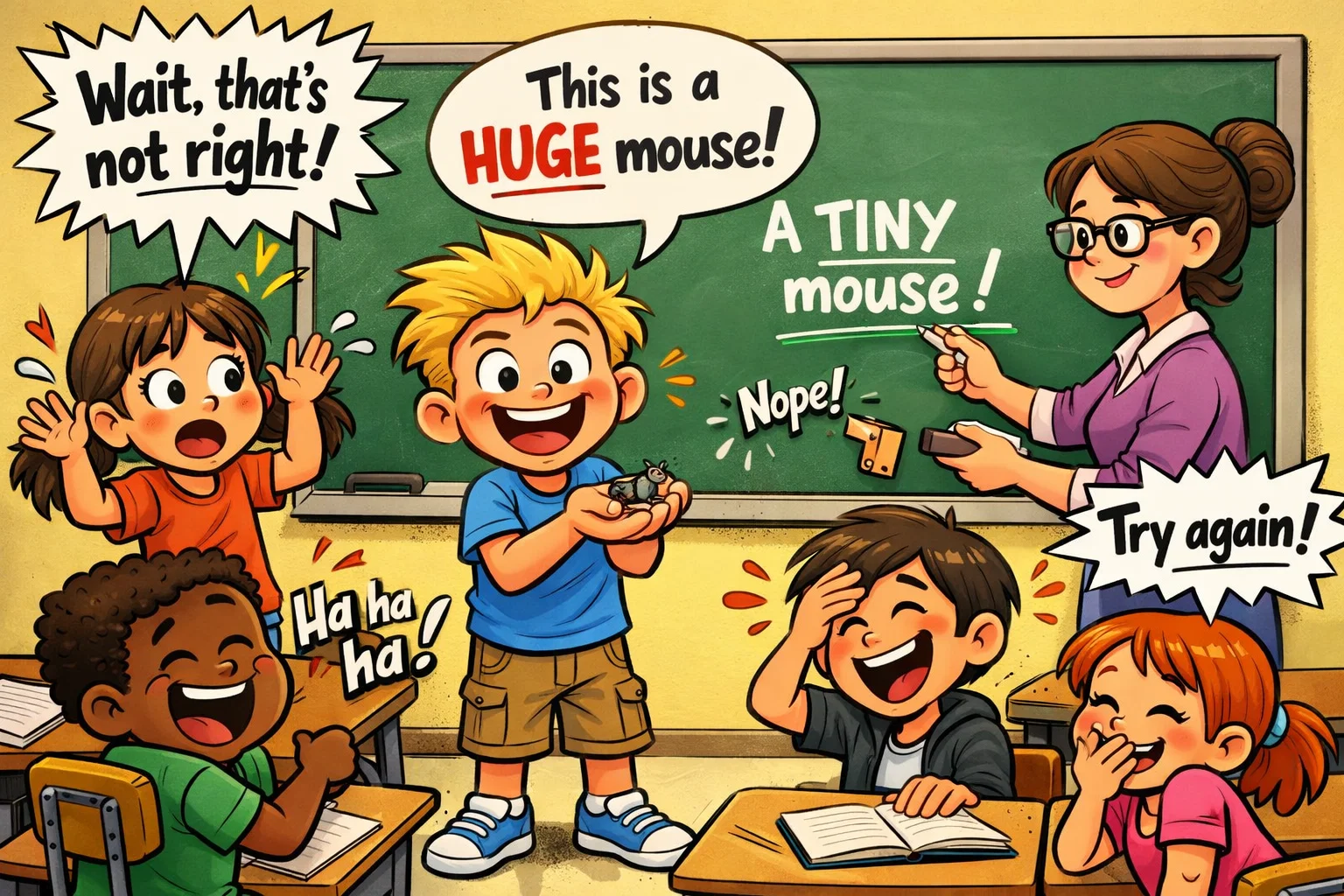
Overusing Basic Adjectives
Many children rely heavily on a small set of words — like “good,” “nice,” “big,” and “bad.” While correct, overuse limits expressive range. Instead of saying “good,” ask your child to be more specific: “Was it exciting? Relaxing? Funny?”
Incorrect Word Placement
In English, describing words typically come before the noun. Children may sometimes place them after the noun — a common pattern in other languages — or use two words in the wrong order. For example, saying “a dog fluffy” instead of “a fluffy dog.” Gentle correction through modeling the correct sentence is the most effective approach.
Confusing Adjectives with Other Parts of Speech
Children sometimes mix up describing words with adverbs (which modify verbs rather than nouns) or use a verb where a descriptive word is needed. For example, saying “She runs happy” instead of “She runs happily.” A simple explanation works well: “Adjectives describe things, adverbs describe actions.”
Conclusion
Adjectives are far more than a grammar lesson — they are tools that help children understand and describe the world around them. From simple color words in the toddler stage to complex comparative language in 5th and 6th grade, learning descriptive vocabulary builds language skills and supports creative thinking.
The most effective approach combines everyday conversation, visual aids, storytelling, and play-based activities. When parents and teachers work together to make descriptive language part of daily life — not just a classroom exercise — children develop richer, more expressive communication skills that serve them for years to come. Start small, stay consistent, and make it fun: the results speak for themselves.
Frequently Asked Questions
What if my child has difficulty learning adjectives?
If a child struggles with descriptive vocabulary, returning to concrete, sensory experiences is the most effective starting point. Focus on simple words tied to physical sensations — “rough,” “cold,” “loud” — and connect each one to a direct experience. Persistent difficulty may sometimes suggest a language delay, and consulting a speech-language pathologist can provide early support.
Can adjectives improve writing skills?
Yes — descriptive language has a direct impact on writing quality. It helps children move from simple sentences (“The dog ran”) to vivid, engaging writing (“The muddy, exhausted dog ran through the tall grass”). Strong use of descriptive words is a measurable indicator of writing development in grades 4, 5, and 6.
How to practice adjectives at home?
Simple daily routines make practice feel natural. Try describing meals (“The soup is warm and salty”), asking your child to describe their day using three words, or reading a book together and spotting descriptive language on each page. Consistency matters more than length — even five minutes daily adds up significantly over time.
What are the easiest adjectives for beginners?
The best starting words are tied to direct sensory experience: colors (red, blue, green), sizes (big, small, tiny), textures (soft, rough, smooth), and basic emotions (happy, sad, scared). These appear frequently in everyday life, giving children many natural opportunities to hear and use them.

Take a short quiz to find out what your everyday choices say about your parenting style
When your child is curious about something new, what’s your instinct?
Take a short quiz to find out what your everyday choices say about your parenting style
“Can I download this app?” What happens next?
Take a short quiz to find out what your everyday choices say about your parenting style
When it comes to rules at home, which sounds most like you?
Take a short quiz to find out what your everyday choices say about your parenting style
If you could give your child one life skill today, what would you pick?
Take a short quiz to find out what your everyday choices say about your parenting style
Your child gets to choose what to watch. What would your ideal setup look like?
Take a short quiz to find out what your everyday choices say about your parenting style
Pick your parenting superpower ✨