How to Give Your Child 80s Childhood: Parenting Guide

 Discover a Free Education Video App for Kids
Pastory uses AI to personalize educational video content based on your child’s interests and personality. Safe, engaging, and built for curious young minds. Sign up now to stay updated and enjoy early access with a free trial

Childhood in the 1980s is remembered with a particular warmth — the kind that comes from scraped knees, long summer days, and the freedom to roam until the streetlights came on. For many parents today, those fond memories of an 80s childhood represent something that feels increasingly out of reach for their own kids.
This guide explores what made growing up in the 80s so formative, why modern childhood looks so different, and how you can give your kids a taste of that same independence, creativity, and connection — even today.
Growing Up in the 80s
Childhood in the 1980s was characterized by autonomy, simplicity, and a level of freedom that shaped how an entire generation approached the world. Children grew up with far fewer structured activities, far more unscheduled time, and a social life built almost entirely on face-to-face interaction.
Daily Life Without Technology
The most defining feature of life as an 80s kid was the absence of constant digital stimulation. There were no smartphones, no social media, and no streaming platforms. Kids spent afternoons watching MTV videos or a handful of Saturday morning cartoons — and when that was done, they went outside. Routines were shaped by physical rhythms: school, play, dinner, bed. Without a screen to fill every idle moment, children developed a different relationship with time and boredom.
Simplicity and Community Environment
Neighborhood culture in the 1980s was genuinely communal. Kids knocked on doors, formed friendships spontaneously, and spent hours at the local park unaccompanied by parents. Families in many cases knew their neighbors well, and children moved relatively freely between homes.
This kind of open-door social life — common in a small town or suburb alike — gave children a natural sense of belonging and social confidence that didn’t require organized playdates or parental scheduling.
Boredom as a Driver of Creativity
Without instant entertainment, 80s kids were left to their own devices — literally. Boredom became a creative engine. Kids often devise their own games, invent elaborate make-believe worlds, or find ways to entertain themselves with whatever was on hand.
Unstructured downtime plays a key role in building executive functioning skills, including planning, problem-solving, and self-regulation. The 80s offered an abundance of that unstructured time, almost by accident.
Why Modern Kids Don’t Experience the Same Freedom

Today’s childhood looks strikingly different from the 80s, and the shift isn’t just cultural — it’s structural. Several overlapping forces have reduced the kind of open, independent experience that once defined growing up.
Rise of Screen-Based Entertainment
Smartphones and tablets have fundamentally changed how children spend their leisure time. According to Common Sense Media, children aged 8–12 now spend an average of nearly five hours per day on screens for entertainment alone.
Playing games, watching content, and scrolling social media have replaced the outdoor activities and imaginative play that once filled those hours. The result is less movement, less boredom-driven creativity, less spontaneous social interaction, and more FOMO.
Increased Parental Control and Safety Concerns
Helicopter parenting and lawnmower parenting — styles in which parents hover over or clear obstacles for their children — have become significantly more common since the 1980s.
While parental concern is understandable, research backs the idea that much less risk-averse environments produce more resilient, capable children. The fear of missing something going wrong has led many parents to supervise more closely and allow less independence than previous generations did.
Loss of Neighborhood Play Culture
The informal social infrastructure that once supported 80s childhood has largely dissolved. Fewer children play outside unsupervised, neighborhood streets are quieter, and kids rarely communicate with each other the way 80s kids did — usually via walkie-talkie, a shout across the yard, or simply showing up.
The result is a generation of children who may have hundreds of online connections but fewer deep, in-person friendships formed through shared physical experience.
Unstructured Play and Freedom of 80s Kids
One of the most research-backed insights in child development is that free, unstructured play is essential — not a luxury. Giving your kids time without a plan is one of the most powerful things a parent can do.
Outdoor Adventures and Exploration
80s kids spent hours biking through neighborhoods, climbing a tree or exploring patches of woods, building forts, and testing limits. These weren’t organized activities with adult supervision — they were self-directed adventures. Outdoor exploration builds spatial awareness, physical confidence, and a comfort with the natural world that structured indoor activities simply cannot replicate.
Minimal Supervision Approach
A hands-off approach to parenting doesn’t mean indifferent parenting. It means trusting children to navigate age-appropriate challenges independently. Kids who engaged in less-supervised play showed greater resilience and stronger social problem-solving skills, according to studies published in journals on child development. Allowing children to work out conflicts, manage minor risks, and make decisions on their own builds the skills of persistence and self-advocacy that serve them throughout life.
Imaginative and Self-Directed Games
When there’s no predetermined activity, children invent their own. Role-playing, storytelling, and made-up games — the kind where kids often devise the rules as they go — are powerful cognitive workouts. These forms of play develop narrative thinking, emotional regulation, and cooperation. The 80s offered a natural environment for this kind of play simply because the alternatives were limited.
Limiting Over-Parenting in the Modern World
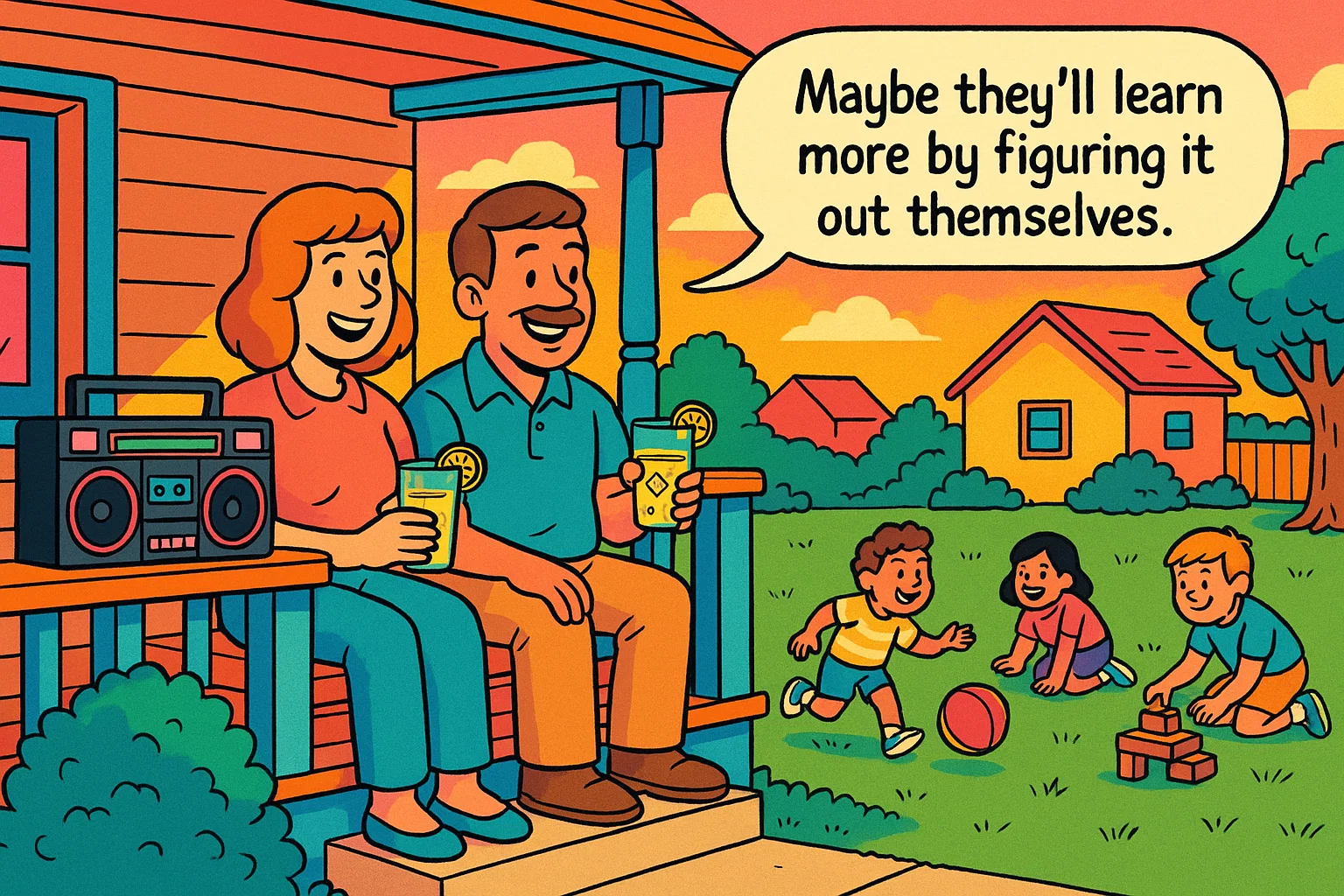
The shift toward intensive parenting has happened gradually, driven by real anxieties. But the job as parents is not to eliminate risk — it’s to prepare children to handle it.
Importance of Independence for Children
Children who are given the opportunity to make decisions, experience natural consequences, and solve problems on their own develop stronger confidence and competence.
If a child is lonely, letting them figure out how to approach a new friend is more valuable than arranging a playdate on their behalf. Independence isn’t just good for children — it’s essential for kids to mature into capable, self-sufficient adults.
Balancing Safety and Freedom
Giving your child more freedom doesn’t mean abandoning common sense. The goal is calibrated risk — expanding autonomy gradually as children demonstrate readiness. Allowing a seven-year-old to play in the backyard unsupervised, letting a ten-year-old ride a bike to a friend’s house, or permitting kids to take the bus after school are all reasonable steps that build confidence without compromising safety.
Here are some practical ways to start:
- Let children walk or bike to nearby locations independently, starting with short, familiar routes
- Allow unstructured outdoor time without checking in every few minutes
- Resist the urge to solve every conflict or problem on your child’s behalf
- Set clear boundaries around time and location, then step back
Building Trust Between Parent and Child
Trust is the foundation of healthy independence. When parents communicate expectations clearly and follow through consistently, children internalize those boundaries and operate within them.
The 80s kids and parents dynamic was often less explicitly negotiated but functioned on a similar principle: children knew what was expected, and parents trusted them to meet it. Rebuilding that kind of trust in a modern context is possible — it just requires intention.
Risky Play and Confidence Building

Recent research backs what 80s and wonder-filled childhoods demonstrated anecdotally: risky play provided real developmental benefits. A shortage of scrapes and challenges in childhood doesn’t mean a safer child — it often means a less prepared one.
Benefits of Risky Play for Development
Risky play provided children with direct experience of consequences, physical limits, and problem-solving under pressure. Activities involving height (climbing a tree), speed (biking downhill), or the elements (water or fire, supervised) build physical confidence and emotional resilience.
Safe Boundaries for Exploration
The goal isn’t to manufacture danger but to stop eliminating it entirely. Parents can create conditions for risky play by:
- Choosing playgrounds with varied, challenging equipment over sanitized flat designs
- Allowing roughhousing and physical play within reasonable limits
- Encouraging activities like camping, swimming in open water, or building with tools
- Stepping back when children test physical limits, unless real danger is present
Friendships and Social Life Like in the 1980s
80s movies imply a social world that was immediate, physical, and deeply felt — and that portrayal isn’t far from accurate. Social life for 80s kids was built on proximity, shared experience, and real-time connection.
Neighborhood Connections and Social Circles
Friendships in the 1980s formed organically, often through sheer geography. Kids who lived on the same street or attended the same school built relationships through repeated, unplanned interaction. This kind of low-stakes, consistent contact is actually the most effective model for building strong friendships — something developmental psychologists refer to as “proximity-based bonding.”
Group Games and Shared Experiences
Street games, pickup sports, and group activities created a shared social vocabulary among 80s kids. Watching MTV videos together, trading cassette tapes, or playing games like Capture the Flag built connection through participation rather than performance. These shared experiences fostered a sense of belonging that was less dependent on individual status or popularity.
Social Skills Development Without Screens
Face-to-face interaction in the 1980s required children to develop real communication skills: reading body language, managing conflict, expressing disagreement, and repairing relationships after arguments.
Kids who engaged regularly in unmediated social play showed stronger empathy and emotional intelligence, according to research on peer relationships in childhood. Without a screen as a buffer, children learned to navigate social complexity in real time.
Alternatives to Phones and Digital Devices
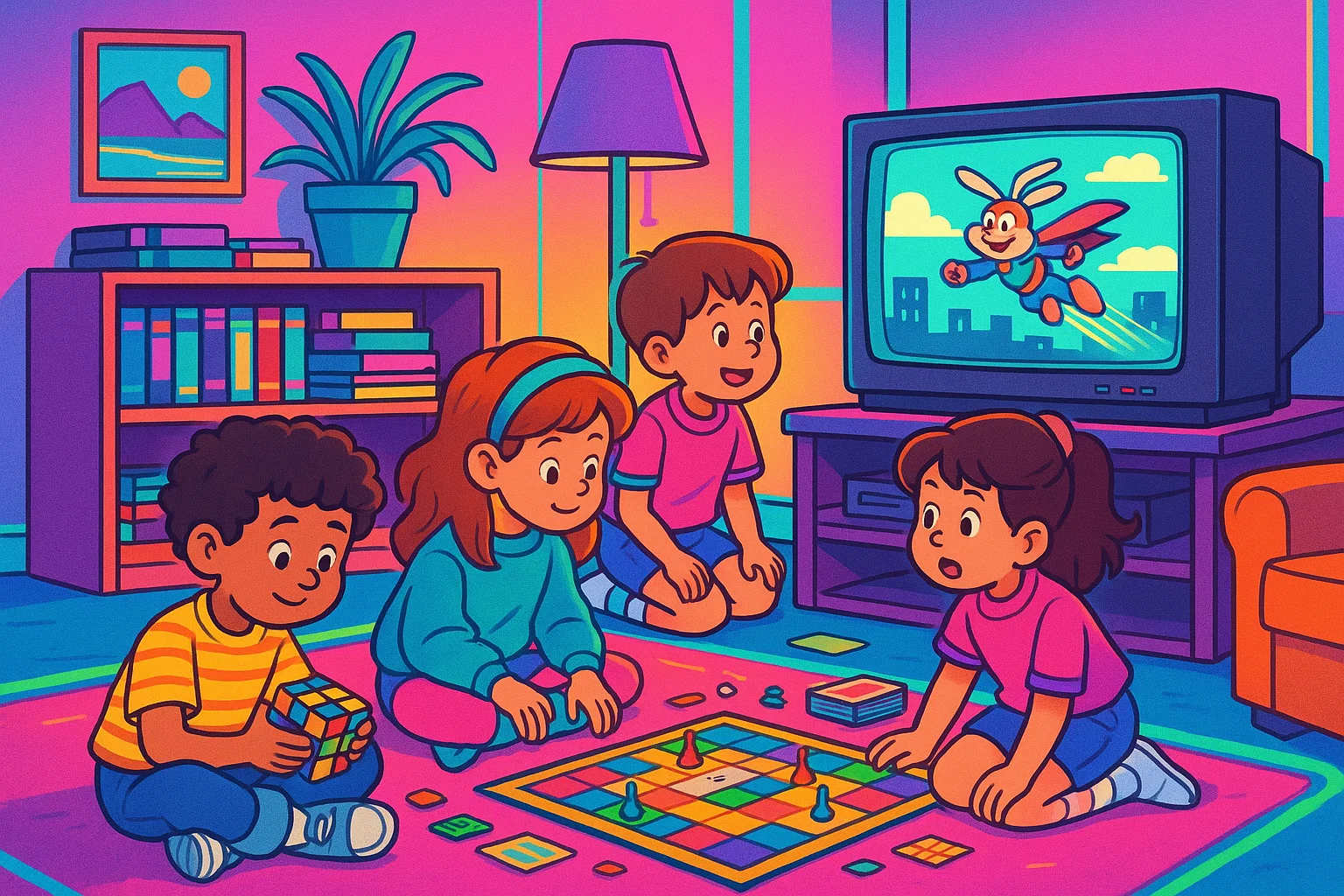
Giving our kids an 80s experience today doesn’t require removing all technology — it requires offering compelling alternatives that engage their attention, creativity, and social instincts.
Music, Movies, and Television Culture
In the 80s, media was a shared, limited experience. Families watched the same television programs together. Kids talked about movies that struck them the previous weekend. Recreating this means watching movies as a family event rather than individually on separate devices, and using music as a communal, physical experience — dancing, singing along, or attending live performances together.
Board Games, Toys, and Physical Play
Tactile, social entertainment was the norm in the 1980s. Board games, building sets, action figures, and outdoor toys encouraged hands-on play and face-to-face competition. These formats remain highly effective today — research on cooperative play suggests that shared physical games build communication skills and strengthen family bonds in ways that parallel digital activities do not.
Reading, Hobbies, and DIY Activities
Books, crafts, model-building, drawing, and personal projects gave 80s kids a sense of mastery and self-expression. Encouraging children to develop a hobby — not as a résumé-builder but purely for interest — mirrors the spirit of 80s childhood exploration. An unscheduled summer afternoon spent building something, writing a story, or teaching yourself a skill is an 80s experience in its purest form.
Analog activities that can replace screen time include:
- Journaling or creative writing
- Drawing, painting, or crafting
- Building with blocks, LEGO, or found materials
- Gardening or cooking
- Learning a musical instrument without structured lessons
Bringing Back 1980s Childhood Today
I’m giving my kids an 80s childhood — or as close to one as possible — is a goal more parents are naming out loud. Here’s how to make it practical.
Creating a Screen-Free Routine
Reducing screen dependence works best when it’s gradual and consistent. Start by designating specific screen-free times — meals, the hour after school, Sunday mornings — and holding to them. Replace that time with available alternatives, not nothing. Children adapt quickly when the environment consistently signals that screens aren’t the default.
Building a Summer Bucket List
An 80s summer was defined by its openness. Create a family bucket list inspired by that spirit:
- Spend a full day at a local park with no schedule
- Build a backyard fort or obstacle course
- Go on a neighborhood scavenger hunt
- Have a screen-free weekend with board games and outdoor play
- Visit a lake, river, or hiking trail without a planned itinerary
Establishing Family Traditions
Rituals create the kind of shared experience that 80s kids had naturally. A weekly game night, a summer camping trip, a tradition of Sunday outdoor time — these aren’t nostalgic gestures. They’re practical structures that give children something to look forward to, belong to, and remember.
Why 1980s Childhood Still Matters Today
Childhood in the 1980s worked because it gave children time, space, and trust. It wasn’t a perfect era, but it understood something important: kids need unstructured time, real friendships, physical freedom, and the chance to develop independence through experience.
Modern parents can give their kids an 80s experience not by turning back the clock, but by being intentional about what they protect — the boredom, the backyard, the scraped knees, and the freedom to figure things out on their own.
FAQs About Childhood in the 1980s
What was childhood in the 1980s like?
Childhood in the 1980s was characterized by autonomy, outdoor play, minimal technology, and strong community connections. 80s kids typically spent their afternoons playing outside unsupervised, navigating social situations independently, and entertaining themselves through imaginative, self-directed activities. The absence of smartphones and constant digital stimulation meant that children developed stronger problem-solving skills and deeper in-person friendships.
Why was unstructured play important in 1980s childhood?
Unstructured play was a defining feature of 80s childhood because it gave children the space to develop creativity, resilience, and executive functioning skills. Without scheduled activities filling every hour, children were free to invent games, resolve conflicts, and entertain themselves — all of which contribute to emotional and cognitive development in ways that structured activities do not fully replicate.
How did kids entertain themselves without smartphones in the 1980s?
80s kids entertained themselves through biking, outdoor games, board games, pickup sports, reading, creative crafts, and watching limited television together. Social life was built on neighborhood proximity — kids knocked on doors, met at the local park, and created their own fun. Music, movies, and shared media experiences also played a central role in forming common cultural ground.
Can modern children experience childhood similar to the 1980s?
Modern children can experience many of the core principles of 80s childhood — less screen time, more independence, and greater unstructured play — with intentional parenting. While the cultural environment has changed, parents can give their child more freedom by allowing unsupervised outdoor play, limiting devices, and creating space for boredom and self-directed exploration. Full recreation of the era isn’t realistic, but its core values are entirely applicable today.
What parenting lessons from the 1980s are still relevant today?
The most durable parenting lessons from the 1980s include: trust your child to navigate age-appropriate challenges, allow independence rather than managing every experience, embrace a hands-off approach to minor risks, and prioritize unscheduled time over constant enrichment activities. Research backs all of these principles — children who are given appropriate freedom and responsibility develop greater resilience, stronger social skills, and more confident self-identities.

Take a short quiz to find out what your everyday choices say about your parenting style
When your child is curious about something new, what’s your instinct?
Take a short quiz to find out what your everyday choices say about your parenting style
“Can I download this app?” What happens next?
Take a short quiz to find out what your everyday choices say about your parenting style
When it comes to rules at home, which sounds most like you?
Take a short quiz to find out what your everyday choices say about your parenting style
If you could give your child one life skill today, what would you pick?
Take a short quiz to find out what your everyday choices say about your parenting style
Your child gets to choose what to watch. What would your ideal setup look like?
Take a short quiz to find out what your everyday choices say about your parenting style
Pick your parenting superpower ✨