7 Types of Text Structure: Examples, Signal Words, and Teaching Tips

 Discover a Free Education Video App for Kids
Pastory uses AI to personalize educational video content based on your child’s interests and personality. Safe, engaging, and built for curious young minds. Sign up now to stay updated and enjoy early access with a free trial
Navigating the complexities of written language is a fundamental milestone in child development. To strengthen reading comprehension and writing skills, students need to understand seven common types of text structure and learn how authors organize information. This guide provides clear definitions, essential signal words, and practical teaching tips that connect reading and writing instruction. By understanding these patterns – from cause and effect to narrative structure – young readers gain tools for summarizing content effectively and improving their performance on academic tasks. Whether students are using a worksheet or a digital template, mastering these patterns can support long-term academic success.
Text Structure Meaning and Role in Reading and Writing
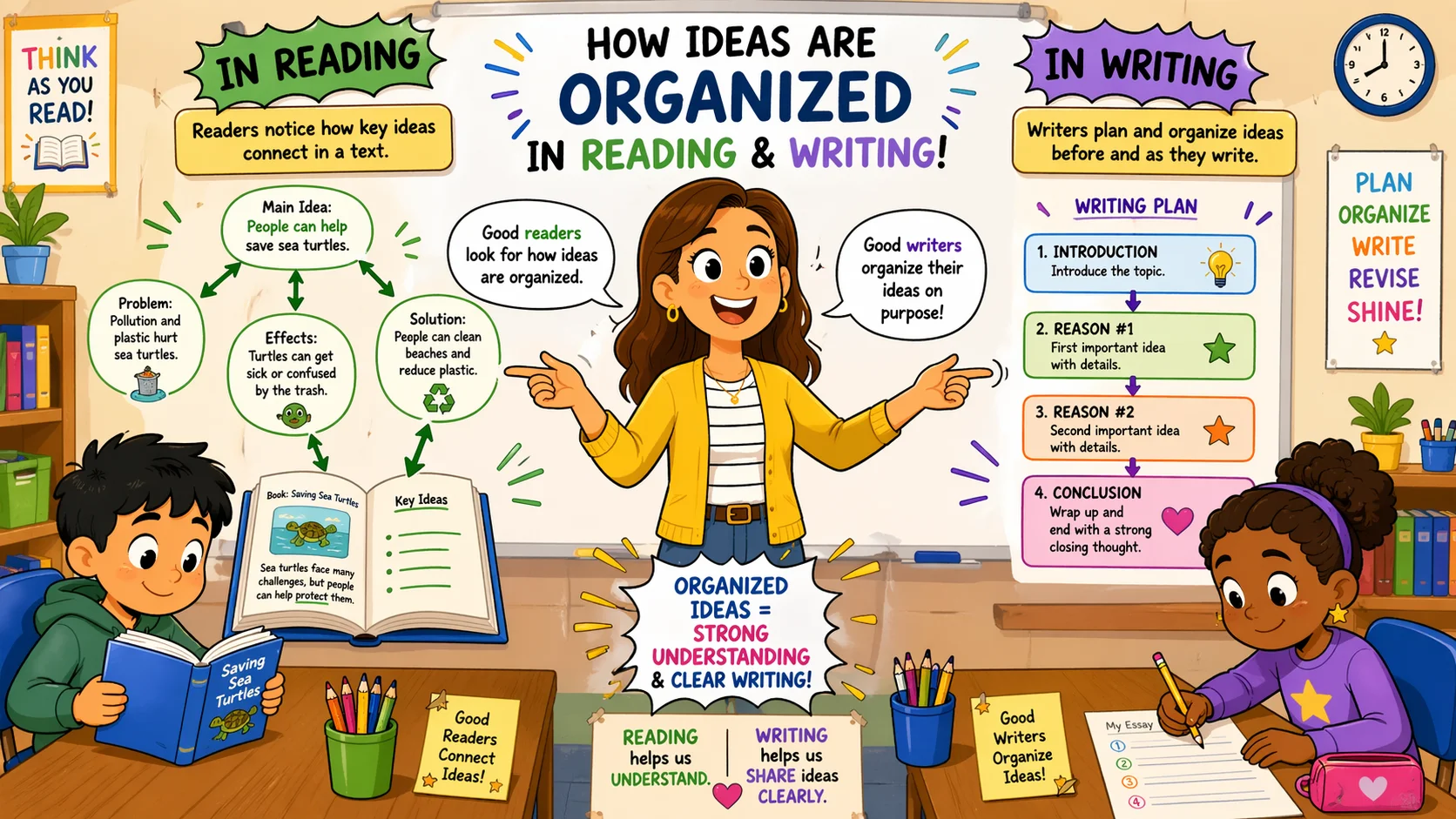
Text structure refers to the internal organization of a narrative, informational, or expository text. It serves as a blueprint for how an author presents information to a reader. Understanding the organization of a passage allows children to anticipate the flow of information, which significantly reduces cognitive load during the reading process. When children can identify and use text structures, they move from passive reading toward more active, analytical thinking.
Distinguishing among text structure, text type, and genre is important for literacy development. While a narrative text tells a story, the specific organizational pattern (such as sequence) dictates the order of events. By teaching students these distinctions, educators provide a framework for both reading comprehension and writing. This dual approach helps students deconstruct complex passages and write logical, well-organized paragraphs of their own.
Text Structure Definition
Text structure is the pattern an author uses to organize ideas and information in a text. For example, a “compare and contrast” pattern organizes information by highlighting similarities and differences between two or more subjects. This organizational choice helps readers understand the relationships among different concepts.
Why Text Structure Matters for Reading
Recognizing a pattern helps readers create a mental map of the information and better understand what they read. When a student identifies a cause and effect pattern, they can quickly locate why an event happened and what the results were. This skill makes it easier to summarize long passages and answer complex comprehension questions.
Why Text Structure Matters for Writing
Writers use a specific organizational pattern to make their message coherent and persuasive. By selecting a clear organizational framework, a student can organize their thoughts into a logical paragraph flow. Mastering these writing skills helps students make their purpose clear and provide sufficient evidence to support their claims.
Text Structure vs Text Type vs Genre
Understanding the hierarchy of written language helps students focus on different layers of a passage. Text structure is the internal pattern of organization, such as cause and effect; text type refers to a broad category, such as informational, narrative, or argumentative writing; and genre refers to a more specific form, such as a biography, lab report, or short story. For instance, a biography is a nonfiction genre that often uses a chronological structure.
7 Types of Text Structures with Examples
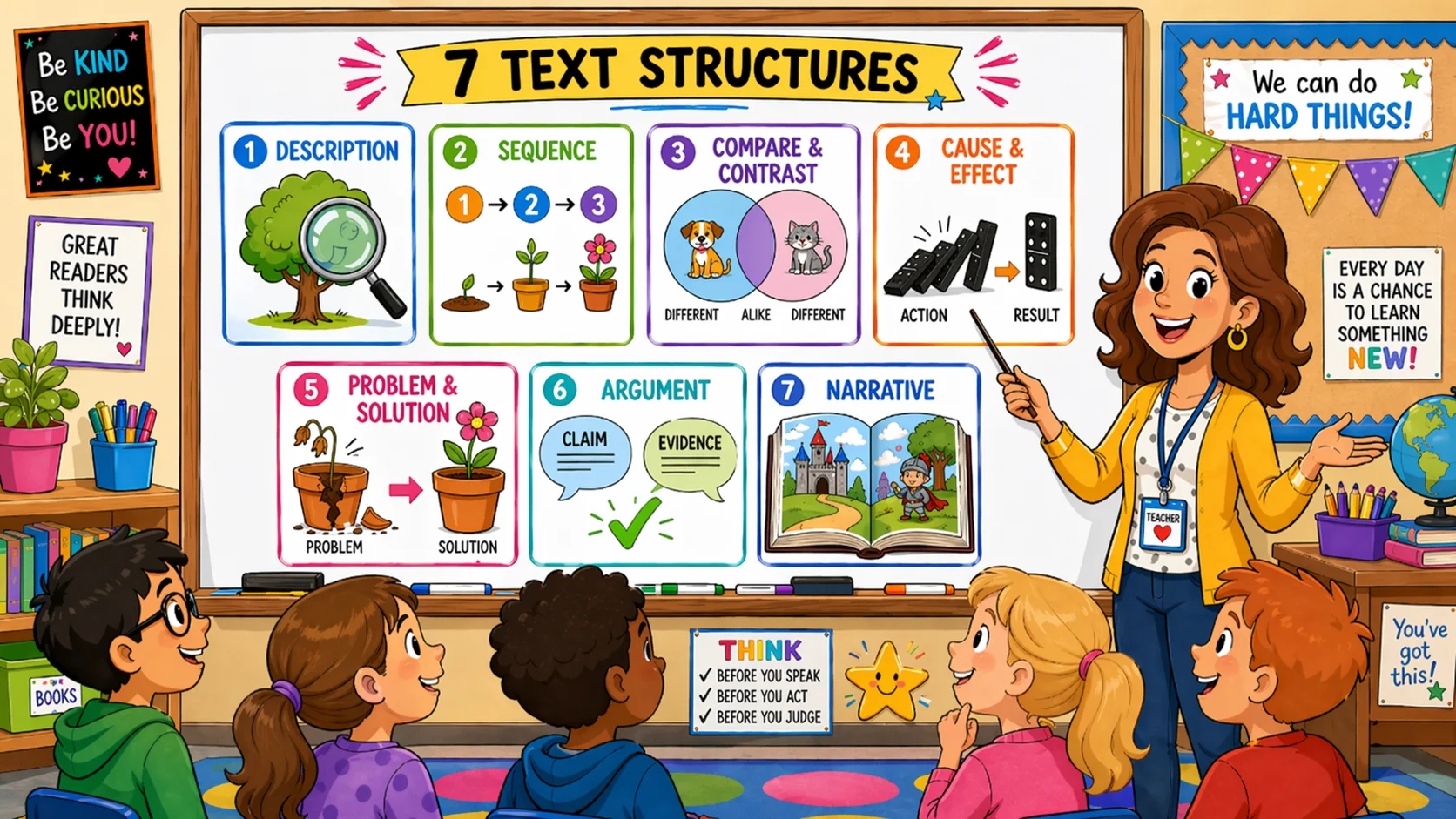
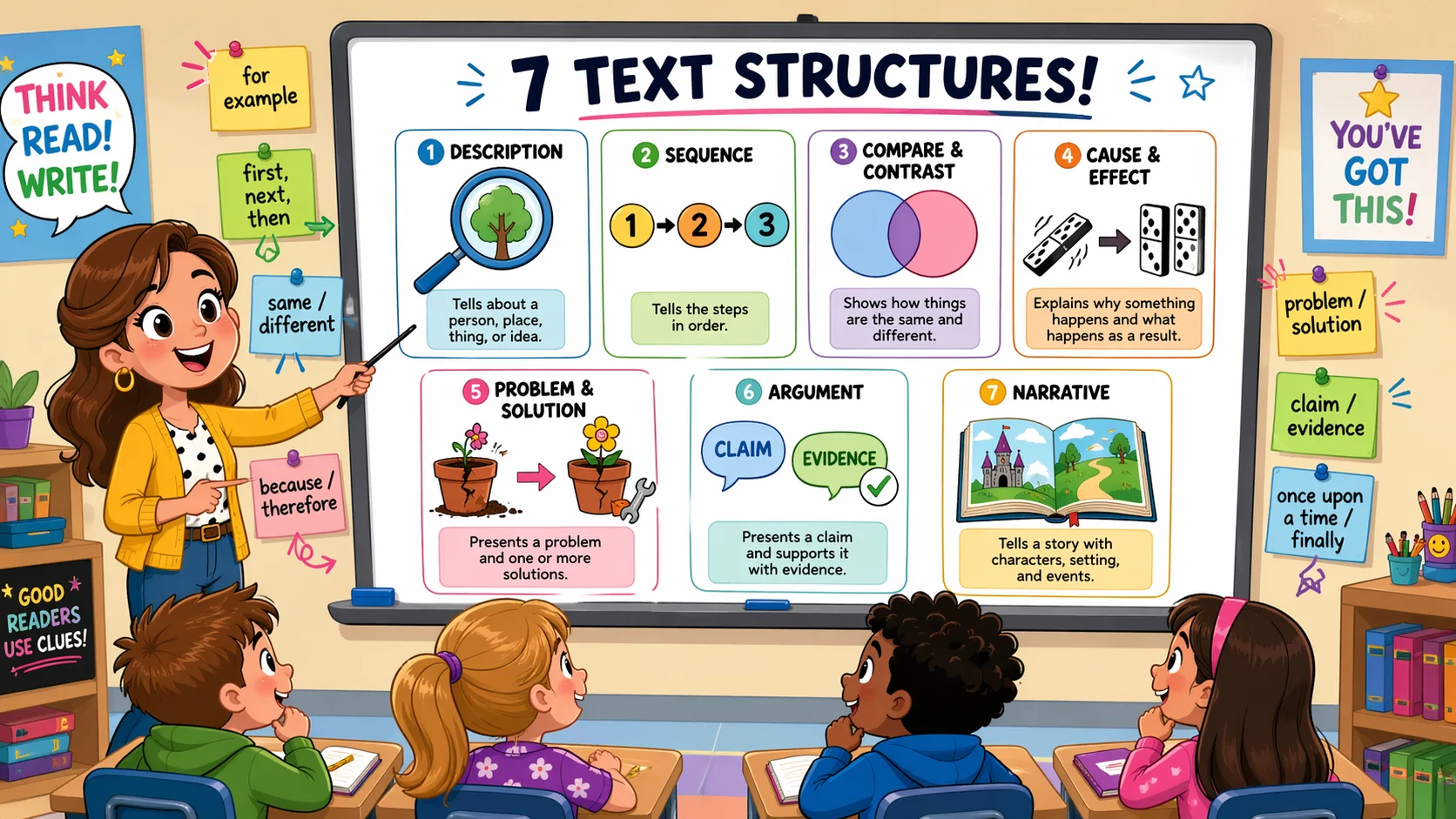
Understanding common text structures in literature and informational writing is essential for developing stronger literacy skills. Below are the seven primary frameworks that readers and writers encounter most frequently.
1. Description
The descriptive pattern involves listing the features, traits, or characteristics of a topic to create a clear mental picture. The primary purpose is to paint a detailed portrait of an object, animal, or event through sensory details and facts.
- Signal Words: For example, such as, consists of, includes, in addition, specifically.
- Example: “The African elephant is the largest land mammal and is known for its long trunk and large ears, which help dissipate heat.”
- Common Usage: This pattern typically appears in textbooks, encyclopedias, and scientific reports.
- Common Mistake: Students often confuse description with sequence when traits are listed in a particular order, but description does not require time-based progression.
2. Sequence and Chronological Order
Sequence organizes information in a step-by-step or time-based order. It is designed to show a progression of events or steps that lead to a specific conclusion or finished product.
- Signal Words: First, next, then, finally, before, after, initially.
- Example: “To bake a cake, first gather the ingredients, then mix the batter, and finally bake it for 30 minutes.”
- Common Usage: Found in history books, recipes, and “how-to” manuals.
- Comparison: Unlike narrative writing, which often focuses on plot and character, sequence focuses on the order of events or instructions.
3. Compare and Contrast
A compare-and-contrast pattern examines similarities and differences between two or more subjects. This framework encourages students to analyze features across subjects and gain a deeper understanding of the text.
- Signal Words: Similar, different, both, however, on the other hand, unlike.
- Example: “Although both the sun and the moon appear in the sky, the sun is a star that produces light, whereas the moon is a satellite that reflects it.”
- Visual Aid: A Venn diagram is the most effective graphic organizer for this pattern.
- Benefit: This helps students develop higher-order thinking by requiring them to categorize information.
4. Cause and Effect
Cause and effect explains why something happened and what consequences followed. It establishes a clear link between an action, event, or condition and its outcome.
- Signal Words: Because, since, as a result, therefore, due to, consequently.
- Example: “Because the temperature dropped below freezing, the water in the pipes turned to ice and caused them to burst.”
- Common Usage: This structure is frequently used in science texts to explain natural phenomena and in history texts to explain the causes of events such as wars.
- Common Confusion: Often mixed up with problem-solution, but cause-effect does not necessarily provide a way to fix the outcome.
5. Problem and Solution
Problem and solution presents an issue or challenge and then describes one or more ways to resolve it. This structure is often used to inform readers about possible solutions or persuade them to support a specific response.
- Signal Words: Problem, challenge, solution, answer, resolve, fix, the dilemma.
- Example: “The city faced a major littering problem in parks; therefore, the council installed more bins and launched a public awareness campaign.”
- Differentiation: While cause and effect explains why something happens, problem and solution focuses on the response, fix, or intervention.
- Benefit: It helps students understand the relationship between difficulties and human agency.
6. Argument and Persuasion
The argument structure presents a specific claim or opinion and supports it with reasons and evidence. It is designed to convince readers to adopt a viewpoint or take a specific action.
- Signal Words: Should, must, clearly, in my view, proponents argue, however.
- Example: “Schools should implement a four-day week because it reduces burnout and lowers operational costs for the district.”
- Modern Context: This is essential for navigating digital media and identifying an author’s bias or intent.
- Skill Growth: It strengthens students’ ability to use logic, evidence, and reasoning in writing.
7. Narrative
A narrative text tells a story that usually includes characters, a setting, a conflict, and a resolution. While it often uses chronological order, its primary goal is to engage readers through a plot, conflict, and character development.
- Signal Words: Once upon a time, suddenly, meanwhile, eventually, in the end.
- Example: “As the sun set, Sarah realized she was lost in the woods, but she remembered her father’s advice and followed the stream home.”
- Distinction: Narratives are typically found in fiction, though “personal narratives” are a common form of non-fiction.
- Complexity: A narrative can contain other structures, such as problem and solution, cause and effect, or sequence.
Signal Words, Form, Layout Conventions, and Language Clues
Identifying how a passage is organized does not require readers to rely on every word alone; they can also use visual and linguistic clues. These clues act as signposts that guide readers through the information.
| Text Structure | Primary Signal Words | Visual Layout Clue |
| Description | For instance, specifically, also | Bulleted lists, detailed captions |
| Sequence | First, then, finally, after | Numbered lists, timelines |
| Compare/Contrast | Similarly, however, unlike | Tables, side-by-side columns |
| Cause/Effect | Result, because, therefore | Arrows, flowcharts |
| Problem/Solution | Solve, issue, resolve | “How-to” boxes, Q&A format |
Signal Words by Structure
Creating a worksheet with words and phrases associated with each pattern is an effective text structure strategy. For instance, teaching students that “consequently” often signals cause and effect can help them grasp the meaning of a passage without understanding every difficult word.
Paragraph Patterns and Visual Clues
The physical layout of a page often reveals its organizational pattern. A passage with many subheadings and bullet points is likely a descriptive piece, while a series of paragraphs starting with dates suggests a chronological framework.
Text Features That Reveal Structure
Modern nonfiction often uses headings, subheadings, diagrams, captions, and boldface terms to support comprehension. For example, a diagram illustrating a life cycle signals that readers should look for a sequence of events in the surrounding passage.
Quick Identification Checklist
To help students solidify their understanding, they can ask these four questions:
- Is the writer describing the features of something? (Description)
- Is there a timeline or a list of steps? (Sequence)
- Are there two things being compared? (Compare/Contrast)
- Is there a conflict and a way it was fixed? (Problem/Solution)
Differences Between Text Structures and Text Types
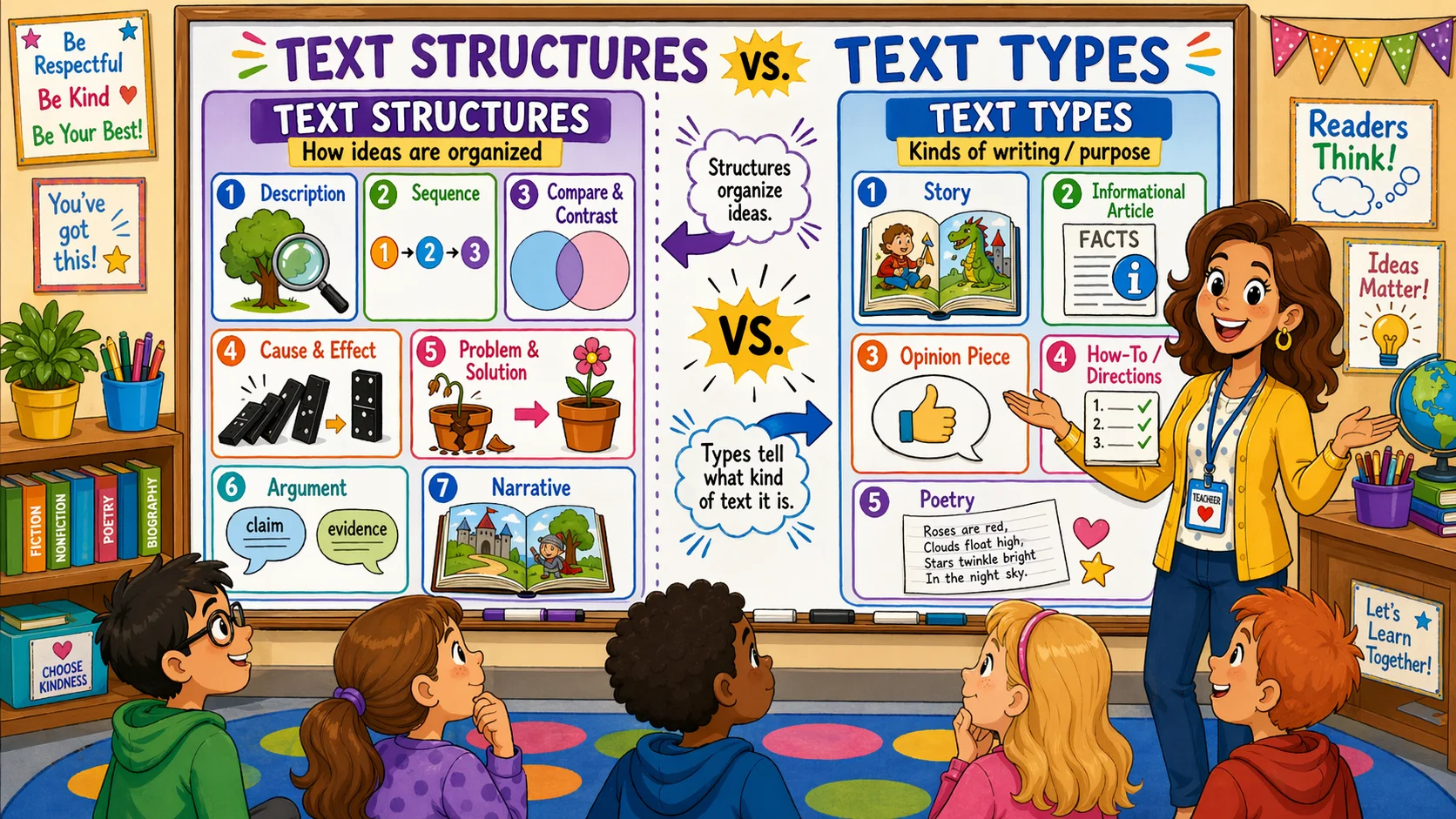
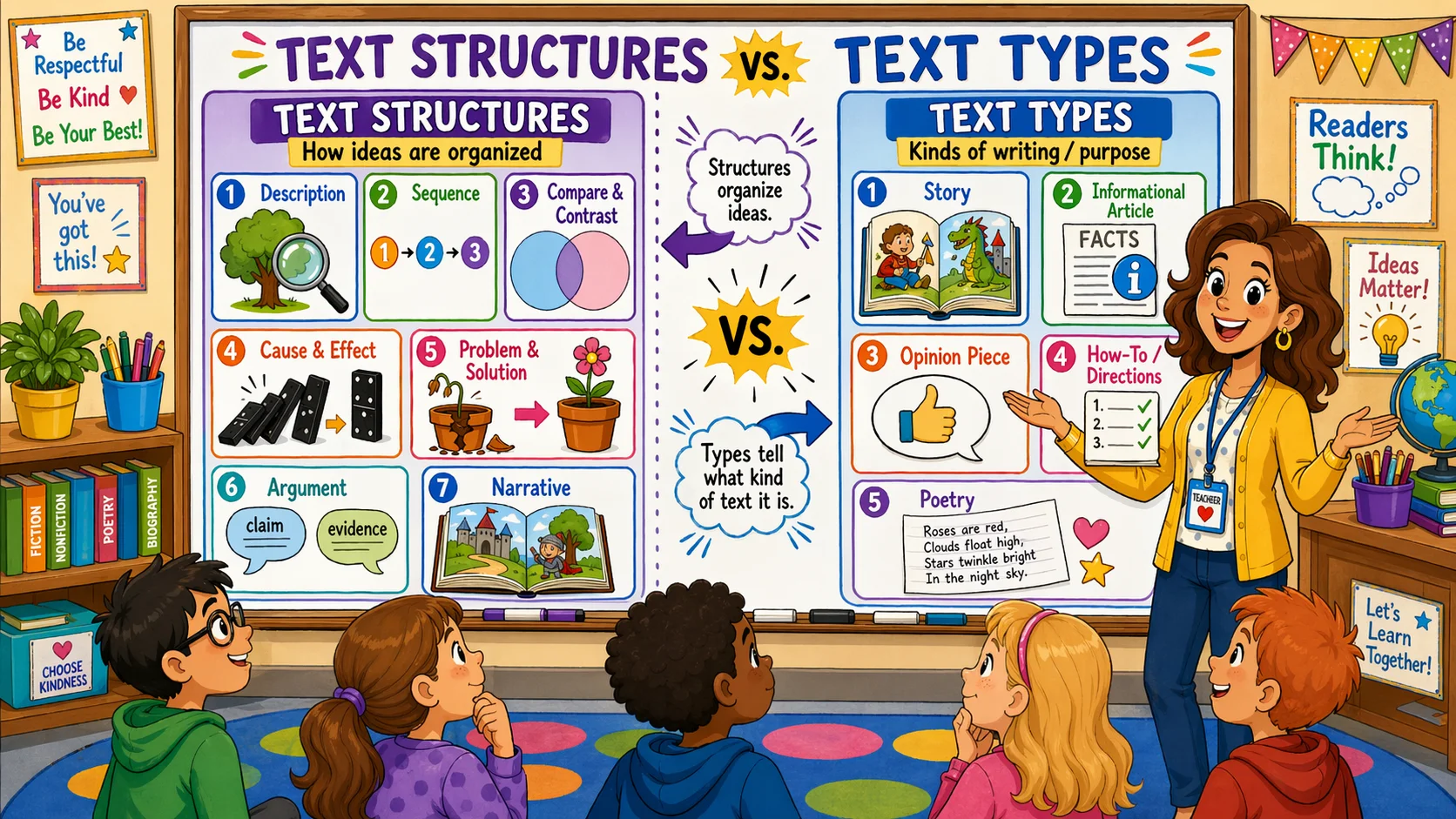
Educators should make clear that text structures often overlap and that different frameworks may classify them differently. A single nonfiction book may use a different organizational pattern in each chapter.
Text Structure vs Text Type
Text type is the “what” of a text, such as informational or narrative writing, while text structure is the “how,” such as compare and contrast or cause and effect. An informational article on climate change might use cause and effect to explain global warming and problem and solution to discuss renewable energy.
Informational vs Narrative vs Argument
Each major category serves a different purpose.
- Informational: Uses description and sequence to educate.
- Narrative: Uses plot, characters, and sequence to entertain or share an experience.
- Argument: Uses logic and evidence to support a claim and persuade readers.
Mixed Structures in a Single Passage
Sophisticated writing rarely relies on only one pattern. A history passage might use chronological organization to list events, but then switch to compare and contrast to discuss two different historical leaders. Learning to identify key transitions is crucial for reading comprehension.
How to Choose the Right Label Quickly
To identify the structure quickly, students should look at the author’s primary goal. If most of the text points toward a specific resolution, the dominant structure is problem and solution, even if some paragraphs are descriptive.
Benefits of Integrating Reading and Writing Instruction
Teaching text structure is most effective when reading and writing are taught together. Reading and writing are reciprocal processes; when a child learns to organize their own essay, they become much better at deconstructing someone else’s work.
Reading Supports Writing
When students analyze “mentor texts,” they see how professional writers use an organizational pattern to support their ideas. By observing how a cause-and-effect text is built with specific transitions, students can learn to use similar tools in their own informational or argumentative writing.
Writing Supports Reading
When students use a template to write their own compare and contrast paragraph, they internalize the logic of the pattern. This “insider knowledge” makes complex passages easier to understand because students can recognize the structure beneath the writing.
Why Integrated Practice Works
Research on text structure instruction suggests that explicitly teaching students to recognize organizational patterns can improve reading comprehension and recall. This integrated approach gives students a reusable toolkit they can apply across subjects, from science to social studies.
3 Steps to Teach Text Structure
To help students develop a deep understanding, educators can follow a three-step process that moves from preparation to analysis.
Step 1: Before Reading
Encourage students to preview the material. Have students look at the headings, diagrams, captions, and boldface words. Ask: “Based on these clues, how do you think the passage is organized?” This sets a purpose for reading.
Step 2: During Reading
Provide a graphic organizer that matches the predicted pattern. As students read, have them identify key signal words and map the information. If the material shows a sequence of events, they should fill in a flowchart.
Step 3: After Reading
Ask students to summarize the passage using the structure they identified. If they read a cause-effect piece, their summary should follow a “This happened, which led to that” format. This helps students consolidate their learning.
5 Tips for Text Structure Mastery
Mastery of different text structures requires more than just memorizing a list. It involves developing a “structural eye” for written language.
1. Fix Confusion Between Similar Structures
The most common confusion is between cause and effect and problem and solution. Teach students that problem and solution usually includes an intentional action taken to fix something, whereas cause and effect may describe a natural or unintentional result.
2. Use Visual Supports and Graphic Organizers
Teach organization with visual support whenever possible.
- Venn Diagram: Compare/Contrast
- Flowchart: Sequence
- Fishbone Map: Cause/Effect
- Story Map: Narrative
3. Prevent Overgeneralization
Young readers often label any ordered information as “sequence” because it is easy to spot. Train them to look for the purpose of the text. If the goal is to describe a person, the structure is a description, even if the description moves from the person’s head to their feet.
4. Slow Down Skimming Habits
Skimming can cause readers to miss words or phrases that signal a shift in organization. Practice “slow reading” by having students highlight transition words and explain how those words connect ideas.
5. Build Retention Through Repeated Practice
Use short worksheets for quick daily practice. Give students three related sentences and ask them to identify a suitable structure, then combine the sentences into a coherent paragraph.
Conclusion
Understanding common types of text structure is a valuable skill for students. By learning to recognize how authors organize information, students move beyond simply “reading words” and begin to understand how texts work. Whether students are analyzing a narrative text or writing a nonfiction report, these structures provide a framework for clear communication and critical thinking. Mastery develops through consistent practice, graphic organizers, and an integrated approach to reading and writing.
Key Takeaways
- Text structure is the organizational pattern of a passage (e.g., cause-effect, compare-contrast).
- Signal words act as clues to help readers identify key patterns.
- Teaching reading and writing together helps students retain and apply these skills.
- Visual tools such as Venn diagrams and flowcharts can make text structures easier to understand.
Next Step for Teachers and Students
Choose a short news article. Before reading, look at the headline, subheadings, images, diagrams, and captions to predict the structure. After reading, highlight three signal words or text features that support your prediction.
Frequently Asked Questions
How do you teach chronological text structure?
To teach chronological order, use timelines and sequencing tasks. Have students practice with a sequence text structure by ordering the steps of a familiar activity, like making a sandwich, then transition to historical timelines.
How do you structure a good essay?
A good essay uses a clear organizational pattern within the body paragraphs. Start with an introduction, use a clear organizational pattern in the body paragraphs, and conclude by summarizing the main points.
What is the text structure strategy approach?
The text structure strategy involves four steps: identifying the pattern, marking signal words, filling out a graphic organizer, and using that organizer to write a summary. Research suggests that this approach can improve reading comprehension, especially when it includes explicit instruction, graphic organizers, and writing.
Can one text use more than one structure?
Yes, most complex non-fiction uses mixed structures. An author might use description to introduce a topic and then shift to cause and effect to explain its impact. The dominant structure is determined by the author’s overall purpose.
Which text structure is easiest to identify?
Sequence is often the easiest structure for young readers to identify because it uses clear time-based words and phrases, such as first, next, and finally. However, students should be careful not to label every list as sequence.

Take a short quiz to find out what your everyday choices say about your parenting style
When your child is curious about something new, what’s your instinct?
Take a short quiz to find out what your everyday choices say about your parenting style
“Can I download this app?” What happens next?
Take a short quiz to find out what your everyday choices say about your parenting style
When it comes to rules at home, which sounds most like you?
Take a short quiz to find out what your everyday choices say about your parenting style
If you could give your child one life skill today, what would you pick?
Take a short quiz to find out what your everyday choices say about your parenting style
Your child gets to choose what to watch. What would your ideal setup look like?
Take a short quiz to find out what your everyday choices say about your parenting style
Pick your parenting superpower ✨