150 Fun Riddles for Kids of All Grade Levels, With Answers

 Discover a Free Education Video App for Kids
Pastory uses AI to personalize educational video content based on your child’s interests and personality. Safe, engaging, and built for curious young minds. Sign up now to stay updated and enjoy early access with a free trial
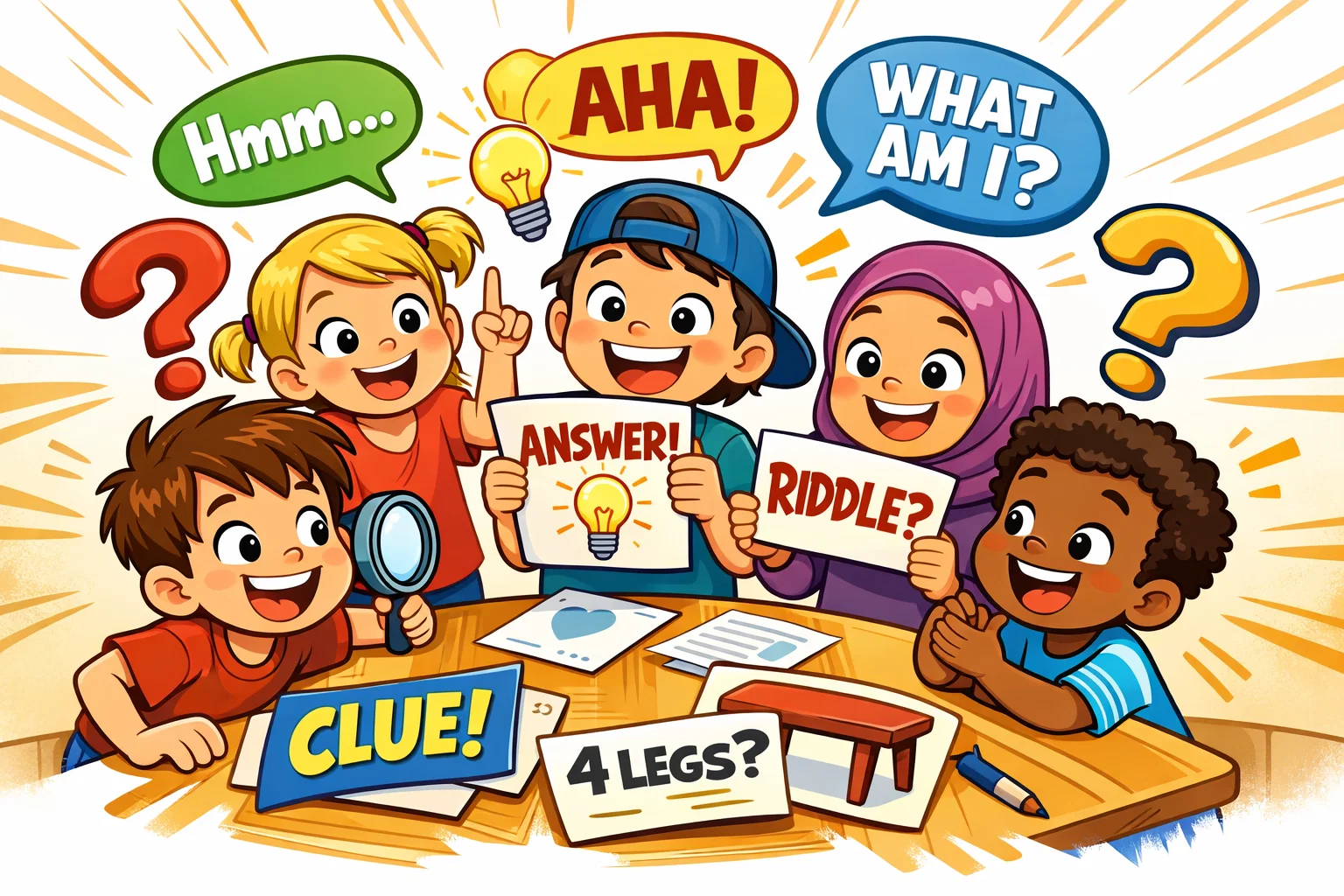
Adding a brain teaser to a child’s daily routine can be an effective way to spark curiosity, engage students, and foster a love of learning. Whether you are a teacher looking to get students thinking during a morning meeting or a parent seeking a fun activity for a long car ride, these puzzles offer a playful blend of entertainment and mental challenge.This collection features 150 riddles for kids, organized by grade level and theme so every child can find a challenge that feels just right.
What Is a Riddle?
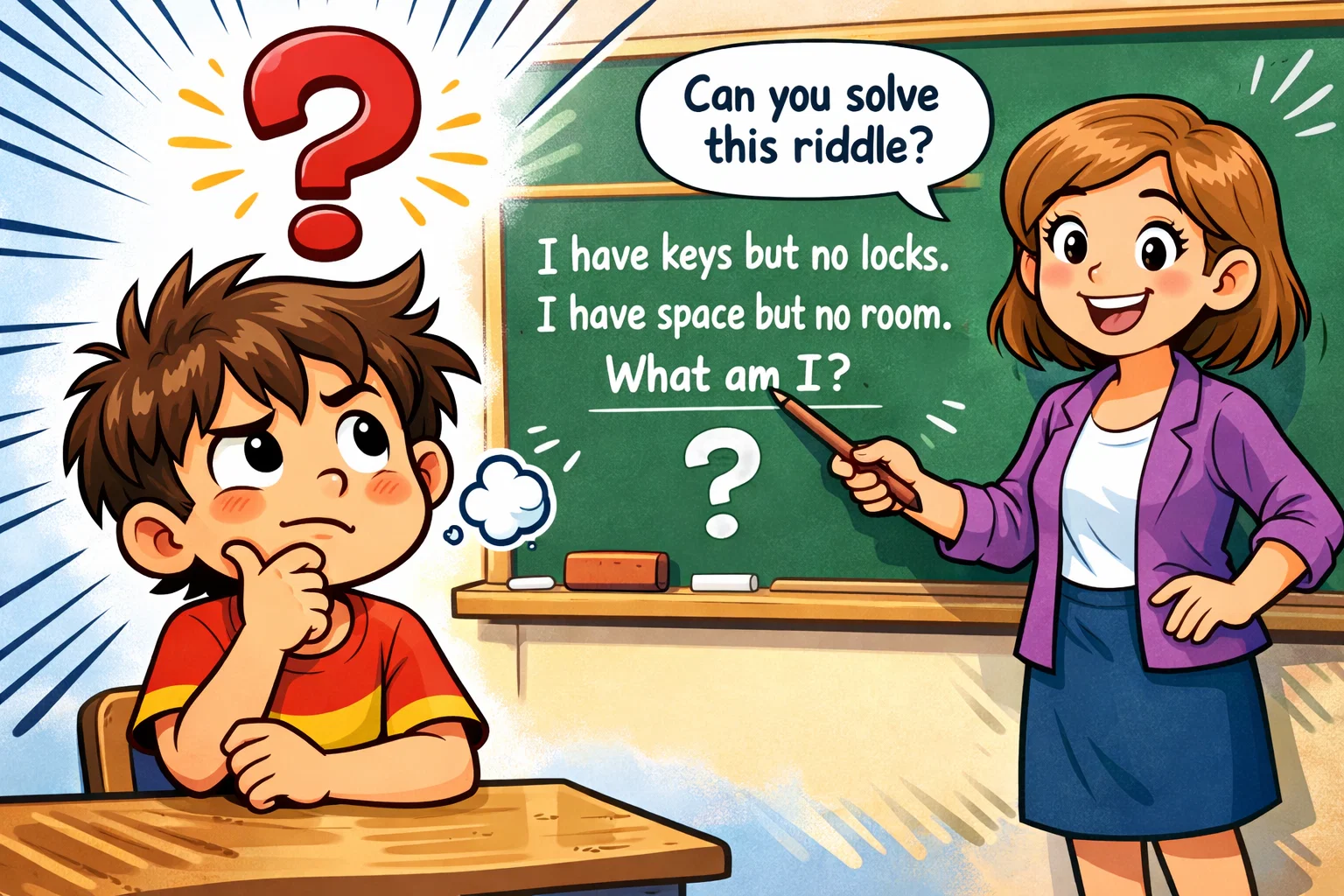
A riddle is a statement, question, or phrase with a double or hidden meaning that is presented as a puzzle to be solved. In educational settings, these puzzles help children think critically and laterally. Readers will find a curated selection of easy, math, and funny riddles designed for different developmental stages and English-language proficiency levels.
Types of Riddles
Understanding different formats helps educators select the right puzzle for their specific lesson goals.
- Classic Puzzles: These use metaphors and descriptive clues to define an object.
- “What Am I?” Tasks: These provide a list of attributes from the perspective of an object or animal.
- Wordplay Challenges: These rely on puns, homophones, and the nuances of the English language.
- Logic Brain Teasers: These require deductive reasoning and often involve a “trick” or a simple calculation.
Why Riddles Work for Kids
Research suggests that riddles can help maintain student engagement because solving them gives children an immediate sense of accomplishment. In classroom practice, these puzzles also work well as brain breaks, helping students reset between more demanding subjects. They can turn an ordinary classroom into a space where learning feels playful while still building reasoning skills.
How to Use This List
The navigation on this page is designed to help you quickly find the best riddles for kids based on their current stage of development. You can browse sections for specific grade levels, from kindergarten through 5th grade, as well as seasonal themes like summer and holidays and subject-based categories like math and science. Every entry includes the text of the puzzle followed by the answer in parentheses for ease of use.
150 Funny and Simple Riddles for Kids
This master list offers a wide range of challenges, from easy riddles for younger kids to harder ones for more confident solvers. Every entry provides the answer in parentheses immediately after the text.
Riddles for Kindergarten Students
Picture Friendly Riddles
- I am round and yellow, and I stay in the sky. (The Sun)
- I have four legs and I bark at the mailman. (A dog)
- I have a long trunk and big ears. (An elephant)
Animal and Object Riddles
- I have hands but no arms, and I tell you what time it is. (A clock)
- I am white and cold, and you can build a man out of me. (Snow)
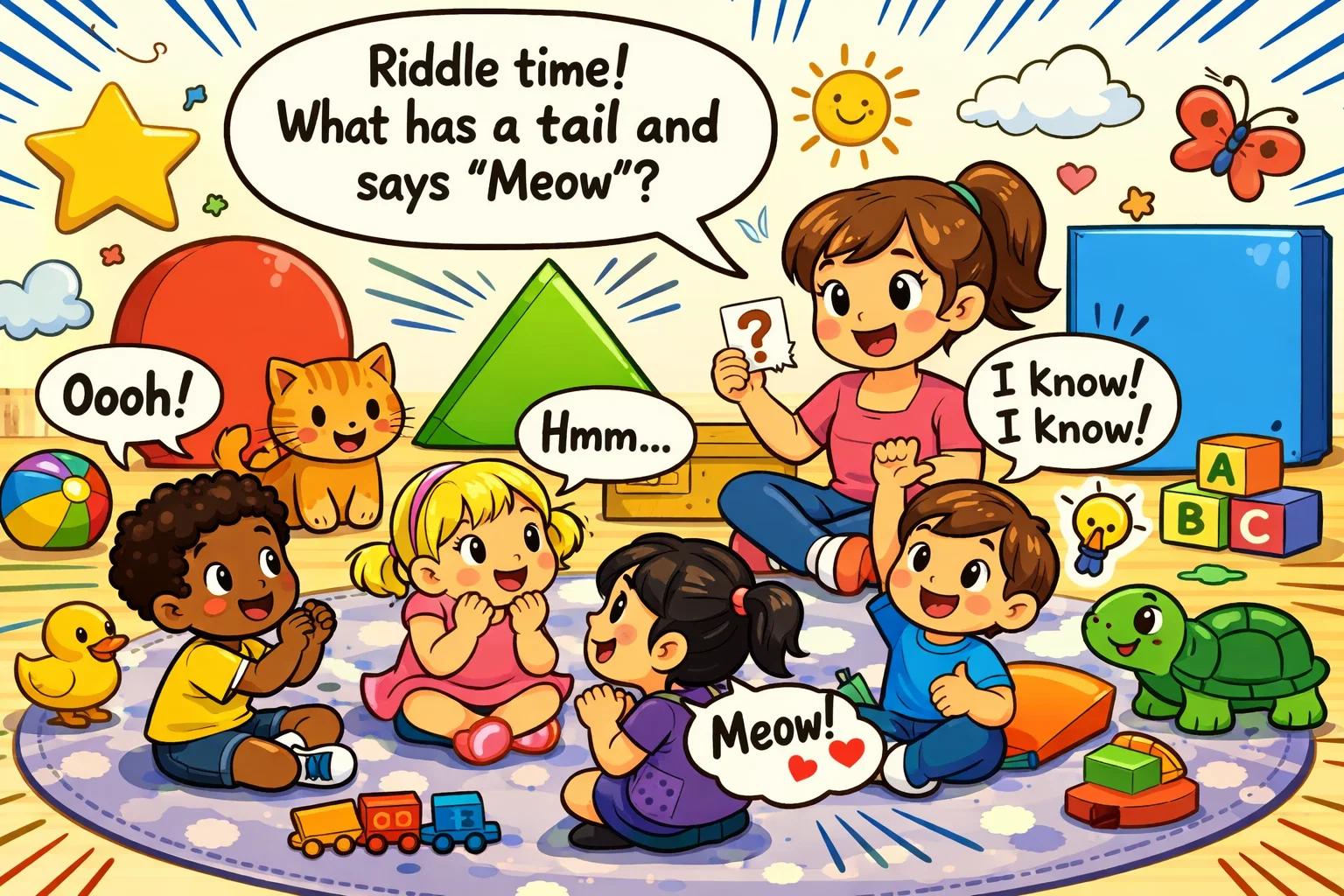
- I have a tail and whiskers, and I like to say “meow.” (A cat)
Short Answer Riddles
- What has to be broken before you can use it? (An egg)
- What falls but never gets hurt? (Rain)
- What has a neck but no head? (A bottle)
- What has one eye but cannot see? (A needle)
- What is full of holes but still holds water? (A sponge)
- What gets wetter the more it dries? (A towel)
Riddles for 1st Grade Students
School Object Riddles
- I have a point but no head, and I help you write your name. (A pencil)
- I have many pages and stories, but I cannot talk. (A book)
- I ring to tell you when it is time for class. (A school bell)
- I sit on your back and carry your lunch and folders. (A backpack)
- I am a long stick used to draw straight lines. (A ruler)
- I come in a box and help you color a rainbow. (A box of crayons)
Simple Wordplay Riddles
- What has legs but cannot walk? (A table)
- What has a thumb and four fingers but is not alive? (A glove)
- What goes up when the rain comes down? (An umbrella)
Daily Life Riddles
- You use me to clean your teeth every morning. (A toothbrush)
- We have laces but no feet, and you wear us to play outside. (Shoes)
- I am where you go at night to dream. (A bed)
- I am a big yellow vehicle that picks you up for school. (A school bus)
- I am a cold treat you eat from a cone. (Ice cream)
- I am water falling from the sky. (Rain)
Riddles for 2nd Grade Students
Funny Logic Riddles
- What belongs to you, but other people use it more than you do? (Your name)
- What can you catch but not throw? (A cold)
- What building has the most stories? (The library)
- What has a bark but no bite? (A tree)
- What has words but never speaks? (A book)
Nature and Animal Riddles
- I am green and I like to hop in the pond. (A frog)
- I have wings but I am not a bird; I am made of colorful patterns. (A butterfly)
- I am always following you around, but you can never touch me. (Your shadow)
- I am a small insect that makes honey. (A bee)
- I am the large body of water that has waves and salt. (The ocean)
- I am the bright arc of color that appears after a storm. (A rainbow)
- I am round and white and I shine at night. (The moon)
Quick Guess Riddles
- What has a face and two hands but no arms or legs? (A clock)
- What kind of cup can’t hold water? (A cupcake)
- What has teeth but cannot bite? (A comb)
Riddles for 3rd Grade Students
What Am I? Riddles
- I have cities, but no houses. I have mountains, but no trees. I have water, but no fish. (A map)
- I am tall when I am young, and I am short when I am old. (A candle)
- I have keys, but no locks. I have space, but no room. You can enter, but you can’t leave. (A keyboard)
- What has many keys but can’t open a single lock? (A piano)
English and Vocabulary Riddles
- What starts with the letter T, is filled with T, and ends with the letter T? (A teapot)
- Which word in the dictionary is spelled incorrectly? (Incorrectly)
- What is at the end of a rainbow? (The letter W)
- What begins with E, ends with E, but only contains one letter? (An envelope)
Short Math Riddles
- If I have three apples and you take away two, how many apples do you have? (Two)
- What has three sides and three corners? (A triangle)
- I am an odd number. Take away a letter and I become even. (Seven)
- How many months have 28 days? (All of them)
- If you multiply me by any other number, the answer remains the same. (Zero)
Riddles for 4th Grade Students
Multi Clue Riddles
- I can travel around the world while staying in a corner. (A stamp)
- The more of me there is, the less you see. (Darkness)
- I have no life, but I can die. I have no lungs, but I need air. (A fire)
- I have a bed but never sleep, and a mouth but never speak. (A river)
Science and Geography Riddles
- I am a giant ball of gas that provides light to Earth. (The Sun)
- I am a mountain that can blow its top. (A volcano)
- I am the tool used to see things that are very far away in space. (A telescope)
- I am the imaginary line that divides the Earth into North and South. (The equator)
- I am the cycle that describes how water moves from the ground to the sky and back. (The water cycle)
- I am the force that keeps you from floating away into space. (Gravity)
Trick Answer Riddles
- What has a heart that doesn’t beat? (An artichoke)
- What has a thumb but no fingers? (A mitten)
- What has a head and a tail but no body? (A coin)
- What has an eye but can’t see? (A hurricane)
- What has many needles but cannot sew? (A pine tree)
Riddles for 5th Grade Students
Harder Logic Riddles
- What is so fragile that saying its name breaks it? (Silence)
- What can you hold in your left hand but not in your right? (Your right elbow)
- What is always in front of you but can’t be seen? (The future)
- If you drop me, I’m sure to crack, but give me a smile and I’ll always smile back. (A mirror)
Classroom Challenge Riddles
- A girl has as many brothers as sisters, but each brother has only half as many brothers as sisters. (Four sisters and three brothers)
- What comes once in a minute, twice in a moment, but never in a thousand years? (The letter M)
- What place has more letters than any other? (The post office)
- What can fill a room but takes up no space? (Light)
Group Discussion Riddles
- What has one head, one foot, and four legs? (A bed)
- I have branches, but no fruit, trunk, or leaves. (A bank)
- What has 13 hearts but no other organs? (A deck of cards)
- What gets bigger the more you take away? (A hole)
- Forward I am heavy, but backward I am not. (The word “Ton”)
- What is seen in the middle of March and April that can’t be seen at the beginning or end of either month? (The letter R)
Back to School Riddles
Classroom Object Riddles
- I am black when I am clean and white when I am dirty. (A blackboard)
- I am a box that holds your pens and pencils. (A pencil case)
- I am a flat surface where the teacher writes with a marker. (A whiteboard)
- I am a tool that makes your dull pencil sharp again. (A pencil sharpener)
- I am a small piece of rubber that makes mistakes go away. (An eraser)
- I am the small cubby where you keep your coat and boots. (A locker)
Teacher and Homework Riddles
- What is a teacher’s favorite tree? (Geome-tree)
- Why was the math book sad? (Because it had too many problems)
- I am the loud noise that tells you school is over for the day. (The school bell)
- I am the work you do at the kitchen table after school. (Homework)
First Week Icebreaker Riddles
- Which letter appears twice in the word “school”? (The letter O)
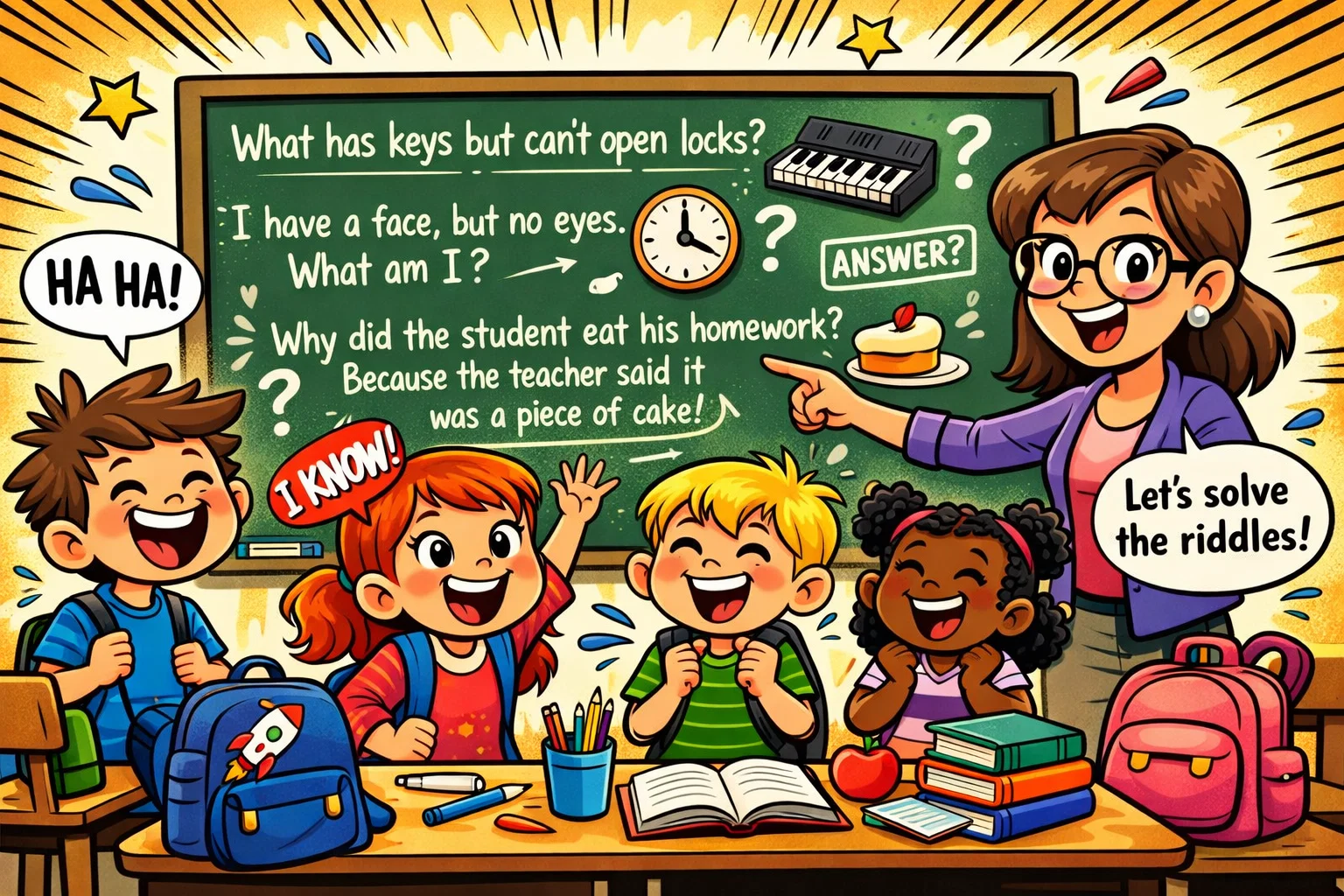
- Why did the student eat his homework? (Because the teacher said it was a piece of cake!)
- What is a librarian’s favorite vegetable? (Quiet peas)
Summer Riddles
Beach and Travel Riddles
- I am made of tiny grains, and you can find me all over the beach. (Sand)
- I am a portable shelter you set up when you go camping. (A tent)
- You wear me on your face to keep the sun out of your eyes. (Sunglasses)
- You use me to build a castle on the beach. (A bucket and spade)
- You wear me on your feet at the beach and I make a clicking sound. (Flip-flops)
Sun and Weather Riddles
- I am hot, I am bright, and I go down at night. (The Sun)
- I am a cold, sweet treat that melts quickly in the heat. (A popsicle)
- I am the colorful arch that appears after a summer rain. (A rainbow)
- I am the drink made from yellow fruit that you sell at a stand. (Lemonade)
Camp and Outdoor Riddles
- I am a fire you sit around to roast marshmallows. (A campfire)
- I am the bag you sleep in when you go camping. (A sleeping bag)
- I am the small light that glows in the grass on a summer night. (A firefly)
Holiday Riddles for Kids
Winter Holiday Riddles
- I am made of snow but I have a warm heart and a carrot nose. (A snowman)
- I am the animal with a red nose that pulls a sleigh. (Rudolph the Reindeer)
- We keep your hands and fingers warm in winter. (Mittens)
- I am the tree you decorate with lights and balls. (A Christmas tree)
- I am the sock you hang by the fireplace for small gifts. (A stocking)
Family Celebration Riddles
- I am the large bird often eaten at Thanksgiving. (A turkey)
- I am the sweet treat with a hole in the middle. (A donut)
- I am the colorful paper you pull apart to find a toy and a joke. (A Christmas cracker)
Silly Festive Riddles
- What do you call a snowman in the summer? (A puddle)
- What falls in the winter but never gets hurt? (Snow)
Halloween Riddles for Kids
Costume Riddles
- I wear a pointy hat and fly on a broomstick. (A witch)
- I am white, I float, and I say “Boo!” (A ghost)
- I am wrapped in white cloth and sleep in a tomb. (A mummy)
- I have sharp teeth and I don’t like garlic. (A vampire)
- I am a skeleton’s favorite instrument. (A trombone)
Pumpkin and Monster Riddles
- I am a pumpkin with a face and a candle inside. (A jack-o’-lantern)
- I have eight legs and I spin a web to catch flies. (A spider)
- I am a black bird that often sits on a scarecrow. (A crow)
- I am the furry animal that howls at the full moon. (A werewolf)
Not Too Scary Riddles
- What do you call a witch who lives at the beach? (A sand-witch)
- Why didn’t the skeleton go to the dance? (Because he had no-body to go with)
Animal Riddles for Kids
Farm Animal Riddles
- I give you milk and I say “Moo.” (A cow)
- I have a curly tail and I love to play in the mud. (A pig)
- I have a long mane and you can ride on my back. (A horse)
- I wake everyone up in the morning with a “Cock-a-doodle-doo.” (A rooster)
Wild Animal Riddles
- I am known as the king of the beasts, and I have a loud roar. (A lion)
- I am a large gray animal with a very long trunk. (An elephant)
- I am a striped cat that lives in the jungle. (A tiger)
- I am a bird that can talk and has colorful feathers. (A parrot)
Sea Themed Riddles
- I have eight arms and I live under the sea. (An octopus)
- I am the biggest animal in the ocean. (A whale)
- I am a fish with very sharp teeth. (A shark)
- I have a hard shell and I walk sideways. (A crab)
English Riddles for Kids
Riddles Using Idioms
- I am something very easy to do, often compared to a dessert. (A piece of cake)
- I describe how you feel when you are extremely happy. (Over the moon)
Multiple Meaning Word Riddles
- I am a wooden stick used in sports, but I am also a flying mammal. (A bat)
- I am the sound a dog makes, but I am also the skin of a tree. (Bark)
- I am a place where you save money, but I am also the land beside a river. (A bank)
Grammar and Spelling Riddles
- Which letter of the alphabet has the most water? (The letter C)
- What is the longest word in the dictionary? (Smiles, because there is a mile between the two s’s)
- What starts with P, ends with E, and has thousands of letters? (The Post Office)
Benefits of Riddles for Kids
The benefits of riddles for kids extend beyond entertainment; they can also support cognitive development. Educators often observe that riddles challenge children and adults alike to use reasoning, pattern recognition, and flexible thinking. By regularly solving tricky riddles, children build the mental “muscles” necessary for advanced problem-solving.
Logic and Critical Thinking
A puzzle requires a child to analyze clues, eliminate impossible scenarios, and deduce the most likely answer. This process resembles scientific reasoning by encouraging children to consider clues, test possibilities, and think about cause-and-effect relationships. Regularly engaging with brain teasers can help children become more comfortable with non-linear thinking and problem-solving.
Vocabulary and Wordplay
Engaging with word-based and English-language riddles can support literacy and language comprehension. These puzzles often use idioms, words with multiple meanings, and puns that require a strong understanding of the English language. For a child in 2nd grade or 3rd grade, discovering that a “bank” can mean both a place for money and the side of a river is a vital linguistic milestone.
Communication and Team Play
When kids share funny riddles, they practice public speaking, listening skills, and social interaction. Using these activities as a group task encourages collaboration, as students must listen to each other’s theories to find the answer. This cooperative environment reduces anxiety around “being wrong” and emphasizes the joy of collective discovery.
Tips for Using Riddles in the Classroom and at Home
Successfully using riddles for kids requires more than just reading them aloud; it involves creating an environment where curiosity is celebrated. Whether you are a teacher or a parent, the following strategies will help you maximize the value of these activities.
Align Riddles With Grade Level
To keep a fun activity from becoming frustrating, match the level of difficulty to the child’s age and ability. For 1st grade students, focus on easy riddles with concrete objects they can see. For older students in 4th grade or 5th grade, introduce tricky riddles for kids that involve abstract concepts or multi-step logic.
Link Riddles to Real Life
Contextualizing a challenge makes it more relevant and memorable. Use food riddles for kids during lunchtime or animal riddles for kids during a trip to the zoo. When a puzzle relates to their immediate environment, children are more motivated to get their brains working to solve it.
Turn Riddles Into a Team Challenge
Gamifying the experience can significantly increase engagement.
- Daily Puzzle: Post one challenge on the board every morning to start the day.
- Team Battle: Divide the class into groups and award points for the fastest correct answer.
- Scavenger Hunt: Use puzzles as clues that lead to different locations in the house or school.
How to Create Your Own Riddles
Writing a personalized challenge is a powerful exercise in creative writing and critical thinking. By learning how brain teasers work, children become better at solving them and develop a deeper appreciation for the English language.
Start With the Answer
The first step in creating a new riddle is to choose the answer. Pick a common object, animal, or school item that is easy to describe but has distinct features. Selecting the solution first allows you to build the mystery backward by identifying what makes that object unique.
Brainstorm Clues
List all the physical and functional attributes of your chosen object. Consider its color, shape, size, the sounds it makes, and where it is usually found. For a puzzle to be effective, you want a mix of obvious characteristics and more subtle details that require the solver to think.
Think Like the Object
Use personification to make the challenge more engaging for the reader. Write from the perspective of the object using “I” statements to describe its life and purpose. For example, instead of saying, “A clock has hands,” you could write, “I have two hands but no arms, and I help you tell time.”
Think Outside the Box
Add a twist or a false lead to make the riddle more challenging for the solver. Use wordplay or puns to create double meanings that might lead the person down the wrong path initially. This element of misdirection is what makes tricky riddles for kids so satisfying to solve.
Write and Test Your Riddle
Once the draft is complete, test it on a friend, classmate, or parent to see whether they can solve it. If they find it too quickly, remove the most obvious clue to increase the difficulty. If they are completely stuck, try adding a hint about the object’s function or its typical location.
FAQ
How to Choose Riddles by Grade
When selecting puzzles for a specific age group, it is important to consider the child’s vocabulary and life experience. For kindergarten and 1st grade, puzzles should focus on physical objects they interact with daily, such as animals or school supplies. As children progress to 2nd grade and 3rd grade, you can introduce simple logic and basic wordplay that uses double meanings. For older students in 4th grade and 5th grade, the challenges should involve abstract concepts, multi-step clues, and more complex linguistic tricks that require deeper analysis.
How to Use Riddles in the Classroom
Teachers can integrate these puzzles into different parts of the school day to support student engagement and focus. A popular method is the “Morning Mystery,” where a challenge is written on the board for students to solve as they arrive. They also work exceptionally well as brain breaks between more demanding subjects like math and science, giving students a mental reset. Additionally, puzzles can be used as exit tickets, where a student provides the correct answer before heading to lunch or recess, or as part of a literacy center that helps students practice identifying descriptive language.
How to Show Answers Without Spoilers
Maintaining the mystery is essential for a successful puzzle experience, so the answer should not be immediately obvious. If you are using a physical worksheet, printing the answers upside down at the bottom of the page is a classic and effective method. For digital presentations, you can use a click-to-reveal effect or a separate slide to show the solution only after students have had time to guess. In a home setting, writing the answer on the back of a card or inside a folded piece of paper ensures that the child has the opportunity to work through the logic before seeing the result.
Take a short quiz to find out what your everyday choices say about your parenting style
When your child is curious about something new, what’s your instinct?
Take a short quiz to find out what your everyday choices say about your parenting style
“Can I download this app?” What happens next?
Take a short quiz to find out what your everyday choices say about your parenting style
When it comes to rules at home, which sounds most like you?
Take a short quiz to find out what your everyday choices say about your parenting style
If you could give your child one life skill today, what would you pick?
Take a short quiz to find out what your everyday choices say about your parenting style
Your child gets to choose what to watch. What would your ideal setup look like?
Take a short quiz to find out what your everyday choices say about your parenting style
Pick your parenting superpower ✨