100 Interesting Debate Topics for Kids by Grade, Theme, and Skill Level

 Discover a Free Education Video App for Kids
Pastory uses AI to personalize educational video content based on your child’s interests and personality. Safe, engaging, and built for curious young minds. Sign up now to stay updated and enjoy early access with a free trial
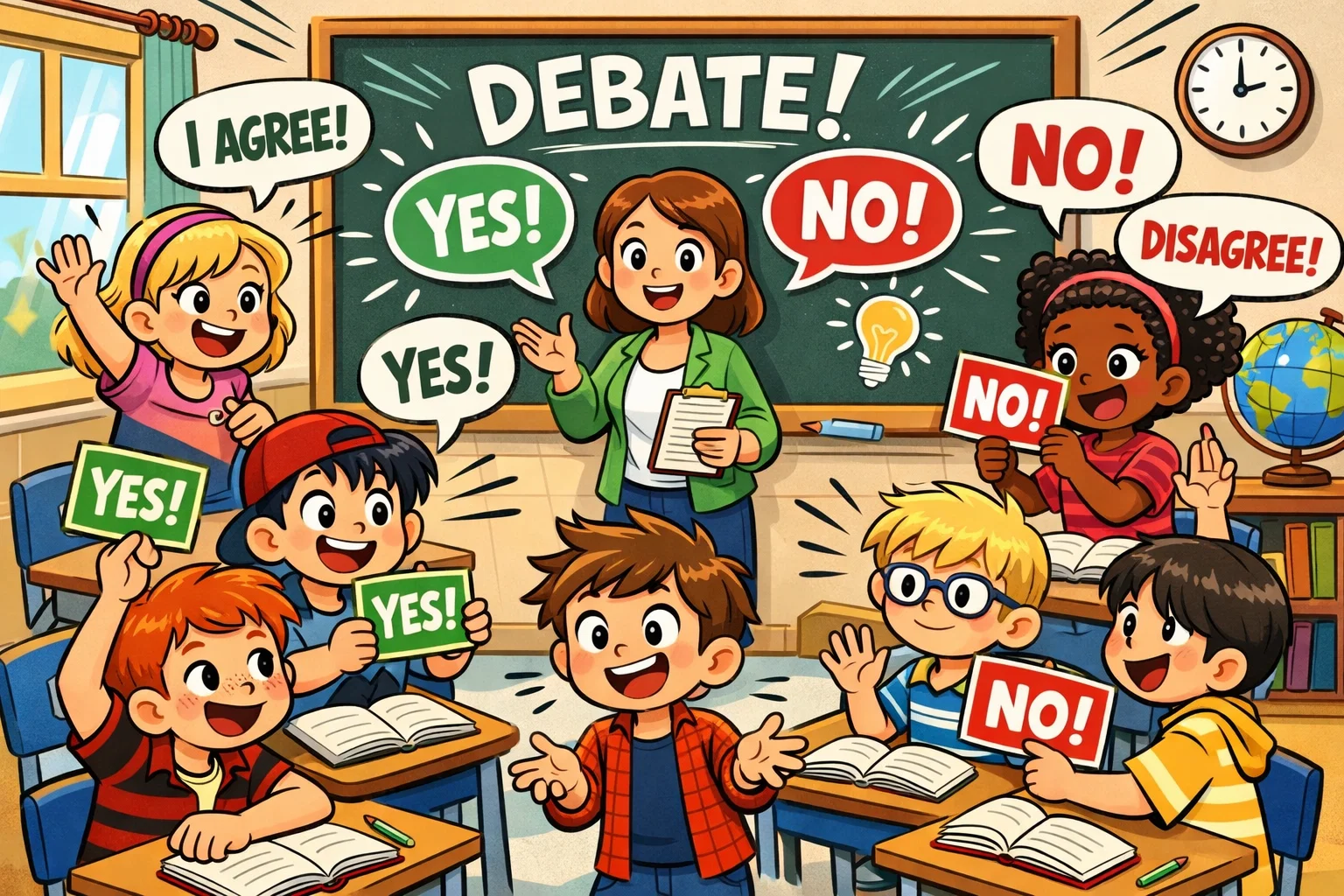
Introducing debate in the classroom or at home is one of the most effective ways to engage students in active learning. Far from being just an exercise in “arguing,” debate is a multifaceted activity that builds literacy, strengthens critical thinking, and prepares children for real-life situations. Whether it is a fifth-grader discussing school uniforms or a high school senior tackling global issues like climate change, formal debate helps students see beyond their own perspective.
This guide provides 100 debate topics tailored for kids of all ages, from kindergarten to the final year of school. By integrating these topics into lessons and home discussions, teachers and parents can spark curiosity and help children become analytical thinkers who can discuss social issues respectfully.
Why Debating Matters for Kids
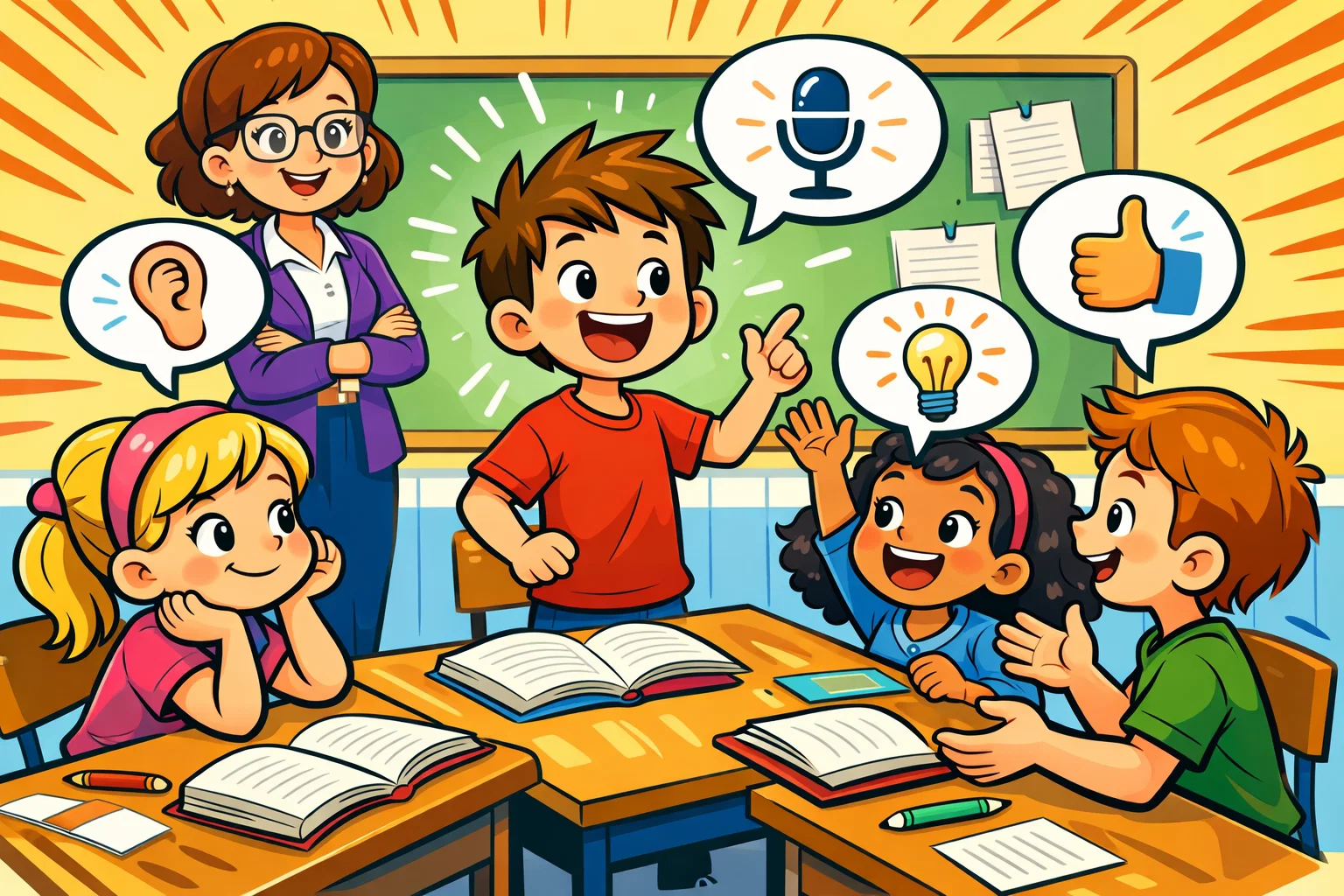
Structured debate is a powerful teaching strategy that helps students move from passive consumers of information to active participants in learning. Many educational frameworks emphasize discussion and presentation as important tools for developing communication and citizenship skills. When students are asked to argue a point – even one they do not personally agree with – they build mental flexibility and resilience.
Critical Thinking Skills
Debate requires students to evaluate evidence and identify logical fallacies. Critical thinking grows when students consider the “why” behind a topic, moving beyond surface-level opinions toward analytical reasoning. Research suggests that students who participate in debate and discussion programs can strengthen reading comprehension because they must synthesize complex information quickly to build an argument.
Public Speaking & Listening Skills
A great debate is as much about listening as it is about speaking. To succeed, students must engage with an opposing perspective, which requires focus, active listening, and strong comprehension skills. Public speaking practice can reduce anxiety, and early exposure to group discussion often boosts children’s confidence when speaking in front of others. Students learn to modulate their tone, use age-appropriate vocabulary, and maintain eye contact, which are essential skills for real-world success.
Confidence, Empathy & Teamwork
Working in teams fosters collaboration and respect. When elementary or middle school students prepare for a topic, they must rely on their peers to strengthen their arguments. Being asked to argue for the “other side” also develops empathy by helping students understand that controversial issues often have more than one valid viewpoint. This emotional intelligence is a cornerstone of teaching children how to be productive members of society.
Debate Prompts for Preschoolers
At this age, the goal is to introduce the idea of giving a reason for a choice. These simple questions focus on children’s immediate world.
Popular & Easy
- Dogs vs. Cats: Which animal makes the best household pet for a family? (Dog / Cat)
- Summer vs. Winter: Which season provides the most fun outdoor activities? (Summer / Winter)
- Apples vs. Bananas: Which fruit makes the better school snack? (Apples / Bananas)
- Bedtime: Should children be allowed to choose their own bedtime on weekends? (Yes / No)
Funny & Imaginative
- Superpowers: Is it better to be able to fly or to be invisible? (Flight / Invisibility)
- Talking Animals: If animals could talk, which one would be the funniest? (Monkey / Parrot / Dog)
- Living Underwater: Would it be more interesting to live in a castle in the clouds or a house under the sea? (Clouds / Underwater)
School & Routine
- Nap Time: Should kindergarten students have a mandatory nap time every day? (Yes / No)
- Toy Sharing: Should you always have to share your favorite toy with a visitor? (Yes / No)
- Outdoor Play: Is the slide better than the swings at the local park? (Slide / Swings)
Prompts for Elementary Students (Grades 1–4)
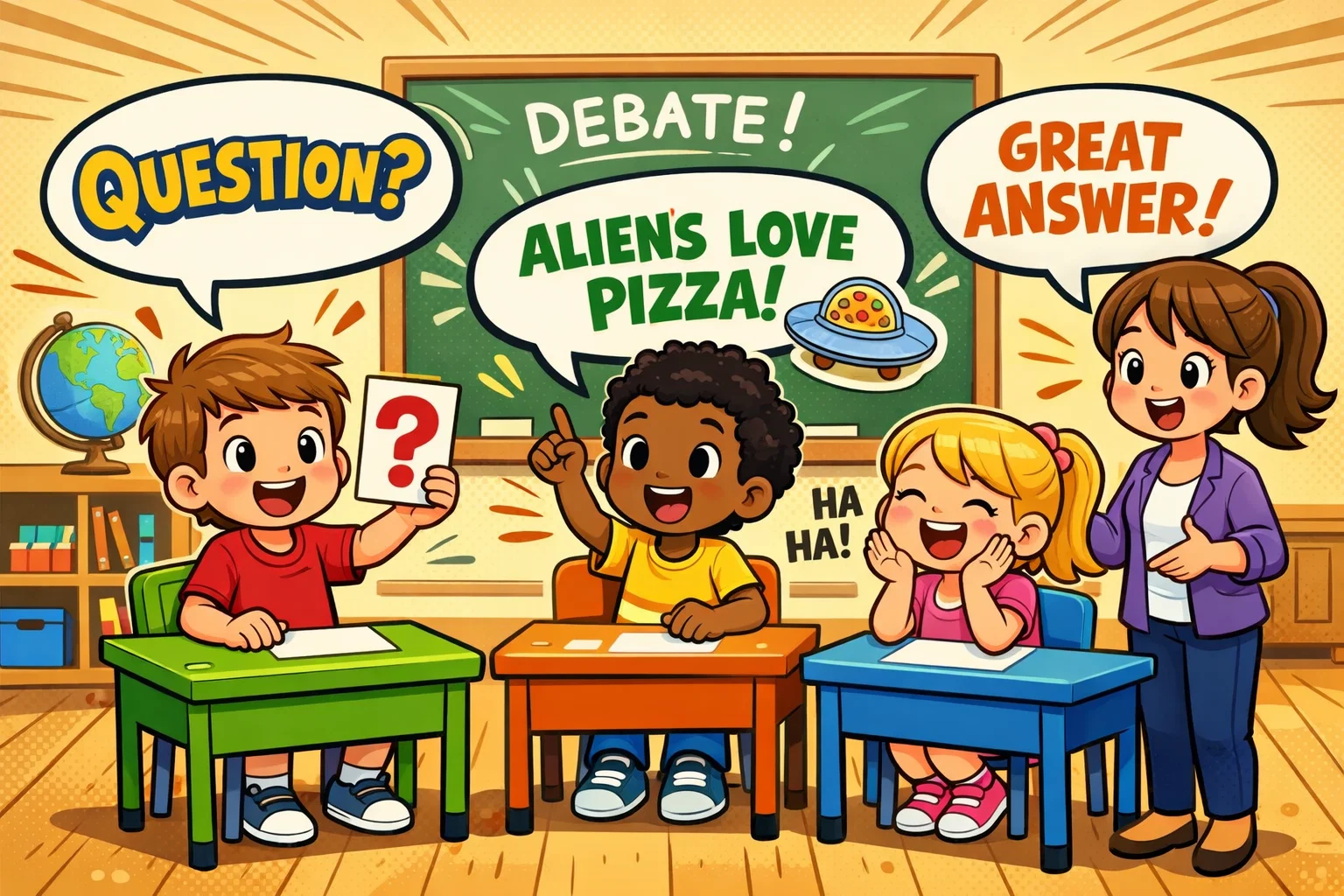
Elementary students are beginning to understand different points of view. These prompts help them build early critical-thinking skills through familiar school and home topics.
Popular Topics
- Homework: Should elementary schools ban homework to allow for more family time? (Ban / Keep)
- School Uniforms: Do uniforms help students focus, or do they limit personal expression? (Uniforms / Free Dress)
- Video Games: Are video games a good way for kids to spend a Saturday morning? (Good Use of Time / Distraction)
- Pocket Money: Should children receive an allowance for doing basic household chores? (Allowance / No Pay)
- Zoos: Are zoos helpful for animal conservation or unfair to wild creatures? (Helpful / Unfair)
- Books vs. Movies: Is the book version of a story always better than the movie? (Books / Movies)
- Dessert: Should children be required to eat all their vegetables before having dessert? (Vegetables First / Dessert Anytime)
Light-Hearted & Funny
- Pizza Toppings: Does pineapple belong on a pizza? (Yes / No)
- Breakfast for Dinner: Is eating pancakes at 6:00 PM the best way to end the day? (Yes / No)
- Santa Claus: Should parents tell children the truth about figures like Santa Claus early on? (Tell the Truth / Preserve the Magic)
- Clowns: Are clowns funny or scary for most children? (Funny / Scary)
- Robots: Would you rather have a robot that does your chores or a robot that does your homework? (Chores / Homework)
- Superheroes: Who would win in a debate: Batman or Superman? (Batman / Superman)
- Time Travel: Is it better to visit the past (dinosaurs) or the future (spaceships)? (Past / Future)
School & Education
- Recess: Should recess be longer than 30 minutes in the elementary school day? (Longer / Current)
- Class Pets: Is a hamster a better classroom pet than a goldfish? (Hamster / Goldfish)
- Tablets in Class: Should every first-grade student be given a tablet for reading lessons? (Digital / Paper)
- School Lunches: Should students be allowed to design the weekly menu? (Students / School)
- Grades: Do letter grades (A, B, C) motivate students or cause unnecessary stress? (Motivation / Stress)
- Summer Break: Should school last all year with shorter, more frequent breaks? (Year-round / Seasonal)
Prompts for Middle Schoolers (Grades 5–8)
Middle school is a good time to introduce more complex and sometimes controversial topics that require research and analysis. These topics encourage students to engage with social, ethical, and global issues.
Controversial Issues
- Social Media: Should the minimum age for social media accounts be raised to 16? (Age 16 / Age 13)
- Mobile Phones: Should middle school students be allowed to use phones during lunch? (Allowed / Banned)
- Standardized Testing: Do standardized tests accurately measure a student’s ability? (Accurate / Flawed)
- Voting Age: Should the legal age to vote in local elections be lowered to 16? (Lower / Keep at 18)
- Junk Food: Should schools be banned from selling soda and candy on campus? (Banned / Choice)
- Gender-Neutral Bathrooms: Should schools provide gender-neutral bathrooms? (Yes / No)
- Animal Testing: Is it respectful or ethical to test medical products on animals? (Ethical / Unethical)
- Violent Video Games: Does playing violent games lead to real-world aggression in middle schoolers? (Yes / No)
- Curfews: Should cities have a mandatory 9:00 PM curfew for everyone under 18? (Curfew / Freedom)
- Peer Pressure: Is peer pressure always negative, or can it be used for positive citizenship? (Negative / Positive)
Environmental & Ethical Subjects
- Climate Change: Is individual action or government regulation more effective in fighting climate change? (Individual / Government)
- Plastic Ban: Should all single-use plastics be made illegal immediately? (Illegal / Gradual Phase-out)
- Vegetarianism: Should everyone adopt a plant-based diet to protect the environment? (Plant-based / Meat-inclusive)
- Public Transport: Should buses and trains be free for all students? (Free / Paid)
- Electric Cars: Should gasoline-powered cars be banned by the year 2035? (Banned / Choice)
- Renewable Energy: Is solar power a reliable enough source to replace coal entirely? (Reliable / Supplemental)
- Fast Fashion: Should we stop buying cheap clothes to save the planet? (Stop / Regulation)
- National Parks: Should humans be banned from certain zones to protect wildlife? (Banned / Limited Access)
- Water Scarcity: Should there be a legal limit on how much water a household can use? (Limited / Unrestricted)
- Ocean Cleanup: Should wealthy nations be solely responsible for cleaning the world’s oceans? (Wealthy Nations / Global Effort)
Technology & Future-Focused
- AI in Education: Is using AI tools like ChatGPT for essays cheating, or can they be used as helpful learning tools? (Cheating / Learning Tool)
- Driverless Cars: Are autonomous vehicles safer for everyday life than human drivers? (Safer / Riskier)
- Space Exploration: Should we spend billions on Mars missions while people are hungry on Earth? (Space / Earth)
- Digital Privacy: Do students and teachers have a right to privacy on school-issued laptops? (Privacy / Monitoring)
- Robots in the Workplace: Will automation create more jobs or lead to mass unemployment? (Jobs / Unemployment)
- Virtual Reality: Could VR headsets eventually replace physical classroom learning? (Digital / Physical)
- Genetic Engineering: Should parents be allowed to choose the traits of their children? (Allowed / Forbidden)
- The Metaverse: Is spending time in a digital world better than real-world interaction? (Digital / Physical)
- Cyberbullying: Should schools be able to punish students for things they say online outside of school hours? (Punish / No Jurisdiction)
- Internet Access: Should high-speed internet be considered a basic human right? (Right / Privilege)
Prompts for High Schoolers (Grades 9–12)
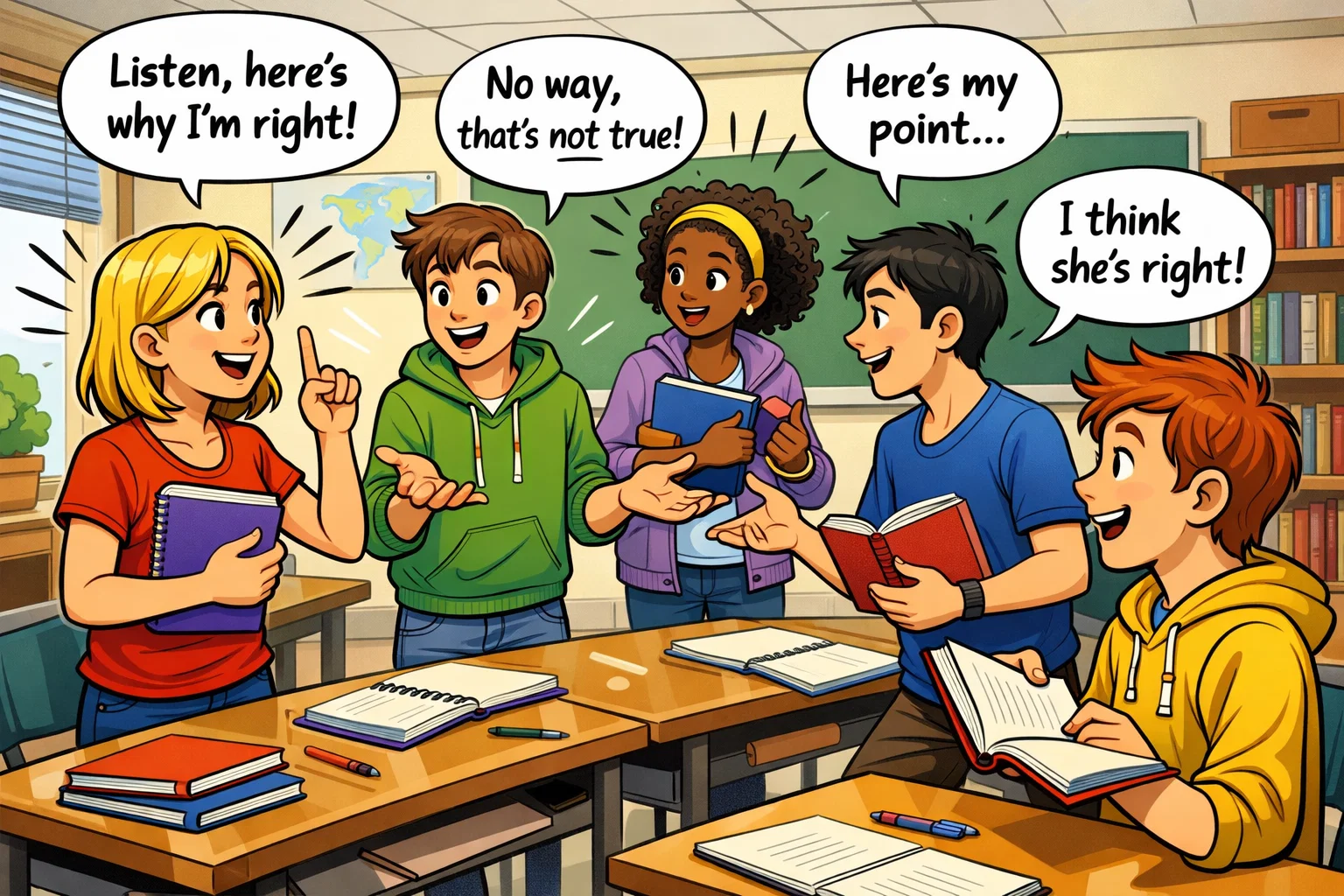
High school students are ready for debate formats that mirror academic, professional, and civic discussions. These focus on analytical depth.
Political & Civil Subjects
- Universal Basic Income: Should the government provide a monthly stipend to all citizens? (UBI / No UBI)
- Compulsory Voting: Should all citizens be legally required to vote in national elections? (Required / Optional)
- Freedom of Speech: Should social media companies have the right to censor controversial political figures? (Censor / Free Speech)
- Gun Control: Are stricter gun laws the most effective way to ensure public safety? (Stricter / Current)
- Immigration: Should borders be more open to support global economic growth? (Open / Restricted)
- Capital Punishment: Is the death penalty a justifiable form of justice in the 21st century? (Justifiable / Unjustifiable)
- Taxes: Should the wealthy be taxed at a significantly higher rate to fund school systems? (Higher / Flat)
- Healthcare: Is a government-funded healthcare system better than a private one? (Public / Private)
- Military Spending: Should nations decrease their military budgets to fund educational research? (Decrease / Maintain)
- Diplomacy: Are economic sanctions a better tool for peace than military intervention? (Sanctions / Military)
Education & Lifestyle
- College Degrees: Is a traditional four-year degree still necessary for success in the AI age? (Necessary / Obsolete)
- Gap Years: Should every high school senior be encouraged to take a year off before college? (Gap Year / Straight to College)
- School Start Times: Should high school begin at 10:00 AM to align with teen sleep patterns? (Late Start / Normal)
- Homeschooling: Does homeschool provide a better learner experience than public school? (Home / Public)
- Mental Health Days: Should students be allowed five excused “mental health days” per semester? (Allowed / Not Allowed)
- Second-Language Learning: Should all students be required to learn a second language at school? (Required / Optional)
- Greek Life: Should fraternities and sororities be banned from university campuses? (Banned / Keep)
- Internships: Should all internships be legally required to be paid? (Paid / Unpaid Allowed)
- Work-Life Balance: Is a 4-day work week better for productivity and everyday life? (4-Day / 5-Day)
- Social Credit: Should society use a digital “reputation” score to determine access to services? (Support / Oppose)
Weird & Unusual
- Simulation Theory: Are we living in a computer simulation? (Simulation / Reality)
- Cryogenics: Should people be allowed to preserve their bodies in the hope of being revived in the future? (Allowed / Banned)
- Alien Life: Should we actively try to contact extraterrestrial civilizations? (Contact / Stay Silent)
- Art & AI: Can AI-generated art ever be as “real” as human-created art? (Real Art / Code)
- Vegetable Rights: If plants can feel “stress,” should we reconsider our diet? (Reconsider / Eat)
- Moon Ownership: Should private companies be allowed to own land on the moon? (Private / Public)
- The 100-Year Life: If humans could live to 150, would it be good for the planet? (Good / Overpopulation)
- Monarchy: Are royal families still relevant in modern society? (Relevant / Outdated)
- Dreams: Should advertisers be allowed to “input” ideas into our dreams via technology? (Allowed / Forbidden)
- Ocean vs. Space: Which is more interesting to explore: the deep sea or outer space? (Ocean / Space)
Final 10 Prompts to Spark Curiosity
This final list provides a mix of fun propositions that cross grade boundaries and engage various interests.
Sports and Competition
- Contact Sports: Should children under 14 be banned from playing high-impact contact sports? (Banned / Parental Choice)
- Esports: Should competitive gaming be treated like a real sport in schools? (Sport / Hobby)
- Participation Trophies: Do they build confidence or discourage students from working harder? (Build Confidence / Discourage)
- Professional Pay: Should male and female professional athletes be paid exactly the same? (Same / Revenue-based)
AI, Robots & the Future
- AI Companions: Is it healthy for a child to have a “best friend” that is an AI? (Healthy / Harmful)
- Robot Rights: Should a robot that can think and feel have legal protections? (Protections / Machine Status)
- Brain Chips: Would you get a chip in your brain if it meant you never had to study again? (Yes / No)
Summer, Reading & Adventure
- Mandatory Reading: Does forced summer reading make students hate books? (Hate / Help)
- Adventure Tourism: Should people be allowed to go on dangerous adventures (like climbing Everest) at any age? (Freedom / Restriction)
- Virtual Travel: Is visiting a museum in VR as good as going there in person? (Digital / Physical)
How to Pick the Right Subject for Kids
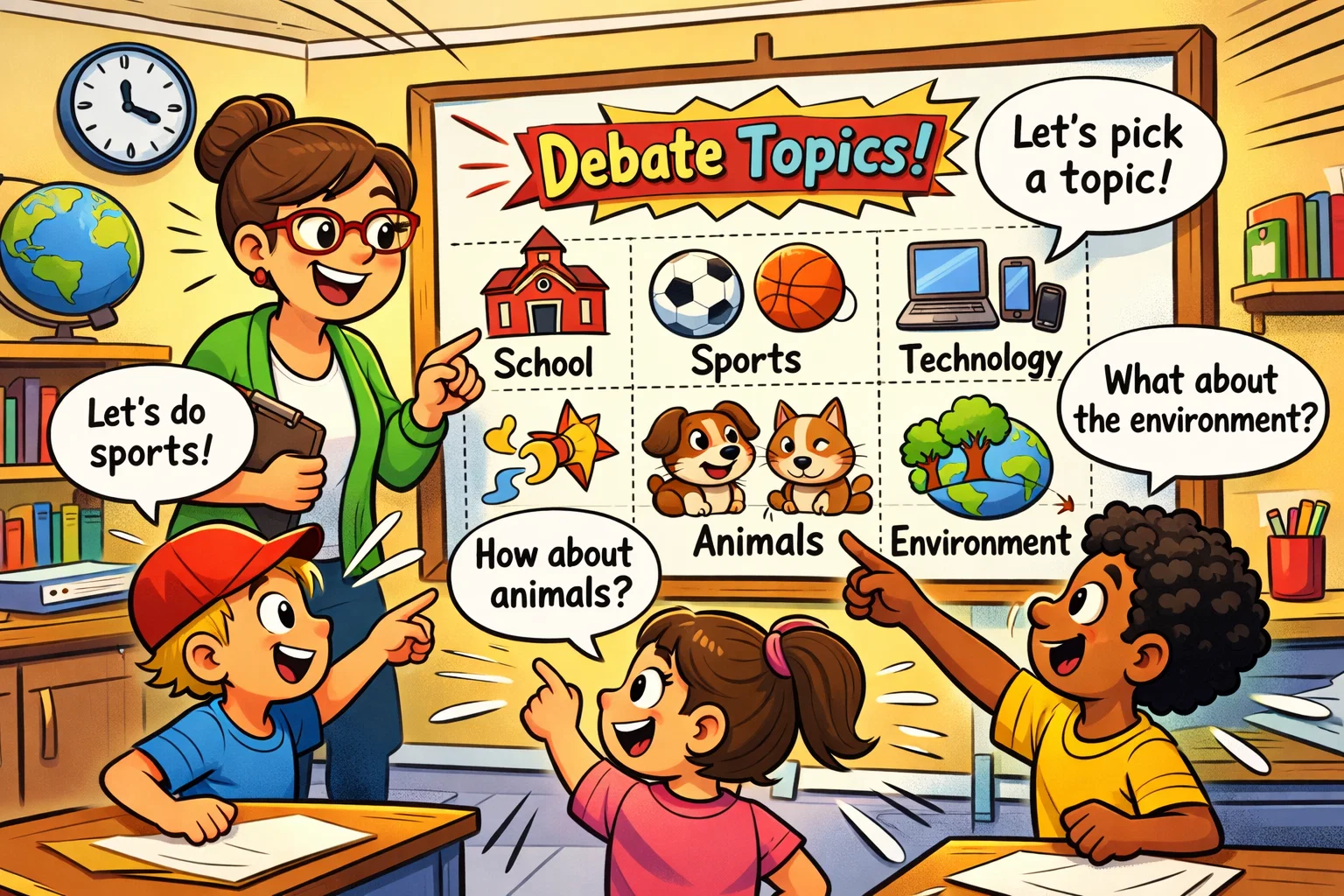
Selecting an easy prompt versus a controversial one depends entirely on the age, grade, and maturity of the students. A teacher must ensure the content is age-appropriate to keep the discussion productive and prevent frustration.
Match the Topic to Age and Grade
The complexity of a debate topic should match students’ cognitive development. For kindergarten or elementary kids, the focus should remain on everyday life and immediate surroundings, such as “Should we have dessert before dinner?” For high school students, the discussion can shift toward global issues, AI, and citizenship.
| Grade Level | Focus Area | Example Topics |
| Preschool/K | Personal Preferences | Favorite snacks, toys, or animals |
| Elementary | School & Home Life | Homework, recess, and screen time |
| Middle School | Social & Tech Issues | Social media, AI, and environmental issues |
| High School | Ethics & Policy | Voting age, climate change, and societal issues |
Balance Fun, Challenge & Clarity
A good prompt should have a clear “hook” while still allowing for more than one reasonable point of view. If a question is too one-sided (e.g., “Is exercise good for you?”), it fails to get students to think critically. A fun prompt like “Is a hotdog a sandwich?” provides a low-stakes environment for middle school students to practice analytical skills without the pressure of a controversial subject.
Keep the Motion Simple & Relevant
A topic is most effective when it feels relevant to students’ real lives. Whether in a homeschool setting or a traditional classroom, the motion should be phrased as a clear “This House believes…” or a “Should…” statement. This clarity ensures that both older and younger students know exactly what they are expected to argue.
Tips for Great Debates
To turn a chosen topic into a successful discussion, teachers and parents should provide a clear framework. Success relies on preparation and structure.
How to Build a Strong Argument
A strong argument is the foundation of critical thinking. Students should follow the ARE formula:
- Assertion (Position): State clearly what you believe. (e.g., “I believe [X]”)
- Reason (Why): Give a logical explanation for your position.
- Evidence (Example): Provide a fact, statistic, or real-world example.
- Conclusion: Tie it back to the original motion.
How to Prepare a Rebuttal
A rebuttal is not about “winning”; it is about responding thoughtfully and logically. Teach students to:
- Listen carefully to the opponent’s perspective.
- Identify a “weak link” in their evidence.
- Explain why your own point is more relevant, more persuasive, or better supported.
- Use phrases like, “While my opponent suggests [X], the evidence actually shows [Y].”
How to Keep the Classroom Friendly
To ensure a respectful environment:
- Use a Timer: Set clear limits (e.g., 2 minutes per speaker) to ensure everyone has a turn.
- Focus on Ideas, Not People: Remind students to challenge the idea, not attack the person.
- Switch Sides: Occasionally ask students to support the side they disagree with to build empathy.
- The “Judge” Role: Let other students act as judges to practice analytical listening.
Summary Table: Key Benefits of Debate by Category
| Category | Primary Benefit | Typical Outcome |
| Cognitive | Critical Thinking | Helps students strengthen reasoning and analytical skills |
| Social | Empathy | Encourages empathy and perspective-taking |
| Academic | Literacy | Supports vocabulary growth and reading comprehension |
| Professional | Public Speaking | Builds foundational skills for real-world presentations |
By choosing the right topics and fostering a respectful environment, teachers and parents can help children become more engaged in their own learning and grow into thoughtful, confident communicators.
Frequently Asked Questions
How Many Topics Should Each Grade Receive?
For a standard lesson plan, focusing on one to three prompts per month is a good pace. This gives students time to explore school-based or global issues in depth instead of rushing through several topics without enough context.
How Long Should a Speech Be?
Speech length should vary by age and grade. Preschool/K: 30 seconds to 1 minute. Elementary: 1 to 2 minutes. Middle School: 2 to 4 minutes. High School: 5 to 7 minutes.
How to Make Kids Better at Debating?
The best way to help a student become a stronger debater is through consistent practice. Incorporating simple prompts into everyday life – such as “Why should we choose this movie tonight?” – helps build the critical-thinking skills students will need for more challenging debates later on. Teachers should also give feedback on delivery, including eye contact, tone, and pacing.

Take a short quiz to find out what your everyday choices say about your parenting style
When your child is curious about something new, what’s your instinct?
Take a short quiz to find out what your everyday choices say about your parenting style
“Can I download this app?” What happens next?
Take a short quiz to find out what your everyday choices say about your parenting style
When it comes to rules at home, which sounds most like you?
Take a short quiz to find out what your everyday choices say about your parenting style
If you could give your child one life skill today, what would you pick?
Take a short quiz to find out what your everyday choices say about your parenting style
Your child gets to choose what to watch. What would your ideal setup look like?
Take a short quiz to find out what your everyday choices say about your parenting style
Pick your parenting superpower ✨