STEM Activities for Teens: The Ultimate Guide to Engaging Projects and Experiments

 Discover a Free Education Video App for Kids
Pastory uses AI to personalize educational video content based on your child’s interests and personality. Safe, engaging, and built for curious young minds. Sign up now to stay updated and enjoy early access with a free trial
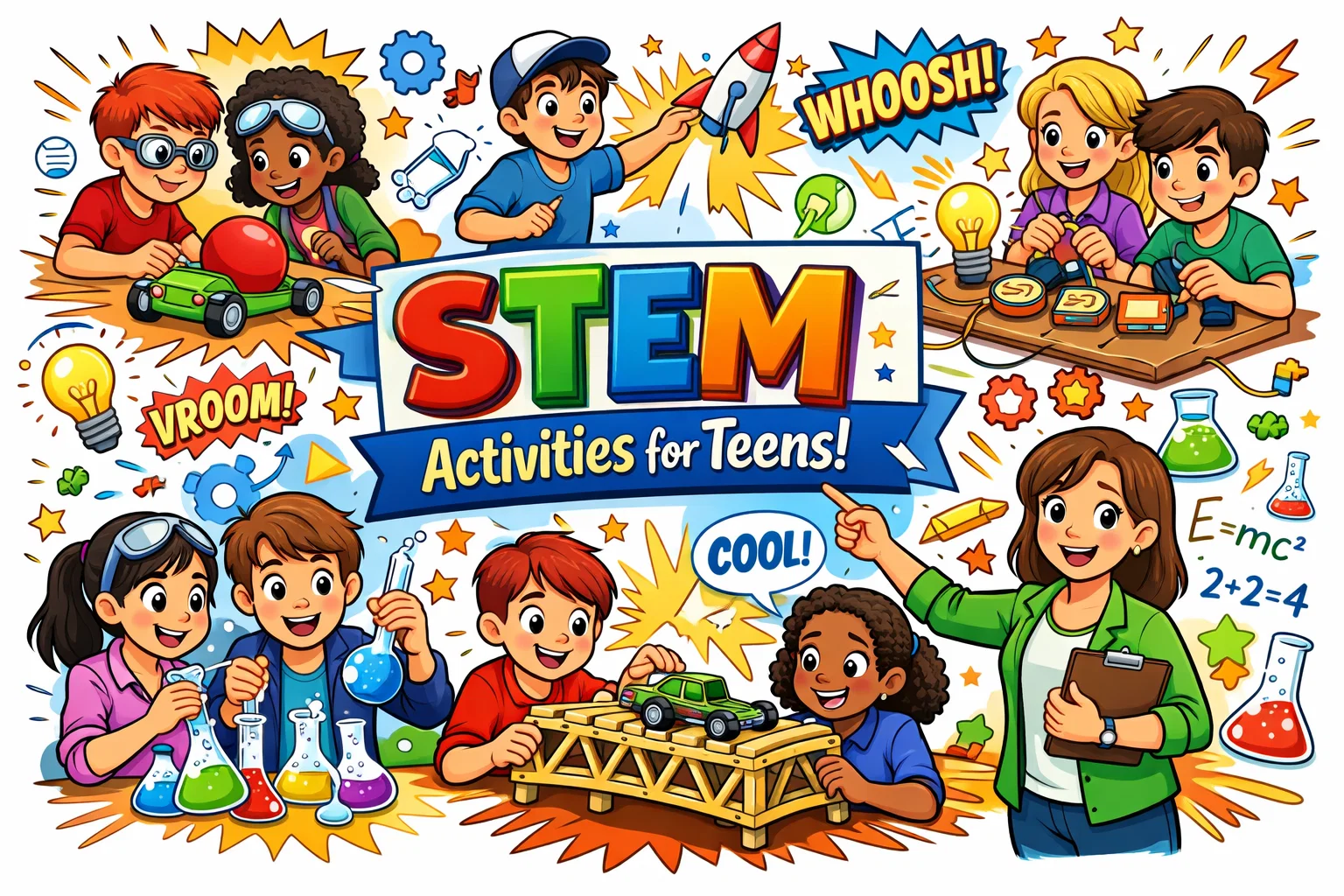
Engaging teenagers in the world of science, technology, engineering, and math requires a shift from simple “kitchen chemistry” to complex, real-world problem-solving. This comprehensive guide provides a curated selection of STEM activities for teens designed to foster critical thinking, creativity, and 21st-century skills. Whether you are a parent looking for fun STEM activities to do at home or a teacher seeking high-quality STEM lessons for the classroom, these projects bridge the gap between abstract concepts and practical application.
What Makes STEM Activities for Teens Different
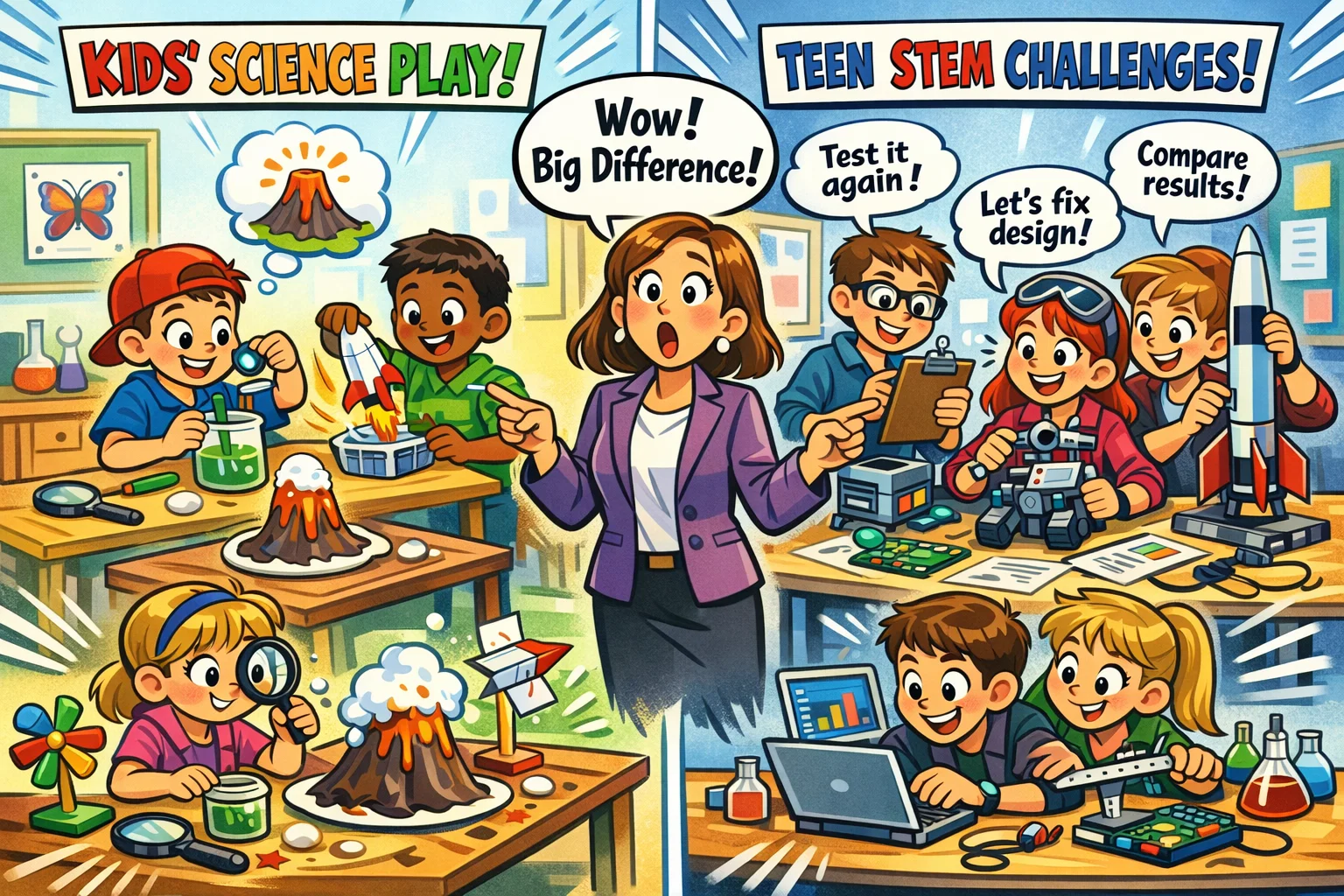
As children transition into adolescence, their cognitive development allows for more sophisticated engagement with STEM concepts. Activities for teens often work best when they move beyond observation toward synthesis and optimization.
Complexity and Independence
Teenagers possess the executive-function skills necessary to manage multi-step STEM projects with minimal supervision. Unlike activities for younger children, stem activities for teens emphasize the formulation of independent hypotheses and the management of variables. By allowing teens to lead the engineering design process, they develop a sense of agency and mastery over technical subjects.
Real-World Problems and Career Links
High school students are increasingly focused on their future, making it essential to link science activities to viable career paths. Projects involving environmental science, robotics, and forensic science show how STEM education can help address real-world challenges such as climate change and public safety. Connecting a physics-focused build to civil engineering or a chemistry experiment to pharmacology increases student buy-in and professional interest.
Data, Iteration, and Design Process
For teens, a hands-on project is not a “one and done” event but a cycle of continuous improvement. The engineering design process requires students to test a model, record data, identify failure points, and iterate on their design. This focus on optimization mirrors the work of a professional innovator and teaches resilience when a science experiment does not yield the expected result immediately.
Materials, Safety, and Supervision
While many DIY STEM activities use household items, more advanced teen projects may introduce tools such as soldering irons, high-voltage components, or concentrated chemicals. Safety protocols must scale with the project difficulty. It is vital to establish clear safety rules so teens understand which activities require safety goggles and which STEM activities are safe for independent exploration at home.
STEM Activities for Teens at Home
Bringing the world of STEM into the living room does not require an expensive laboratory. Using household materials, teens can explore sophisticated science concepts with a low barrier to entry.
Household Materials Projects
Many engaging STEM activities rely on basic supplies to demonstrate concepts related to fluid dynamics and chemistry. These projects are ideal for demonstrating science behind everyday phenomena:
- Oil and Water Density Tower: Teens use oil and water along with food coloring to visualize molecular polarity and density layers.
- Alka-Seltzer Lava Lamp: This chemistry experiment uses a chemical reaction to produce carbon dioxide bubbles, demonstrating gas solubility and pressure.
- Walking Water: By using paper towels and colored water, students observe capillary action, a fundamental concept in plant biology.
45-Minute Projects
For a quick hands-on science session, these activities provide immediate feedback and allow for rapid testing:
- Paper Rocket: Using a straw and paper, teens design and build a projectile to study aerodynamics and thrust.
- Binary Bracelets: A gateway to coding, this project uses different colored beads to represent 0s and 1s, teaching binary representation and, if desired, basic ASCII encoding.
- Light-Up Postcard: By using copper tape and a coin battery, teens create a simple circuit, merging art with electrical engineering.
Low-Prep Team Challenges
These engineering challenges are designed for teens to work collaboratively using minimal supplies:
- Leaning Tower of Pasta: Teams use dried spaghetti and marshmallows to build the tallest structure possible, testing structural integrity.
- Protect the Payload: In this variation of the egg drop, students design a protective container for a mint candy or other small object using only recycled materials such as cardboard and bubble wrap.
- Paper Chain Challenge: Using a single piece of paper, teens must create the longest possible chain, requiring strategic cutting and “outside the box” thinking.
Low-Budget Builds
Accessibility is key to ensuring that all teens can explore STEM regardless of financial constraints. These low-cost STEM ideas focus on simple mechanics and basic physics:
- Balloon Car: A classic stem project using a plastic bottle, straws, and a balloon to demonstrate Newton’s Third Law of Motion.
- Paper Bridge: Using only paper and tape, students must design and build a bridge that can support the weight of several coins, teaching tension and compression.
Safety Rules and Setup
To maintain a safe environment at home, follow these guidelines:
- Ventilation: Ensure windows are open when working with vinegar, baking soda, or glues.
- Protective Gear: Use gloves and eye protection for any chemistry experiment.
- Disposal: Never pour cooking oil, paint, or chemicals down the kitchen sink, and follow local guidelines for battery disposal.
Science STEM Activities for Teens
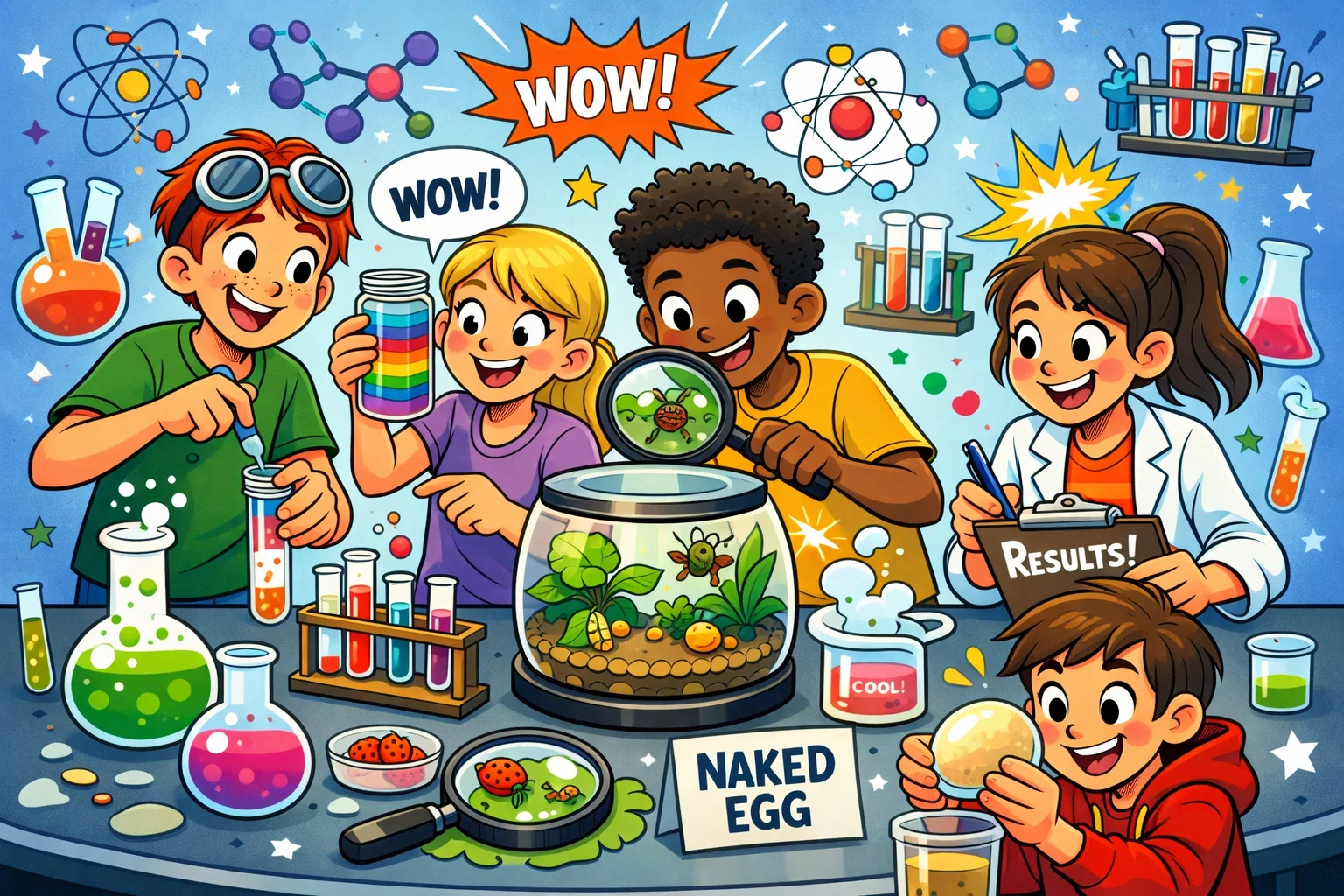
Advanced science-focused STEM activities allow high school students to act as researchers, collecting and analyzing data to better understand living systems and the environment.
Biology and Ecology Projects
Teens can study life science through direct observation of ecosystems and biological structures:
- Mold Terrarium: By exposing bread or fruit to controlled conditions, students can observe fungal growth and record how temperature and light affect decomposition.
- Future Farmers: This project involves growing microgreens under different conditions (LED light vs. sunlight) to simulate modern agricultural challenges.
Chemistry and Reaction Labs
Chemistry for teens should move toward quantitative analysis. These lab activities focus on the “why” behind the “wow”:
- Black Magic (Chromatography): Using coffee filters and markers, teens separate ink pigments to understand solubility, capillary action, and why different pigments travel at different rates.
- Rainbow Lightning: This involves using red cabbage juice as a pH indicator to test various household liquids, creating a visual spectrum of acidity.
Earth, Water, and Agriculture Projects
Understanding earth science is critical for the next generation of innovators facing environmental shifts:
- Rising Water Table Model: Teens use a model made of sand and gravel to visualize how groundwater levels change with rainfall and extraction.
- Landslide Simulation: Using flour or sugar on a sloped board, students test different barriers to see which structures best slow or prevent slides.
| Activity Type | Main Concept | Data Point to Measure |
| Biology | Plant Growth | Stem length (cm) over 10 days |
| Chemistry | pH Analysis | Color change vs. pH scale value |
| Earth Science | Erosion | Volume of runoff water (ml) |
Physics-Focused STEM Activities for Teens
Physics becomes tangible when teens engage in hands-on stem builds that involve motion, force, and energy transfer.
Motion and Forces Challenges
Understanding how objects interact with gravity and air resistance is a core part of high-school physics:
- Barbie Bungee: Using rubber bands, teens calculate the exact length needed for a doll to fall from a height without hitting the ground, demonstrating elasticity and potential energy.
- How Different Objects Fall: Students compare how objects of different shapes and masses move through the air to explore air resistance.
Simple Machines and Launchers
These projects utilize pulley systems and leverage to achieve mechanical advantage:
- Mini Trebuchet: Teens build a wooden or cardboard trebuchet to study projectile motion, torque, and energy transfer; sensors can be added later for data collection.
- Hand Crank Winch: A project using cardboard tubes and string to demonstrate how simple machines multiply force to lift heavy objects.
Paper Physics Projects
Paper is an incredibly versatile, fun, and accessible medium for exploring complex physics concepts:
- Paper Roller Coaster: Using cardstock and tape, teens create a track for a marble, calculating the transition from potential to kinetic energy.
- Paper Rocketry: Testing different fin shapes on a rocket to see how stability affects flight distance.
Technology STEM Activities for Teens
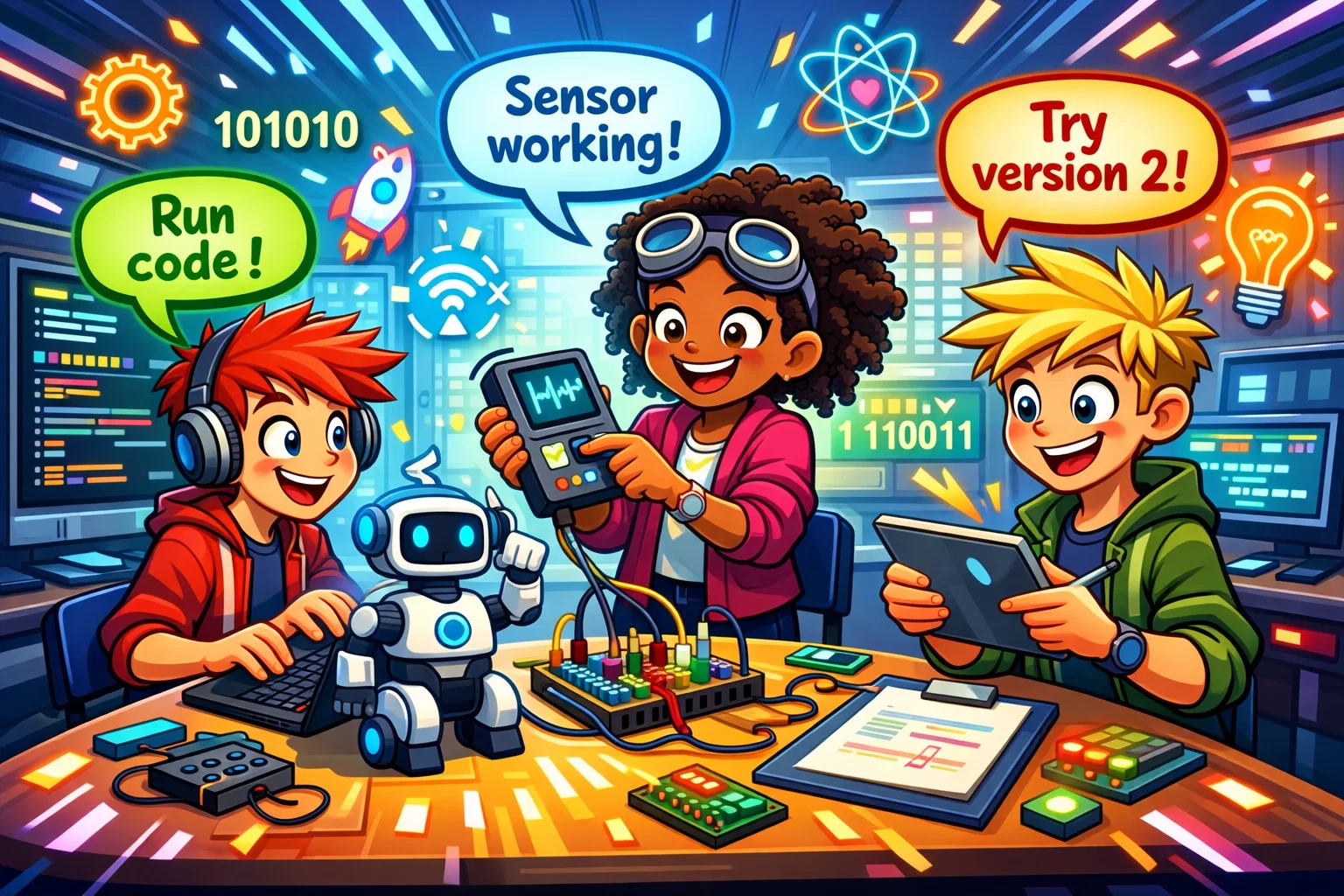
In the 21st century, technology is the ‘T’ that ties STEM together. These activities range from digital creation to hardware interaction.
Coding and Robotics
While kits like LEGO Mindstorms are excellent, teens develop strong skills through free platforms as well:
- Game Design: Using Scratch or Python to build a simple logic-based game.
- Simple Robot: Creating a “bristlebot” using a toothbrush head, a vibrating motor, and a small battery.
Virtual Robotics and Simulations
For schools with a limited budget, virtual environments provide a way to bring STEM to life:
- VEXcode VR: A free web-based simulator where teens can code a virtual robot to navigate mazes and clean up “trash,” teaching logic without the hardware cost.
Engineering STEM Activities for Teens
Engineering is the application of math and science to solve a specific problem within constraints. These engineering challenges require teens to act as professional designers.
Structural Design and Towers
- Pasta Towers: Using the principle of triangulation, teens build towers that must withstand simulated ‘earthquakes’ created by shaking the table.
- Bridge Building: A stem project where students use balsa wood or popsicle sticks to create a truss bridge, testing it to the point of failure to find the “breaking load.”
Biomimicry and Prosthetic Design
This advanced engineering challenge explores how nature inspires technology:
- Prosthetic Hand: Using cardboard, straws, and string, teens design a mechanical hand that can “grip” a cup, simulating the mechanics of human tendons and muscles.
Fantastic Forensic Science STEM Activities
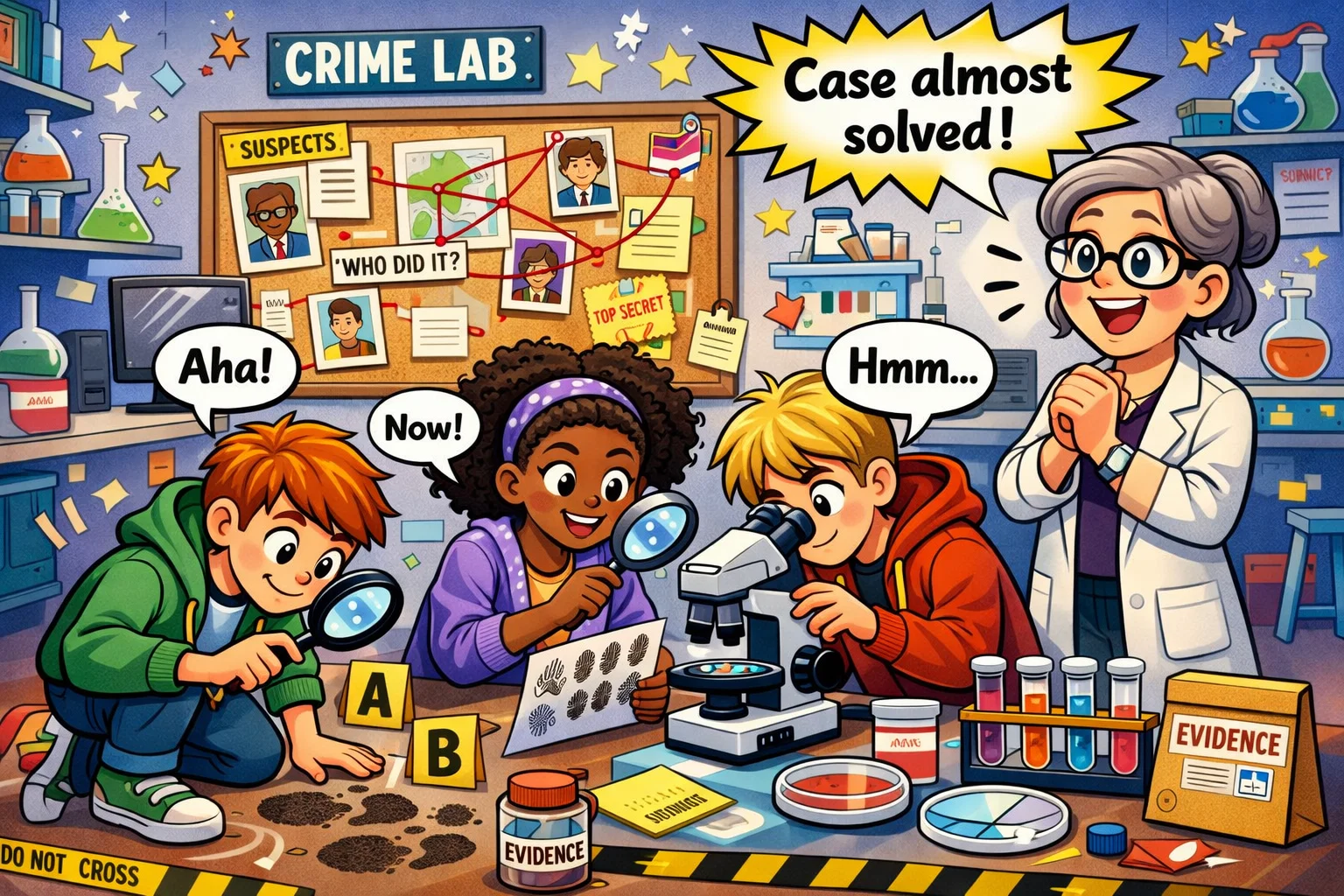
Forensics is an engaging STEM field that combines biology, chemistry, and math to investigate cases.
Blood Spatter Geometry
By dropping “fake blood” (corn syrup and dye) from various heights and angles, teens use trigonometry to calculate the point of origin. This STEM-based math activity shows how geometry can be used in crime-scene reconstruction.
Microscopic Precision
Using a microscope, teens can compare trace evidence such as:
- Hair and Fiber Analysis: Comparing different animal hairs or synthetic fibers to identify a “suspect.”
- Fingerprint Lifting: Using cocoa powder and clear tape to lift prints from household items, then classifying them into loops, whorls, and arches.
Math STEM Activities for Teens
Mathematics is the language of STEM, and these activities turn abstract formulas into interactive tools for problem-solving.
Catapult Quadratics
When launching a projectile from a catapult, the path follows a parabola. Teens can use the quadratic equation to predict where the projectile will land, merging engineering and math into a single science activity.
Half-Life Modeling
Using 100 pennies in a box, shaking it, and removing the “tails,” teens can model the radioactive decay of isotopes. This provides a visual and statistical representation of half-life, a concept crucial in both physics and archaeology.
How to Bring STEM to Any Class
STEM should not be siloed into a single period. It is a cross-disciplinary approach that can inspire future innovators in any subject.
ELA and Social Studies Links
- Research Writing: After a science experiment, students write a formal lab report or a persuasive pitch for their innovation project.
- Sustainability: Linking environmental science to social studies by discussing how different cultures manage water cycles and renewable energy.
FAQ
What Makes STEM Activities for Teens Different From Activities for Younger Kids?
Teen activities focus on the design and build cycle, involving independent research, data logging, and higher-level math. While younger kids might enjoy the “fizz” of a volcano, teens analyze the chemical concentrations required to produce a specific volume of gas.
Are STEM Activities for Teens Expensive at Home?
Not necessarily. Most activities, such as bridge building or paper physics, rely on household materials. High-tech options like robotics can be supplemented with free virtual simulations.
How Can Parents and Teachers Keep Teens Engaged in STEM?
The key to engaging STEM activities is relevance and autonomy. Allow teens to choose their own STEM topics, provide real-world constraints, and encourage either a competitive or a collaborative challenge-based atmosphere.

Take a short quiz to find out what your everyday choices say about your parenting style
When your child is curious about something new, what’s your instinct?
Take a short quiz to find out what your everyday choices say about your parenting style
“Can I download this app?” What happens next?
Take a short quiz to find out what your everyday choices say about your parenting style
When it comes to rules at home, which sounds most like you?
Take a short quiz to find out what your everyday choices say about your parenting style
If you could give your child one life skill today, what would you pick?
Take a short quiz to find out what your everyday choices say about your parenting style
Your child gets to choose what to watch. What would your ideal setup look like?
Take a short quiz to find out what your everyday choices say about your parenting style
Pick your parenting superpower ✨