Best Board Games for 8–10-Year-Olds: Strategy and Co-Op Picks

 Discover a Free Education Video App for Kids
Pastory uses AI to personalize educational video content based on your child’s interests and personality. Safe, engaging, and built for curious young minds. Sign up now to stay updated and enjoy early access with a free trial
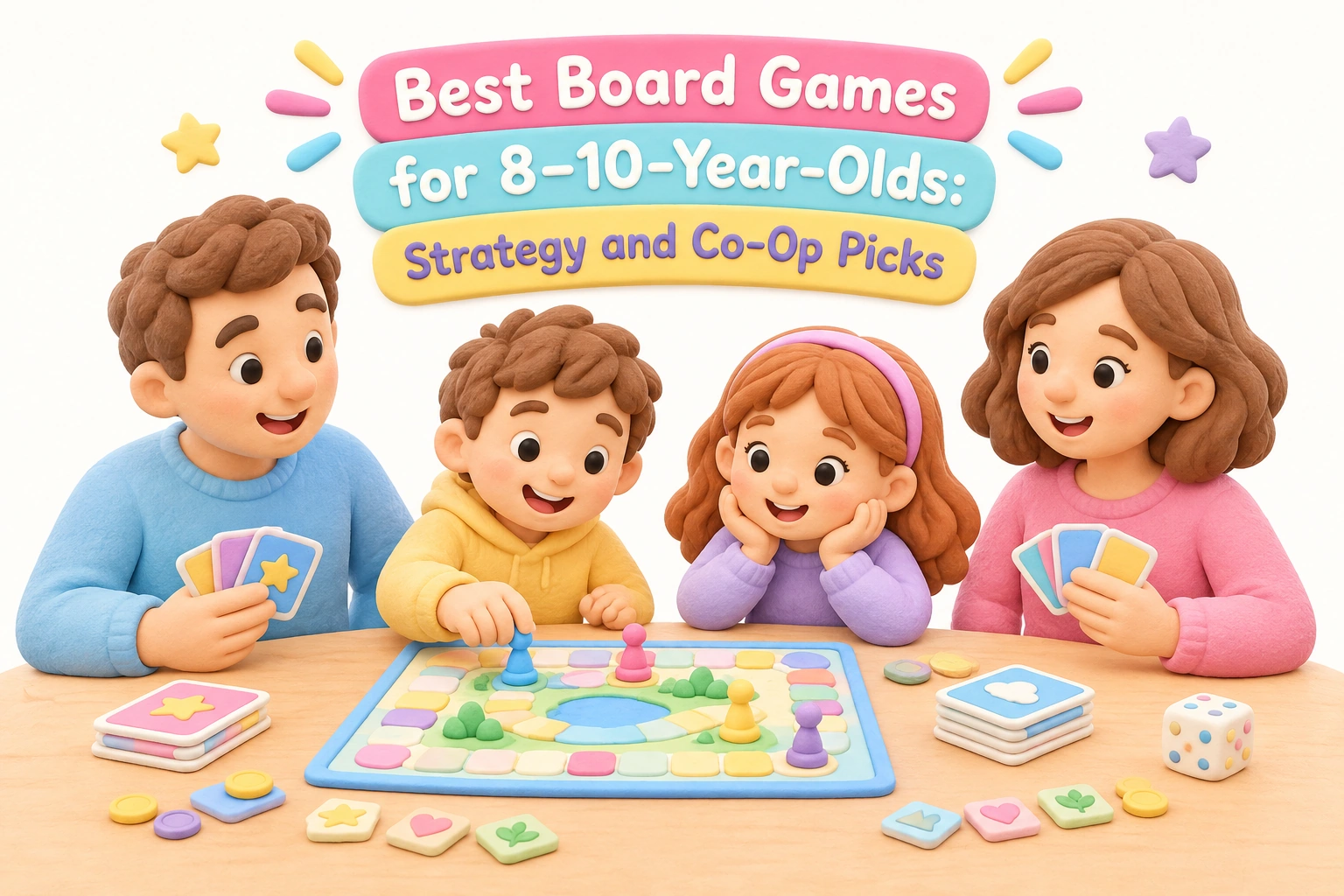
Children aged 8 to 10 are at a developmental sweet spot for board games: they can follow multi-step rules, think a move or two ahead, manage mild frustration, and genuinely enjoy the social experience of playing with others. The challenge for parents is finding games that are engaging enough to hold attention, complex enough to feel rewarding, but not so demanding that a family game night turns into a homework session. This guide covers the best strategy and cooperative board games for this age band, explains what makes each one developmentally appropriate, and helps you choose the right game for your child’s temperament and your family’s play style.
Key Takeaways
- Children aged 8–10 are ready for genuine strategy games that require planning ahead, resource management, and deductive thinking — not just luck-based roll-and-move mechanics.
- Cooperative games are particularly valuable for kids who struggle with losing, mixed-age families, and children new to modern board games.
- Research suggests that regular board game play may support executive function, mathematical reasoning, and social skills in primary-school-aged children.
- The best games for this age band balance accessible rules with enough depth to stay fresh after many plays — a quality known as replayability.
- Choosing between a strategy game and a co-op game depends on your child’s temperament, player count, and whether you want a collaborative or competitive experience.
Why Board Games Matter for 8–10-Year-Olds
Modern board games — as distinct from classic roll-and-move titles like Snakes and Ladders — ask players to make meaningful decisions every turn. That decision-making process is developmentally significant. A published study examining board game interventions with children in this age range found associations between regular play and improvements in cognitive and mathematical development. Separately, research published in peer-reviewed journals has linked game-based learning to gains in executive function, the cluster of mental skills that includes working memory, cognitive flexibility, and impulse control. These are not guaranteed outcomes for every child, but the evidence is encouraging enough that many educators now incorporate structured game play into classroom routines.
Beyond the research, the practical benefits are easy to observe at home. A child playing Ticket to Ride is practising route planning and spatial reasoning. A child playing Forbidden Island is learning to communicate under pressure and coordinate with teammates. A child playing Kingdomino is developing pattern recognition and spatial awareness. These are real cognitive skills wrapped in screen-free fun, and they develop naturally through repeated play rather than explicit instruction.
Turn-taking, negotiation, and graceful losing are social skills that board games rehearse in a low-stakes environment. For children aged 8 and up, who are increasingly aware of peer comparison and fairness, a well-chosen game can be a genuinely useful social tool — not just entertainment.
Strategy Games for 8–10-Year-Olds
Strategy games ask each player to pursue their own goal, usually competing for points, territory, or resources. The best strategy games for this age group have clear rules that can be learned in one sitting, but enough decision depth to reward repeated play. Below are the strongest picks, organized roughly from lower to higher rule complexity — a progression path that helps children build confidence before tackling more demanding titles.
Kingdomino — Best Gateway Strategy Game
Kingdomino (Blue Orange Games, ages 8+, 2–4 players, 15–20 minutes) is an ideal starting point for children new to modern board games. Players draft domino-style tiles and arrange them into a 5×5 kingdom, scoring points for connected terrain types. The tile-placement mechanic is intuitive, the rules take about five minutes to explain, and a full game fits comfortably into a short evening. Kingdomino develops spatial reasoning and basic planning without overwhelming younger or less experienced players. Its replayability is high because the tile draw changes every game. For children closer to 8, this is often the right entry point before moving to more complex titles.
Ticket to Ride — Best Overall Strategy Game
Ticket to Ride (Days of Wonder, ages 8+, 2–5 players, 45–75 minutes) appears near the top of almost every recommended list for this age group, and for good reason. Players collect coloured train cards and claim railway routes across a map, completing destination tickets for points. The rules are straightforward, but the strategy — when to claim a route, when to draw more cards, how to block opponents — deepens with experience. Ticket to Ride is a genuine gateway board game: it introduces competitive strategy in a friendly format that works for mixed ages and mixed experience levels. The longer playtime means it suits weekend evenings rather than quick weeknight sessions.
Carcassonne — Best Tile-Placement Game
Carcassonne (Z-Man Games, ages 7+, 2–5 players, 30–45 minutes) is a classic tile-placement game in which players build a shared medieval landscape of cities, roads, and fields, placing their followers (called meeples) to score points. Each turn involves drawing a tile and deciding where to place it — a simple action with surprisingly rich strategic implications. Carcassonne is particularly good for developing spatial reasoning and forward planning. It scales well from 8-year-olds playing casually to 10-year-olds exploring deeper tactical play, and the base game can be expanded with numerous add-ons as children grow.
Azul — Best for Pattern Recognition
Azul (Next Move Games, ages 8+, 2–4 players, 30–45 minutes) challenges players to draft coloured tiles from a central market and arrange them on a personal board to score points. The rules are clean and the components — smooth, satisfying resin tiles — are genuinely appealing to children. Azul rewards spatial reasoning and planning ahead while also requiring players to pay attention to what opponents are taking. It is a strong pick for children closer to 10 who are ready for a step up in strategic depth from Kingdomino. The game has very low reading requirements, making it accessible for children with dyslexia or those who are still developing reading fluency.
King of Tokyo — Best for High Energy Play
King of Tokyo (IELLO, ages 8+, 2–6 players, 30 minutes) puts players in control of giant monsters battling for control of Tokyo. The core mechanic involves rolling custom dice and choosing which results to keep — a push-your-luck system that is immediately exciting and easy to grasp. King of Tokyo is louder and more chaotic than the other strategy picks here, which makes it excellent for playdates, sleepovers, and larger groups. It supports up to 6 players, a practical advantage when player count is high. The game develops basic probability intuition and decision-making under uncertainty without requiring deep strategic thinking, making it a good bridge between luck-based games and genuine strategy titles.
Splendor — Best for Ages Closer to 10
Splendor (Space Cowboys, ages 10+, 2–4 players, 30 minutes) is a resource management and engine-building game in which players collect gem tokens to purchase development cards, gradually building an economic engine that generates points. The box says ages 10+, and that guidance is reasonable: the strategic depth — particularly the concept of building an engine that compounds over time — is better suited to children at the upper end of this age band. For a 10-year-old who has already enjoyed Ticket to Ride or Carcassonne, Splendor represents a satisfying step up in complexity. It has minimal reading requirements and plays in about 30 minutes.
Qwirkle and Blokus — Best for Spatial Thinkers
Qwirkle (MindWare, ages 6+, 2–4 players, 45 minutes) and Blokus (Mattel, ages 7+, 2–4 players, 20–30 minutes) are both strong picks for children who enjoy puzzles and spatial challenges. Qwirkle involves matching tiles by colour or shape to build lines and score points — a mechanic that develops pattern recognition and planning. Blokus asks players to place geometric pieces on a grid, blocking opponents while expanding their own territory. Both games have very low rule complexity and almost no reading requirements, making them accessible entry points for children who are new to strategy games or who find text-heavy games frustrating.
Cooperative Board Games for 8–10-Year-Olds
In a cooperative game, all players work together against the game itself rather than against each other. Cooperative game mechanics fundamentally change the social dynamic at the table: there is no winner who gloats and no loser who feels singled out. This makes co-op games particularly valuable for kids who hate to lose, for mixed-age families where skill gaps are wide, and for introducing younger or less experienced players to modern board games without the pressure of direct competition.
One practical challenge worth naming is the “bossy player” problem: in co-op games, a more experienced or dominant player — often an adult — can end up making all the decisions, leaving other players feeling like spectators. The best co-op games for this age group mitigate this through simultaneous action, hidden information, or real-time pressure that forces everyone to contribute independently.
Forbidden Island — Best Introductory Co-Op
Forbidden Island (Gamewright, ages 10+, 2–4 players, 30 minutes) is widely regarded as one of the best entry-level cooperative games available. Players work together to collect four treasures from a sinking island before it disappears beneath the water. The tension escalates naturally as the island floods, creating genuine urgency without overwhelming complexity. Forbidden Island is excellent for teaching cooperative game mechanics — shared goals, communication, and collective decision-making — in a format that children aged 8 and up can follow with a little adult guidance. The box suggests ages 10+, but many families find it accessible from age 8 with a brief rules walkthrough.
Outfoxed! — Best Co-Op for Younger 8-Year-Olds
Outfoxed! (Gamewright, ages 5+, 2–4 players, 20 minutes) is a deduction game in which players work together to identify a fox thief before it escapes. Players use a clever decoder device to eliminate suspects, combining clue-gathering with movement across the board. Outfoxed! is one of the most accessible cooperative games for children at the younger end of this age band, and it plays in under 30 minutes — a practical advantage for shorter attention spans or busy evenings. The deduction mechanic gently introduces logical reasoning and process-of-elimination thinking.
Castle Panic — Best Co-Op for Longer Sessions
Castle Panic (Fireside Games, ages 10+, 1–6 players, 60 minutes) challenges players to defend a castle from waves of monsters using a hand of cards. Players trade cards with each other and coordinate attacks, making communication central to success. Castle Panic is one of the better co-op games for mitigating the bossy player problem because card trading requires genuine negotiation rather than one player simply directing others. It supports up to 6 players, making it a strong choice for larger families or group playdates. The longer playtime and slightly higher rule complexity make it better suited to children closer to 10.
Ghost Fightin’ Treasure Hunters — Best for Active Groups
Ghost Fightin’ Treasure Hunters (Gamewright, ages 8+, 2–4 players, 30 minutes) sends players into a haunted house to collect treasures before ghosts overrun the building. The game uses dice-driven movement and a ghost-spawning mechanic that creates escalating tension. It is one of the most immediately exciting co-op games for this age group, with enough randomness to keep outcomes unpredictable and enough strategy to reward thoughtful play. The theme and components are highly appealing to children aged 8 and up, and the 30-minute playtime makes it practical for weeknight play.
5-Minute Dungeon — Best for Beating the Bossy Player Problem
5-Minute Dungeon (Wiggles 3D, ages 8+, 2–5 players, 5–10 minutes) is a real-time cooperative card game in which players simultaneously play cards to defeat dungeon obstacles before a five-minute timer runs out. Because every player acts at the same time, no single player can dominate the decision-making — everyone must contribute independently and quickly. This makes 5-Minute Dungeon one of the most effective co-op games for preventing one player from taking over. The very short playtime also means it works well as a warm-up game or for children with limited patience for longer sessions.
Co-Op vs. Competitive: Which Should You Choose First?
The choice between a cooperative game and a competitive strategy game depends less on age and more on your child’s temperament and your family’s dynamics. Cooperative games are generally the better starting point when a child is new to modern board games, when there is a significant skill gap between players (such as a parent playing with a younger child), or when a child finds losing genuinely distressing. Starting with a co-op game allows children to experience the satisfaction of winning together before navigating the more complex emotions of competitive play.
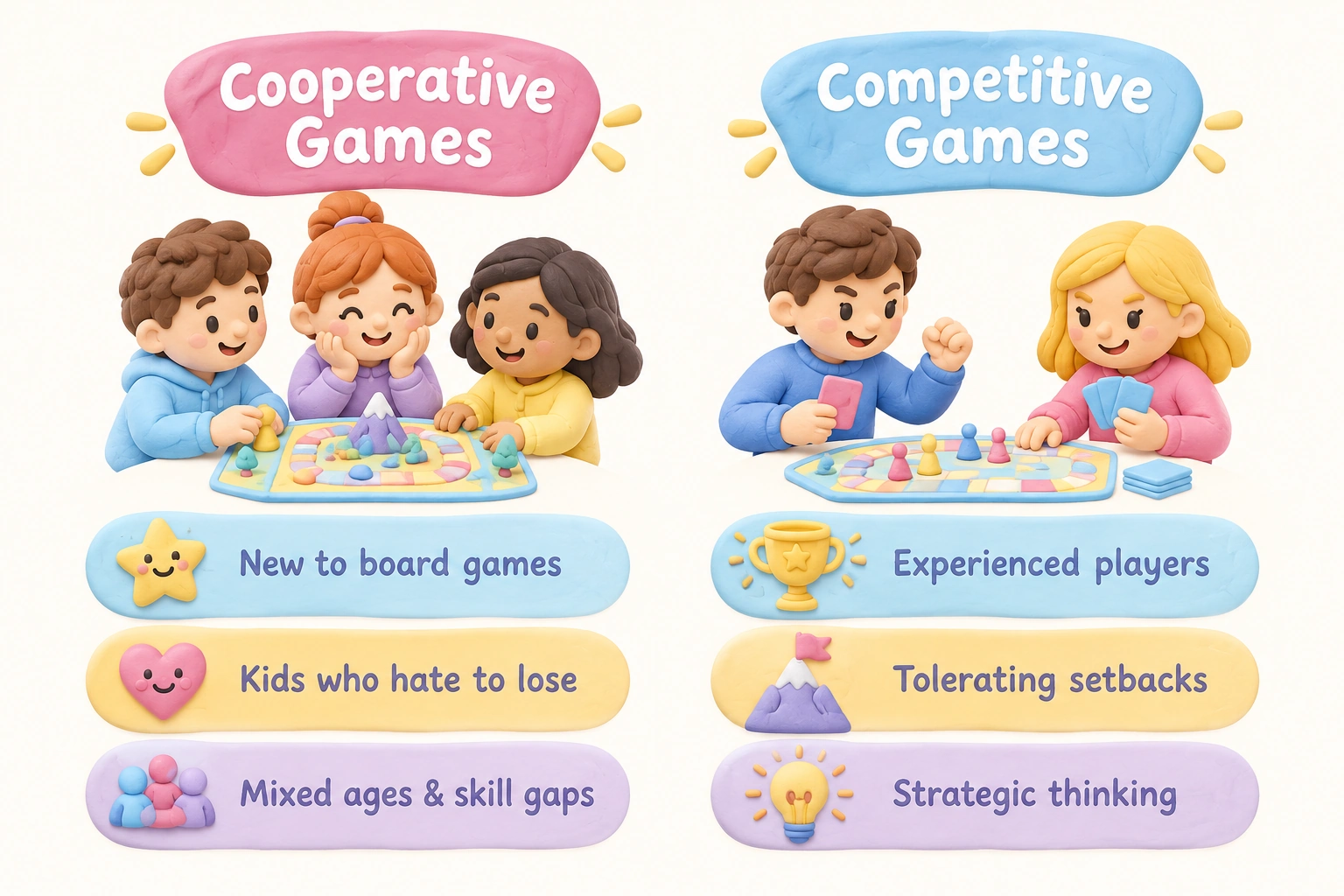
Competitive strategy games become more appropriate once a child has developed some tolerance for losing and can understand that an opponent’s win is not a personal attack. Games like Kingdomino and King of Tokyo are good bridges because they are competitive but low-stakes — the tone is light enough that losing rarely feels devastating. Ticket to Ride and Carcassonne involve more direct competition and are better suited to children who have already had some experience with competitive play.
How to Choose the Right Game: A Practical Guide for Parents
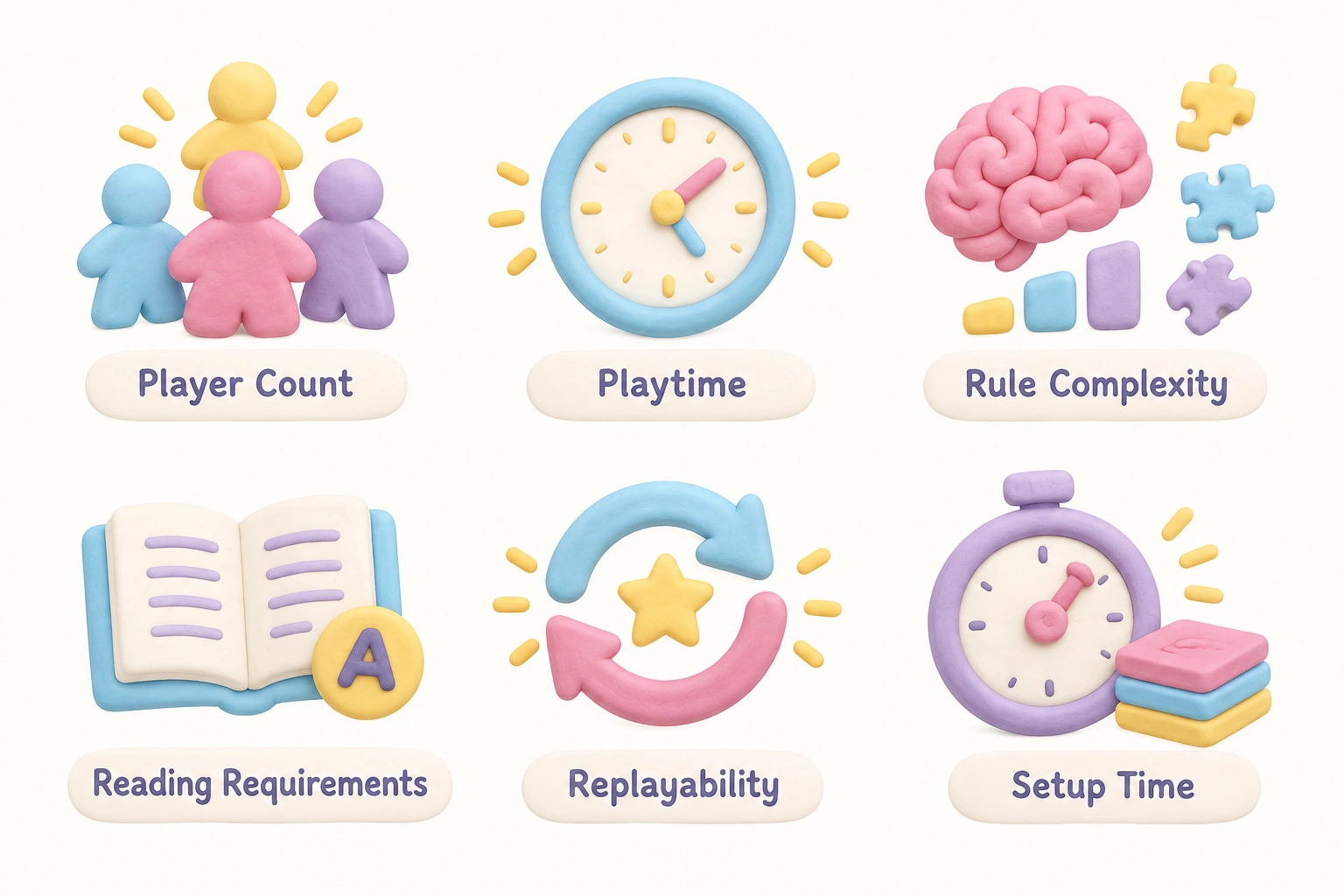
Selecting a board game for an 8–10-year-old involves more than checking the age label on the box. The following factors are worth considering before you buy.
Player Count
Player count is one of the most practical filters. If you are buying a game for two children to play together, check that the game works well at 2 players — some games are designed for 3 or 4 and feel thin with only two. Ticket to Ride, Azul, and Splendor all play well at 2. If you need a game for a larger group or family gathering, King of Tokyo (up to 6) and Castle Panic (up to 6) are strong options.
Playtime
Playtime under 30 minutes is a practical advantage for weeknight play or for children who lose focus during longer sessions. Outfoxed!, 5-Minute Dungeon, Kingdomino, and King of Tokyo all fit this window. Ticket to Ride and Castle Panic run longer and are better suited to weekend evenings when time is less constrained.
Rule Complexity
Rule complexity — sometimes called rule weight — is distinct from strategic depth. A game can have simple rules but rich strategy (Kingdomino, Azul) or complex rules with moderate strategy (some dungeon-crawl games). For children new to modern board games, start with low rule weight and build up gradually. The progression path from Kingdomino to Ticket to Ride to Splendor is a natural one that introduces new mechanics incrementally.
Reading Requirements
Many modern board games rely heavily on icons and symbols rather than text, which makes them accessible to children who are still developing reading fluency or who have dyslexia. Azul, Blokus, Qwirkle, and King of Tokyo have minimal reading requirements. Games with more text on cards — such as Castle Panic or Forbidden Island — may need adult support for children who find reading challenging.
Replayability
Replayability refers to how fresh a game feels after many plays. Games with variable setups, randomized components, or deep strategy tend to stay engaging longer. Ticket to Ride, Carcassonne, and Forbidden Island all have high replayability because the map, tile draw, or island layout changes each game. Simpler games like Outfoxed! may feel more repetitive after 15–20 plays, though they remain useful as quick warm-up games.
Setup Time and Storage
Setup time is a real friction point that many buying guides overlook. A game that takes 15 minutes to set up is less likely to be played on a busy Tuesday evening than one that is ready in two minutes. Kingdomino, Azul, and 5-Minute Dungeon set up quickly. Games with many small pieces or complex board configurations — such as some dungeon-crawl titles — require more patience and storage space. Consider where you will store the game and whether the components are durable enough for regular handling by children.
Games Children Can Play Without an Adult
Some games are simple enough for a group of 8–10-year-olds to run independently, without an adult facilitating. Kingdomino, King of Tokyo, Qwirkle, and Blokus all fall into this category. This is a practical advantage for playdates or for parents who want children to engage in screen-free play without requiring constant supervision. More complex games like Ticket to Ride or Forbidden Island may need an adult to help with rules questions during the first few plays.
A Progression Path: From Beginner to Confident Player
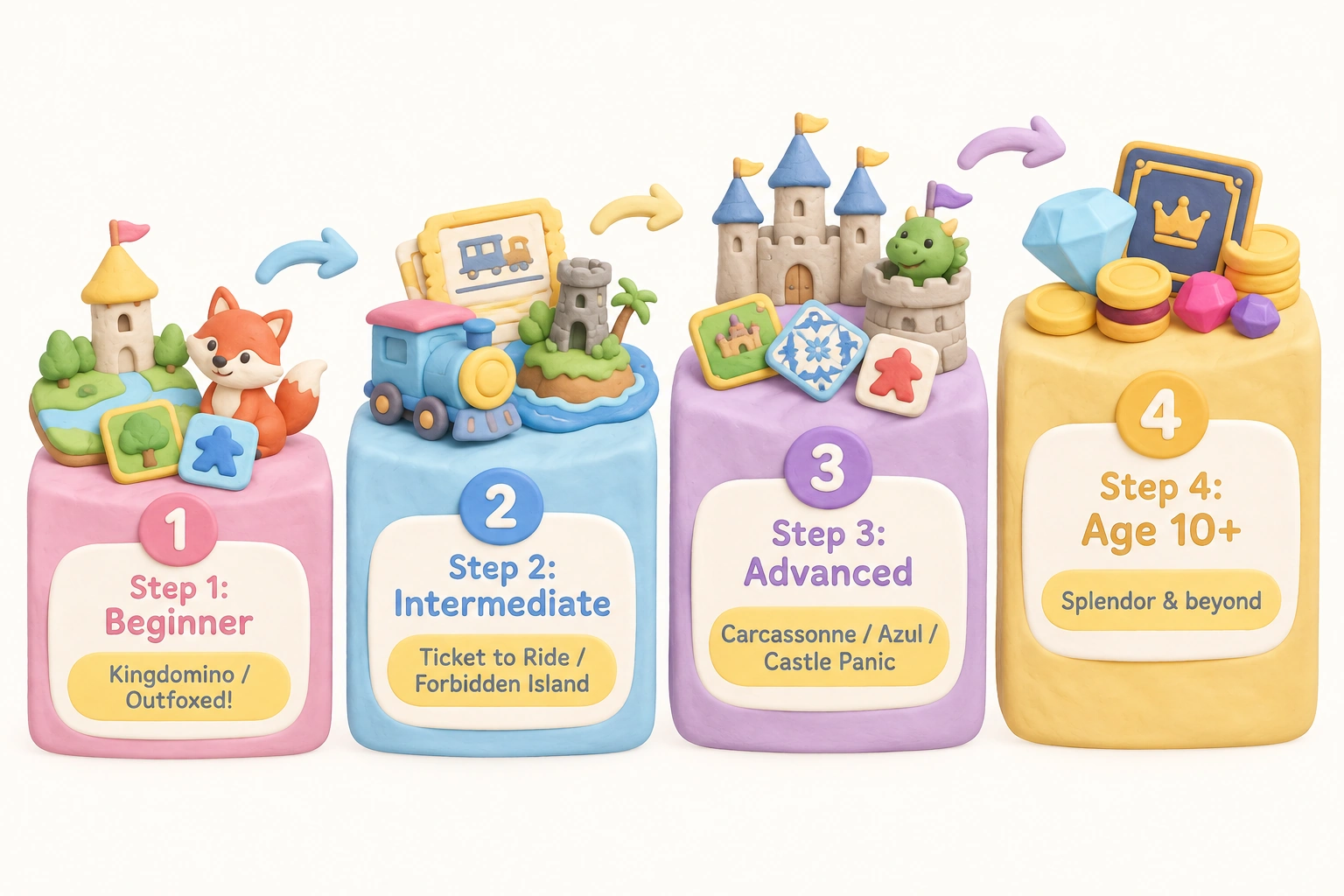
One of the most useful things a parent can do is sequence games deliberately, introducing new mechanics gradually so that each game builds on skills developed in the previous one. A reasonable progression path for a child starting at age 8 might look like this: begin with Kingdomino or Outfoxed! to establish comfort with modern game mechanics and turn-taking; move to Ticket to Ride or Forbidden Island once the child is ready for longer games with more strategic depth; then introduce Carcassonne, Azul, or Castle Panic as confidence grows; and finally explore Splendor or more complex titles around age 10. This approach prevents the frustration that comes from introducing a game that is too complex too soon, and it gives children a genuine sense of progression and mastery.
Quick Comparison: Strategy vs. Co-Op Games at a Glance
| Game | Type | Players | Playtime | Key Skill | Best For |
|---|---|---|---|---|---|
| Kingdomino | Strategy | 2–4 | 15–20 min | Spatial reasoning | Beginners, ages 8+ |
| Ticket to Ride | Strategy | 2–5 | 45–75 min | Route planning | Family game night |
| Carcassonne | Strategy | 2–5 | 30–45 min | Tile placement, planning | Mixed ages |
| Azul | Strategy | 2–4 | 30–45 min | Pattern recognition | Ages closer to 10 |
| King of Tokyo | Strategy | 2–6 | 30 min | Probability, decisions | Large groups, playdates |
| Splendor | Strategy | 2–4 | 30 min | Resource management | Ages 10, experienced players |
| Outfoxed! | Co-op | 2–4 | 20 min | Deduction, logic | Younger 8-year-olds |
| Forbidden Island | Co-op | 2–4 | 30 min | Teamwork, communication | Kids who hate to lose |
| Castle Panic | Co-op | 1–6 | 60 min | Negotiation, coordination | Larger families |
| 5-Minute Dungeon | Co-op | 2–5 | 5–10 min | Real-time teamwork | Beating the bossy player problem |
| Ghost Fightin’ Treasure Hunters | Co-op | 2–4 | 30 min | Strategy under pressure | Active, theme-loving kids |
Frequently Asked Questions
What is the best board game for an 8-year-old who is new to strategy games?
Kingdomino is consistently the strongest starting point. Its rules are simple enough to learn in one sitting, the tile-placement mechanic is intuitive, and games finish in about 20 minutes. It introduces genuine strategic thinking — planning your kingdom layout, watching what tiles opponents take — without overwhelming a child who is new to modern board games.
Are cooperative games better than competitive games for this age group?
Neither type is universally better. Cooperative games are particularly valuable for children who find losing very difficult, for mixed-age groups where skill gaps are wide, and for introducing new players to board game mechanics without competitive pressure. Competitive games develop different skills — tolerating setbacks, strategic thinking against an opponent, and graceful winning and losing. Ideally, a family’s game collection includes both types.
Can 8–10-year-olds play adult strategy games like Catan?
The standard version of Catan (ages 10+) is generally accessible to confident 10-year-olds who have experience with games like Ticket to Ride. CATAN Junior (ages 6+) is a simplified version designed specifically for younger players and is a good bridge. Most children in this age band are not yet ready for the full trading and negotiation complexity of standard Catan without adult support.
Which games work well for just two players?
Azul, Splendor, Ticket to Ride, Carcassonne, and Forbidden Island all play well with two players. Kingdomino also works at two, though some families prefer the slightly modified two-player rules. King of Tokyo and Castle Panic are better with three or more players.
How do I stop one player from dominating a cooperative game?
The bossy player problem is common in co-op games, particularly when an adult plays with children. Games with simultaneous action — like 5-Minute Dungeon — naturally prevent this because everyone acts at once. For turn-based co-ops like Forbidden Island, a house rule that each player makes their own decisions without input from others can help. Framing the game as a learning experience rather than a win-at-all-costs exercise also reduces the tendency for experienced players to take over.
How long does it take to learn a new board game?
Most of the games recommended here can be taught in 5–15 minutes. Gateway games like Kingdomino and Outfoxed! are at the shorter end; Ticket to Ride and Castle Panic take a little longer to explain fully. Reading the rulebook in advance and doing a brief practice round before playing for real significantly reduces learning friction, especially for children who get frustrated when a game stops and starts during the first play.
Which Board Games Are Worth Adding to Your Family’s Collection?
The games that tend to earn a permanent place in a family’s collection are those that work for mixed ages, stay engaging after many plays, and can be set up quickly enough that they actually get played. For most families with children aged 8–10, a practical starting collection might include one accessible gateway strategy game (Kingdomino or Ticket to Ride), one cooperative game suited to the child’s temperament (Outfoxed! for younger or more sensitive children, Forbidden Island for those ready for more challenge), and one higher-energy option for groups (King of Tokyo or 5-Minute Dungeon).
As children grow and their strategic thinking develops, games like Azul, Carcassonne, and eventually Splendor offer a natural progression path that keeps board game play rewarding well into the preteen years. The evidence that regular board game play may support critical thinking skills, executive function, and social development is encouraging, but the most important factor is simply that the games get played — which means choosing titles that your specific child finds genuinely enjoyable, not just developmentally optimal on paper. Start with one game that matches your child’s current interests and experience level, play it regularly, and let the collection grow from there.

Take a short quiz to find out what your everyday choices say about your parenting style
When your child is curious about something new, what’s your instinct?
Take a short quiz to find out what your everyday choices say about your parenting style
“Can I download this app?” What happens next?
Take a short quiz to find out what your everyday choices say about your parenting style
When it comes to rules at home, which sounds most like you?
Take a short quiz to find out what your everyday choices say about your parenting style
If you could give your child one life skill today, what would you pick?
Take a short quiz to find out what your everyday choices say about your parenting style
Your child gets to choose what to watch. What would your ideal setup look like?
Take a short quiz to find out what your everyday choices say about your parenting style
Pick your parenting superpower ✨