Best Preschool Board Games: First Games for Ages 3–5

 Discover a Free Education Video App for Kids
Pastory uses AI to personalize educational video content based on your child’s interests and personality. Safe, engaging, and built for curious young minds. Sign up now to stay updated and enjoy early access with a free trial
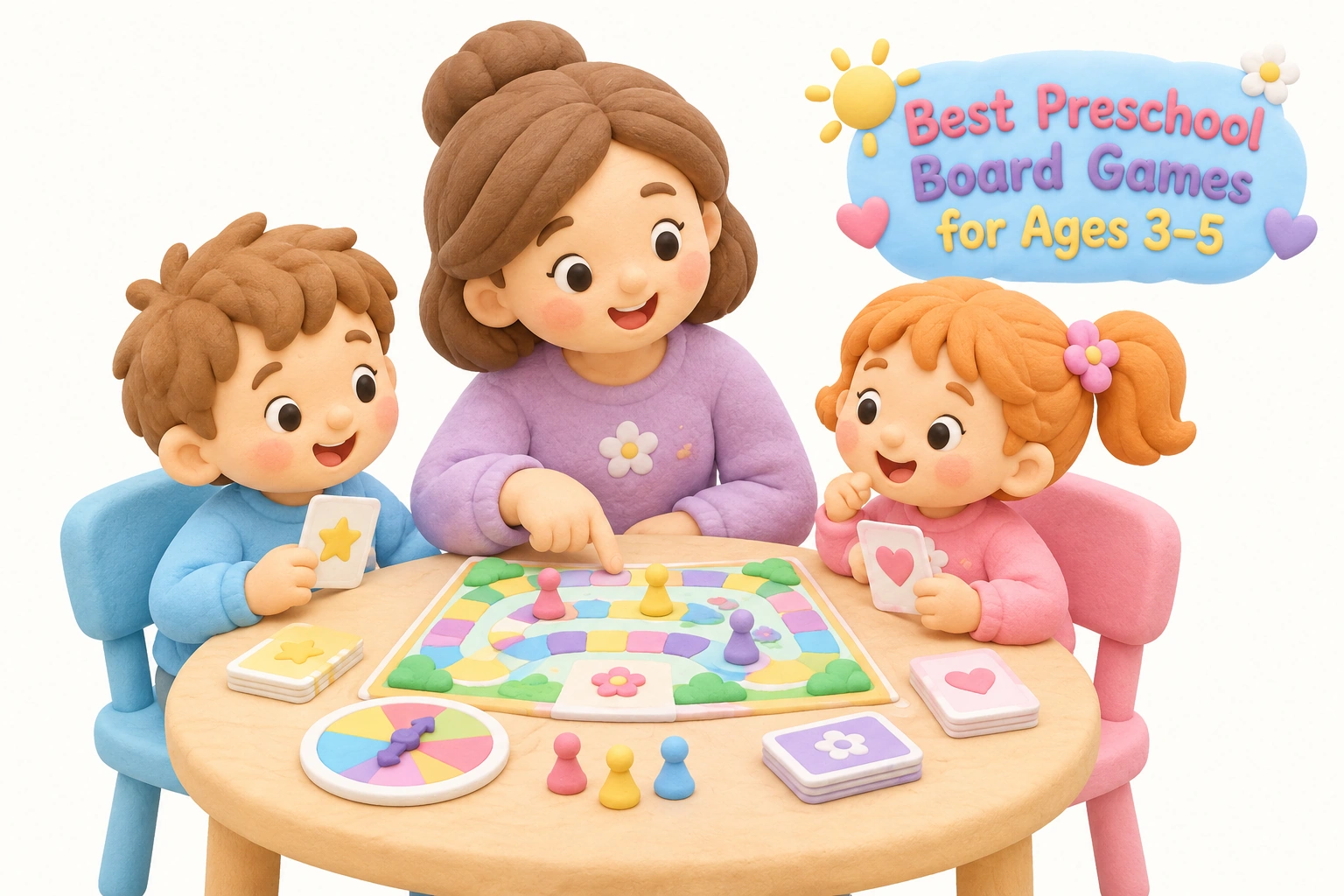
Choosing the right preschool board games can feel overwhelming when the shelves are full of options promising to teach everything from counting to cooperation. The good news is that the best first board game for a child aged 3–5 does not need to be complicated — it needs to be age-appropriate, short enough to hold a young child’s attention, and engaging enough that everyone at the table actually wants to play again. This guide covers what developmental skills board games genuinely support, how to match a game to your child’s current stage, which titles are most consistently recommended for this age group, and practical tips for making those first game sessions go smoothly.
Key Takeaways
- The best preschool board games require no reading, use chunky game pieces, and last around 10–20 minutes — matching the attention span of children aged 3–5.
- Cooperative board games, where everyone plays together against the board rather than against each other, are generally better suited to ages 3–4 because they remove the emotional pressure of winning and losing.
- Board games for preschoolers can support color recognition, counting skills, turn-taking, fine motor skills, and early problem-solving — all areas linked to school readiness.
- A child’s readiness for board games depends less on age alone and more on whether they can sit for about 10 minutes, understand “my turn,” and follow a simple two-step instruction.
- Brands such as Peaceable Kingdom and HABA are frequently cited for producing durable, developmentally appropriate games designed specifically for pre-readers.
Why Board Games Matter for Preschool Development
Board games are one of the few play formats that naturally combine social interaction, rule-following, and cognitive challenge in a single short session. For children aged 3–5, this combination is particularly valuable because it mirrors the structured-yet-playful environment they will encounter in early school settings. Research published in peer-reviewed developmental psychology journals suggests that tabletop game play may support early numeracy, visual perception, and self-regulation — skills that are closely tied to school readiness. While no single game guarantees specific learning outcomes, the repeated practice of waiting, counting spaces, matching colors, and managing mild frustration builds a foundation that transfers to classroom learning.
Educational board games for 3–5 year olds also offer something that screens rarely provide: face-to-face interaction with a caregiver or sibling. That social layer — reading expressions, negotiating whose turn it is, celebrating a shared win — supports language development and emotional intelligence in ways that passive or solo digital play typically does not. In a screen-heavy environment, a well-chosen board game provides a meaningful screen-free alternative that still feels like entertainment rather than a lesson.
Is Your Child Ready for a First Board Game?
Age ranges on game boxes are useful starting points, but individual readiness matters more than the number on the label. Before introducing a first board game, it helps to check whether your child can do the following: sit relatively still for around 10 minutes, understand the concept of “my turn” and “your turn,” follow a simple two-step instruction such as “roll the die, then move your piece,” and tolerate mild disappointment without becoming overwhelmed. Most children reach these milestones somewhere between ages 3 and 4, though temperament and prior experience with structured play vary considerably.
If a child is not yet ready for formal rules, that is not a problem — many games work well as guided play first. A parent can introduce the pieces, talk about the pictures, and play a simplified version before introducing all the rules. Treating the first few sessions as exploration rather than competition removes pressure and builds positive associations with the game itself.
Cooperative vs. Competitive Games: What Works at Each Age
One of the most useful distinctions when choosing preschool board games is whether a game is cooperative or competitive. In a cooperative board game, all players work together toward a shared goal — for example, helping owls reach their nest before sunrise, or collecting fruit before a raven eats it. In a competitive game, players work against each other, and only one person wins.
For children aged 3–4, cooperative games are generally the stronger choice. A 3-year-old who loses a competitive game may experience genuine emotional overwhelm, not because they are being dramatic, but because the cognitive and emotional tools needed to handle losing gracefully — perspective-taking, delayed gratification, emotional regulation — are still developing. Cooperative games let young children experience the pleasure of playing together and following rules before they are asked to manage the harder feelings that come with competition. By ages 4–5, many children are ready for more complex cooperative games that involve light strategy, and by age 5–6, gentle competitive games become more appropriate for most children.
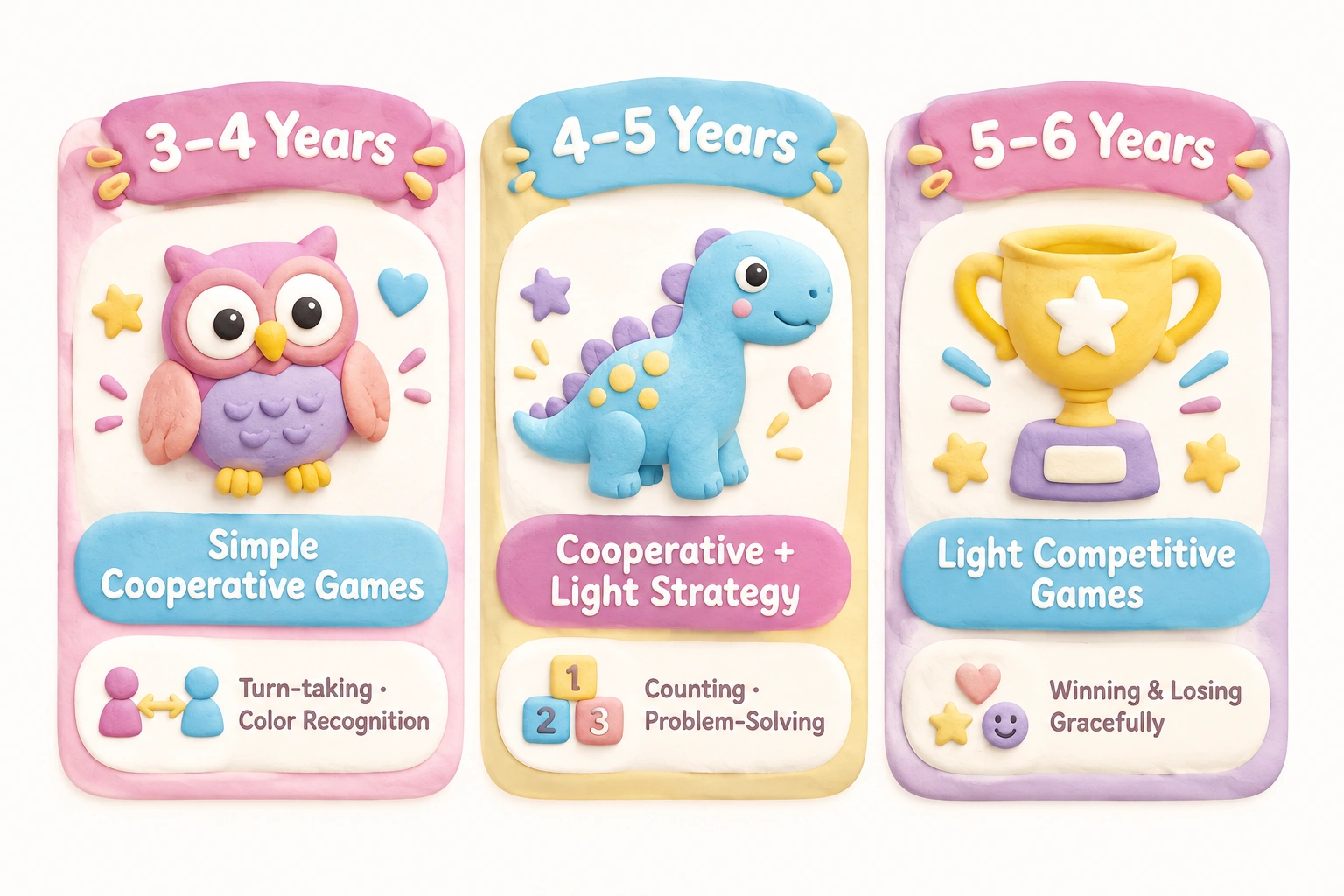
| Age Range | Recommended Game Type | Key Developmental Focus | Typical Play Time |
|---|---|---|---|
| 3–4 years | Simple cooperative games | Turn-taking, color recognition, rule-following | 10–15 minutes |
| 4–5 years | Cooperative games with light strategy | Counting, problem-solving, memory | 15–20 minutes |
| 5–6 years | Light competitive games | Winning and losing gracefully, early numeracy | 15–25 minutes |
What to Look for When Choosing a Preschool Board Game
The buying criteria for preschool board games are fairly consistent across developmental guidance and parent experience. The most important factors are listed below, along with the reasoning behind each one.
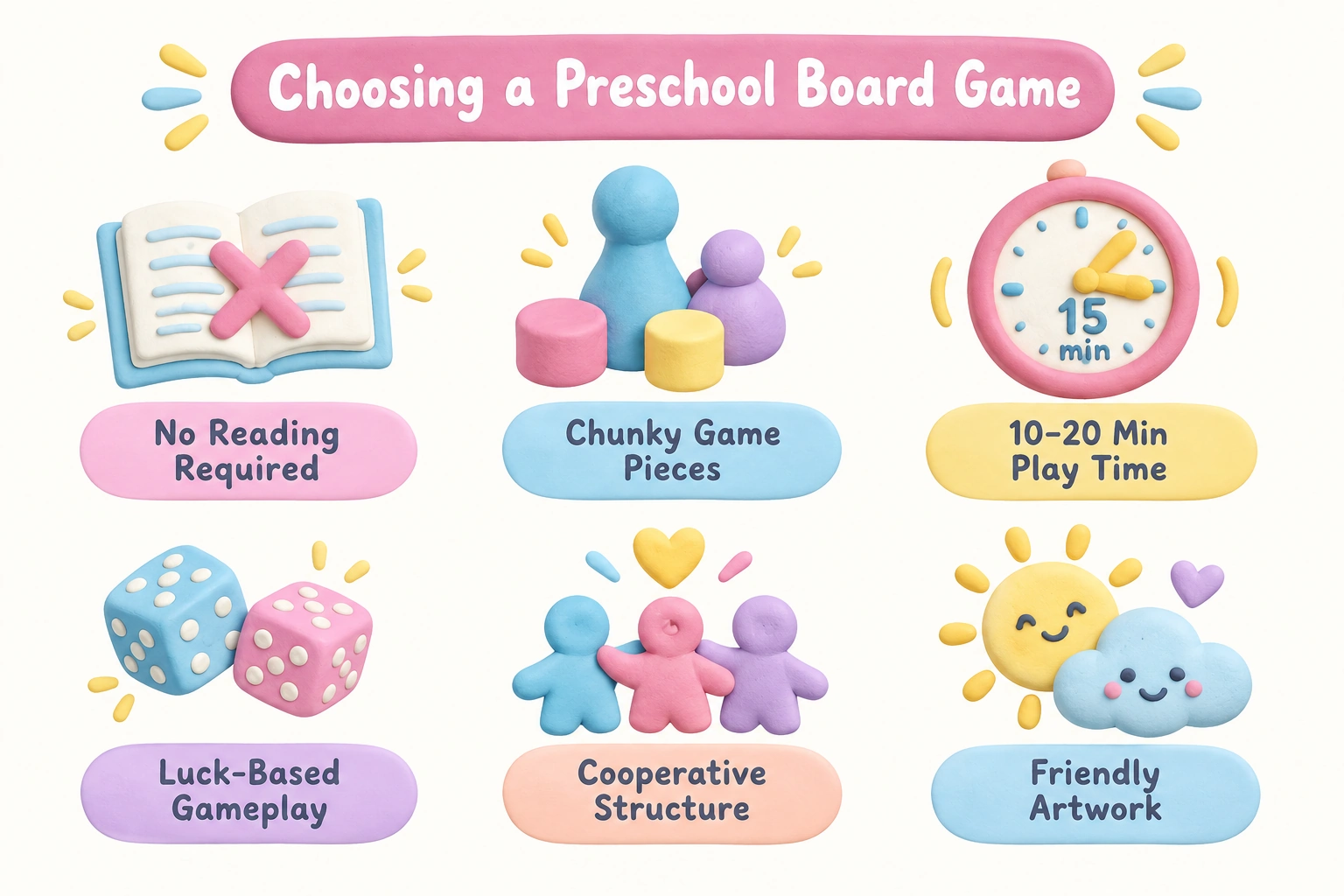
- No reading required: Pre-readers aged 3–5 cannot engage with text-heavy games. The best games for this age use pictures, colors, shapes, and symbols instead of words, so children can participate fully and independently.
- Chunky game pieces and durable components: Small parts are a choking hazard for younger children and are easily lost. Chunky game pieces made from thick cardboard, wood, or sturdy plastic are easier for small hands to grip and far more durable for repeated play.
- Simple rules: A game that can be explained in two or three sentences is ideal for ages 3–4. Rules that require reading the manual mid-game will frustrate both child and caregiver.
- Short play time: The sweet spot is 10–15 minutes for ages 3–4 and 15–20 minutes for ages 4–5. Games that run longer than this risk outlasting a young child’s attention span, leading to abandoned sessions and reluctance to play again.
- Luck-based gameplay: Games that rely primarily on luck rather than strategy give younger children a genuine chance of winning and keep the experience feel fair. Pure strategy games tend to frustrate children who cannot yet think several moves ahead.
- Bright, friendly artwork: Visual appeal matters enormously for young children. Games with engaging characters and clear imagery hold attention better and make the experience feel inviting.
- Cooperative structure (for ages 3–4): As discussed above, cooperative games reduce the emotional stakes of early play and make the experience more consistently positive.
Best Preschool Board Games for Ages 3–4
The games below are among the most consistently recommended for children at the younger end of the preschool range. Each one requires no reading, uses luck-based gameplay, and supports at least one key developmental skill.
Hoot Owl Hoot! (Peaceable Kingdom)
Hoot Owl Hoot! is a cooperative board game in which players work together to fly all the owls back to their nest before sunrise. It is widely regarded as one of the best first board games for ages 4 and up, though many 3-year-olds with some adult support manage it well. The game uses color matching rather than numbers or letters, making it genuinely accessible to pre-readers. Players draw color cards and move the corresponding owl, which introduces color recognition and simple decision-making without reading. Play time is typically 10–15 minutes. Peaceable Kingdom, the publisher, specializes in cooperative games for young children and is one of the most trusted brands in this category.
First Orchard (HABA)
First Orchard is specifically designed as a first board game for children as young as 2, making it one of the earliest entry points into structured tabletop play. Players roll a color die and pick the matching fruit from the orchard before a raven reaches the end of the path. The game is fully cooperative, requires no reading, and uses large wooden pieces that are easy for small hands to manage. HABA, the German toy manufacturer behind First Orchard, is consistently cited for producing high-quality, durable components and developmentally appropriate games for toddlers and preschoolers. The game supports color recognition, fine motor skills, and the basic concept of turn-taking.
Go Away Monster! (Gamewright)
Go Away Monster! is a tactile game in which children reach into a bag, feel a piece, and decide whether to keep it or shout “Go away, monster!” and discard it. The tactile element makes it particularly engaging for sensory-oriented children, and the monster theme tends to appeal strongly to the 3–4 age group. The game supports hand-eye coordination, shape recognition, and the early ability to follow a simple rule. Because the outcome depends entirely on what piece a child pulls from the bag, luck-based gameplay keeps the experience fair and exciting for everyone at the table.
Sneaky Snacky Squirrel (Educational Insights)
Sneaky Snacky Squirrel asks players to use a squirrel-shaped spinner and a squirrel-shaped card to collect colored acorns and fill their log. The game builds color recognition, fine motor skills through the use of the squirrel squeezer tool, and turn-taking. It is one of the most frequently recommended games for ages 3 and up, partly because the physical act of squeezing the tool to pick up acorns is genuinely satisfying for young children. Play time is short, the rules are minimal, and the components are designed to be handled by small hands.
Feed the Woozle (Peaceable Kingdom)
Feed the Woozle is another cooperative game from Peaceable Kingdom in which players work together to feed snacks to a silly monster called the Woozle. Children use a spoon to carry plastic snack pieces across the board without dropping them, which directly supports hand-eye coordination and fine motor development. The game has three difficulty levels, which means it can grow with a child’s abilities over time — a useful feature for families looking for replay value. It is suitable from around age 3 and plays in approximately 10–15 minutes.
Best Preschool Board Games for Ages 4–5
By age 4–5, many children are ready for games with slightly more complexity — a few more rules, some light decision-making, or a longer play time. The games below are well-suited to this stage.
Dinosaur Escape (Peaceable Kingdom)
Dinosaur Escape is a cooperative game in which players work together to rescue dinosaurs from an island before a volcano erupts. It introduces a simple matching mechanic and requires players to make basic decisions about which dinosaur to move, adding a small layer of strategy without overwhelming younger players. The game supports color and pattern recognition, counting, and cooperative problem-solving. It is typically recommended for ages 4 and up and plays in around 15–20 minutes.
Zingo! (ThinkFun)
Zingo! is a bingo-style game that uses picture tiles rather than numbers or letters, making it accessible to pre-readers while also supporting early vocabulary and visual matching skills. A sliding “Zinger” device dispenses tiles, which children match to their boards. The game is fast-paced, which suits the shorter attention span of preschool-aged children, and can be played with two to six players — making it a good option for family game night or small group play. ThinkFun’s Zingo! is frequently cited as one of the best educational board games for 3–5 year olds because it builds school readiness skills including visual discrimination and language without feeling like a lesson.
Spot It! Jr. Animals (Dobble/Asmodee)
Spot It! Jr. Animals is a simplified version of the popular Spot It! card game, designed specifically for younger children. Each round, players race to find the one matching animal between two cards. The game builds visual perception, processing speed, and vocabulary in a format that feels more like a fast-paced activity than a traditional board game. It plays in around 10–15 minutes and works well with two to five players. Because the cards are the only components, it is also one of the most portable options for travel or restaurant play.
Richard Scarry’s Busytown Eye Found It!
This large-format seek-and-find game unfolds into a six-foot game board depicting Richard Scarry’s Busytown. Players work cooperatively to find hidden objects before Pig Will and Pig Won’t eat all the food on the picnic boat. The game supports visual scanning, vocabulary, and cooperative play, and the familiar Busytown characters make it immediately appealing to children who know the books. It accommodates up to ten players, which makes it one of the few preschool board games that works well in larger family or classroom settings. Play time is around 20–30 minutes, which is on the longer side for this age group, so it is better suited to children aged 4–5 who can sustain attention for slightly longer sessions.
Count Your Chickens (Peaceable Kingdom)
Count Your Chickens is a cooperative counting game in which players work together to move a mother hen around the farm, collecting chicks before reaching the coop. Each space landed on tells players how many chicks to collect, which directly supports early numeracy and counting skills. The game is simple enough for ages 3 and up but engaging enough for 5-year-olds, and it plays in around 15 minutes. It is one of the clearest examples of a game that builds school readiness skills — specifically counting and number recognition — through play rather than instruction.
Classic Games Worth Considering
Several classic titles remain popular for this age group, though they come with some caveats worth knowing. Candy Land and Chutes and Ladders are pure roll-and-move games with no decision-making involved — children simply follow the instructions on each space. This makes them very easy to learn but also means they offer limited cognitive challenge beyond color recognition and turn-taking. They can be good starting points for very young or hesitant players, but children often outgrow them quickly. Hi Ho! Cherry-O involves counting and fine motor skills and holds up slightly better developmentally. The classic Memory matching game supports visual memory and concentration and remains one of the most genuinely educational options in this category, though the standard version can be challenging for children under 4 — starting with a reduced set of pairs makes it more accessible.
How to Introduce Board Games to a Preschooler
The first game session sets the tone for whether a child associates board games with fun or frustration. A few practical steps can make a significant difference.
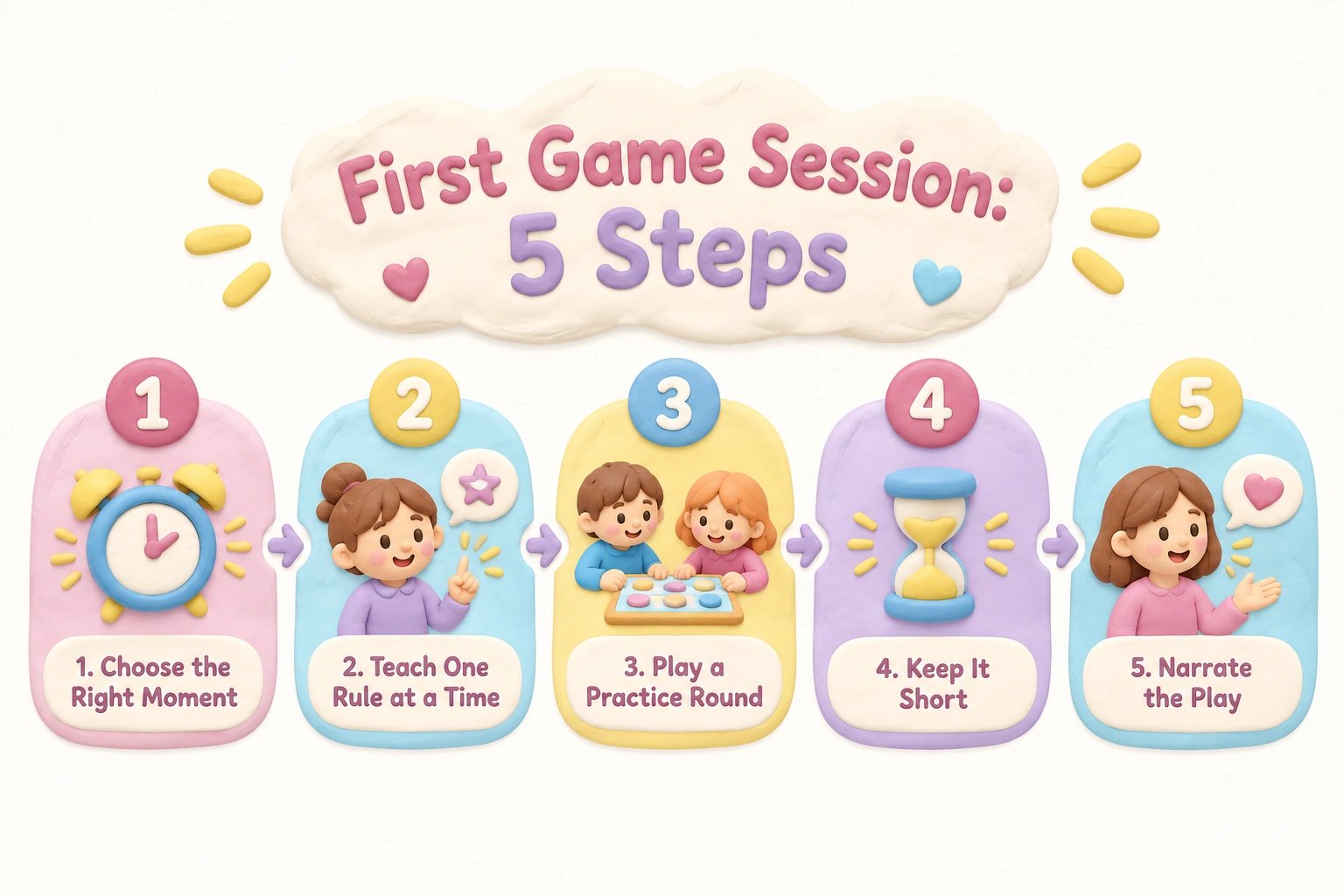
- Choose the right moment: Introduce a new game when your child is rested, not hungry, and not already engaged in something else. Avoid introducing a new game right before a nap or bedtime.
- Teach one rule at a time: Rather than explaining all the rules upfront, introduce the core mechanic first — for example, “We roll the die and move our piece” — and add additional rules as the game progresses naturally.
- Play a practice round: A face-up, no-stakes practice round where everyone can see each other’s pieces and decisions helps children understand the flow before the “real” game begins.
- Keep it short: It is better to stop while a child is still engaged than to push through to the end of a game they have lost interest in. A positive, incomplete session is more valuable than a complete but miserable one.
- Narrate the play: Talking through what is happening — “You rolled a blue, so let’s find the blue owl” — reinforces the connection between the game mechanic and the skill it is building, and keeps younger children oriented.
Handling Losing, Rule-Breaking, and Meltdowns
One of the most common challenges with preschool board games is managing the emotional response when things do not go a child’s way. A child who flips the board, refuses to take a turn, or dissolves into tears is not misbehaving — they are demonstrating that the emotional skills needed to handle winning and losing gracefully are still developing. This is, in fact, one of the most valuable things board games can teach, but it takes time and repeated gentle experience.
Cooperative games reduce this pressure considerably because there is no individual loser. When a competitive element is introduced, it helps to frame losing as part of the game rather than a personal failure: “The raven got there first this time — let’s try again.” Keeping the focus on the experience rather than the outcome, and modeling good sportsmanship yourself, gives children a template to follow. If a child consistently struggles with losing, returning to cooperative games for a few more months before reintroducing competition is a reasonable and developmentally sound choice.
Rule-breaking is equally common and equally normal. Young children are still learning that rules are fixed and apply to everyone, including themselves. Rather than treating rule deviations as defiance, treat them as teaching moments: “In this game, we always move forward, not backward — let’s put the piece back and try again.” Visual reminders such as a simple picture-based rule card can help children who need a concrete reference point.
Games That Grow With Your Child: Thinking About Replay Value
One practical consideration that is often overlooked is how long a game will remain engaging as a child develops. Some games — particularly very simple roll-and-move games — are outgrown within a few months. Others, particularly those with adjustable difficulty levels or mechanics that reward growing skills, remain useful for two or three years. Feed the Woozle, for example, has three difficulty settings. Zingo! can be played at different speeds. Count Your Chickens remains engaging as children’s counting skills become more fluent and they can take on more of the game independently.
Investing in one well-made, durable game with genuine replay value is usually a better choice than buying several cheaper games that will be discarded quickly. HABA and Peaceable Kingdom games, while sometimes priced higher than mass-market alternatives, are consistently noted for their durable components and thoughtful design — factors that matter when a game is going to be handled by multiple children over several years.
Frequently Asked Questions
What is the best first board game for a 3-year-old?
First Orchard by HABA is widely recommended as one of the best first board games for children as young as 2–3. It is fully cooperative, requires no reading, uses large wooden pieces, and plays in around 10 minutes. Go Away Monster! and Sneaky Snacky Squirrel are also strong choices for this age. The key is choosing a game with simple rules, chunky game pieces, and a cooperative structure that removes the pressure of winning and losing.
Are board games actually educational for preschoolers?
Board games can support a range of developmental skills including color recognition, counting, turn-taking, fine motor skills, visual memory, and early problem-solving. Research suggests that tabletop game play may also support early numeracy and self-regulation. However, outcomes vary by child, and the quality of the experience depends significantly on caregiver involvement and how the game is introduced. Board games are best understood as one valuable tool among many rather than a guaranteed educational intervention.
Should I let my preschooler win at board games?
Deliberately letting a child win every time is generally not recommended, as it prevents them from developing the ability to handle losing gracefully. Cooperative games sidestep this issue entirely because winning and losing is a shared outcome. For competitive games, playing honestly while keeping the emotional tone warm and supportive — and framing losses as part of the game rather than a personal failure — is more developmentally useful than consistently letting a child win.
How long should a board game session be for a preschooler?
For children aged 3–4, aim for games that last around 10–15 minutes. For children aged 4–5, 15–20 minutes is generally appropriate. It is better to stop while a child is still engaged than to push through a game they have lost interest in. Many preschool board games are specifically designed with short play times to match the attention span of this age group.
What is the difference between cooperative and competitive board games for preschoolers?
In a cooperative board game, all players work together toward a shared goal and either win or lose as a group. In a competitive game, players work against each other and only one person wins. Cooperative games are generally better suited to ages 3–4 because they remove the emotional weight of individual losing, which young children often find genuinely overwhelming. Competitive games become more appropriate as children develop greater emotional regulation, typically around ages 5–6.
Can preschool board games be played with just one parent and one child?
Yes — most preschool board games work well with just two players, and many cooperative games are specifically designed to be played with as few as two people. One-on-one game play also has the advantage of giving a parent the opportunity to narrate, explain, and support the child’s understanding without the pace pressure of a larger group. Games like First Orchard, Hoot Owl Hoot!, and Count Your Chickens all work well in a two-player format.
Choosing the Right Preschool Board Game for Your Family
The best preschool board game is the one your child will actually want to play — and play again. For most children aged 3–4, that means a cooperative game with no reading required, chunky game pieces, simple rules, and a play time of around 10–15 minutes. For children aged 4–5, slightly more complex cooperative games or gentle competitive games with luck-based gameplay become appropriate as emotional regulation and attention span develop. Brands like Peaceable Kingdom and HABA have built strong reputations in this space precisely because their games are designed with young children’s developmental needs in mind rather than simply scaled-down adult games.
If you are buying a first board game as a gift or starting a family game night tradition, a cooperative game from either of these publishers is a reliable starting point. From there, you can expand based on your child’s interests — whether that is animals, counting, memory challenges, or dexterity play. The goal at this stage is not to find the most educational game on the market, but to find one that makes sitting around a table together feel like the best part of the day.

Take a short quiz to find out what your everyday choices say about your parenting style
When your child is curious about something new, what’s your instinct?
Take a short quiz to find out what your everyday choices say about your parenting style
“Can I download this app?” What happens next?
Take a short quiz to find out what your everyday choices say about your parenting style
When it comes to rules at home, which sounds most like you?
Take a short quiz to find out what your everyday choices say about your parenting style
If you could give your child one life skill today, what would you pick?
Take a short quiz to find out what your everyday choices say about your parenting style
Your child gets to choose what to watch. What would your ideal setup look like?
Take a short quiz to find out what your everyday choices say about your parenting style
Pick your parenting superpower ✨