Best Educational Board Games for Kids by Age and Skill

 Discover a Free Education Video App for Kids
Pastory uses AI to personalize educational video content based on your child’s interests and personality. Safe, engaging, and built for curious young minds. Sign up now to stay updated and enjoy early access with a free trial
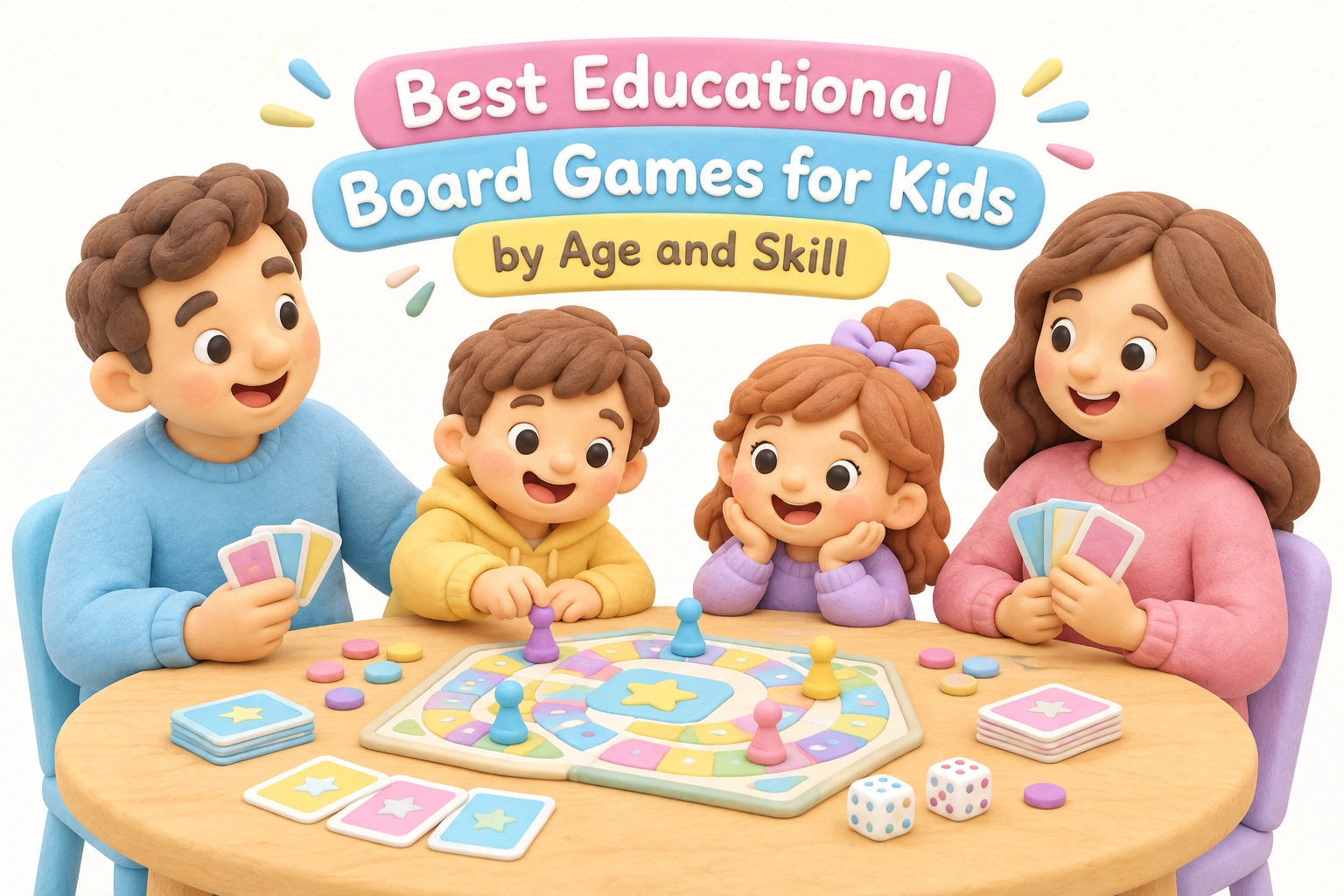
Board games have been a staple of childhood for generations, but the best educational board games for kids do far more than pass the time. Research in developmental psychology suggests that well-chosen games can support early math skills, vocabulary development, executive functions, and social-emotional learning — all while children are genuinely having fun. This guide organizes top picks by age bracket and skill area, explains the developmental mechanisms behind game-based learning, and gives parents and educators a practical framework for choosing games that match a child’s current stage.
Key Takeaways
- Educational board games can support a wide range of skills including critical thinking, early math, vocabulary, spatial reasoning, and turn-taking, depending on the game and the child’s age.
- Cooperative board games are particularly valuable for building social-emotional learning and emotional regulation, especially for younger children who are still developing the ability to handle losing.
- Age-appropriateness matters: a game that is too complex can frustrate a child, while one that is too simple offers little developmental challenge. Matching the game to the child’s stage is more important than matching it to the box’s age label.
- Screen-free play through board games offers a meaningful alternative to digital media, encouraging face-to-face interaction, attention span development, and family game night connection.
- Parental or caregiver involvement significantly increases the developmental value of any board game, particularly for children under six.
Why Board Games Support Child Development
Game-based learning works because it places children in a context where they are motivated to engage, repeat, and problem-solve. Unlike passive consumption of content, board games require active participation: a child must hold rules in working memory, plan ahead, respond to other players, and regulate their emotions when things do not go their way. These demands map directly onto what developmental psychologists call executive functions — the cluster of cognitive skills that includes working memory, cognitive flexibility, and inhibitory control.
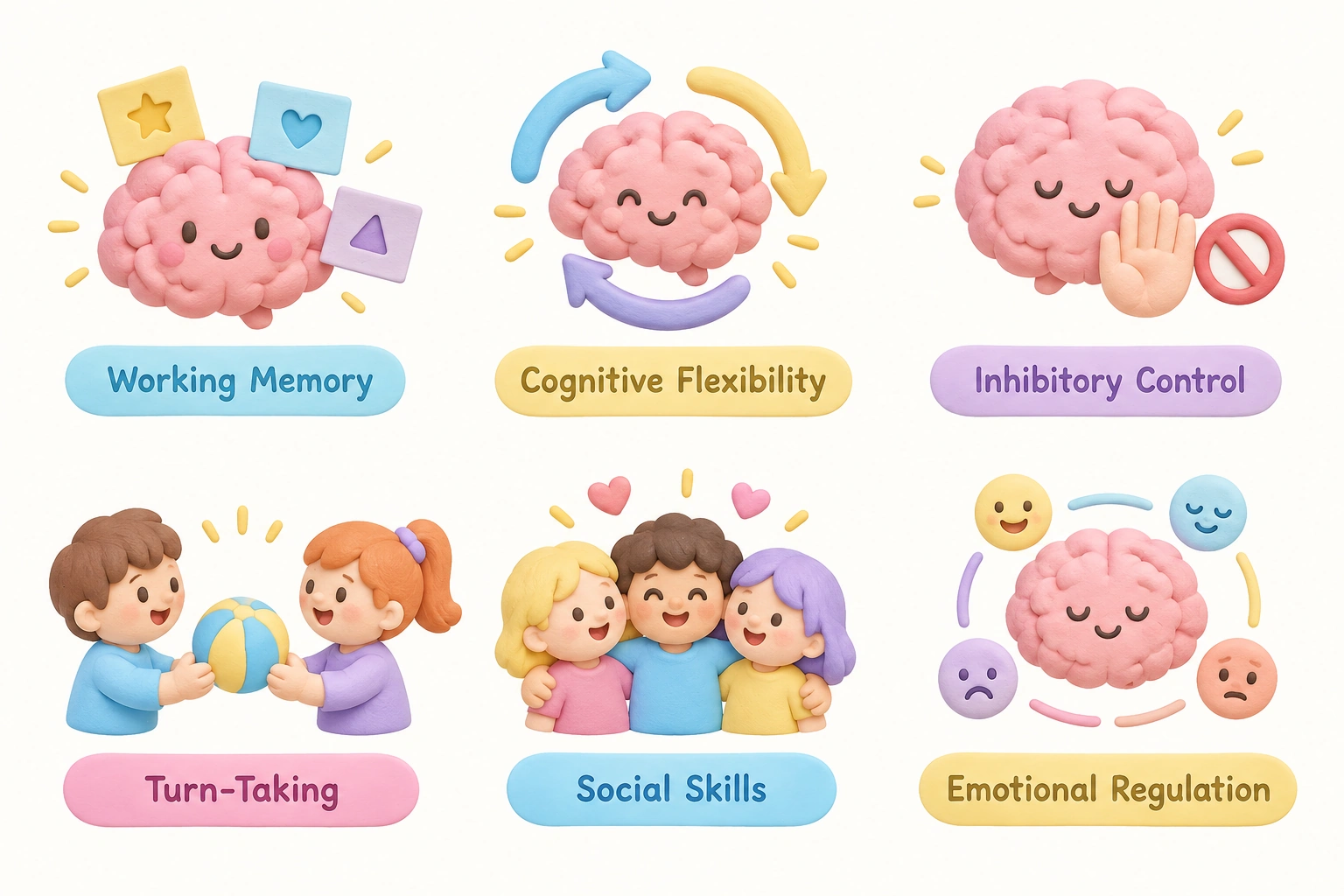
Emerging research supports this connection. Studies examining structured game interventions in classroom settings have found associations between regular board game play and improvements in executive functioning and academic readiness, particularly in early childhood. A 2025 randomized controlled trial published in a peer-reviewed journal found that board game programs used as a protective intervention showed measurable effects on children’s metacognitive and self-regulatory skills. While individual outcomes vary and evidence is still developing, the theoretical basis for game-based learning is well-grounded in established cognitive development frameworks.
Beyond cognition, board games provide a natural setting for social skills development. Children practice turn-taking, learn to communicate clearly, negotiate rules, and manage the emotional experience of winning and losing. Cooperative games add an additional layer by requiring players to work toward a shared goal, which can be especially beneficial for children who are still developing emotional regulation and frustration tolerance.
Best Educational Board Games for Toddlers and Preschoolers (Ages 2–5)
Children in the toddler and preschool years are developing foundational skills including number recognition, color and shape identification, fine motor skills, and the very early concept of taking turns. Games at this stage should have simple rules, short play times, and low-frustration mechanics. Cooperative formats work particularly well because they remove the pressure of winning and losing before children are developmentally ready to handle that experience gracefully.
Hoot Owl Hoot!
Hoot Owl Hoot! is a cooperative board game designed for ages three and up in which players work together to guide owls back to their nest before sunrise. Because all players share the same goal, there is no winner or loser in the traditional sense, which makes it an excellent introduction to cooperative play and turn-taking for preschoolers. The game also supports color recognition and basic sequencing, and its short play time suits the limited attention span typical of this age group.
Count Your Chickens
Count Your Chickens is another cooperative game that introduces early math skills through counting. Children move a mother hen around the board, collecting chicks, and practice counting aloud with each move. The cooperative structure means the whole family wins or loses together, reducing competitive pressure while reinforcing number sense and one-to-one correspondence — foundational skills for early numeracy.
Sneaky Snacky Squirrel
Sneaky Snacky Squirrel builds fine motor skills through a squeezing mechanism that children use to pick up and sort colored acorns. The game reinforces color matching and turn-taking while the physical manipulation of the squirrel tool supports the hand strength and dexterity that underpin later writing skills. It is one of the few games at this age level that explicitly targets fine motor development alongside cognitive skills.
Best Educational Board Games for Early Elementary Children (Ages 5–8)
Children in the early elementary years are developing reading and writing skills, expanding their mathematical understanding beyond simple counting, and becoming more capable of following multi-step rules. Games at this stage can introduce vocabulary and spelling, early addition and subtraction, deductive reasoning, and more sustained strategic thinking. Attention spans are longer, allowing for slightly more complex gameplay.
Zingo
Zingo is a fast-paced matching game that builds sight words and vocabulary recognition in a format similar to bingo. Players race to match picture and word tiles to their cards, which reinforces word recognition and pre-reading skills in a low-pressure, high-energy context. The game’s quick rounds make it well-suited to children with shorter attention spans, and it works equally well in classroom use and at home.
Sum Swamp
Sum Swamp is a math board game that uses addition and subtraction equations on dice to move players through a swamp. Children must solve simple equations to determine how many spaces to move, embedding arithmetic practice into gameplay without it feeling like a worksheet. The game supports early math skills including number recognition, basic operations, and even and odd number concepts, making it a strong choice for kindergarten through second grade.
Robot Turtles
Robot Turtles introduces coding concepts to children as young as four through a board game format that requires no screens. Players use instruction cards to program their turtle’s path toward a jewel, building sequencing, logical thinking, and early computational thinking skills. The game scales in complexity as children grow, making it one of the better examples of a game that can grow with the child across multiple years of play.
Outfoxed
Outfoxed is a cooperative deductive reasoning game in which players work together to identify a fox thief before it escapes. Children use a clue-revealing device to gather evidence and eliminate suspects, which builds deductive reasoning, logical elimination, and collaborative communication. The cooperative structure makes it accessible for mixed-age sibling play, as older children can support younger ones without the game becoming unbalanced.
Best Educational Board Games for Elementary-Age Children (Ages 6–10)
By the middle elementary years, children are ready for games with more complex rules, longer play times, and genuine strategic depth. This age range benefits from games that develop spatial reasoning, strategic thinking, pattern recognition, and more advanced literacy and math skills. Games that offer replay value through variable setups or increasing difficulty levels are particularly worthwhile investments at this stage.
Qwirkle
Qwirkle is a tile-placement strategy game that challenges players to build lines of matching colors or shapes while blocking opponents. It develops pattern recognition, spatial reasoning, and strategic planning without requiring reading ability, which makes it accessible across a wide age range and useful for mixed-age family game night. The game’s abstract nature means children are building genuine cognitive skills without the game feeling overtly academic.
Ticket to Ride: First Journey
Ticket to Ride: First Journey is the child-friendly version of the popular route-building game. Players collect colored train cards and claim routes between cities on a map, building geography awareness, planning skills, and strategic thinking. The game introduces concepts of resource management and forward planning in an accessible format, and its map-based structure naturally supports geographic literacy.
Rush Hour
Rush Hour is a single-player sliding puzzle game in which children must maneuver a red car out of a gridlocked traffic jam by moving other vehicles. It develops spatial reasoning, logical thinking, and problem-solving through a series of increasingly difficult challenges. Because it is a solo game, it is particularly useful for children who benefit from self-paced learning or who find competitive games frustrating — making it a strong option for neurodiverse learners.
Wildcraft!
Wildcraft! is a cooperative nature-themed game in which players forage for plants and use herbal remedies to overcome challenges on the trail. It builds cooperative play skills, nature literacy, and strategic thinking while introducing children to concepts from science and ecology. The cooperative format and nature theme make it a distinctive choice for families interested in STEM board games with an environmental focus.
Best Educational Board Games for Tweens and Middle Schoolers (Ages 10+)
Older children and tweens are capable of handling complex rule sets, abstract thinking, and games that require sustained strategic planning across many turns. This age group benefits from games that challenge higher-order thinking, introduce real-world concepts such as financial literacy, and offer enough depth to remain engaging across many play sessions.
Prime Climb
Prime Climb is a math board game built around prime numbers and arithmetic operations. Players race to the center of a circular board using multiplication, division, addition, and subtraction, with the board’s color-coded design making prime factorization visually intuitive. The game makes abstract number theory genuinely engaging and is widely used in homeschool settings and math enrichment programs for its ability to build number sense and mathematical reasoning in older children.
Carcassonne
Carcassonne is a tile-placement strategy game in which players build a medieval landscape and compete to score points by completing cities, roads, and farms. It develops spatial reasoning, strategic thinking, and forward planning, and its variable setup ensures strong replay value across many sessions. The game is accessible enough for ages seven and up but offers sufficient depth to remain challenging for adults, making it an excellent choice for mixed-age family play.
Mastermind
Mastermind is a classic two-player deductive reasoning game in which one player creates a hidden code and the other attempts to crack it through a series of logical guesses. It builds deductive reasoning, logical thinking, and systematic problem-solving skills, and its short play time makes it suitable for children who benefit from quick, focused cognitive challenges. The game has been used in educational settings to introduce concepts of logic and hypothesis testing.
Cashflow for Kids
Cashflow for Kids introduces financial literacy concepts including income, expenses, assets, and liabilities through gameplay. Children make financial decisions, track their cash flow, and learn the difference between assets and liabilities in a concrete, game-based context. Financial literacy is an underserved area in many school curricula, and game-based approaches to money management concepts can make abstract financial ideas more accessible to children before they encounter them in real life.
Games Organized by Skill Area
| Skill Area | Recommended Games | Age Range |
|---|---|---|
| Early Math Skills | Count Your Chickens, Sum Swamp, Hi Ho Cherry-O, Prime Climb | 3–12 |
| Vocabulary and Spelling | Zingo, Scrabble Junior, Bananagrams, Boggle Junior | 5–12 |
| STEM and Coding Concepts | Robot Turtles, Gravity Maze, Code Master, Genius Star | 4–12 |
| Cooperative Play | Hoot Owl Hoot!, Count Your Chickens, Outfoxed, Wildcraft! | 3–10 |
| Strategic Thinking | Qwirkle, Carcassonne, Mastermind, Chess | 6–14+ |
| Spatial Reasoning | Rush Hour, Gravity Maze, Genius Star, Blokus | 6–12 |
| Financial Literacy | Monopoly Junior, Cashflow for Kids, Money Bags Math Game | 5–12 |
| Geography and Science | Ticket to Ride: First Journey, Wildcraft!, Trekking the World | 6–14 |
How to Choose the Right Educational Board Game
Selecting an age-appropriate board game involves more than checking the age label on the box. Manufacturers’ age recommendations are a starting point, but a child’s individual developmental stage, attention span, and interests matter more than chronological age. A useful framework for parents involves evaluating five key factors before purchasing.
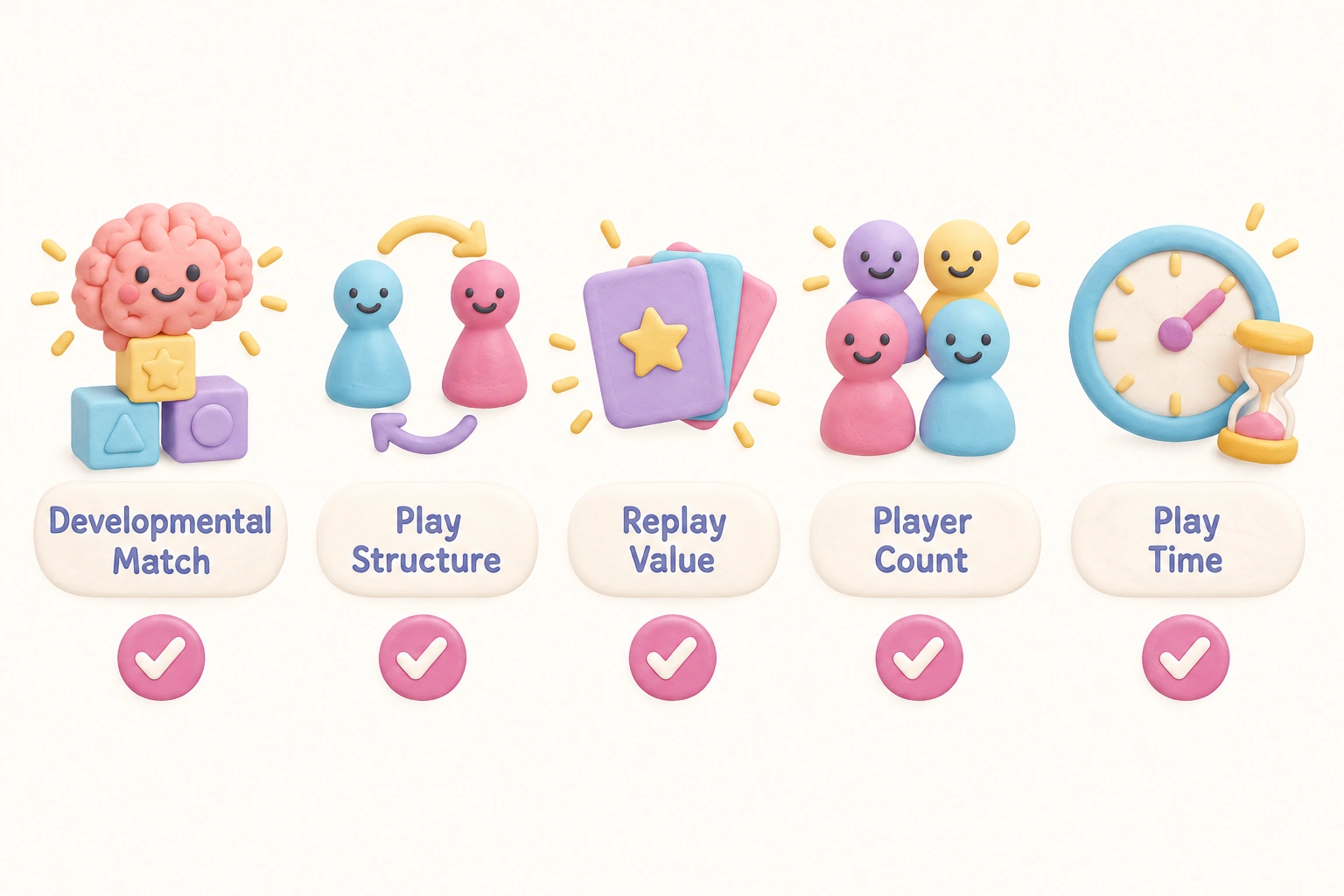
First, consider the developmental match: does the game target skills the child is currently developing or is just beginning to consolidate? A game that is too easy offers little challenge, while one that is too complex can cause frustration and disengagement. Second, evaluate the play structure: cooperative games tend to be better for younger children and for children who struggle with losing, while competitive games can build resilience and strategic thinking in older children who are developmentally ready for that experience.
Third, think about replay value: games with variable setups, multiple difficulty levels, or scalable rules offer better long-term value than those with a fixed, predictable structure. Fourth, consider player count and whether the game works for the number of people typically available to play — a two-player game may not suit a family of five, and a six-player game may be impractical for a single parent and one child. Fifth, assess play time relative to the child’s attention span: a 45-minute game may be ideal for a ten-year-old but exhausting for a five-year-old.
Games That Grow With the Child
One underappreciated feature in educational board games is scalable difficulty — the ability to adjust rules, challenge levels, or game modes as a child develops. Robot Turtles, for example, introduces simple directional programming for young children but adds function cards and bugs for older players, extending its useful age range considerably. Coder Bunnyz offers thirteen levels of programming complexity within a single game, making it genuinely useful from early elementary through middle school.
Games with dual-sided boards, modular rule sets, or expansion packs offer similar scalability. When a family invests in a game that can grow with the child, the educational value compounds over time rather than being exhausted after a single developmental stage. This is a particularly relevant consideration for homeschool families and educators who want games that remain useful across multiple school years.
Board Games for Neurodiverse Children and Mixed-Age Siblings
Children with ADHD, anxiety, or sensory processing differences may benefit from specific game features that reduce frustration and support engagement. Quick-play games with rounds under fifteen minutes are generally more accessible for children with shorter attention spans or difficulty sustaining focus. Cooperative formats remove the social pressure of direct competition, which can be particularly supportive for children who experience heightened emotional responses to losing. Games with clear, visual rule structures and minimal reading requirements also reduce cognitive load for children who find text-heavy instructions challenging.
Mixed-age sibling play is another practical consideration that most game guides overlook. Games like Outfoxed, Qwirkle, and Carcassonne work across a wide age range because older children can engage at a more strategic level while younger children participate meaningfully at a simpler level. Cooperative games are especially well-suited to mixed-age groups because older siblings can support younger ones without the dynamic becoming unbalanced or competitive.
The “Stealth Learning” Effect
One of the most consistent observations from parents and educators who use educational board games regularly is that children often do not realize they are learning. A child who resists math worksheets may enthusiastically calculate moves in Prime Climb or count spaces in Sum Swamp for an hour without noticing the arithmetic involved. This stealth learning effect is not accidental — it is a direct result of intrinsic motivation, which developmental psychologists identify as one of the most powerful drivers of deep learning and skill retention.
When children are engaged in play they have chosen and find genuinely enjoyable, they are more likely to persist through difficulty, repeat the activity voluntarily, and transfer skills to new contexts. This is why game-based learning is increasingly recognized not as a supplement to serious education but as a legitimate and effective mode of skill development in its own right. The key condition is that the game must be genuinely engaging to the individual child — a game that bores or frustrates a child provides none of these benefits regardless of its educational credentials.
What Makes a Board Game Genuinely Educational?
Not every game marketed as educational delivers meaningful skill development. A useful test is to ask whether the game requires children to actively use the target skill to play, or whether the educational content is incidental to the gameplay. A game that requires children to solve arithmetic problems to move forward is more educationally substantive than one that simply uses numbers as decoration on the board.
Red flags to watch for include games where the educational content can be bypassed without affecting play, games where the primary mechanic is pure luck with no decision-making involved, and games where the “educational” label appears to be primarily a marketing claim rather than a reflection of the game’s actual mechanics. Games that require children to make meaningful decisions, apply knowledge, and adapt their strategy based on outcomes are the ones most likely to deliver genuine skill development.
Frequently Asked Questions
What age can children start playing board games?
Most children can begin engaging with simple board games around age two to three, particularly cooperative games with basic color-matching or counting mechanics and very short play times. The key is matching the game’s complexity to the child’s current developmental stage rather than relying solely on the box’s age recommendation.
Are educational board games useful in classroom settings?
Many educational board games are well-suited to classroom use, particularly those with two to four players, short play times, and clear curriculum connections. Teachers and homeschool educators often find that games targeting math skills, vocabulary, or logical reasoning can complement formal instruction by providing low-pressure practice in a social context. Player count and setup time are the most important practical considerations for classroom use.
What board games help with early math skills?
Games that embed arithmetic into their core mechanics are most effective for building early math skills. Count Your Chickens and Hi Ho Cherry-O support counting and number recognition for preschoolers. Sum Swamp introduces addition and subtraction for early elementary children. Prime Climb develops multiplication, division, and number theory for older children. The common feature is that children must use math to play, not merely encounter numbers incidentally.
Are board games beneficial for children with ADHD?
Board games can be beneficial for children with ADHD when selected carefully. Quick-play games with rounds under fifteen minutes, cooperative formats that reduce competitive pressure, and games with clear visual structures tend to be most accessible. Games that require sustained attention for forty-five minutes or more may be less suitable. As with any approach, individual responses vary, and caregivers should observe how a specific child engages with a specific game rather than assuming a universal fit.
How do I know if a board game is truly educational?
A genuinely educational board game requires children to actively apply the target skill as part of the core gameplay mechanic. If a child must solve problems, make decisions, or use knowledge to progress in the game, the educational content is substantive. If the educational label is primarily cosmetic — numbers on a spinner, for example, that do not require any mathematical thinking — the game’s developmental value is likely limited.
What are the best cooperative board games for young children?
Hoot Owl Hoot!, Count Your Chickens, and Outfoxed are among the most consistently recommended cooperative board games for young children. All three require players to work toward a shared goal, which supports turn-taking, communication, and emotional regulation without the pressure of direct competition. Wildcraft! is a strong cooperative option for slightly older children with an interest in nature and science.
Choosing Board Games That Match Your Child’s Stage and Interests
The most effective educational board game for any child is one that sits at the intersection of genuine engagement and appropriate developmental challenge. A game that a child asks to play repeatedly, that requires them to think, adapt, and interact with others, and that introduces skills just slightly beyond their current comfort zone is doing exactly what the best game-based learning is designed to do.
Parents and educators do not need to build an extensive collection to see meaningful benefits. Two or three well-chosen games that match a child’s current developmental stage and interests — one cooperative, one skill-building, one with strong replay value — will provide more developmental value than a shelf full of games that are rarely played. As children grow, revisiting the age-bracket and skill-area frameworks in this guide can help identify when it is time to introduce a new level of challenge.
If you are unsure where to start, cooperative games for younger children and strategy or deductive reasoning games for older children are reliable entry points. Teachers, school librarians, and homeschool communities are also excellent sources of practical recommendations based on direct experience with specific games and specific age groups.

Take a short quiz to find out what your everyday choices say about your parenting style
When your child is curious about something new, what’s your instinct?
Take a short quiz to find out what your everyday choices say about your parenting style
“Can I download this app?” What happens next?
Take a short quiz to find out what your everyday choices say about your parenting style
When it comes to rules at home, which sounds most like you?
Take a short quiz to find out what your everyday choices say about your parenting style
If you could give your child one life skill today, what would you pick?
Take a short quiz to find out what your everyday choices say about your parenting style
Your child gets to choose what to watch. What would your ideal setup look like?
Take a short quiz to find out what your everyday choices say about your parenting style
Pick your parenting superpower ✨