Best Math Board Games for Kids: Counting to Multiplication

 Discover a Free Education Video App for Kids
Pastory uses AI to personalize educational video content based on your child’s interests and personality. Safe, engaging, and built for curious young minds. Sign up now to stay updated and enjoy early access with a free trial
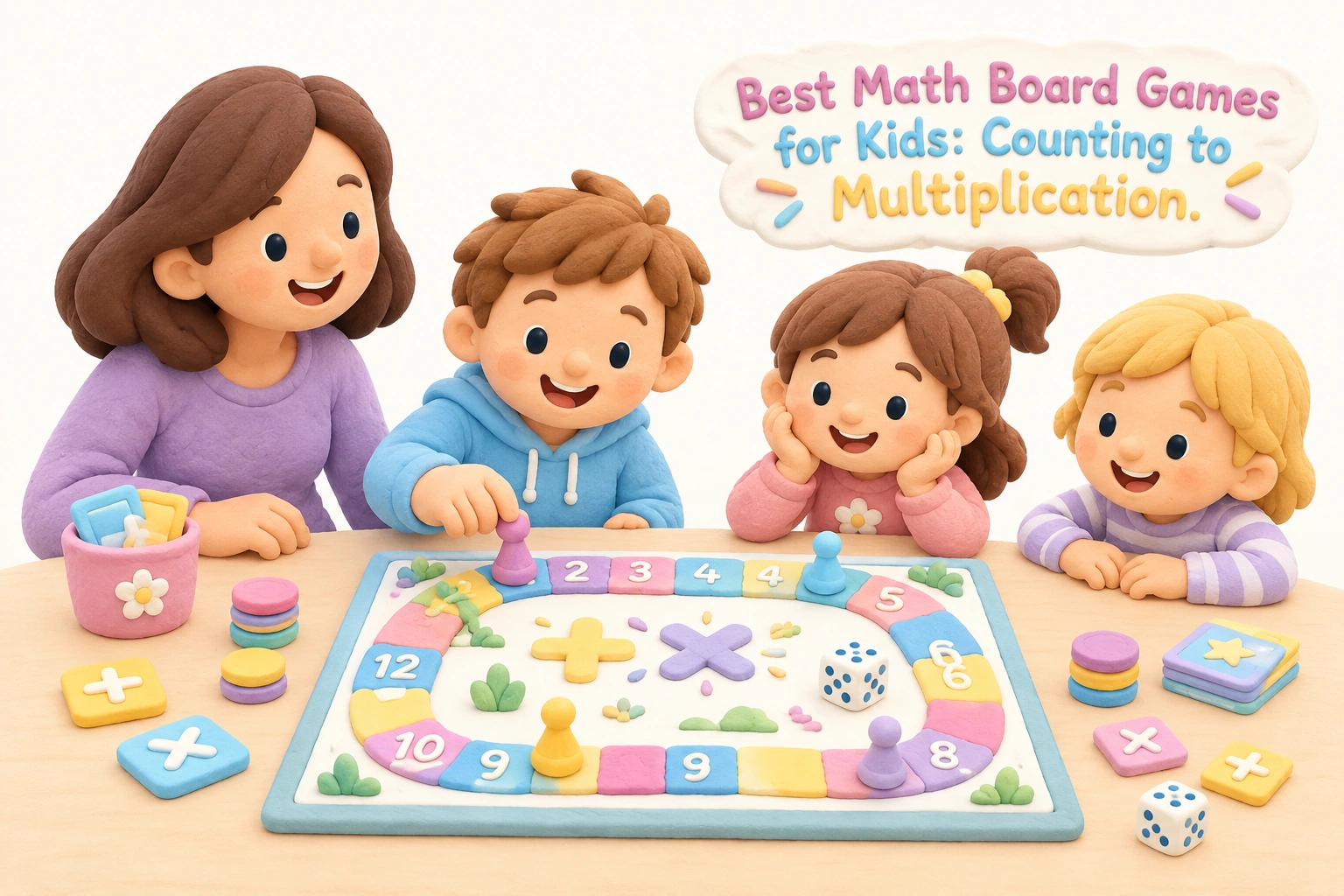
Math board games for kids offer something that worksheets and apps rarely can: the chance to build genuine number sense through play, laughter, and a little friendly competition. Whether your child is just learning to count or beginning to tackle multiplication tables, there is a well-designed educational board game suited to their current skill level—and the research behind these games is more compelling than many parents realize.
Key Takeaways
- A 2026 meta-analysis of 18 studies from the University of Oregon found that playing linear number board games can meaningfully improve foundational early math skills including counting, number recognition, and understanding of quantity.
- Even short sessions matter: researchers found that just a few 10-minute play sessions may produce lasting improvements in numeracy skills for young children.
- The best math board game for your child depends on their current grade-level math skills—games are most effective when they sit just above a child’s comfort zone, not far beyond it.
- Screen-free, hands-on math practice through board games supports arithmetic fluency in ways that complement classroom learning without adding homework pressure.
- Several games families already own—Monopoly, Yahtzee, Dominoes, and Uno—quietly teach meaningful math skills without requiring any additional purchase.
Why Math Board Games Work: What the Research Shows
The case for math board games is grounded in developmental research, not marketing. A meta-analysis published in the journal Early Years, drawing on more than two decades of studies, found consistent evidence that structured board game play supports numeracy development in young children. More recently, a 2026 University of Oregon review of 18 studies confirmed that linear number board games—those where players move a token along a numbered path—can produce meaningful gains in counting, number recognition, and number magnitude comparison.
One particularly useful finding from researchers Ramani and Siegler concerns the “counting on” technique. When children are encouraged to count forward from their current position on a number line rather than restarting from one, they develop stronger numeral identification, better number line estimation, and a more flexible understanding of quantity. This suggests that how a parent or caregiver plays the game matters as much as which game is chosen. Prompting a child to say “I’m on five, and I rolled three, so I move to six, seven, eight” rather than counting from one each time can meaningfully accelerate learning.
Researchers also found that brief, repeated sessions are sufficient to produce observable benefits. A few 10-minute rounds of an age-appropriate math game may be enough to support lasting improvements in early math skills—a reassuring finding for busy families who cannot commit to long structured sessions.
The Math Learning Roadmap: From Counting to Multiplication
Understanding where your child sits on the math learning continuum helps you choose a game that challenges without frustrating. Math skills in early childhood and elementary school generally develop along a recognizable progression, and the best math board games are designed to target specific points along that journey.
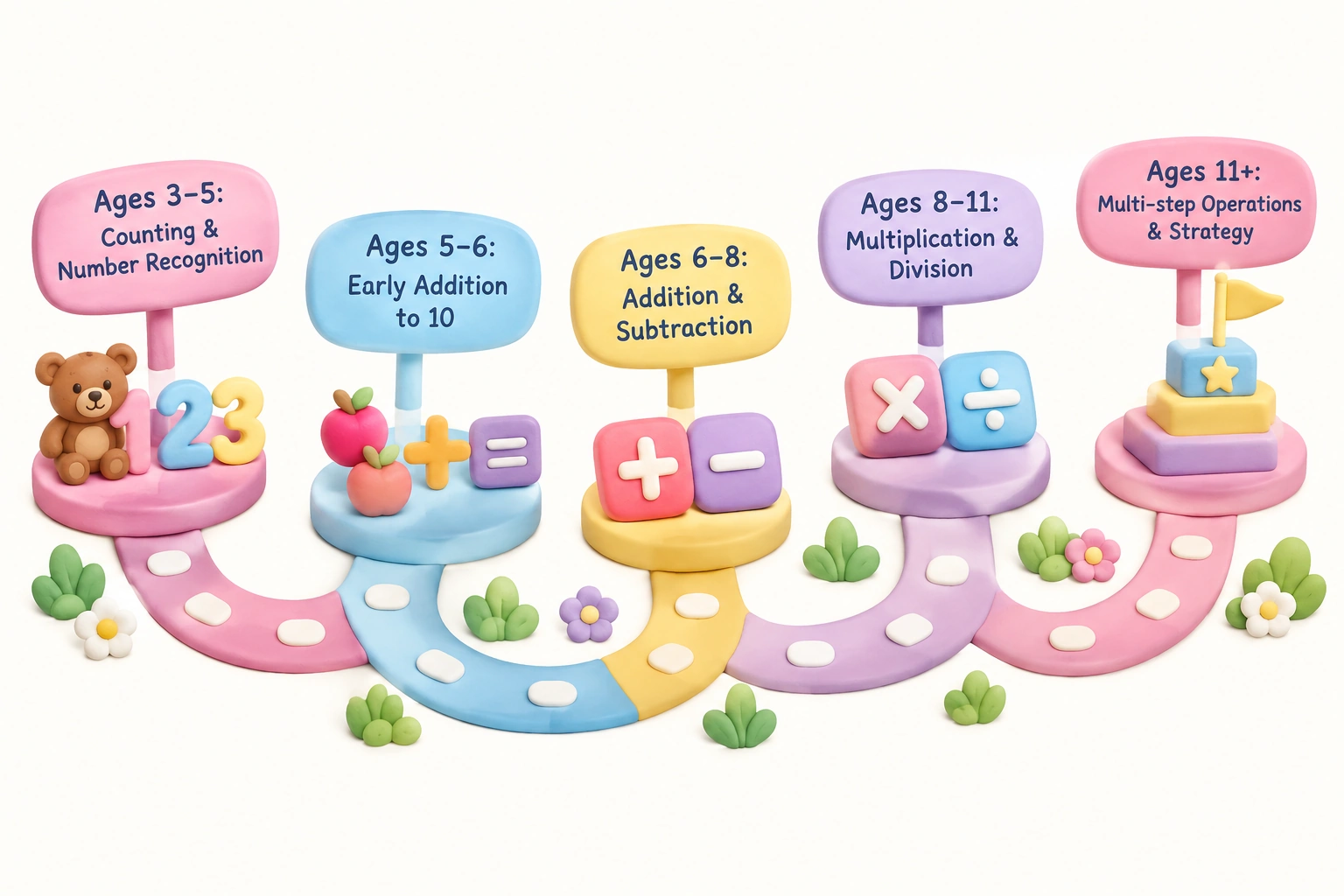
- Ages 3–5 (Preschool): Counting objects, number recognition, subitizing (recognizing small quantities without counting), and color or shape matching.
- Ages 5–6 (Kindergarten): Counting to 20 and beyond, early addition facts to 10, and developing number sense through comparison.
- Ages 6–8 (Grades 1–2): Addition and subtraction practice, early place value, and beginning to use a number line fluently.
- Ages 8–11 (Grades 3–5): Multiplication tables, division, skip counting, mental math skills, and early fractions.
- Ages 11+ (Middle School): Multi-step arithmetic operations, probability, ratio math, and strategic resource management.
Choosing a game that aligns with your child’s current stage—rather than their age alone—tends to produce the most engagement and the most learning. A child who has not yet mastered addition and subtraction will find a multiplication-focused game frustrating rather than educational.
Best Math Board Games for Preschool and Kindergarten (Ages 3–6)
At this stage, the primary goals are counting and number recognition, subitizing, and building early number sense. Games should be simple, visually engaging, and short enough to hold a young child’s attention.
Tiny Polka Dot
Math Skill Focus: Counting, number recognition, subitizing, number sense
Tiny Polka Dot uses colorful cards with dots arranged in different patterns, helping children recognize quantities visually rather than always counting one by one. The game includes multiple play modes that grow with the child, making it useful from around age three through early elementary school. It is one of the most developmentally thoughtful options for preschool-age children because it builds the approximate number sense that underpins later arithmetic fluency.
Hi Ho Cherry-O
Math Skill Focus: Counting to 10, one-to-one correspondence
Hi Ho Cherry-O is a classic roll-and-move game in which children pick or return small fruit pieces based on a spinner result. It reinforces one-to-one counting and introduces the concept of adding and subtracting small quantities in a concrete, tactile way. Recommended for ages three and up, it works well as a first introduction to turn-based game structure alongside early counting practice.
Zingo! Number Sense
Math Skill Focus: Number recognition, counting, early addition
Zingo! uses a bingo-style format with number tiles, helping kindergarten-age children quickly recognize numerals and small quantities. The fast-paced format encourages number recognition without the pressure of calculation, making it a good fit for children who are building confidence with numbers rather than practicing operations.
Sum Swamp
Math Skill Focus: Addition and subtraction, number line understanding
Sum Swamp is a roll-and-move game designed for ages five through eight that uses dice to generate simple addition and subtraction problems. Players move along a swamp-themed path, making it an accessible and engaging introduction to addition and subtraction practice. The game’s linear path structure aligns well with the research on number line games, and the swamp theme tends to hold children’s attention through multiple rounds.
Best Math Board Games for Early Elementary (Ages 6–9)
Children in this age range are consolidating addition and subtraction and beginning to develop arithmetic fluency. Games that require mental calculation—rather than just counting—help build the automatic recall of math facts that supports later multiplication learning.
Math Dice Jr.
Math Skill Focus: Addition, early mental math skills
Math Dice Jr. uses a target number and a set of smaller dice, asking players to combine the smaller numbers through addition to reach the target. It is a fast-paced game that builds mental math skills without requiring written calculation, making it well suited to family game night with mixed ages. The game is recommended from age six and can be played in under 15 minutes, which aligns with the research finding that short sessions can be highly effective.
Sequence Numbers
Math Skill Focus: Addition and subtraction, number recognition
Sequence Numbers replaces the standard Sequence card deck with addition and subtraction equations. Players match an equation card to its answer on the board, reinforcing math fact fluency through repeated, low-pressure practice. It works well for grades one through three and supports two to four players, making it a practical choice for classroom use or family play.
Shut the Box
Math Skill Focus: Addition to 12, number combinations, mental math
Shut the Box is a traditional dice game in which players roll two dice and then flip down numbered tiles that sum to the total rolled. It builds flexible thinking about number combinations—recognizing, for example, that a roll of nine could be covered by tiles 1+8, 2+7, 3+6, 4+5, or 9 alone. This kind of decomposition thinking is a strong foundation for later multiplication and division understanding.
Dominoes
Math Skill Focus: Counting, matching, early addition, pattern recognition
Standard dominoes sets are an underrated hands-on math practice tool. Matching dot patterns builds subitizing and number recognition, while scoring variants introduce addition. Dominoes are inexpensive, durable, and suitable for a wide age range, making them one of the most practical options for families on a budget.
Best Math Board Games for Multiplication (Ages 8–12)
Multiplication is often the point where children’s confidence in math begins to diverge. Games that make times tables practice feel like play rather than drill can meaningfully reduce math anxiety while building the arithmetic fluency children need for more advanced work. This section addresses the multiplication-specific gap that many general math game lists overlook.
Prime Climb
Math Skill Focus: Multiplication, division, prime numbers, strategy
Prime Climb is widely regarded as one of the most mathematically rich board games available for children and adults. Players roll two 10-sided dice and apply any combination of addition, subtraction, multiplication, or division to move their pawns toward the center of a circular board. The board itself is color-coded by prime factors, so children absorb the structure of multiplication and prime numbers visually through repeated play. Prime Climb is suitable from around age ten and works well for homeschool settings or family game night with older children. It rewards strategic thinking alongside arithmetic fluency, making it engaging for adults too.
Proof!
Math Skill Focus: Mental math speed, all four arithmetic operations
Proof! is a fast-paced card game in which players race to find valid equations within a set of number cards. It covers addition, subtraction, multiplication, and division, and its competitive speed element makes it particularly motivating for children who find standard multiplication tables practice tedious. Recommended from age nine, Proof! is a strong choice for children who have basic multiplication knowledge and need to build automaticity—the ability to recall math facts quickly without conscious effort.
Adsumudi
Math Skill Focus: All four arithmetic operations, multi-step mental math
Adsumudi presents players with a target number and a set of smaller numbers, requiring them to combine the smaller numbers using any arithmetic operation to reach the target. It is more open-ended than many multiplication games, encouraging flexible mathematical thinking rather than rote recall. Suitable for ages eight and up, it works well in both classroom and homeschool contexts because it can be differentiated easily by adjusting which cards are used.
Equate
Math Skill Focus: Equation building, all four operations, fractions
Equate is a Scrabble-style board game in which players build valid mathematical equations using numbered and operation tiles. It covers all four arithmetic operations and introduces fractions, making it suitable for ages eight through twelve and beyond. The equation-building format encourages children to think about mathematical relationships rather than simply recalling isolated facts, which supports deeper understanding of how multiplication and division relate to each other.
Yahtzee
Math Skill Focus: Number combinations, addition, probability, strategic thinking
Yahtzee is a game most families already own, and it teaches more math than its reputation suggests. Scoring requires addition of multiple dice, recognition of number patterns, and basic probability reasoning about which combinations are worth pursuing. For children in grades three and above, Yahtzee can be a natural introduction to the idea that some outcomes are more likely than others—a foundational concept in later mathematics.
Games You Already Own That Teach Math
Several common household games function as effective, screen-free math practice tools without requiring any additional purchase. Recognizing the math embedded in familiar games can help parents extend learning opportunities without adding structured homework time.
- Monopoly: Counting money, making change, addition and subtraction of larger numbers, and basic resource management. Most effective for ages seven and up when children can handle multi-digit arithmetic.
- Uno: Number recognition, skip counting when using skip cards, and early strategic thinking. Suitable from around age five with adult support.
- Snakes and Ladders (Chutes and Ladders): A classic linear number board game that supports number line understanding and counting. Research on linear board games applies directly to this format, making it more educationally valuable than its simple appearance suggests.
- Dominoes: Matching, counting, and addition depending on the variant played. Suitable from preschool age through elementary school.
- Standard playing cards: War (number comparison), Go Fish (number matching), and simple addition games using card values all build number sense and arithmetic fluency with no specialist equipment required.
How to Play Math Board Games to Maximize Learning
The research on linear number board games suggests that the way a game is played influences how much children learn from it. Parents and caregivers can make a meaningful difference by applying a few evidence-informed strategies during play.
Encouraging children to use the “counting on” technique—starting from their current position rather than counting from one—has been shown to improve numeral identification, number line estimation, and the ability to count from numbers other than one. In practice, this means gently prompting a child who is on square seven and rolls four to say “eight, nine, ten, eleven” rather than counting from the beginning of the board.
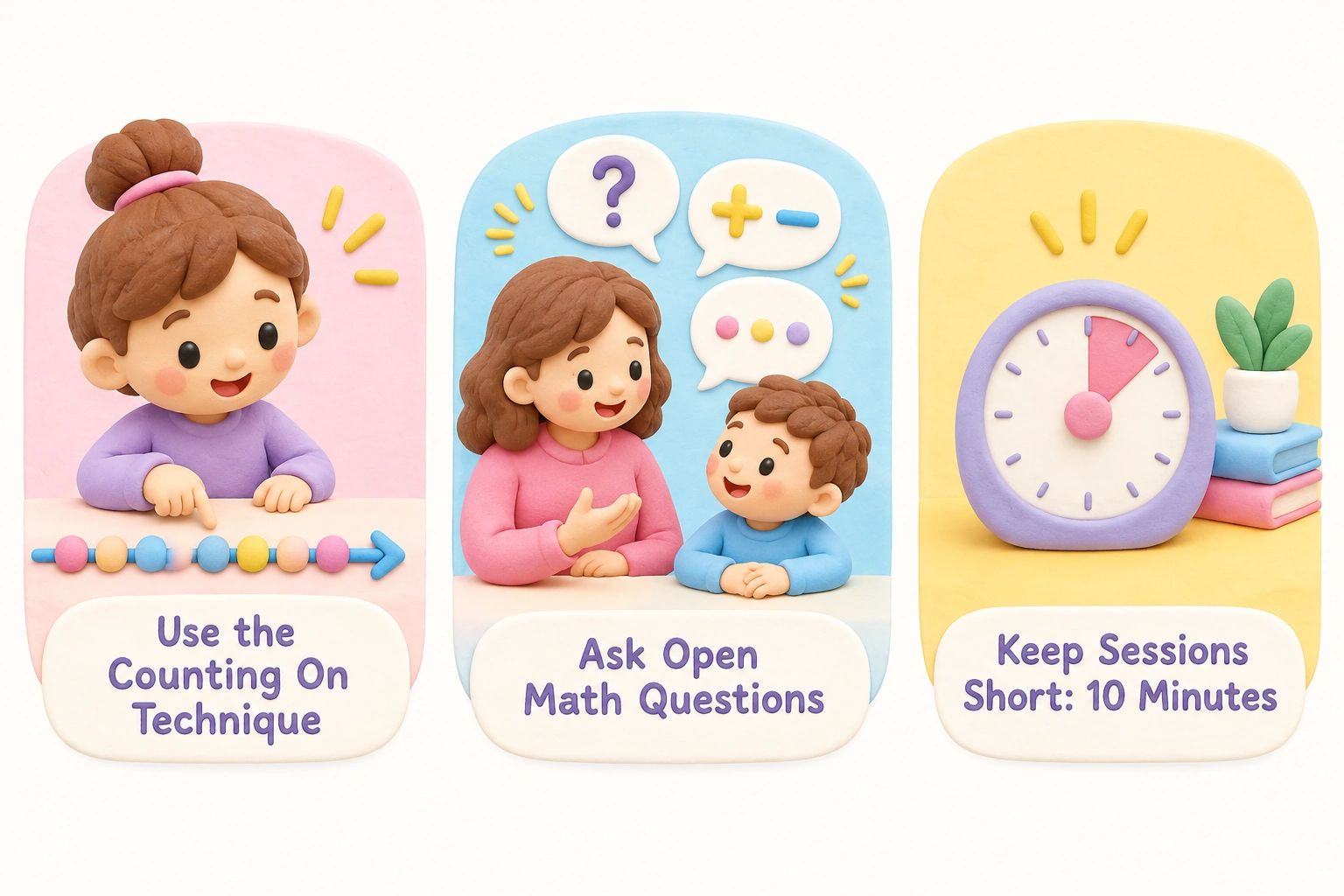
Asking open questions during play also deepens engagement. Questions such as “How many more spaces do you need to reach the finish?” or “If you roll a five, where will you land?” encourage children to apply mental math skills in context rather than simply moving a token. This kind of guided play, sometimes called “math talk,” has been associated with stronger number sense development in early childhood research.
Finally, keeping sessions short and positive tends to produce better outcomes than long, pressured sessions. The research finding that a few 10-minute sessions may produce lasting benefits is a useful reminder that consistency matters more than duration. A brief, enjoyable game before dinner is likely more effective than a long session that ends in frustration.
Cooperative vs. Competitive Math Board Games
Parents often ask whether cooperative or competitive math games are better for children. The honest answer is that both formats offer distinct developmental benefits, and the right choice depends on the child’s temperament and the learning goal.
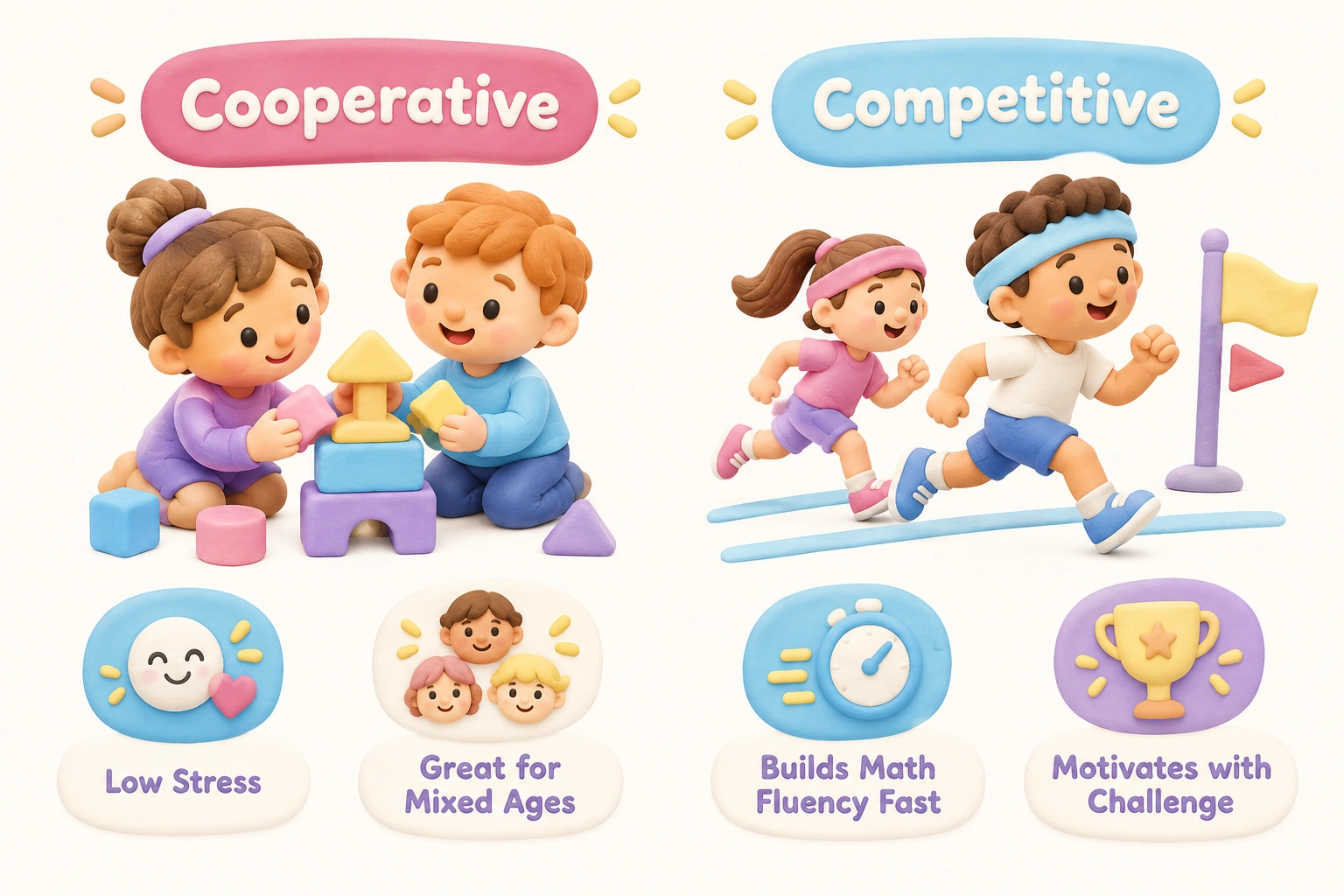
Competitive math games—such as Proof!, Math Dice Jr., and Yahtzee—tend to motivate children who respond well to challenge and enjoy the excitement of winning. The time pressure in speed-based games like Proof! can accelerate math fact fluency by pushing children toward automatic recall rather than deliberate calculation. However, competitive formats can increase anxiety in children who are already uncertain about their math abilities, potentially undermining confidence rather than building it.
Cooperative math games, where all players work together toward a shared goal, tend to be more inclusive and less stressful. While fewer dedicated cooperative math games exist compared to competitive ones, games like Tiny Polka Dot can be played cooperatively, and many standard games can be adapted by having players help each other rather than compete. Cooperative formats are particularly well suited to mixed-age family play, where a younger child might otherwise feel outmatched.
For children who are anxious about math or who have had negative experiences with timed tests, starting with cooperative or low-stakes formats before introducing competitive speed games is generally a more supportive approach.
Choosing the Right Math Board Game: A Practical Guide
With dozens of educational board games available, narrowing the choice to the right one for your child involves a few practical considerations beyond age range alone.
- Match the skill, not just the age: Age recommendations on packaging are guidelines. A child who is advanced in math may benefit from a game rated for older children, while a child who needs consolidation may find more value in a game rated slightly below their age.
- Consider play time: Games that take 10–20 minutes are more likely to be played regularly than those requiring 45 minutes or more. Shorter games also allow for multiple rounds in a single session, which increases practice repetitions.
- Think about number of players: Some games work best with two players, others with three or four. Choosing a game that fits your household’s typical game night configuration increases the likelihood it will actually be played.
- Assess the fun factor independently of the math: A game that children ask to play again is more educationally valuable than a mathematically sophisticated game that sits unused on a shelf. Engagement is a prerequisite for learning.
- Budget considerations: Effective math games exist at every price point. Hi Ho Cherry-O, Shut the Box, and standard Dominoes are available for under $15. Math Dice Jr. and Sequence Numbers typically fall in the $15–$30 range. Prime Climb and Equate are generally priced above $30 but offer broader age ranges and longer-term value.
Math Board Games for Homeschool and Classroom Use
Math board games are particularly well suited to homeschool and classroom environments because they provide hands-on math practice that complements structured curriculum without feeling like additional work. Several of the games described in this article—including Adsumudi, Equate, and Prime Climb—are used in elementary and middle school classrooms specifically because they reinforce grade-level math skills through repeated, low-pressure practice.
For homeschool families, rotating two or three games that target the child’s current skill level can provide consistent arithmetic fluency practice without the monotony of drill sheets. Edutopia and similar educator-focused resources note that game-based math practice tends to increase willingness to engage with challenging problems, particularly for children who have developed negative associations with formal math instruction.
In classroom settings, games with clear rules and short play times—such as Math Dice Jr. or Shut the Box—work well as warm-up activities or math center rotations. Games that support two to four players are generally more practical for classroom use than those requiring larger groups.
Frequently Asked Questions
What is the best math board game for kindergarteners?
For kindergarten-age children, Sum Swamp and Zingo! Number Sense are strong choices. Both focus on counting and early addition and subtraction practice, and both are designed to be engaging for children who are just beginning to develop number sense. Tiny Polka Dot is also excellent for this age group, particularly for building subitizing skills.
Are math board games actually effective, or are they just fun?
Research suggests they can be both. A 2026 University of Oregon meta-analysis found that linear number board games produced meaningful improvements in foundational math skills including counting, number recognition, and number magnitude understanding. The key is choosing an age-appropriate game and playing it in a way that encourages active mathematical thinking rather than passive token-moving.
How long should a math board game session be?
Research findings suggest that even a few 10-minute sessions may produce lasting benefits in early numeracy skills. For most children, sessions of 10–20 minutes are sufficient and more sustainable than longer sessions that risk frustration or disengagement. Consistency over time matters more than session length.
What is the best math board game for multiplication practice?
Prime Climb is widely considered the most mathematically rich option for multiplication, as its board design visually encodes prime factorization and the gameplay naturally reinforces multiplication and division. For faster-paced multiplication practice, Proof! and Adsumudi are strong alternatives that also cover other arithmetic operations.
Can math board games replace math homework or tutoring?
Math board games are best understood as a complement to, rather than a replacement for, structured math instruction. They are particularly effective at building arithmetic fluency, number sense, and positive associations with mathematics—but they do not systematically cover curriculum content in the way that classroom instruction or targeted tutoring does. For children who are significantly behind grade level, professional educational support remains important alongside game-based practice.
Are there math board games that work for mixed ages?
Yes. Prime Climb, Adsumudi, and Equate all work well across a range of ages because they involve strategic choices that older players can engage with more deeply while younger players still participate meaningfully. Tiny Polka Dot is specifically designed to scale across ages three through eight. For family game night with a wide age spread, choosing a game with adjustable difficulty or multiple play modes tends to work best.
Do math board games help children who are anxious about math?
They can, particularly when the game format is cooperative or low-stakes rather than competitive and timed. The informal, playful context of a board game can reduce the performance pressure that many children associate with formal math assessment. Starting with games that feel genuinely fun—rather than obviously educational—tends to be more effective for math-anxious children.
Which Math Board Game Is the Right Starting Point for Your Child?
The most effective math board game for any child is the one that matches their current skill level, holds their genuine interest, and gets played regularly. For preschool and kindergarten children, games that build counting and number recognition through colorful, tactile play—such as Tiny Polka Dot or Hi Ho Cherry-O—provide the strongest developmental foundation. For early elementary children consolidating addition and subtraction, Sum Swamp, Math Dice Jr., and Shut the Box offer hands-on math practice that complements classroom learning without adding pressure. For children working on multiplication tables and mental math skills, Prime Climb and Proof! stand out as genuinely engaging options that reward repeated play.
It is also worth remembering that the games already in your home—Monopoly, Yahtzee, Dominoes, and even a standard deck of cards—contain more mathematical learning potential than most families realize. Before purchasing anything new, exploring the math embedded in familiar games can be a low-effort, high-value starting point.
If you are unsure where your child sits on the math learning continuum, a brief conversation with their classroom teacher or a homeschool curriculum guide can help identify which skills are currently developing and which games would best support that growth. The research is clear that game-based math practice can be genuinely beneficial—the most important step is simply to start playing.

Take a short quiz to find out what your everyday choices say about your parenting style
When your child is curious about something new, what’s your instinct?
Take a short quiz to find out what your everyday choices say about your parenting style
“Can I download this app?” What happens next?
Take a short quiz to find out what your everyday choices say about your parenting style
When it comes to rules at home, which sounds most like you?
Take a short quiz to find out what your everyday choices say about your parenting style
If you could give your child one life skill today, what would you pick?
Take a short quiz to find out what your everyday choices say about your parenting style
Your child gets to choose what to watch. What would your ideal setup look like?
Take a short quiz to find out what your everyday choices say about your parenting style
Pick your parenting superpower ✨