15 Best Halloween Games for Kids: Party, Classroom and Online Picks

 Discover a Free Education Video App for Kids
Pastory uses AI to personalize educational video content based on your child’s interests and personality. Safe, engaging, and built for curious young minds. Sign up now to stay updated and enjoy early access with a free trial
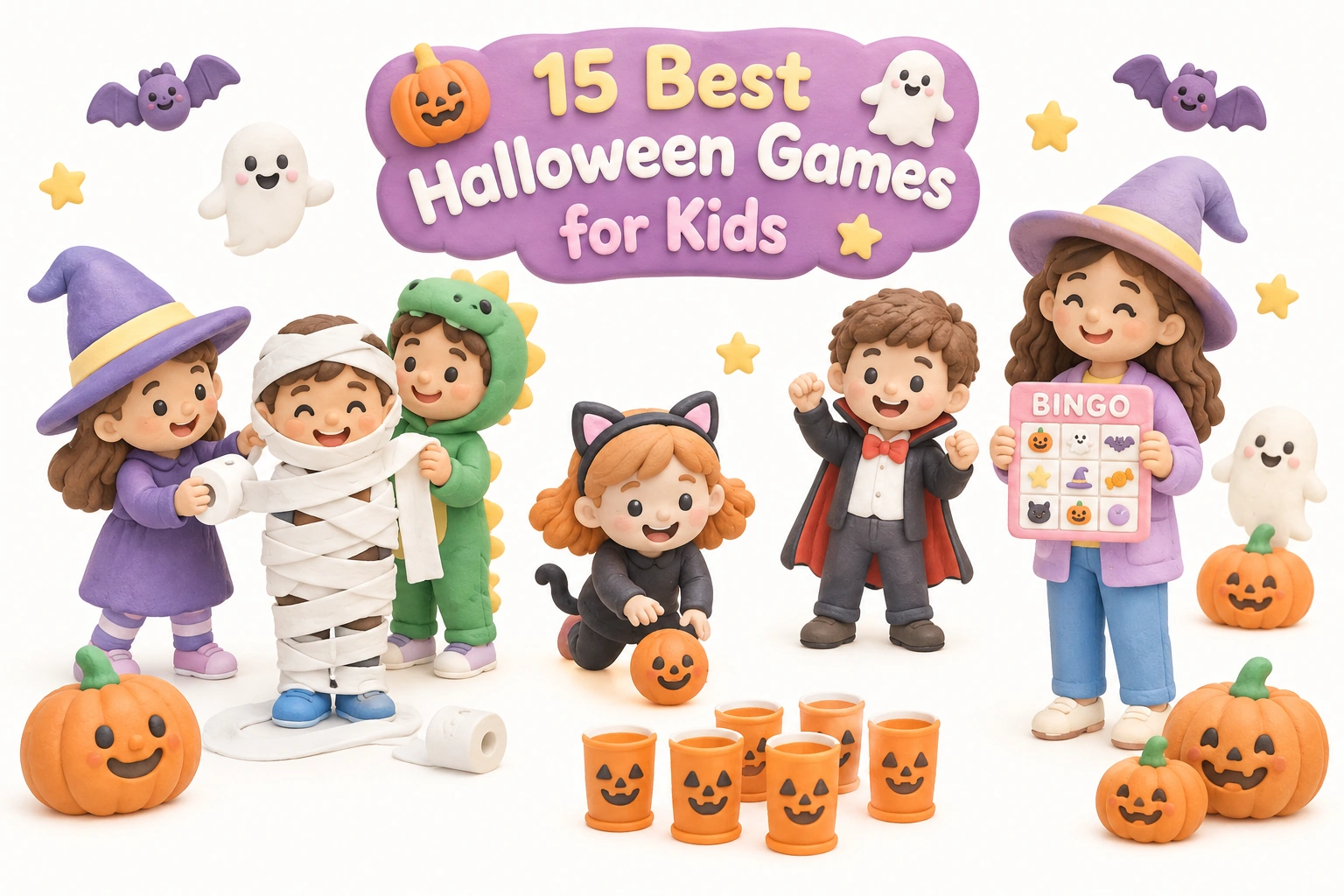
Finding Halloween games for kids that actually work — ones that fit your space, your group size, and the ages of the children involved — takes more thought than grabbing the first list you find. This guide cuts through the noise with 15 carefully chosen games organized by setting: Halloween party games for home or community events, no-prep options for the classroom, and free online picks for digital celebrations or rainy-day fun. Each entry includes age guidance, what you need, and practical notes on safety and inclusivity so you can choose with confidence.
Key Takeaways
- The 15 games below are organized by setting — party, classroom, and online — so you can match the right activity to your actual situation.
- Age-appropriate design matters: games for toddlers and preschoolers need simple rules, short rounds, and soft or large-piece materials; older elementary children can handle timed challenges and team competition.
- Many of the best Halloween games require only everyday household supplies such as toilet paper, plastic cups, and painter’s tape.
- Free browser-based Halloween games exist that require no download, no student login, and no personal data — a practical option for classroom smartboards or shared devices.
- Keeping the spooky factor “silly, not scary” and checking for food allergies in food-based games are the two most important safety and inclusivity steps.
How to Choose the Right Halloween Game for Your Group
Before picking a game, consider three practical factors: the age range of the children, the available space, and how much setup time you realistically have. A mummy wrap game works brilliantly for a living room party of six-year-olds but becomes chaotic with thirty second-graders in a gym. Halloween bingo scales easily to large groups but needs printed cards or a digital display. Matching the game format to the context — rather than choosing whatever looks most fun on a screen — is what separates a smooth celebration from a stressful one.
Child development research consistently shows that children aged three to six benefit most from games with a single, clear instruction, short rounds of two to five minutes, and a physical or sensory element. Children aged seven and up can follow multi-step rules, tolerate mild competitive tension, and sustain engagement for ten to fifteen minutes per activity. Mixed-age groups work best when the game has a role for every skill level, such as a scavenger hunt where younger children find picture clues and older children solve riddles.
A Quick Age-by-Age Reference
| Age Group | What to Prioritize | Best Game Format |
|---|---|---|
| Toddlers (1–3 years) | Sensory exploration, simple motion, adult supervision | Sensory bin, soft ring toss, costume parade |
| Preschool (3–6 years) | One-step rules, short rounds, movement breaks | Freeze dance, Halloween bingo, pumpkin toss |
| Early Primary (6–8 years) | Team play, mild competition, creative tasks | Mummy wrap, scavenger hunt, Halloween charades |
| Middle Childhood (9–11 years) | Strategy, timed challenges, group problem-solving | Halloween trivia, Minute to Win It, escape room |
Halloween Party Games for Kids (Physical and Active)
The games in this section work well at home parties, community events, and trunk-or-treat setups. Most need only basic supplies and can be adapted for indoor or outdoor use.
1. Mummy Wrap Game
The mummy wrap game is one of the most reliably popular Halloween party games for children aged five and up. Teams of two race to wrap one player entirely in toilet paper before time runs out. It encourages cooperation, generates genuine laughter, and costs almost nothing. For younger children, use crepe paper streamers instead of toilet paper, which tears more easily and reduces frustration. Avoid this game with children under three due to the risk of paper wrapping near the face.
2. Spooky Freeze Dance
Spooky freeze dance is the go-to active game for preschoolers and kindergarteners at a Halloween party. Play a Halloween-themed playlist and have children dance like monsters, ghosts, or witches; when the music stops, everyone freezes. The developmental value is real: freeze dance builds impulse control, body awareness, and listening skills in a low-pressure format. Rounds last about thirty seconds each, making it easy to fit into a tight party schedule. This is also one of the safest indoor Halloween games because it requires no props and no physical contact.
3. Pumpkin Bowling
Pumpkin bowling replaces a standard bowling ball with a small sugar pumpkin or a round orange balloon and uses plastic cups or empty water bottles as pins. Set up a lane with painter’s tape on the floor. This game works well for ages four and up and can run as a station at a trunk-or-treat event, allowing multiple children to play simultaneously without adult supervision for each turn. For toddlers, use a soft foam ball and place the cups closer together.
4. Halloween Scavenger Hunt
A Halloween scavenger hunt is one of the most flexible games on this list because it scales from a single room to an entire backyard or neighborhood. For children aged four to six, use picture-based clue cards showing a ghost, a pumpkin, or a spider web. For children aged seven and up, written riddles or a map add problem-solving challenge. Scavenger hunts work especially well for large groups of ten or more children because teams can search simultaneously, reducing wait time. Free printable Halloween scavenger hunt cards are widely available online and require no preparation beyond printing.
5. Pin the Spider on the Web
This is a modern, Halloween-themed spin on the classic pin-the-tail-on-the-donkey format. A large spider web is drawn or printed on poster board, and blindfolded players try to place a paper spider in the center. It is a calm, turn-based game that works well as a transition activity between higher-energy games. Best for ages four and up; younger toddlers may find the blindfold distressing, so offer the option to simply close their eyes instead.
6. Eyeball Spoon Relay Race
Children balance a plastic eyeball — or a ping-pong ball with a drawn pupil — on a spoon and race to a finish line without dropping it. This game builds fine motor control and concentration while keeping the Halloween theme light and silly rather than frightening. It works well outdoors or in a long hallway. For groups of ten or more, run multiple lanes simultaneously so children spend more time playing than waiting.
7. Donut on a String
Hang ring doughnuts from a string or a horizontal rod at child height and challenge players to eat the doughnut without using their hands. This classic game is a crowd favorite for ages five and up. Always check for food allergies before using any food-based game, and have an alternative non-food activity ready for children who cannot participate. This is one of the most important inclusivity steps for any Halloween party involving edible props.
8. Halloween Bingo
Halloween bingo is the single most versatile game on this list. It works for toddlers using picture-only cards, for early primary children using simple words, and for older kids using Halloween trivia clues as the call. Free printable Halloween bingo cards are available in multiple difficulty levels, making this a true no-prep Halloween game once you have printed the cards. For large classroom groups, a digital bingo caller displayed on a smartboard removes the need for a dedicated caller and keeps the pace consistent.
No-Prep Halloween Games for the Classroom
Classroom Halloween party games face a specific set of constraints: limited space, mixed reading levels, a need for calm transitions, and often very little setup time. The games below require minimal or no materials and can be started within two minutes.
9. Halloween Charades
Halloween charades needs no materials at all. Write Halloween-themed words — vampire, cauldron, trick-or-treat, haunted house — on slips of paper, or simply call them out to the acting player. Children take turns acting out the word while their team guesses. This game supports expressive language, perspective-taking, and creative thinking. It works best for children aged six and up who have enough vocabulary to recognize and act out abstract concepts. For younger children, limit the word list to concrete nouns such as ghost, bat, and witch.
10. Halloween “Would You Rather”
Read out Halloween-themed “Would You Rather” questions — for example, “Would you rather have a pet dragon or a pet werewolf?” — and have children vote by raising hands or moving to opposite sides of the room. This is a genuinely no-prep Halloween game that doubles as a calm-down activity after a high-energy game. It also sparks discussion and perspective-sharing, which supports social-emotional development. Questions can be adjusted instantly for any age group.
11. One-Word Spooky Story
Children sit in a circle and build a Halloween story one word at a time, each player adding the next word. The game requires no materials, no preparation, and no reading ability, making it accessible to mixed-age groups. It builds narrative thinking, listening skills, and creative language use. Keep rounds short — about two minutes — and start a new story when the narrative reaches a natural pause or becomes too silly to continue. This is one of the most developmentally rich no-prep options for a classroom Halloween party.
12. Halloween Minute to Win It Challenges
Halloween Minute to Win It games are timed sixty-second challenges using simple props: stack candy corn as high as possible, move cotton ball “ghosts” across a table using only breath, or sort Halloween-colored candies by color. These challenges work well for children aged seven and up and can be run as stations, allowing multiple children to compete simultaneously. Adding Minute to Win It rounds to a classroom party schedule provides a high-energy burst that is easy to contain within a defined time block. For groups with mixed abilities, frame the challenge as a personal best rather than a head-to-head competition.
A Simple Halloween Party Schedule for a 45-Minute Classroom Celebration
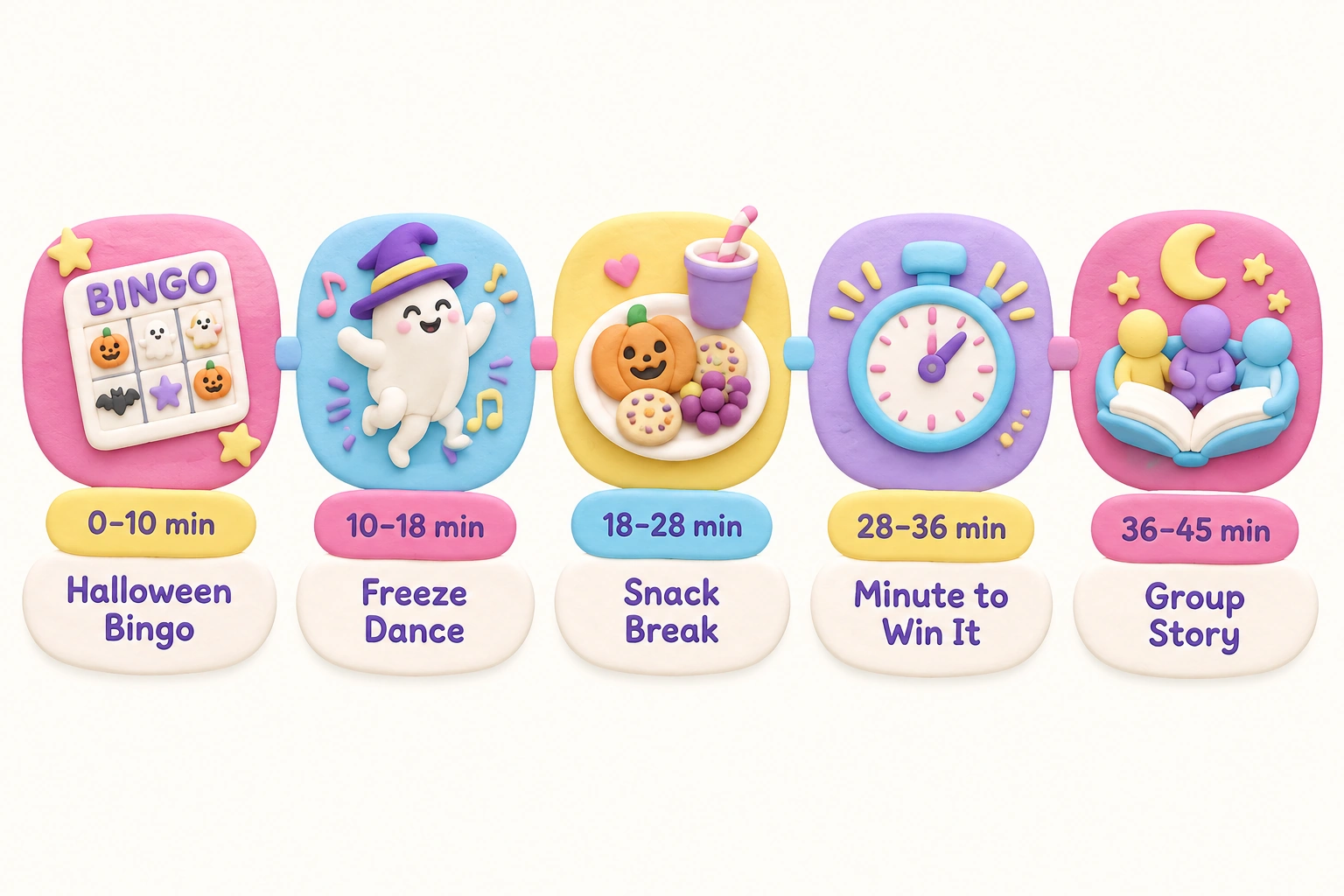
Party flow matters as much as game selection. A useful structure for a 45-minute classroom Halloween party is: open with Halloween bingo for ten minutes to settle the group, move into a high-energy game such as freeze dance or a relay race for eight minutes, transition to a quiet creative activity or snack break for ten minutes, run a short Minute to Win It or charades round for eight minutes, and close with a group activity such as the one-word spooky story for the final nine minutes. This sequence alternates active and calm activities, which helps regulate children’s energy and reduces the likelihood of overstimulation.
Free Online Halloween Games for Kids
Free online Halloween games fill a genuine need for classroom smartboard use, virtual Halloween parties, and rainy-day home play. The most useful digital options require no download, no student account creation, and no personal data — a critical consideration for school settings governed by student privacy requirements.
13. Browser-Based Halloween Puzzle and Memory Games
Sites such as digipuzzle.net and kidsgameland.com host collections of free browser-based Halloween games including Halloween memory match, Halloween jigsaw puzzles, and Halloween hidden object games. These are compatible with Chromebooks, iPads, and interactive smartboards without requiring installation. Memory match games are particularly well-suited to children aged four to eight because they reinforce visual discrimination, short-term memory, and concentration in short, self-contained rounds. When using these platforms in a classroom, preview each game individually to confirm it contains no advertising or age-inappropriate content before displaying it to students.
14. Virtual Halloween Charades and Trivia
For virtual Halloween parties or hybrid classroom celebrations, online Halloween charades generators and Halloween trivia quiz tools allow groups to play together over a video call or on a shared screen. Free Halloween trivia question sets are available for multiple age ranges — picture-based trivia for younger children, pop-culture and history-of-Halloween questions for tweens. Halloween trivia works especially well for children aged nine and up who can read questions independently and enjoy the competitive format of a trivia night structure.
15. Halloween Coloring and Creative Browser Games
Browser-based Halloween coloring tools and simple creative games — such as digital pumpkin decorating or monster builder activities — provide a calm, screen-based option for children who need a quieter activity during a party or classroom celebration. These are best used as a transition or wind-down activity rather than a primary game, and they work well for children aged three to seven who are not yet ready for competitive or rule-based digital games. As with all screen-based activities, brief supervised sessions are preferable to extended independent use, in line with general guidance from pediatric health organizations recommending that screen time for young children be purposeful, limited, and ideally accompanied by an adult.
Safety, Inclusivity, and the “Silly, Not Scary” Principle
The most effective Halloween games for kids keep the spooky factor playful rather than frightening. Young children — particularly those under six — may find realistic monster imagery, jump-scare elements, or dark themes genuinely distressing rather than fun. Choosing games with cartoonish, friendly Halloween characters and bright colors rather than graphic or horror-adjacent imagery makes the celebration accessible to every child in the group, including those who are sensitive to frightening content.
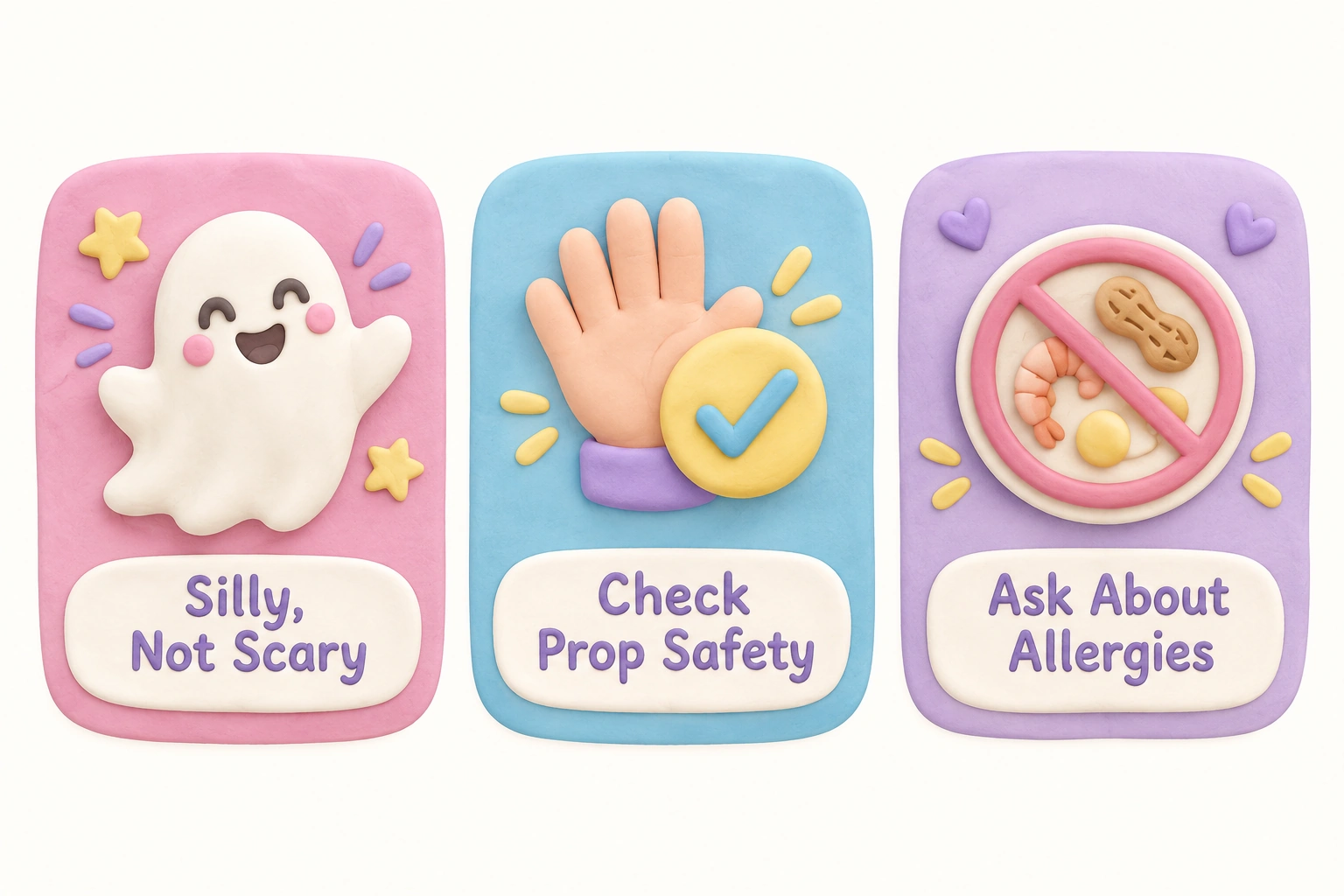
Physical game safety requires checking all props against the age of the youngest player. Small objects such as candy corn, plastic eyeballs, or mini pumpkin decorations present a choking risk for children under three and should be replaced with larger alternatives. For food-based games such as donut on a string or candy corn challenges, always ask families about food allergies in advance and prepare a non-food alternative activity so that no child is excluded. For outdoor Halloween games after dark, glow sticks, reflective tape on props, and adequate lighting make the play area safer and add an exciting visual element that older children particularly enjoy.
For trunk-or-treat games specifically, choose activities that work in a small, defined space — pumpkin bowling, ring toss, and bean bag toss are all well-suited to a single parking space setup. Games requiring running or large movement are better reserved for open areas where children are not moving between vehicles.
Glow-in-the-Dark and After-Dark Game Variants
After-dark Halloween games add a distinctive atmosphere that older children find genuinely exciting. Glow-in-the-dark variants of standard games — glow stick ring toss, flashlight tag, or ghost bowling with glow sticks placed inside plastic cups — require minimal additional cost and transform familiar games into memorable experiences. These variants work best for children aged seven and up who can navigate a dimly lit outdoor space safely. Always ensure the play area is free of trip hazards before switching off standard lighting, and keep at least one adult with a flashlight visible to the group at all times.
Halloween Games for Large Groups of 10 or More Children
Large group Halloween games require formats where multiple children can participate simultaneously rather than waiting for individual turns. The most effective options for groups of ten or more are: Halloween scavenger hunts run in small teams, freeze dance where the entire group plays at once, relay races with parallel lanes, pumpkin bowling set up as multiple stations, and Halloween bingo where every child has a card. Games that require one child to perform while others watch — such as charades or Minute to Win It challenges — work better in smaller groups or when the audience role is actively engaging, such as guessing or cheering for a team.
Frequently Asked Questions
What are the easiest Halloween games for very young children?
For toddlers and preschoolers, the easiest Halloween games are spooky freeze dance, a simple pumpkin toss with a soft ball, and picture-based Halloween bingo. These require minimal rules, short rounds, and no reading ability. Sensory bins filled with Halloween-themed items — plastic spiders, small pumpkins, dried corn — also work well for children under three with close adult supervision.
What Halloween games work with no supplies at all?
Halloween charades, Halloween “Would You Rather,” and the one-word spooky story game all require zero materials. These are the best no-prep Halloween games for a classroom setting where supplies are limited or unavailable at short notice.
Are free online Halloween games safe for classroom use?
Many free browser-based Halloween games are safe for classroom use, but teachers should preview each game individually before displaying it to students. Look for platforms that do not require student account creation, do not collect personal data, and do not display advertising. Confirm device compatibility — Chromebook, iPad, or smartboard — before the session begins.
How do I keep Halloween games inclusive for children who find Halloween scary?
Choose games with cartoonish, friendly Halloween imagery rather than realistic monster or horror themes. Frame the event as a costume and harvest celebration rather than a fright night. Offer non-competitive roles — scorekeeper, timer, card distributor — for children who prefer not to be in the spotlight. Always have a quiet activity available as an alternative for children who become overwhelmed.
What Halloween games work best for trunk-or-treat events?
Trunk-or-treat games need to work in a small, defined space with brief engagement per child. Pumpkin bowling, witch hat ring toss, bean bag toss, and a candy corn guessing jar are all well-suited to a single-vehicle setup. Avoid games requiring running or large group coordination in a parking lot environment.
How many games should I plan for a one-hour Halloween party?
Three to four games is a realistic target for a one-hour party, allowing time for transitions, snack breaks, and the inevitable moments when a game runs longer than expected. Alternate high-energy and calm activities to help children regulate their excitement. Having one backup game ready — such as Halloween “Would You Rather” — costs nothing and prevents dead time if a planned activity finishes early.
Choosing Halloween Games That Work for Your Specific Group
The 15 games in this guide cover the most common Halloween celebration contexts — home parties, classroom events, trunk-or-treat setups, and virtual gatherings — with age guidance and practical notes for each. No single game works perfectly for every group, and the best choice always depends on the ages of the children, the available space, and how much preparation time you have. The most reliable approach is to select one high-energy physical game, one calm or creative game, and one group game that everyone can join simultaneously, then adjust based on how the children respond in the moment. Keeping the atmosphere silly rather than scary, checking for allergies and choking hazards, and having a no-prep backup ready are the three habits that consistently make Halloween celebrations go smoothly for children and adults alike.
Take a short quiz to find out what your everyday choices say about your parenting style
When your child is curious about something new, what’s your instinct?
Take a short quiz to find out what your everyday choices say about your parenting style
“Can I download this app?” What happens next?
Take a short quiz to find out what your everyday choices say about your parenting style
When it comes to rules at home, which sounds most like you?
Take a short quiz to find out what your everyday choices say about your parenting style
If you could give your child one life skill today, what would you pick?
Take a short quiz to find out what your everyday choices say about your parenting style
Your child gets to choose what to watch. What would your ideal setup look like?
Take a short quiz to find out what your everyday choices say about your parenting style
Pick your parenting superpower ✨