
Emotions Activities for Preschoolers That Build Social and Emotional Skills

 Discover a Free Education Video App for Kids
Pastory uses AI to personalize educational video content based on your child’s interests and personality. Safe, engaging, and built for curious young minds. Sign up now to stay updated and enjoy early access with a free trial
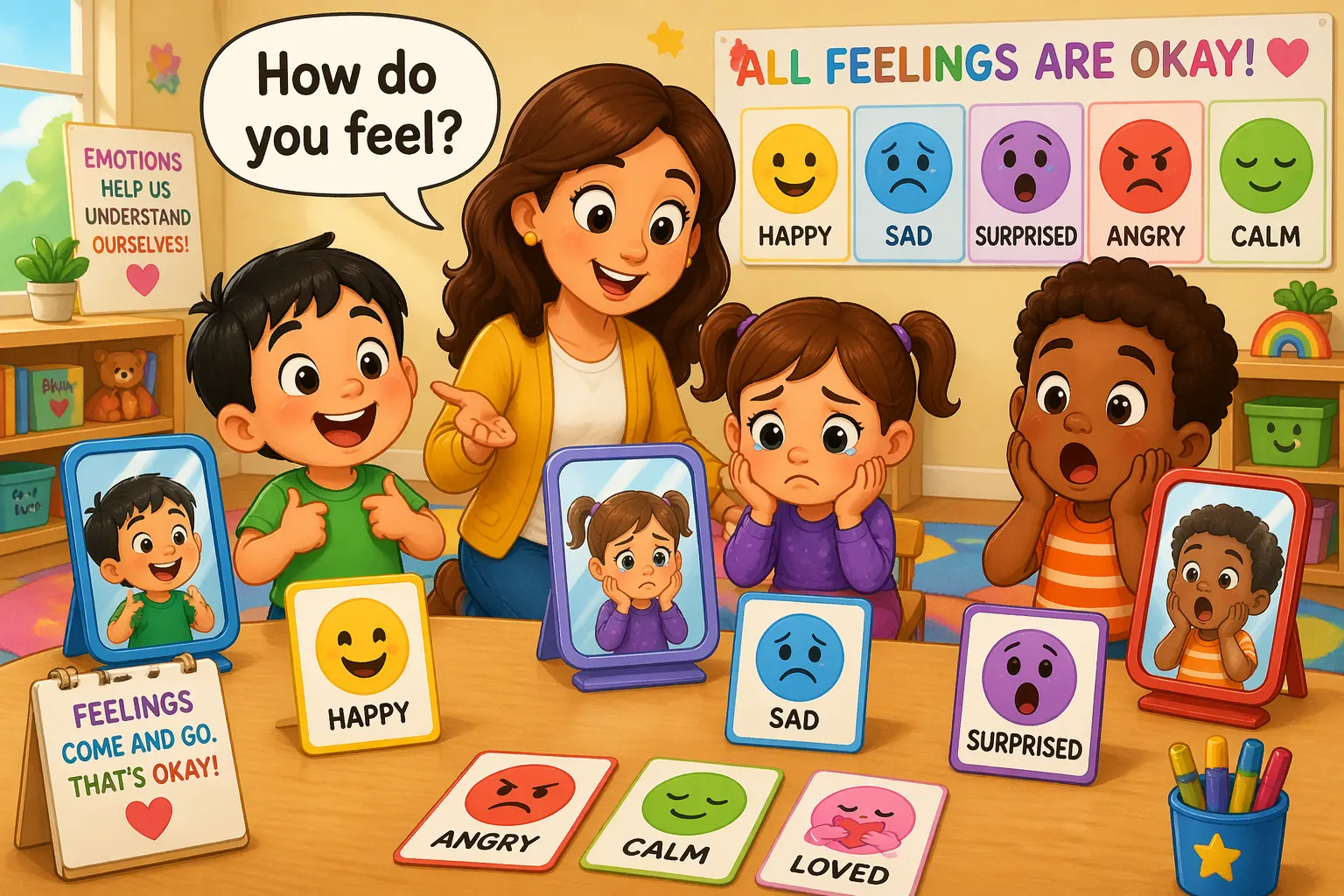
Preschool is one of the most formative periods in a child’s emotional life. Between ages 3 and 5, children begin to name their emotions, understand the feelings of others, and practice the social skills they will carry throughout their lives. This guide covers practical emotions activities for preschoolers, explains the core components of social-emotional development, and offers strategies for parents and teachers to support emotional growth both at home and in the classroom.
What Social Emotional Development Means for Preschoolers
Social-emotional development in the preschool years lays the groundwork for how children relate to themselves and others. Understanding what this development looks like — and what skills it involves — helps parents and educators provide the right support at the right time.
Definition of Social and Emotional Skills in Early Childhood
Social and emotional skills are the abilities that allow children to recognize, understand, and manage their own feelings, as well as respond appropriately to the emotions of others. In early childhood, these skills include:
- Emotional recognition: Identifying and naming feelings like happiness, sadness, fear, and frustration
- Self-regulation: Managing big emotions without becoming overwhelmed
- Empathy: Noticing and caring about the feelings of others
- Cooperation: Working alongside peers to share, take turns, and solve problems together
- Communication: Expressing emotions clearly using words, gestures, or creative expression
These foundational skills support children’s ability to form friendships, navigate conflict, and thrive in structured learning environments.
Key Emotional Milestones for Ages 3–5
Preschoolers go through significant emotional growth in a relatively short time. Most children between ages 3 and 5 begin to use basic emotion words like “happy,” “sad,” and “mad,” start to show concern when a peer is upset, and can follow simple social rules like waiting their turn. By age 5, many children can identify a wider range of emotions, begin to understand that feelings can be complex (feeling both excited and nervous, for example), and start to manage their reactions with adult guidance. These milestones vary by child, and development is rarely perfectly linear.
Difference Between Social Skills and Emotional Skills
Social skills and emotional skills are closely related but distinct. Emotional skills are internal — they involve recognizing and regulating one’s own feelings. Social skills are interpersonal — they involve how a child interacts, communicates, and cooperates with others. For example, a child who can identify when they feel frustrated (emotional skill) and then ask a peer for help instead of grabbing a toy (social skill) is drawing on both. Effective social-emotional activities for preschoolers target both areas simultaneously through play, storytelling, and group interaction.
Types of Social and Emotional Skills to Teach Preschoolers
Before choosing activities, it helps to understand the specific categories of skills that emotions activities for preschoolers are designed to build. A well-rounded approach covers self-regulation, empathy, communication, and cooperation.
Self-Regulation and Calming Skills
Self-regulation is the ability to manage strong emotional responses — to pause before reacting, or to calm down after feeling overwhelmed. For preschoolers, this is one of the most challenging skills to develop because the prefrontal cortex, which governs impulse control, is still maturing. Simple tools like deep breathing, calm-down corners, and sensory bottles give children concrete strategies to manage big feelings. Consistent practice with these tools helps children internalize calming routines over time.
Empathy and Perspective-Taking
Empathy involves recognizing and responding to the feelings of others. Preschoolers are naturally egocentric, which is developmentally normal, but they are also fully capable of learning empathy with the right guidance. Activities that ask children to consider how a character in a story might feel, or how a friend might feel if left out of a game, build perspective-taking skills gradually. Research in developmental psychology suggests that empathy in early childhood is a strong predictor of prosocial behavior and positive peer relationships in later years.
Communication and Listening Skills
Emotional communication means being able to express feelings clearly and listen when others share theirs. Preschoolers benefit from being taught specific emotion words — not just “happy” and “sad,” but also “worried,” “proud,” “left out,” and “surprised.” Giving children a richer emotional vocabulary helps them express those feelings accurately instead of acting them out through behavior. Listening games and circle-time routines also build active listening as a practice, not just a passive habit.
Cooperation and Teamwork Skills
Cooperation involves sharing, negotiating, and working toward a shared goal. Group activities like building a puzzle together, participating in a class project, or playing a collaborative game give preschoolers practice with these skills in low-stakes settings. Learning to cooperate also teaches children to manage disappointment, celebrate others’ contributions, and find solutions when disagreements arise — all core components of social-emotional learning.
Best Emotions Activities for Preschoolers
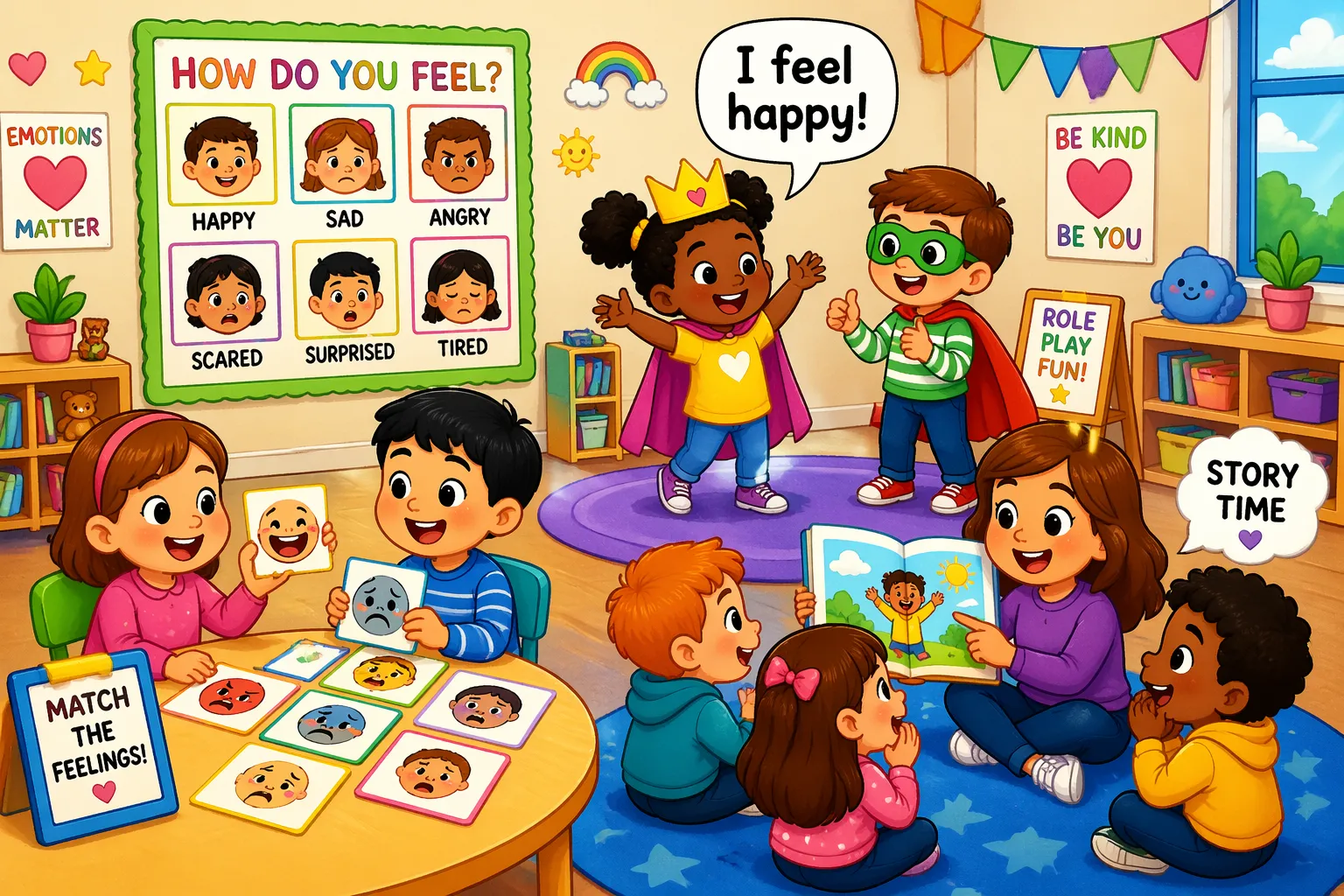
This section covers a wide range of emotions activities for preschoolers that can be adapted for home or classroom use. Each activity is designed to be engaging, age-appropriate, and connected to specific emotional development goals.
Emotion Charades
Emotion charades involves one child acting out a feeling — without words — while others guess what it is. This activity builds emotional recognition through facial expressions and body language, helping children become more aware of nonverbal cues. It also encourages children to observe others closely, which strengthens empathy and perspective-taking.
Feelings Faces Collage
Children cut out faces from magazines or draw their own to create a collage of different emotions. This activity helps preschoolers visually identify a wide range of feelings and connect facial expressions to emotion words. Creating the collage also opens natural conversations about emotions, making it a useful starting point for discussing feelings in a relaxed, creative setting.
Emotion Cards and Matching Games
Emotion card games involve matching facial expressions to written emotion words or pairing two cards showing the same feeling. This structured activity reinforces emotional vocabulary and helps children identify emotions quickly and accurately. Printable emotion card sets or handmade versions with photos work equally well, and the activity can be adapted for individual or group play.
Feelings Bingo
Feelings Bingo uses a standard bingo format where each square contains an emotion face or word. The caller describes a scenario (“someone just got a surprise present — how do they feel?”) and children mark the matching emotion on their card. This game reinforces emotional awareness through repetition and friendly competition, making it particularly effective in classroom settings.
Puppet Show Expressions
Children use puppets or stuffed animals to act out scenarios involving different emotions — perhaps a puppet who feels left out, or one who is nervous about something new. Puppets give preschoolers a safe distance from which to explore difficult feelings without feeling personally exposed. This activity is especially helpful for shy children or those who struggle to talk about their own emotions directly.
Storytime Sharing and Read-Aloud Connections
Reading aloud and pausing to ask questions about characters’ feelings is one of the most natural and effective emotions activities for preschoolers. Questions like “How do you think she feels right now?” or “Have you ever felt that way?” connect the story to the child’s own experience. Books with emotionally rich characters — such as The Invisible String or When Sophie Gets Angry — provide ideal entry points for these conversations.
Role-Play Games and Scenarios
Role-play involves practicing real-life situations such as asking to join a game, apologizing after a conflict, or dealing with disappointment when something doesn’t go as planned. Preschool teachers and parents can set up simple scenarios and encourage children to work through them using words and problem-solving. Role-play builds emotional skills alongside social ones, giving children a rehearsal space for situations they will encounter in everyday life.
Emotion Freeze Dance
In Emotion Freeze Dance, children dance freely until the music stops — at which point they must freeze and show a specific emotion with their face and body. This high-energy activity combines movement with emotional awareness, making it ideal for kinesthetic learners. It is also an excellent transition activity to re-engage children after a quiet task.
Gratitude Journals and Kindness Jar
Adapted for preschoolers, gratitude practices might involve drawing one thing they are thankful for each day, or placing a small token in a “kindness jar” when someone does something thoughtful. These activities help children notice positive emotions and develop an awareness of how their actions affect others. Simple, consistent gratitude routines have been linked to improved emotional wellbeing and prosocial behavior in young children.
Calm Down Bottles and Calm-Down Supports
A calm-down bottle is a sealed, glitter-filled container that children shake and then watch settle — using the experience as a visual metaphor for letting emotions settle too. These sensory tools give children a physical, concrete way to practice self-regulation. A calm-down corner stocked with a few supportive tools (soft toys, breathing cards, a calm-down bottle) gives children a designated space to manage big feelings independently.
Mindfulness Breathing Exercises
Simple breathing exercises — like “smell the flowers, blow out the candles” or “belly breathing” — teach preschoolers to use breath as a calming tool. Regular mindfulness practice, even in very short sessions of two to three minutes, helps children develop the habit of pausing before reacting. Breathing exercises are easy to integrate into daily classroom transitions or bedtime routines at home.
Feelings Thermometer and Check-In Activities
A feelings thermometer is a visual tool where children indicate how intensely they are feeling an emotion — from calm at the bottom to very upset at the top. Daily emotional check-ins using this tool or an emotion wheel help children develop self-awareness and give educators early signals when a child may need extra support. These check-ins also normalize talking about feelings as a regular, valued part of the school day.
Friendship Bracelets and Kindness Rocks
Making friendship bracelets or painting kindness rocks for a peer encourages children to think about others’ feelings and express care through a tangible act. These activities build positive social interactions and reinforce the idea that small, intentional gestures matter. They work particularly well as part of a broader kindness or community-building theme.
Teamwork Puzzles and Group Projects
Tasks that require collaboration — like completing a large floor puzzle together or building a shared structure from blocks — give preschoolers direct practice with cooperation. These activities require children to communicate, negotiate, and share materials, creating natural opportunities to practice social-emotional skills in context. Group projects also give educators a chance to observe how children manage disagreements and celebrate shared achievements.
Listening Games and Active Listening Circle
Games like “Simon Says” or “Pass the Sound” require children to pay close attention and respond only when the right cue is given. Active listening circles, where each child takes a turn speaking while others listen without interrupting, teach both sides of communication. These activities build the attentional skills that underpin both academic learning and meaningful social connection.
Nature Scavenger Hunt with Emotions
A nature scavenger hunt can be extended with an emotional awareness layer — for example, asking children to find something that makes them feel calm, something exciting, or something that reminds them of a feeling. Combining outdoor play with emotional reflection helps children connect their inner experiences to the world around them. Time in nature also has a naturally regulating effect on children’s stress levels and mood.
Preschool Yoga and Movement Activities
Preschool yoga incorporates simple poses, breathing, and imagination to help children develop body awareness and emotional regulation. Poses like “strong mountain” or “wobbly tree” give children metaphors for stability and flexibility that extend to their emotional lives. Movement-based activities are particularly effective for children who have difficulty sitting still or processing emotions through verbal expression alone.
Mirror Play and “How Would You Feel?” Scenarios
Children practice making different facial expressions in a mirror while naming the emotion they are showing. Adults then present simple “how would you feel if…” scenarios — “if a friend gave you a hug,” “if your toy broke” — and children respond using words or by making the corresponding face. Mirror play builds emotional literacy by connecting inner feelings to their outward expression.
Emotional Development Activities for Preschoolers at Home and School
The environments in which children practice emotional skills matter. While the core activities remain similar, the approach and structure may shift depending on whether the setting is home or classroom.
Easy Activities for Parents at Home
At home, emotions activities for preschoolers work best when they are low-preparation and woven naturally into daily routines. A few effective options:
- Name emotions during everyday moments (“You look frustrated — do you want to talk about it?”)
- Use bedtime as a time to reflect on the day’s feelings with a simple question like “What made you happy today?”
- Read picture books together and discuss how characters feel
- Keep a small calm-down kit — a stuffed animal, a pinwheel for breathing, a squeeze ball — accessible when emotions run high
Classroom Activities for Teachers
In a classroom setting, preschool teachers have the advantage of a structured daily schedule and a peer group that naturally creates social-emotional learning opportunities. Effective classroom strategies include morning meeting check-ins, role-play scenarios during circle time, cooperative art projects, and the use of emotion cards as part of literacy activities. Posting an emotion chart at child height gives children a visual reference they can use independently throughout the day.
Adapting Activities for Different Learning Styles
Children engage with emotional learning in different ways. Visual learners benefit from emotion charts, face collages, and feelings thermometers. Auditory learners respond well to read-alouds, discussion circles, and listening games. Kinesthetic learners — those who learn best through movement — thrive with freeze dance, yoga, puppet play, and hands-on projects like kindness rocks or play dough face-making. Offering a range of activity types ensures that all children have meaningful access to social-emotional learning.
How to Implement Social Emotional Learning in Preschool
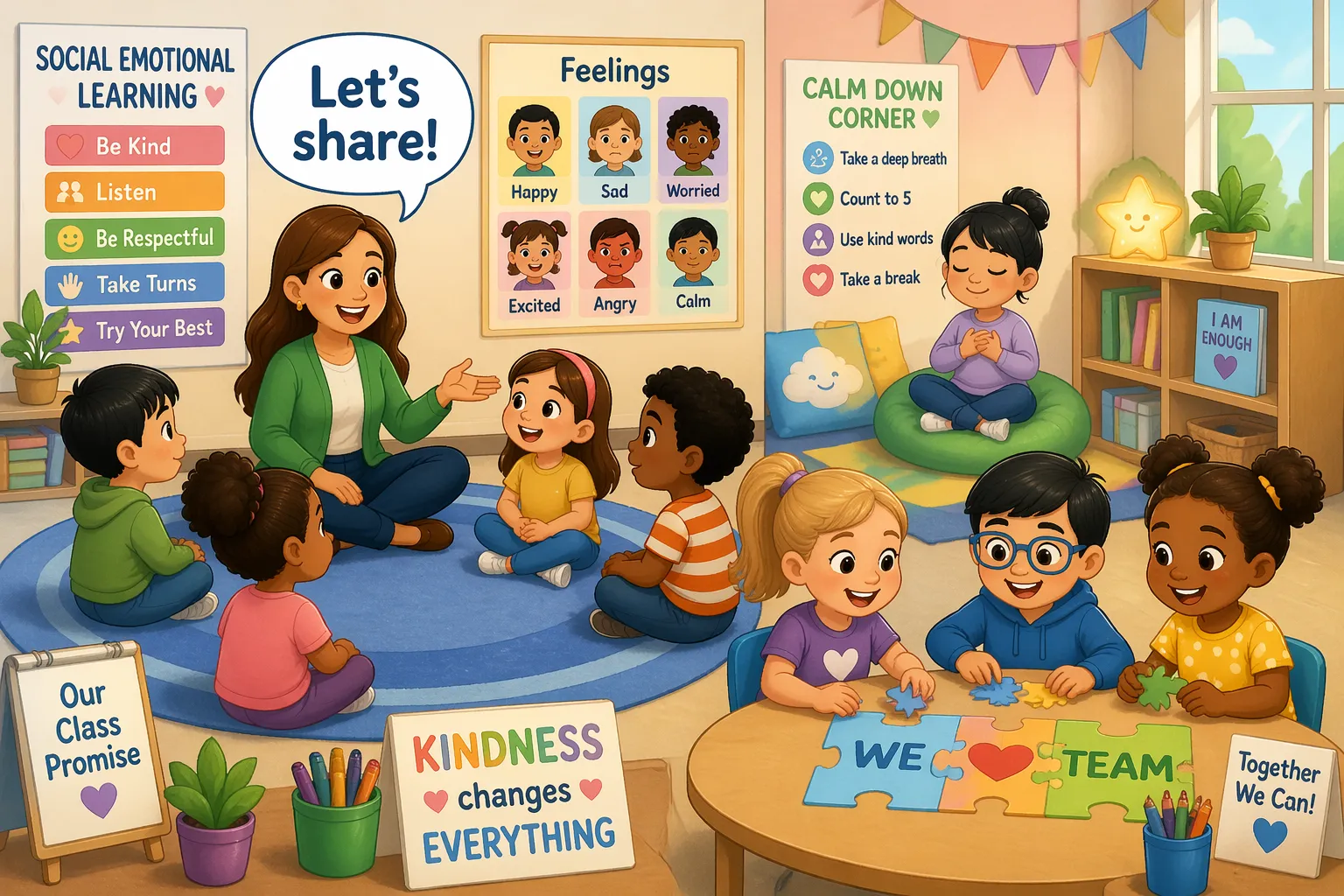
Effective social-emotional learning does not happen in isolated lessons — it is woven into the fabric of daily preschool life.
Daily Routines That Support Emotional Growth
Morning circle time, transition moments, and end-of-day reflections are all natural entry points for emotional learning. A brief feelings check-in at the start of the day, a mindfulness breath before a transition, or a quick sharing moment at the close of class can reinforce emotional awareness without taking significant time away from other learning goals.
Creating a Safe and Supportive Environment
Children can only engage honestly with their emotions when they feel safe to do so. A classroom or home environment that models non-judgmental emotional expression — where all feelings are acknowledged, even when behaviors need to be redirected — gives children the psychological safety to explore their inner lives. Trust between adult and child is the foundation on which all social-emotional learning is built.
Using Visual Aids and Tools
Emotion wheels, feelings charts, and visual check-in boards make abstract emotional concepts concrete and accessible for preschoolers. Displaying these tools at eye level and referring to them consistently during the day helps children internalize the language of emotions over time. Visual aids are particularly valuable for children who are still developing verbal fluency or who are learning in a second language.
Encouraging Positive Reinforcement
When children use their emotional skills — choosing words over actions, asking for help, or noticing a friend’s feelings — acknowledging that choice specifically and warmly reinforces the behavior. Praise like “I noticed you told Maya you were upset instead of pushing — that was a really kind, brave thing to do” is far more effective than generic approval. Modeling emotional language and regulation in adults’ own behavior is equally powerful.
Make Social Emotional Activities Fun and Consistent
The most important factors in building emotional skills in preschoolers are consistency and genuine engagement. No single activity will transform a child’s emotional development — but small, repeated, joyful experiences add up over time. Keep activities playful, follow the child’s lead when possible, and prioritize connection over perfection. When social-emotional activities feel like a natural, fun part of daily life rather than a formal lesson, children absorb the learning far more deeply.
Frequently Asked Questions
What Age Should Children Start Emotions Activities?
Emotional learning can begin earlier than most parents expect. Infants respond to facial expressions and tone of voice from birth, and simple naming of emotions (“you seem hungry and frustrated”) can start in toddlerhood. Structured emotions activities for preschoolers become most effective around ages 3 to 4, when children have enough language and social awareness to engage with them meaningfully.
How Often Should Emotional Activities Be Done?
Short, frequent practice is more effective than occasional in-depth sessions. Integrating a brief emotional check-in, a calming exercise, or a feelings-related question into daily routines — even for five to ten minutes — produces more lasting results than one weekly lesson. Consistency helps children build emotional habits rather than just encountering emotional concepts occasionally.
How to Help Shy or Non-Verbal Children Participate?
For shy or non-verbal children, activities that allow nonverbal responses — pointing to an emotion card, making a face in the mirror, or placing a token on a feelings chart — reduce the pressure of verbal participation. Puppets and art activities are also excellent entry points, as they offer creative distance from direct self-expression. Meeting children where they are, without pushing, builds the trust that eventually opens communication.
Are Emotions Activities Effective for Children with Special Needs?
Emotions activities are beneficial for children across a wide range of developmental profiles, though they may need to be adapted. Children with autism spectrum disorder, for example, may benefit from more explicit instruction in facial expression recognition and structured social stories. Children with sensory processing differences may prefer calming tools adapted to their sensory profile. Working with a specialist or occupational therapist can help identify the most effective approaches for individual children.

Take a short quiz to find out what your everyday choices say about your parenting style
When your child is curious about something new, what’s your instinct?
Take a short quiz to find out what your everyday choices say about your parenting style
“Can I download this app?” What happens next?
Take a short quiz to find out what your everyday choices say about your parenting style
When it comes to rules at home, which sounds most like you?
Take a short quiz to find out what your everyday choices say about your parenting style
If you could give your child one life skill today, what would you pick?
Take a short quiz to find out what your everyday choices say about your parenting style
Your child gets to choose what to watch. What would your ideal setup look like?
Take a short quiz to find out what your everyday choices say about your parenting style
Pick your parenting superpower ✨



