Easy Magic Tricks for Kids: Simple Illusions Anyone Can Learn and Perform

 Discover a Free Education Video App for Kids
Pastory uses AI to personalize educational video content based on your child’s interests and personality. Safe, engaging, and built for curious young minds. Sign up now to stay updated and enjoy early access with a free trial

Whether you want to entertain a room full of friends, dazzle your family at the dinner table, or just discover a new hobby, magic is one of the most rewarding skills a child or beginner can pick up. This guide covers easy magic tricks for kids of all ages — from simple illusions requiring nothing more than a pencil or a coin, to beginner card tricks that look genuinely impressive from the very first performance. Every trick here is easy to learn, uses everyday props, and can be practiced in minutes.
Easy Magic Tricks for Young Kids Ages 5 and Up
Starting early with magic gives young children a wonderful creative outlet. The best tricks for this age group rely on surprise, simple physics, and basic misdirection rather than fine motor control or complex technique. These beginner magic tricks are safe, fun, and guaranteed to produce delighted reactions.
Invisible Water Trick
This classic illusion uses a glass, a stiff card, and a little bit of science. Fill a glass with water, place the card firmly over the top, then carefully flip the glass upside down while pressing the card. Hold the card in place for a moment, then slowly release your grip — the card stays and the water doesn’t fall. The trick works because atmospheric pressure from below pushes up against the card with more force than gravity pulls the water down. For maximum effect, perform it over a sink at first while you practice, and build up to doing it over an audience. The moment of “letting go” is everything — pause for dramatic effect before releasing your hand.
Rubber Pencil Illusion
This is one of the easiest magic tricks for kids to learn on the spot with zero preparation. Hold a regular pencil loosely between your thumb and index finger, about a third of the way from the eraser. Shake your hand up and down loosely and quickly, letting the pencil bounce with the motion. When you get the rhythm right, the pencil appears to bend and wobble like rubber. The trick relies entirely on the brain’s motion-blur effect — the rigid pencil stays perfectly solid, but rapid oscillation fools the eye. Practice in front of a mirror to find the right speed; too fast or too slow and the illusion breaks.
Disappearing Coin Trick
The coin vanish is perhaps the most iconic trick in any beginner magician’s toolkit. Hold a coin flat in one palm, then pretend to pick it up with the other hand while actually letting it slide into the fingers of the holding hand. Close the “picking up” hand as if it holds the coin, wave it theatrically, and open it to reveal — nothing. The secret is in the moment of pretend-transfer: your eyes and the audience’s eyes naturally follow the closing hand, which is the misdirection at work. Practice the motion slowly in front of a mirror until the fake pick-up looks completely natural. The key is confidence — hesitation gives it away.
Sugar Cube Magic Trick
This simple prediction trick works beautifully for kids who love storytelling. Before the trick, use a pencil to write a number on a sugar cube, pressing firmly so it leaves a mark. Tell your audience you’ve predicted the number they’re about to choose. Have them pick a number, reveal your prediction on the cube — and they match. A more dramatic version involves pressing the cube lightly against your thumb when you pick it up (this transfers the pencil mark to your skin), then “reading” their number from your thumb after they choose. It’s a brilliant introduction to the idea that magic is really just well-rehearsed theatre.
Easy Magic Tricks for Kids Ages 7 and Up
As children develop better coordination and longer attention spans, they can take on tricks that require a bit more practice and performance skill. These illusions look noticeably more impressive to an audience while still being straightforward to learn.
Magnetic Pencil Trick
Wrap one hand firmly around the opposite wrist as if measuring your pulse. Hold a pencil in the gripped hand and slowly release your fingers — the pencil appears to stay stuck, defying gravity. The secret: one finger from the gripping hand secretly presses against the pencil from behind, out of the audience’s line of sight. The angle you present to your audience is everything here. Practice performing it with your side facing the viewer so the hidden finger stays invisible. With a little rehearsal, this trick looks genuinely puzzling.
Spoon Bending Illusion
Made famous by stage performers for decades, a convincing spoon bend can be faked beautifully. Hold the spoon upright with both hands, then as you press down firmly, dramatically let your grip slowly lower while the hands appear to be pushing against something solid — this creates the illusion of the handle bending. Combine this with an intense expression and slow movement and the effect can be very convincing. The real bending happens in the performance, not the metal. It’s a great example of how misdirection and pacing can carry an entire trick without any physical secret at all.
Walking Through Paper Trick
This trick uses a simple cutting technique to create what looks impossible. Start with a standard piece of paper. Fold it in half lengthwise, then make a series of alternating cuts — from the folded edge and from the open edge — stopping each cut just before the opposite side. One final cut along the fold (except the two end sections) opens the paper into a large, continuous loop. With practice, you can create a loop wide enough to step through — to the complete astonishment of your audience. Preparation is key: measure and practise your cuts before performing, and keep the final reveal as a dramatic moment.
Cup Through Table Trick
This classic illusion uses a plastic cup, a piece of paper, and careful timing. Wrap the cup tightly in paper so it holds the cup’s shape even when the cup is removed. Pretend to push the wrapped shape through the table, secretly drop the cup into your lap during the misdirection moment, and then slam the paper flat on the table to reveal it’s empty. The crumple at the end produces a great dramatic effect. Practice the moment of dropping the cup — it needs to happen smoothly while your eyes are drawing the audience upward.
Levitating Card Trick
Using a small loop of clear thread attached to a playing card and looped over a finger, you can make a card appear to float and follow your hand like it’s under control. Move slowly and ensure your background is dark or plain for best effect. The thread is nearly invisible at performance distance. This trick requires the most patience of any on this list, but the payoff — a visibly floating playing card — is one of the strongest reactions you can get from a young audience.
Easy Card Magic Tricks You Can Do Today
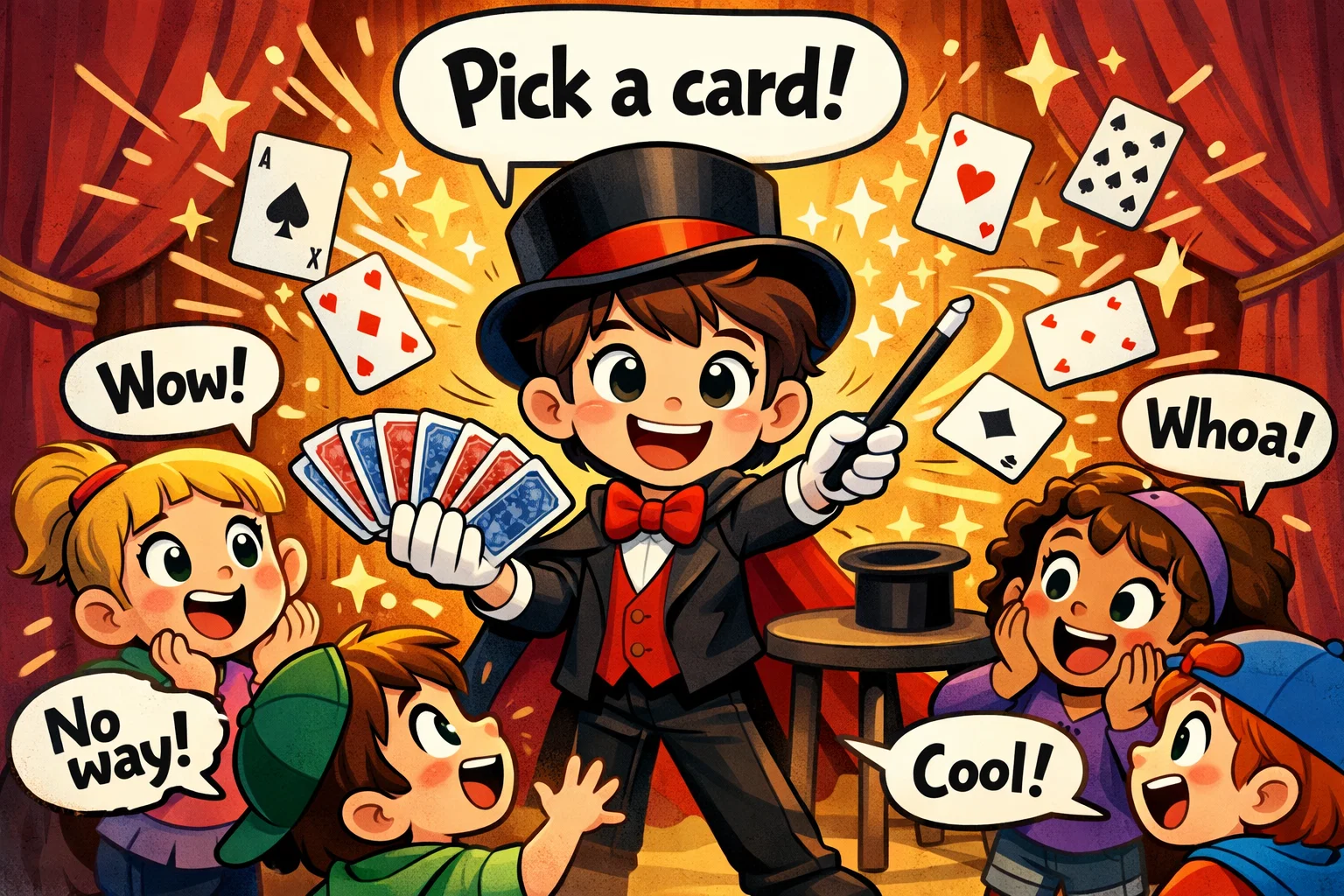
Card tricks are among the most popular and accessible beginner magic tricks in existence. A standard deck of playing cards requires no batteries, no special materials, and fits in a pocket. The following tricks work beautifully for beginners and require only a bit of practice to perform convincingly.
Here are five essential card tricks every beginner should learn first:
- Mind Reading Card Trick — Ask a spectator to select a card and remember it. Use a simple “force” technique (peek at the bottom card as they cut the deck, then control the selection back to a known position) to identify their card, then reveal it with theatrical flair.
- Find Any Card in Deck — Before performing, secretly memorise the top card. Have a spectator cut the deck anywhere, place their chosen card on top of the bottom half, then place the top half back. Their card is now directly below your known card. Fan through the deck to “find” it.
- Upside Down Card Trick — Before the performance, secretly flip the bottom card of the deck face-up. Fan the deck carefully and have a spectator select any card. While they look at it, flip the entire deck over (now the reversed card hides the whole deck’s reversed state). Have them return their card and then reveal it as the one card facing the wrong way.
- Do As I Do Card Trick — Use two decks, one for you and one for the spectator. Both of you shuffle and swap decks, each select a card, return it, and swap back. Because you each secretly memorised the top card of the other’s deck before swapping, you can both find the matching cards — it looks like mind reading.
- Color Changing Card Trick — Using a double-backed card or simple sleight of hand, make a selected card appear to change colour. This requires more practice than others on the list but delivers one of the most visual reactions possible.
Coin and Money Magic Tricks
Coins are the magician’s most portable prop — always on hand, instantly recognisable to any audience, and versatile enough to support dozens of different illusions. Coin tricks are especially satisfying because they happen inches from the spectator’s eyes, making the surprise even greater.
Coin From Thin Air
The classic production of a coin from nowhere starts with a coin palmed in the curve of your fingers. Reach toward someone’s ear, behind a book, or into the air, and smoothly bring the coin into view by straightening your fingers. The palm position takes practice to hold comfortably and casually — many beginners grip too tightly, which looks unnatural. Relax your hand fully and let the coin sit in the natural curve. Once you have that, you can produce coins from ears, noses, elbows, or anywhere else you can reach.
Pen Through Bill
This classic illusion makes it look as though you’ve pushed a pen straight through a banknote — and then restored it completely. The secret involves a small pre-made fold in the bill that creates an optical illusion of penetration. Push the pen into the fold rather than through the bill itself, then straighten the fold to restore the note. Presentation matters enormously here: slow, deliberate movement and a storytelling patter (“a trick so old it was first performed for royalty…”) turns a simple fold into a memorable piece of theatre.
Rope, Rubber Band, and Object Magic Tricks
Everyday objects make the most relatable magic. When the audience can see that the props are completely ordinary, the impossibility hits harder.
Jumping Rubber Band Trick
Loop a rubber band around your index and middle finger. Show the audience clearly. Then, curl all four fingers into your palm so all four fingertips are inside the band without the audience seeing the repositioning. Straighten your fingers and the band visibly jumps to your ring and pinky fingers. The movement looks completely impossible and requires zero special equipment. This trick takes about five minutes to learn and can be performed anywhere, at any moment, with any rubber band.
Cut and Restored Rope Trick
Cut a piece of rope in the middle, then magically restore it to one piece. The secret involves a short secret loop hidden in the hand — when you appear to cut the centre of the rope, you actually cut only the small extra loop, leaving the main rope intact. The restored rope then uncoils to reveal no cut at all. Preparation and patter are the core skills here: the cutting moment should feel genuinely dramatic so the restoration has maximum impact.
Tips to Perform Magic Tricks Like a Pro

Knowing the secret to a trick is only half the work. Professional magicians will tell you that performance — the patter, the pacing, the confidence — accounts for at least half the impact of any illusion. Here are the core performance principles every young magician should practice alongside the tricks themselves.
Practice and Repetition
Muscle memory is what separates a smooth performance from a nervous fumble. Every sleight of hand move — a coin palm, a card force, a rubber band repositioning — should be rehearsed until it requires no conscious thought. Practice in front of a mirror so you can watch your own hands the way the audience will. Film yourself on a phone and watch it back critically. Most moves need 50 to 100 repetitions before they look natural under pressure.
Misdirection Basics
Misdirection is the magician’s most important tool. The audience looks wherever you look: make eye contact with a spectator at the precise moment your hands perform the secret move and their gaze will naturally follow yours. Sudden sounds, sudden movements, and questions (“Did you remember your card?”) all redirect attention effectively. Good misdirection doesn’t feel like distraction — it feels like natural conversation.
Building Confidence on Stage
Stage fright is normal, but it can be managed. Start by performing for one trusted person — a sibling, a parent, a close friend — before attempting a group. Keep your voice steady and at a conversational pace; nerves tend to speed speech up. Maintain eye contact rather than looking down at your hands. And embrace the moments when something goes slightly wrong — experienced performers know that a confident recovery is often more impressive than a flawless performance.
Start Learning Magic Tricks Today
Magic is one of the few skills that rewards you almost immediately. Within an afternoon of practice, a complete beginner can produce a coin from thin air, make a rubber band jump fingers, or find a chosen card in a full deck — and that’s genuinely exciting at any age.
The tricks in this guide were selected because they are easy to learn, use everyday objects, and scale naturally as skills improve. Start with one trick, practice it until it feels effortless, and then perform it for someone. That first real reaction — the surprise, the delight, the “how did you do that?” — is what turns a beginner into a magician.
Frequently Asked Questions
What age can kids start learning magic tricks?
Children as young as four or five can learn and perform very simple tricks — the rubber pencil illusion, basic coin vanishes, and counting games all work beautifully at this age. More complex sleight of hand, like card controls or multi-step coin routines, typically suits ages eight and above when fine motor skills and memory are more developed.
How do magic tricks help child development?
Learning magic builds a notably wide range of skills. Children develop fine motor coordination through repeated physical practice, logical thinking through understanding the structure of an illusion, and public speaking confidence through performance. Research in educational psychology consistently links performance arts activities to improved self-esteem and communication skills in children. Magic also teaches patience — the understanding that meaningful skill requires time and repetition.
How long does it take to learn simple magic tricks?
Many of the tricks in this guide can be learned to a basic performance level within 20 to 30 minutes of practice. Tricks involving sleight of hand — coin palming, card controls — typically need several hours of practice spread over days before they look truly convincing. Setting a goal of one well-polished trick is more satisfying than learning five tricks poorly.
What materials are needed for beginner magic tricks?
Most tricks on this list require nothing beyond what’s already in the house. The essential beginner kit includes:
- A standard deck of playing cards
- Several coins of different sizes
- A few rubber bands
- A length of soft rope (about 1 metre)
- A pencil or pen

Take a short quiz to find out what your everyday choices say about your parenting style
When your child is curious about something new, what’s your instinct?
Take a short quiz to find out what your everyday choices say about your parenting style
“Can I download this app?” What happens next?
Take a short quiz to find out what your everyday choices say about your parenting style
When it comes to rules at home, which sounds most like you?
Take a short quiz to find out what your everyday choices say about your parenting style
If you could give your child one life skill today, what would you pick?
Take a short quiz to find out what your everyday choices say about your parenting style
Your child gets to choose what to watch. What would your ideal setup look like?
Take a short quiz to find out what your everyday choices say about your parenting style
Pick your parenting superpower ✨