100 Idiom Examples for Kids: Meanings, Categories, and Teaching Tips

 Discover a Free Education Video App for Kids
Pastory uses AI to personalize educational video content based on your child’s interests and personality. Safe, engaging, and built for curious young minds. Sign up now to stay updated and enjoy early access with a free trial
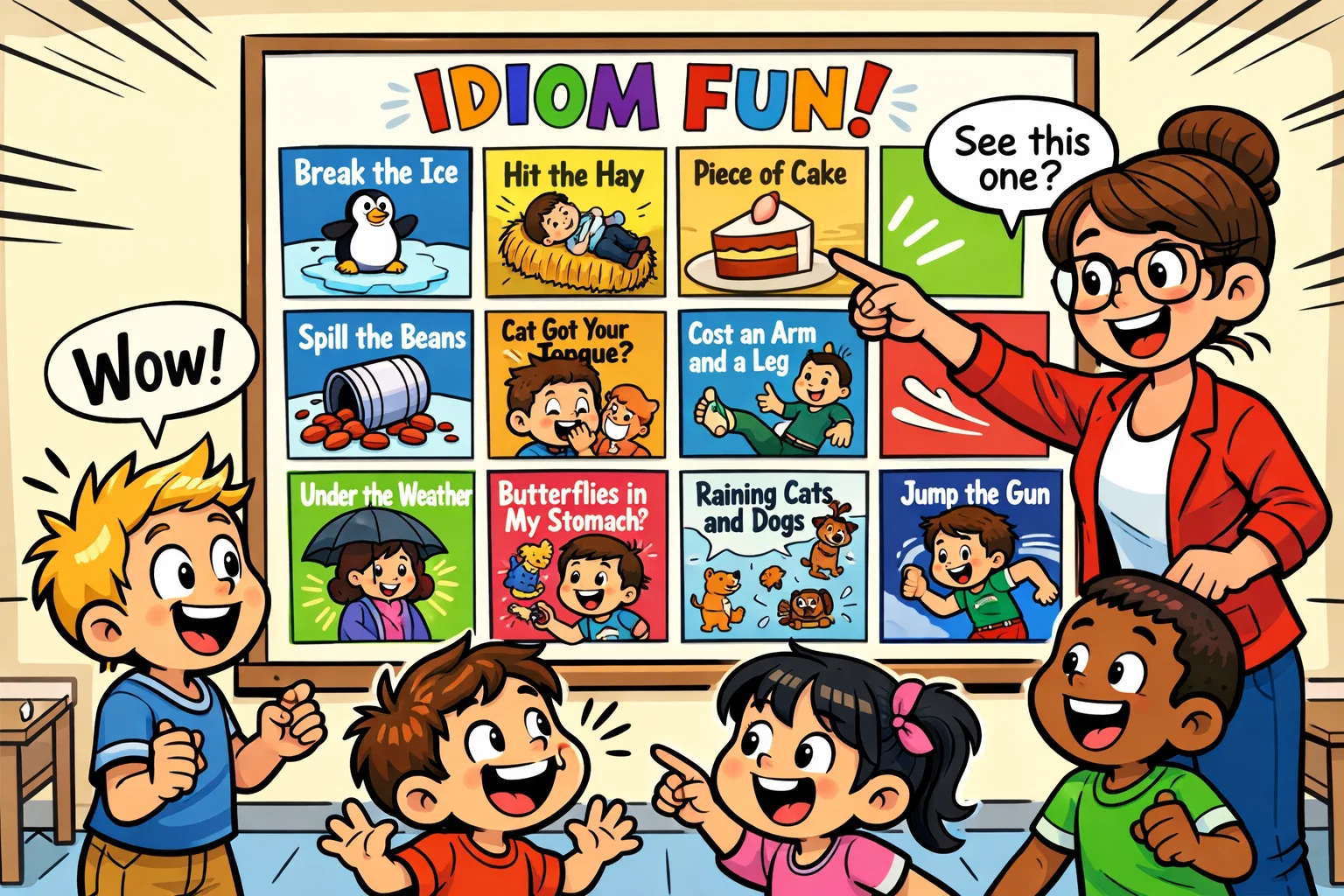
Idiom examples for kids make figurative language easier to understand and far more fun to learn. An idiom is a phrase where the figurative meaning differs from the literal words, and children encounter these expressions in everyday conversation, books, and the classroom long before they know what to call them.
This article brings together 100 kid-friendly idioms organized by category, from animal and food idioms to body part and weather expressions. Each entry includes a clear meaning and a simple example, giving parents and teachers a practical resource for building vocabulary and natural English skills.
Key Takeaways
- This article covers 100 idiom examples for kids, organized into categories such as animal, food, body part, and weather idioms.
- Each idiom includes a plain-language meaning and a simple example sentence children can relate to.
- Understanding the difference between literal and figurative meaning helps kids grasp why idioms can sound funny or confusing at first.
- Parents and teachers can use picture-first strategies and real-life context to make idiom learning stick.
- The article also covers how idioms support vocabulary growth, reading comprehension, and more natural everyday speaking.
What Idioms Mean for Kids
For a child, language is often a very literal tool. When an adult says it is “raining cats and dogs,” a young learner might instinctively look out the window for falling pets. Realizing that English is full of phrases that do not mean exactly what they say is an important step in language development.
Simple Definition Kids Can Grasp
An idiom is a phrase where the words work together to create a new, “hidden” meaning. Think of it like a team: the words “piece” and “cake” are fine on their own, but when they team up in an idiomatic way, they mean “very easy.”
Literal Meaning vs Figurative Meaning
To learn idioms, children must master the art of “reading between the lines.” This skill also helps children make inferences from context.
- Literal Meaning: This is what the words actually say (e.g., a person physically biting a metal bullet).
- Figurative meaning: This is how the phrase is actually used (e.g., “bite the bullet” means deciding to do something difficult or unpleasant).
| Term | Definition | Child-Friendly Example |
| Literal | Exactly what the words describe. | “I ate a piece of cake for dessert.” |
| Figurative | A symbolic or “hidden” meaning. | “The math homework was a piece of cake.” |
Why Idioms Sound Funny to Kids
Funny idioms are a gateway to better memory retention. Because children are naturally visual thinkers, the mental image of a bull in a china shop knocking over teacups is hilarious. This humor acts as a “hook” in the brain, making the correct meaning much easier to remember than a dry dictionary definition. Humor can make idioms more memorable because funny mental images are often easier to remember than dry definitions.
Top 5 Most Popular Idioms for Kids
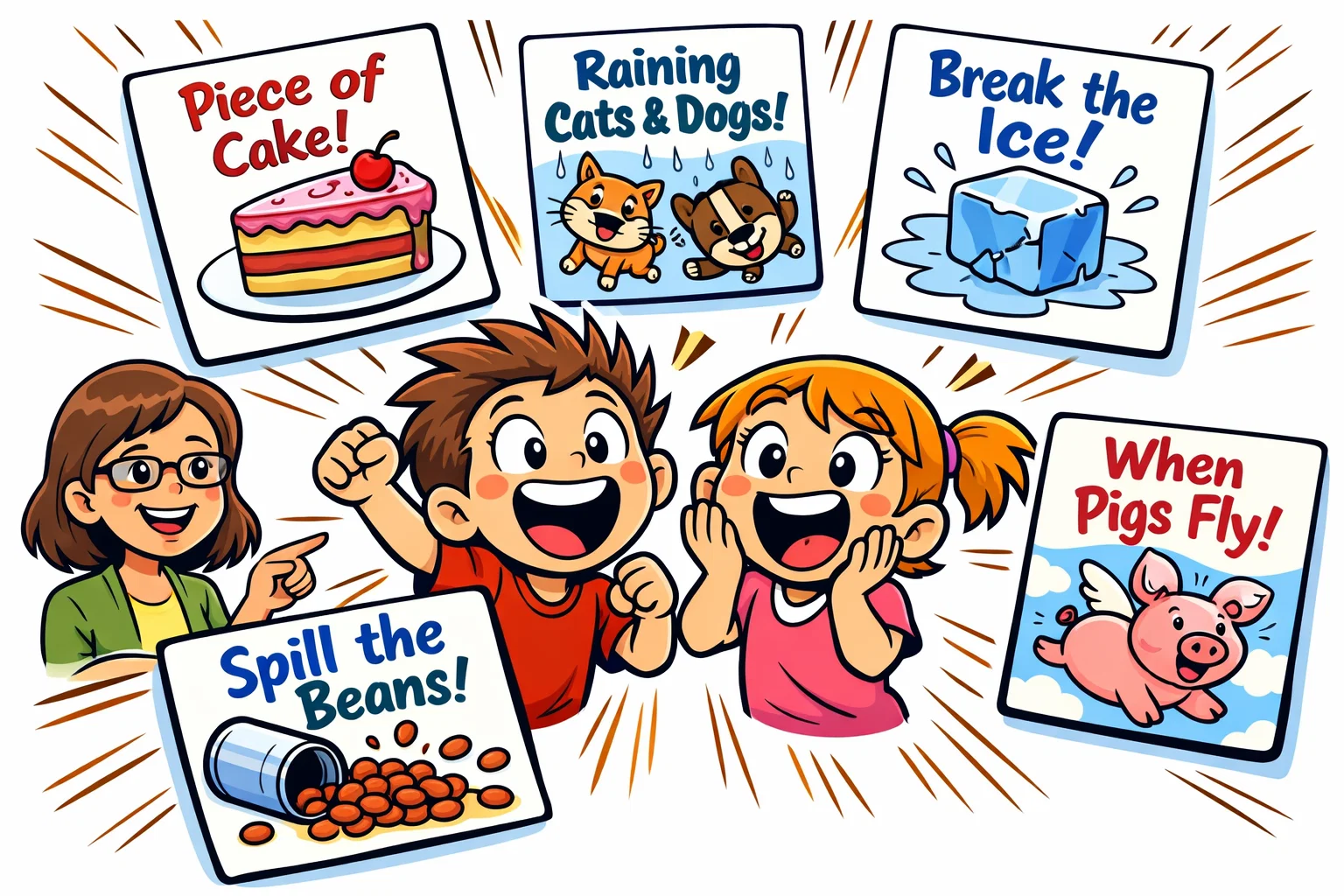
Before we move to the full list, here are five common idioms children are likely to hear at school and at home. These are essential phrases that every child should have in their linguistic toolkit.
1. Break the Ice
- Meaning: To say or do something that makes people feel more relaxed in a social setting. It helps start a conversation among people who don’t know each other well.
- Example: “On the first day of camp, the counselor played a fun name game to break the ice.”
2. Piece of Cake
- Meaning: Something that is very easy to accomplish, requiring little effort.
- Example: “I practiced my spelling words so much that the quiz was a piece of cake.”
3. Spill the Beans
- Meaning: To reveal a secret, often accidentally or without permission.
- Example: “We were planning a surprise for Dad, but my little brother spilled the beans at breakfast.”
4. Hit the Nail on the Head
- Meaning: To describe exactly what is causing a situation or to arrive at the exact, correct answer.
- Example: “When you said the printer wasn’t working because it was unplugged, you hit the nail on the head.”
5. Let the Cat Out of the Bag
- Meaning: To accidentally reveal a secret or a surprise that was supposed to be hidden.
- Example: “It was supposed to be a surprise party, but Sarah let the cat out of the bag by mentioning the balloons.”
22 Idioms for Kids With Meanings
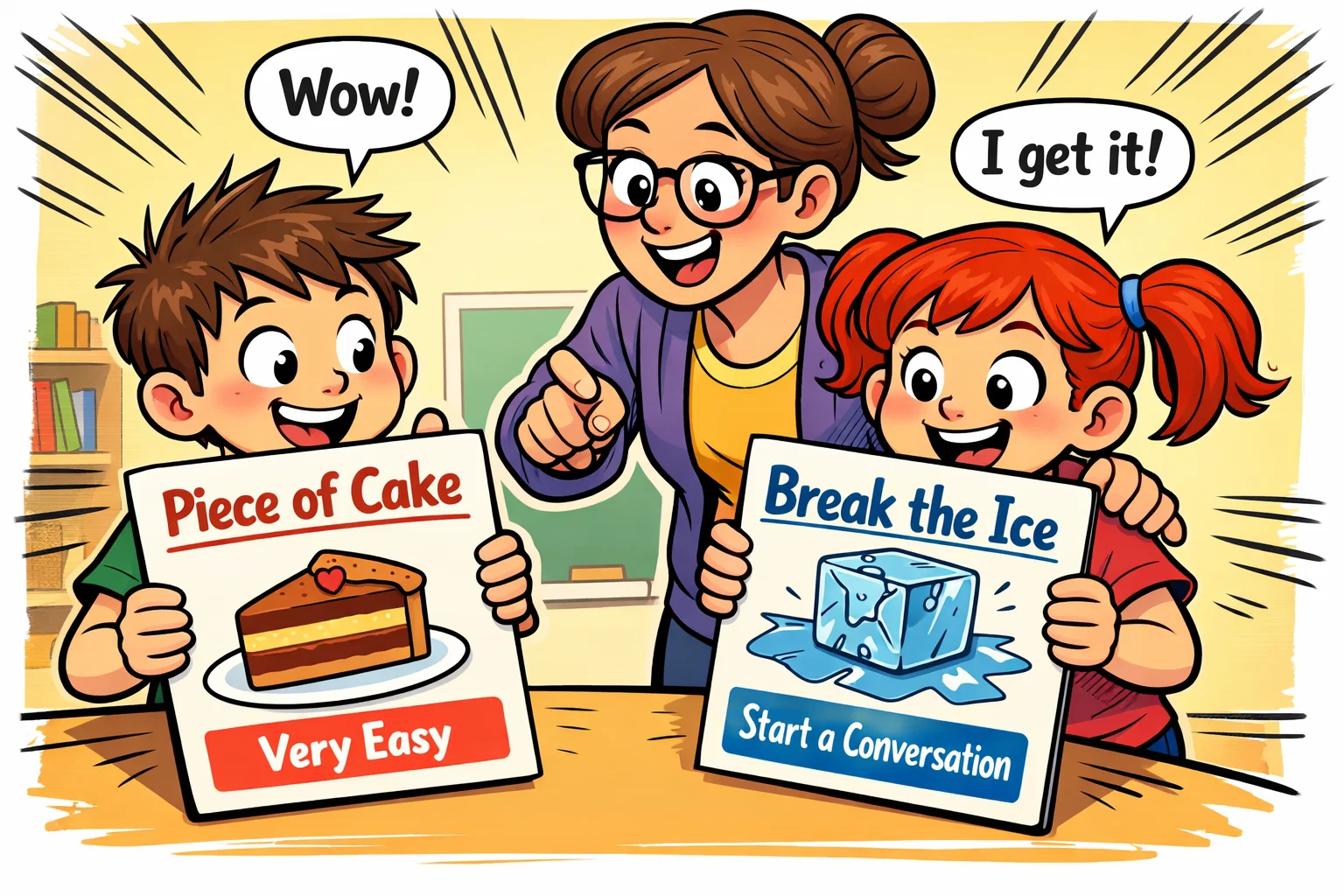
The sections below organize the idioms by theme to make them easier to learn and review. We have organized these by theme to help kids learn through association. Grouping idioms by theme can make the list easier to navigate, teach, and review.
The entries below provide the meanings and examples necessary for kids to understand how native speakers use these phrases naturally.
Everyday Idioms for Kids
These are some of the most common expressions children may hear in everyday life. They appear in writing and speech constantly and are essential for navigating school and home environments.
School and Homework Idioms
- Hit the books: To begin studying very hard, especially before an exam. (e.g., “I have a big history test tomorrow, so I really need to hit the books tonight.”)
- Teacher’s pet: The student who the teacher seems to like the best, often because they try hard to please. (e.g., “Timmy always brings an apple for the teacher; he’s definitely the teacher’s pet.”)
- Brainstorm: To suggest many different ideas very quickly, often during a group discussion. (e.g., “Let’s brainstorm some ideas for our science fair project.”)
- Pass with flying colors: To succeed very well in a test, task, or challenge. (e.g., “She was nervous about her piano recital, but she came through with flying colors.”)
- A bookworm: Someone who loves to read and spends a lot of time reading. (e.g., “You’ll always find her in the library; she’s a total bookworm.”)
- Draw a blank: To be unable to remember something or to have no ideas. (e.g., “The teacher asked for the answer, but I completely drew a blank.”)
- A copycat: Someone who copies another person’s work, actions, or style. (e.g., “Stop drawing exactly what I’m drawing, don’t be a copycat!”)
- Bite off more than you can chew: To take on more work or responsibility than you can handle. (e.g.,”I think I bit off more than I could chew when I agreed to do three projects at once.”)
- Under the weather: To feel ill or unwell. (e.g.,”I’m feeling a bit under the weather today, so I think I’ll stay home from school.”)
- Jump the gun: To do something too soon, before the proper time. (e.g.,”I think I jumped the gun by starting the project before getting all the details.”)
Family and Home Idioms
- Under the weather: Feeling a little bit sick, tired, or not at your best. (e.g., “I’m feeling a bit under the weather, so I think I’ll stay home from soccer practice.”)
- Hit the sack: To go to bed to sleep. (e.g., “It’s been a long day and I’m exhausted; I’m ready to hit the sack.”)
- On the same page: When two or more people agree on something or understand a situation in the same way. (e.g., “Before we start building the fort, let’s make sure we are all on the same page about the plan.”)
- Clean as a whistle: Something that is extremely clean and tidy. (e.g., “Dad said I can go out to play once my room is clean as a whistle.”)
- Wake up on the wrong side of the bed: To start the day in a bad mood for no particular reason. (e.g., “My sister has been grumpy all morning; I think she woke up on the wrong side of the bed.”)
- Rain on someone’s parade: To spoil someone’s enjoyment or their plans. (e.g., “I don’t want to rain on your parade, but the park is closed today.”)
Feelings and Friendship Idioms
- On cloud nine: A state of perfect happiness or extreme excitement. (e.g., “When she won the spelling bee, she was on cloud nine.”)
- See eye to eye: To agree completely with someone about a specific topic. (e.g., “My best friend and I don’t always see eye to eye on which video game is the best.”)
- A shoulder to cry on: Someone who listens carefully and offers sympathy when you are sad or upset. (e.g., “After her pet died, she really needed a shoulder to cry on.”)
- In the same boat: When two or more people are in the same difficult or unpleasant situation. (e.g., “If we both forget our homework, we’ll be in the same boat.”)
- Over the moon: Delighted, extremely pleased, or happy about something. (e.g., “I’m over the moon about my new bike!”)
- Have a change of heart: To change your opinion or decision about something, often becoming kinder or more agreeable. (e.g., “At first I didn’t want to go to the park, but I had a change of heart.”)
- Keep your fingers crossed: To hope for good luck or success. (e.g., “I’m going to the audition today – keep your fingers crossed for me!”)
Body Part Idioms for Kids
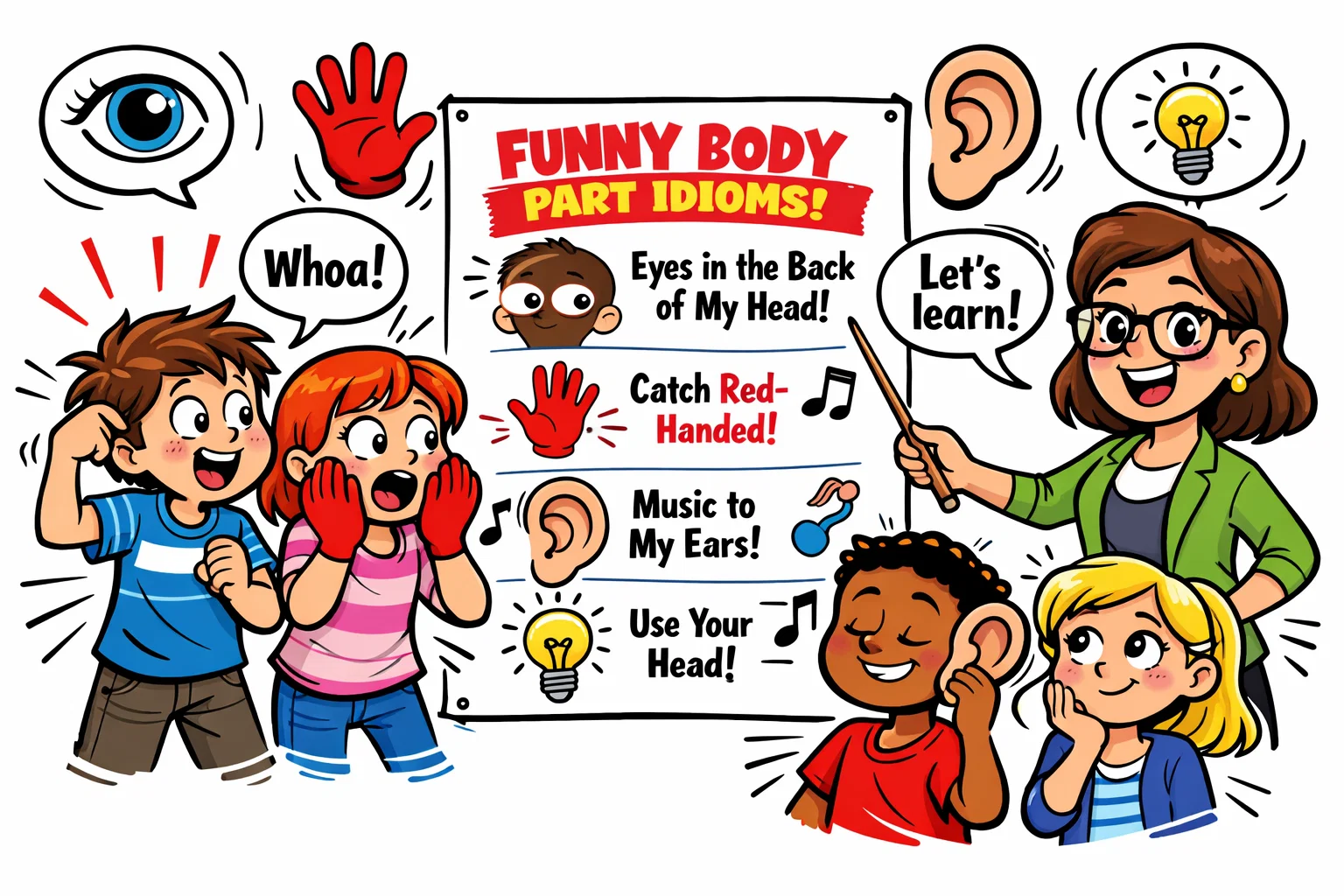
Figurative language involving the body is incredibly common because it is so easy to visualize. ESL (English as a Second Language) students often find these the most interesting idioms because they use tangible concepts (like hands or eyes) to describe abstract actions or emotions.
Hand and Finger Idioms
- All thumbs: To be very clumsy with your hands or fingers, often dropping things. (e.g., “When I tried to tie that tiny knot, I was all thumbs.”)
- Give a hand: To offer help or assistance to someone who needs it. (e.g., “Can you give me a hand carrying these heavy grocery bags?”)
- Rule of thumb: A general or basic rule that usually works, even if it’s not perfectly accurate. (e.g., “As a rule of thumb, you should always wash your hands before you eat.”)
- Caught red-handed: To be caught in the act of doing something wrong or illegal. (e.g., “He was trying to sneak a cookie, but Mom caught him red-handed.”)
Eye and Ear Idioms
- Keep an eye out: To watch carefully and be alert for something to appear. (e.g., “Please keep an eye out for the postal worker; I’m expecting a package.”)
- All ears: To be listening very intently and carefully. (e.g., “Tell me about your trip to the zoo – I’m all ears!”)
- See eye to eye: (As mentioned above) To agree completely.
- Cry your eyes out: To cry very hard for a long period. (e.g., “She cried her eyes out after she lost her favorite teddy bear.”)
- Music to my ears: Information or news that you are very pleased to hear. (e.g., “When the teacher said we have no homework, it was music to my ears.”)
Head and Heart Idioms
- Keep your head up: To stay positive, hopeful, and confident during a difficult time. (e.g., “Even though we lost the game, you need to keep your head up; you played well.”)
- Head over heels: To be completely or extremely excited about an idea, or to be deeply in love (for older kids). (e.g., “After seeing the new puppy, I was head over heels.”)
- Change of heart: (As mentioned above) Changing an opinion.
- By heart: To have learned something so well that you can remember it perfectly without looking. (e.g., “I know my times tables by heart.”)
- Heart of gold: To be extremely kind, generous, and caring toward others. (e.g., “Our neighbor has a heart of gold; she always bakes cookies for us.”)
Animal Idioms for Kids
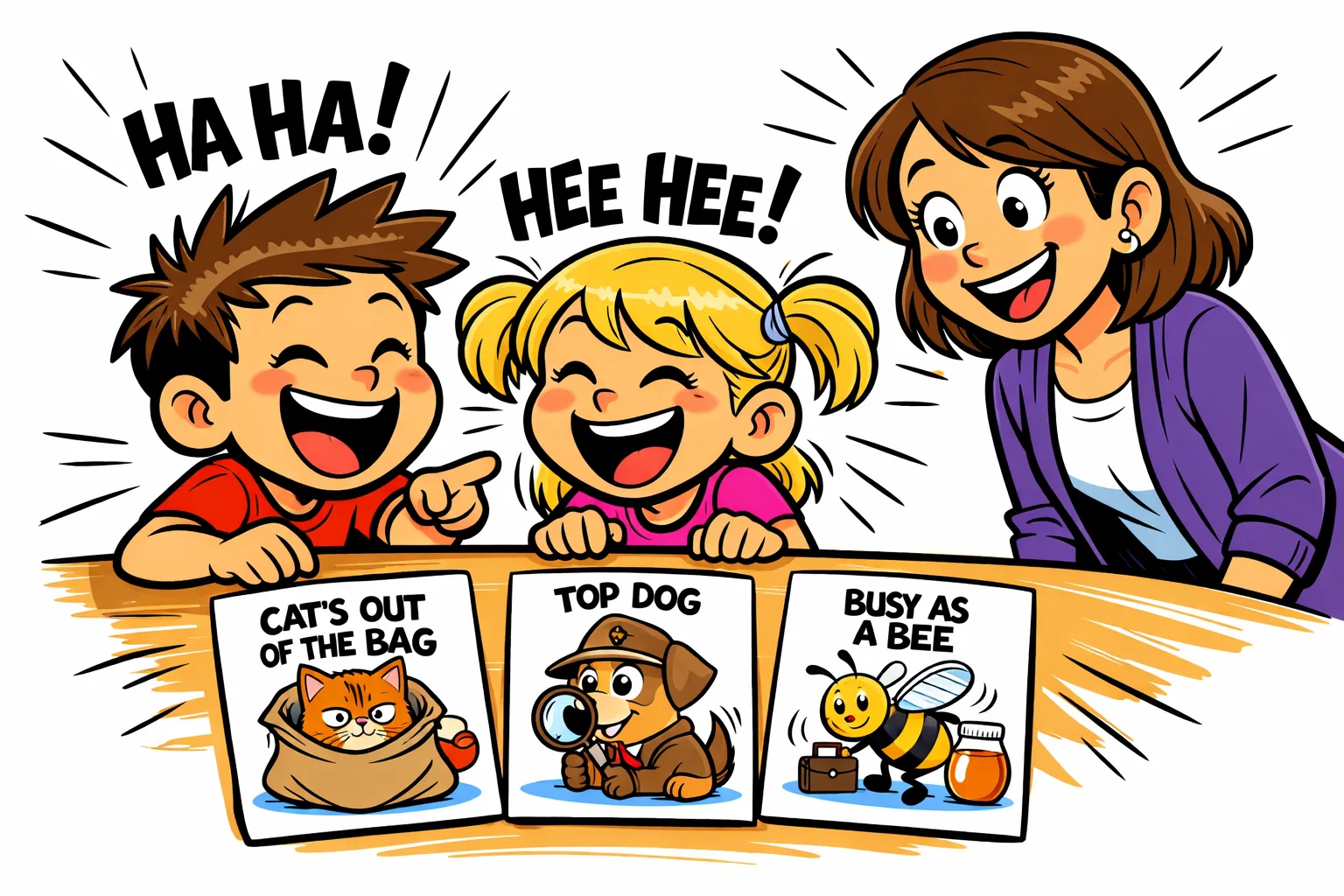
Animal idioms are often some of the funniest because they give animals human-like traits or place them in human situations. Animal idioms work especially well for children because they are vivid, playful, and easy to picture.
Farm Animal Idioms
- Hold your horses: A request to wait a moment, slow down, or not act too quickly. (e.g., “Before you run outside, hold your horses – you need your coat!”)
- When pigs fly: A phrase used to say that something will absolutely never happen. (e.g., “I’ll clean my brother’s room when pigs fly!”)
- Black sheep: A member of a family or group who is considered different or odd compared to the others. (e.g., “Everyone in my family is a doctor, but I want to be an artist; I guess I’m the black sheep.”)
- Till the cows come home: For a very, very long and indefinite period. (e.g., “We can talk about video games till the cows come home, but you still have to do homework.”)
- Get your goat: To make someone extremely annoyed or angry. (e.g., “It really gets my goat when people cut in line.”)
Pet Idioms
- Raining cats and dogs: Raining very heavily or intensely. (e.g., “We can’t have the picnic today because it’s raining cats and dogs.”)
- Cat got your tongue?: A question asked when someone is being unusually quiet or is refusing to speak. (e.g., “Why aren’t you answering? Cat got your tongue?”)
- Barking up the wrong tree: Following a mistaken course of action, accusing the wrong person, or looking for an answer in the wrong place. (e.g., “If you think I took your pen, you’re barking up the wrong tree.”)
- Let sleeping dogs lie: To leave a difficult situation or argument alone so you don’t make it worse. (e.g., “They are not arguing anymore, so let’s let sleeping dogs lie.”)
- As faithful as a dog: Very loyal and dependable.
- Lead a dog’s life: To have a very difficult, unhappy, or miserable existence.
Wild Animal Idioms
- Busy as a bee: Working very hard and staying actively involved in tasks. (e.g., “Mom has been busy as a bee all morning getting ready for the party.”)
- The lion’s share: The biggest part or the majority of something. (e.g., “My big brother always eats the lion’s share of the pizza.”)
- Monkey business: Silly, mischievous, or slightly dishonest behavior. (e.g., “The teacher told us to stop the monkey business and settle down.”)
- A fly on the wall: Wanting to be in a place secretly so you can hear what is being discussed without being noticed. (e.g., “I wish I could have been a fly on the wall when they were discussing the surprise.”)
- Sly as a fox: Very clever, cunning, and good at getting what you want.
Food Idioms for Kids
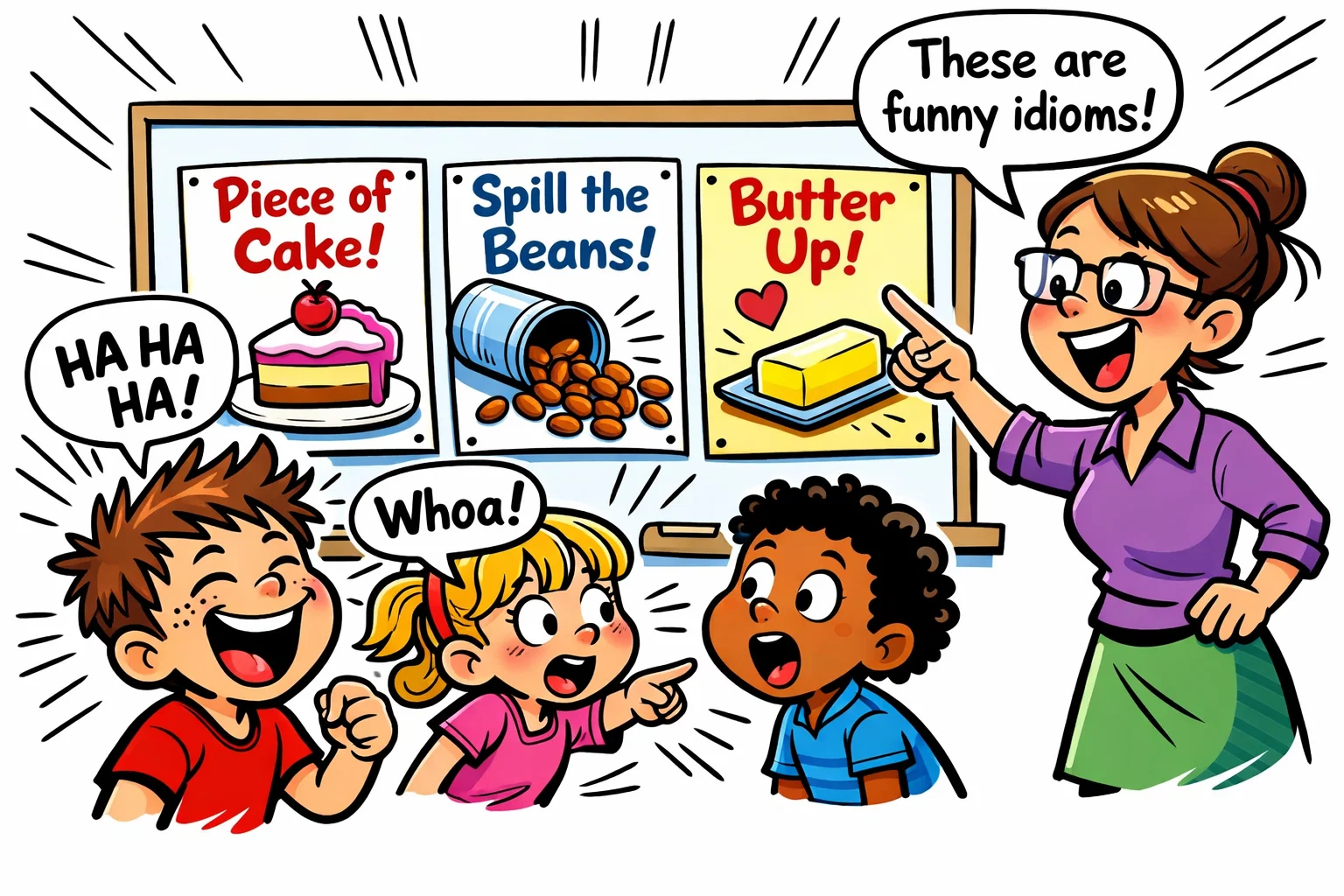
Food idioms are a staple of common English. They are perfect for easy-to-understand lessons because every child knows what a cookie, an apple, or a piece of cake is, making the leap to the figurative meaning simpler.
Sweet Food Idioms
- Icing on the cake: Something extra good that makes an already great situation or event even better. (e.g., “Winning the soccer game was fantastic, but getting ice cream afterward was the icing on the cake.”)
- Smart cookie: A very intelligent, clever, or resourceful person. (e.g., “He solved that puzzle so fast; he’s one smart cookie.”)
- Easy as pie: Something that is very simple, effortless, or easy to do. (e.g., “After I learned the formula, the math problems were easy as pie.”)
- Like taking candy from a baby: Something that is so easy to achieve that it seems almost unfair. (e.g., “The opposing team was so weak that winning was like taking candy from a baby.”)
- Sell like hotcakes: To sell very quickly and in large quantities. (e.g., “The new video game is so popular that it’s selling like hotcakes.”)
Fruit and Vegetable Idioms
- Cool as a cucumber: Someone who stays very calm, relaxed, and controlled, even in a very stressful situation. (e.g., “Even when he was on stage in front of the whole school, he was cool as a cucumber.”)
- Apple of my eye: Someone you are extremely proud of, love dearly, and cherish. (e.g., “You will always be the apple of my eye, sweetheart.”)
- Spill the beans: (As mentioned above) To tell a secret.
- Full of beans: Having a lot of energy, excitement, and enthusiasm. (e.g., “The kids were full of beans after so much birthday cake.”)
- In a pickle: To be in a difficult, messy, or uncomfortable situation with no easy solution. (e.g., “If I forget my keys, I’ll be in a pickle.”)
- Life is a bowl of cherries: An old-fashioned expression meaning life is pleasant and easy.
Number Idioms for Kids
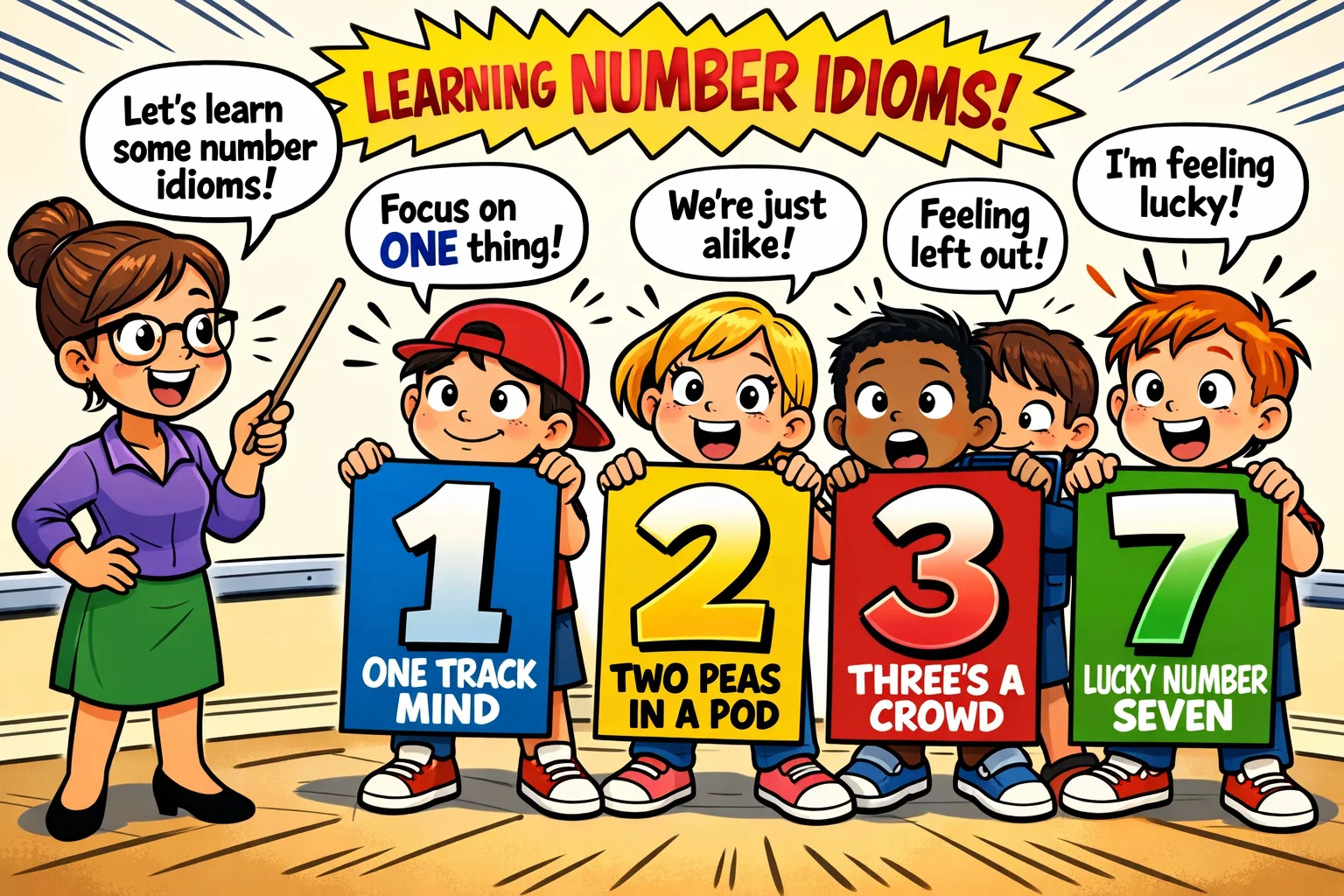
Numbers help organize our world, and number idioms often describe the “how many,” “how often,” or “how good” of a situation.
One and Two Number Idioms
- Kill two birds with one stone: To accomplish two different goals or solve two problems with a single action. (e.g., “If I bike to the library, I can get exercise and return the books – I’ll kill two birds with one stone.”)
- Two peas in a pod: Two people who are very similar in appearance, personality, or behavior. (e.g., “My brother and I are two peas in a pod.”)
- Back to square one: Having to start all over again from the very beginning of a process or task. (e.g., “Our fort collapsed, so now we are back to square one.”)
- One in a million: Something or someone that is very special, unique, or rare.
- Take five: To take a short break (of five minutes) from working or practicing.
Big Number Idioms
- Dressed to the nines: Dressed very formally, elegantly, or in your best clothes. (e.g., “They were all dressed to the nines for the school dance.”)
- On cloud nine: (As mentioned above) Extremely happy and excited.
- A dime a dozen: Something that is very common, easy to find, and not very special or valuable. (e.g., “Those cheap plastic toy rings are a dime a dozen.”)
- Million miles away: Not paying attention because you are daydreaming or lost in your thoughts.
- Count your blessings: To be grateful for the good things in your life.
Nature and Weather Idioms
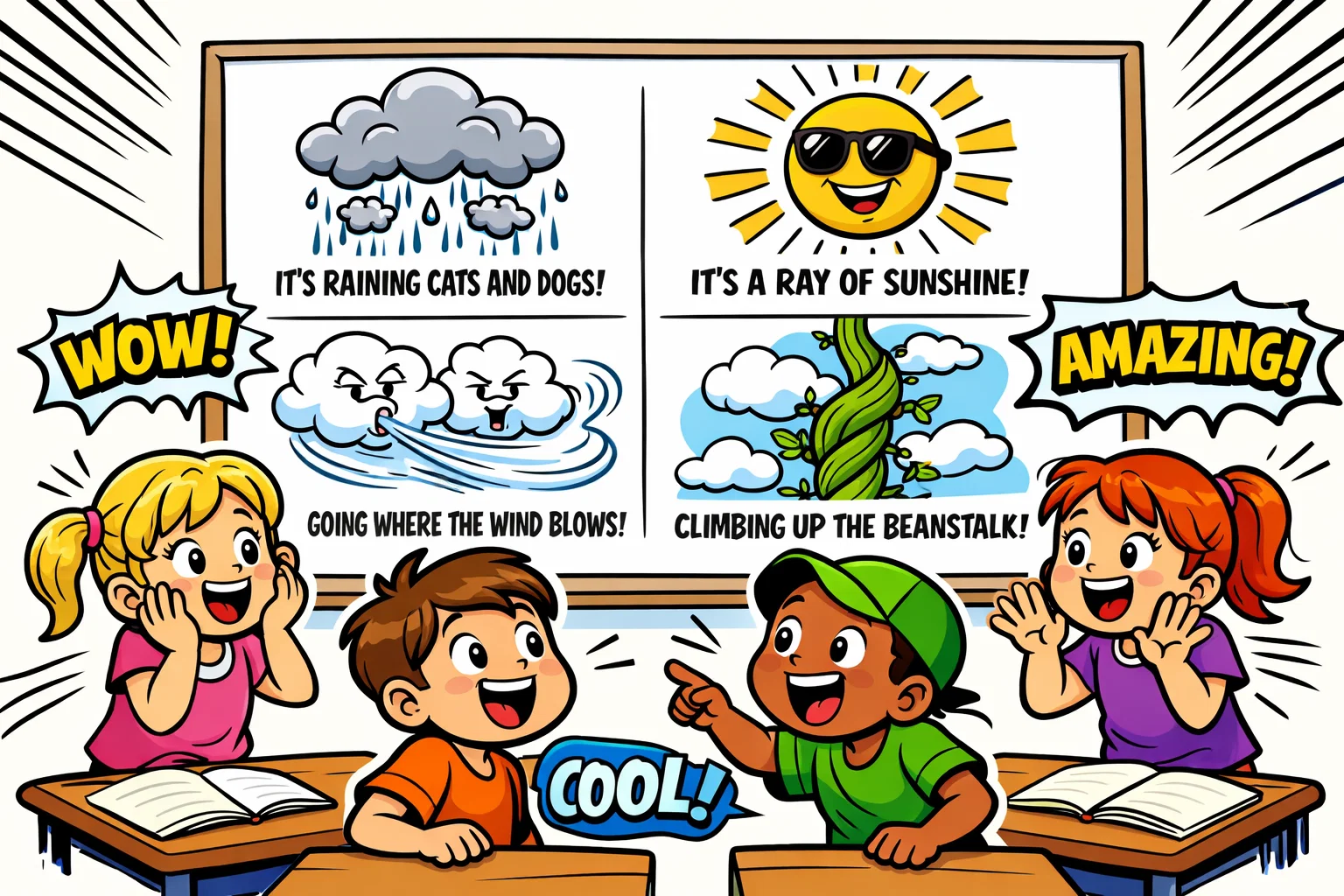
Nature provides a beautiful and clear backdrop for figurative language, helping kids describe their emotions and the world around them in a more vivid way.
Weather Idioms
- Every cloud has a silver lining: Even a difficult, bad, or sad situation has a positive side or something good in it. (e.g., “The rain canceled our game, but the silver lining is that I finally have time to finish my book.”)
- Steal someone’s thunder: To take the credit, attention, or praise that someone else deserved. (e.g., “I wanted to announce the news, but my sister stole my thunder.”)
- A storm in a teacup: A lot of anger or worry about something that is not important.
- Save for a rainy day: To save money or resources for a future time when you might really need them.
Sky and Star Idioms
- Reach for the stars: To set very high goals for yourself or to try to be the very best at something. (e.g., “Don’t settle for less; reach for the stars in your work.”)
- Once in a blue moon: Something that happens very, very rarely. (e.g., “We only eat ice cream for breakfast once in a blue moon.”)
- Over the moon: (As mentioned above) Delighted and extremely pleased.
- The sky’s the limit: There is no limit to what someone can achieve.
Situation Idioms for Kids
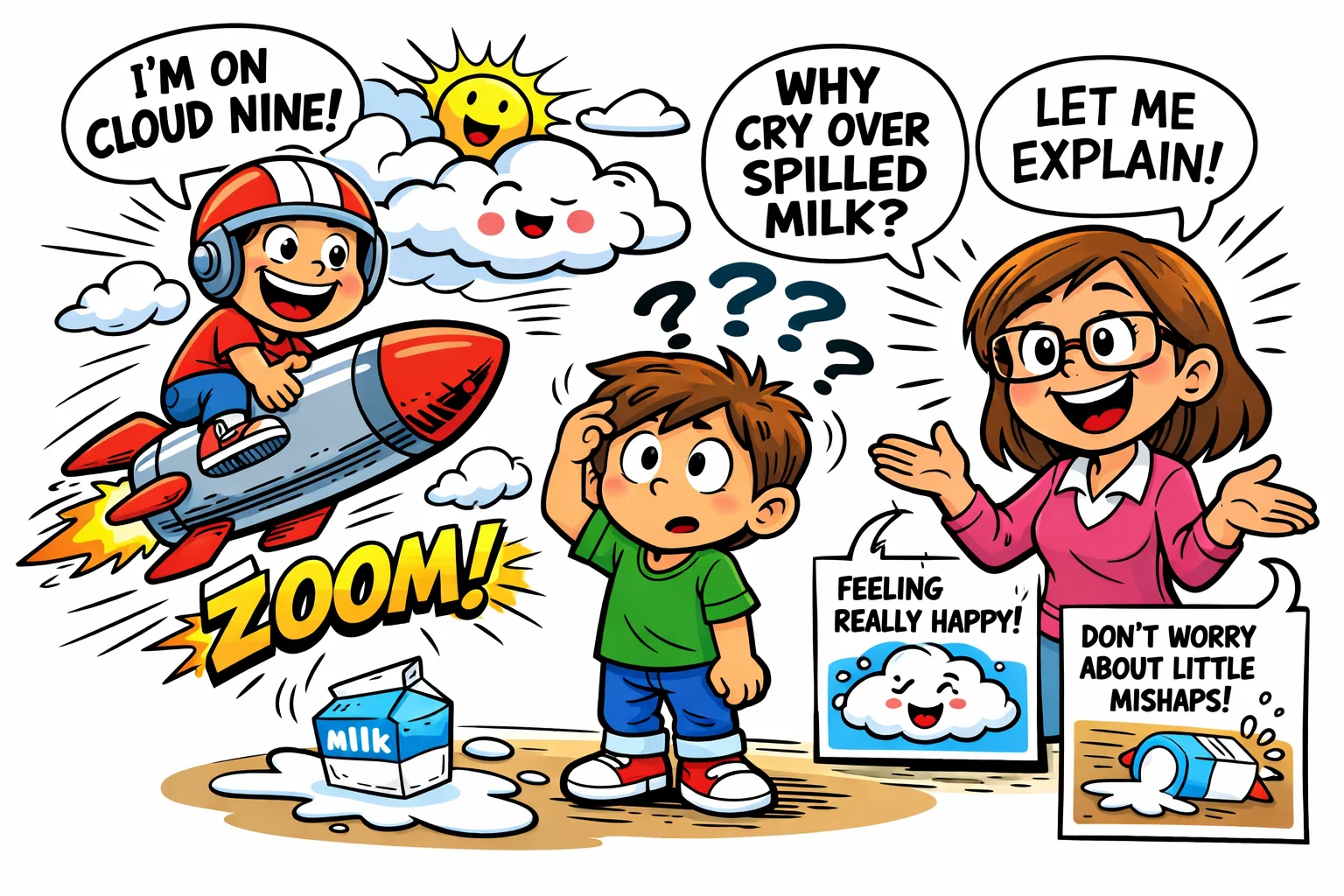
These idioms help children describe complex social situations, effort, and unexpected events.
Success and Effort Idioms
- Bite the bullet: To force yourself to face a difficult, unpleasant, or painful situation that you have been avoiding. (e.g., “I hate getting shots, but I just have to bite the bullet and get it over with.”)
- Go the extra mile: To make a significant effort, doing more than what is required of you. (e.g., “She always goes the extra mile to help her friends with their homework.”)
- Barking up the wrong tree: (As mentioned above) Looking for a solution in the wrong place.
- Pull your socks up: An instruction to try harder and improve your behavior or performance.
- Where there’s a will, there’s a way: If you are determined to do something, you will find a way to achieve it.
- Cut to the chase: To get to the point without wasting time on unnecessary details. (e.g., “We don’t have much time, so let’s cut to the chase and start the meeting.”)
- The ball is in your court: It’s now your turn to make a decision or take action. (e.g., “I’ve done all I can to help you, now the ball is in your court.”)
Trouble and Surprise Idioms
- Out of the blue: Something that happens completely unexpectedly or without any warning. (e.g., “I hadn’t seen him in years, and then, out of the blue, he called me.”)
- Fish out of water: Someone who feels extremely uncomfortable or awkward because they are in an unfamiliar situation. (e.g., “When I moved to the new city, I felt like a fish out of water.”)
- In hot water: To be in trouble or facing punishment because you did something wrong. (e.g., “I’m in hot water with Mom for breaking the vase.”)
- The coast is clear: The immediate danger or the risk of being caught has passed, so it is safe to proceed.
Unique Expressions for Kids
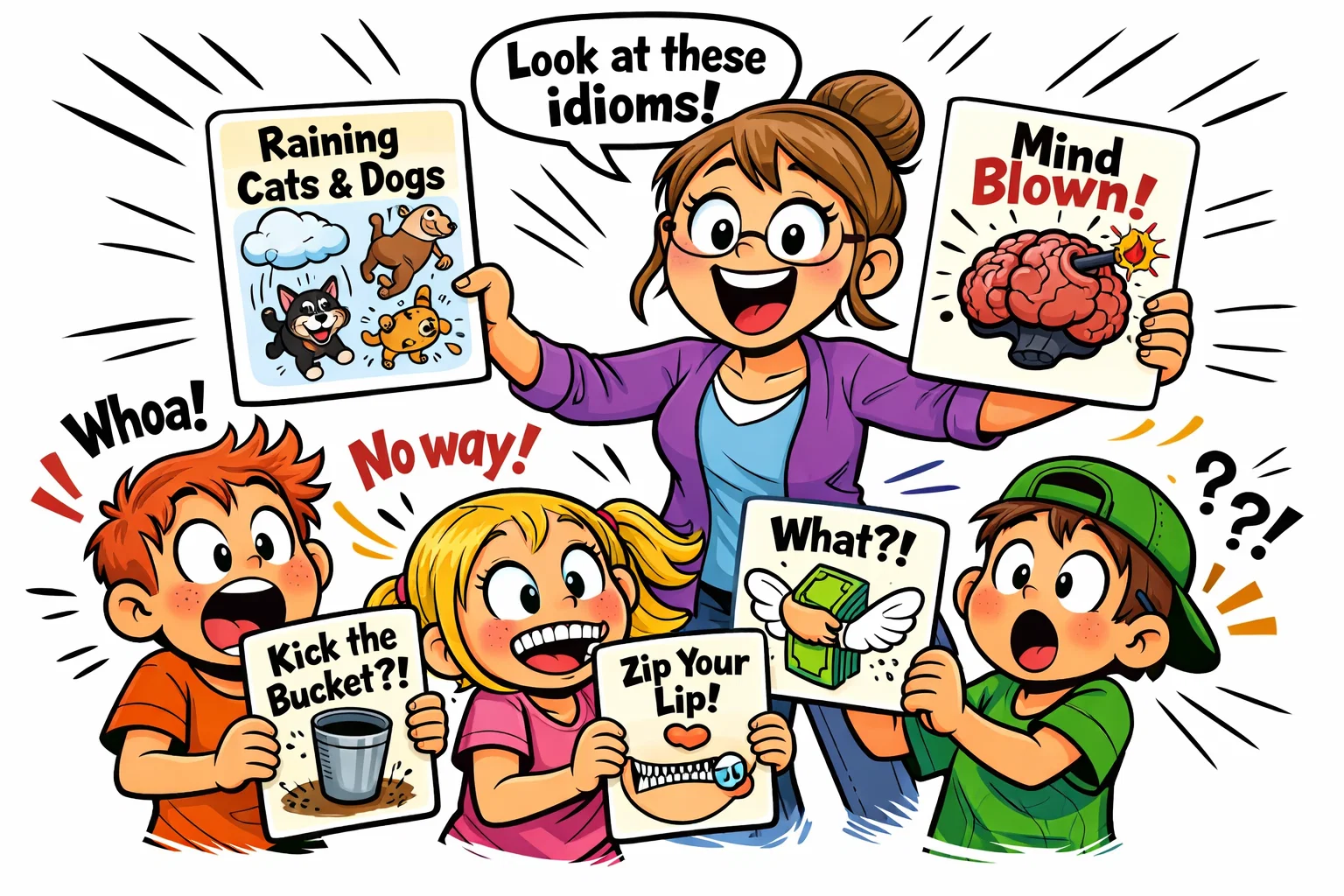
This section includes some of the funniest and most unusual idioms – phrases that younger learners often remember easily.
Funny Idioms Kids Remember Fast
- Bull in a china shop: Someone who is very clumsy or careless and is likely to break things or make mistakes. (e.g., “When my toddler brother tries to play with my Lego fort, he is like a bull in a china shop.”)
- Keep your fingers crossed: To hope for good luck for yourself or someone else. (e.g., “I kept my fingers crossed that our team would win the game.”)
- Mad as a hatter: Being very silly, strange, eccentric, or slightly crazy.
Creative Expressions for Speaking and Writing
These idioms help children make their writing and speech more vivid and expressive.
- Actions speak louder than words: What a person actually does is more important than what they say they will do. (e.g., “You promised to help clean, but you’re just sitting there. Remember, actions speak louder than words.”)
- Don’t judge a book by its cover: You cannot know what someone or something is really like by only looking at their appearance.
- The early bird catches the worm: The person who starts a task early or gets somewhere first has the best chance of success.
Teach Kids Idioms With Ease for Language Skills Boost
Understanding idioms enables children to participate more fully in the nuance of English language interaction. However, presenting these abstract concepts to younger learners requires specific strategies. Pictures and active use can make figurative language easier for children to understand and remember.
Why Picture-First Learning Works
When a child is introduced to a funny idiom like bull in a china shop, their initial mental reaction is the literal one – a comical image of a large animal destroying teacups. The brain’s immediate amusement acts as a powerful mnemonic “hook.” Once the correct meaning (clumsiness) is explained, the silliness of the initial mental picture ensures that the figurative meaning is easily recalled. Pictures provide the essential concrete anchor for the abstract idea.
How Parents and Teachers Can Use This List
Using a complete list of idioms for kids is most effective when the material is integrated naturally into daily activities:
- Contextualized Reading: When you encounter an idiom in a storybook or cartoon, stop and discuss it. Ask your child, “Does that sound like something that could literally happen?” and then explain what the idiom really means.
- Idiom of the Day: Choose one idiom from the everyday, animal, or food idioms categories and commit to using it naturally at the dinner table or in the classroom that day.
- Visual Projects: A classic exercise involves drawing the literal meaning (e.g., raining pets) on one side of a paper and the figurative meaning (heavy rain) on the other. This visual contrast locks in the concept.
Using Idioms in Real Life
Knowing idioms is one thing; understanding where to use idioms naturally is the final step in language learning.
Idioms in Speaking
Children should be encouraged to use common English expressions. Playful situations with friends or family are perfect. It is essential to teach them not to overuse idioms, but to sprinkle them into speech to add humor and color. Using “piece of cake” when describing easy homework, or telling someone who is very quiet, “Cat got your tongue?” is a great start.
Idioms in Reading
Understanding idioms is crucial for reading comprehension. As children move beyond simple picture books, they will encounter expressions like “every cloud has a silver lining” or “spill the beans” in literature and news articles. Recognizing these as idiomatic expressions helps them interpret the author’s meaning correctly.
Benefits of Idioms for Kids
Why is this effort to learn idioms so valuable? The benefits extend far beyond a single lesson.
- Express Yourself in a Fun Way: Idioms make communication more creative and help kids describe feelings or situations in a playful way.
- Follow Grown-Up Speech: Many adults use idiomatic expressions constantly without thinking. Knowing these allows kids to understand “grown-up talk” better, especially at the dinner table or in group settings.
- Boost Vocabulary and Memory: Learning idioms introduces new vocabulary in highly memorable contexts, reinforcing general language skills.
- Improve Writing Skills: Encouraging idioms in writing can make children’s stories and school essays more expressive and engaging.
Real Learning Outcomes From Idioms
The practical results of mastering figurative language are substantial. Students who understand idioms often find it easier to follow texts that rely on inference and figurative meaning, and their English may sound more natural. These skills improve confidence, which has a measurable, positive effect on overall academic outcomes in elementary education.
Conclusion
Learning idioms is an important part of helping children understand more natural, flexible English. By moving beyond literal translations and embracing the fun way of learning through pictures and active usage, children bridge the gap to truly understanding the nuance of English language interaction. Mastery of idiomatic expressions turns a student into a creative, natural communicator, making the journey to fluency feel like a true piece of cake!
Start today by selecting five everyday or animal idioms from this list and integrating them into your family or classroom conversation.
Frequently Asked Questions
What are the most common types of idioms for kids to learn?
There are many different types of idioms based on their origin. Some of the best idioms for kids involve animals, body parts, or colors. For example, expressions like being “cool as a cucumber” (calm) or feeling “on cloud nine” (very happy) are perfect examples of idioms for kids because they are easy to visualize and frequently used by english speakers.
How can I teach idioms to students effectively?
To teach idioms in an interesting way, try to avoid dry memorization. Instead, use a worksheet where students draw the literal vs. the figurative meaning. You can also integrate board games or matching cards. Using idiom examples for kids in real-life stories helps them see how these phrases function in common in english conversations.
Why is the importance of idioms so high in language learning?
When children learn a new language, they often struggle with phrases that don’t make sense literally. Understanding english idioms is a vital part of cultural awareness. It allows kids to move beyond basic vocabulary and speak english for kids that sounds more natural and sophisticated. Idioms can help a child feel like a true part of the community.
Take a short quiz to find out what your everyday choices say about your parenting style
When your child is curious about something new, what’s your instinct?
Take a short quiz to find out what your everyday choices say about your parenting style
“Can I download this app?” What happens next?
Take a short quiz to find out what your everyday choices say about your parenting style
When it comes to rules at home, which sounds most like you?
Take a short quiz to find out what your everyday choices say about your parenting style
If you could give your child one life skill today, what would you pick?
Take a short quiz to find out what your everyday choices say about your parenting style
Your child gets to choose what to watch. What would your ideal setup look like?
Take a short quiz to find out what your everyday choices say about your parenting style
Pick your parenting superpower ✨