
Reading Eggs vs Reading.com: Detailed Comparison of Two Top Learning Apps

 Discover a Free Education Video App for Kids
Pastory uses AI to personalize educational video content based on your child’s interests and personality. Safe, engaging, and built for curious young minds. Sign up now to stay updated and enjoy early access with a free trial
Choosing the right reading program to help your child learn to read can feel overwhelming, especially with so many apps promising quick results and dramatic progress in just a few weeks. Two names that come up consistently in parent forums, educator communities, and homeschool circles are Reading Eggs and Reading.com. Both are grounded in phonics research and designed to help children build solid literacy skills, but they take meaningfully different approaches to getting there.
This comparison breaks down how each platform works, what makes it effective, where each one falls short, and which might be the better fit for your child’s age, learning style, and your family’s daily routine. Neither app is universally superior — but one may be a significantly stronger match for your specific situation.
What Makes a Good Reading Program for Kids?
Before diving into the specifics of each platform, it’s worth asking a more fundamental question: what should a quality literacy program actually accomplish for a young learner?
Research from the Science of Reading — a growing body of cognitive and educational science that has reshaped how schools approach early literacy — consistently identifies five foundational pillars that effective instruction must address:
- Phonemic awareness — the ability to recognize and manipulate individual sounds (phonemes) in spoken words, independent of print
- Phonics — understanding the systematic relationship between letters and the sounds they represent
- Vocabulary — knowing what words mean in context, not just how to decode them
- Fluency — decoding written text smoothly, accurately, and at an appropriate pace
- Comprehension — constructing meaning from what has been read, which is ultimately the goal of the entire enterprise
These five pillars are supported by decades of peer-reviewed research and were formally identified by the National Reading Panel in its landmark 2000 report, commissioned by the U.S. Congress. Programs that skip or underweight any of these components — particularly phonics and phonemic awareness — tend to produce weaker outcomes over time, especially for children who struggle with literacy acquisition.
Beyond the curriculum itself, the best programs for children share several practical qualities that matter enormously in real-world use:
- Engagement that lasts: Children won’t practice what bores them after the novelty wears off. The best platforms make learning feel rewarding, not like a chore. Gamification, reward systems, and genuinely varied activity formats help sustain motivation over weeks and months, not just the first exciting session.
- Adaptability to individual pace: Kids develop at wildly different rates. A strong program meets children where they actually are, not where an age chart suggests they should be. Placement assessments and adaptive lesson pacing are hallmarks of well-designed platforms.
- Structured, sequential reading lessons: Children learn to read most effectively through systematic instruction, not random exposure. Platforms that organize content into clearly sequenced reading lessons — each building on the last — tend to produce more consistent results than those with a looser, exploratory approach.
- Parental visibility: Progress tracking tools help caregivers identify gaps early, celebrate milestones, and communicate meaningfully with classroom teachers.
- Evidence base: Programs backed by independent research and real school-use data tend to outperform those built primarily on marketing claims. Look for third-party studies, teacher endorsements, and transparent efficacy data.
- Device flexibility: Most families use a mix of tablets, phones, and computers at different times of day. A platform that works consistently across devices reduces friction and keeps children on track.
When parents start researching literacy apps, they typically encounter a handful of well-known names alongside these two. Programs like Hooked on Phonics, Teach Your Monster to Read, and the classic print-based “Teach Your Child to Read in 100 Easy Lessons” all have their advocates. But Reading Eggs and Reading.com represent the current generation of fully digital, research-grounded platforms — and comparing them directly is particularly useful because they occupy similar territory while approaching it very differently.
With these benchmarks in mind, let’s look at what each platform brings to the table — and where each one may leave something to be desired.
Reading Eggs vs Reading.com Overview
Both apps target the early literacy years and draw heavily on phonics principles — but their scope, format, and underlying educational philosophy differ considerably. Reading Eggs is designed as a comprehensive, largely child-independent learning platform, while Reading.com is structured around dedicated parent-child co-sessions. Understanding this distinction is arguably the single most important factor in deciding which suits your household.
What is Reading Eggs?
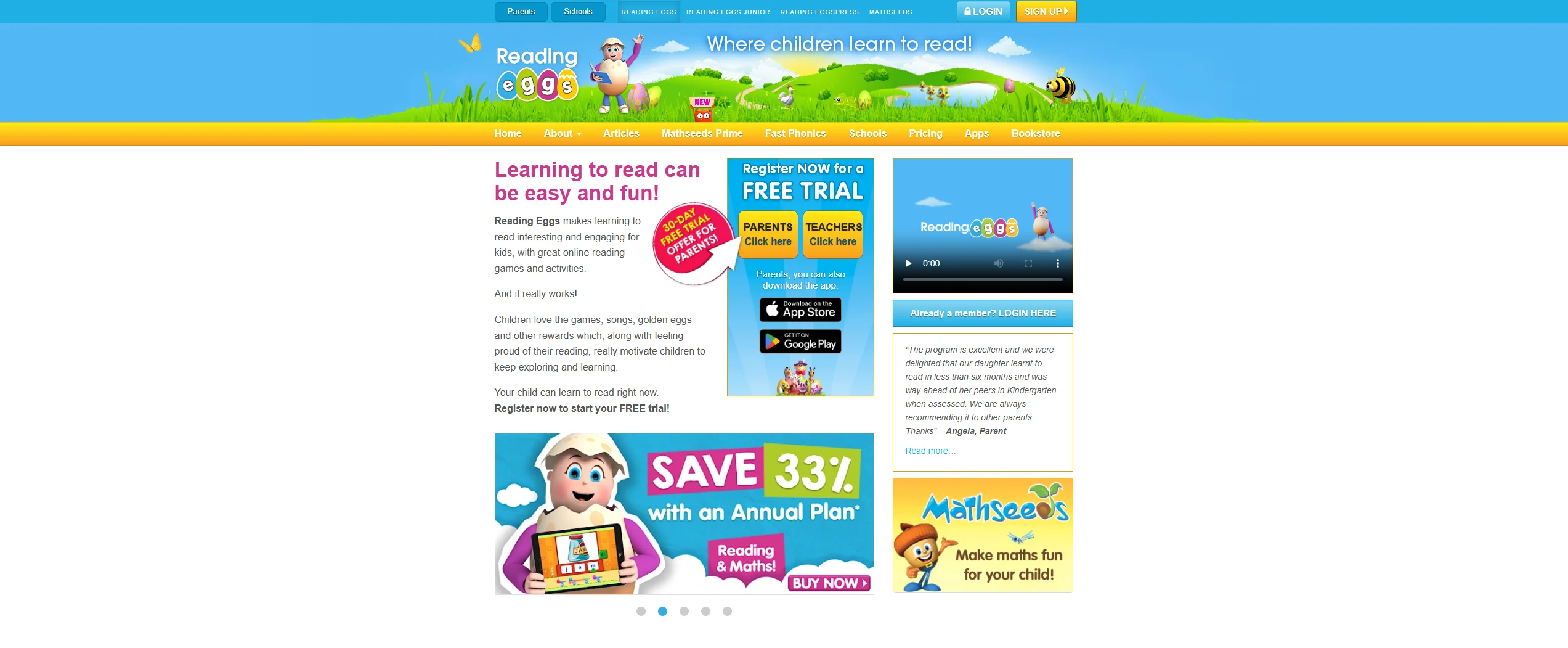
Reading Eggs is a multi-award winning program developed by Blake eLearning in Australia. Used by over 20 million students and implemented in approximately 16,000 schools worldwide, it is one of the most widely adopted online literacy platforms available today. The suite covers children aged 2–13, delivering a full curriculum through interactive lessons, animated characters, thousands of digital books, and an in-app reward system that keeps young learners motivated session after session.
The platform is actually a family of four distinct but connected sub-programs, each targeting a specific developmental stage:
- Reading Eggs Junior (ages 2–4) — introduces alphabet knowledge, early vocabulary, and foundational phonics through songs and short animated videos designed for very young children
- Reading Eggs (ages 3–7) — the flagship program, delivering structured phonics, phonemic awareness, sight words, spelling, and comprehension in a sequential, mastery-based format
- Fast Phonics (ages 5–10) — a systematic synthetic phonics module designed to accelerate fluency for children who need more targeted, intensive phonics instruction
- Reading Eggspress (ages 7–13) — shifts focus toward comprehension, vocabulary development, and deeper textual engagement for children who have cracked the code of decoding but need to grow as independent thinkers about what they encounter on the page
The platform includes over 3,500 eBooks and uses a built-in placement assessment to determine where each child should begin, with instruction matched to individual ability levels. Parents receive automated progress emails after every five lessons, and a detailed dashboard provides data on Lexile scores, lesson completion rates, time-on-task, and skill category breakdowns.
One standout structural feature: children cannot guess or tap their way through lessons. The platform requires demonstrated mastery of each concept before a child can advance. This design choice distinguishes it meaningfully from platforms where a child can progress simply by clicking through activities without genuine comprehension.
What is Reading.com?
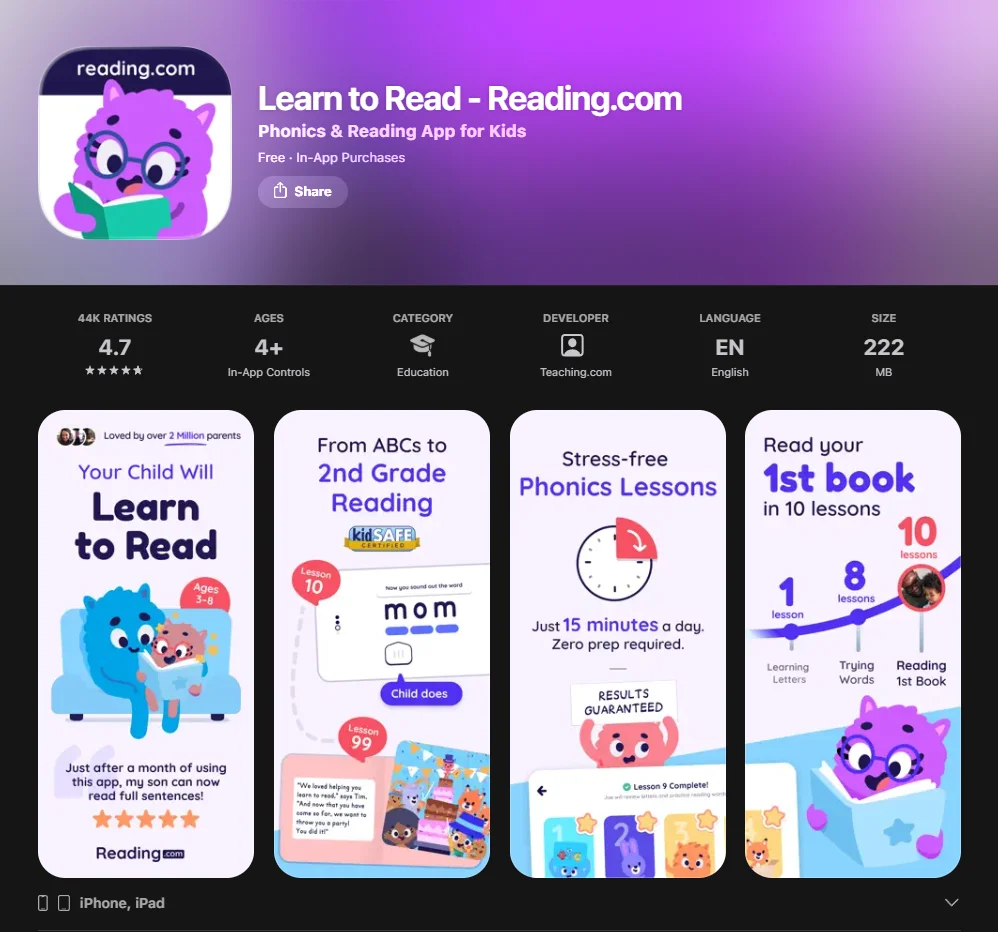
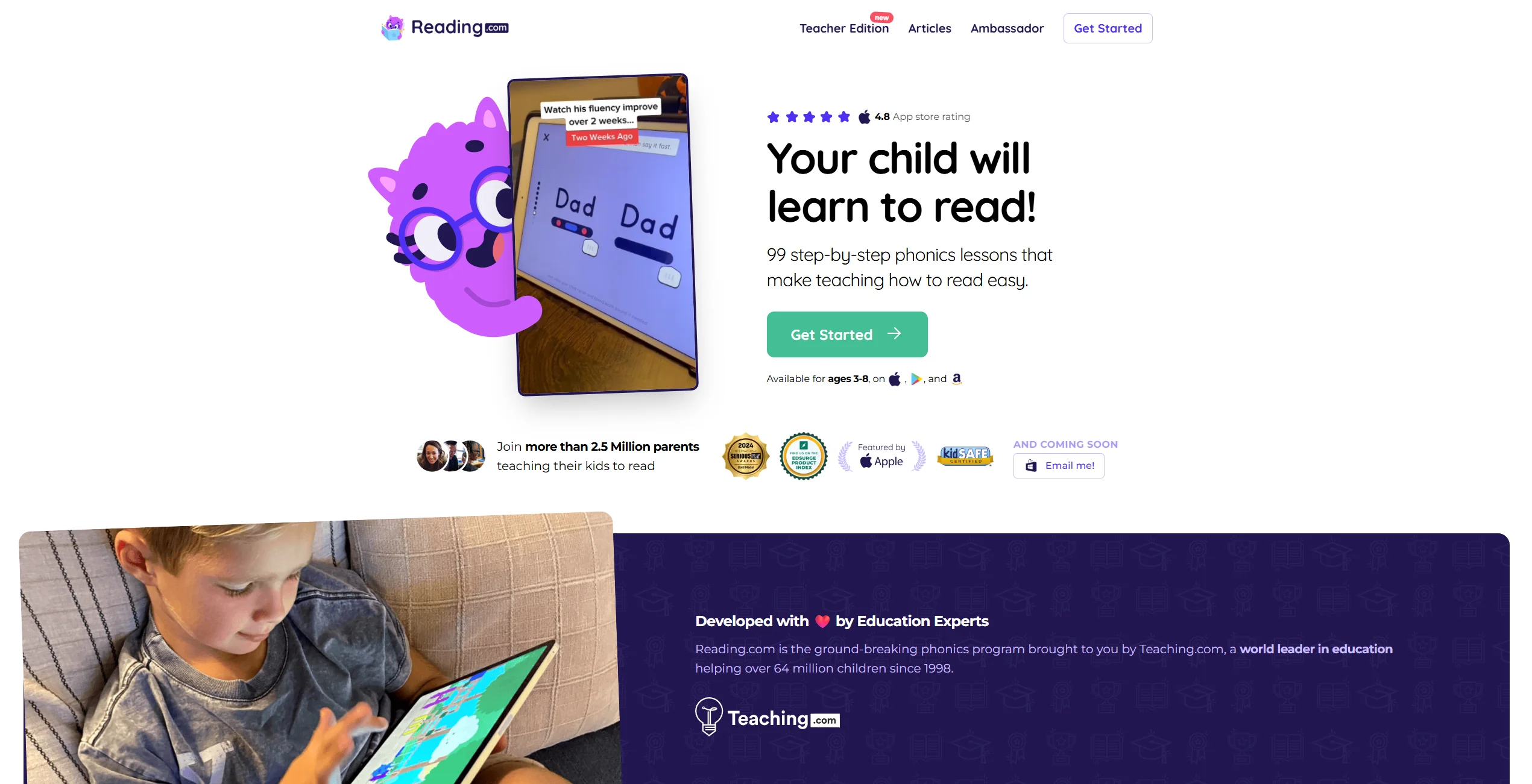
Reading.com is a newer entrant to the market, developed by Teaching.com — a company that describes itself as serving over 75 million students and 1.7 million educators worldwide. Unlike Reading Eggs, this app is designed specifically as a co-play experience, meant for a parent or caregiver to engage with the child during dedicated sessions. The core philosophy draws on research suggesting children benefit significantly more from educational apps when an engaged adult participates alongside them.
The app contains 99 fully scripted lessons, a curated library of scaffolded decodable digital books, printable worksheets, and supplementary games to reinforce each phonics skill. It uses synthetic phonics delivered through the Direct Instruction model — one of the most rigorously studied instructional frameworks in educational research, with strong evidence for its effectiveness particularly for children who need more structured, explicit guidance.
No special training or prior phonics knowledge is required from the parent. The lesson scripts handle all the instructional language — the adult simply reads their prompts, and the child responds accordingly. The program covers individual letters, blends, long vowel sounds, and digraphs, taking children from basic alphabetic knowledge to approximately a late 1st-grade literacy level. By lesson 10, most children will be attempting their first complete decodable book. The app targets ages 3–8, with particular effectiveness reported in the preschool-to-kindergarten range.
Key Differences Between Reading Eggs and Reading.com
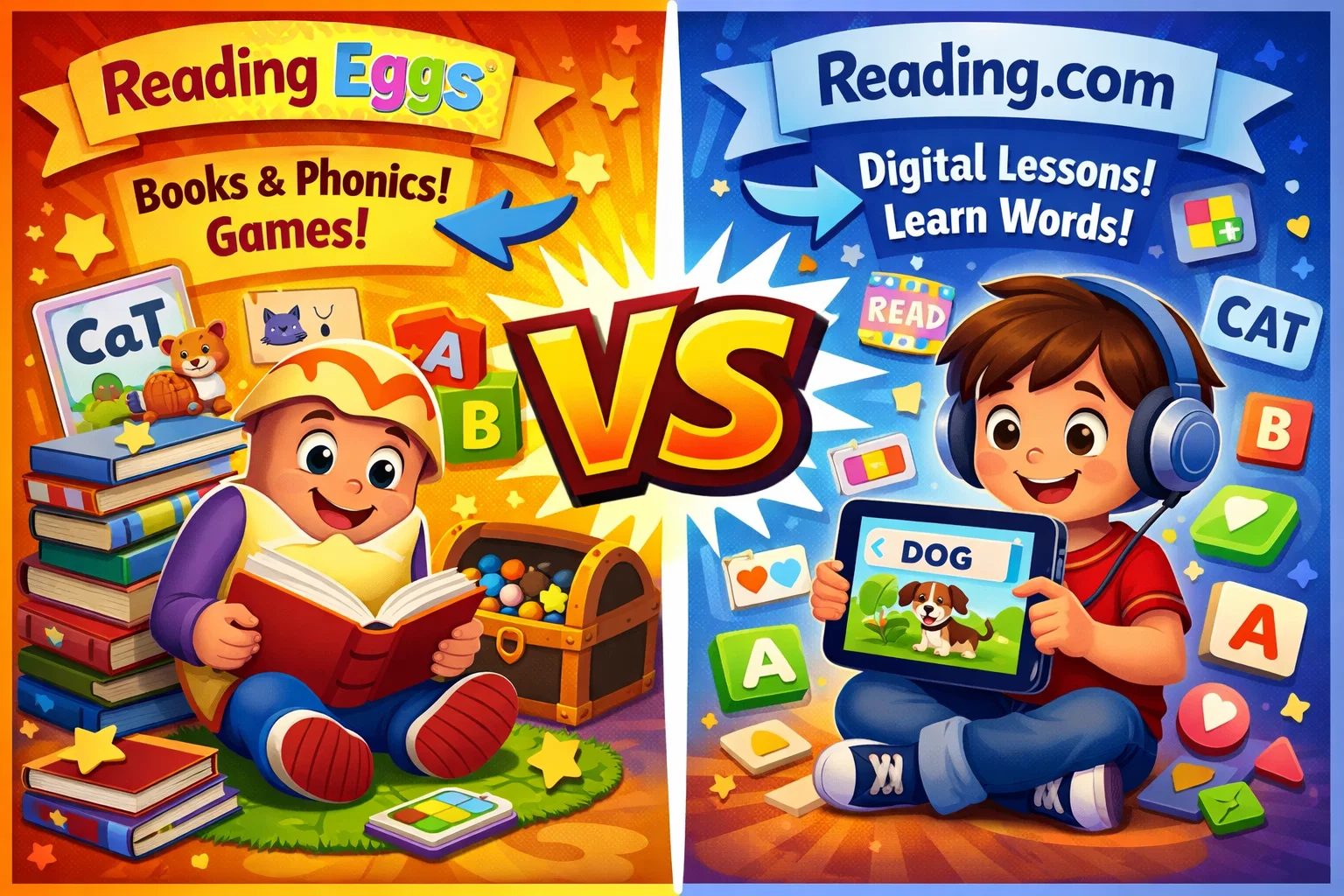
Program Structure and Learning Path
The two apps approach lesson architecture very differently, and this shapes the entire experience for both child and parent.
Reading Eggs organizes content into sequential maps, each consisting of ten lessons. At the end of each map, a quiz checks for skill proficiency. Children who don’t yet demonstrate mastery can repeat the map as many times as needed. When they pass, they earn a printable certificate — a small but meaningful milestone. The full suite spans hundreds of lessons across its sub-platforms, and children can progress largely independently once they’ve established a routine.
Reading.com takes a co-learning approach. Each lesson requires a parent to enter a code before it begins — a deliberate design decision that prevents children from starting without adult supervision, since the lessons are specifically built for two participants. All 99 lessons follow a scripted format: the parent reads their part aloud while the child responds and contributes their portion of the shared text. There is no independent mode.
The practical implication: The platform suits busy households or children who enjoy working at their own pace. Reading.com requires consistent parental involvement — a genuine strength for families who want a structured daily ritual, but a real obstacle for those with limited daily availability.
Engagement and Interactivity
The platform leans heavily into gamification. Children earn “eggs” as in-app currency to spend in a virtual store on avatars, digital pets, and arcade credits. Completing activities, advancing through map levels, and earning certificates all contribute to a reward loop that motivates even reluctant learners. The platform features animated songs, colorful recurring characters, and hundreds of varied activity formats — which helps prevent the repetition fatigue that can derail consistent practice over months.
Reading.com includes supplementary games as well, but they serve as reinforcement tools rather than central motivators. The platform’s most distinctive engagement features are structural:
- A sound-blending slider bar makes the abstract process of merging phonemes into words concrete and tactile for young children
- Delayed picture reveals in decodable books prevent children from guessing at words using picture context rather than phonics knowledge
- The co-reading story format allows children to engage with richer narratives than a purely decodable text could support, because the parent handles the non-decodable portions while the child reads only what they’ve been prepared for
The app wins on sheer variety and independent play value. Reading.com wins on the depth and intentionality of its parent-child interaction design.
Curriculum and Educational Value
| Feature | Reading Eggs | Reading.com |
| Phonemic awareness | ✅ Yes | ✅ Yes |
| Systematic phonics | ✅ Comprehensive | ✅ Comprehensive |
| Sight words | ✅ Yes | ⚠️ Some (limited) |
| Vocabulary development | ✅ Yes | ✅ Yes |
| Fluency practice | ✅ Yes (Fast Phonics) | ⚠️ Limited |
| Comprehension instruction | ✅ Extensive (Eggspress) | ❌ Not a focus |
| Math supplement | ✅ Mathseeds available | ❌ No |
| Age range covered | 2–13 years | 3–8 years |
| Total lessons | 500+ across platform | 99 |
| Decodable books | ✅ 3,500+ | ✅ Curated library |
| Printable worksheets | ✅ Yes | ✅ Yes |
Reading Eggs offers a significantly broader curriculum. The Eggspress section alone contains 220 reading comprehension lessons — a depth that Reading.com does not attempt to match, since its purpose ends at establishing the decoding foundation. Reading Eggs also makes learning enjoyable at every stage: structured phonics lessons, reading practice activities, and fluency-building exercises are woven throughout the program so children develop every key reading skill in sequence rather than in isolation.
Reading.com’s 99 structured lessons are more focused but genuinely intensive. Each one introduces new sounds explicitly, then reinforces them through decodable books and games before moving on — a tight loop that works well for building reading fluency from scratch. The platform is less concerned with making learning feel like entertainment and more focused on making it stick.
It’s worth noting a recurring concern in user reviews: some parents feel that later Reading Eggs content incorporates more sight-word memorization than pure phonics decoding. This is a minority view and may reflect a misunderstanding of how the two approaches work together in a balanced literacy program — but it’s worth being aware of if you’re specifically seeking a code-first, phonics-only experience throughout.
User Experience and Interface Design
The platform uses a vibrant, cartoonish visual style that young children find immediately appealing. The interface is intuitive enough that most children aged 4 and up can navigate it with minimal adult guidance after the first session or two. The parent dashboard is well-organized, offering Lexile levels, completion percentages, and time-on-task data. Recent updates have also improved the mobile experience, bringing it closer to parity with the browser version.
Reading.com has a cleaner, more minimal design. Because a parent is always present during lessons, the interface prioritizes lesson flow and script clarity over independent child navigation. The visual style is polished and age-appropriate without being overwhelming — a deliberate contrast to the busyness of some competing platforms. Parents who find heavy gamification distracting for their child often appreciate the more restrained aesthetic.
Accessibility and Age Appropriateness
The suite is the clear winner for age range coverage:
- Ages 2–4: Junior program
- Ages 3–7: Core program
- Ages 5–10: Fast Phonics
- Ages 7–13: Eggspress
Reading.com is firmly positioned for ages 3–8, with its 99-lesson arc designed to bring children to approximately a late 1st-grade or early 2nd-grade literacy level. Once a child completes the program, there’s no natural next step within the app — families will need to transition to another platform. For older children or those who advance quickly, this endpoint can feel abrupt.
For parents looking for a single online reading program to carry their child through multiple years — from the very beginning of the reading journey through upper elementary — Reading Eggs offers considerably more runway. Its curriculum is structured to evolve alongside the child, making it one of the most complete early reading skills platforms available without switching apps.
Progress Tracking and Parental Controls
The platform provides one of the most detailed progress tracking systems available on any consumer literacy platform. The parent dashboard shows Lexile score growth over time, highest level completed, skill category performance, lesson streaks, and time per session. Automated email updates arrive after every five lessons, meaning parents stay informed without needing to check the dashboard manually.
Reading.com’s tracking is intentionally simpler. Since lessons are completed with a parent present, progress is observed organically in real time. The app shows which lessons have been completed and tracks books read, but doesn’t offer the same data depth. For parents who prefer to observe over measure, this may feel like a feature rather than a gap.
Both platforms support multiple child profiles — up to 4 profiles under one Reading Eggs subscription, and up to 3 profiles with Reading.com.
Pricing and Payment Options
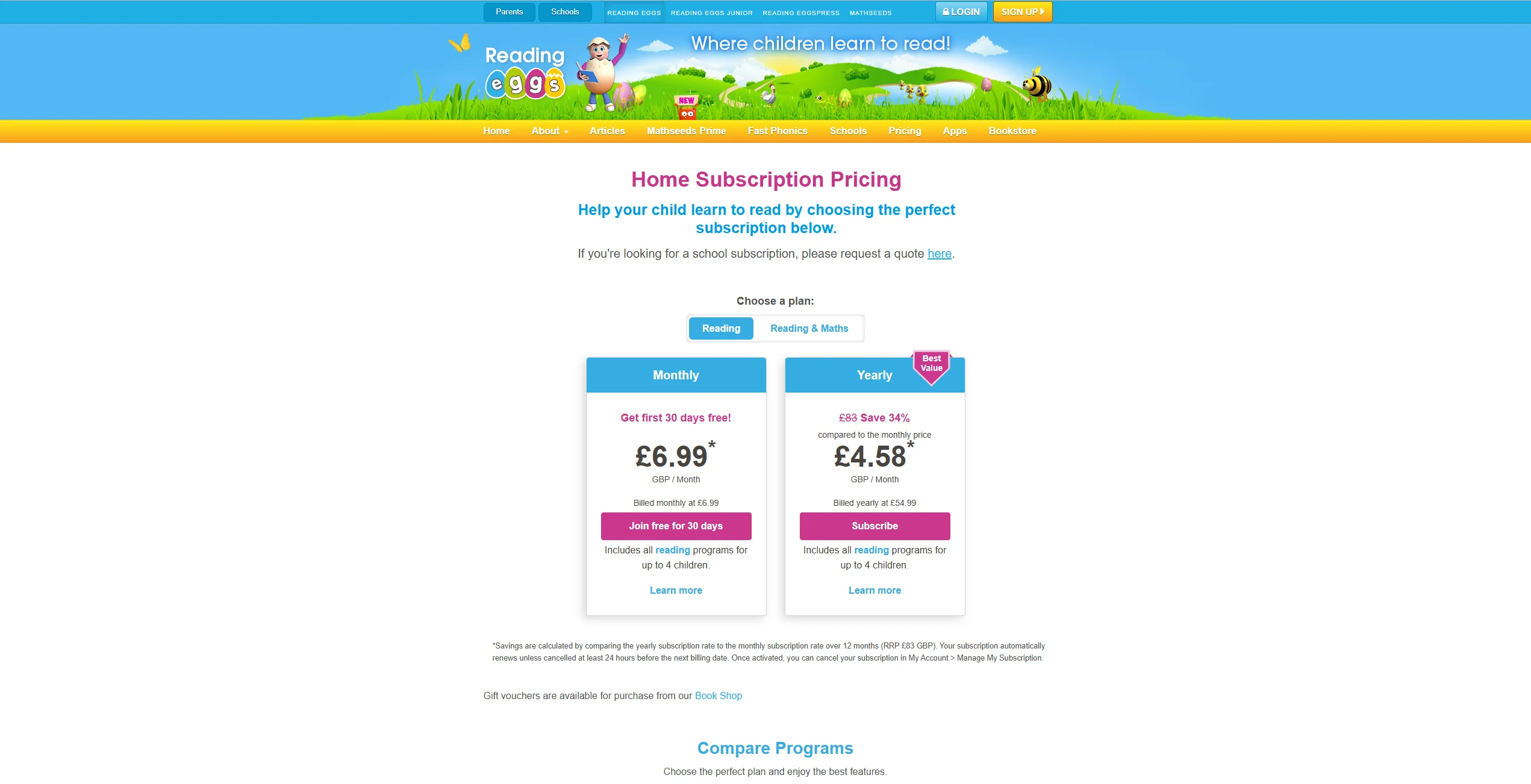
| Reading Eggs | Reading.com | |
| Free trial length | 30 days (full access) | 7 days |
| Monthly plan | $9.99/month | $12.49/month |
| Annual plan | $69.99/year (~$5.83/month) | ~$75/year (~$6.25/month) |
| Literacy + Math bundle | $99.99/year (~$8.33/month) | Not available |
| Child profiles included | Up to 4 | Up to 3 |
| Platform availability | Web, iOS, Android | iOS, Android only |
| Refund policy | Contact support | No refunds noted in user reviews |
The 30-day free trial is truly generous — it unlocks everything and gives families ample time to work through multiple lesson maps before committing. The annual plan represents approximately a 41% saving versus the monthly price.
Reading.com’s annual plan works out to roughly $75/year — slightly higher than Reading Eggs alone, though the difference is modest. The 7-day trial is considerably shorter and has prompted criticism from parents who felt it wasn’t long enough to properly evaluate the program. Both platforms are fully ad-free, which matters for young children engaging with content regularly.
Pros and Cons of Reading Eggs vs Reading.com
Reading Eggs: Advantages and Limitations
Advantages:
- Spans ages 2–13 with a coherent, progressive curriculum across connected programs
- Children can work largely independently after the initial setup — no adult supervision required per session
- Backed by independent school use data and recognized by multiple educational award bodies
- Enormous content library: 3,500+ digital books, 500+ lessons, printable worksheets, and offline materials
- Reward system and gamification genuinely sustain long-term motivation
- Mastery-based progression prevents children from advancing on shaky foundations
- 30-day free trial provides meaningful evaluation time before any financial commitment
- Browser access gives a clear device flexibility advantage over mobile-only alternatives
Limitations:
- The suite of sub-programs (Junior, Fast Phonics, Eggspress) can feel complex to navigate initially
- Gamification may occasionally distract from focused lesson work in some children
- Some user reviews flag difficulties with the subscription cancellation process
- The visual style, while popular with young children, can feel dated to older users or parents expecting a more contemporary interface
Reading.com: Advantages and Limitations
Advantages:
- Fully scripted lessons remove the instructional guesswork — no prior phonics knowledge needed from parents
- The co-play model is research-backed and creates genuine daily parent-child connection
- The tactile blending slider is a standout tool for making abstract sound-merging concrete
- Decodable books with delayed picture reveals remove the temptation to guess at words by context
- Clean, focused design minimizes visual distraction
- Direct Instruction methodology has a strong independent evidence base
- Slightly lower total cost on an annual basis
Limitations:
- Requires consistent parental involvement for every session — not suitable for independent child use
- Only 99 lessons, covering up to approximately late 1st-grade level — no continuation within the app
- Shorter free trial (7 days vs. 30) limits evaluation time considerably
- Reported no-refund policy has frustrated some users after committing to annual plans
- Mobile-only platform limits use to tablets and phones — no browser version
- No built-in progression beyond the program’s designed endpoint
Comparing the Underlying Phonics Methodologies
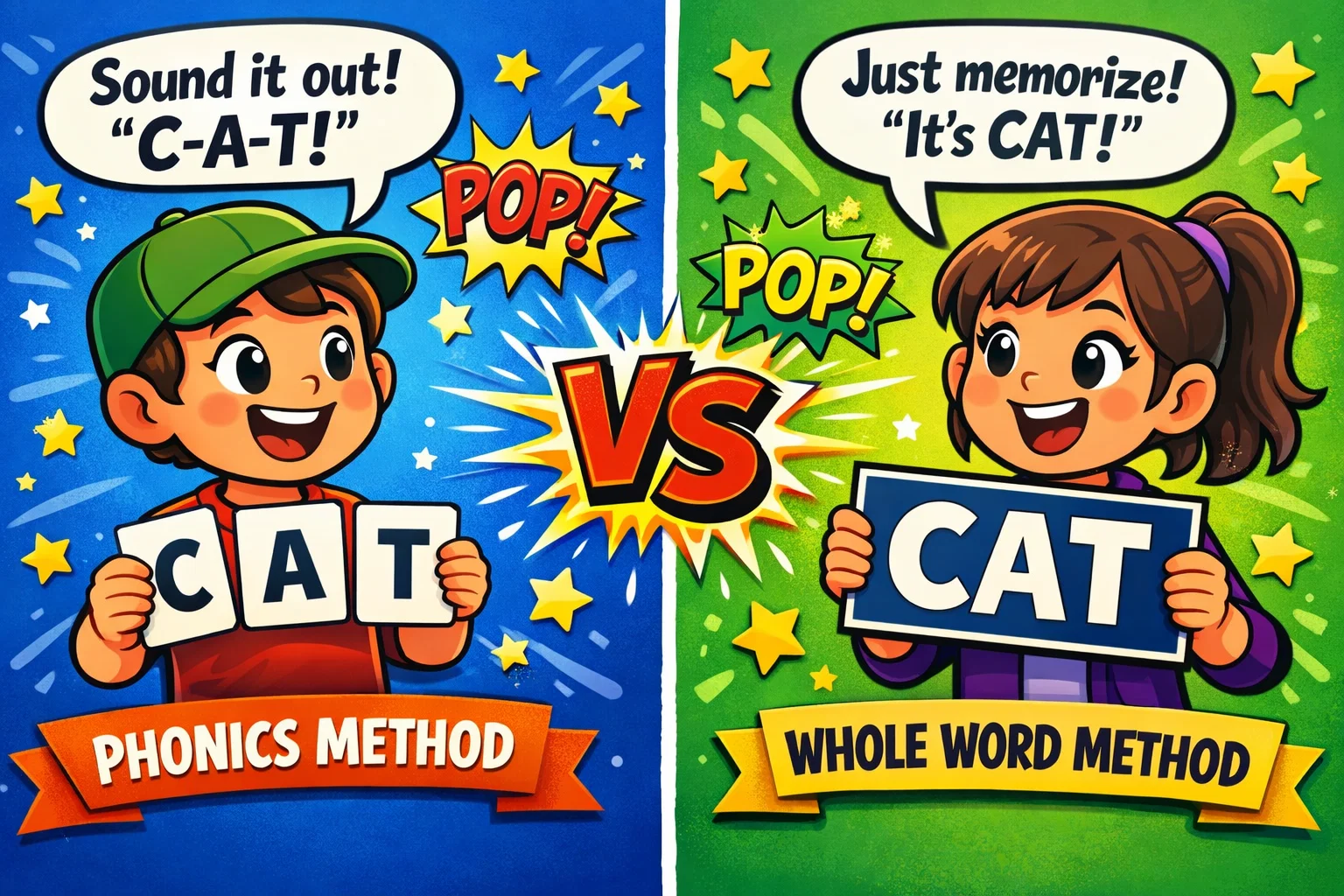
This is an area where parents with some background in educational research may want to look more closely before deciding. It’s also where comparisons with other well-known programs become useful: Hooked on Phonics reviews, for instance, often highlight its explicit phonics-first approach — and both platforms here share that same philosophical grounding, even if they express it differently.
Reading Eggs employs a balanced approach to phonics instruction. Systematic synthetic phonics forms the backbone of the core program — children learn letter-sound correspondences explicitly, blend sounds into words, and apply this knowledge to books and activities. Sight words are also taught alongside phonics, and later lessons incorporate broader vocabulary and text-level work. Progress through the program is tied to reading level advancement, with Lexile scores helping parents track exactly where their child sits on the developmental spectrum.
Reading.com uses exclusively synthetic phonics from lesson one, with no sight words in the traditional sense. The delayed picture reveal feature and the Direct Instruction methodology are both specifically aimed at preventing guessing habits. For families aligned with the Science of Reading movement — seeking a strictly code-first approach — Reading.com’s methodology is particularly consistent with that philosophy.
Neither approach is categorically wrong. The science supports systematic phonics as the essential foundation, while also supporting the development of vocabulary and comprehension in parallel. The choice of emphasis depends partly on where your child currently struggles and on your personal philosophy around early literacy.
What Real Parents Are Saying
User reviews across the App Store, Google Play, and independent parenting forums reveal some consistent themes for both platforms.
Reading Eggs users frequently highlight:
- Children who previously resisted books becoming eager to complete daily lessons to earn rewards
- The value of automatic progress emails for parents who don’t have time to monitor the dashboard
- The breadth of the content library as a key long-term advantage over narrower programs
Common criticisms include occasional technical glitches on older devices, and some frustration with the subscription cancellation process.
Reading.com users frequently highlight:
- The satisfaction of watching a child complete their first full book within the first two weeks
- The scripted lesson format as a major confidence-booster for parents uncertain about teaching phonics themselves
- The co-learning experience as a genuinely meaningful daily ritual
Common criticisms include the 7-day trial feeling too short, the mobile-only limitation, and the absence of a clear in-app path forward once the 99 lessons are finished.
Which App is Better for Your Child?
The honest answer is: it depends on your child’s developmental stage, your schedule, and what you’re trying to accomplish. Here’s how to think through the decision practically.
Best for Early Learners: Reading Eggs vs Reading.com
For children aged 3–6 just beginning their literacy journey and learning to read, both apps are well-suited options — but they cater to different family dynamics.
If you have 20–30 minutes per day to sit with your child, Reading.com’s co-learning model is thoughtfully designed for this stage. The scripted format means you don’t need any prior knowledge of phonics instruction — you follow the prompts. The blending slider is particularly effective for children who struggle to merge individual sounds into words, and the decodable books feel like real stories rather than pure phonics drills.
If you need a program your child can use more independently — perhaps while you’re occupied with a younger sibling or finishing work — this app is the stronger choice. Children as young as 4 can navigate the interface with minimal guidance after the first few sessions, and the lessons deliver genuine phonics instruction without requiring adult presence every time.
Best for Struggling Learners
For children falling behind or identified as needing extra literacy support, this platform generally offers more comprehensive tools for an extended journey.
Its mastery-based structure ensures no child moves forward without solidifying each skill — critically important for learners who might otherwise build on shaky foundations. The Fast Phonics module provides targeted phonics reinforcement, and the Eggspress comprehension strand is thorough enough to support children through upper elementary school.
Reading.com can also be highly effective for struggling younger learners, particularly where the parent-led, script-guided model provides the consistent scaffolding they need. The Direct Instruction approach has strong evidence specifically for children with learning difficulties. However, its 99-lesson scope means families will need a supplementary platform once the program is complete.
If your child has been assessed as having dyslexia or a related language processing difficulty, it’s worth consulting with a specialist before selecting a self-directed app as your primary intervention. Both platforms can be valuable supplements to professional support, but neither is designed as a clinical intervention tool.
Device Compatibility and Technical Requirements
Before subscribing to either platform, it’s worth confirming compatibility with the devices your family actually uses.
| Reading Eggs | Reading.com | |
| Web browser | ✅ Full access | ❌ Not available |
| iPad / iPhone (iOS) | ✅ Yes | ✅ Yes |
| Android tablet / phone | ✅ Yes | ✅ Yes |
| Chromebook | ✅ Yes (via browser) | ❌ Limited |
| Desktop / laptop | ✅ Yes (via browser) | ❌ Not available |
Its browser compatibility is a meaningful practical advantage for families without a dedicated tablet. Reading.com requires a mobile device, which may limit flexibility for some households — worth confirming before signing up.
Final Thoughts on Reading Eggs vs Reading.com
These are two genuinely different products solving slightly different problems. Reading.com is a focused, parent-led early phonics tool with a clear beginning and a designed endpoint. Reading Eggs is a comprehensive literacy curriculum that a child can largely navigate independently, spanning a full decade of skill development from toddler to tween.
Neither is definitively superior. The better choice depends almost entirely on your child’s current age and stage, your daily availability, and whether you’re looking for a long-term platform or a focused early foundation you’ll build on with other resources.
When to Choose Reading Eggs
This platform is likely the better fit if:
- Your child is anywhere between ages 2 and 13 and you want a single reading app to grow with them over multiple years
- You need something your child can use semi-independently on a regular basis
- You want comprehensive vocabulary instruction alongside systematic phonics to develop every reading skill in sequence
- You have multiple children at different ages — the 4-profile limit and broad age range suit sibling households particularly well
- You’re homeschooling and need a reading curriculum that covers several years of development without requiring a platform switch
- Your child responds strongly to gamification and reward systems as ongoing motivators — the platform is especially good at making learning feel rewarding rather than like work
- You want detailed progress data, Lexile tracking, and regular automated reporting
When to Choose Reading.com
This app is likely the better fit if:
- Your child is between ages 3 and 7 and you’re beginning from the very start — much like starting with “Teach Your Child to Read in 100 Easy Lessons,” the program works best as a structured beginning rather than a mid-journey addition
- You have 20–30 minutes per session available to sit with your child and work through lessons together
- You prefer a focused, uncluttered app over an expansive platform with multiple interconnected sections
- You want fully scripted lessons that require no phonics background from you as the parent
- Your priority is building a rigorous synthetic phonics foundation before moving to other programs
- You value the daily intimacy of a shared learning activity as a core part of the design itself
- You’re committed to the Science of Reading philosophy and want a strictly code-first instructional approach
FAQs: Reading Eggs vs Reading.com
Are these apps suitable for different age groups?
Yes, and this is one of the most important factors in choosing between them.
Reading.com is designed for ages 3–8, with its 99-lesson program taking children from letter recognition to roughly a late 1st-grade literacy level. It’s genuinely well-suited to preschoolers and kindergarteners, especially those starting with little or no letter knowledge. It is not designed to serve older elementary students — once the 99 lessons are complete, the journey ends within the app. Reading Eggs spans ages 2–13 through its suite of programs: Junior handles the toddler and preschool years; the core program serves ages 3–7; Fast Phonics extends phonics work through age 10; and Eggspress carries comprehension instruction all the way to age 13. For a family looking for a single platform that can serve a 4-year-old and a 10-year-old simultaneously, Reading Eggs handles that considerably better. Reading.com is the stronger choice for very young beginners whose parents want a structured co-learning experience — but it has a natural endpoint that Reading Eggs does not.
Which app offers a better learning experience for kids?
Both apps offer genuinely enjoyable experiences, but in meaningfully different ways. The first platform immerses children in a colorful animated world where completing lessons earns currency to spend on in-app items, pets, and arcade access. The variety of activities — songs, games, stories, quizzes — keeps things fresh across hundreds of sessions. Reading.com builds its experience around the parent-child relationship itself. The scripted co-play format creates a shared daily ritual rather than a solo screen session, which many families find more meaningful. The decodable storybooks are engaging, and the blending slider is a standout tool for early sound merging. Younger children who enjoy learning alongside a caregiver often respond very positively to Reading.com’s format, while children who prefer independence and thrive with gamification may sustain engagement more readily with Reading Eggs over the long run.
Can I try both apps for free before deciding?
Yes, both platforms offer free trials. Reading Eggs provides a 30-day free trial with full access to the entire platform — a generous window that allows families to evaluate the experience across many sessions and multiple sub-programs before committing. Reading.com offers a 7-day free trial for both monthly and annual subscription tiers. The shorter window means you’ll want to engage actively from day one to get a clear sense of whether the format works for your child and your schedule. It’s worth noting that Reading.com’s no-refund policy has drawn criticism in app store reviews, so making full use of the trial before committing to an annual plan is strongly advisable. If in doubt, start with a monthly option on either platform and switch to annual billing once you’re confident it’s the right fit.
Which is more affordable: Reading Eggs or Reading.com?
Pricing is relatively close between the two. Reading Eggs costs $9.99/month or $69.99/year for the literacy program alone, or $99.99/year bundled with its companion mathematics app, Mathseeds — making it one of the more affordable full reading programs for kids on the market. Reading.com costs $12.49/month or approximately $75/year on an annual plan. On a per-month basis, its annual plan works out to roughly $5.83/month, compared to approximately $6.25/month for Reading.com. The value question depends on your time horizon. Reading Eggs’ significantly larger content library, extended age range, and multi-year curriculum offer more long-term value per dollar for families expecting to use the platform beyond a single school year. Reading.com’s lower total lesson count means most families complete the full program within months — making it a shorter-term investment by design. The 30-day free trial also gives considerably more evaluation time before any financial commitment is required.
How does Reading Eggs compare to Hooked on Phonics?
This is one of the most common questions parents ask when looking for a reading program, and it’s worth addressing directly. Reading Eggs vs Hooked on Phonics is a genuinely interesting comparison because both are multi-award winning reading programs with decades of combined use behind them — but they target slightly different needs.
Reading Eggs is the multi-award winning platform that covers ages 2–13 with a broad range of reading activities, from early phonics through advanced comprehension. Hooked on Phonics, by contrast, has historically focused on a narrower, more intensive phonics-first approach designed for children in the earliest stages of learning how to read. If you’re looking for a reading program that grows with your child across many years, Reading Eggs offers considerably more scope. If eggs vs Hooked on Phonics comes down to methodology, Reading Eggs incorporates both phonics and comprehension into a single suite, while Hooked on Phonics stays tightly focused on decoding. Reading Eggs and Hooked on Phonics can even complement each other — some families use Hooked on Phonics as an intensive early foundation, then transition to Reading Eggs or Hooked on Phonics extensions for broader literacy development. Neither is a wrong choice; the better read program for your child depends on where they are in their journey and what gaps you’re trying to fill.
Is Reading Eggs suitable for older kids?
Reading Eggs is often discovered by parents of young children, but the platform also has a great deal to offer older students. Older kids using the Reading Eggspress section — the comprehension-focused strand designed for ages 7–13 — can work through 220 structured lessons that build vocabulary, inferential thinking, and textual analysis skills well beyond what most phonics-only apps address. For parents who initially signed up for a younger child and want to know whether the platform remains valuable as their child grows, the answer is yes: the Reading Eggspress section specifically addresses the transition from learning to read to reading to learn, which is the critical shift that happens around ages 7–9. Kids using the Reading Eggspress content encounter a wide range of reading materials — fiction, nonfiction, poetry, and informational texts — which supports the kind of broad reading ability needed for academic success. So if you’ve discovered Reading Eggs through a younger sibling and want to know whether to carry it forward to your older kids, the Eggspress strand makes that worthwhile.

Take a short quiz to find out what your everyday choices say about your parenting style
When your child is curious about something new, what’s your instinct?
Take a short quiz to find out what your everyday choices say about your parenting style
“Can I download this app?” What happens next?
Take a short quiz to find out what your everyday choices say about your parenting style
When it comes to rules at home, which sounds most like you?
Take a short quiz to find out what your everyday choices say about your parenting style
If you could give your child one life skill today, what would you pick?
Take a short quiz to find out what your everyday choices say about your parenting style
Your child gets to choose what to watch. What would your ideal setup look like?
Take a short quiz to find out what your everyday choices say about your parenting style
Pick your parenting superpower ✨



