
Lingokids vs SplashLearn comparison: Comparing Best Educational Apps For Kids

 Discover a Free Education Video App for Kids
Pastory uses AI to personalize educational video content based on your child’s interests and personality. Safe, engaging, and built for curious young minds. Sign up now to stay updated and enjoy early access with a free trial

Choosing the right digital tool to aid a child’s development often feels like navigating a maze. With numerous best learning apps vying specifically to capture parental attention, the decision usually depends on a child’s developmental stage and unique family goals. This detailed comparison examines Lingokids and SplashLearn, two major educational platforms, assessing their suitability for families in 2026.
While both platforms aim to make learning fun, they approach the educational journey from different angles. One prioritizes play-based immersion for younger learners, while the other provides structured learning aligned with school curricula. This neutral review helps you choose an app that aligns with your child’s needs, whether they are starting to learn to read or mastering grade 5 math. We evaluate these tools through the lens of cognitive development, engagement sustainability, and long-term educational ROI.
Lingokids vs SplashLearn: Educational Apps For Kids

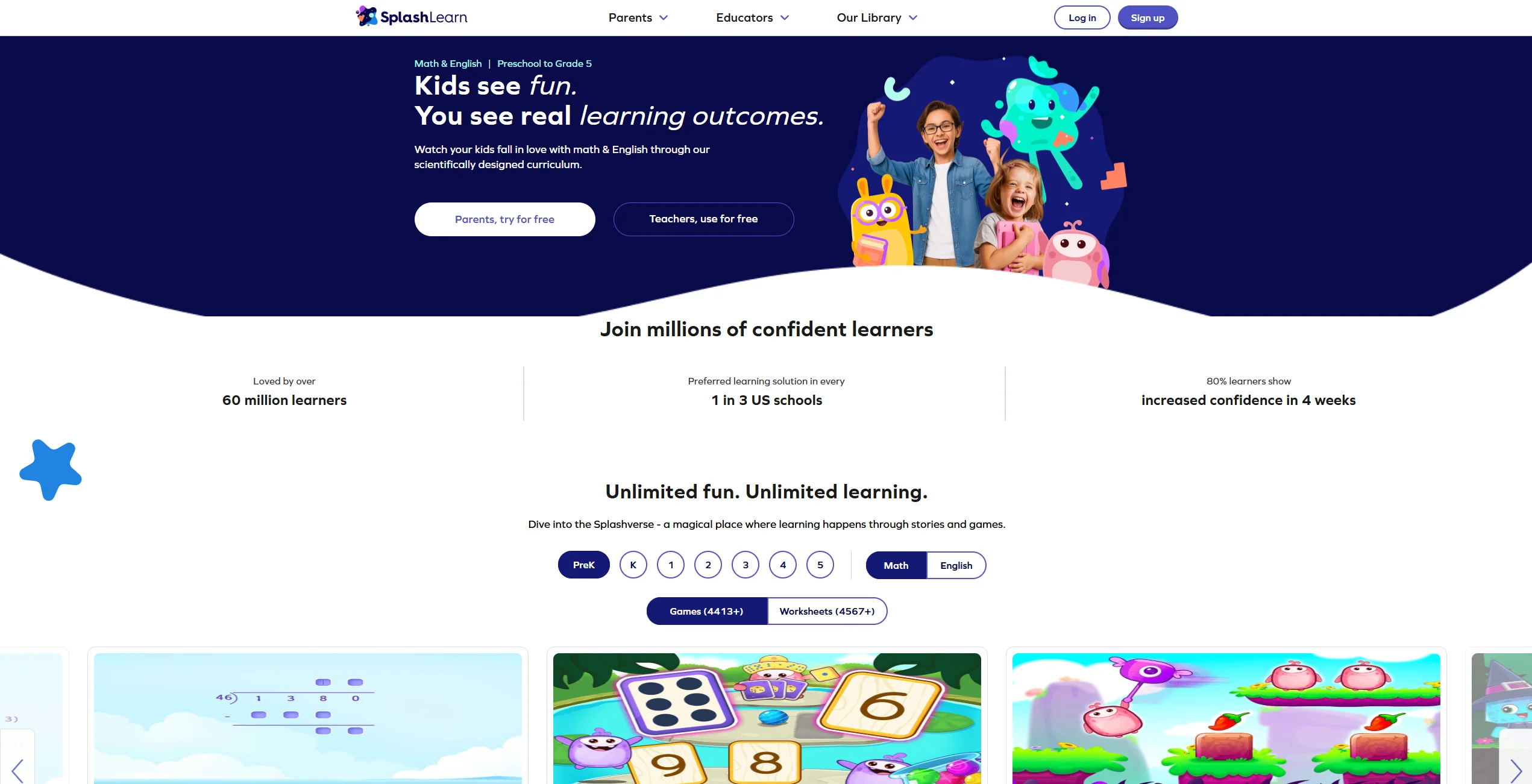
Parents often compare Lingokids and SplashLearn because both carry high educational value. However, they aren’t clones. Lingokids earns praise for its “Playlearning™” philosophy, ideal for early learning and building a love for learning through a library of 3,000+ interactive games, videos, and activities, according to the app’s current store listings. Conversely, SplashLearn serves as an academic reinforcement powerhouse, particularly for math and reading, and is marketed as being loved by over 60 million children worldwide and used in 1 in 3 US schools, according to company-reported figures.
In 2026, parents expect more than digital babysitting; they want measurable learning outcomes. Lingokids positions itself as a “whole-child” development tool, whereas SplashLearn markets itself as a curriculum-aligned mastery platform. Understanding this fundamental distinction remains the first step in selecting the best learning apps for kids in your household.
Core Differences at a Glance
The primary difference lies in pedagogical intent. Lingokids serves as a multidisciplinary learning app emphasizing 21st-century skills like social-emotional learning (SEL), creativity, and vocabulary. It creates a “gamified world” where children aged 2–8 engage with characters, solve puzzles, and watch educational videos. It offers an exploration-focused environment.
SplashLearn is curriculum-driven. It delivers a structured learning experience focused on math skill development and reading fluency. While incorporating educational games, its backbone consists of rigorous lessons aligned with Common Core standards, making it a favorite among older children who need targeted academic practice. If Lingokids is a digital playground with hidden lessons, SplashLearn is a digital classroom that feels like a playground.
Ideal learner profiles
To help you choose apps effectively, consider these profiles:
- The Preschool Explorer (Lingokids): Best suited to children aged 2–5 starting their educational journey. These kids learn via songs, movement, and light English/numeracy exposure. It is ideal for families who want an all-in-one introduction to a variety of subjects.
- The Academic Achiever (SplashLearn): Ideal regarding students from kindergarten through grade 5. It works well for children who need to master multiplication, fractions, or reading comprehension via rewarding gameplay.
- The ESL Learner (Lingokids): Due to its partnership with Oxford University Press, Lingokids remains one of the stronger options for non-native English speakers building basic vocabulary.
Evaluation criteria used in review
To provide a fair assessment, we analyzed these various educational apps based on:
- Curriculum Depth: Subject coverage in math and literacy.
- Engagement Level: Motivation techniques to keep kids focused.
- Independent Usability: Can a 4-year-old navigate the app without constant help?
- Reporting Tools: Do they help kids and parents understand progress?
- Pricing Transparency: Features the apps offer free versus subscription content.
- Cognitive Load: How the apps manage screen time intensity.
Lingokids features and learning experience
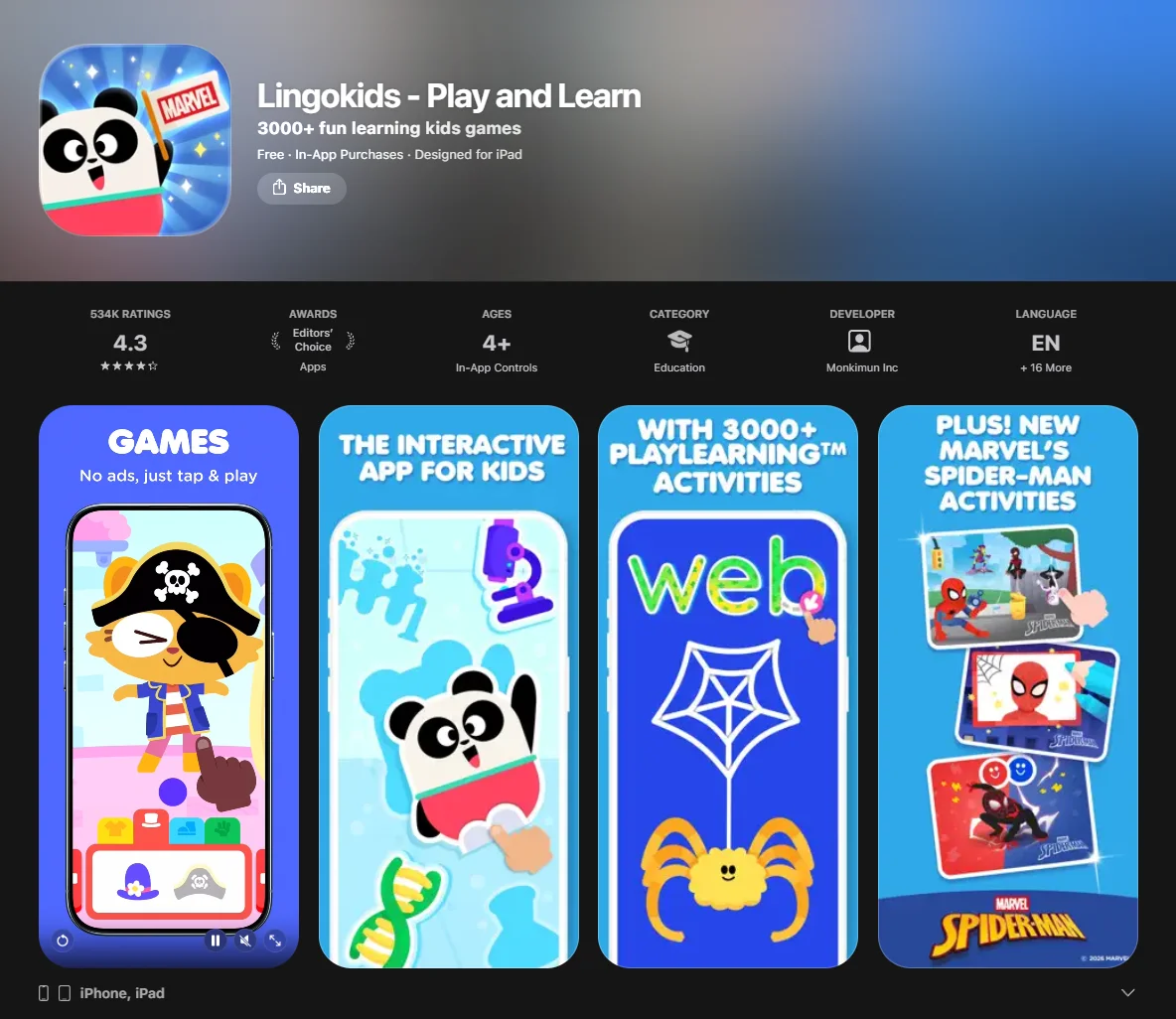
Lingokids positions itself as an immersive universe rather than a mere collection of games. Developed with Oxford University Press content, it focuses on high-quality educational content delivered through “Playlearning.” This approach suggests that children absorb information more effectively when they don’t realize they are being “taught.”
Curriculum scope: literacy, math, social-emotional skills
The Lingokids curriculum is exceptionally broad. Early learning modules introduce phonics, basic vocabulary, and “Big Ideas” like sustainability. In 2026, many parents look for apps that support empathy; Lingokids addresses this through activities designed to build mindfulness and emotional intelligence.
Beyond standard ABCs, the app explores:
- STEM subjects: Basic coding concepts and engineering logic.
- Global Citizenship: Learning about different cultures and environmental responsibility.
- Creative Arts: Digital painting and music rhythm exercises.
Game-based environment and characters

The experience centers around animated characters such as Billy the Chick and Cowy. These characters guide the child’s learning, making the interface feel friendly. The educational games are short, suiting preschoolers’ limited attention spans, and often include “Playtogether” features encouraging parental involvement. The high-quality animation rivals modern children’s television, which helps keep kids engaged longer than static learning apps.
Learning progression and adaptability
Lingokids utilizes adaptive learning technology. Upon setting up the app, you enter a child’s age, and the algorithm suggests content. As kids solve puzzles, difficulty subtly shifts. However, progression is a “spiral” rather than a linear path, prioritizing exposure over rigid mastery. This prevents the frustration often found in more demanding apps for older kids, keeping the vibe light and encouraging.
Independent usability for young children
The visual interface is essential regarding apps for preschoolers. Because it uses audio cues, non-readers can use the app independently. This allows children to use the app independently during quiet time while still engaging with educational content. The “Parent Area” is strictly separated by a gate, ensuring kids use only the designated student sections.
SplashLearn features and learning experience

SplashLearn offers a focused, academic environment. It functions as a comprehensive learning app that can supplement traditional tutoring. Its design philosophy rests on the idea that “mastery leads to confidence.”
Math and reading curriculum depth
SplashLearn’s curriculum is impressive. It covers:
- Math: From kindergarten apps basics to grade 5 algebra, geometry, and word problems.
- Reading: A full learn to read program including phonics, sight words, and reading fluency boosters.
Lessons are sequenced. Rather than just “playing,” children follow a structured learning path ensuring no knowledge gaps. This makes it a strong option for academic readiness.
Skill mastery and progress tracking
One of the best learning apps regarding data-driven parents, SplashLearn provides a parent dashboard. You receive weekly reports detailing exactly which math skills your child mastered and where struggles occurred. This detail makes it a top choice regarding homeschool support.
Immediate feedback—something SplashLearn provides—can be particularly helpful when children are practicing mathematical concepts.
Gamification and reward system
To make learning fun, SplashLearn uses a “coin” system. As kids practice math, they earn coins to spend in an in-app “Aquarium.” This creates a clear incentive: complete the work to earn the reward. It is highly effective regarding older kids tackling dry subjects like long division. The sense of ownership over their digital pet collection encourages daily login and practice.
Suitability for classroom and homeschool use
SplashLearn promotes itself as being used in 1 in 3 US schools, a company-reported statistic frequently cited in its marketing materials. Teachers can assign modules, and homeschoolers can use learning paths as a primary math curriculum. It is available on web browsers, a plus regarding families preferring desktops over tablets to minimize “tablet neck.”
Age range comparison and developmental fit

Understanding where your child sits on the developmental spectrum is key to choosing between these best educational apps.
Detailed Age Breakdown Table
| Feature | Lingokids | SplashLearn |
| Primary Age Target | 2–8 years | 2–11 years |
| Toddler Support | High (Songs & Nursery Rhymes) | Moderate (Simple Shapes) |
| Elementary Support | Basic (Up to Grade 2) | High (Up to Grade 5) |
| Focus Area | General Knowledge & SEL | Math & Literacy Mastery |
| Language Support | Strong (Focus on English/ESL) | Standard (English instruction) |
Ages 2–5 preschool learners
Regarding the youngest users, Lingokids usually wins. Navigation is simpler, and the song/video focus matches the developmental stage of preschoolers. SplashLearn has a toddler section, but the interface can feel “busy” compared to Lingokids’ streamlined experience. Kids aged 5 might find SplashLearn’s structure rewarding, but a 3-year-old will likely prefer the “Lingokids” characters.
Kindergarten to Grade 2 students
Here, both apps overlap. If the goal is kids to practice reading and math specifically regarding school readiness, SplashLearn has the edge. If you prefer a holistic approach including language learning, Lingokids is a strong contender. Many kindergarten apps aim to balance both approaches, so some parents choose to use both platforms—one for math and one for “fun” discovery.
Grade 3–5 students
Regarding older kids, SplashLearn is the clear choice. Lingokids becomes less relevant after around age 8. SplashLearn continues challenging kids aged 9–11 with advanced math and reading comprehension that remains engaging and effective learning. Most apps for kids in 2025 and 2026 struggle to keep 10-year-olds engaged, but SplashLearn’s “Aquarium” and complex puzzles succeed.
Subject coverage comparison
Reading and phonics programs
Both are excellent reading apps, but they differ in style. Lingokids focuses on vocabulary growth and phonics exposure. SplashLearn offers a traditional learn to read sequence, including decodable books and comprehension quizzes vital regarding kindergarten success. SplashLearn’s reading path is more linear, helping kids learn the “mechanics” of reading.
Math skill development
- Lingokids: Focuses on “Early Numeracy”—counting, basic patterns, and simple addition. It’s an introduction, not a deep dive.
- SplashLearn: Provides a deep-dive into the entire elementary math spectrum. It is one of the stronger math apps for building skill mastery. It covers more than 400 math skills.
Social-emotional and life skills (SEL)
Lingokids shines here. In an era where “emotional intelligence” is as valued as IQ, Lingokids includes content on:
- Persistence and resilience: Failing a task and trying again.
- Environmental awareness: Recycling and nature conservation.
- Healthy habits: Sleep hygiene and nutrition.
SplashLearn focuses almost entirely on academics, offering minimal SEL content.
Creative and multimedia content
Lingokids functions like a “Netflix for education,” offering high-quality educational videos and interactive songs. SplashLearn relies more on its game engine and static (though colorful) lesson screens. If your child is a visual learner who thrives on narrative, Lingokids will likely resonate more.
User experience and design quality

The design of an app for kids determines whether it’s a tool or a toy.
Interface clarity and child navigation
Lingokids is “playful.” SplashLearn is “functional.” Both apps use interactive elements to provide consistent positive reinforcement. Lingokids uses a “bubble” navigation system that feels very natural regarding touchscreens. SplashLearn uses a more traditional map/pathway layout that provides a clear sense of “moving forward.”
Ad-free environment and safety
Both platforms are apps with strong privacy policies. Paid versions are 100% ad-free, a critical factor regarding apps for your kids. Both platforms state that they comply with child data protection regulations such as COPPA and highlight their kidSAFE certifications, emphasizing restricted data collection and ad-free paid environments.
Device compatibility and access
Both are apps available on iOS and Android. SplashLearn offers a full web version, allowing use on school laptops. Lingokids provides an offline mode, allowing you to download activities—a lifesaver regarding long car rides or flights where Wi-Fi is spotty.
Pricing comparison and subscription plans
Note: Prices fluctuate based on regional promotions. Always check the official app stores.
| Plan Type | Lingokids (Plus) | SplashLearn |
| Free Version | Free Version Limited daily access (the exact number of free activities may vary by region and version, with sources indicating either 3 or up to 10 activities per day) | Limited daily access, commonly capped at approximately 20 minutes per day for home users |
| Monthly Subscription | around $13.49–$14.99 depending on region and promotion | Typically ranges from $7.99 to $11.99 depending on whether parents choose Math-only or Math + Reading plans |
| Annual Subscription | Typically ranges between approximately $71.88 and $154.99 depending on country, app store, and promotional offers | Commonly listed around $89.99 for bundled Math + Reading access, though pricing may vary by region |
| Family Sharing | Up to 4 child profiles | Up to 3 profiles |
Value for money based on learning goals
If you have a toddler wanting a “jack of all trades” app, Lingokids offers great value. If a school-aged child needs math help, SplashLearn is a better investment targeting specific academic needs. Since many apps offer free trials, testing both is highly recommended. Often, apps offer free trials ranging from 7 to 14 days; use this period to see which one your child asks for the next morning.
Pros and cons of Lingokids

Strengths
Lingokids excels as a safe entry point into online learning. Its multidisciplinary approach doesn’t just teach kids ABCs; it teaches global citizenship. The “Playlearning” methodology builds a learning style focused on curiosity. The high production value of the educational videos makes it a favorite regarding families who want to replace passive YouTube time with something constructive.
Limitations
The main drawback involves lacking academic rigor regarding older kids. Once a child hits grade 3, games might feel too “babyish.” Furthermore, learning paths are less granular than those found in structured learning apps. It’s better regarding breadth than depth.
Pros and cons of SplashLearn
Strengths
SplashLearn is among the best learning apps regarding core subject improvement. Curriculum alignment makes it a “tutor in your pocket.” The adaptive learning engine identifies where a child struggles and provides interactive learning to fix it. It is arguably the best educational app for kids who are already in the school system and need to keep their grades up.
Limitations
It can feel repetitive. While trying to make learning more fun, it remains “doing math.” It lacks the creative and social-emotional depth making Lingokids unique. Some children may find the mastery requirements frustrating if they get stuck on a specific logic puzzle.
Learning goals and practical use cases
How do these apps fit into a busy family schedule?
Structured academic reinforcement
Regarding measurable math and reading improvement, SplashLearn is the winner. It is designed to move the needle on school performance. Use it for 20 minutes a day after school to ensure your child stays ahead of the curve.
Play-based early learning
Regarding keeping a 3-year-old engaged while learning about colors, animals, and emotions, Lingokids is the better fit. It’s less about “getting the right answer” and more about “experiencing the world.”
Homeschool support
Both apps serve as excellent supplements. SplashLearn can act as the primary math curriculum regarding kindergarten or 1st grade, while Lingokids provides the “enrichment” activities (art, music, SEL) that round out a homeschool day.
Safety and parental controls
When choosing an educational app, it’s important to consider privacy policies carefully. In the digital age, a child’s data is sensitive. Both apps are kidSAFE certified and comply with international standards.
Screen time management tools
Both platforms understand parental anxiety regarding screen time.
- Lingokids: Allows setting screen-time limits in-app. When the time is up, the characters “go to sleep,” signaling a natural end to the session.
- SplashLearn: Provides a “Parent Connect” app to monitor your child’s learning progress and set limits from your own phone.
Advanced Insights: The “Engagement Loop”
One reason these apps are considered the best learning apps for kids is their mastery of the “Engagement Loop.”
- Challenge: The child is presented with a puzzle.
- Action: The child solves the puzzle using logic or memory.
- Reward: Characters celebrate, or coins are earned.
- Progression: The next challenge is slightly harder.
SplashLearn’s loop is tighter and more academic, while Lingokids’ loop is more narrative and emotional. Depending on your child’s learning style, one of these loops will be more effective than the other.
Summary of Subject Focus
- Lingokids: Vocabulary, English exposure, Science, Art, Emotional Intelligence, Music.
- SplashLearn: Math (all areas), Reading (phonics to comprehension), ELA (English Language Arts).
Frequently asked questions
Are Lingokids and SplashLearn suitable for different age groups?
Yes, they cater to different stages. Lingokids focuses on ages 2 to 8, emphasizing the “Playlearning” phase of early childhood. SplashLearn reaches further, starting at age 2 but extending to age 11, specifically supporting math and reading through the end of elementary school. Generally, Lingokids is for discovery, while SplashLearn is for mastery.
Which app is better for preschool children?
Lingokids is generally better regarding preschoolers due to its emphasis on vocabulary, music, and social-emotional skills. The interface suits non-readers perfectly, and content variety keeps young minds engaged without testing pressure. SplashLearn works if you want to focus exclusively on early math or reading mechanics, but it feels more “academic” than most 3-year-olds require for their daily stimulation.
Which app is stronger for math practice?
SplashLearn is the superior choice regarding dedicated math practice. It offers a comprehensive, grade-aligned curriculum covering everything from counting to complex fractions and decimals. While Lingokids introduces basic numeracy concepts through play, SplashLearn is built regarding mastery and academic achievement, making it a favorite for parents looking to improve school grades.
Can children use Lingokids or SplashLearn independently?
Both apps allow independent use, featuring voice-over instructions so children navigate without reading. Lingokids’ interface is particularly friendly regarding the very young. SplashLearn is also easy, though its structured lessons might occasionally require a parent explaining a new mathematical concept before the child can complete the corresponding game.
Do Lingokids and SplashLearn offer free trials?
Most educational apps, including Lingokids and SplashLearn, offer free trials—typically 7 days—to explore full features. Both also provide limited free versions, though these are often too restricted for daily use. Check their websites regarding current promotions or “back-to-school” discounts before subscribing to ensure you get the best value for your family.
How do these compare to other popular options like Khan Academy Kids or PBS KIDS?
While Lingokids and SplashLearn are subscription-based, Khan Academy Kids offers a completely free alternative with no ads or hidden costs, making it one of the top learning choices for families on a budget. PBS KIDS Games is also a fantastic free resource that focuses on characters children already love from television to help kids develop critical thinking. If you are looking for reading apps for kids specifically, SplashLearn provides more structured phonics than YouTube Kids, which is better suited for broad educational videos rather than a step-by-step curriculum.
What should I look for to ensure my child is experiencing real learning?
To ensure real learning is taking place, you should opt for apps that align with educational standards and provide a clear parent dashboard. The best educational games aren’t just about learning and having fun; they should provide adaptive learning that challenges the child without causing frustration. When kids see fun rewards like the ones in SplashLearn or Lingokids, they are more likely to stay consistent, which is how kids learn best. For kids for 2026, the focus has shifted toward apps with interactive components that encourage active participation rather than passive screen consumption.

Take a short quiz to find out what your everyday choices say about your parenting style
When your child is curious about something new, what’s your instinct?
Take a short quiz to find out what your everyday choices say about your parenting style
“Can I download this app?” What happens next?
Take a short quiz to find out what your everyday choices say about your parenting style
When it comes to rules at home, which sounds most like you?
Take a short quiz to find out what your everyday choices say about your parenting style
If you could give your child one life skill today, what would you pick?
Take a short quiz to find out what your everyday choices say about your parenting style
Your child gets to choose what to watch. What would your ideal setup look like?
Take a short quiz to find out what your everyday choices say about your parenting style
Pick your parenting superpower ✨



