
Lingokids vs Kiddopia Comparison: Kids Learning Apps

 Discover a Free Education Video App for Kids
Pastory uses AI to personalize educational video content based on your child’s interests and personality. Safe, engaging, and built for curious young minds. Sign up now to stay updated and enjoy early access with a free trial

Navigating the vast sea of the App Store to find the perfect learning app can feel like a full-time job. With many educational games promising to turn screen time into a learning path, distinguishing high-quality educational content from simple entertainment is essential. Lingokids and Kiddopia are among the leading apps in the preschool and early elementary learning space. Both platforms use gamification to make learning fun, but they take different pedagogical approaches.
This comprehensive review explores the nuances of Lingokids vs Kiddopia, comparing their curricula, engagement strategies, and overall value. Whether you’re looking for a free introduction to educational apps or a more comprehensive program covering math and science, understanding how these platforms work can help you choose the right fit for your child.
Lingokids Overview

Lingokids is widely recognized as a leading early learning app built around its trademarked Playlearning™ model. Originally known for its strong focus on English language learning, the app has since expanded to cover a wider range of subjects. Lingokids maintains a content collaboration with Oxford University Press, incorporating selected educational materials into its platform. This partnership supports the app’s literacy-focused positioning, though the entire app is not solely developed by OUP.
The app offers a structured learning path that balances academic skills such as literacy and phonics with social-emotional learning (SEL). Available on both iOS and Android, Lingokids operates a freemium model. Its most potent features—including offline access and detailed parental tracking—require the Plus subscription.
Lingokids Core Features
- Literacy and Phonics: A comprehensive focus on ABCs, sight words, and pronunciation, supported by engaging animations.
- STEM Foundations: Interactive math and science modules covering shapes and colors, counting, and basic engineering.
- Social-Emotional Learning (SEL): Unique learning activities focused on empathy, responsibility, and mindfulness.
- Playlearning™ Content: Over 3,000 games and activities, including collaborations with brands such as BBC Earth. (Note: Public confirmation of an in-app Pinkfong partnership is not clearly documented on official Lingokids materials.)
Lingokids Learning Methodology

The app employs an adaptive learning algorithm adjusting the difficulty of learning games based on the child’s performance. This progressive learning approach ensures that preschoolers are neither bored nor overwhelmed. By following a guided learning path, children move from basic phonics to complex sentence structures, making language learning enjoyable and effective.
Lingokids Advantages
Lingokids’ primary strength lies in its content authority. The Oxford University Press partnership ensures that the literacy components remain pedagogically sound. Parents often praise the safe environment. The paid version is ad-free, while the free version may have limited promotional messaging for upgrades. Furthermore, “Play Together” activities encourage active parental participation in the child’s learning journey.
Lingokids Limitations
While the app is comprehensive, the free version is limited to a small number of daily activities. Depending on the current plan structure and region, Lingokids Basic may allow approximately 3–10 activities per day. Features such as offline access, multiple child profiles, and detailed progress reports require a paid subscription. The monthly subscription typically costs around $14.99 when purchased through the Lingokids website (USD). However, pricing varies significantly by region and platform (App Store / Google Play), and may differ outside the U.S. Additionally, while it covers many subjects, its core remains heavily centered on English learning.
Parent Feedback on Lingokids
Many parents report noticeable improvements in pronunciation within a few weeks of consistent use. They often note that the animation feels engaging rather than repetitive, while the learning objectives remain clearly structured.
Many parents appreciate how the app motivates kids to learn basic sight words through repetition that avoids tediousness. However, some feedback suggests that older children (ages 7-8) might find the content too “young” compared to more advanced learning apps for kids.
Kiddopia Overview
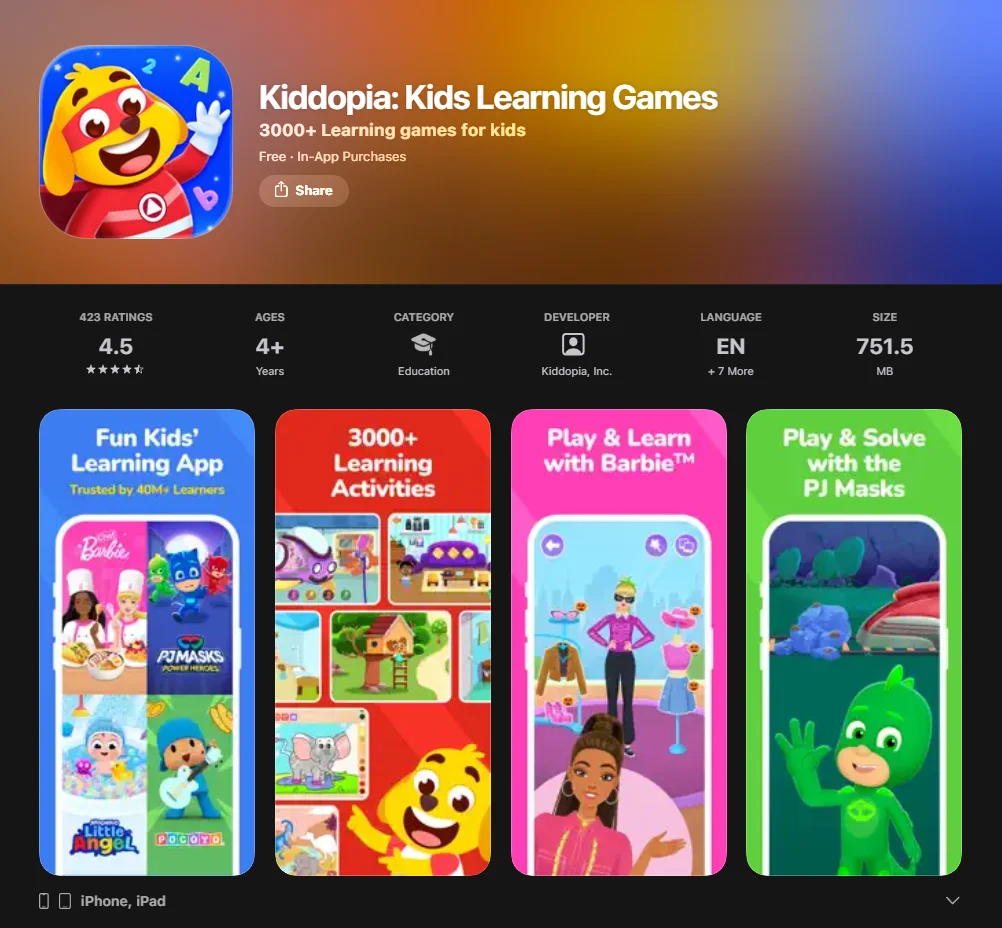
Kiddopia is an award-winning app for kids focusing on an “edutainment” philosophy. While Lingokids feels more like a structured classroom, Kiddopia resembles an interactive learning playground. Designed primarily for toddlers and preschoolers (ages 2–7), it places heavy emphasis on creativity and problem-solving via open-ended kids games.
The platform is renowned for its vibrant, high-energy animation and a massive and expanding library advertised in app stores as offering 3,000+ games and activities, though some pages still reference 1,000+ games, reflecting ongoing content growth. It covers the standard preschool curriculum—abcs, math, and science—but stands out by including “real-life” learning activities like cooking, pet care, and even basic coding.
Kiddopia Core Features
- STEAM Focus: Integrated learning games blending Science, Technology, Engineering, Arts, and Math.
- Role-Playing Activities: Games for kids allowing them to “work” as doctors, chefs, or farmers to foster problem-solving skills.
- Creativity Suite: Robust tools supporting drawing, coloring, and music composition.
- Regular Content Updates: New games and activities are typically added every two weeks, keeping the experience fresh and engaging.
Kiddopia Learning Methodology
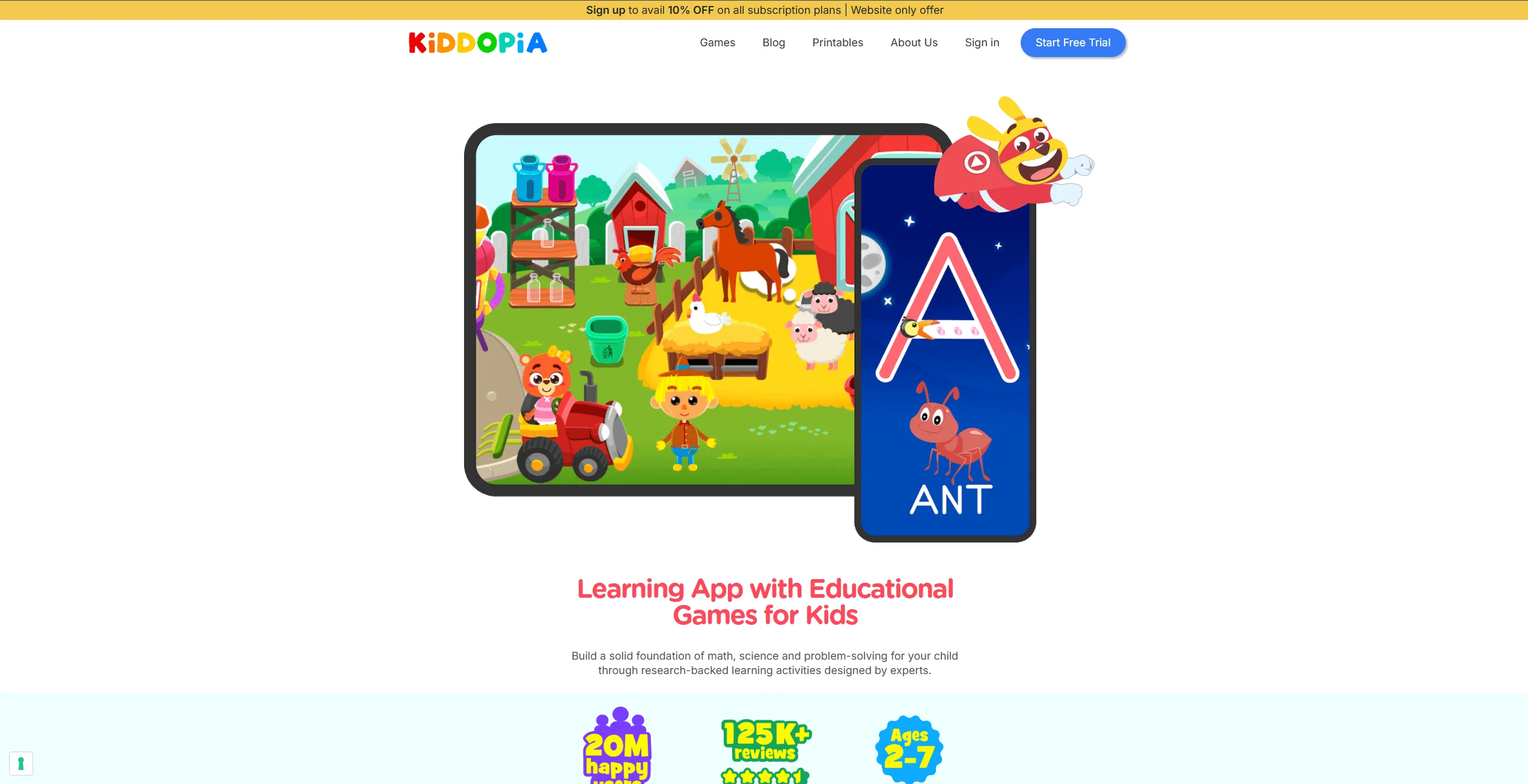
Unlike the more structured learning paths found in some educational apps, Kiddopia encourages children to explore freely. The methodology is exploration-based, giving children choice. While progressive learning elements exist in the math and science sections, the overall design prioritizes interactive learning through play rather than a linear curriculum.
Kiddopia Advantages
The variety of games and activities is Kiddopia’s biggest selling point. It is incredibly fun to play, and the gamification elements—like earning stickers—effectively maintain a child’s attention. Kiddopia operates on a subscription model and is ad-free within the paid experience. While the app includes in-app purchases (for subscription activation), it does not contain third-party advertisements in the subscribed version.
Kiddopia Limitations
The app’s open-ended nature can be a double-edged sword. Some parents find that without a strictly guided learning path, children might gravitate toward the “fun” kids games and skip challenging math or literacy exercises. Additionally, like Lingokids, the full experience requires a paid subscription, and the free app version offers limited access.
Parent Feedback on Kiddopia
Users frequently highlight how the app keeps them engaged during long car rides. Parents of toddlers especially love the shapes and colors activities. Some parents, however, have noted the app can be quite stimulating, requiring close screen time monitoring to prevent overstimulation.
Lingokids vs Kiddopia Feature Comparison

When choosing between these platforms, it’s important to consider how they address specific learning objectives. Both apps provide a safe ad-free experience, but their execution differs.
Curriculum Structure Comparison
Lingokids suits parents preferring a learning program that mirrors school-like progression. It uses a learning path systematically introducing phonics, literacy, and math. In contrast, Kiddopia offers an exploratory curriculum. It prioritizes making learning fun through discovery, where the child decides the topic and timing.
Subjects and Skill Development
| Feature | Lingokids | Kiddopia |
| Primary Focus | English learning & Communication | Broad Preschool & STEAM |
| Math Content | Foundation to Early Grade 1 | Discovery-based & Real-world puzzles |
| Literacy | Extensive Phonics & Sight Words | Basic ABC & Spelling Games |
| Creativity | Art & Music Videos/Activities | Open-ended Drawing & Role-play |
| Modern Skills | Emotional Intelligence (SEL) | Coding Basics & Life Skills |
Engagement and Game Design
Kiddopia generally wins on pure entertainment value. The animation is fast-paced and the interactive learning is highly responsive. Lingokids is also fun and engaging, but it relies more on catchy songs and a consistent cast of characters to build a familiar learning environment.
Safety and Ad Policy
Both apps remain completely free of third-party advertisements in their paid versions. Both apps state compliance with COPPA and kidSAFE standards. Lingokids offers built-in screen time limits within the app. Kiddopia provides a parent-gated environment, though screen time controls may depend on device-level parental settings rather than in-app timers. Lingokids offers a slightly more robust “Parent Area” providing detailed reports on the learning objectives met.
Device Compatibility and Accessibility
Both apps are available on the App Store and Google Play. They support offline access, which is essential during travel. Lingokids allows up to four child profiles on one account, making it a great app for kids in multi-child households. Kiddopia also supports multiple profiles and is optimized across tablets and smartphones.
Lingokids vs Kiddopia Pricing Comparison
Understanding the cost helps families decide. Both apps follow a subscription model, the industry standard among best learning apps.
Lingokids Subscription Plans
- Monthly: Approximately $14.99/month.
- Annual: Often discounted to around $5.99/month (billed annually at ~$71.88).
- Trial: Usually offers a 7-day free trial.
- Note: Prices may vary based on regional promotions in 2026.
Kiddopia Subscription Plans
Pricing varies by region and platform. In many markets, monthly plans range between $12.99–$19.99, and annual plans may range from approximately $70–$120 per year depending on country, platform, and promotional offers. Always check the App Store or Google Play listing in your region for current pricing. Standard 7-day free trial available.
Free Version Comparison
Neither app is truly a free app long-term. The free version of Lingokids limits daily activities. Kiddopia’s free access is similarly restricted, acting more as a demo than a sustainable learning program. For a completely free alternative, parents often explore Khan Academy Kids.
Value Evaluation
If the goal is targeted language learning and a structured learning path, Lingokids offers excellent value. If you’re looking for a wide range of educational games — from math concepts to role-playing activities like being a dentist — Kiddopia provides a broader library at a slightly lower monthly price.
How to Choose Between Lingokids and Kiddopia

Choice Based on English Language Focus
If your child’s learning priorities include mastering phonics, expanding vocabulary, and improving pronunciation, Lingokids is the superior choice. Its Oxford University Press partnership provides a level of literacy expertise hard to match.
Choice Based on Broad Preschool Curriculum
Kiddopia is the best educational bet for preschoolers who love variety. It covers a wider range of “general knowledge” and STEAM topics, making it ideal for curious kids to explore different interests every day.
Choice Based on Budget
Kiddopia tends to be slightly more budget-friendly on a month-to-month basis. However, both apps offer significant savings via annual plans. Always check the App Store for seasonal discounts before subscribing.
Choice for High Engagement Needs
If a child loses interest quickly, Kiddopia’s fast-paced gamification is designed to keep them engaged. Constant rewards and diverse kids games prevent the “boredom wall” some children hit with academic apps.
Choice for Homeschool Support
Lingokids offers better reporting tools. Families using these apps for learning to supplement homeschooling will find the ability to track specific math and science or literacy progress invaluable.
Lingokids vs Kiddopia by Age Group
Toddlers 2–3 Years
At this stage, both apps focus on foundational concepts such as shapes and colors. Kiddopia’s “Buzzle” and motor skill games are excellent. Lingokids offers simple songs and videos that are easy and fun for a toddler to follow without frustration.
Preschool 4–5 Years
This is the “sweet spot.” Lingokids excels at phonics readiness, while Kiddopia shines with interactive learning challenges preparing kids for the social and cognitive demands of kindergarten.
Early Elementary 6–8 Years
Lingokids scales better into early elementary school, especially with its advanced reading and math foundations. Kiddopia may start to feel too simplistic, as its content is heavily geared toward the preschool mindset.
Educational Benefits of Learning Apps for Kids
When used thoughtfully and in moderation, educational apps can be a helpful addition to a child’s learning routine.
Cognitive Skill Development
Interactive learning games require problem-solving skills, memory, and spatial awareness. Apps like Kiddopia challenge kids to figure out sequences and logic puzzles, which are foundational skills.
Language and Literacy Growth
Educational apps such as Lingokids and Duolingo ABC use multisensory approaches—combining sight, sound, and touch—to reinforce phonics and literacy. This variety helps diverse learners succeed.
Math and Logical Thinking Skills
Turning math into a game involving shapes and colors removes numerical “fear.” Children learn to count and categorize before even realizing they are practicing math.
Screen Time Balance
The American Academy of Pediatrics (AAP) recommends limiting high-quality screen time to about one hour per day for children aged 2 to 5. Experts recommend “co-viewing,” where parents watch or play alongside the child to reinforce learning objectives.
Real Parent Experience and Practical Use
Engagement Over Time
While children often love these apps initially, retention depends on content updates. Kiddopia is particularly good at refreshing its library, while Lingokids relies on its deep learning path to maintain momentum.
Ease of Use for Parents
An easy-to-use dashboard is important for parents. Lingokids provides weekly emails with progress reports, which many parents prefer over digging through app settings themselves.
Combining Lingokids and Kiddopia
Some families use both! You might use Lingokids for 20 minutes of structured literacy and allow Kiddopia for creative play later. This provides a balanced learning environment covering all bases.
Lingokids vs Kiddopia Final Verdict
Situations Favoring Lingokids
Choose Lingokids if the primary goal is academic preparation, specifically in English learning and literacy. It is the best learning app for kids who thrive with structure and character-driven stories.
Situations Favoring Kiddopia
Choose Kiddopia if you want a diverse, high-energy app designed to spark curiosity and creativity across many subjects. It is perfect for toddlers who enjoy interactive learning and role-playing.
Balanced Recommendation
Ultimately, the best app is the one your child enjoys and benefits from the most. Most platforms offer a free version or trial. We recommend downloading both, letting your child play, and observing which one motivates them more.
Frequently Asked Questions
Is Lingokids or Kiddopia Better for Different Age Groups?
Lingokids generally suits a wider age range, specifically children from 2 to 8 years old, because its curriculum scales into complex reading and math. Kiddopia is a powerhouse within the 2 to 6 age bracket, offering a highly engaging environment for toddlers and preschoolers, but it may lose appeal as children enter later elementary years and require more academic depth.
Are Lingokids and Kiddopia Suitable for Toddlers?
Both apps are highly suitable starting at age 2. They feature intuitive, kid-centric designs that do not require reading skills to navigate. Kiddopia often appeals to the youngest users because of its bright animations and simple cause-and-effect games, while Lingokids uses music and repetition to teach basic concepts like colors and animal names.
Can Lingokids Replace Preschool Curriculum?
While Lingokids is an exceptional educational tool, it is designed to supplement rather than replace a full preschool curriculum. It provides excellent reinforcement for literacy, math, and social-emotional skills, but it lacks the physical social interaction and hands-on sensory play that are vital components of a traditional preschool environment.
Does Kiddopia Offer Structured Learning Progression?
Kiddopia is primarily an exploration-based app, meaning it encourages kids to jump between different games and activities freely. While there is a sense of progression within specific modules—such as math levels getting harder—it does not enforce a single linear learning path in the same way that a more academic app like Khan Academy Kids or Lingokids might.
Which App Offers Better Value for Price?
Value depends on your family’s needs. If you value a structured, teacher-approved curriculum with a focus on language mastery, Lingokids offers high value. If you prefer a massive variety of games that keep a child entertained while they learn diverse life skills and creative arts, Kiddopia is often considered the more budget-friendly option based on its content volume.
Can Both Apps Be Used Together?
Yes, many parents find these apps complement each other well. You can use Lingokids for “focused” learning time to work on phonics and numbers, and treat Kiddopia as “choice” time where the child can explore creative interests like cooking or music. Using them together covers both the academic and creative needs of a developing child.
How Much Screen Time Is Appropriate for Learning Apps?
Pediatric experts generally recommend limiting high-quality screen time to about one hour per day for children aged 2 to 5. For children over 6, the focus should be on a healthy balance between digital activities, physical play, and sleep. Using a timer or built-in parental controls helps maintain these boundaries while ensuring the time spent is educational.

Take a short quiz to find out what your everyday choices say about your parenting style
When your child is curious about something new, what’s your instinct?
Take a short quiz to find out what your everyday choices say about your parenting style
“Can I download this app?” What happens next?
Take a short quiz to find out what your everyday choices say about your parenting style
When it comes to rules at home, which sounds most like you?
Take a short quiz to find out what your everyday choices say about your parenting style
If you could give your child one life skill today, what would you pick?
Take a short quiz to find out what your everyday choices say about your parenting style
Your child gets to choose what to watch. What would your ideal setup look like?
Take a short quiz to find out what your everyday choices say about your parenting style
Pick your parenting superpower ✨



