
Reading Eggs vs Fast Phonics Comparison Guide: Features, Pricing, Age Suitability

 Discover a Free Education Video App for Kids
Pastory uses AI to personalize educational video content based on your child’s interests and personality. Safe, engaging, and built for curious young minds. Sign up now to stay updated and enjoy early access with a free trial
Choosing the right digital tool for your child’s literacy journey can feel like navigating a maze of “educational” buzzwords. If you have been exploring the Reading Eggs program, you have likely encountered its companion module, Fast Phonics. Both are developed by Blake e-Learning and are often bundled together, yet they serve distinct roles. While the main app offers a comprehensive path through the five pillars of literacy, Fast Phonics is a specialized tool focused strictly on systematic synthetic phonics.
This guide provides a neutral, expert comparison of both platforms. We will break down their curricula, age suitability, and pricing to help you determine which approach—or combination—is the best fit for your young learner. Whether you are a homeschooling parent or a teacher looking for classroom supplements, understanding the nuances between these two systems is key to fostering reading success.
What Is Reading Eggs
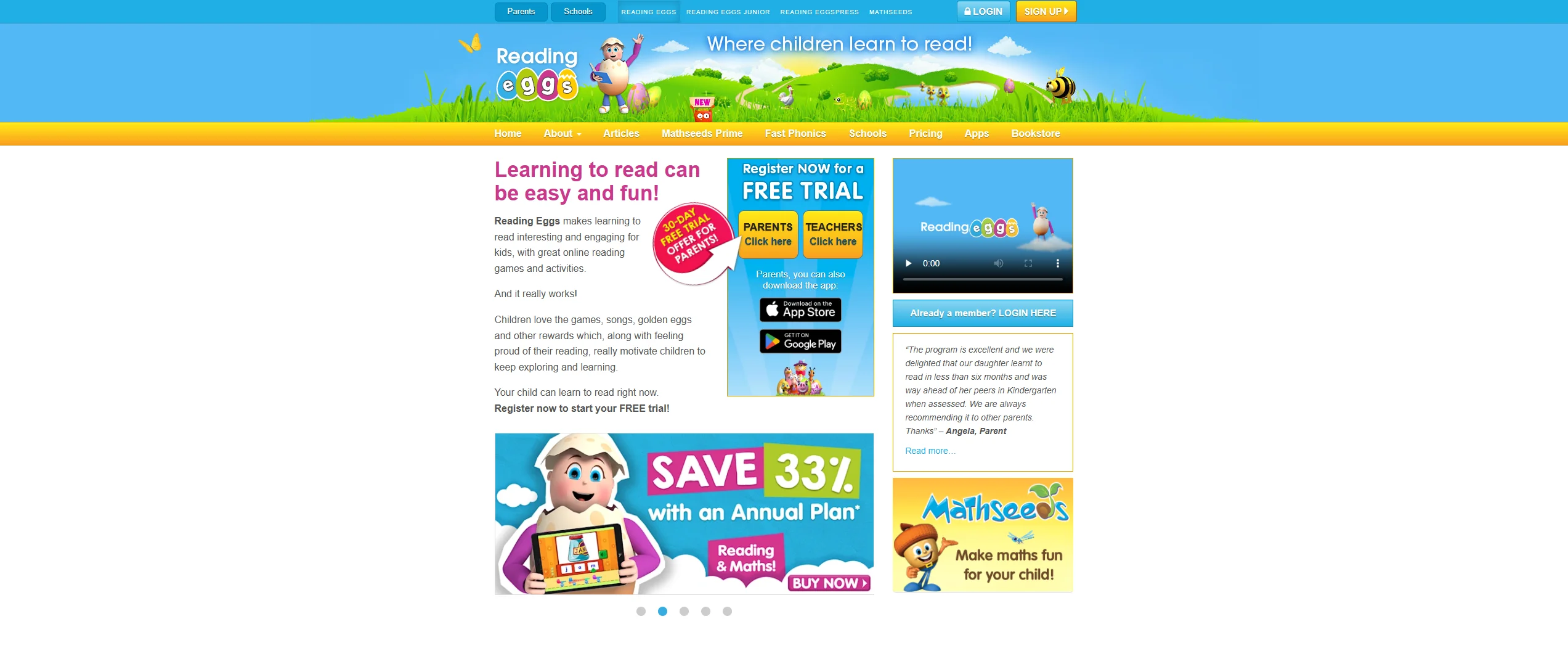
This award-winning reading program is designed to support children as they progress from non-readers to confident, fluent readers. It uses a structured pathway that blends multiple instructional strategies, including phonemic awareness, sight words, and comprehension. The core philosophy is to make learning feel like a game, utilizing a “map-based” progression where children complete tasks to move their avatar across a digital world.
The platform is highly adaptive, meaning it adjusts to a child’s pace. It doesn’t just focus on the mechanics of decoding; it emphasizes the joy of books by providing a digital library of 4,000+ e-books (as stated on the current official pricing page; older materials may reference 3,500+ titles). For many families, it serves as a core reading supplement that covers everything from the first letter sound to advanced reading comprehension, vocabulary, spelling, and grammar skills in the later stages.
Program Structure and Levels
The platform is divided into several sub-sections tailored to specific developmental stages:
- Junior (Ages 2–4): Focuses on pre-reading skills like alphabet knowledge through songs and play.
- Core Maps (Ages 3–7): Consists of 120 lessons that cover phonics skills, sight words, and basic sentence structure.
- Reading Eggspress (Ages 7–13): Shifts focus toward reading comprehension, advanced spelling skills, and grammar.
Children progress by completing “maps.” Each map contains 10 units, and each ends with a quiz. Students earn “Golden Eggs” as rewards for completing lessons and quizzes. These rewards can be used within the platform’s incentive systems (such as avatar items and in-program reward features), helping motivate continued progress.
Skills Covered
The system is a “broad-spectrum” literacy tool. It specifically targets:
- Phonemic Awareness: Identifying and manipulating sounds (phonemes) in spoken words.
- Decoding: Learning the relationship between letters (grapheme) and sounds.
- Vocabulary: Expanding the bank of words a child understands and uses.
- Fluency: The ability to read words and sentences accurately and with expression.
- Comprehension: Ensuring the child actually understands the “why” and “how” behind the story.
Age Range and Grade Focus
While the general guideline is ages 2 to 13, the software is skill-dependent rather than strictly age-bound. A 5-year-old who is already decoding may jump into the later maps, while a struggling 9-year-old might find the spelling skills section of Eggspress perfectly suited to their remedial needs.
Placement Test and Starting Level
To ensure a child isn’t bored or overwhelmed, the journey starts with a placement test. This assessment determines their current phonics knowledge and literacy level, dropping them into the exact spot on the map where they will be most challenged without being frustrated. Parents can reset or retake this assessment at any time.
What Is Fast Phonics
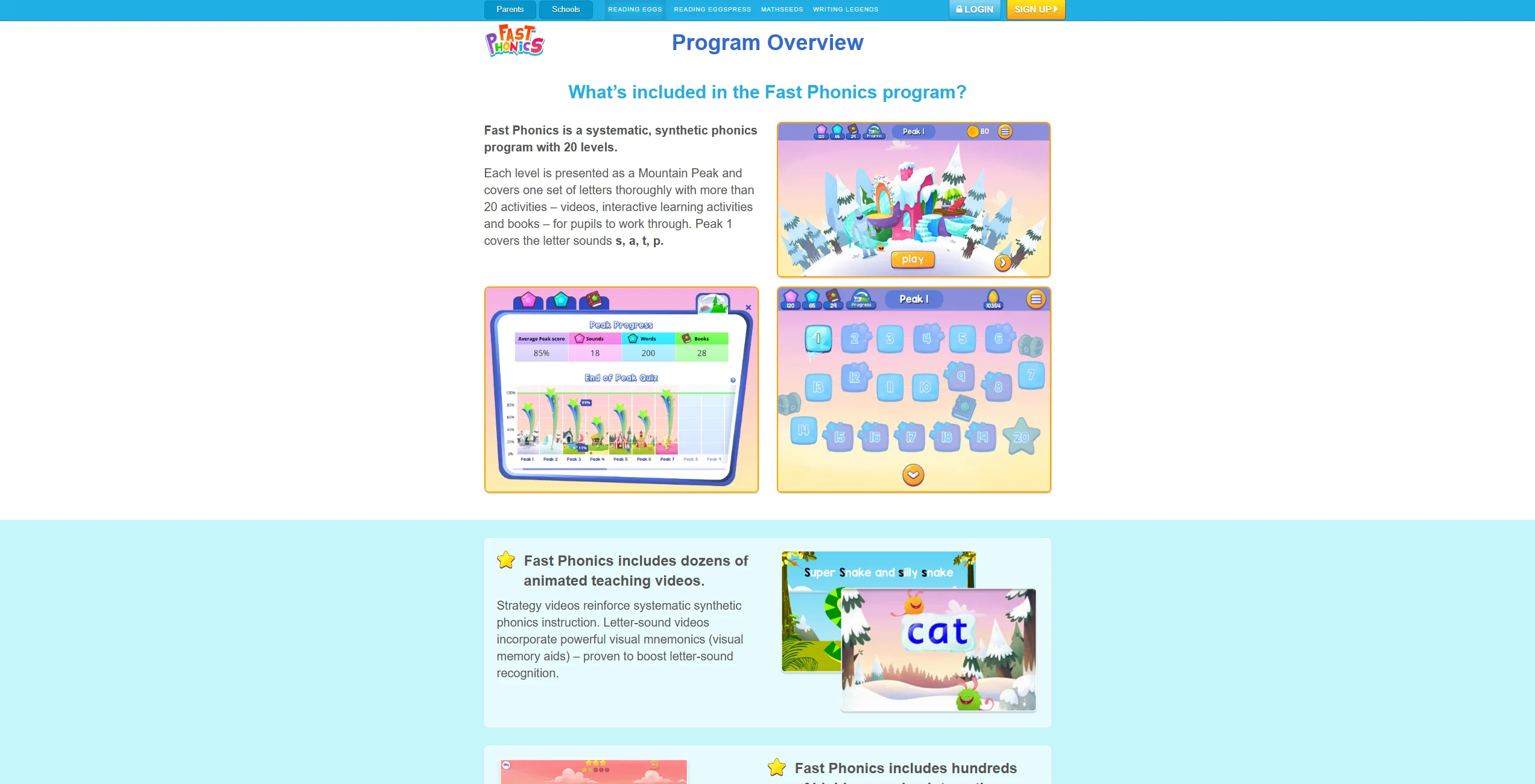
This module was added to the Reading Eggs subscription suite in 2022 and is designed as a systematic synthetic phonics program aligned with structured literacy principles. Unlike the broader main app, which uses a variety of methods, this component is “phonics-first.” It is modeled after the systematic synthetic phonics approach and is intended to get children decoding words as quickly as possible.
Phonics-First Instruction Approach
This tool uses explicit phonics instruction. It starts with a small set of sounds and immediately teaches children how to blend those sounds into words. For example, once a child knows /s/, /a/, /t/, and /p/, they are shown how to blend sounds to read “sat,” “pat,” and “tap.” This systematic method reduces reliance on contextual guessing based on pictures or initial letters.
Lesson Organization and Sequence
The curriculum is organized into 20 peaks (levels), styled after mountain climbing. Each peak focuses on a specific set of sound-letter correspondences.
- Instruction: Animated videos introduce the new sounds using visual mnemonics.
- Practice: Engaging phonics activities like “segmenting and blending” games.
- Review: Regular check-ins to ensure the child retains the sounds long-term.
- Assessment: An “End of Peak” quiz that acts as a gatekeeper to the next level.
Decodable Books and Practice Activities
A standout feature is the inclusion of fully decodable books aligned with the sequence of taught sounds. In this mode, children only encounter words in stories that contain the sounds they have already learned. These decodable readers build immense confidence because the child can actually “unlock” every word on the page using their current phonics knowledge.
Target Learners and Reading Level
The peaks are primarily aimed at early readers (ages 5–10) or any student who needs a “booster shot” in their decoding ability. It is particularly effective for struggling readers or English Language Learners (ELL) who need a more systematic way to learn to read.
Key Differences Between Reading Eggs and Fast Phonics
While they live in the same interface, the experience and educational philosophy differ.
Curriculum Scope Comparison
| Feature | Reading Eggs | Fast Phonics |
| Primary Goal | Comprehensive Literacy (Reading + Writing) | Rapid Decoding (Phonics Mastery) |
| Instructional Method | Blended (Sounds, Sight Words, Context) | Systematic Synthetic Phonics |
| Content Focus | Comprehension, Fluency, Vocabulary | Phonemic awareness and phonics |
| Reading Material | Wide variety of fiction/non-fiction | Strictly decodable books |
Learning Goals and Outcomes
The core app aims for “whole-child” development. The goal is for a child to understand the story, build a rich vocabulary, and learn to spell. The peaks maintain a strong focus on the mechanics of phoneme–grapheme correspondence and decoding. The goal is for a child to see a word they’ve never seen before and have the tools to sound it out accurately.
User Experience and Engagement Style
The main map is whimsical and exploratory. Fast Phonics features a more fast-paced, high-energy environment centered around a Yeti guide character. While both use games and activities, the mountain climbing feels more like a focused “sprint,” whereas the islands are a “marathon” through a larger world.
Standalone Availability
It is important to note that you cannot buy the peaks as a separate product. It is an integrated module. When you subscribe to the suite, Fast Phonics is included at no additional cost.
How the Programs Are Organized
Both programs provide detailed progress reporting, giving parents a clear view of what their child is learning.
Lesson Flow Comparison
In the core maps, a unit typically follows a “Watch, Play, Read” cycle. In the mountain peaks, the flow is even tighter:
- Introduction: A “strategy video” explains a concept like segmenting and blending.
- Interactive Tasks: Students complete roughly 20 engaging activities per peak.
- The Book: Students read a story that perfectly matches the peak’s sounds.
- The Quiz: A final check to celebrate learning and unlock the next peak.
Skill Reinforcement Methods
Both tools use “spiraling,” returning to old sounds while introducing new ones. However, the mountain path is more repetitive by design, ensuring that key phonics skills like vowel digraphs are mastered before moving to complex phonics like split digraphs.
Progress Tracking and Reporting Tools
Parents can access detailed progress reports in the parent dashboard and may receive regular email updates (particularly in school-linked accounts) summarizing reading activity, lessons completed, quiz results, and overall progress.
Pros and Cons Comparison
Reading Eggs Strengths
- Variety: Keeps children from getting bored with over 3,000 digital books.
- Comprehensive: Covers the “Five Pillars” of literacy development.
- Independence: Most children can use it with minimal parent intervention.
- Placement: The placement test is remarkably accurate.
Reading Eggs Limitations
- Pacing: Some parents report that the progression may feel slow for children who acquire reading skills quickly.
- Screen Time: Like all apps, it requires a digital device.
- Guessing: The inclusion of some “whole word” strategies may lead some kids to guess based on pictures.
Fast Phonics Strengths
- Effective: The synthetic phonics approach is widely regarded by literacy researchers as one of the most evidence-based methods for early decoding instruction.
- Focused: Perfect for “filling the gaps” for a student who can’t seem to blend sounds.
- Confidence Building: Decodable readers ensure the child never feels like a failure.
Fast Phonics Limitations
- Scope: It doesn’t teach high-level reading comprehension or creative writing.
- Intensity: The fast-paced nature might be overstimulating for very young children.
Pricing and Subscription Comparison
The following prices reflect the current official USD pricing listed on the Reading Eggs website. Always check the official site for regional variations or promotional offers.
Reading Eggs Subscription Plans
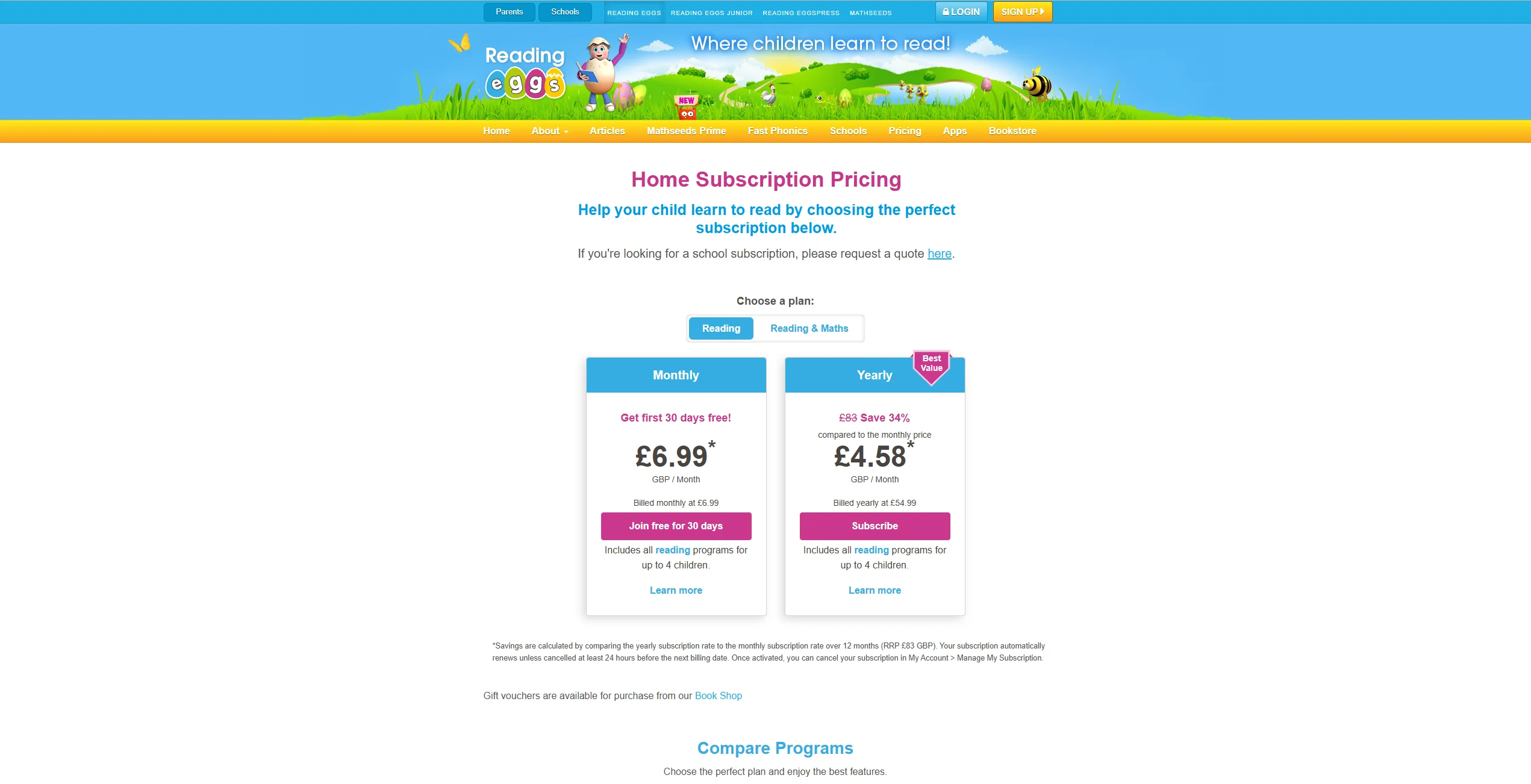
Most families opt for either a monthly or annual plan.
- Monthly Subscription: $9.99 per month (Reading plan) or $13.99 per month (Reading & Math plan). The Homeschool Max plan is $41.90 per month.
- Annual Subscription: $69.99 per year (Reading plan), $99.99 per year (Reading & Math plan), or $299.00 per year (Homeschool Max plan).
Bundles Including Fast Phonics
The “Suite” almost always includes:
- Reading Eggs Junior
- Reading Eggs core program
- Reading Eggspress
- Fast Phonics
- Mathseeds (included in the Reading & Math and Homeschool Max plans; not included in the Reading-only plan)
Value for Money Analysis
Since one subscription covers up to four children, the overall value may be particularly high for multi-child households. Compared to private tutoring, these provide a high-quality phonics program for a fraction of the cost.
Trial Period and Cancellation Policy
New home subscribers receive a 30-day free trial. Subscriptions renew automatically unless cancelled at least 24 hours before the next billing date. A 30-day money-back guarantee applies to initial web subscriptions (terms may vary for app-store purchases).
Age Suitability and Skill Level Comparison
The right program is determined less by a child’s age and more by their current reading challenges, such as difficulties with decoding sounds or understanding meaning.
Preschool and Kindergarten Learners
For this group, the Junior maps are the starting point. However, if a Kindergartener is ready to start reading, beginning with Fast Phonics Peak 1 may provide additional preparation aligned with early classroom phonics expectations.
First and Second Grade Students
This is the “sweet spot” for the peaks. Most school curricula at this age are heavily focused on phonics. Using this tool at home can reinforce the phonics instruction they receive in class.
Struggling or Reluctant Readers
The mountain peaks are often better for the “reluctant” reader because the tasks are short, snappy, and provide immediate rewards. It removes the “guesswork” that often makes students feel anxious.
Advanced Elementary Readers
Once a child is fluent, Reading Eggspress is the clear winner. At this stage, they may no longer require explicit phonics instruction and instead benefit more from the Reading Eggs library to build deeper comprehension and analytical skills.
Is Fast Phonics a Full Reading Curriculum?
In short: No. While it is an exceptional systematic synthetic phonics instruction tool, it is only one piece of the puzzle.
- Decoding Coverage: It is comprehensive in teaching how to read words.
- Comprehension: It is limited. It doesn’t teach deep inference or “reading between the lines.”
- When to Pair: For a balanced literacy approach, Fast Phonics can be used to strengthen decoding skills while the main program supports comprehension and broader literacy development.
Educator and Homeschool Use Cases
For Classroom Educators
Teachers often use the peaks for “Tier 2” intervention—small groups who need extra phonics knowledge reinforcement. The reporting and growth dashboard allows teachers to see exactly which phoneme a group is struggling with.
For Homeschool Families
The Reading Eggs program may be suitable for homeschooling families because it provides a structured scope and sequence aligned with many literacy standards. It acts as a digital “tutor” that handles the repetitive drill work, freeing the parent to focus on discussion.
Final Comparison Verdict
When Reading Eggs May Be a Better Fit
- Your child is a “whole picture” learner who loves stories.
- You want a single app that covers all aspects of literacy.
- Your child is a toddler or a preschooler just starting out.
When Fast Phonics May Be Better Fit
- Your child is struggling to blend sounds together.
- You want a strictly systematic synthetic phonics approach.
- Your child needs high-incentive engaging activities to stay focused.
When Combined Use Makes Sense
The most effective strategy is to use the peaks as the “heavy lifter” for decoding and allow the child to “play” in the broader islands to build their reading comprehension and love for books.
FAQ
Is Reading Eggs or Fast Phonics Better for Different Age Groups?
The main platform is generally more versatile across the entire 2 to 13 age range because it adapts from basic recognition to advanced comprehension. The mountain peaks are specifically optimized for the 5 to 10 age group where the primary goal is mastering the mechanics of decoding. If your child is under 5, the core app is the better starting point, whereas an older student with gaps in their decoding would benefit more from the targeted nature of the peaks.
Can Fast Phonics Replace Reading Eggs?
The peaks cannot fully replace the main app because they do not cover the full spectrum of literacy skills like long-form comprehension or advanced vocabulary. It is a specialized tool for decoding mastery. While a child can learn to sound out words using only the peaks, they will eventually need the broader resources found in the core maps to become truly proficient readers who understand complex texts.
Are Both Programs Suitable for Struggling Readers?
Yes, both offer significant support for students who find literacy difficult, but they do so in different ways. The peaks help by providing a very clear, predictable structure that removes the frustration of guessing. The main app helps by using high levels of gamification and variety to keep a discouraged reader engaged. Many parents find that starting a struggling reader on the peaks builds the “how-to” confidence they need to then succeed in the wider curriculum.
How Much Do Reading Eggs and Fast Phonics Cost?
Access to both tools is included in a single subscription to the educational suite. As of the current official pricing, a Reading plan costs $9.99 per month or $69.99 per year, while the Reading & Math plan costs $13.99 per month or $99.99 per year. Homeschool Max is $41.90 per month or $299.00 per year. There is no separate fee to “unlock” the peaks once you are a member of the platform.
Is a Placement Test Available in Both Programs?
The main app features a comprehensive assessment that evaluates overall ability across many skills. The peaks also include their own specific assessment to determine which level a child should start on based strictly on their decoding ability. This ensures that in either case, the child begins at a level that is challenging but achievable.

Take a short quiz to find out what your everyday choices say about your parenting style
When your child is curious about something new, what’s your instinct?
Take a short quiz to find out what your everyday choices say about your parenting style
“Can I download this app?” What happens next?
Take a short quiz to find out what your everyday choices say about your parenting style
When it comes to rules at home, which sounds most like you?
Take a short quiz to find out what your everyday choices say about your parenting style
If you could give your child one life skill today, what would you pick?
Take a short quiz to find out what your everyday choices say about your parenting style
Your child gets to choose what to watch. What would your ideal setup look like?
Take a short quiz to find out what your everyday choices say about your parenting style
Pick your parenting superpower ✨



