Paper Bridge STEM Challenge for Kids Coin Load Test

 Discover a Free Education Video App for Kids
Pastory uses AI to personalize educational video content based on your child’s interests and personality. Safe, engaging, and built for curious young minds. Sign up now to stay updated and enjoy early access with a free trial

Have you ever looked at a massive steel structure and wondered how it stays up while carrying thousands of cars? It seems like magic, but it is actually pure engineering! You don’t need a degree or a construction crew to explore these principles at home. In fact, you can dive into the world of physics using nothing more than a simple sheet of office paper and a handful of pocket change.
The paper bridge challenge is a classic hands-on STEM activity that transforms a flimsy piece of copy paper into a weight-bearing span. The goal is simple: build a bridge that crosses a gap between two supports and see how many pennies or coins it can support before it starts to collapse. Through this engineering task, kids step into the role of an engineer or designer, learning to test hypotheses, brainstorm solutions, and understand the science of structural integrity.
Paper Bridge Challenge Overview
Challenge purpose and learning goals
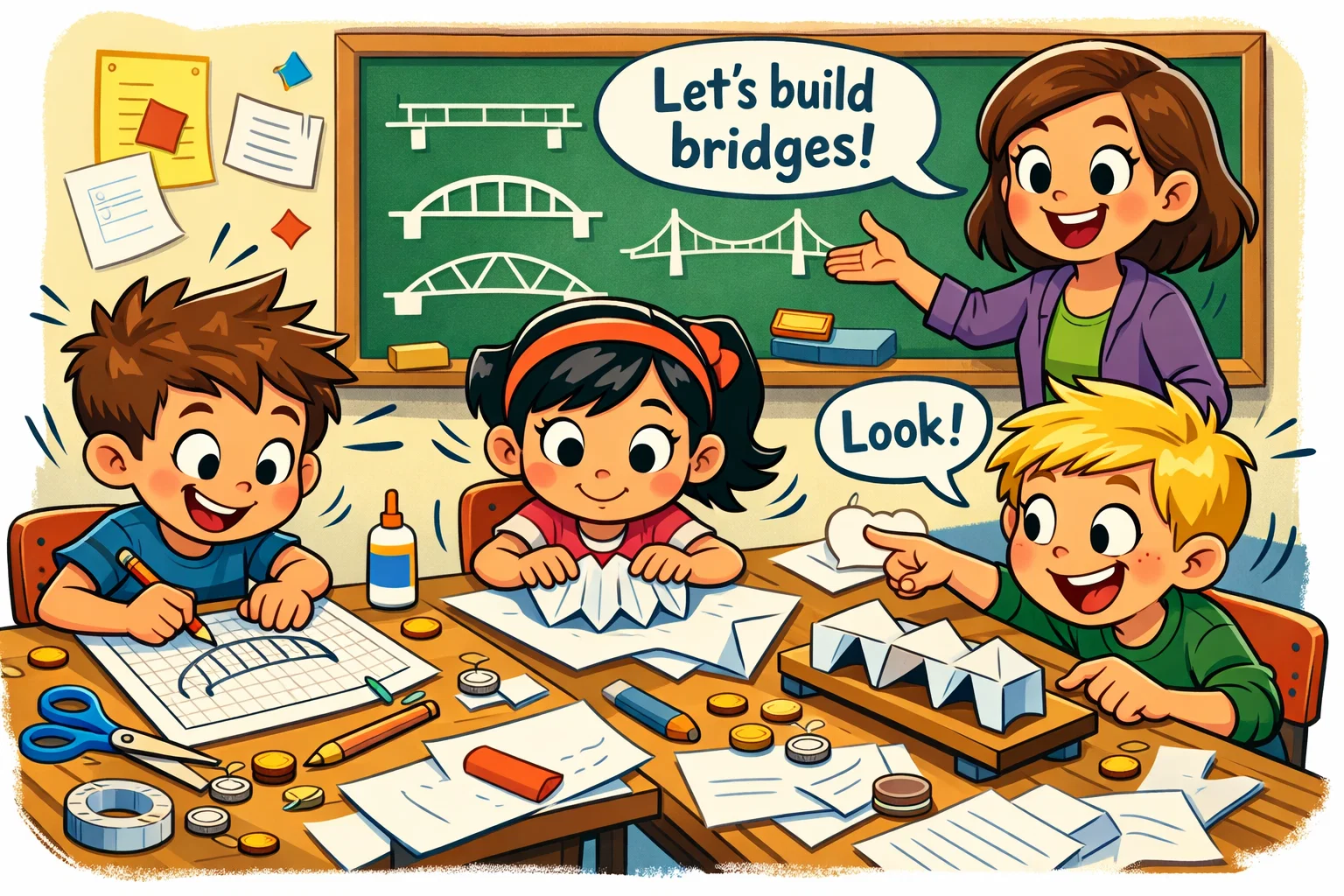
The primary aim of the paper bridge challenge is to encourage kids to think critically about how shapes affect strength. When a flat piece of paper laid across a gap fails almost instantly, it prompts the question: “How can I change this material to make it tougher?” This activity teaches the design-test-improve cycle, a cornerstone of technical thinking. Kids are expected to design and build a structure that can withstand a distributed load without the bridge collapsing under the weight.
Age range and skill level
This activity is incredibly versatile, making it one of the most popular STEM activities for various age groups:
- Preschoolers (Ages 3–5): Focus on the “wow” factor. It’s a great way to develop motor skills as they fold the paper and place coins.
- Elementary (Ages 6–10): Perfect for exploring science standards like the Next Generation Science Standards (NGSS). They can begin to record results and observations.
- Middle School (Ages 11+): Can be made more complex by adding strict constraints, such as limiting the type of paper or requiring a specific bridge span.
STEM concepts involved
At its heart, this is a lesson in physical science. Kids will encounter:
- Gravity: The force pulling the coins down.
- Load Distribution: Learning why stacking all the weight in one spot makes the bridge buckle.
- Structural Geometry: Discovering why certain shapes make a structure incredibly strong.
Science Behind Strong Paper Bridges
Understanding the science behind why a strong bridge stays up involves looking at the invisible forces at play. Even a simple design is a battleground between opposing mechanical stresses.
Forces acting on paper bridges
When you place a coin on a crossway, it creates a “load.” This load exerts a downward force. If the structural model isn’t strong enough to hold that force, the fibers will give way. Engineers look for balanced forces – where the structure provides an equal upward support force to the applied load.
Load distribution and point loads
A point load occurs when you stack all your coins or metal weights in one tiny spot. This concentrates the stress and usually leads to a quick collapse. A distributed load, however, spreads the number of pennies across the entire bridge span, allowing the craft to support significantly more weight.
Compression, tension, and bending
To build the strongest version possible, you must manage tension and compression:
- Compression: A pushing or squeezing force. The top of your span is usually being squeezed together.
- Tension: A pulling or stretching force. The bottom of the structure is being pulled apart.
| Force Type | Action | Effect on Material |
| Compression | Squeezing | Causes the fibers to wrinkle or buckle. |
| Tension | Stretching | Tries to pull the cellulose apart. |
| Torsion | Twisting | Can cause the structure to twist or rotate. |
Bridge Types
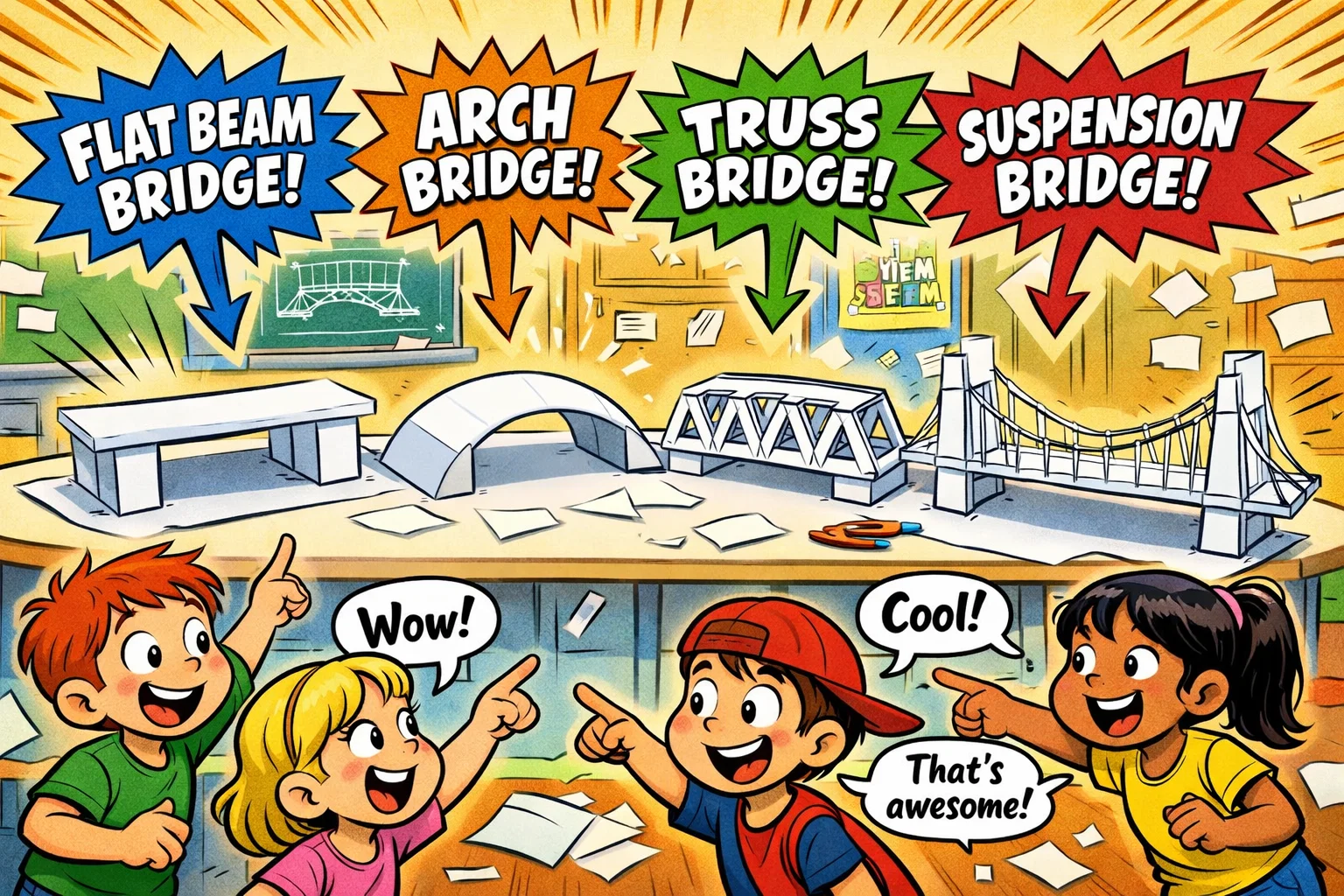
Before you start folding paper, it helps to know which structural design you are aiming for. Different geometries handle weight differently.
Beam design
The flat bridge is the simplest version of a beam design. While a flat piece of paper is weak, folding the paper into a “U” shape or a box beam creates a much stronger paper structure. The vertical sides of the fold act as “walls” that resist bending.
Arch design
An arch bridge redirects the weight outward toward the supports (the abutments). You can create this by wedging a curved sheet of paper between two heavy books. It is incredibly strong because the curve stays primarily in compression, transferring the load to the sides.
Truss design
A truss uses triangles to distribute weight. In a paper bridge STEM project, you can simulate this by creating an accordion fold (zig-zags). Triangles are the most rigid shape in geometry because they don’t change shape easily under heavy pressure.
Suspension-style paper bridge model
While harder to make with just one piece of paper laid, you can use materials like cardstock strips as “cables” to help hold weight. This teaches how pulling forces (tension) can support a roadbed from above.
Materials Needed for Paper Bridge Challenge
One of the best parts of fun stem activities is that you likely have everything you need in your desk drawers!
- Paper types: Experiment with copy paper, A4 paper, construction sheets, or materials like cardstock. Notice how stiffer paper performs compared to thinner sheets.
- Coins for load testing: Use many pennies, nickels, or washers. It is best to use the same type of currency so your data stays consistent.
- Supports: Two cups, boxes, or stacks of books work well.
- Optional tools: A ruler to measure the bridge span, scissors, and a small amount of adhesive (if your rules allow it).
Paper Bridge Challenge Step by Step
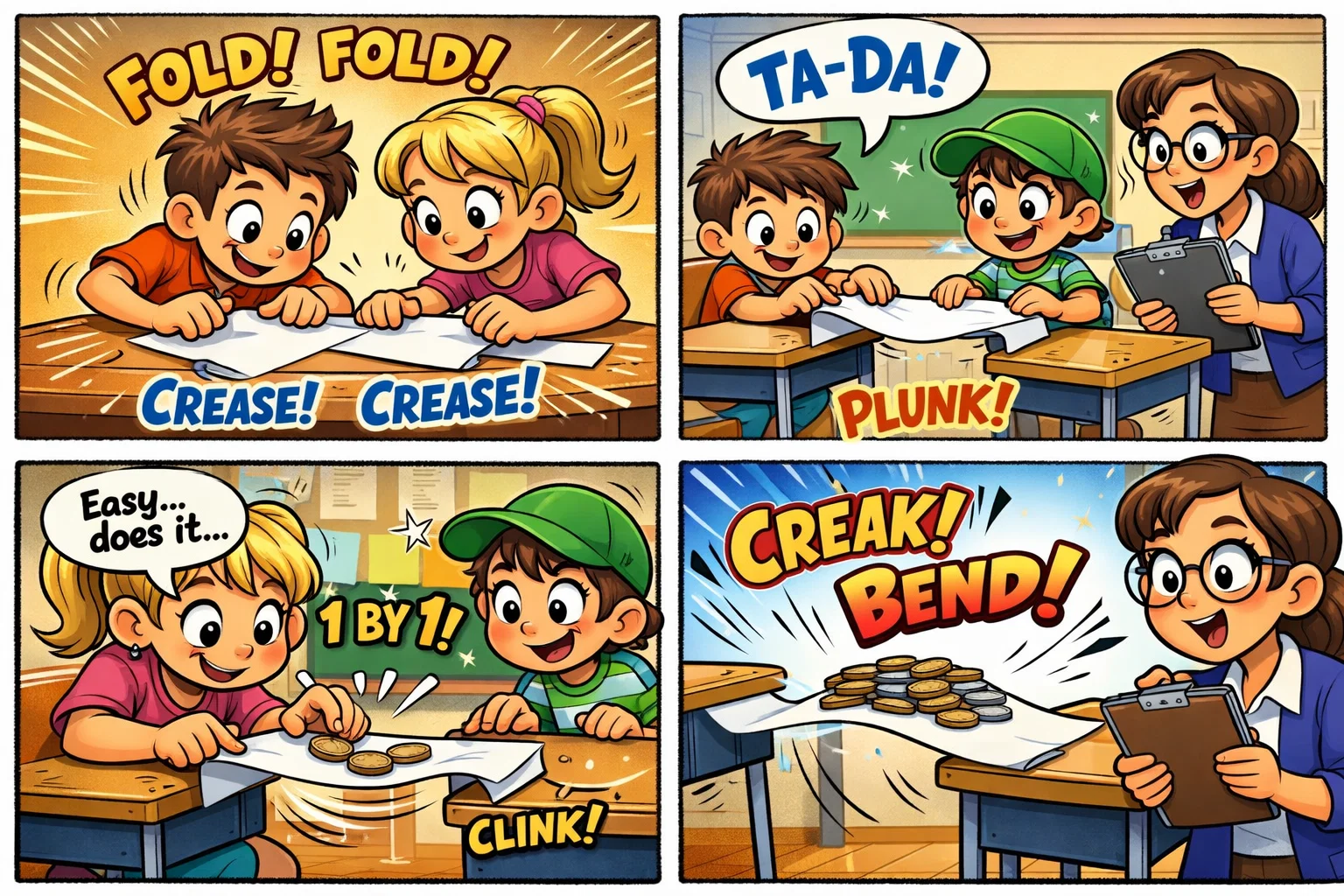
Ready to build a paper bridge? Follow these steps to conduct your own experiment with various designs.
1. Setup for coin load test
Set your two foundations (books or cups) on a level surface. Use a ruler to ensure they are about 6 inches (approximately 15 cm) apart. This gap represents the “canyon” that needs crossing.
2. Baseline flat paper bridge test
Start with a flat piece of paper laid across the gap. Predict how many coins it will hold. (Hint: It probably won’t be many!) Place a penny in the center and watch it collapse. This is your “control” for the trial.
3. Folding and shaping experiments
Now, fold your piece of paper. Try these common structural folds:
- The Half-Fold: Fold the paper in half lengthwise to create a double-layered beam.
- The “U” Channel: Bend up 1-inch walls on both sides.
- The Accordion: Crease the sheet back and forth like a fan.
4. Coin loading procedure
Place your model across the supports. Add coins one by one. To test hypotheses about load distribution, try placing them in a single stack first, then try a second design where you spread them out.
5. Recording results and observations
Keep an “Engineering Log.” Note the type of paper, the fold style, and the number of pennies it holds before the bridge buckles.
Expert Tip: “In structural engineering, failure is just another word for data. When the span collapses, look closely at where it broke. Did the material tear? Did it slide off the books? That ‘failure point’ tells you exactly where to reinforce your next iteration.”
Coin Load Test Methods and Variations
To make your paper bridge challenge truly scientific, you need to be consistent in how you apply the weight.
Central load versus distributed load
Does a bridge that holds 50 pennies spread out also hold 50 pennies in a stack? Usually, no. Spreading the load across the surface prevents any single point from reaching its breaking limit too quickly. This mimics how cars are spaced out on real highways.
Incremental loading strategy
Don’t just toss a handful of coins on. Add them slowly. This allows you to see the “deformation” – the way the strong paper bridge design begins to sag or twist – before the final collapse. Observing how the paper fibers stretch and deform provides great insight into material science.
Repeat testing for accuracy
Scientific practices suggest that you should test each bridge design at least three times. This ensures that a “fluke” (like a coin falling off the side or a gust of wind) doesn’t ruin your data set.
Advanced Paper Bridge Design Challenges
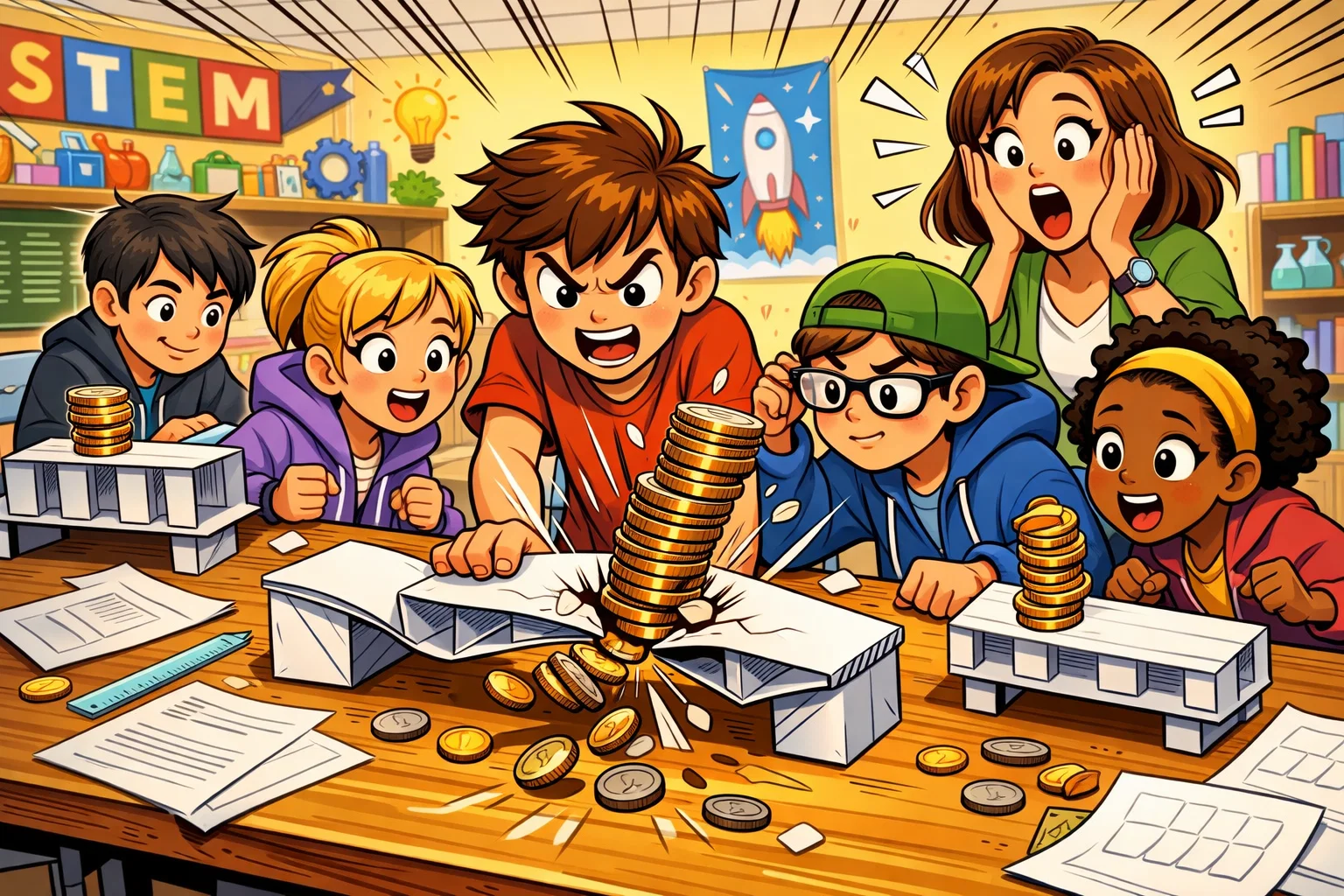
If the basic bridge building is too easy, try these advanced paper bridge design constraints to spark curiosity and creativity:
- Material Limitation: Can you build a strong bridge using only half a sheet of stationery?
- Span Length Challenge: Increase the gap from 6 inches to 10 inches. You’ll notice the bridge will buckle much easier as the span gets longer due to the increased leverage.
- The “Tape-Free” Rule: Build a crossing using only folding techniques – no adhesives allowed! This requires clever interlocking of the fibers.
- Weight Efficiency: Calculate the “Strength-to-Weight” ratio. Divide the number of pennies held by the weight of the structure itself. Sometimes a lighter model is more “efficient” than a bulky one!
Engineering Thinking for Kids
The bridge challenge teaches more than just physics; it teaches a systematic way of thinking. This is commonly known as the Engineering Design Process.
Design-test-improve cycle
Rarely does the first bridge design work perfectly. Engineers brainstorm solutions, build a prototype, test it until it fails, and then use that information to make the next version better. This iterative process is how every skyscraper and airplane is created.
Problem solving and teamwork
When kids work together to build a bridge, they have to communicate. One person might suggest folding the paper into a tube, while another wants a triangle. Negotiating these ideas is a vital life skill.
Real-world bridge connections
Look at photos of the Golden Gate Bridge or a local truss bridge. You’ll see the same triangles and arches you used in your paper bridge challenge. Seeing these real-world science and engineering connections helps kids realize that the world is built on these very physical laws.
Classroom and Home Activity Extensions
Data and math integration
Turn your stem activities into a math lesson. Create a table to compare your results.
| Design Type | Number of Pennies (Trial 1) | Number of Pennies (Trial 2) | Average (Coins) |
| Flat Sheet | 1 | 2 | 1.5 |
| U-Channel | 25 | 30 | 27.5 |
| Accordion | 50 | 55 | 52.5 |
Creative storytelling extension
Have the kids name their project and tell a story about what it is crossing. Is it a path over a lava pit? A crossing for a tiny kingdom? This keeps the engagement high for younger learners and adds an element of art to the science.
Common Paper Bridge Failure Points
Even the strongest paper bridge has a limit. Here is what to look for during your experiment:
- Buckling: This happens when the vertical walls of your fold “crimp” or fold over under pressure.
- Tearing: If the tension is too high, the fibers of the copy paper will actually rip apart.
- Tipping: If the bridge span is too narrow, the weight of the coins might make the structure flip over sideways.
More STEM Bridge Building Activities
If you enjoyed the paper bridge, don’t stop there!
- Straw and Craft Stick Bridges: Move from fiber sheets to materials that can handle even more weight, like wood or plastic.
- Egg Drop Challenge: Another classic stem activity that deals with forces, momentum, and protection.
- Build the Tallest Tower: Use the same folding principles to see how high you can go with just office supplies.
FAQ
Best paper bridge design for coins?
The accordion fold (corrugated) or the box beam (a square tube) usually holds the most weight. These designs create many vertical surfaces that resist compression.
Ways to make challenges harder for older kids?
Limit the materials to a single sheet of paper and no tape. Increase the span, or require the bridge to support a “moving load” (rolling a toy car across while it is loaded with coins).
Ways to simplify the challenge for younger children?
Reduce the gap between the supports and provide pre-creased pieces of material. Focus on counting the coins aloud together to build numeracy skills while observing the physical changes.
Other materials to test after paper?
Try materials like cardstock, aluminum foil, or even snack crackers! Comparing how different bridge materials react to weight is a fantastic way to extend the learning into chemistry and physics.
Take a short quiz to find out what your everyday choices say about your parenting style
When your child is curious about something new, what’s your instinct?
Take a short quiz to find out what your everyday choices say about your parenting style
“Can I download this app?” What happens next?
Take a short quiz to find out what your everyday choices say about your parenting style
When it comes to rules at home, which sounds most like you?
Take a short quiz to find out what your everyday choices say about your parenting style
If you could give your child one life skill today, what would you pick?
Take a short quiz to find out what your everyday choices say about your parenting style
Your child gets to choose what to watch. What would your ideal setup look like?
Take a short quiz to find out what your everyday choices say about your parenting style
Pick your parenting superpower ✨