Marshmallow Toothpick Tower Challenge for Kids

 Discover a Free Education Video App for Kids
Pastory uses AI to personalize educational video content based on your child’s interests and personality. Safe, engaging, and built for curious young minds. Sign up now to stay updated and enjoy early access with a free trial
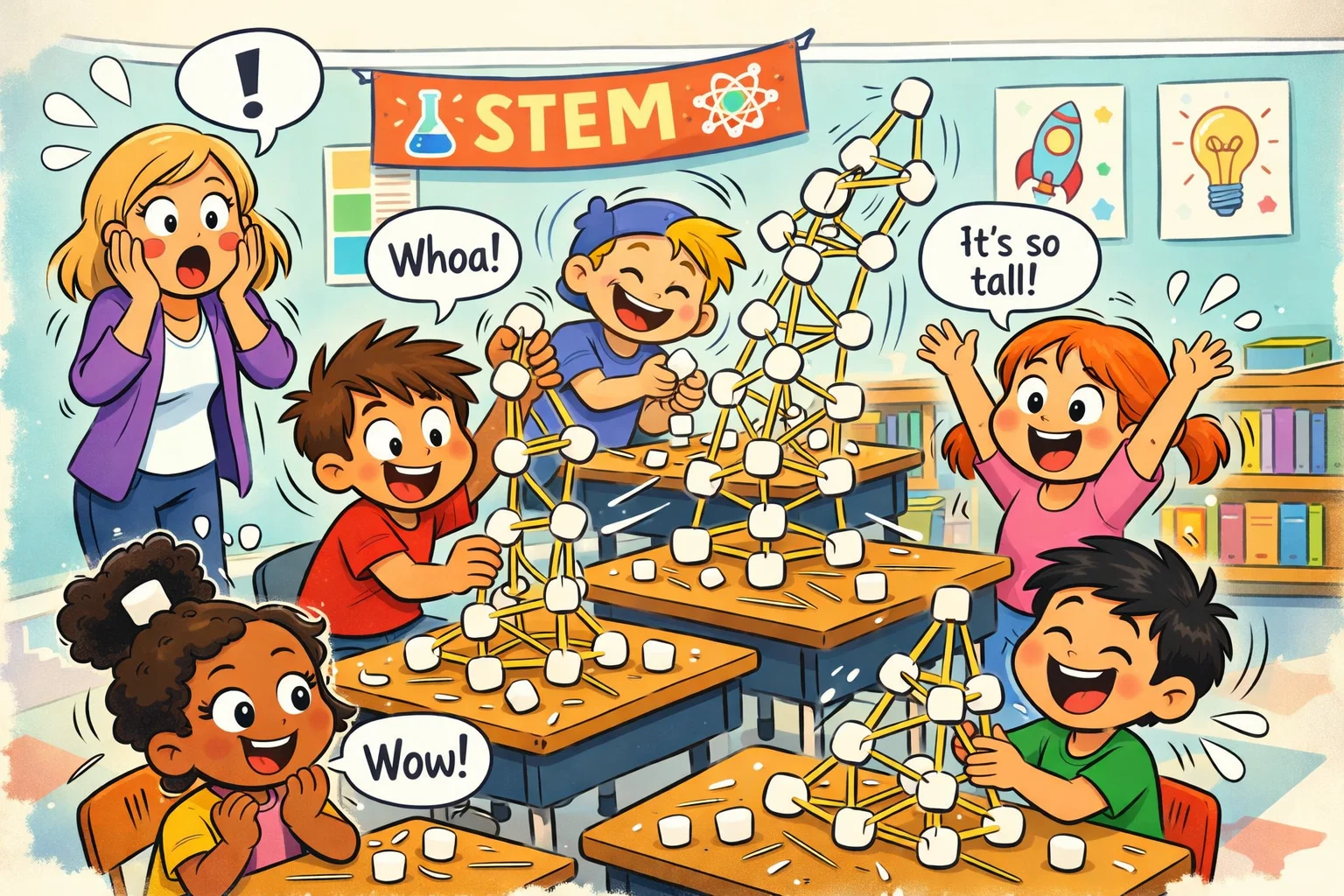
The marshmallow toothpick tower challenge is a classic STEM activity that has earned its place in classrooms and living rooms worldwide. It’s the perfect blend of hands-on engineering and low-cost materials, requiring nothing more than a bag of mini marshmallows and a box of toothpicks. At its core, this building challenge invites children to explore the fundamental principles of physics and mathematics while engaging in hands-on learning that feels like play-based learning.
Whether you are a teacher looking for a collaborative classroom project or a parent wanting to foster a growth mindset on a rainy afternoon, this marshmallow engineering task delivers. The goal is simple: using only these two materials, who can build the tallest free-standing structure? While the objective is straightforward, the path to a stable tower involves a deep dive into geometry, problem-solving, and iterative design. This activity is ideally suited for children ages 5 to 14, with the complexity scaling naturally as they move from simple 2D shapes to complex 3D shapes.
Marshmallow Toothpick Tower Challenge
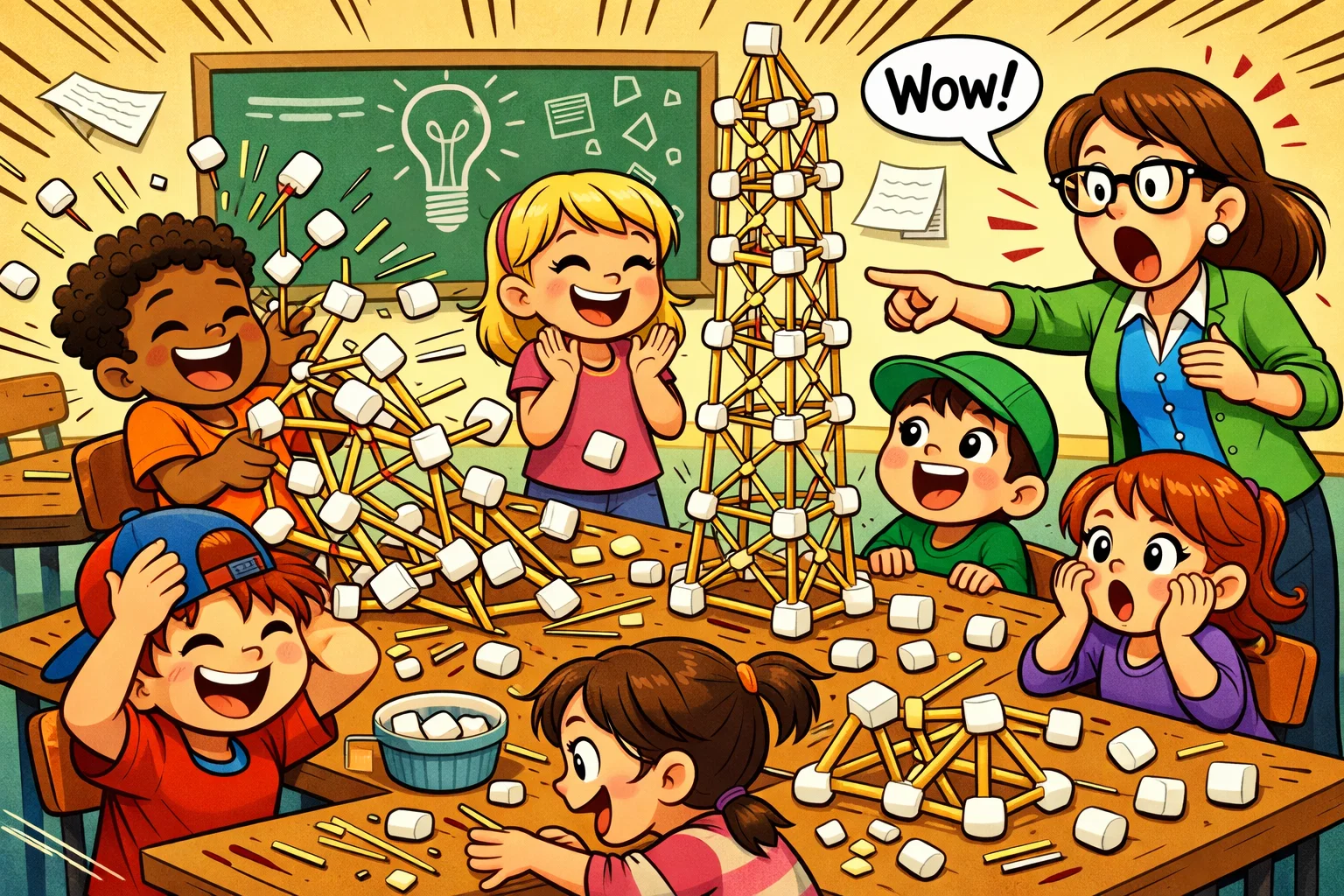
The marshmallow toothpick tower challenge is more than just a craft; it is a gateway to the engineering design process. In the world of STEAM (Science, Technology, Engineering, Arts, and Math), this activity serves as a primary lesson in structural integrity. Participants must combine soft, flexible joints (marshmallows) with rigid beams (toothpicks) to create an object that can withstand the force of gravity.
What the challenge involves
The concept is elegantly simple. Each child or team is given a specific set of materials – often around 30 toothpicks and 25 marshmallows – and a time limit. The primary instruction is to create a free-standing tower that can support its own weight without being taped or leaned against another surface. The building must be measured from the base to the highest point of the structure, often leading to an intense final few seconds as teams try to add one last level before the timer runs out.
Why kids love building towers
There is a primal joy in building something tall. For kids, the appeal lies in the tactile nature of the material – the squish of the marshmallow and the precision of the toothpick. It turns abstract math into something they can touch. Plus, the risk of a “tower fall” adds a layer of excitement. When a structure collapses, it isn’t a failure; it’s a hilarious, sticky experiment that provides immediate feedback for their next attempt.
Skills developed during the challenge
Participating in a marshmallow tower challenge nurtures several critical developmental areas:
- Fine Motor Skills: The act of pinching small marshmallows and carefully threading a sharp toothpick through them requires significant hand-eye coordination.
- Spatial Thinking: Kids must visualize how dimensional shapes will fit together in a three-dimensional space.
- Teamwork: In a group setting, children must develop communication skills, delegating roles such as “the sorter” or “the architect.”
- Problem-Solving: When a tower starts to lean, the engineer must analyze the angle and the base to find a solution before the whole thing topples.
Marshmallow and Toothpick Towers
When it comes to marshmallow and toothpick construction, the logic of the structure is what determines success. A tall tower isn’t just about stacking; it’s about understanding how forces such as tension and compression work together.
Tower shapes and design options
Kids often start by building a square or a rectangle. However, they quickly discover that these shapes tend to wobble. To build tall, they must transition into 3D shapes such as:
- Cubes: The most intuitive but least stable for height.
- Pyramids: Naturally stable because they have a wide base and a low center of gravity.
- Prisms: Specifically triangular prisms, which are the secret weapon of any young engineer.
Stable tower techniques
The secret to a free-standing masterpiece lies in stability.
- The Power of the Triangle: In structural engineering, triangles are highly resistant to deformation without changing the length of its sides. Encouraging kids to use triangular supports makes their towers significantly stronger.
- Wide Bases: Just like a skyscraper, the bottom of the marshmallow tower needs to be wider than the top to distribute weight effectively.
- Stale Marshmallows: A “pro tip” for parents: leave the bag open overnight. Slightly dried marshmallows are firmer and hold the toothpick more securely than fresh, gooey ones.
Common building mistakes
Most towers fall because of one of three things:
- Top-heaviness: Adding too many marshmallows at the top.
- Weak Joints: Poking the toothpick too far through or not deep enough.
- Over-complication: Trying to build a complex bridge or tower before securing the foundation.
| Feature | Square Base | Triangle Base |
| Stability | Moderate | High |
| Complexity | Simple | Slightly Higher |
| Weight Bearing | Low | High |
| Best For | Cubes/Rooms | Tall Towers |
Materials Needed
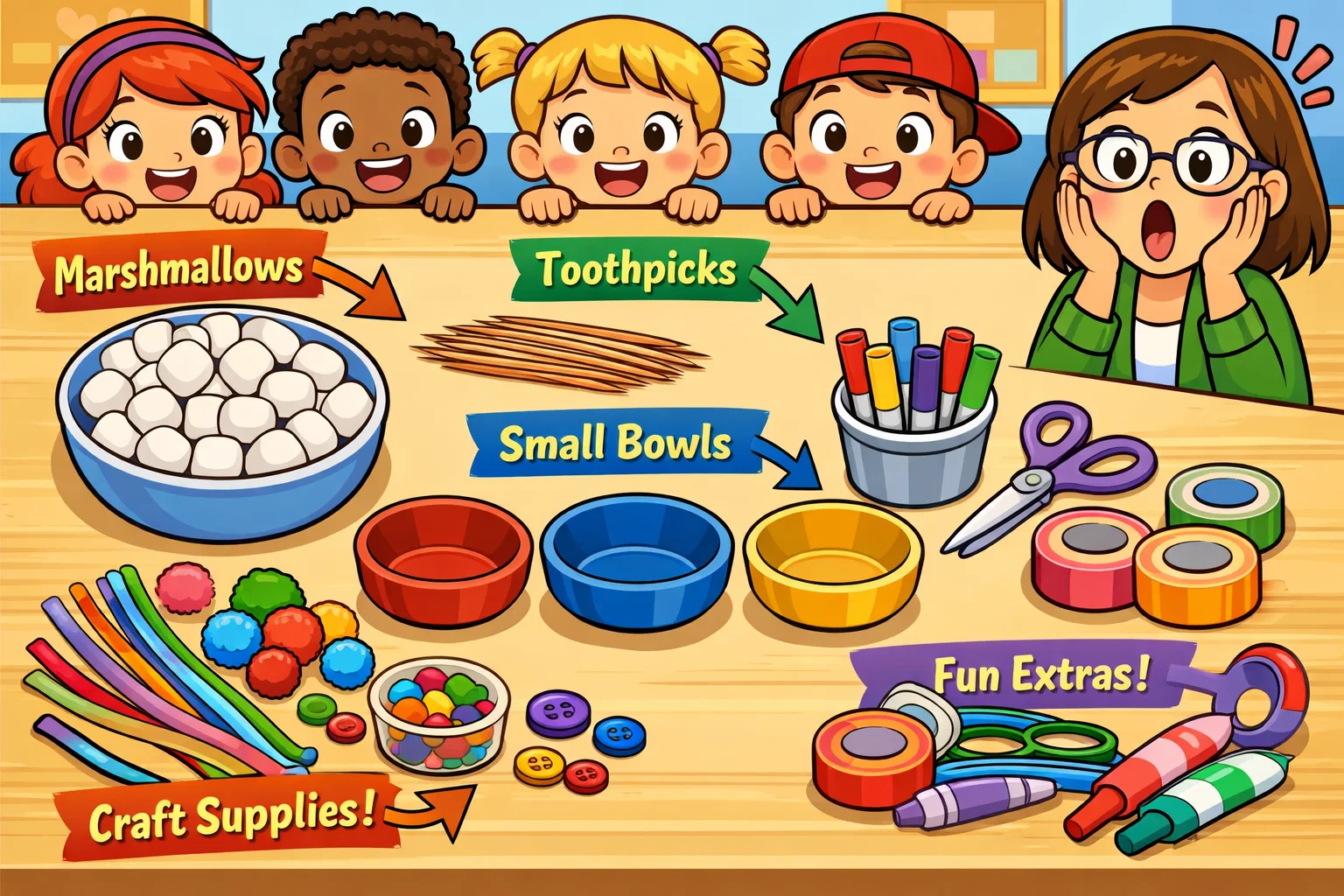
To set up a successful STEM challenge, you don’t need a high budget. You likely have most of these in your pantry.
Marshmallow types for building
- Mini Marshmallows: Best for intricate geometric designs and 3D shapes. They are lightweight and allow for more connections.
- Large Marshmallows: Good for the bases of a tall tower, providing a heavy, steady anchor.
Toothpick safety tips
Because toothpicks are sharp, safety is paramount.
- Ensure the classroom or home area is well-lit.
- Remind kids that toothpicks are for building, not for poking friends or eating.
- For very young children, you might replace toothpicks with spaghetti (broken into pieces) or straws to avoid sharp points.
Optional materials for variations
To keep the activity fresh, consider adding:
- Gumdrops: These are heavier and stickier than marshmallows, offering a different experiment in weight.
- Dry Spaghetti: This is much more brittle than a toothpick, forcing kids to be even more gentle and precise.
- Cardboard: To use as “floors” between levels.
Step One: Geometry Concepts and Vocabulary
Before the building begins, use the marshmallows and toothpicks to teach some basic mathematics. This prep work helps kids understand the “why” behind their designs.
Basic 2D shapes in towers
Start on a flat surface. Ask the kids to explore making a triangle, a square, and a rectangle. Discuss the number of vertices (marshmallows) and edges (toothpicks) each shape has. Experience shows that understanding basic 2D shapes helps children build more stable 3D structures.
Simple 3D shapes kids can build
Transition from flat shapes to dimensional shapes. Show them how to combine four triangles to make a pyramid or two squares to make a cube.
- Rectangular Prism: Great for building long bridge sections.
- Pyramid: The gold standard for height.
Shape strength comparison
“Triangles are among the strongest shapes used in engineering structures,” is a phrase every engineer knows. Have the kids build a square and a triangle. Ask them to gently push on the top angle. The square will likely collapse into a rhombus, while the triangle remains rigid. This is a lightbulb moment for many students.
Step Two: Engineering Tower Build
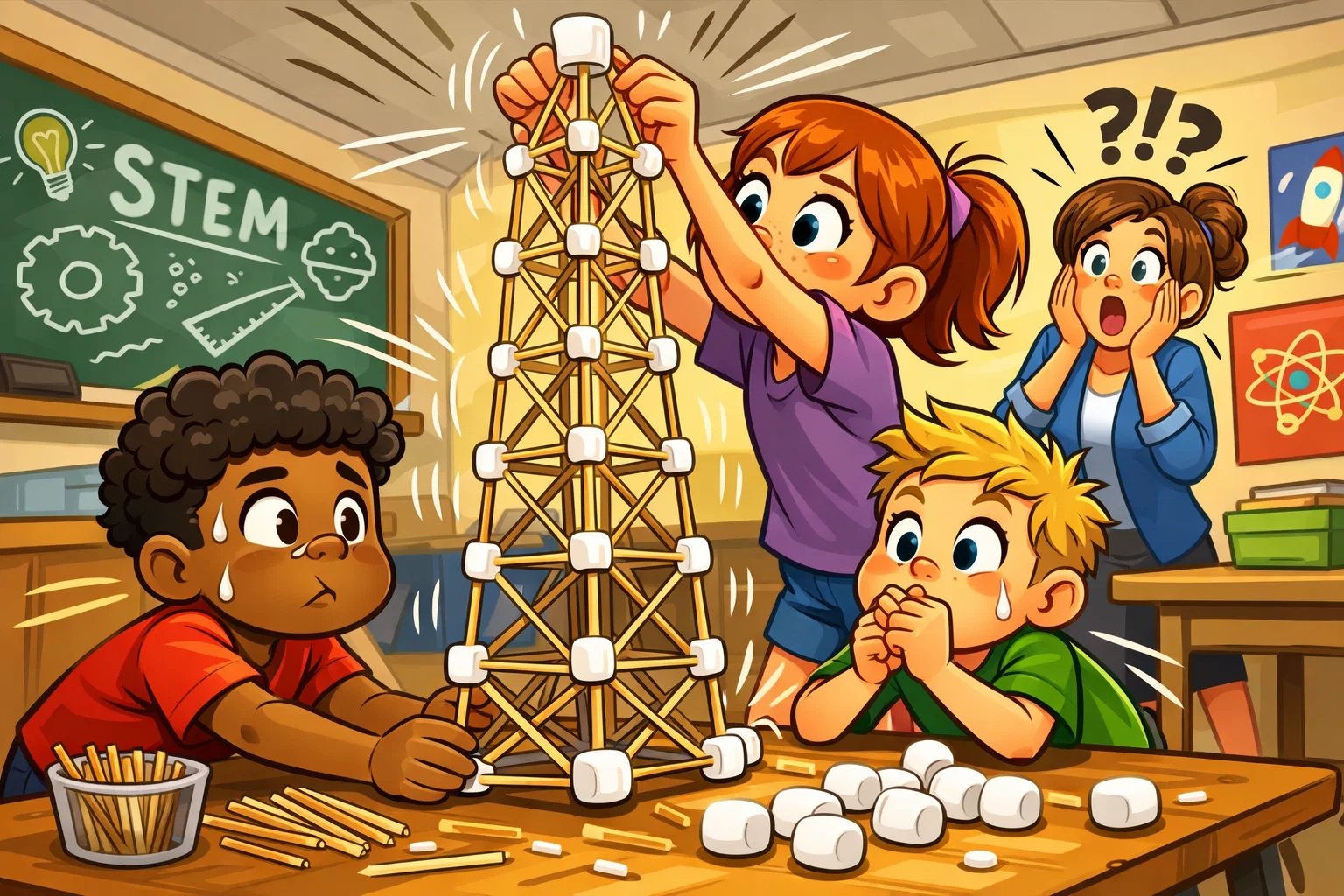
Now it’s time for the hands-on portion. This is where the building marshmallow magic happens!
Planning tower before building
Don’t let them dive into the bag immediately. Give them 5 minutes to sketch their tower on paper. This encourages problem-solving and forces them to think about the structure before they get their hands sticky.
Building base and vertical structure
Start with a stable base. Instruct them to build their foundation first. If the base isn’t free-standing and firm, the rest of the tall tower won’t stand a chance.
Testing and improving tower strength
As the towers grow tall, they will inevitably start to lean. This is the experiment phase. Encourage the kids to:
- Identify the “weak connect point.”
- Add a diagonal toothpick to create a triangle.
- Check if the marshmallow is getting too warm or soft from their hands.
Teamwork and Communication Skills
The marshmallow tower challenge is a social activity as much as a scientific one. It’s an excellent way to observe how children interact under pressure.
Group building challenges
When kids work in pairs, they learn the art of negotiation. One might want to build a cube, while the other insists on a pyramid. Resolving these conflicts is a vital life skill.
Role distribution during build
In larger classroom groups, you can assign roles:
- The Architect: The only one who can look at the plan.
- The Supplier: The only one who can touch the box of toothpicks.
- The Builder: The only one allowed to combine the pieces.
Problem-solving through discussion
If a tower starts to fall, the team must stop and discuss. “Why did it fall?” “Which angle failed?” This dialogue turns a messy moment into a high-value learning opportunity.
Fine Motor Activities With Marshmallows

For younger children (ages 3–5), the goal might not be the tallest tower but rather the development of fine motor skills.
Pinching and placing movements
The precision required to put a stick into a small marshmallow strengthens the muscles in the fingers. This supports later development of proper pencil grip and handwriting.
Hand-eye coordination practice
Aligning the toothpick with the center of the marshmallow requires focus. It’s a quiet, meditative craft that helps children learn to steady their hands.
Age-appropriate adaptations
For toddlers, use larger marshmallows and blunted straws. This removes the safety risk while keeping the concept of building intact. They can focus on making “snakes” or flat shapes on the table.
STEM Challenge Variations
Once the kids have mastered the basic tall tower, it’s time to level up the stem activities.
- Height Limit Challenge: Give them a set amount of materials and see who can reach exactly 12 inches first.
- Marshmallow Limit: Can you build a tower 2 feet tall using only 15 marshmallows? This forces them to use the toothpicks as the primary structure.
- Famous Structure Recreation: Ask them to replicate the Eiffel Tower or a famous bridge. This adds a layer of history and STEAM learning to the project.
Rainbow Marshmallow Building Idea
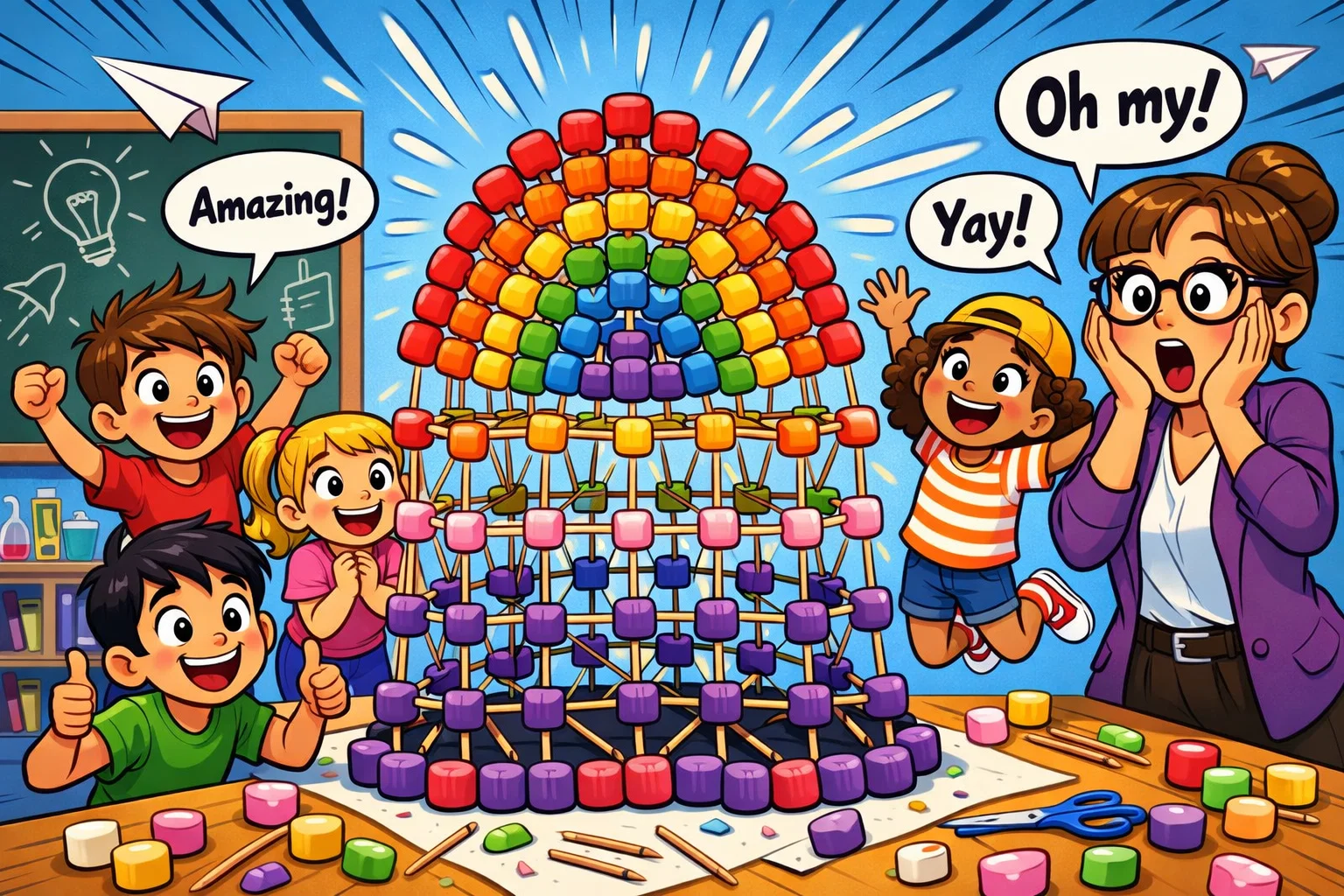
To add a splash of creativity, try the rainbow marshmallow variation. This is particularly popular in creative classroom settings and for visual learners.
How to color marshmallows
You can use a mist of food coloring or even edible markers to color the mini marshmallows before the activity.
- Red: Foundations
- Blue: Vertical supports
- Yellow: Top-level decorations
Color-based building rules
Create a game where different colors represent different “costs” or “strengths.” For example, blue marshmallows might be the only ones allowed to touch the table. This adds a layer of mathematics and logic to the building challenge.
Visual learning benefits
Seeing the tower in color helps kids differentiate between the various parts of the structure. It highlights the geometric patterns they are creating, making the 3D shapes much easier to identify.
Bonus STEM Activities With Marshmallows
The fun doesn’t have to stop at towers. The marshmallow toothpick duo is incredibly versatile.
Marshmallow catapults
Use the same materials plus a plastic spoon and a rubber band. This introduces basic ideas about trajectory and potential energy.
Bridge building challenge
Instead of going up, go across. See who can build a bridge between two books that can hold the weight of a few pennies.
Marshmallow math games
Use the marshmallows for counting, addition, and subtraction. “If you have a box of toothpicks and 50 marshmallows, and each cube takes 8 marshmallows, how many cubes can you build?”
Tips for Parents and Educators
Implementing a marshmallow toothpick tower session requires a little bit of prep and a lot of patience.
Best age ranges for challenge
- Preschool: Focus on 2D shapes and fine motor play.
- Elementary: Focus on the tallest tower and 3D shapes.
- Middle School: Focus on load-bearing, physics concepts, and strict material constraints.
Classroom vs home setup
In a classroom, time limits (15–20 minutes) create a healthy sense of competition. At home, you can let the activity span an entire afternoon, allowing for more experimentation and redesign. Cleanup tip: Put a disposable tablecloth down first! Sticky marshmallow residue is no joke.
Learning outcomes to observe
Don’t just look at the height. Look for:
- Did the child try a new shape after the first one failed?
- Did they use triangular bracing?
- How did they react when the tower started to fall?
More Fun STEM Challenges To Try
If your little engineer has a blast with marshmallows, they might also enjoy:
- Paper Towers: Using only 20 sheets of paper and tape.
- Cup Stacking: Exploring the bases and balance of plastic cups.
- Straw Bridges: A more flexible (and less sticky) version of the marshmallow engineering challenge.
Frequently Asked Questions
How long does the activity take?
On average, the marshmallow toothpick tower challenge takes about 30 to 45 minutes. This includes 5 minutes of planning, 20 minutes of building, and 10 minutes of measuring and reflection.
How many marshmallows are needed?
For a single child, a handful of about 30 mini marshmallows is plenty. For a classroom of 30, two large bags will be more than enough (allowing for some “taste testing” along the way).
Safety considerations
Always supervise children with toothpicks. If you are worried about the sharp points, you can snip the ends off with scissors beforehand, or substitute them with blunt coffee stirrers or spaghetti. Ensure no one has a sugar-related dietary restriction before allowing them to eat the materials!
Take a short quiz to find out what your everyday choices say about your parenting style
When your child is curious about something new, what’s your instinct?
Take a short quiz to find out what your everyday choices say about your parenting style
“Can I download this app?” What happens next?
Take a short quiz to find out what your everyday choices say about your parenting style
When it comes to rules at home, which sounds most like you?
Take a short quiz to find out what your everyday choices say about your parenting style
If you could give your child one life skill today, what would you pick?
Take a short quiz to find out what your everyday choices say about your parenting style
Your child gets to choose what to watch. What would your ideal setup look like?
Take a short quiz to find out what your everyday choices say about your parenting style
Pick your parenting superpower ✨