Spaghetti Bridge STEM Challenge for Kids: Design a Strong Pasta Bridge

 Discover a Free Education Video App for Kids
Pastory uses AI to personalize educational video content based on your child’s interests and personality. Safe, engaging, and built for curious young minds. Sign up now to stay updated and enjoy early access with a free trial

Building a spaghetti masterpiece is a classic engineering activity that transforms a pantry staple into a hands-on lesson in physics and structural engineering. At its core, this STEM challenge asks a simple yet provocative question: how can something as fragile as a noodle support a heavy weight? While a single piece of spaghetti is brittle and snaps easily under pressure, an organized structure of these noodles can withstand surprising forces. This duality makes the pasta project an ideal tool for teaching children the fundamental principles of design and construction.
The weight test is the climax of this hands-on project, providing a clear, measurable outcome for the students’ efforts. By challenging kids to see how much weight their pasta creation can withstand before it reaches the point of collapse, we move beyond simple craft and into the realm of true mechanical testing. This phase of the STEM challenge introduces kids to the engineering design process used by real-world engineers, where failure isn’t just a possibility—it’s a critical data point for future improvement.
Spaghetti Bridge STEM Challenge Overview

The spaghetti construction challenge is more than just a fun STEM game; it is a simplified model of real-world civil engineering principles. The general idea is to build an architectural model using only uncooked spaghetti and an adhesive, such as glue or tape, to span a specific distance (the length of the gap). The beauty of this challenge lies in its constraints. Because spaghetti is not very strong on its own, students must rely on geometric shapes and smart structural design to achieve success.
Purpose of spaghetti bridge challenge
The primary objective is for the structure to support the greatest possible load relative to its own mass. This goal forces participants to investigate how different truss patterns and support systems work. It isn’t just about using the most pasta; it’s about using the material efficiently. A heavy, bulky framework might fail sooner than a lightweight, well-engineered truss model if the latter distributes tension and compression more effectively.
Engineering concepts behind spaghetti bridges
To design a crossing that doesn’t immediately collapse, kids must grasp a few foundational mechanical concepts:
- Load: The total weight (such as a bag of sugar or a container of coins) that the framework must carry.
- Compression: A pushing force that squeezes the spaghetti noodles together.
- Tension: A pulling force that stretches the structure apart.
- Span: The horizontal distance the structure must cross without intermediate supports.
STEM skills developed during challenge
Participating in a pasta engineering project nurtures a holistic suite of STEM skills:
- Problem-Solving: When a noodle snaps, kids must figure out why and strengthen that specific area.
- Mathematics: Using a ruler for precise measurement and calculating the efficiency ratio (weight supported relative to the structure’s mass).
- Teamwork: Most school-based challenges require kids to collaborate on a single sketch and final assembly.
- Resilience: Learning that when a structure breaks, it is an opportunity to investigate and redesign.
Materials for Spaghetti Bridge Weight Test
Preparation is key. Before you build, you need to gather specific materials that will dictate the difficulty and success of the engineering activity.
Spaghetti types and quantities
Standard uncooked spaghetti is the gold standard for this challenge. However, the length and thickness of the noodle matter. Thinner hair-like pasta is too weak, while thick linguine might be too heavy for a delicate structure. Most challenges provide a set amount (e.g., one 500g box) to ensure a level playing field.
Expert Tip: Avoid using cooked pasta! It must be uncooked to maintain the necessary stiffness for compression members within the framework.
Adhesives and connectors
How you join the pasta is just as important as the pasta itself.
- Hot Glue: Fast-drying and strong, but excessive heat can weaken or deform the spaghetti.
- White Glue (PVA): Very strong once dry, but requires a long drying and curing time.
- Tape: Good for quick prototypes, but often lacks the rigidity needed for a high weight test.
- Rubber Bands: Occasionally used for suspension designs, though they allow for too much movement in a truss.
Weight testing tools
To test its strength, you will need:
| Tool | Purpose |
| Ruler | Measure the bridge length and verify the required span. |
| Small Bucket | Hang from the center of the structure to apply the load. |
| Weights | Gradually add mass (coins, washers, or water). |
| Scale | Record the maximum weight supported before failure. |
Safety considerations during building and testing
While building with pasta is generally safe, engineers in training should be careful. Hot glue can cause minor burns, and when a structure reaches its breaking point, spaghetti pieces can snap and eject small fragments. It is highly recommended that kids wear safety goggles during the weight test to protect their eyes from flying pasta shards.
Spaghetti Bridge Design and Planning
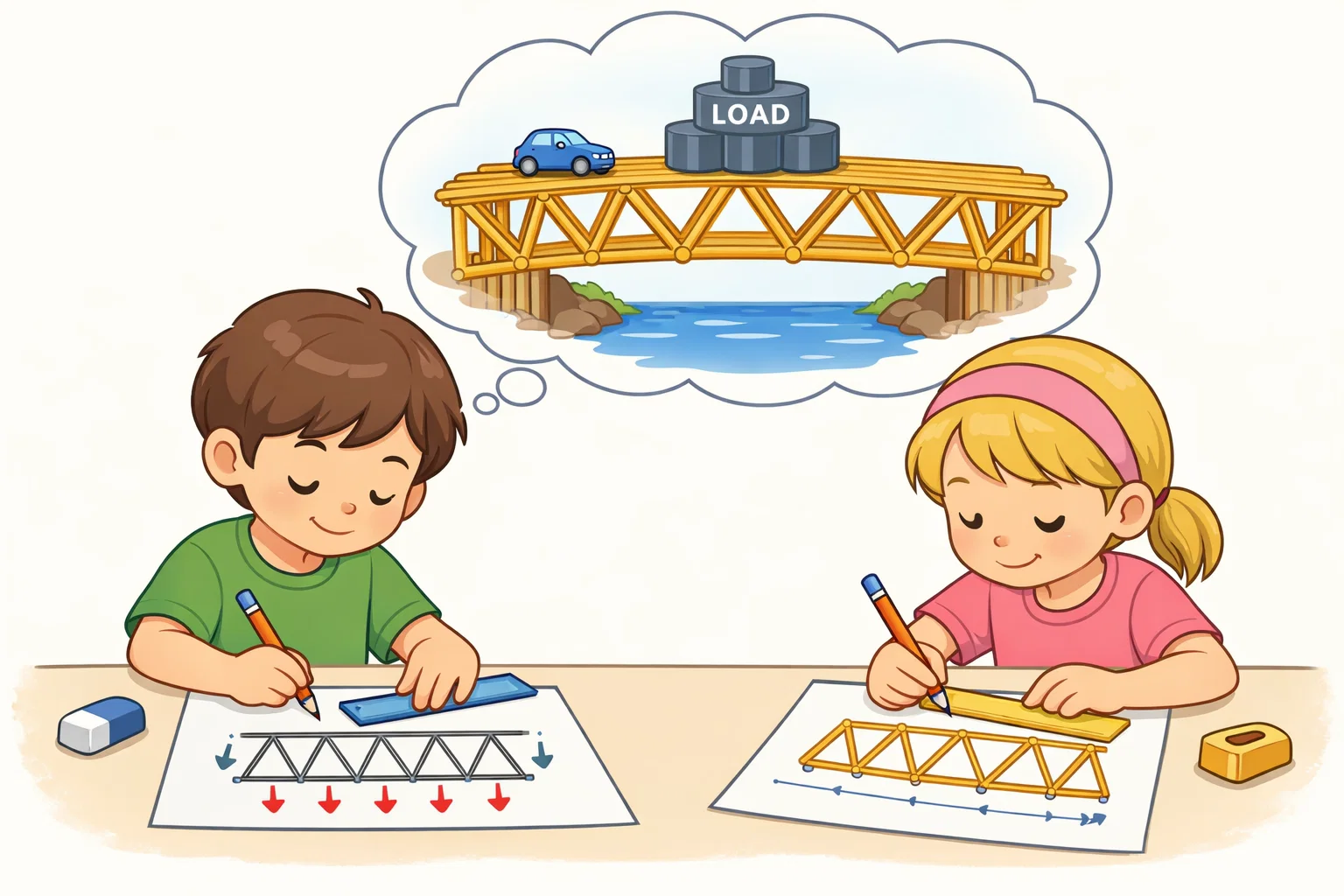
Before touching the pasta, a successful engineer must sketch a plan. Jumping straight into gluing often leads to a messy structure that can’t hold the most weight.
Bridge shape selection
The shape of your crossing determines how it will distribute weight. Triangular shapes are the strongest because they do not easily deform. This is why almost all engineers designing large-scale bridges use truss patterns. A square frame can tilt and turn into a diamond under pressure, but a triangle stays rigid.
Load distribution planning
If all the weight is concentrated on one single piece of spaghetti, it will break instantly. The goal of structural design is to move that weight away from the center and down into the supports at each end of the span. This is known as load distribution.
Compression and tension zones
In a standard truss model:
- The top horizontal members are usually in compression (being squeezed).
- The bottom members are in tension (being pulled).
- Spaghetti is surprisingly strong in tension but can buckle easily under compression. To strengthen a compression member, engineers often bundle multiple noodles together or shorten unsupported lengths using bracing.
Sketching bridge design before building
Encourage kids to draw a life-sized sketch on a piece of paper. They can then place components directly on the paper to use as a template. This ensures that the length of each piece is consistent, leading to a much more stable structure.
Step-by-Step Spaghetti Bridge Building Process
Step 1: Plan bridge structure
Choose whether you want a suspension style, an arch, or a truss layout. For a weight test, the truss is usually the most reliable. Decide on the span (e.g., 30cm) and ensure your design is at least 5cm longer to sit securely across the gap.
Step 2: Assemble main supports
Start by building two flat side panels of your truss. Use triangular patterns throughout. Once you have two identical side “walls,” you will stand them up and connect them with horizontal cross-braces. These braces prevent the structure from twisting.
Step 3: Reinforce critical points
Identify where the weight will be applied. This is usually the center of the span. You may want to strengthen this area by using a thicker bundle of spaghetti noodles. Also, reinforce the joints where the build sits on the “land” (columns or tables).
Step 4: Drying and curing time
This is the hardest part for kids: waiting! If you use white glue, the structure must sit for at least 24 hours. Testing a “wet” model is a guaranteed way to see an early collapse.
Spaghetti Bridge Weight Test Procedure
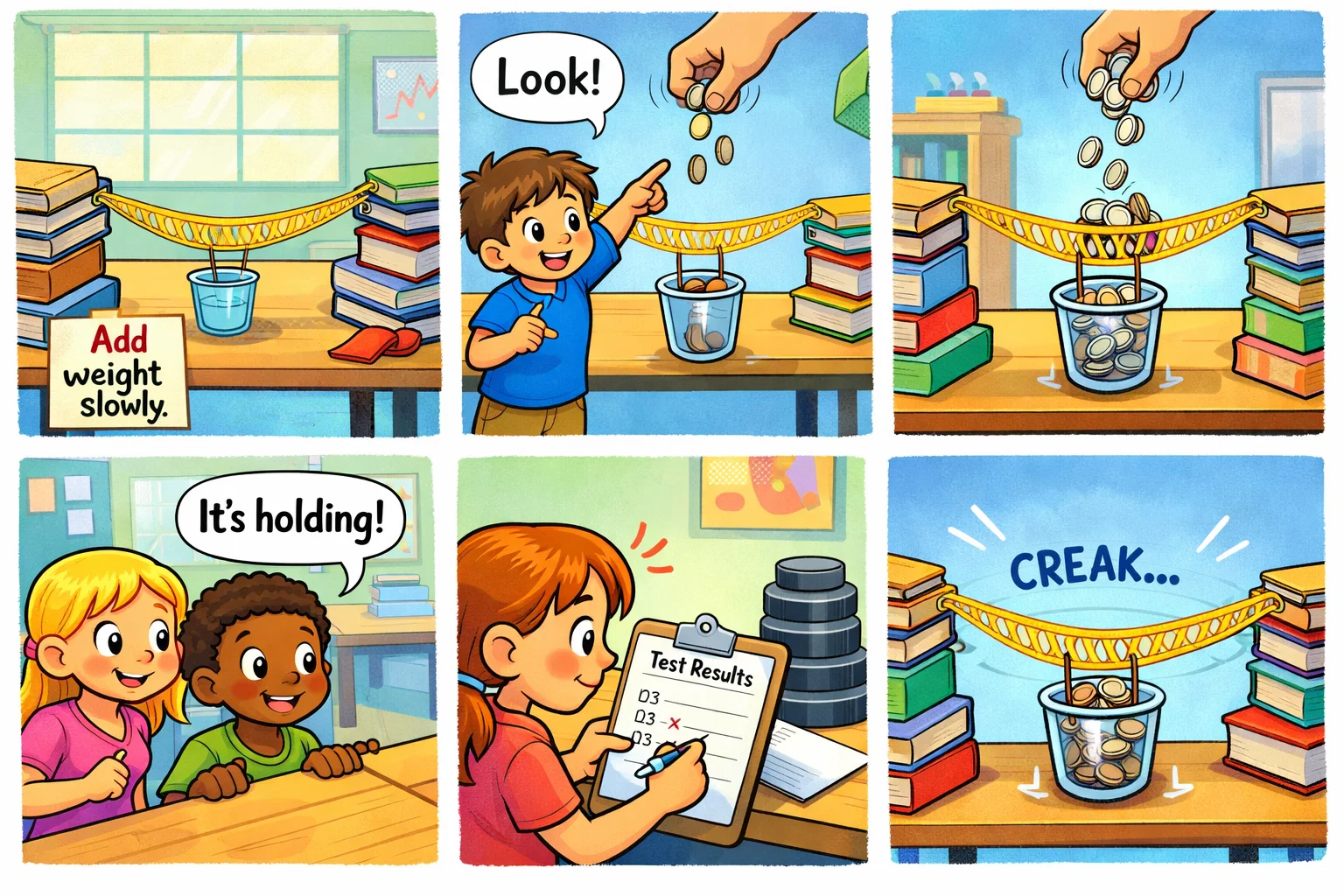
The weight test is where the investigation phase turns into measurable data.
Weight testing setup
Place your finished model across two tables or desks. The gap between the tables should be exactly the span distance you planned for. Ensure the tables are level and stable before you test its strength.
Gradual load increase method
Do not just drop a bag of sugar onto the structure. Instead:
- Loop a string or cable around the center of the frame.
- Attach a light bucket or hook to the string.
- Add weight slowly (e.g., one cup of sand at a time).
- Pause for 5 seconds between each addition to let the pasta settle.
Recording results and observations
Have one student act as the “recorder.” They should note the weight at which the build begins to creak. These sounds indicate micro-fractures forming as the spaghetti begins to fail under stress. Record the final weight the structure held just before it snapped.
Common bridge failure points
Most pasta models fail at the joints. If the glue isn’t strong enough, the noodle will pull right out. Another common failure is “buckling,” where a long piece of spaghetti in compression bends and snaps because it wasn’t braced by a triangular support.
Science Behind Spaghetti Bridge Strength
Why triangles increase strength
A triangle is the only polygon that is inherently rigid. If you have three pieces of pasta joined in a triangle, you cannot change the angles between them without breaking the pasta or the joint. This stability is the secret to why a truss can hold a massive weight.
Role of material properties in spaghetti
Spaghetti behaves like a brittle material under load. It is “brittle,” meaning it doesn’t stretch much before it breaks. Engineers must account for this by ensuring no single noodle is asked to bend. If the design requires a curve, it must be made of many small, straight segments to maintain the structure.
Real-world bridge engineering comparison
The same math used in a pasta project is used to build the large-scale truss and suspension bridges or local railroad truss crossings. By using spaghetti, kids are performing a localized version of the design and construction tasks performed by professionals.
Challenge Variations and Difficulty Scaling
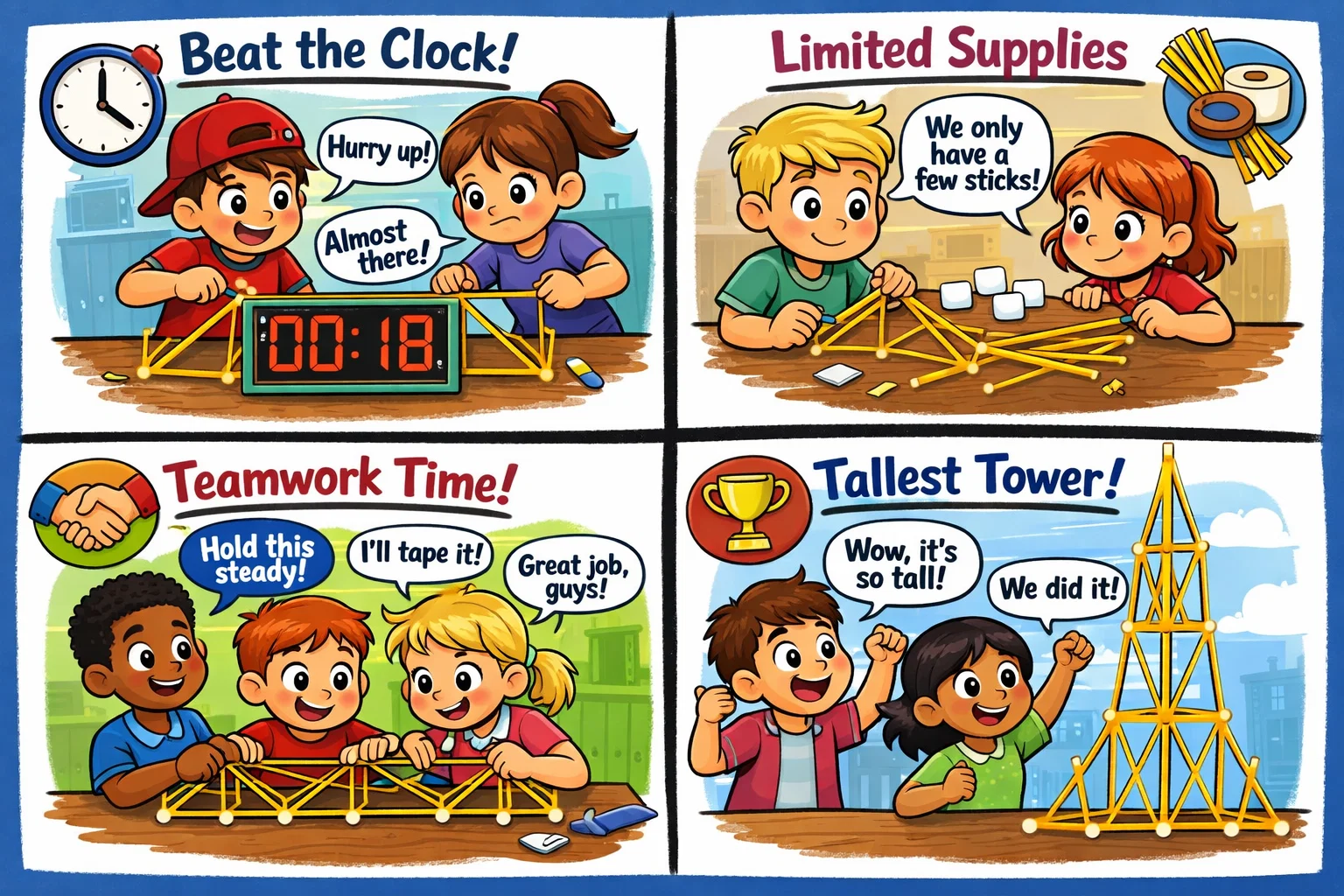
Age-based challenge adjustments
- Younger Kids (Ages 5–8): Focus on marshmallow-and-spaghetti structures rather than weight testing. The goal is height rather than heavy weight.
- Older Kids (Ages 9-12): Introduce strict measurement rules and a limited “budget” of pasta.
- Teens: Introduce the “Efficiency Ratio,” where you divide the weight held by the mass of the structure itself.
Material restriction challenges
Try a “no-glue” challenge using only tape or rubber bands. This completely changes the mechanical properties of the joints and forces a redesign of the truss patterns.
Time-based build challenges
Give the teams 45 minutes to design and build. This mimics the “fast-track” design process often found in real-world engineering projects where deadlines are tight.
Learning Outcomes for Kids
Problem-solving through trial and error
When a structure breaks, it provides an “Aha!” moment. A child might notice that the horizontal beam snapped because it was too thin. This leads them to investigate reinforcement techniques, which is the heart of the engineering mindset.
Creativity and innovation development
While triangular trusses are standard, some kids might design a model with an arch or a complex web of noodle supports. This hands-on creativity is vital for future innovation in any STEM field.
Early engineering mindset formation
“Failure is the best teacher” is a common phrase among engineers. By seeing their structure fail under a weight test, children learn that failure is not a personal defeat, but a necessary step toward a more withstand-ready design.
Fun STEM Challenges Related to Spaghetti Bridges
If your kids enjoyed the pasta construction, try these related STEM activities:
- Pasta Tower Building: See how high you can build a noodle tower before it topples.
- Paper Crossing Challenge: Use a single sheet of paper to span a gap. This teaches about folding for strength.
- Egg Drop Challenge: Another classic engineering activity focusing on impact and compression.
Tips for Successful Spaghetti Bridge Weight Test
- Layering: Instead of one piece of spaghetti, glue 3 or 4 together to create a “super-beam” for the main structure.
- Symmetry: Ensure both sides of the framework are identical. If one side is weaker, the build will twist and collapse early.
- Clean Joints: Don’t use giant blobs of glue. Large amounts of adhesive add weight without adding much support. A clean, small bead of glue is often stronger.
Final Thoughts on Spaghetti Bridge Challenge for Kids
The Spaghetti Engineering Challenge is a profound STEM challenge that bridges the gap between play and professional mechanical science. It teaches kids that with the right shape, a little glue, and a solid design process, even the humblest spaghetti noodles can achieve great things. Encourage your students to sketch, build, and most importantly, test its strength methodically and safely. Each snapped noodle is a lesson learned in the fascinating world of engineering.
FAQ
Which bridge design held the most weight?
In most classroom tests, the Warren Truss (a series of equilateral triangles) or the Arch tends to hold the most weight. These designs are excellent at moving the load from the center to the columns.
How did design changes affect the results?
Students usually find that adding horizontal bracing to prevent twisting significantly increases the weight the structure can withstand. Moving from a square design to a triangular one often doubles the strength of the build.
What engineers would change next time?
Most kids realize they should have allowed more drying and curing time or used more pasta to strengthen the top compression chord of the model. Iteration is the core of the design and construction cycle!

Take a short quiz to find out what your everyday choices say about your parenting style
When your child is curious about something new, what’s your instinct?
Take a short quiz to find out what your everyday choices say about your parenting style
“Can I download this app?” What happens next?
Take a short quiz to find out what your everyday choices say about your parenting style
When it comes to rules at home, which sounds most like you?
Take a short quiz to find out what your everyday choices say about your parenting style
If you could give your child one life skill today, what would you pick?
Take a short quiz to find out what your everyday choices say about your parenting style
Your child gets to choose what to watch. What would your ideal setup look like?
Take a short quiz to find out what your everyday choices say about your parenting style
Pick your parenting superpower ✨