Diffusion Experiment for Kids Using Food Coloring in Water

 Discover a Free Education Video App for Kids
Pastory uses AI to personalize educational video content based on your child’s interests and personality. Safe, engaging, and built for curious young minds. Sign up now to stay updated and enjoy early access with a free trial
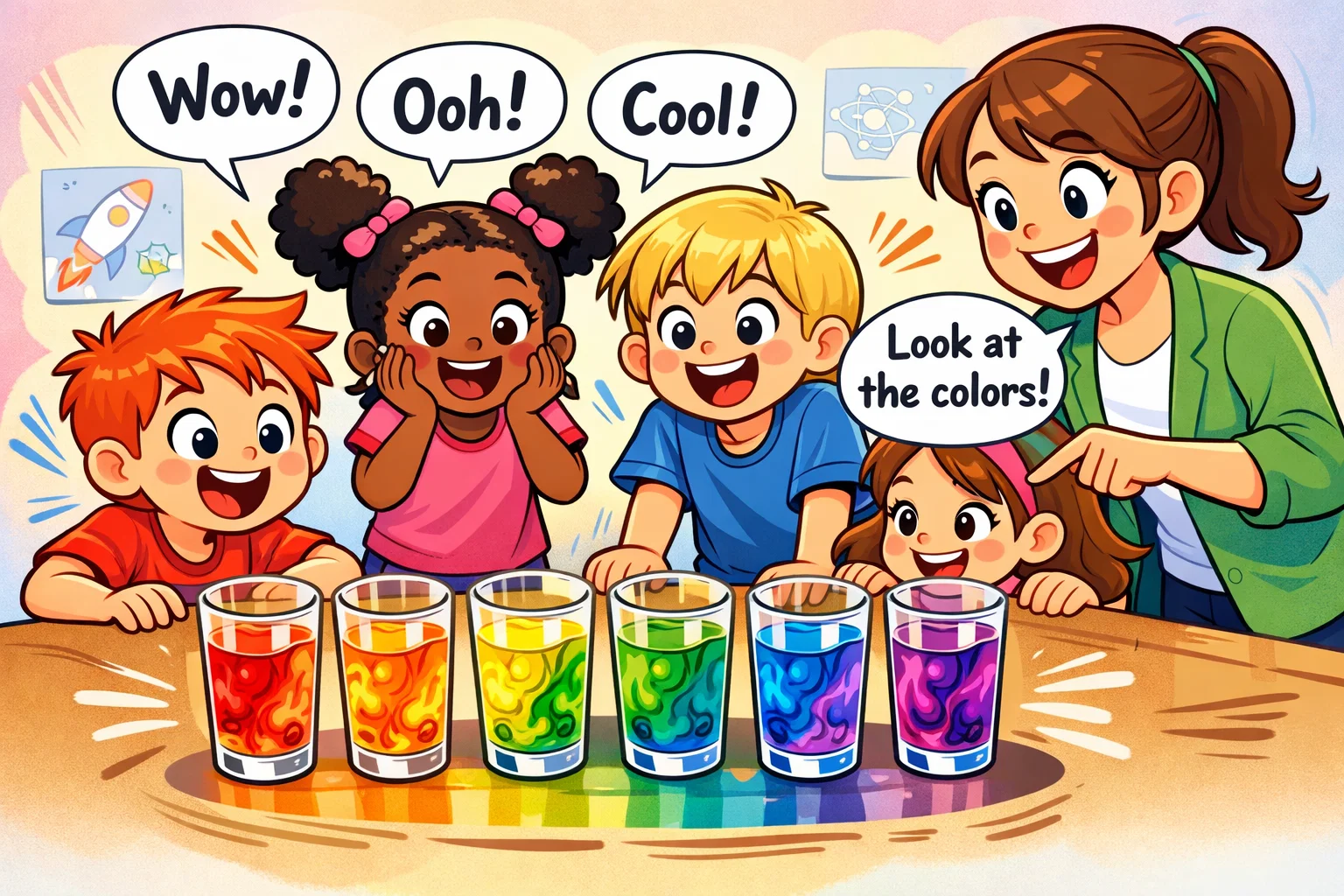
Welcome to a world where science feels like magic! If you are looking for a way to spark curiosity in your living room or classroom, a diffusion science experiment is one of the most effective tools in a parent or teacher’s toolkit. This simple science experiment for kids uses nothing more than water and food coloring to reveal the hidden, constantly moving world of molecules that exists all around us.
The primary purpose of this activity is to make invisible processes visible. By watching how food coloring and water interact, children can witness the movement of particles in real-time. It is a low-prep, high-impact science activity that perfectly balances entertainment with foundational physical science concepts. Best of all, it requires no specialized equipment—just a few household items and a curious mind.
Introduction to Diffusion Experiment for Kids
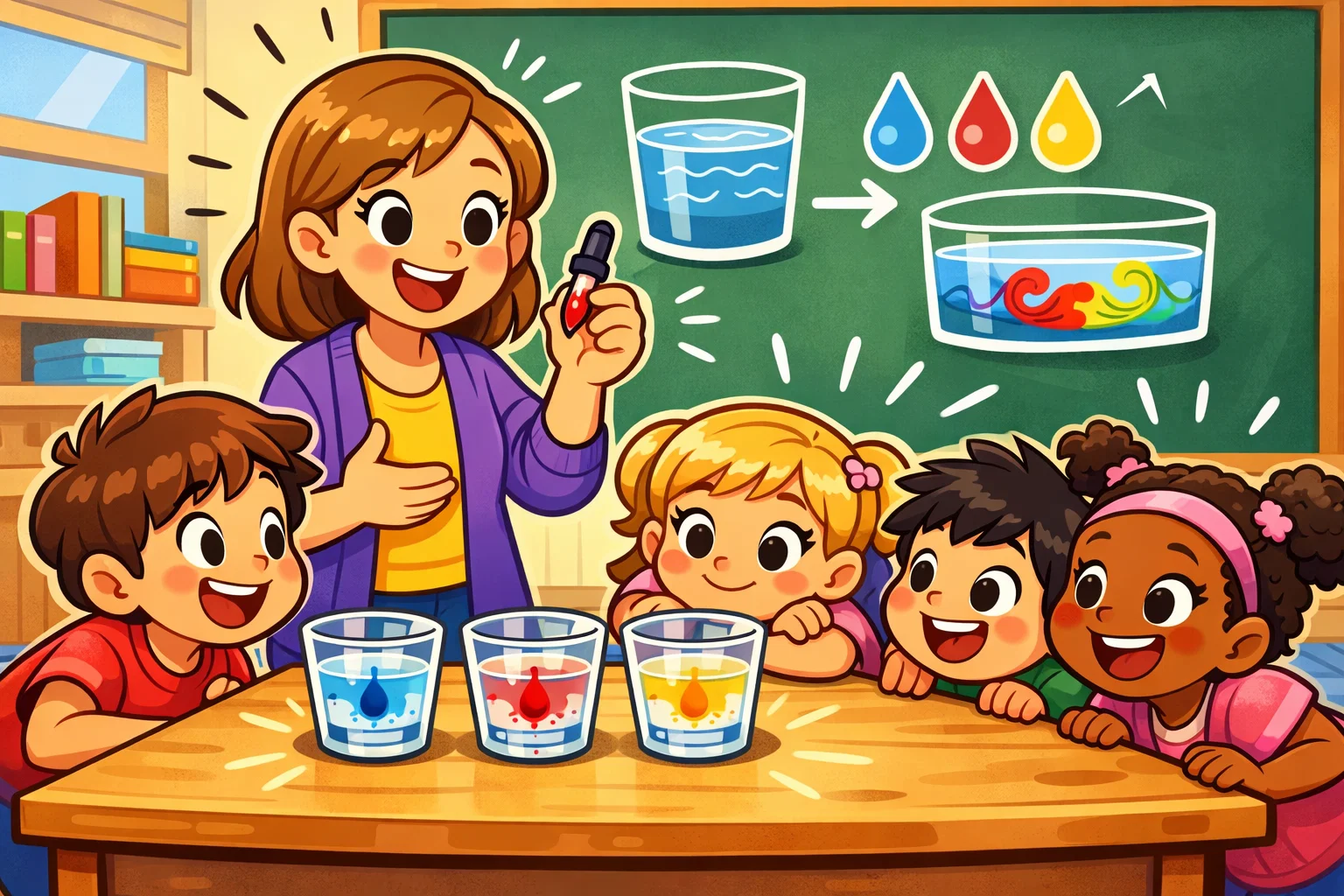
Have you ever wondered why a drop of ink eventually turns an entire glass of water blue, even if you never pick up a spoon to stir it? This fascinating process is called diffusion. For children, seeing is believing. While we can’t see individual water molecules with our eyes, we can use food coloring as a “tracer” to show us where those molecules are going and how particles move over time.
This diffusion experiment serves as a perfect introduction to chemistry and physics. It sets the stage for kids to understand that everything—the air we breathe, the water we drink, and even the chairs we sit on—is made of tiny building blocks that are constantly in motion. Through this hands-on activity, children transition from passive observers to active young scientists, making predictions and testing their theories about the natural world. 🧪
Why diffusion experiment works well for kids
The beauty of a diffusion science experiment lies in its simplicity and safety. This activity is often recommended in early science education because it provides immediate visual feedback. There are no long wait times; the colors begin to spread the moment the drop hits the liquid.
- Safety: Uses non-toxic food coloring instead of harsh chemicals.
- Visual Appeal: The “fireworks” effect of dye swirling through water is mesmerizing for all ages.
- Accessibility: You likely already have the materials in your kitchen pantry.
- Versatility: It can be adapted for a toddler’s sensory play or a middle-schooler’s lab report.
When to use diffusion experiment at home or school
This science experiment for kids is incredibly adaptable across different educational settings:
| Setting | Ideal Age Range | Learning Focus |
| Preschool | 3–5 years | Observation, color identification, and sensory play. |
| Elementary | 6–10 years | Understanding molecule movement and kinetic energy. |
| Middle School | 11–13 years | Comparing rates of diffusion and introducing basic osmosis concepts. |
| Homeschool | All ages | A fun and simple way to fulfill physical science curriculum requirements. |
Key Concepts of Diffusion
To understand why the food coloring in each cup behaves the way it does, we need to look at the concept of diffusion. At its heart, diffusion is the movement of a substance from an area of high concentration to an area of low concentration.
Particle movement in liquids
In any liquid, the water molecules are not sitting still. They are actually bumping into each other and sliding past one another. Think of the water in your glass as a crowded dance floor. Even if you aren’t “stirring” the water, the dancers (molecules) are constantly shifting. When we add food coloring, we are essentially dropping new dancers onto the floor, and they naturally get pushed around by the crowd.
Mixing without stirring
One of the most surprising things for kids is that the water and dye mix together without any help. This happens because particles move randomly. In science, this random motion is often described using the concept of Brownian motion. Because the particles are always moving, they eventually bump the food coloring into every corner of the glass until the color is distributed throughout a space evenly.
Everyday diffusion examples kids recognize
Diffusion isn’t just a lab trick; it happens around us every day!
- Smelling Cookies: When someone bakes cookies, the scent molecules diffuse through the gas (air) from the kitchen to your bedroom.
- Tea Steeping: Watch a tea bag in hot water; the tea particles move from the bag to the rest of the glass of water.
- Perfume: If someone sprays perfume in a room, the scent eventually reaches the area of low concentration across the hall.
What Diffusion Means in Simple Terms
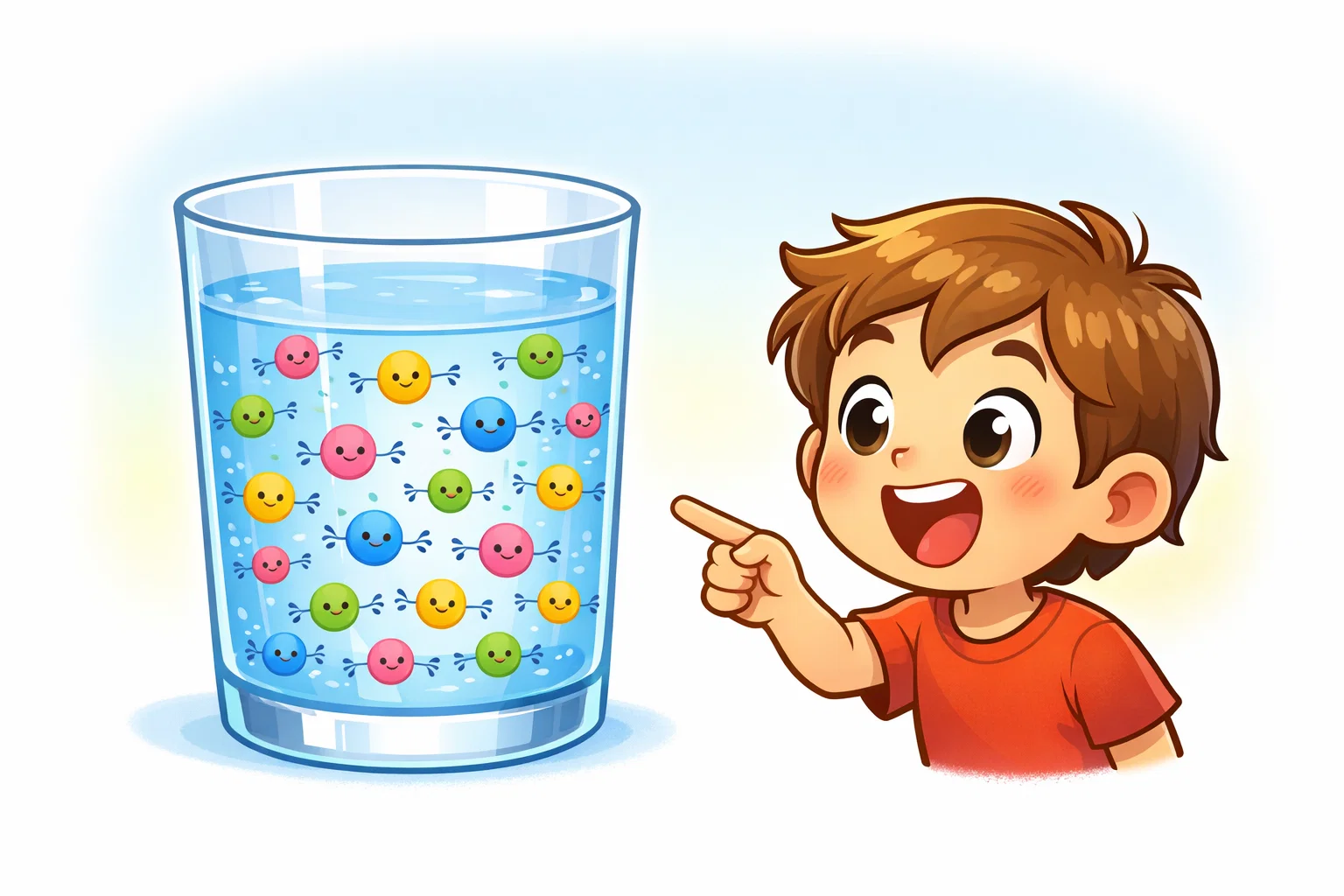
If you had to explain diffusion to a five-year-old, you might say: “It’s when things spread out to find more elbow room.”
Diffusion explained using water and color
Imagine a tiny drop of blue food coloring. In that one drop, there is a very high concentration of blue particles. The water around it has a lower concentration (zero blue). Because particles like to move away from crowded spots, the blue ones start to diffuse outward until they find areas of low density. Eventually, they aren’t crowded anymore, and the whole glass is a light, even blue.
Diffusion compared to crowd spreading
A great analogy is a school bus. When the bus doors open at school, all the kids (high concentration) are packed inside. As soon as they step out, they spread out across the playground (area of low concentration). They don’t all stay standing in one tight clump; they move around until they have plenty of space. This is exactly how a molecule behaves during the process called diffusion.
Factors That Affect Diffusion
While diffusion happens naturally, it doesn’t always happen at the same speed. Several factors can change the rate of diffusion, making it a cool science experiment to test variables.
Temperature influence on diffusion
This is the most exciting part of the hot and cold water test. In hot water, the water molecules have more kinetic energy, meaning they vibrate and move much faster. Because they are moving faster, they collide with the food coloring particles more often and with more force. This causes the color to spread almost instantly. In cold water, the molecules are “sleepy” and move slowly, so the color may take a long time to spread.
Color concentration effect
If you put one drop of food coloring in a gallon of water, it will diffuse quickly but look very faint. If you put ten drops in a small cup, the higher concentration makes the movement easier to track. The “steepness” of the concentration gradient—how large the difference is between areas of high and low concentration—can change how aggressively the particles move.
Still versus moving water
For a true diffusion science experiment, the water must be still. If you stir the water, you are using “forced convection,” which isn’t true diffusion. True diffusion relies solely on the natural, internal movement of molecules.
Materials Needed for Diffusion Experiment
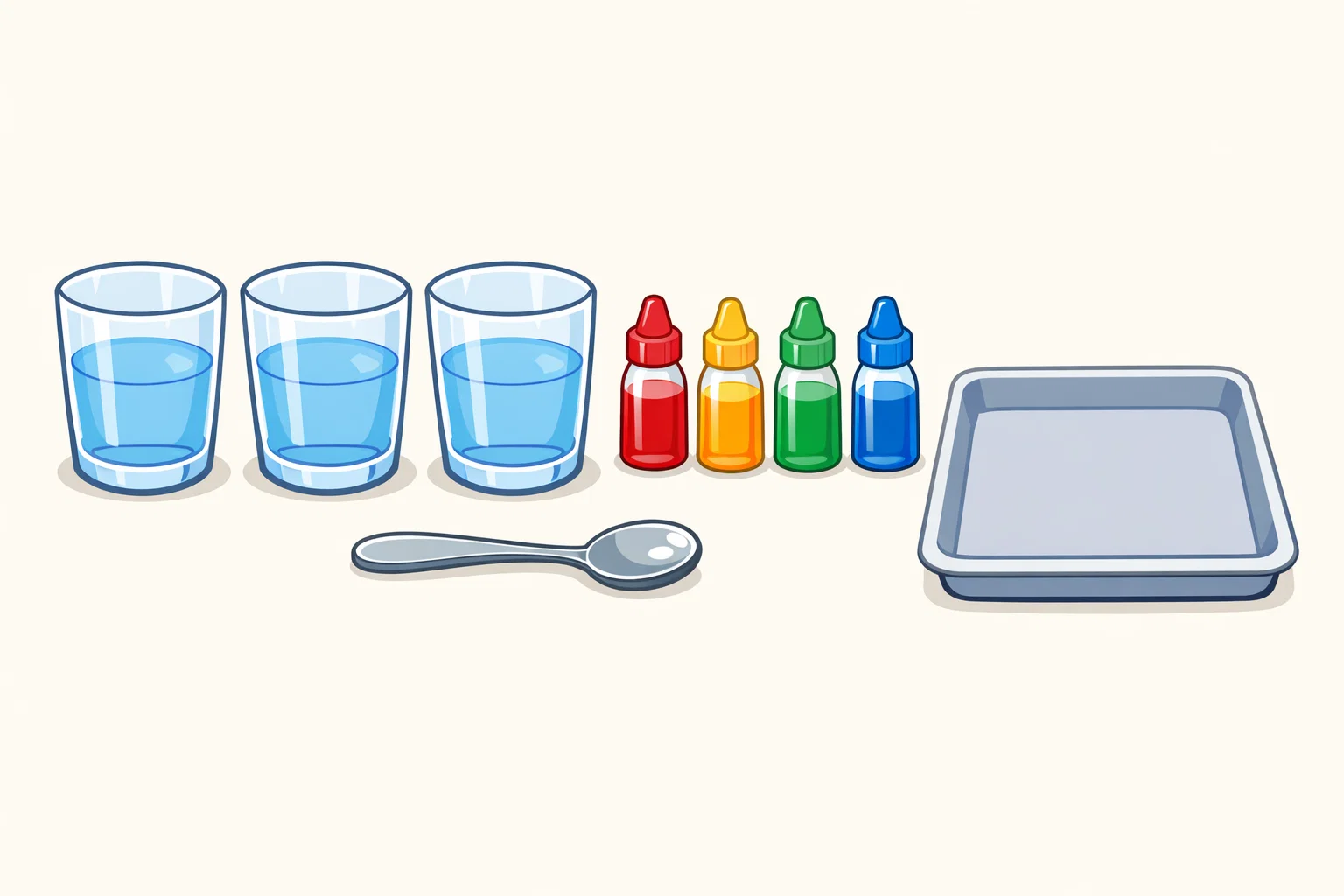
You don’t need a lab coat for this simple science project! Gather these items from around the house.
Items required for food coloring diffusion
- 2–3 clear glasses or jars: Glass is best so you can see the sides and bottom clearly.
- Food coloring: Liquid drops work better than gel.
- Water: Different temperatures (ice cold, room temp, and very warm).
- A white piece of paper: To place behind the glasses so the colors pop.
- A stopwatch or phone timer: To measure the rate of diffusion.
Safe materials for kids activities
Always prioritize science safety. Use plastic clear cups if you are worried about glass breaking. Ensure the food coloring is “washable” or be prepared for some stained fingers—it’s a rite of passage for young scientists!
Preparation for Diffusion Experiment
A little prep goes a long way in making this a fun and simple experience.
Setting up clear containers
Place your glasses on a flat, stable surface where they won’t be bumped. If you’re doing this in a classroom, give each group of kids their own set of food coloring and water stations. Make sure the background is clear; a white tablecloth or paper helps kids see the “tendrils” of color as they diffuse.
Preparing hot and cold water safely
This is where safety precautions are vital.
- Cold water: Use water from the fridge or add ice cubes (but remove them before adding dye).
- Hot water: It should be warm to the touch, like a hot cup of cocoa, but not boiling. Boiling water can crack glass and cause burns. Always have an adult handle the pouring of the warm liquid.
Instructions for Diffusion Experiment
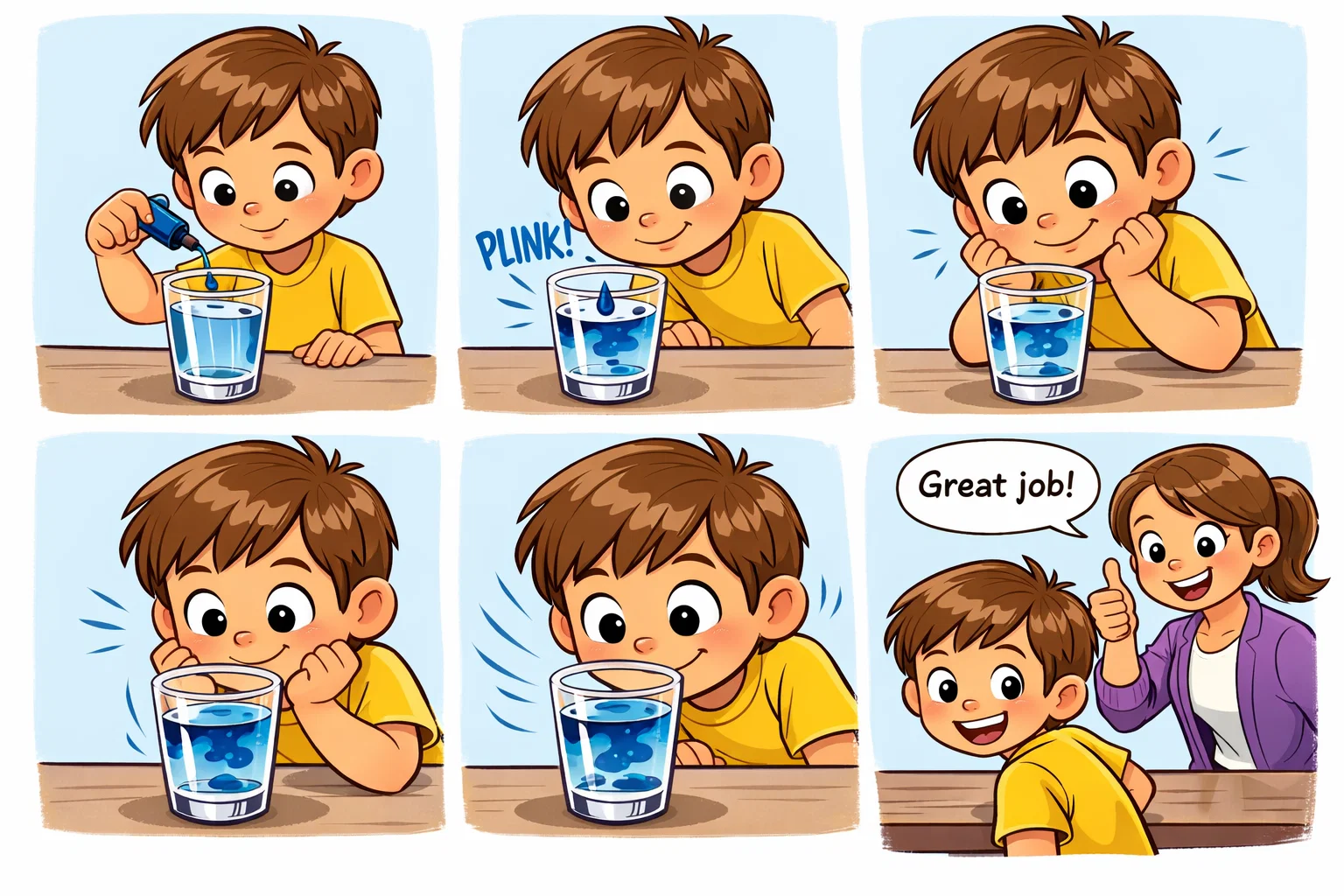
Ready to start? Follow these steps for a successful science experiment.
Step-by-step diffusion procedure
- Fill the glasses: Fill one glass with cold water and another with warm water. Fill them to the same level.
- Let them settle: Wait about 30 seconds for the water to stop moving from the pour.
- Add the dye: At the same time (or with a partner), place exactly one drop of food coloring in each cup.
- Observe: Do not stir! Watch how the colors begin to move.
- Record: Start your timer and see how long it takes for the water to become one solid color.
Comparing hot and cold water diffusion
Ask the kids to watch the difference. In the warm water, you’ll see the color “dance” and swirl rapidly. In the cold water, the dye might sink to the bottom in a clump and take longer to diffuse.
Observation and Results
This is where the learning happens! Encourage your “mini-scientists” to describe what they see using descriptive words.
What kids should observe during experiment
Kids might notice that the dye in the cold water forms thin, ribbon-like strands that stay separated for a while. In the warm water, it looks more like a cloud that expands quickly. They should see that the dye particles move from an area of high concentration (where the drop landed) to the lower concentration (the rest of the water).
Why diffusion happens faster in warm water
The scientific “Aha!” moment comes when we explain kinetic energy.
Heat can be thought of as increased molecular motion, which causes particles to collide more frequently. When water is hot, the molecules are crashing into each other like bumper cars. This high-speed collision pushes the food coloring out much faster than in cold water.
| Temp | Particle Speed | Diffusion Rate |
| Hot | Very Fast | High |
| Room Temp | Moderate | Medium |
| Cold | Slow | Low |
How Diffusion Experiment Works
Let’s dive a little deeper into the “why.” This section helps bridge the gap between a “magic trick” and actual science.
Invisible particle movement explanation
Even though the water looks perfectly still, it is actually a constant, random motion of molecules. This movement of a substance is constant. Because the water molecules are always vibrating, they provide the “transportation” for the food coloring. The dye doesn’t have its own motor; it is simply being shoved around by the water.
Cause of color spreading in water
The spreading continues until the system reaches “equilibrium.” This is a fancy way of saying that the color is distributed throughout a space so evenly that there is no longer a high concentration or low concentration area. The particles are still moving, but because they are spread out, the color looks uniform to us.
Questions to Ask Kids After Experiment
Critical thinking is a skill that develops through questioning. Use these prompts to spark a discussion.
Observation-based questions
- “Which glass started changing color first?”
- “Did the color stay at the top or sink to the bottom?”
- “What did the shape of the food coloring look like as it spread?”
Prediction and comparison questions
- “What do you think would happen if we used vegetable oil instead of water?”
- “If we used a giant bucket of water, would it take longer or be faster?”
- “Do you think the color would diffuse in a solid piece of ice?”
Diffusion Examples in Real Life
Connecting the diffusion science experiment to the real world helps kids retain the information.
Diffusion in food and drinks
Think about making a glass of chocolate milk with syrup. If you don’t stir it, the syrup stays at the bottom (high concentration). Over a very, very long time, it would eventually diffuse, but we usually stir it to speed up the process! Similarly, when you drop a bouillon cube into a pot of soup, the flavor diffuses through the whole pot.
Diffusion in the human body
This is a great chance to mention biology. Our red blood cells rely on a similar process. Oxygen diffuses from our lungs into our blood because there is a higher concentration of oxygen in the air we breathe than in our blood cells. This is how our bodies get the energy they need to run and play!
Diffusion in plants
Plants are masters of this process. They don’t have hearts to pump “plant blood” around; instead, they use diffusion and osmosis to move water and nutrients from the soil into their roots and up to their leaves.
More Diffusion Demonstrations for Kids
If your kids loved the first experiment, try these variations to keep the momentum going.
Diffusion with different liquids
Try the experiment using food coloring in different solvents.
- Saltwater: Does the salt in the water make it harder for the color to move? (Hint: The water is more “crowded,” so it might take longer to diffuse).
- Corn Syrup: This is a very “thick” liquid. Watch how slowly the molecule movement happens here!
Color mixing diffusion activities
Put a drop of blue on one side of a shallow tray of water and a drop of yellow on the other. Watch as they diffuse toward the center and mix together to create a green line in the middle. This is a beautiful way to show how two different substances can diffuse simultaneously.
Safety First and Adult Supervision
Science is fun, but science safety is the priority.
Safe handling of warm water
Ensure that the “hot” water used is not hot enough to cause a burn. A temperature of about 120°F (49°C) is plenty to show the rate of diffusion without being dangerous. Adults should always be the ones to handle the kettle or microwave.
Preventing spills and stains
Food coloring is notorious for staining granite countertops and white shirts.
- Pro Tip: Perform the experiment on a rimmed baking sheet to catch any spills.
- Attire: Have the kids wear an old t-shirt or a “science smock” (an oversized button-down shirt works great).
Skills Kids Develop During Diffusion Experiment
Beyond science, kids are growing in other ways during this science activity.
Observation and patience skills
In a world of instant gratification, waiting for the color to diffuse teaches patience. It encourages kids to look closely and notice small changes, a key skill for any future scientist or artist.
Early science thinking skills
This experiment introduces the scientific method.
- Question: Does heat change how color moves?
- Hypothesis: I think hot water will be faster.
- Experiment: Adding the drops.
- Conclusion: Hot water was faster because the particles moved more.
Educational Standards Supported
For teachers, this activity aligns with many Next Generation Science Standards (NGSS).
Physical science concepts covered
- Structure and Properties of Matter: Matter is made of particles too small to be seen.
- Energy: Moving expressions of energy (heat) affect the motion of particles.
Suitable grade levels for diffusion experiment
While it is most common in elementary school (Grades 1-5), it can be scaled up for middle school by introducing the mathematical formula for the rate of diffusion or discussing the semi-permeable membranes involved in osmosis.
Clean Up After Diffusion Experiment
A good scientist always leaves their “lab” clean!
Disposing colored water safely
The water used in this experiment is just water and food dye, so it is perfectly safe to pour down the kitchen sink. Run some clear water afterward to ensure no dye lingers in the drain.
Cleaning containers and surfaces
If you used glass jars, a simple wash with soap and water will remove any color. If dye got on the counter, a little baking soda and water paste usually lifts the stain right out.
More Science Experiments for Kids
Don’t stop here! The world of simple science experiments for kids is vast.
Simple science activities
- Surface Tension: See how many drops of water can fit on a penny.
- Floating and Sinking: Test different household objects to see which are denser than water.
Color and liquid experiments for kids
- Walking Water: Use paper towels to watch water move against gravity through capillary action.
- Oil and Water: Explore why these two liquids refuse to mix together.
The concept of diffusion is just the beginning of a lifelong journey of discovery. By taking twenty minutes to drop some color into a glass of water, you are helping build curiosity that can last a lifetime. Happy experimenting!
Take a short quiz to find out what your everyday choices say about your parenting style
When your child is curious about something new, what’s your instinct?
Take a short quiz to find out what your everyday choices say about your parenting style
“Can I download this app?” What happens next?
Take a short quiz to find out what your everyday choices say about your parenting style
When it comes to rules at home, which sounds most like you?
Take a short quiz to find out what your everyday choices say about your parenting style
If you could give your child one life skill today, what would you pick?
Take a short quiz to find out what your everyday choices say about your parenting style
Your child gets to choose what to watch. What would your ideal setup look like?
Take a short quiz to find out what your everyday choices say about your parenting style
Pick your parenting superpower ✨