Weathering Experiments for Kids: Freeze-Thaw

 Discover a Free Education Video App for Kids
Pastory uses AI to personalize educational video content based on your child’s interests and personality. Safe, engaging, and built for curious young minds. Sign up now to stay updated and enjoy early access with a free trial
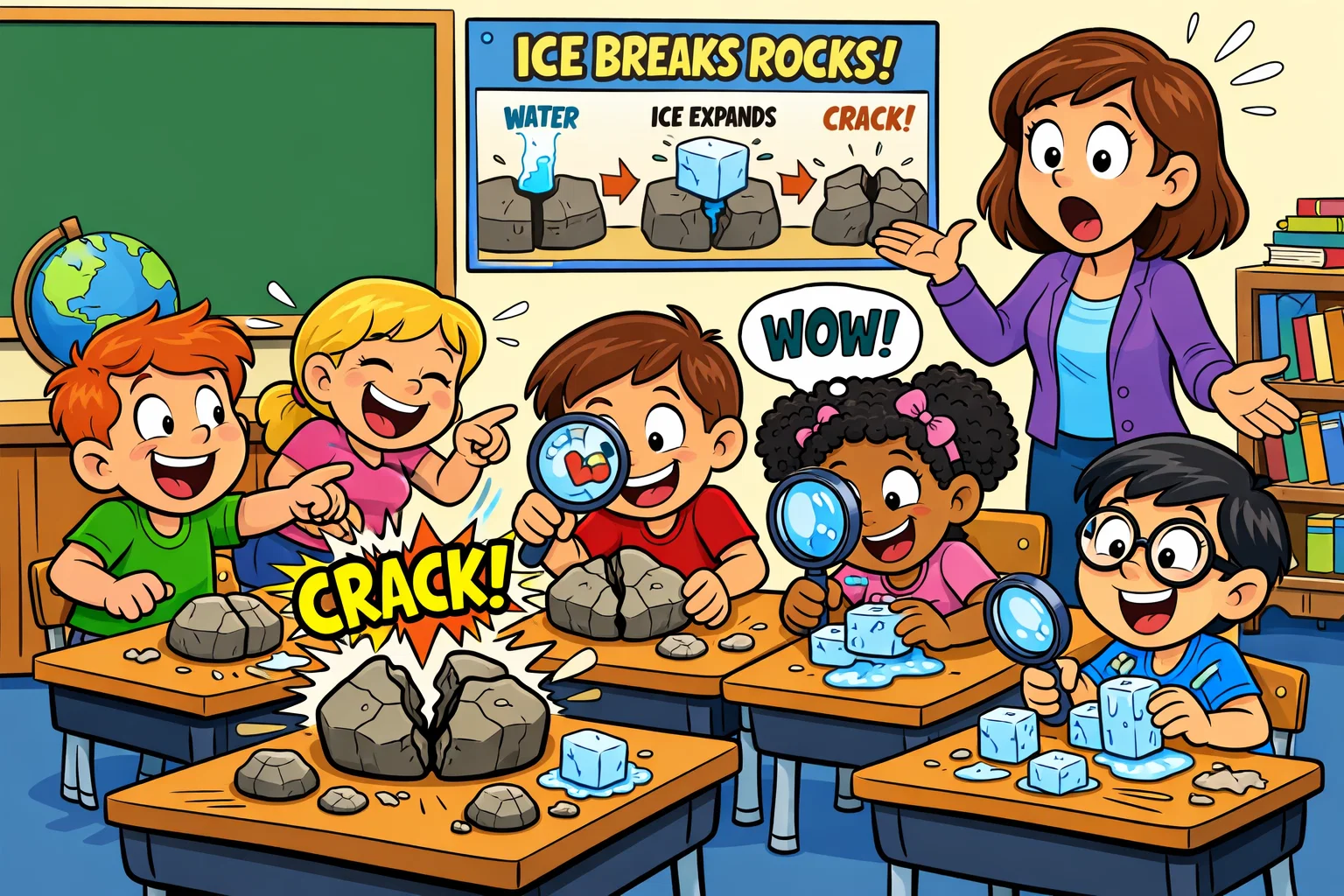
If you have ever noticed a jagged crack in a sidewalk after a long winter or wondered why the edges of rocks on a mountain look so sharp and broken, you have witnessed one of nature’s most powerful natural sculpting processes. Freeze-thaw weathering is a fascinating, hands-on science topic that allows children to see the slow, gradual power of weather in action. By exploring how water freezes and thaws, kids can grasp complex geological concepts through simple, tactile activities.
Whether you are looking for a winter science project to do at home or a structured earth science lesson for the classroom, these science experiments provide a clear demonstration of how the weathering of rocks shapes our world. By simulating the cycles of freezing and thawing, a kitchen freezer can be transformed into a geological laboratory, showing how even the hardest rock breaks when faced with the relentless expansion of ice.
Freeze-Thaw Weathering Concept
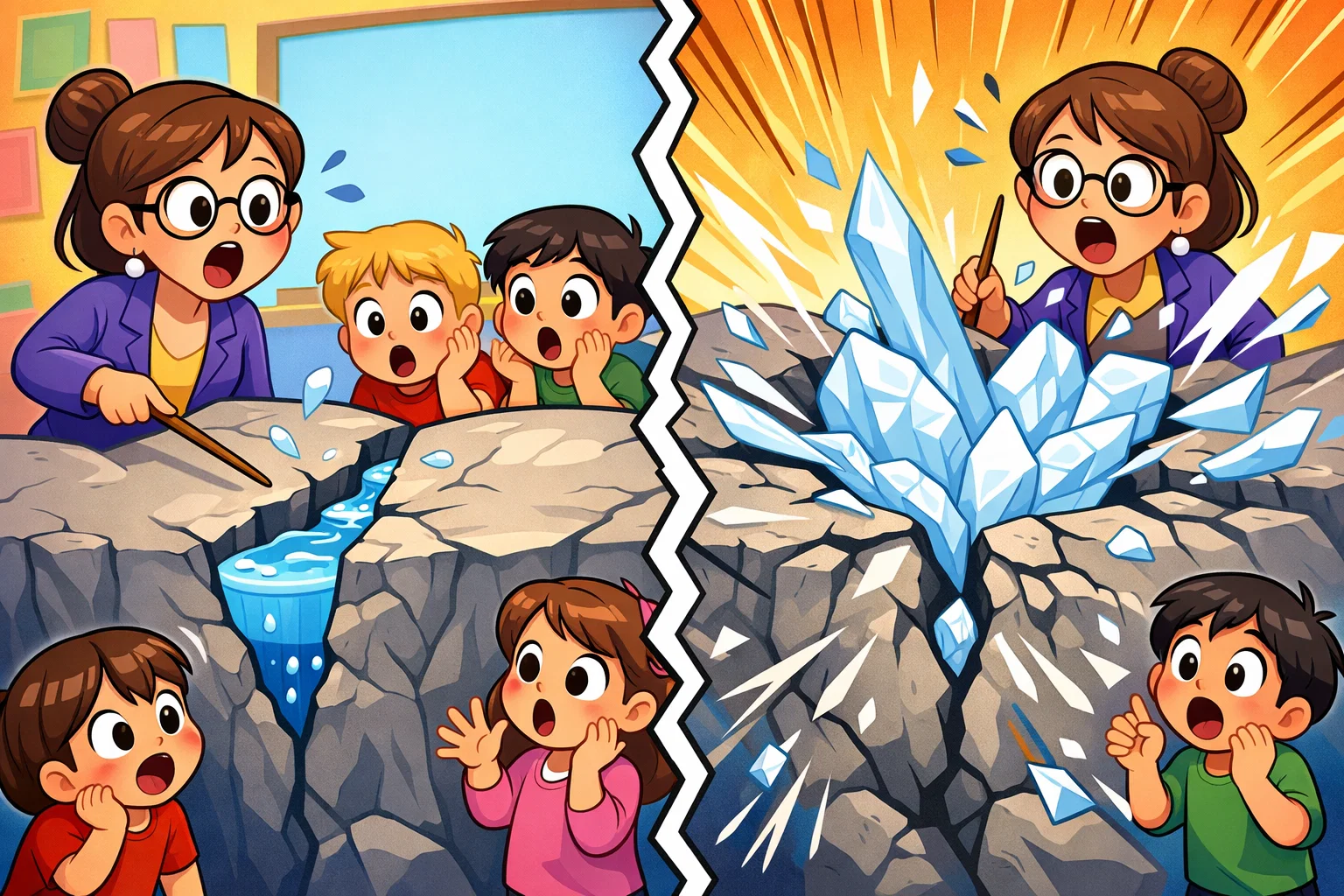
Freeze-thaw weathering is a specific type of physical weathering that occurs when water seeps into small cracks and pores within a rock. This isn’t a chemical change; the rock’s minerals stay the same, but its physical structure is torn apart. This process is most common in environments where the temperature frequently fluctuates around the freezing point, such as mountainous regions or areas with distinct winter weather.
When the temperature drops below 0 °C (32 °F), the water inside the crevice turns to ice. Later, as the weather warms, the ice will melt (or thaw), allowing the liquid to sink deeper into the newly widened gaps. This repeated freezing and thawing acts like a slow lever, eventually breaking the rock into smaller pieces.
Water Expansion During Freezing
To understand why this happens, we have to look at the water molecule. Most substances shrink when they get cold, but water behaves differently. Because of the way the molecule structures itself into a crystal lattice as it turns to ice, water expands as it freezes.
In fact, water volume increases by approximately 9% when it transitions from liquid to solid. This is why a glass bottle filled with water and left in the freezer will likely shatter; the ice simply takes up more space than the liquid did. In nature, this expansion can create immense internal pressure – up to tens of thousands of pounds per square inch – which is more than enough to break apart even the toughest limestone or granite.
Temperature Cycles Impact
It is rare for a single freeze to shatter a massive boulder. Instead, weathering that breaks down mountains is a game of persistence. Each time the water freezes and expands, the crack grows just a tiny bit wider. During the next thaw, more water enters the enlarged space. Over hundreds or thousands of these cycles, the structural integrity of the stone is compromised until it finally fails.
Mechanical Weathering Definition
Geologists categorize this as physical weathering (also known as mechanical weathering).
- Physical Weathering: The rock is broken into smaller fragments by physical force (like ice, wind, or tree roots).
- Chemical Weathering: The rock is broken down by chemical reactions (like acid rain dissolving limestone).
Freeze-thaw is one of the most effective forms of physical weathering in cold climates because it relies purely on the mechanical force of expanding ice.
Learning Objectives For Kids
Engaging in cool science like this isn’t just about making a mess; it’s about building a foundation for scientific inquiry. Through these activities, children develop several key competencies:
Rock Weathering Observation Skills
Children learn to move beyond “the rock looks the same” and start looking for small cracks, thinning edges, or sediment at the bottom of their containers. They learn that geology is often about subtle changes that lead to big results.
States Of Matter Connection
This experiment provides a concrete example of how matter changes. Kids see water move from a liquid to a solid and back again. They begin to understand that “solid” doesn’t mean “immobile” – the formation of ice crystals is a dynamic process that exerts force on its surroundings.
Cause And Effect Thinking
By controlling the temperature, students can directly link the “cause” (freezing water) to the “effect” (the rock breaks). This strengthens their ability to form hypotheses: “If I freeze this rock ten times instead of five, will it break more?”
Equipment And Materials
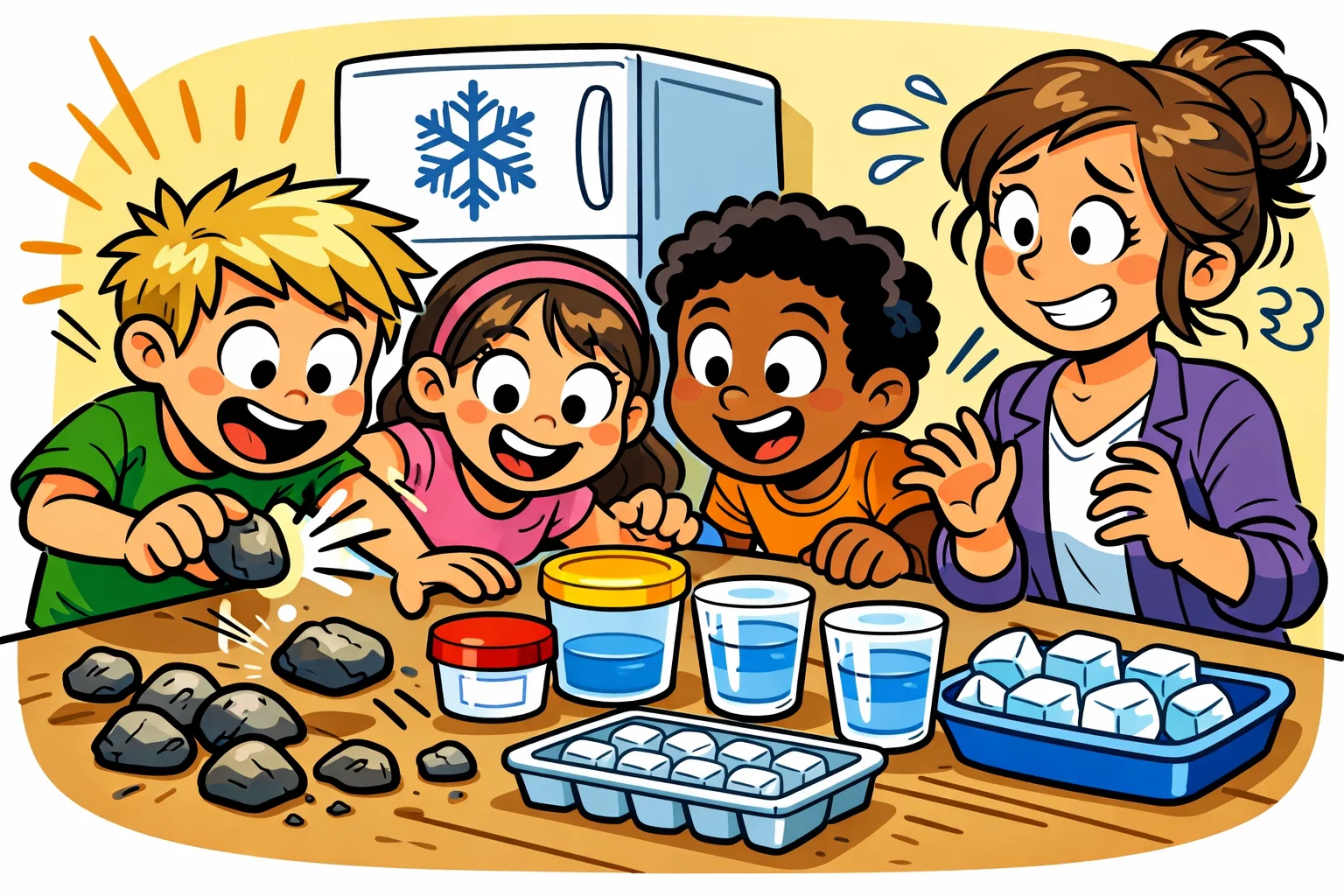
One of the best things about teaching the weathering of rocks is that you don’t need a high-tech lab. Most materials are already in your kitchen or backyard.
Common Household Materials
- Rocks: Porous varieties work best (see “Rock Selection Tips” below).
- Water: To fill the cracks and pores.
- Plastic containers: Use flexible plastic containers or heavy-duty freezer bags. Avoid glass, as it will shatter.
- Freezer: To simulate cold weather.
- Chalk: A great “soft” alternative to show rapid results.
Classroom Lab Alternatives
If you are in a classroom without a freezer, you can use salt-and-ice baths to reach sub-zero temperatures, though this is much harder to maintain for multiple cycles. Alternatively, if you live in a cold climate, simply placing the samples on a windowsill overnight during winter works perfectly.
Rock Selection Tips
Not all rocks are created equal when it comes to weathering.
| Rock Type | Porosity | Expected Result |
| Limestone | High | Visible cracks and dust or flakes |
| Sandstone | High | Often crumbles at the edges |
| Chalk | Very High | Rapid breakdown; highly visible |
| Granite | Low | Very slow; may show no change in a short experiment |
Health Safety And Technical Notes
While this is a low-risk experiment, working with cold weather simulations requires a few ground rules to keep young scientists safe.
Child Safety Precautions
- Cold Handling: Use gloves or tongs when removing items from the freezer. Touching ice or frozen containers with wet hands can cause the skin to stick.
- Eye Protection: If you are examining rock breaks that have become unstable, wearing safety goggles is a good habit to prevent small stone chips from hitting the eyes.
Freezer Usage Guidelines
Always label your containers clearly: “SCIENCE EXPERIMENT – DO NOT EAT.” Ensure the containers are sealed well so that water inside doesn’t spill and create a slippery ice layer on the freezer floor.
Experiment Duration Notes
To truly show that water expands and breaks stone, you need patience. One cycle is rarely enough. Plan for at least 5 to 10 cycles of repeated freezing and thawing to see significant results. This makes it a great “Monday to Friday” classroom project.
Freeze-Thaw Experiment Procedure
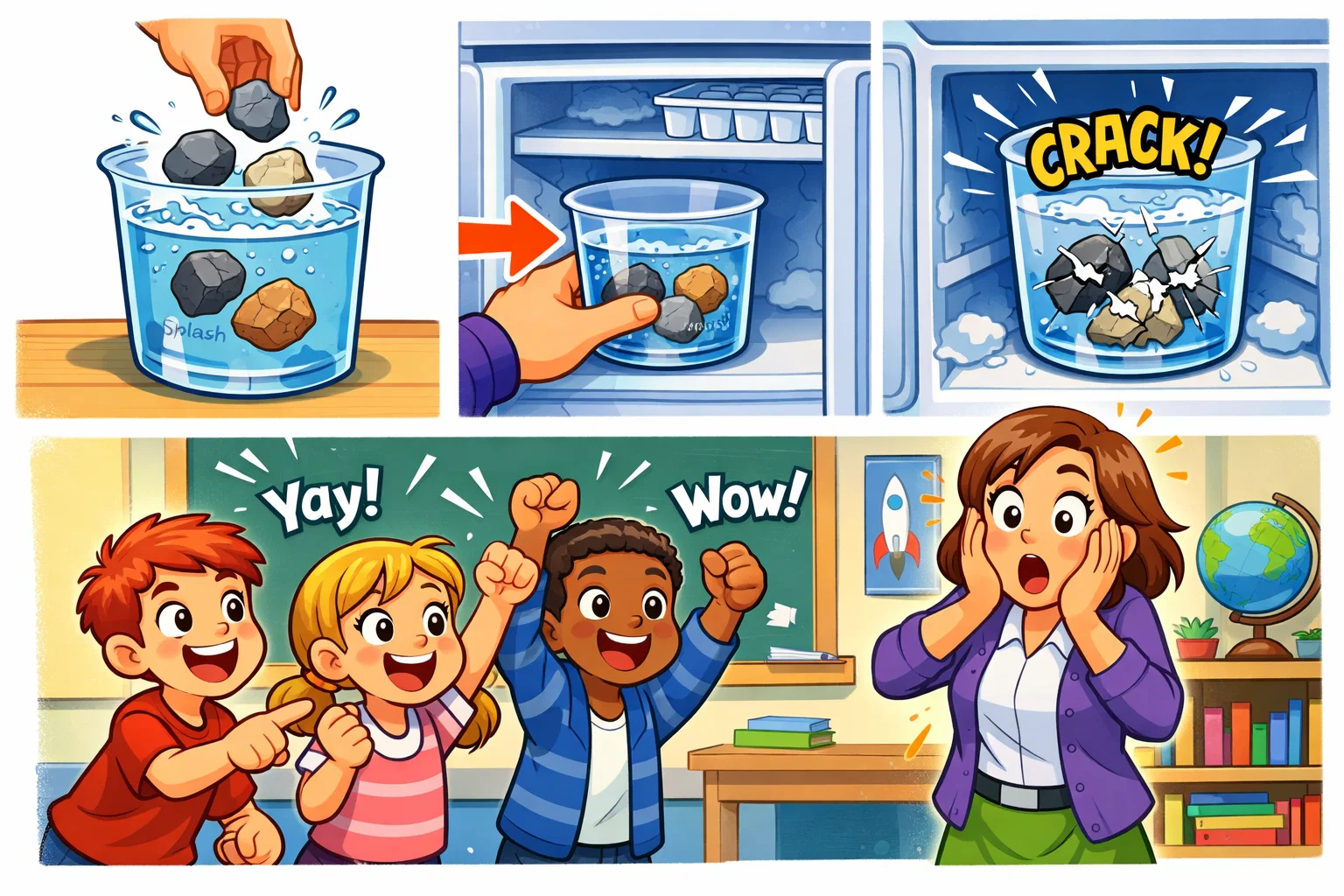
Ready to see physical weathering in action? Follow these steps for a successful demonstration.
1. Experiment Setup Steps
First, collect your rock samples. To ensure there is plenty of water inside, soak your rocks in a bowl of warm or hot water for about an hour. The heat helps the water penetrate deeper into the pores. Once soaked, place each rock in a plastic container and add just enough water to submerge it halfway.
2. Freezing Phase
Place the containers in the freezer overnight. You want to ensure the water is completely frozen through to the center of the rock. This is where the water freezes and the molecular structure of ice starts pushing against the stone walls.
3. Thawing Phase
Remove the containers and let them thaw completely at room temperature. You can speed this up by placing them in a sunny spot. Once the ice has turned back to liquid, examine the rock. Use a magnifying glass to check the edges of rocks for small bits that may have flaked off.
4. Repetition Cycles
Drain the water (which might now contain sediment), add fresh water, and repeat. As the cycles of freezing and thawing continue, you will notice the crack in the rock – or the chalk – becoming more pronounced.
Winter Science Experiment Variations
Ice Crack Demonstration
If you want a faster result, use a piece of chalk. Because chalk is so porous, it absorbs a lot of water. You will often see it break apart in just two or three cycles, making it an excellent “quick” version of the experiment.
Salt Versus Water Comparison
Does salt change the weathering of rocks? Set up two containers: one with fresh water and one with a heavy salt solution. Since salt lowers the freezing point of water, the salted sample may not freeze at the same temperature, demonstrating why we use salt on roads in the winter.
Outdoor Winter Experiment Option
If the temperature drops below freezing outside, move the lab to the porch! This connects the experiment to the real winter weather the kids see every day.
Teaching Notes And Classroom Use
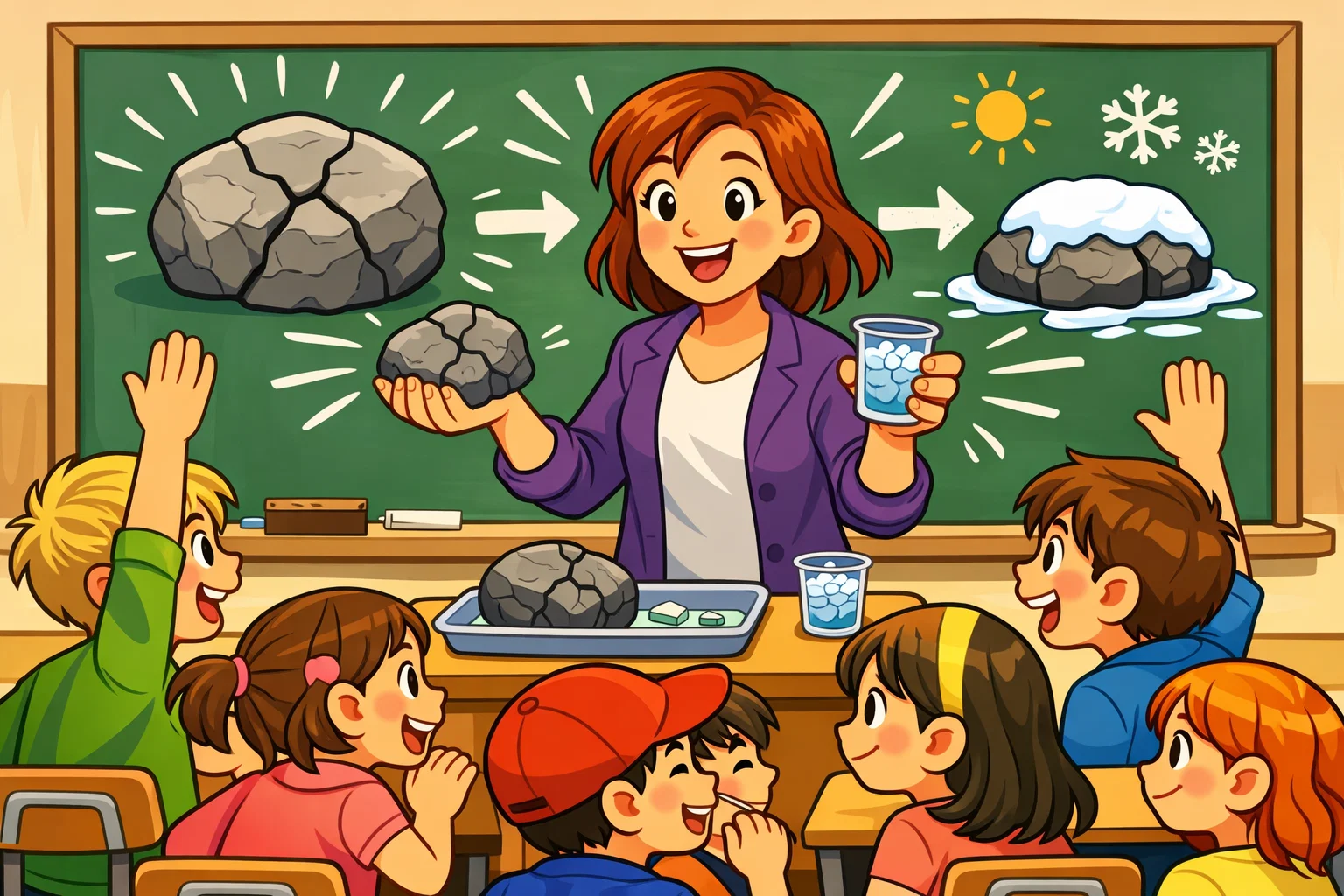
Lesson Integration Ideas
This experiment fits perfectly into units on the rock cycle, erosion, or states of matter. You can use it to explain why “potholes” appear in roads during the spring – it’s just freeze-thaw weathering happening to asphalt!
Grade Level Adaptation
- Elementary: Focus on the “wow” factor. Show that water expands using a balloon (see below) and observe the rock crumbling.
- Middle School: Introduce density and measure the weight of the sediment that breaks off. Have students calculate the percentage of mass lost over five cycles.
Discussion Questions
- Why does the water need to be in a crack for the rock to break?
- What would happen if the temperature stayed below freezing all year long? (Hint: Weathering requires the thaw to let more water in!)
- How does this process help create soil for plants?
Why Freeze-Thaw Weathering Works
The “magic” here is actually simple physics. When water freezes and expands, it is settling into a lower-energy state. The molecules are moving from a disorganized liquid to a structured crystal.
Pressure Inside Cracks
Because ice is less dense than water, it must occupy more space. If it is trapped inside a crevice, it exerts an outward force. The rock has high “compressive strength” (you can’t easily squish it), but low “tensile strength” (it’s easy to pull it apart). Ice expansion pulls the rock apart from the inside.
Real World Examples
In mountainous regions, freeze-thaw processes turn solid cliffs into talus slopes – the piles of broken rock found at the base of mountains.
Experiment Level And Age Range
- Elementary School (Ages 5-10): High supervision. Focus on the visual of the rock breaks and the concept of “water getting bigger.”
- Middle School (Ages 11-14): Independent work. Focus on data collection, density calculations, and the molecular structure of the water molecule.
- Home Science Projects: Excellent for parents and kids to do together over a school break.
Additional Hands-On Science Activities
Ice Expansion Demonstrations
To show that ice expands without waiting for a rock to break, fill a small plastic water bottle to the very top and screw the cap on tight. Place it in the freezer. By morning, the bottom or sides of the bottle may be pushed outward, or the sides will be distorted. This is a clear demonstration that water takes up more space as a solid.
Winter STEM Extensions
Challenge kids to build a “house” out of sugar cubes and “weather” it using a spray bottle of water. While this simulates rain erosion rather than freezing, it’s a great way to compare different types of weathering.
More Experiments For Kids
If your young scientist enjoyed learning about how rocks break, they might also like:
- States of Matter: Exploring sublimation with dry ice.
- Weather Science: Creating a “cloud in a jar” to understand condensation.
- Earth Science Mini Labs: Using vinegar on limestone to demonstrate chemical weathering.

Take a short quiz to find out what your everyday choices say about your parenting style
When your child is curious about something new, what’s your instinct?
Take a short quiz to find out what your everyday choices say about your parenting style
“Can I download this app?” What happens next?
Take a short quiz to find out what your everyday choices say about your parenting style
When it comes to rules at home, which sounds most like you?
Take a short quiz to find out what your everyday choices say about your parenting style
If you could give your child one life skill today, what would you pick?
Take a short quiz to find out what your everyday choices say about your parenting style
Your child gets to choose what to watch. What would your ideal setup look like?
Take a short quiz to find out what your everyday choices say about your parenting style
Pick your parenting superpower ✨