
Parachute Design Challenge for Kids: Slowest Fall STEM Project

 Discover a Free Education Video App for Kids
Pastory uses AI to personalize educational video content based on your child’s interests and personality. Safe, engaging, and built for curious young minds. Sign up now to stay updated and enjoy early access with a free trial
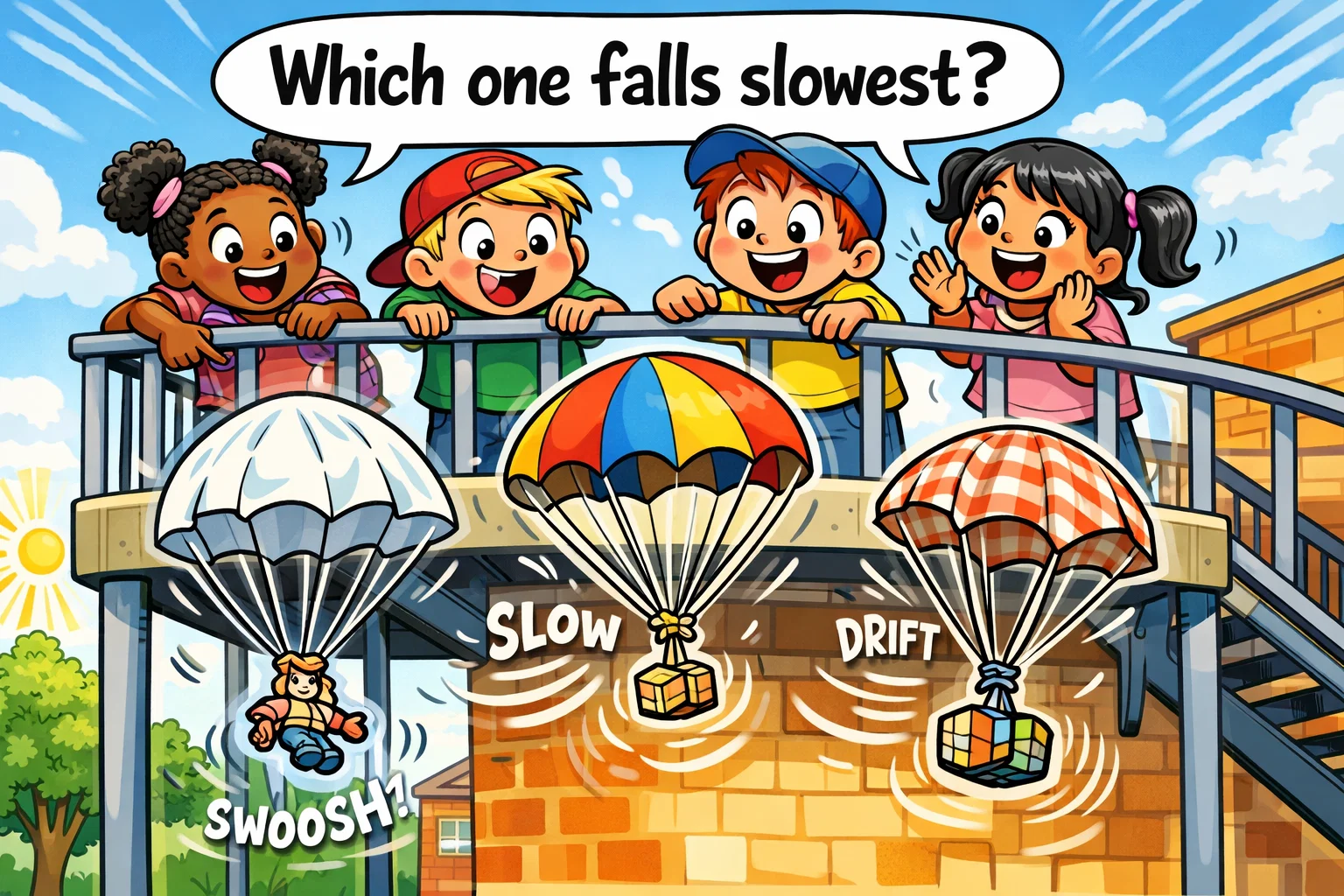
Have you ever watched a skydiver drift gracefully toward the earth or wondered how a massive space capsule lands safely in the ocean after speeding through the atmosphere? The secret lies in the fascinating physics of air resistance and clever engineering. Bringing this high-flying science into your living room or classroom is easier than you might think. A slow-fall device activity is one of the most effective ways to introduce children to the engineering design process through hands-on play.
In this STEM challenge, young engineers are tasked to design a parachute that achieves the slowest possible drop time. Using simple household items like a plastic bag, string, and tape, kids will explore how changing the canopy size or different materials impacts how a falling object interacts with the air. Whether you are a teacher looking for a physics lesson or a parent seeking a fun slow-descent experiment for a rainy afternoon, this guide provides everything you need to build a parachute that slows the effect of gravity.
Parachute STEM Challenge Overview
Quick Look
- Age Range: 6–14 years (Elementary to Middle School)
- Time Needed: 45–60 minutes
- Skills Learned: Physics (Forces and Motion), Math (Measurement/Timing), Engineering Design
- Mess Level: Low
- Supervision Level: Medium (Adult help may be needed for using scissors or dropping from heights)
Activity Summary
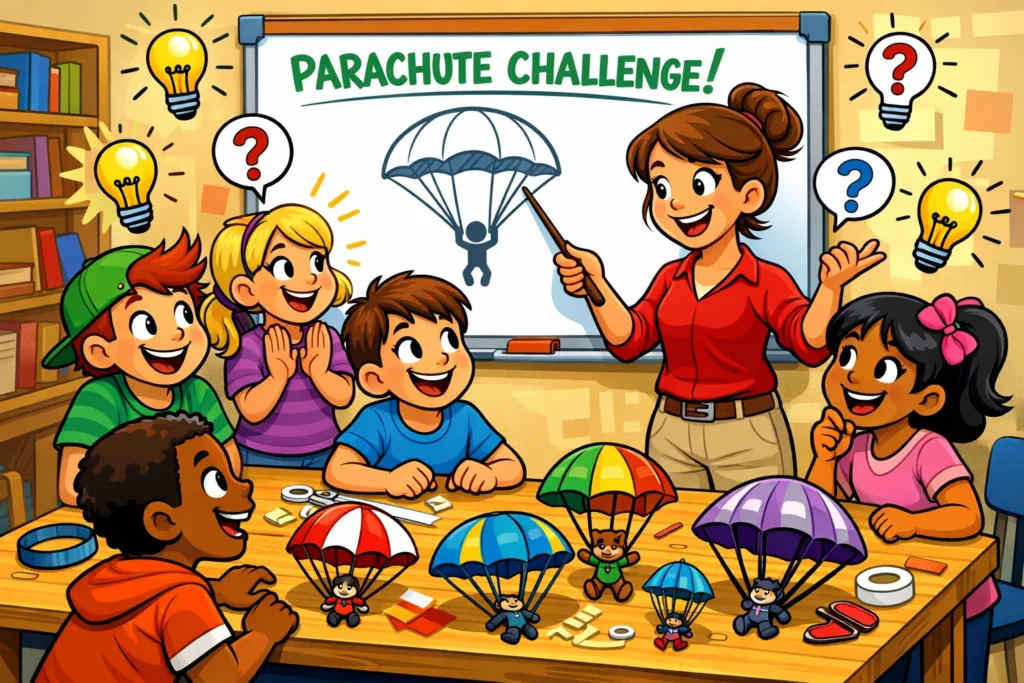
The core of this STEM project is simple: kids must make a descent system to transport a”payload” (like a toy figure or a washer) safely to the ground. The goal isn’t just to land; it’s to fall more slowly than any other design. Participants will brainstorm, sketch their design concepts, and then test their models by dropping their creations from a high spot. After the first test, they use their findings to refine their work, aiming for the longest hang time.
Engineering Connection
Engineers don’t just build things; they solve problems under specific constraints. In the real world, aerodynamics plays a crucial role in controlled landings and emergency deliveries to remote areas. By participating in this stem challenge, children mimic the engineering design process: they identify the problem, research (learn about air and forces), develop a prototype, test it, and iterate to improve the best design.
Real-World Parachute Applications
Parachutes are used in various critical fields today:
- Skydiving: For recreation and military maneuvers.
- Space Exploration: NASA uses large parachute systems to slow down capsules returning from the International Space Station.
- Cargo Drops: Delivering food and medicine to disaster zones where planes cannot land.
- Emergency Systems: Some small planes are now equipped with whole-airframe parachutes to ensure a safe landing during engine failure.
Learning Goals and STEM Skills
Learning Objectives
By the end of this hands-on science activity, students will be able to:
- Identify the force of gravity and how it pulls objects downward.
- Explain how air resistance acts as a force that opposes motion.
- Demonstrate how changing the surface area affects the drop time.
- Collect and compare data using a stopwatch.
Key Science Concepts
To understand how a drag-based landing system works, kids need to grasp the tug-of-war between two forces. Gravity pulls every falling object toward the center of the Earth. However, air is not “empty” space; it is filled with molecules. When a parachute is dropped, the canopy pushes against air molecules, creating air resistance to slow the descent. This is often called drag force.
Forces and Motion Concepts
When an object falls without a drag device, it accelerates quickly because it has a small profile and faces little resistance. A parachute canopy increases the surface area, forcing it to “push” more air out of the way. According to NASA, as the fall continues, the upward drag eventually balances the downward weight, leading to a steady speed known as terminal velocity.
Quick Vocabulary
| Term | Definition |
| Gravity | The force that pulls objects toward the center of the Earth. |
| Air Resistance | A type of friction (drag) that acts against an object moving through air. |
| Canopy | The fabric or plastic surface that captures air during descent. |
| Payload | The object or weight being carried by the parachute. |
| Surface Area | The total amount of space the surface of the canopy occupies. |
Materials and Supplies List
Basic Materials
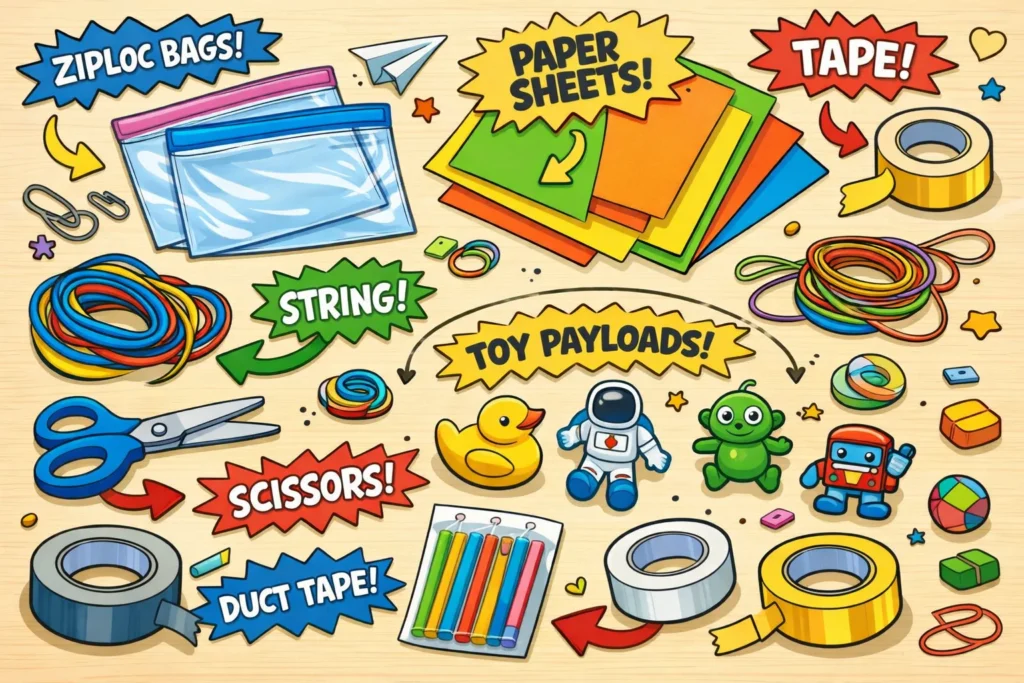
- Canopy: Plastic bag (grocery or trash bag), tissue paper, or a cut square of lightweight fabric.
- Strings: Yarn or kitchen twine (at least four strings per parachute).
- Adhesive: Pieces of tape (masking or clear).
- Payload: Small toy figure, large paperclip, or a metal washer.
- Tools: Scissors, ruler, and a hole punch (optional).
Optional Materials
- Coffee filters (great for different sized parachutes).
- Napkins or silk scraps.
- Small paper cups (to hold “Eggstronauts”).
- Balloons (for experimenting with lift).
Classroom Setup Materials
- Stopwatch or smartphone timer.
- Measuring tape (to ensure every parachute drop happens from the same height).
- Data recording sheets or a whiteboard for class results.
- A stable step ladder (for adult use only).
Parachute Design Instructions
How to Make a Parachute
- Prepare the Canopy: Cut a circle or a square from your plastic bag or tissue paper. For a standard toy parachute, a diameter of 30 cm is a great starting point.
- Attach the Strings: Cut four lengths of string (approx. 30 cm each). Use a piece of tape or a hole punch to attach one string to each corner (if square) or around the edge at equal intervals (if circular).
- Meet in the Middle: Gather the loose ends of all strings and tie them together in a knot.
- Attach the Payload: Secure your toy or weight to the knotted end of the strings.
Payload Attachment Methods
Consistency is key! Ensure the number of strings is even and that they are all the same length. If one string is shorter, the parachute canopy will tilt, allowing air to escape and causing the object to fall faster. You can use a small basket or simply tie the strings directly around the “waist” of an action figure.
Safe Testing Setup
Always drop your parachute from a consistent and safe high spot, such as a stairwell or indoor landing area. Ensure the landing zone is clear of people and obstacles. Note: If testing outdoors, even a slight breeze will significantly alter your drop time.
Design Challenge: Slowest Fall Goal
Challenge Rules
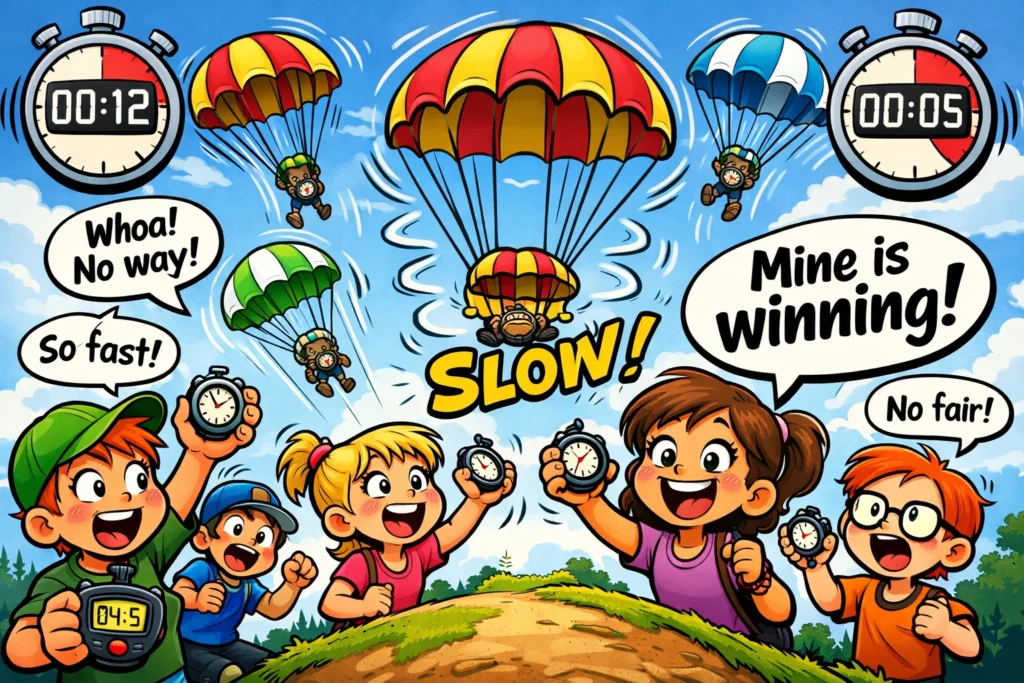
The goal is simple: the slowest descent wins!
- The payload must remain attached throughout the flight.
- The parachute must fully deploy (open up).
- The payload must achieve a soft landing (no “breaking” the toy).
Testing Procedure
To ensure scientific accuracy, use a stopwatch to measure the time from the moment the device is dropped until it hits the ground. Perform at least three trials for each parachute design to find an average time.
Recording Results
Use a table like the one below to keep track of your parachute experiment:
| Design Type | Trial 1 (sec) | Trial 2 (sec) | Trial 3 (sec) | Average Time |
| Small Plastic (30cm) | 1.5 | 1.6 | 1.4 | 1.5 |
| Large Plastic (50cm) | 2.4 | 2.5 | 2.3 | 2.4 |
| Tissue Paper (30cm) | 1.8 | 1.9 | 1.7 | 1.8 |
Investigating Questions
Does a Larger Canopy Fall More Slowly?
Generally, yes! The larger the surface area, the more air the canopy catches.This creates more drag force, which fights against the pull of gravity. However, if the canopy is too large for the weight, it may become unstable and collapse.
How Does Weight Affect Fall Speed?
If you keep the parachute size the same but increase the weight of the payload, the parachute will drop faster. This is because a heavier object requires more air resistance to slow it down. In physics terms, gravity pulls more strongly on objects with greater mass, requiring a large surface area to compensate.
How Does Material Type Change Results?
Different materials have different weights and levels of porosity (how much air can pass through them). A plastic bag is excellent because it is airtight and lightweight. Tissue paper is even lighter but can be fragile. Comparing different parachute designs made of silk versus plastic is a great way to see how “billowy” materials capture air differently.
Science Behind Parachutes
Why Parachutes Float Down
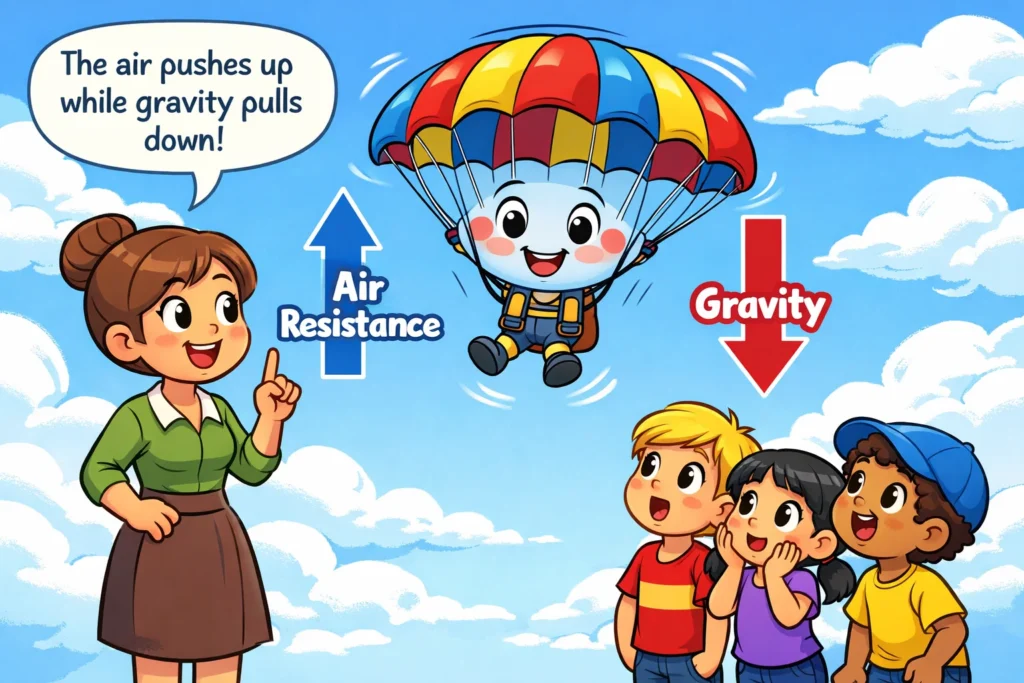
You can think of it as a balance. Gravity pulls down, while air resistance pushes up. When you first drop your parachute, gravity is winning. But as the canopy opens, the force of air increases until it almost matches the weight of the payload. This allows for a safe landing at a much lower speed than a freefall.
Hammer vs. Feather Drop Comparison
On the Moon (where there is no air), a hammer and a feather hit the ground at the same time. On Earth, the feather’s large surface area relative to its tiny weight creates enough air resistance to make it float. A parachute makes your toy behave more like a feather by giving it a massive surface area!
Air Resistance Explained for Kids
“Imagine running through a swimming pool. The water pushes against you, making it hard to move fast. Air does the same thing, but it is much less dense than water. A parachute acts like a giant sail that catches that ‘thick’ air to slow you down.”
Parachute Design Ideas
Classic Round Parachute
The first parachute designs were often circular. This shape provides a very stable descent. Cut a circle of plastic and attach at least six to eight strings to keep the edges from flapping too much.
Multi-Parachute Design
Modern spacecraft often use three or more parachutes at once. Try attaching three small coffee filter parachutes to a single payload. Does it work better than one large canopy?
Origami Parachutes
Using thin paper, you can fold specific “vane” shapes. While these may fall faster than plastic ones, they often provide a very stable, spinning descent that is fascinating to watch.
Balloon Variations
Attach a small, air-filled balloon above the canopy. The slight buoyancy of the balloon can help the parachute stay open and potentially create the slowest fall of all.
Activity Extensions
Egg Drop Challenge Version
Ready for high stakes? Use your best design to protect a raw egg. You’ll need to design a “seat” for the egg and ensure the parachute is large enough to guarantee a soft landing.
Timed Competition Format
Host a “Hang Time” derby! Give everyone the same plastic bag and four strings, then see who can modify their design (by adding a hole in the middle or changing the shape) to get the longest flight time.
Standards and Educational Alignment
This project aligns well with NGSS (Next Generation Science Standards):
- PS2.A: Forces and Motion: Pushing and pulling on an object can change the speed or direction of its motion.
- ETS1.B: Developing Possible Solutions: Tests are often designed to identify failure points or difficulties, which suggest the elements of the design that need to be improved.
Tips, Comments, and Teacher Notes
Common Mistakes to Avoid
- Tangled Strings: If strings are too long or messy, the canopy won’t open.
- Off-Center Payload: If the weight isn’t balanced, the parachute will tip and “dump” its air, causing it to fall faster.
- Too Much Tape: Tape adds weight! Use just enough to secure the strings.
Teacher Tips
Encourage students to change only one variable at a time (e.g., keep the material the same but change the size). This teaches the importance of controlling variables in a real parachute experiment.
Parent Tips
Don’t give them the “right” answer immediately. If their toy parachute fails, ask: “Why do you think it fell so fast?” Let them brainstorm and design a parachute version 2.0. Exploration is the heart of science!
FAQs
Lightweight, non-porous materials like thin plastic (trash bags) or ripstop nylon usually perform best. They are light enough not to add much extra weight but strong enough to hold the air.
A height of at least 2–3 meters (about 6–10 feet) is ideal. This gives the parachute canopy enough time to fully deploy and reach its steady descent speed.
Yes! Adding a small hole in the middle (a vent) actually helps. It allows air to escape through the center, which prevents the parachute from wobbling side-to-side, making the parachute fall much straighter.

Take a short quiz to find out what your everyday choices say about your parenting style
When your child is curious about something new, what’s your instinct?
Take a short quiz to find out what your everyday choices say about your parenting style
“Can I download this app?” What happens next?
Take a short quiz to find out what your everyday choices say about your parenting style
When it comes to rules at home, which sounds most like you?
Take a short quiz to find out what your everyday choices say about your parenting style
If you could give your child one life skill today, what would you pick?
Take a short quiz to find out what your everyday choices say about your parenting style
Your child gets to choose what to watch. What would your ideal setup look like?
Take a short quiz to find out what your everyday choices say about your parenting style
Pick your parenting superpower ✨



