Penny Boat Buoyancy STEM Challenge for Kids Using Foil Boats

 Discover a Free Education Video App for Kids
Pastory uses AI to personalize educational video content based on your child’s interests and personality. Safe, engaging, and built for curious young minds. Sign up now to stay updated and enjoy early access with a free trial

Have you ever stood on a pier and wondered how a massive steel ship, weighing thousands of tons, can glide effortlessly across the ocean while a tiny pebble sinks straight to the bottom? To a child, this feels like a magic trick. In reality, it is a perfect, tangible demonstration of physics in action. The foil boat challenge is one of the most beloved and effective ways to bring these complex concepts to life for young learners. By using just a few household items, you can transform your kitchen table or classroom into a hands-on naval engineering laboratory.
The penny boat challenge – often dubbed the “pennies test” – is a classic hands-on STEM activity where children design small vessels from aluminum foil and load them with many pennies to see how much weight they can carry before sinking. It is an engaging way to demonstrate why some objects float while others sink, encouraging kids to think like little engineers and scientists. This isn’t just about making a mess with water; it is a gateway to understanding the scientific principles and engineering that keep our world moving.
Introduction

Activity purpose and learning goals
The primary purpose of a boat STEM challenge is to foster a “maker” mindset. When kids make a boat and watch their creation sink after adding that one final penny, they aren’t just failing; they are collecting data. This activity is designed to move beyond passive learning and into active discovery, where the “failure” of a design is actually the most important data point in the experiment.
By participating, children develop several core competencies:
- Problem-solving skills through iterative engineering design.
- A deep understanding of upward force (buoyancy) through physical resistance.
- Fine motor skills through the precise manipulation of aluminum foil.
- Mathematical literacy by counting and recording the number of pennies to compare data sets.
Age range and learning context
This simple activity is incredibly versatile. It is most effective for children aged 7–11 (grades 2–5), as they have the cognitive ability to connect boat design to the science behind floating and buoyancy. However, the context can be adapted easily:
- Preschoolers: Focus on the sensory play of “sink vs. float” and basic counting of a handful of pennies.
- Middle Schoolers: Introduce calculations for density, volume, and displacement using specific dimensions.
- Environments: It works equally well in a kitchen sink filled with water at home or as a structured engineering challenge in a large classroom setting.
What Is a Boat Buoyancy Challenge for Kids?
Pennies test explained
In this stem challenge, the mechanics are straightforward but the implications are deep. Participants are given a single piece of aluminum foil and tasked with designing a boat. Once the aluminum foil boat is constructed, it is placed in a sink filled with water. The participant then begins to add pennies one at a time. The goal is to see how many pennies the model can hold before it sinks. It turns a dry physics lesson into a high-stakes competition to hold as many pennies as possible.
Why pennies are used as weights
Pennies are the gold standard for this boat challenge for several practical reasons:
- Uniformity: Each modern U.S. penny weighs approximately 2.5 grams. This standardization allows for fair comparisons between designs.
- Abundance: Most households or classrooms have a handful of pennies (or even 100 pennies) sitting in a jar.
- Incremental Loading: Because they are small, kids can add pennies slowly, allowing them to observe the exact moment the weight of the craft overcomes the water’s resistance.
STEM concepts introduced naturally
Without opening a textbook, children encounter the engineering design process. They observe how pennies are added and how keeping the vessel afloat becomes harder as the weight increases. They naturally begin to explore buoyancy and how the surface area of the bottom affects its capacity to hold more weight.
Science Behind Floating Boats
Buoyancy force basics
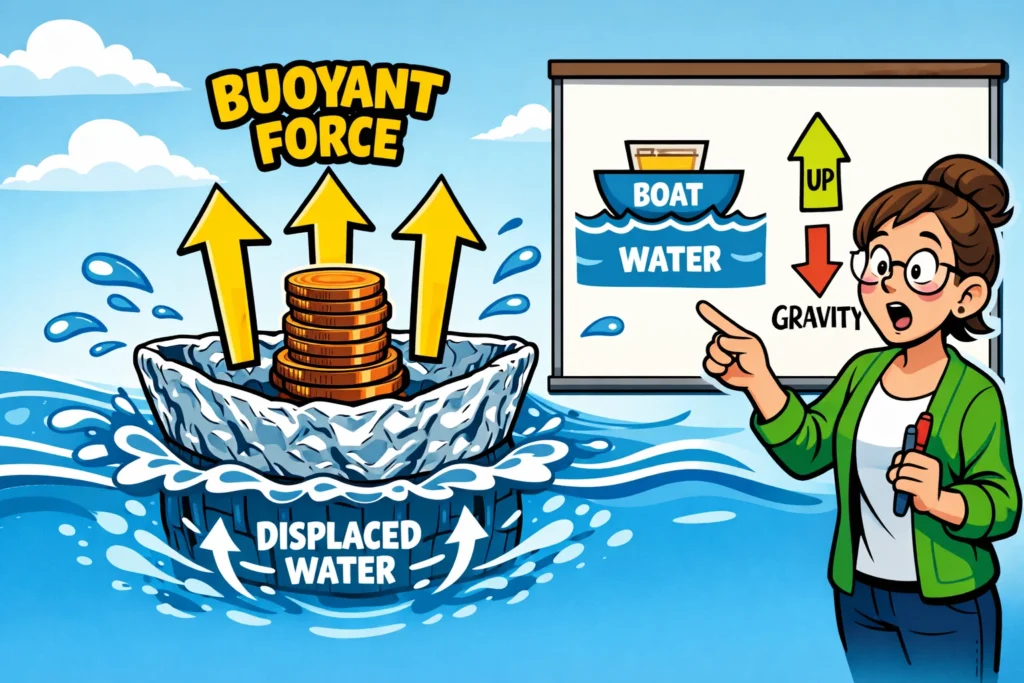
At the heart of this experiment is buoyancy, the upward force exerted by a fluid that opposes the weight of an immersed object. As a child places a penny in the boat, they are increasing the downward gravitational force. The water pushes back with an upward force. If the upward force is greater than or equal to the weight, the boat remains afloat.
Density comparison concepts
Whether a boat design succeeds depends on its density compared to the water. A ball of foil is dense and displaces very little water, so it sinks immediately. However, when you make a boat out of that same piece of foil, you are effectively “stretching” the foil over a larger volume that includes air. This lowers the overall density, allowing the craft to float even when carrying many pennies.
Displacement in water experiments
When you place your aluminum foil boat in water, it moves water out of the way. This is called displacement.
“An object will float if it weighs less than the amount of water it pushes out of the way.” — This principle explains why objects float or sink based on displaced water.
A different shape – like a wide, flat barge – displaces more water than a narrow, tall one, which is why wider designs usually hold the most weight without the boat sinks.
Materials Needed for Pennies Boat Challenge
To ensure a successful stem activity, gather these items beforehand:
| Material | Purpose | Quantity/Notes |
| Aluminum Foil | Primary building material | 12×12 inch foil squares are ideal. |
| Pennies | Cargo/Testing weights | Aim for 50–100 pennies per participant. |
| Water Container | The testing environment | A kitchen sink filled with water or a plastic tub. |
| Towels | Cleanup and drying | Foil and pennies will get wet! |
| Paper & Pencil | Data recording | To track the number of pennies each boat can hold. |
Material safety notes
Supervision is key, especially with younger children. One penny might not seem like much, but a handful of pennies can be a choking hazard. Ensure the foil edges are folded over to prevent minor scratches, and keep the floor dry to prevent slips around the sink filled with water.
Step by Step Boat Buoyancy Challenge Guide
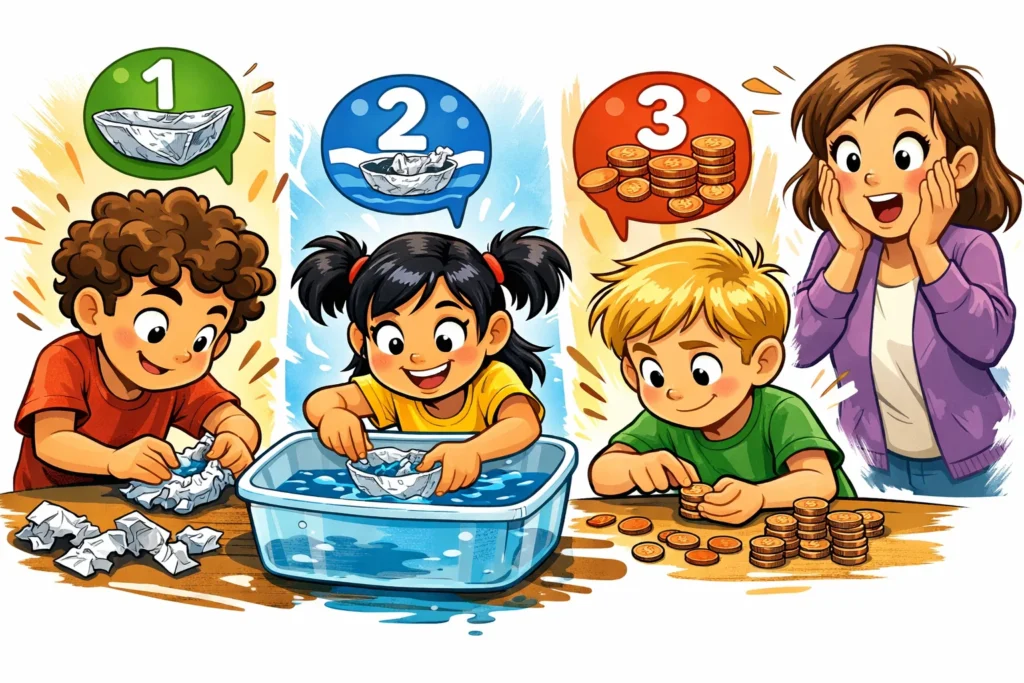
Step 1: Challenge introduction
Explain the mission clearly: “Your goal is to design a stable boat that can hold as many pennies as possible using only one piece of foil.” Present the foil boat challenge as a puzzle to be solved.
Step 2: Design planning phase
Before touching the foil, have the children draw their boat design. Ask: “What different shapes should we try? Will a circular design or a square one hold more weight?”
Step 3: Boat construction
Give them the foil squares. Encourage them to fold, bend, and mold. Remind them that the dimensions and wall height are critical – if the walls are too low, water will leak in early as they add pennies.
Step 4: Pennies testing process
Place the foil boat in the water. Add pennies one at a time, placing each penny carefully. Guide them to distribute the weight evenly – this is a vital part of engineering skills.
Step 5: Redesign and improvement
Once the boat sinks, record the number of pennies. Now, ask the child to design a boat that is even better. This is the “Improve” step in the engineering process.
Engineering Design Process in Action
The boat stem challenge isn’t just a game; it’s a professional workflow simplified for kids.
- Ask and Imagine: What is the problem? (The boat needs to carry weight).
- Plan and Create: Translating the mental boat design into a physical tin foil boat.
- Test and Improve: Observing where the boat failed and fixing it.
Boat Design Factors Affecting Results
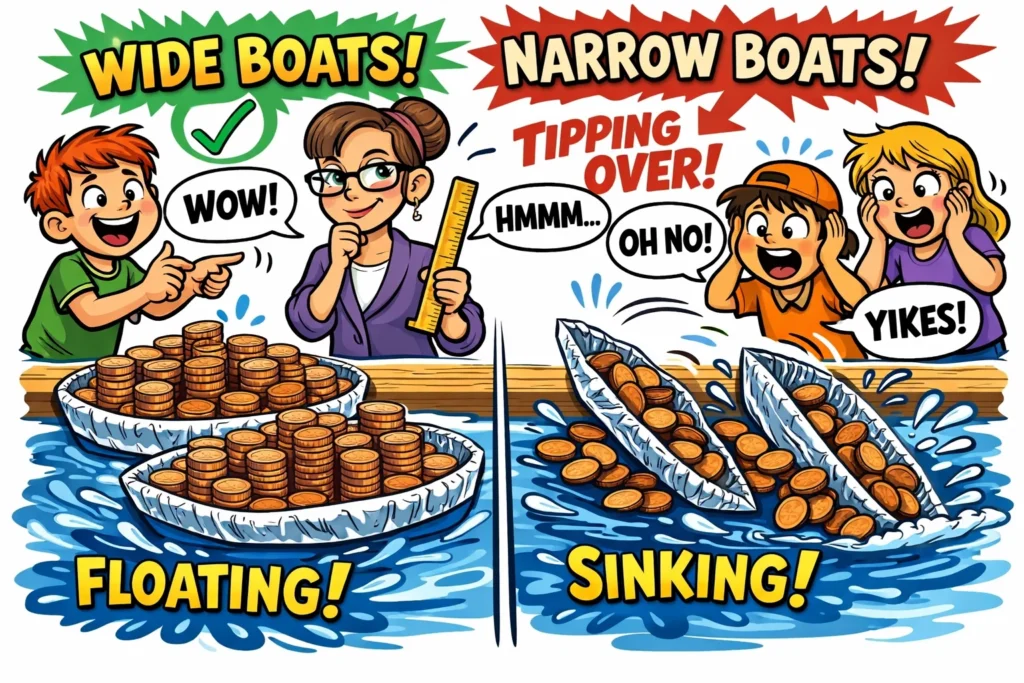
Boat shape and surface area
A boat with a large, flat surface area on the bottom spreads the weight over a larger volume of water. This usually results in a boat that can hold the most pennies.
Wall height and edge folding
If the walls are too short, the boat can hold only a small amount of weight before the water line reaches the top. Folding the edges also makes the structure strong enough to hold weight.
Weight distribution strategies
Strategic loading is just as important as the boat-building phase. If you stack all 100 pennies in one corner, the boat will tip. To hold as many pennies as possible, they must be placed carefully.
Variations and Extensions for Deeper Exploration
- Different Materials: Try making a boat out of wax paper or plastic wrap.
- Alternative Weights: Use paper clips or washers.
- Water Environment: Does the boat hold more pennies in salt water than in fresh water?
- The “Ball” Challenge: See how many pennies a ball of foil can hold to prove that shape is the deciding factor.
Reflection Questions for Kids
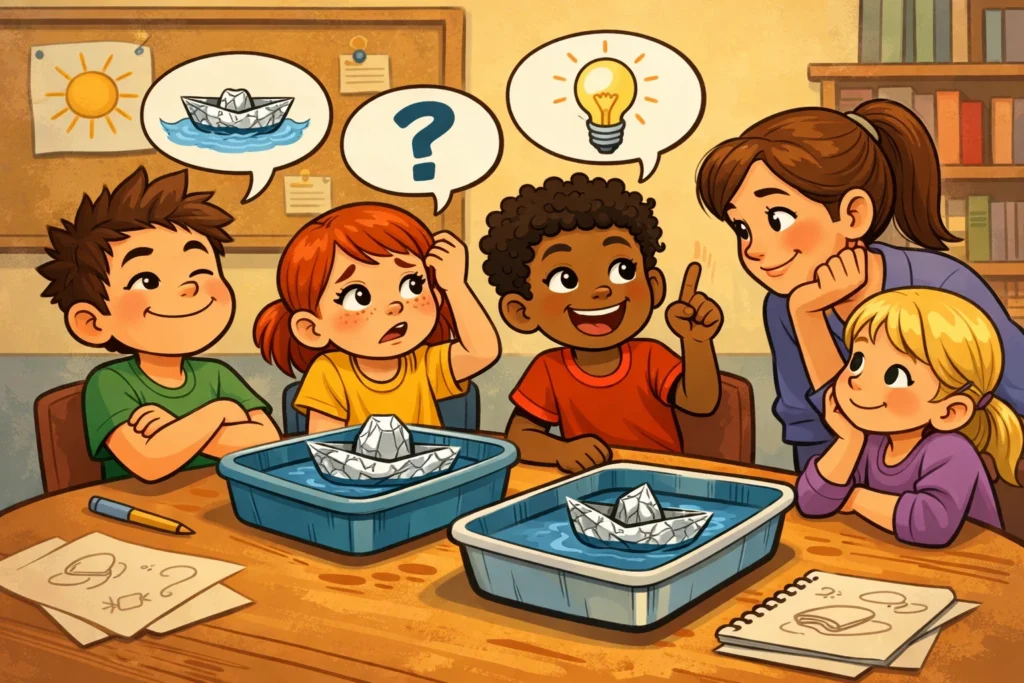
To cement the learning, ask these questions after the penny boat challenge:
- “What was the main reason your boat sank? Was it a leak or did the water go over the top?”
- “If you had a larger piece of aluminum foil, how would you change your dimensions?”
- “How does this experiment help you understand how real-life cargo ships carry heavy containers?”
Tips for Parents and Educators
Encouraging exploration without answers is the most powerful teaching tool. If their boat sinks immediately, don’t tell them to make the bottom wider. Ask, “Where did the water enter first?”
Managing frustration is also a key part of the engineering challenge. Remind them that real-life engineers fail thousands of times before a product is finished. This builds emotional resilience alongside engineering skills.
Common Mistakes and Troubleshooting
| Problem | Likely Cause | Solution |
| Boat sinks empty | Pinholes or tears in the foil | Check the corners where the foil was folded. |
| Tips over quickly | High center of gravity | Make the boat wider and place pennies one at a time. |
| Water seeps in | Walls are too flimsy | Double-fold the edges of the tin foil. |
Conclusion
The foil boat challenge is a fun and easy way to bridge the gap between abstract physics and hands-on fun. By using simple foil and pennies, children learn that science isn’t just about formulas; it’s about the design and build strategies that solve real-world problems. Whether they manage to hold 10 or 100 pennies, the real victory is the problem-solving and curiosity sparked during the process.
The science behind floating is something they will now carry with them every time they see a boat on the horizon. By mastering the engineering design process today, they are preparing to build the real-world solutions of tomorrow.
Frequently Asked Questions
While children as young as five can enjoy the sensory aspect, the sweet spot is 7–11 years old. This is when they can truly grasp the science behind the upward force.
A standard 12×12 inch piece of foil can often hold between 40 and 70 pennies if designed as a wide barge. Exceptional designs have been known to hold more weight, reaching over 100 pennies.
You can reuse the piece of foil, but be careful! Repeated folding creates “fatigue” in the aluminum foil, which may lead to leaks. It is often better to start with fresh foil squares for a new boat design.
Expect the stem activity to last 30–45 minutes. This allows for an intro, two rounds of boat design, and a final discussion about the engineering skills used.