Earthquake-Proof Building Challenge for Kids

 Discover a Free Education Video App for Kids
Pastory uses AI to personalize educational video content based on your child’s interests and personality. Safe, engaging, and built for curious young minds. Sign up now to stay updated and enjoy early access with a free trial
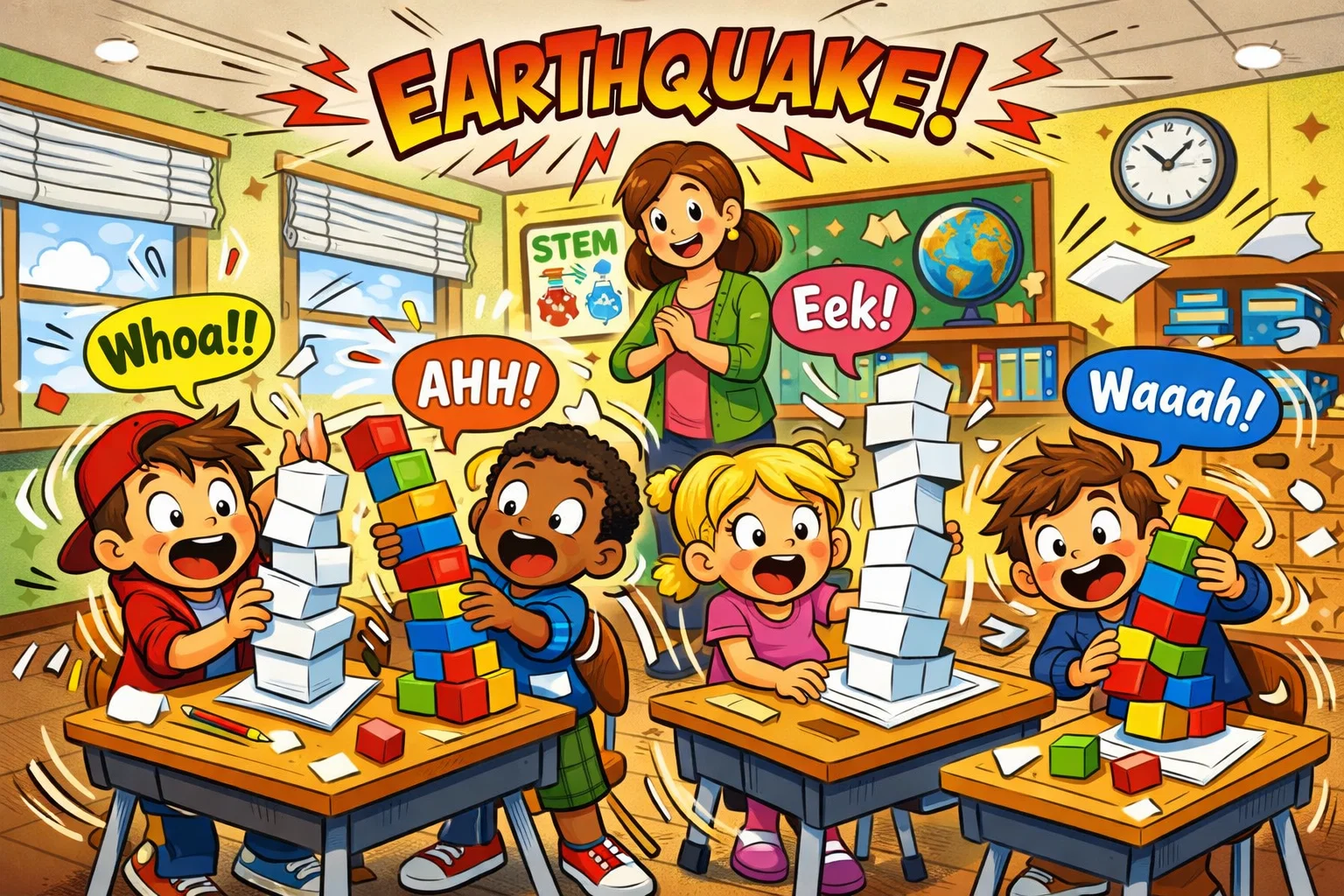
Imagine a classroom buzzing with the focused energy of young innovators. On one desk, a skyscraper made of dried spaghetti and mini marshmallows reaches toward the ceiling; on another, a dense LEGO fortress sits ready for battle. Suddenly, the “ground” begins to shake. Some structures snap instantly, while others bend and sway, absorbing the energy of the simulated earthquake. This isn’t just a craft project – it is a hands-on learning laboratory where children step into the shoes of a structural engineer.
The earthquake STEM challenge is a cornerstone of modern science education because it transforms abstract physics into a tangible design challenge. By participating, students don’t just learn about disasters; they learn how engineers design solutions to keep people safe. Through the engineering design process, they discover that “failure” is simply the first step toward a more resilient prototype.
Earthquake STEM Challenge Overview
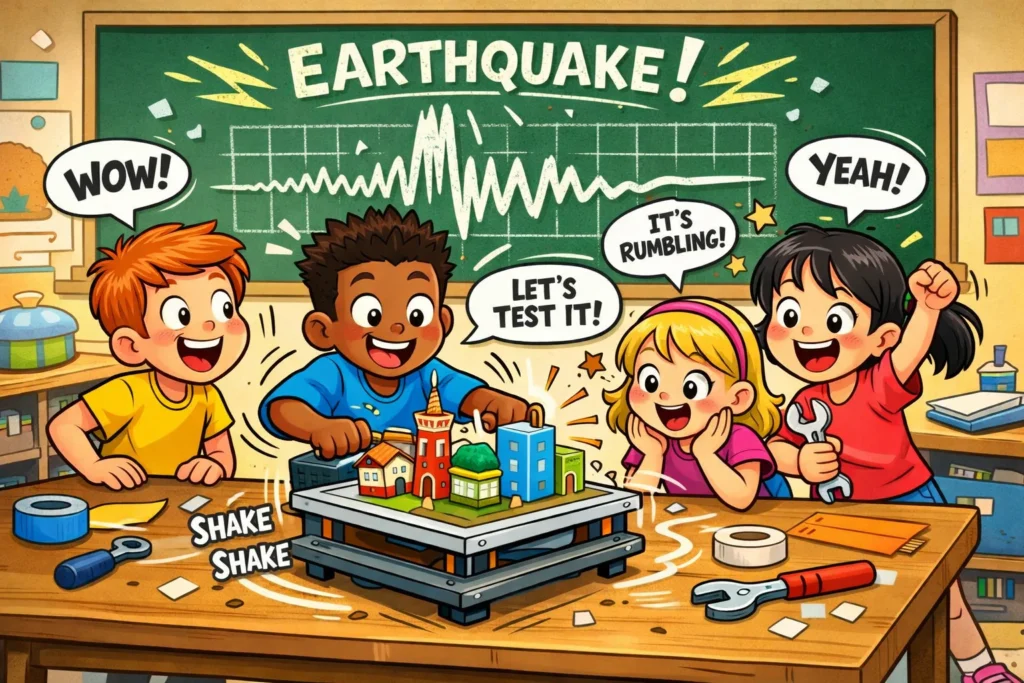
At its core, the earthquake-proof building challenge is an iterative STEM project that tasks participants with creating a model structure capable of surviving a shake table test. It bridges the gap between theoretical earth science and practical application.
Challenge Purpose and Learning Goals
The primary objective is to instill a “fail fast, learn faster” mindset. In most school subjects, a mistake is a deduction in points; in a stem challenge, a collapse is a goldmine of data.
- Engineering Mindset: Moving from “I built it” to “I optimized it.”
- Spatial Reasoning: Understanding how 2D sketches translate into 3D structural integrity.
- Predictive Analysis: Learning to brainstorm and identify potential weak points before the test begins.
Real-world inspiration from earthquakes
Every year, hundreds of thousands of minor tremors occur globally. However, when major earthquakes happen in earthquake-prone regions like Japan or Chile, the world watches to see which building designs hold up. This challenge uses that real-world urgency to motivate students. They aren’t just building for a grade; they are learning the principles that allow real skyscrapers to withstand shifts in the Earth’s surface.
STEM skills developed through activity
This activity is a powerhouse of integrated learning:
- Science: Students investigate how seismic waves transfer energy through different materials.
- Technology: Utilizing simulation tools (even DIY ones) to collect data.
- Engineering: Applying the engineering design process – Ask, Imagine, Plan, Create, Test, and Improve.
- Math: Calculating the strength-to-cost ratio or the height-to-base-width proportion.
Earthquake Science for Kids
To design buildings that don’t fall, kids must first understand why the ground moves in the first place. The science of seismology is a story of a restless planet.
Earthquake definition and causes
The earth’s surface might feel solid, but it is actually made of massive puzzle pieces called tectonic plates. These plates float on a layer of semi-molten rock. As they move, they don’t always slide smoothly. Often, they get stuck at their edges, building up immense pressure. When that pressure is finally released, the plates slide past each other suddenly, sending vibrations through the earth’s crust.
Locations where earthquakes occur
Most earthquake activity is concentrated along fault lines. The most famous area is the “Ring of Fire,” a massive horseshoe-shaped zone around the Pacific Ocean. Here, plates are constantly moving in different directions, making it the most earthquake-prone region on Earth.
Types of earthquakes and ground motion
During a simulation, students will notice two primary types of movement:
- Horizontal (Side-to-Side): This is often the most damaging to tall buildings, as it creates a “shearing” force.
- Vertical (Up-and-Down): While less common as a primary force, it can compress a building’s foundations.
Earthquake measurement and scales
Engineers use magnitude and intensity scales to quantify quakes. In a STEM project, a simplified “magnitude” scale can be used based on the duration or speed of our shake table.
“Understanding that an earthquake’s intensity decreases as you move away from the epicenter helps students realize why foundation stability is so critical.” — Seismology expert.
Fun earthquake facts and real-world impact
- The Incan Secret: Ancient Incan builders didn’t use mortar; their stones were cut so precisely that they would “dance” during a quake and settle back into place.
- Deepest Quake: Some earthquakes occur over 400 miles below the surface!
- Animals: Some people believe animals can sense seismic waves before humans do.
Engineering Resilient Structures
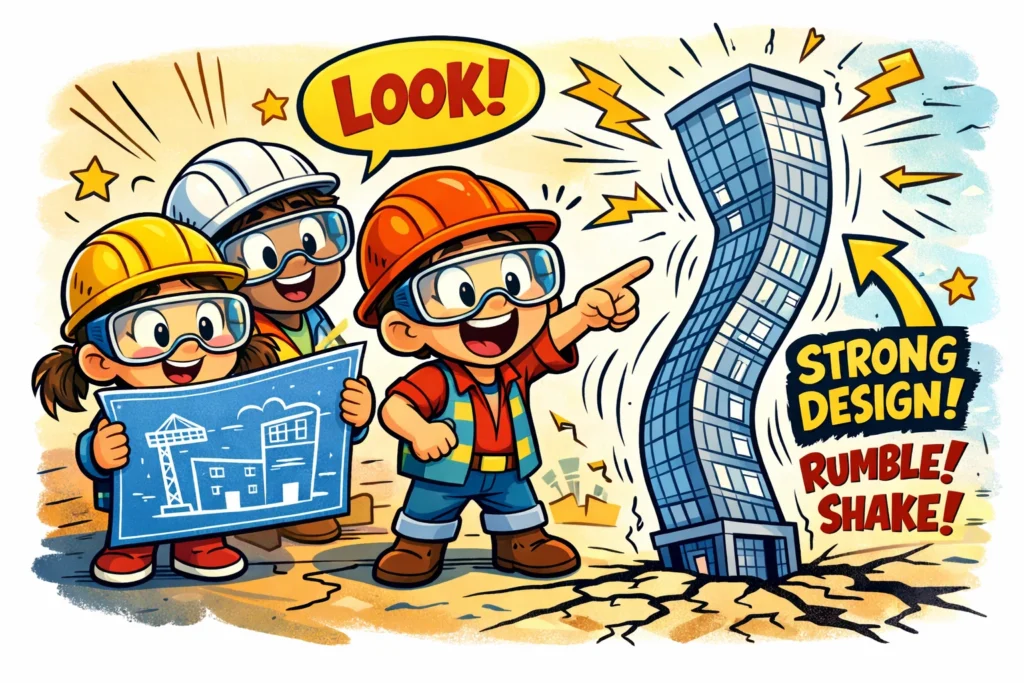
How do we make buildings that survive? It is a challenge shaped by the laws of physics.
Structural engineering role in earthquakes
A structural engineer doesn’t try to make a building “unbreakable.” Instead, they design it to be resilient. This means the building can absorb energy and even bend and sway without a total collapse.
Building features that improve stability
To withstand damage, engineers use several advanced techniques:
- Cross-Bracing: Adding diagonal supports (creating a triangle) to prevent the frame from twisting.
- Tapered Geometry: Designing the building to be wider at the bottom (like a pyramid) to lower the center of gravity.
- Base Isolation: Using shock absorbers or foundations to move on rollers, which allows the ground to move under the building while the structure stays still.
- Large Bases: Providing a wider footprint to prevent tipping during side-to-side motion.
Common building failures during earthquakes
Why do some building designs fail?
- Soft First Stories (Soft-Story Buildings): Buildings with open parking garages on the ground floor often collapse because they lack structural support.
- Resonance: If a building’s natural sway matches the frequency of the earthquake forces, the shaking becomes amplified until it breaks.
- Poor Materials: Brittle materials like unreinforced brick crack easily.
Engineering design process for kids
This cycle is the heart of the design challenge:
- Ask: What are the constraints of the design? (e.g., “Use only 30 toothpicks and 30 marshmallows”).
- Imagine: Brainstorm ways to make the joints stronger.
- Plan: Draw a detailed prototype diagram.
- Create: Build the tower.
- Test: Use the shake table.
- Improve: Redesign based on where it snapped.
Materials Needed for Earthquake Challenge
The beauty of an earthquake stem activity is its accessibility. You can use simple household items to teach complex concepts.
Building materials for structures
| Material | Purpose | Pro Tip |
| Toothpicks | Beams and columns | Use 30 toothpicks and 30 marshmallows for a classic limit. |
| Marshmallows | Joints and connectors | Mini marshmallows work better than large ones for weight. |
| Spaghetti | Brittle beams | Great for teaching “snap” points and tension. |
| Craft Sticks | Heavy-duty frames | Use rubber bands for flexible joints. |
| LEGO | Modular building | Best for testing different floor heights quickly. |
Shake table materials
To simulate the quake, you need a moving platform:
- The Cardboard Slider: Two sheets of cardboard with marbles sandwiched in between, loosely held together by rubber bands.
- The Jell-O Method: Build your structure on a tray of firm gelatin. When you shake the tray, the Jell-O mimics soft, sandy soil.
Shake Table Construction

The shake table is the most important tool for fair tests. It ensures every student’s building is subjected to the same intensity.
Purpose of shake table
In the real world, engineers use massive hydraulic tables to test full-sized rooms. For kids, the table helps them visualize how energy travels from the “ground” up into the structural frame.
Simple vs. Advanced designs
- Level 1: A simple baking sheet on top of tennis balls.
- Level 2: The “Cardboard Sandwich” with marbles. This creates a very smooth side to side motion.
- Level 3: A motorized table using a small DC motor and an offset weight to create consistent, high-frequency vibrations.
Earthquake-Proof Building Design Challenge
Challenge rules and constraints
To make it a true design challenge, set specific limits:
- Height Requirement: Must be at least two “stories” tall (approx. 15-20cm).
- Load Test: Must be able to hold a “live load” (like a tennis ball) on the top floor.
- Time: Must survive 15 seconds of a simulated earthquake.
Structure design planning
Encourage students to draw their designs first. Ask them: “Where is your cross bracing?” “Is your base wide enough?” This forces them to think like an engineer before they start sticking marshmallows together.
Testing and Redesign
The most important part is the “Second Build.” After the first shake, students often observe that their pyramid design performs better than their square one. This iteration is where the real learning happens.
Assessment and Evaluation Methods
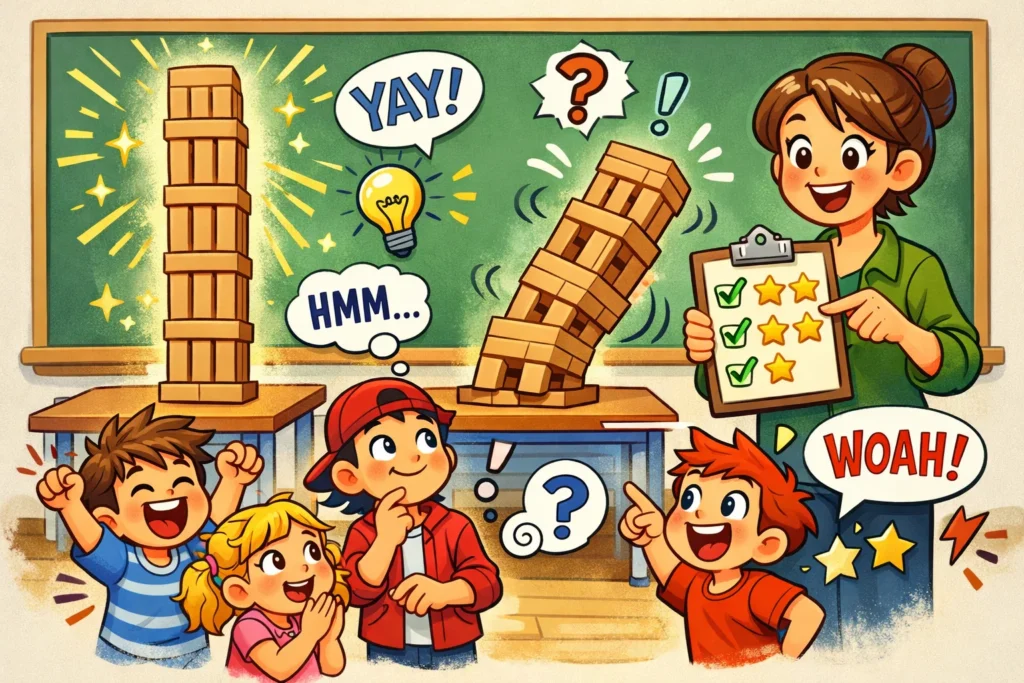
Performance-based assessment
Instead of a test, evaluate the prototype based on:
- Integrity: Did it stay standing?
- Efficiency: Did they achieve the greatest height using the fewest materials?
- Innovation: Did they try a unique strategy like base isolation?
Reflection prompts
- “If you had 10 more toothpicks, where would you put them to work better?”
- “Which part of the building felt the most earthquake forces?”
Activity Extensions and Variations
Age-based difficulty scaling
- Ages 5-8: Focus on “strong shapes” (triangles vs. squares).
- Ages 9-12: Introduce “Base Isolation” using marbles or rubber bands as shock absorbers.
- Ages 13+: Use an accelerometer (for example, via a teacher-operated smartphone app) to measure the exact G-force of the shake.
Cross-curricular connections
- History: Study the 1906 San Francisco earthquake and how it changed building codes.
- Geography: Map out the world’s major fault lines.
Classroom and Home Implementation Tips
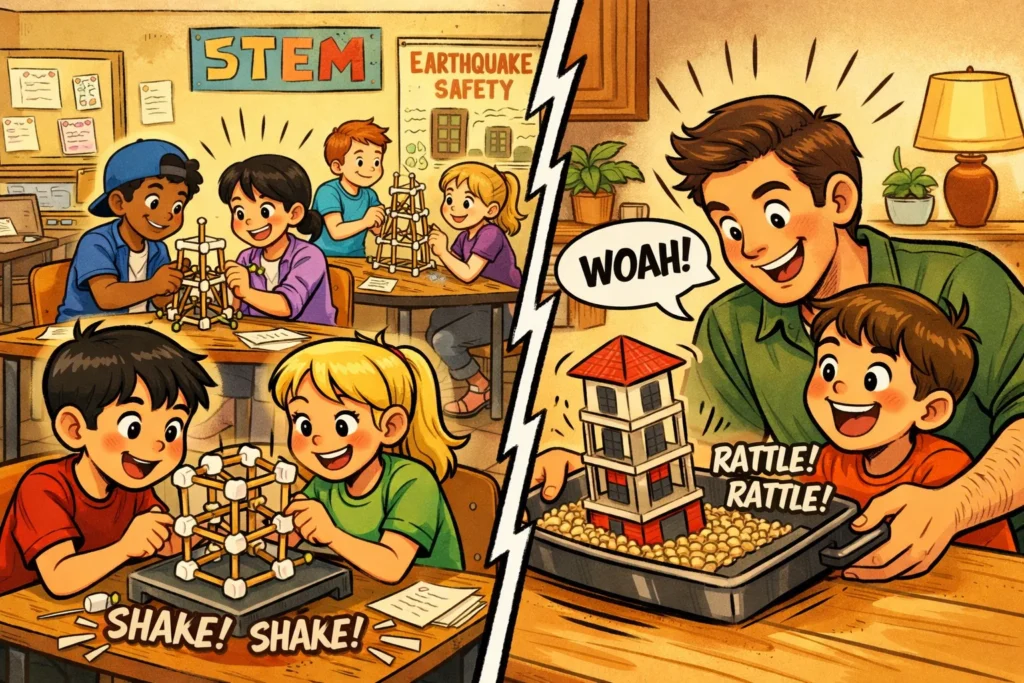
Earthquake STEM classroom and home activity with kids building structures.
Troubleshooting common problems
- Sticky Mess: If using mini marshmallows, let them sit out overnight to become “stale.” They get much harder and hold the toothpicks more securely.
- Unfair Shaking: Ensure one person is the “Shaker” to keep the simulation consistent for all groups.
Educational Standards Alignment
This challenge directly addresses the NGSS (Next Generation Science Standards):
- MS-ETS1-1: Define the criteria and constraints of a design problem.
- 4-ESS3-2: Generate and compare multiple solutions to reduce the impacts of natural Earth processes.
Conclusion and Learning Takeaways
The earthquake-proof building challenge is more than just a stem project; it is a lesson in resilience. Students walk away with a deep understanding of how earthquake-resistant structures are designed to keep people safe. They learn that the most successful buildings are those that can bend and sway without breaking – a metaphor for the engineering design process itself.
By the time they clean up their toothpicks and marshmallows, they aren’t just students who built simple models – they are the next generation of thinkers ready to tackle the challenges of our shifting world.
Frequently Asked Questions
Triangles are the gold standard. Whether using craft sticks, spaghetti, or toothpicks, forming triangular trusses is the best way to ensure the building doesn’t “skew” or collapse sideways.
Ideally, 90 minutes. 20 for the science of tectonic plates, 45 for the design and build phase, and 25 for testing and reflection.

Take a short quiz to find out what your everyday choices say about your parenting style
When your child is curious about something new, what’s your instinct?
Take a short quiz to find out what your everyday choices say about your parenting style
“Can I download this app?” What happens next?
Take a short quiz to find out what your everyday choices say about your parenting style
When it comes to rules at home, which sounds most like you?
Take a short quiz to find out what your everyday choices say about your parenting style
If you could give your child one life skill today, what would you pick?
Take a short quiz to find out what your everyday choices say about your parenting style
Your child gets to choose what to watch. What would your ideal setup look like?
Take a short quiz to find out what your everyday choices say about your parenting style
Pick your parenting superpower ✨