
3 Pulley Challenge Activities for Kids: Examples of Pulleys in Daily Life

 Discover a Free Education Video App for Kids
Pastory uses AI to personalize educational video content based on your child’s interests and personality. Safe, engaging, and built for curious young minds. Sign up now to stay updated and enjoy early access with a free trial
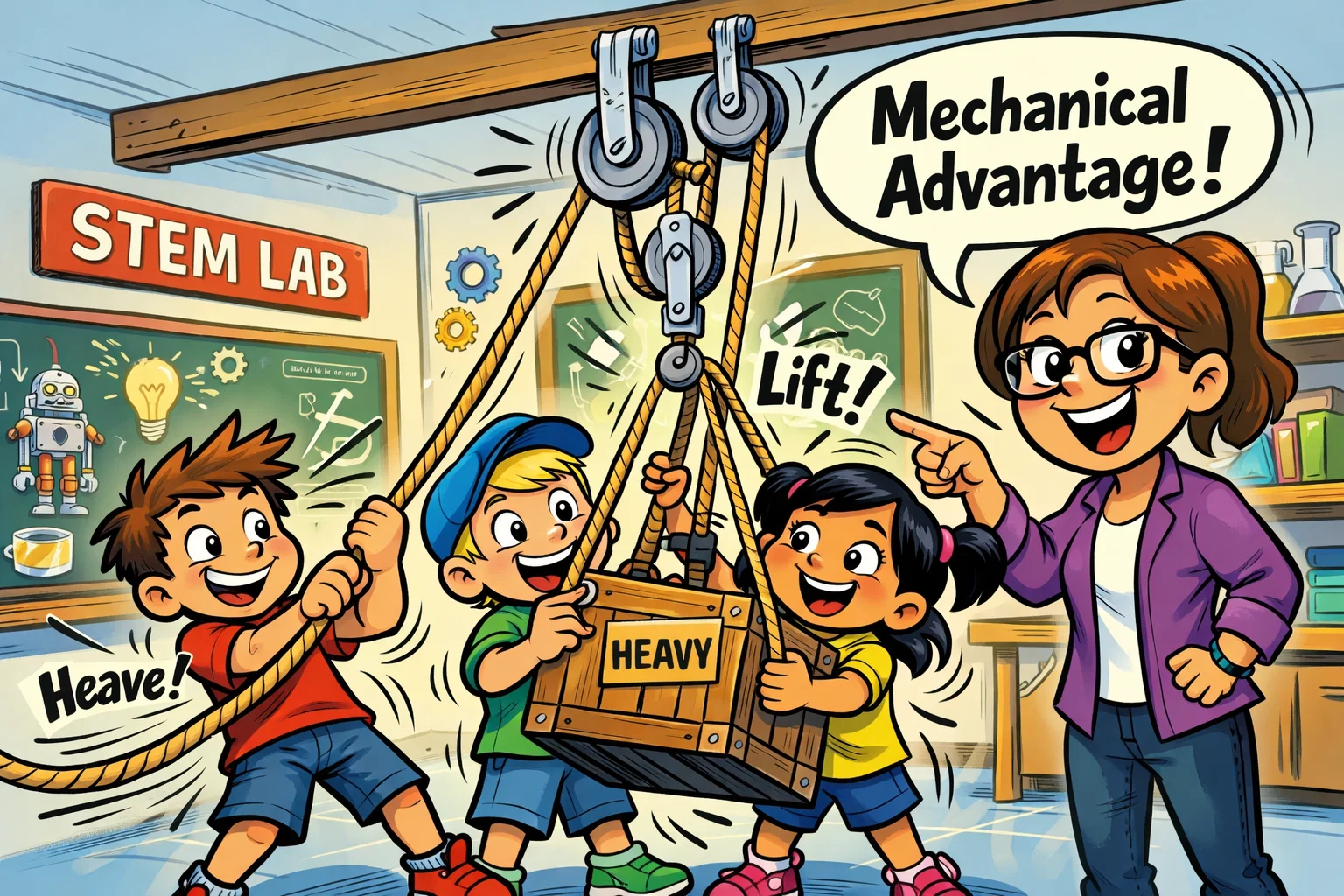
Pulleys are among the most familiar examples of simple machines in daily life — from flagpoles and window blinds to elevators and construction cranes. This hands-on pulley challenge helps kids connect those everyday examples to real physics concepts like mechanical advantage, force direction, and load versus effort through three structured lift and carry activities they can build and test at home or in the classroom.
The activities progress from a single fixed pulley to a compound pulley system, giving kids a measurable way to see how pulley design changes the effort needed to move a load. The guide also covers materials, safety guidelines, troubleshooting tips, and STEM curriculum connections for educators and parents.
Key Takeaways
- Pulleys appear in many daily life examples, including flagpoles, elevators, window blinds, and cranes, making them easy for kids to recognize.
- This challenge includes 3 structured activities: a single pulley lift test, a multiple pulley lift test, and a carry simulation.
- Kids explore mechanical advantage by comparing the effort different pulley systems require to lift the same load.
- The guide covers safe materials, common issues like rope slippage and alignment errors, and secure attachment practices for child safety.
- Activities connect to STEM curricula and can be adapted for classroom group work or independent home learning.
Challenge Overview and Learning Goals
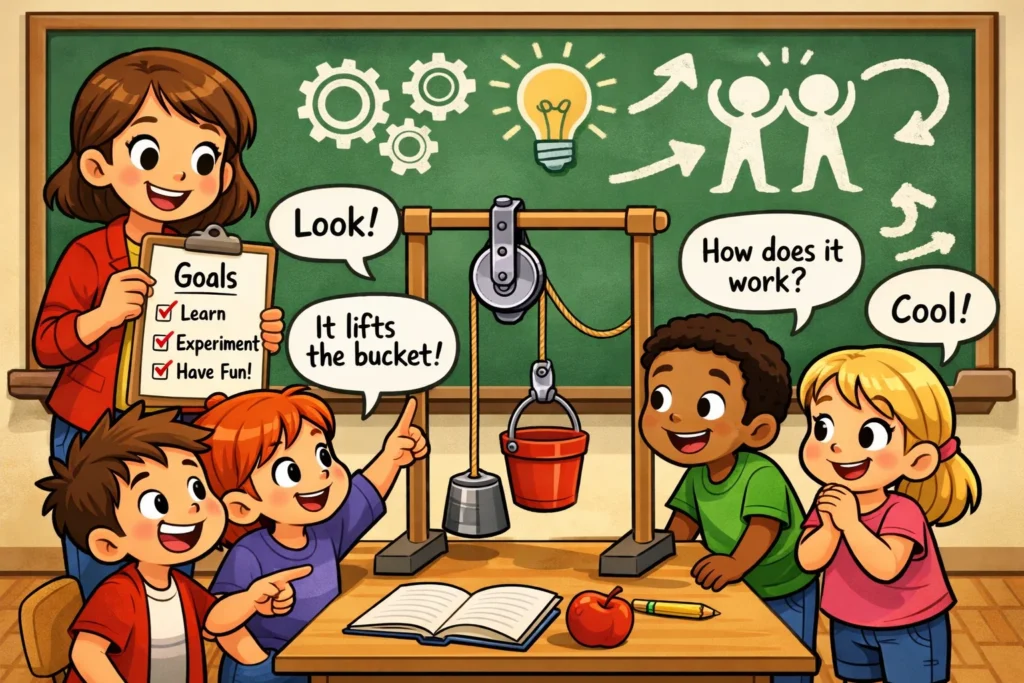
The Lift and Carry Pulley Challenge is a STEM-based activity where kids are tasked with designing, building, and testing various types of pulley systems to move objects from point A to point B. The core idea is simple: give children a “problem” (a heavy object) and a “tool” (this simple machine), then let them discover how different pulley configurations affect the effort required.
Primary Learning Goals:
- Identify Components: Understanding that a pulley is a wheel with a groove for a rope.
- Master Mechanical Advantage: Discovering how multiple pulleys can make a heavy object feel lighter.
- Observe Force/Distance Trade-offs: Recognizing that to lift the load with less force, you must pull the rope a longer distance.
- Apply Engineering Design: Using the “Plan, Build, Test, Improve” cycle to optimize their system with a mechanical edge.
Real-World Problem Scenario for Kids
To make the activity engaging, we frame it with a story. You aren’t just pulling a rope; you are an engineer on a construction site or a rescuer in a mountain village.
- Scenario A: The Treehouse Supply Run. A group of friends needs to get a heavy basket of snacks (the load) up to their high-altitude fort. They cannot carry it up the ladder.
- Scenario B: The Ancient Temple Discovery. Explorers have found a heavy “golden” idol (a brick or water bottle) at the bottom of a pit. They must use pulleys to lift it out without breaking it.
- Scenario C: The Hospital Elevator. A small toy town needs a way to move patients (action figures) between floors safely and smoothly.
Skills Developed Through Pulley Challenge
This challenge is a powerhouse for skill development. Beyond the basic physics of pulleys, kids exercise engineering thinking. They must decide where the wheel and axle is attached and how to secure the end of the rope.
Teamwork is also essential. In a group setting, one child might act as the “Load Master,” ensuring the heavy object is balanced, while another acts as the “Force Engineer,” measuring the force required to lift the weight. This collaboration mimics real-world engineering teams where different specialties come together to solve a complex problem.
Age Range and Difficulty Levels
The beauty of this STEM exploration is its scalability:
- Ages 4–7 (Beginners): Focus on the simple pulley and how it helps change the direction of a pull (pulling down to move something up).
- Ages 8–11 (Intermediate): Introduce the movable pulley and combinations of fixed and movable pulleys. Focus on “counting the ropes” to predict mechanical advantage.
- Ages 12+ (Advanced): Explore a complex compound pulley system (block and tackle), calculate exact force using spring scales, and tackle friction-related challenges.
Pulley Exploration: Pulley as a Simple Machine for Kids
At its simplest level, a pulley, as a simple machine, consists of a pulley wheel (the sheave) and a flexible line (rope, string, or cable). It is designed to make work easier by either changing the direction of the effort or multiplying the force applied.
How Pulleys Work: Wheel and Rope in Action
The interaction between the wheel and axle is crucial. The round component reduces friction; instead of dragging a rope over a stationary branch, the grooved wheel rotates, allowing the rope to glide. This is why a pulley system allows for much smoother movement than a simple rope-over-a-beam setup.
Pulleys in Action: Direction Change vs Mechanical Advantage
It is important to distinguish between “making it easier to pull” and “reducing the force.”
- Direction Change: A single fixed pulley allows you to pull down on the rope to lift an object. This is “easier” because you can use your body weight to help, but the amount of force required remains roughly the same as the weight of the load.
- Effort Reduction: A movable pulley system actually reduces the force to lift the object. By sharing the weight between two parts of the rope, you only feel half the weight, though you must pull the rope twice as far.
Everyday Pulley Examples Kids Recognize
To build content authority and trust, we look at how these tools are used in many real-world applications. Seeing these helps kids realize that pulleys are powerful instruments, not just toys.
| Application | Function | Type of Device Used |
| Flagpole | Raises the flag to the top. | Fixed pulley |
| Construction Crane | Lifts steel beams. | Compound pulley system |
| Window Blinds | Opens/closes slats. | Fixed pulley system |
| Sailing Boat | Hoists the heavy sails. | Block and tackle pulley |
| Elevator | Moves the car up and down. | Multiple fixed and movable pulleys |
Mechanical Advantage in Lift and Carry Tasks
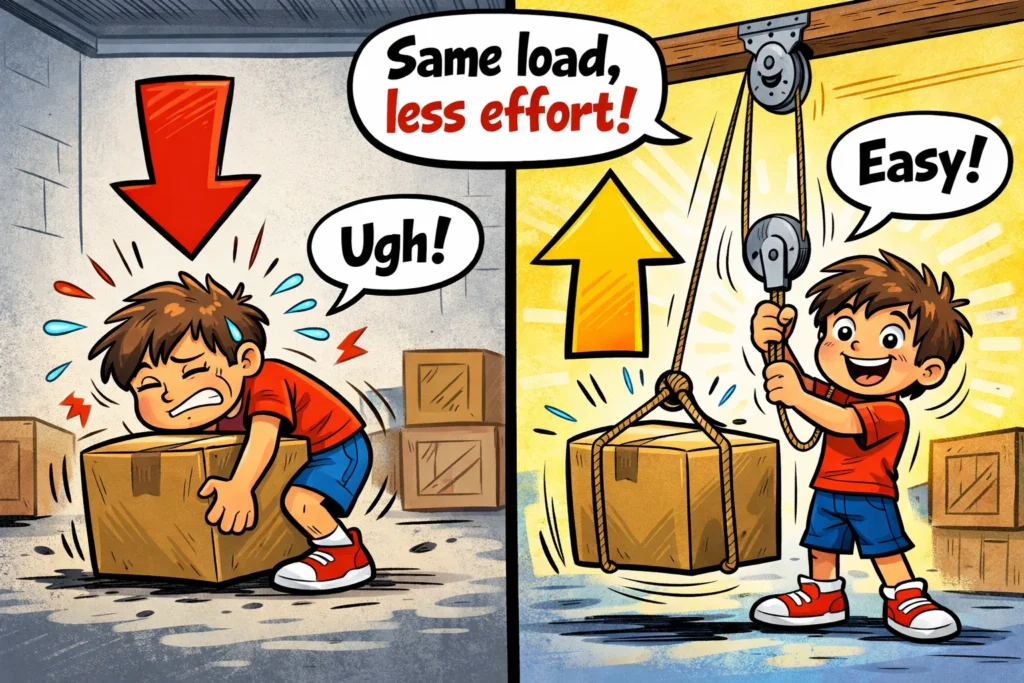
Mechanical advantage is the “secret sauce” of engineering. It is the ratio of the output force (the weight of the load) to the input force (the effort you apply).
Meaning of Mechanical Advantage in Kid-Friendly Terms
Think of mechanical advantage as a “strength multiplier.” If a system has a mechanical advantage of 2, it’s like having a second person helping you lift the load. You only have to provide half the “muscle,” and the pulley system distributes the load. In a pulley system with a mechanical advantage, we achieve this by adding more loops of rope.
Load Weight vs. Effort Comparison
In a classroom setting, you can demonstrate this by having a child try to lift a gallon of water (about 8 lbs) directly. Then, have them use pulleys to lift it.
Trade-Off Between Distance and Force
Physics has a “no free lunch” rule. While pulleys make lifting less force-intensive, you pay for it in distance. To lift something 1 foot using a system with a mechanical advantage of 2, you must pull the rope 2 feet. This “Force-Distance Trade-off” is a fundamental law of the universe.
Types of Pulley Systems for Lift and Carry Tasks
During the challenge, kids should experiment with the three main types of pulleys.
Simple Pulley System and Direction of Force
In this setup, the device is attached to a stable support, like a hook or a bar.
- Mechanical Advantage: 1.
- Benefit: It only changes the direction of the force. It is easier to pull down than to lift up.
- Example: A single fixed pulley on a flagpole.
Movable Pulley System
Here, the movable pulley is attached directly to the load. One end of the rope is fixed to a support, and you pull the other end upward.
- Mechanical Advantage: 2.
- Benefit: It cuts the force needed to lift in half.
- Drawback: You have to pull the rope upward, which can be awkward.
Compound Pulley System
This system, often called a block and tackle, combines fixed and movable pulleys.
- Mechanical Advantage: 2 or more, depending on the number of rope segments.
- Benefit: You get the best of both worlds – reduced effort and a comfortable pulling direction. Combining multiple pulleys allows a child to lift heavy loads that an adult might struggle with.
Multi-Wheel Pulley Variations
For older kids, using three pulleys or more can introduce complex physics. A tackle pulley with multiple sheaves (wheels) can provide a greater mechanical advantage, allowing a student to lift a heavy object using only a few fingers.
Materials and Supplies for Pulley Challenge
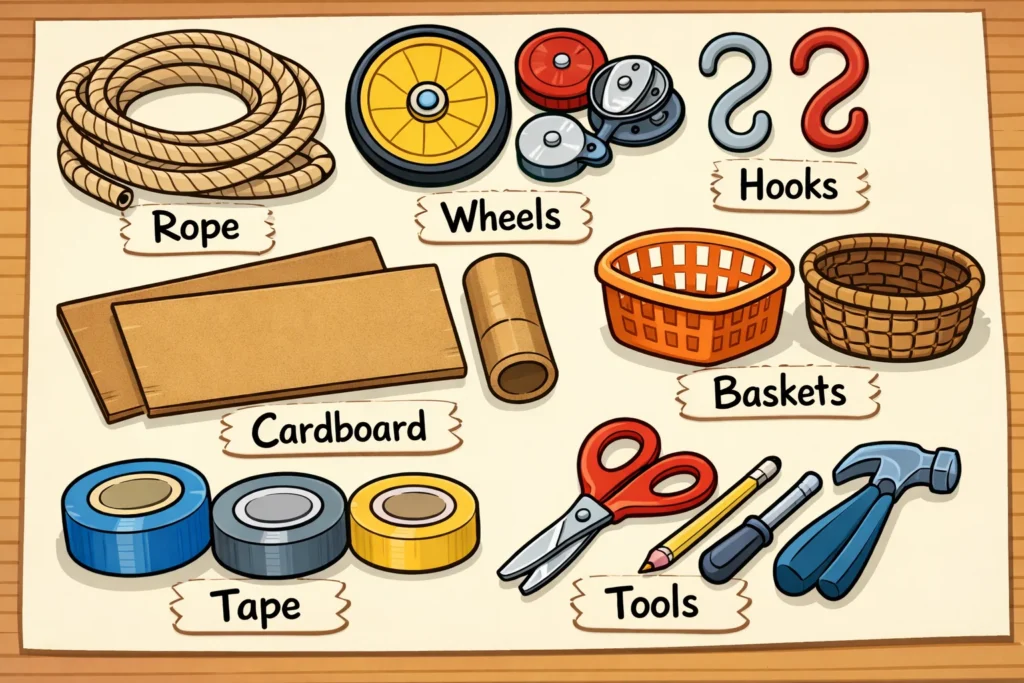
You don’t need a high-tech lab to explore pulleys in action. Most items can be found around the house or in a standard classroom.
Household Items for Classroom or Home
- Wheels: Thread spools, empty ribbon spools, or even toilet paper rolls (for very light demonstration loads).
- Axles: Pencils, dowels, or smooth skewers.
- Rope: Yarn, twine, clothesline, or paracord.
- Load Containers: Plastic cups, small buckets, or berry baskets.
- Weights: Marbles, pennies, washers, or small rocks.
Safety-Friendly Materials for Kids
Ensure all “wheels” have smooth edges to prevent the rope from snagging. If using a pulley made of wood or plastic, check for splinters or sharp points. Stable supports are the most important safety factor; a lifting wheel attached to a wobbly chair can lead to tipped furniture.
Optional Measurement Tools
- Spring Scale: To measure the exact amount of force in Newtons.
- Ruler/Tape Measure: To measure how much rope is pulled vs. how high the load lifts.
- Stopwatch: For timed “rescue” challenges.
Building Lift and Carry Pulley System
Follow these steps to ensure a successful pulley-building project.
Preparing Load Container
Take a plastic cup and poke two holes near the rim. Thread a short piece of string through the holes to create a handle. This is your “cargo bucket.”
Assembling Pulley Wheel and Axle
If using a thread spool, slide a pencil through the center. Ensure the spool can spin freely. If it sticks, the mechanical device will be inefficient due to friction.
Mounting Support Structure
Find a sturdy place to mount your fixed pulley. This could be a broomstick held between two desks or a hook in a doorway. Use strong tape or zip ties to ensure the apparatus is attached securely.
Threading Rope and Testing Movement
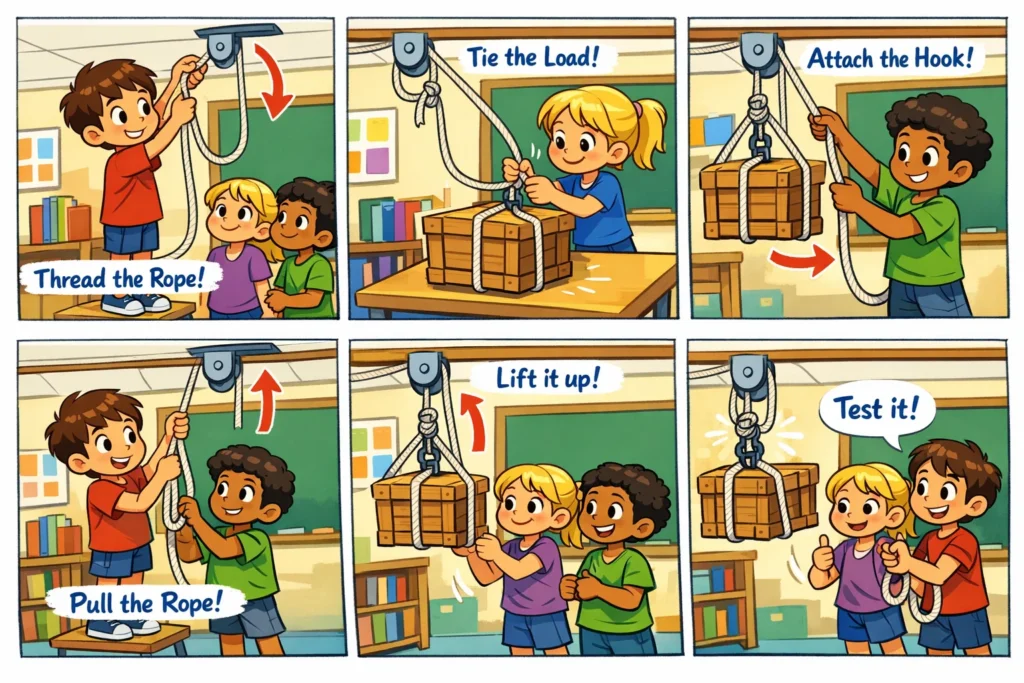
Run the rope over the groove of the wheel. Ensure the one end is attached to your load (or the support, depending on the system type). Pull down on the rope to ensure the wheel spins and the container moves smoothly.
Pulley Challenge Activity Instructions
1. Lift Test with Single Pulley
Start with one pulley in a fixed position. Have the child fill the bucket with 20 marbles. Ask them to pull the rope and describe how it feels. Does it feel “heavy” or “light”?
2. Lift Test with Multiple Pulleys
Now, set up a movable pulley system. Use the same 20 marbles. Ask the child to compare the effort. Most will notice immediately that it is easier to lift the bucket.
3. Carry Simulation Using Pulley System
Set up two wheels across a room (a “zip-line” style). Challenge the kids to move the “supplies” across the “river” (the floor) without the bucket touching the ground. This introduces the concept of tension.
Measuring Results and Comparing Systems
To turn this into a true STEM exploration, we need data.
Effort Comparison Between Systems
Use a table to record “Perceived Effort” on a scale of 1 to 10.
| System Type | Number of Wheels | Effort Rating (1–10) |
| Simple Pulley (Fixed) | 1 | 8 |
| Movable Pulley | 1 | 4 |
| Compound Pulley | 2 | 2 |
Distance Pulled vs. Height Lifted
Mark the rope with a marker. Measure how many inches of rope the child pulls to lift the object 6 inches off the ground.
- Fixed Pulley: 6 inches pulled = 6 inches lifted.
- Movable Pulley: 12 inches pulled = 6 inches lifted.
Recording Observations and Drawings
Encourage kids to draw their system of pulleys, labeling the “Load,” “Effort,” and “Fixed Point.” This helps solidify the pulley simple machine concept in their visual memory.
Engineering Design Challenge Extensions
Design Strongest Pulley System
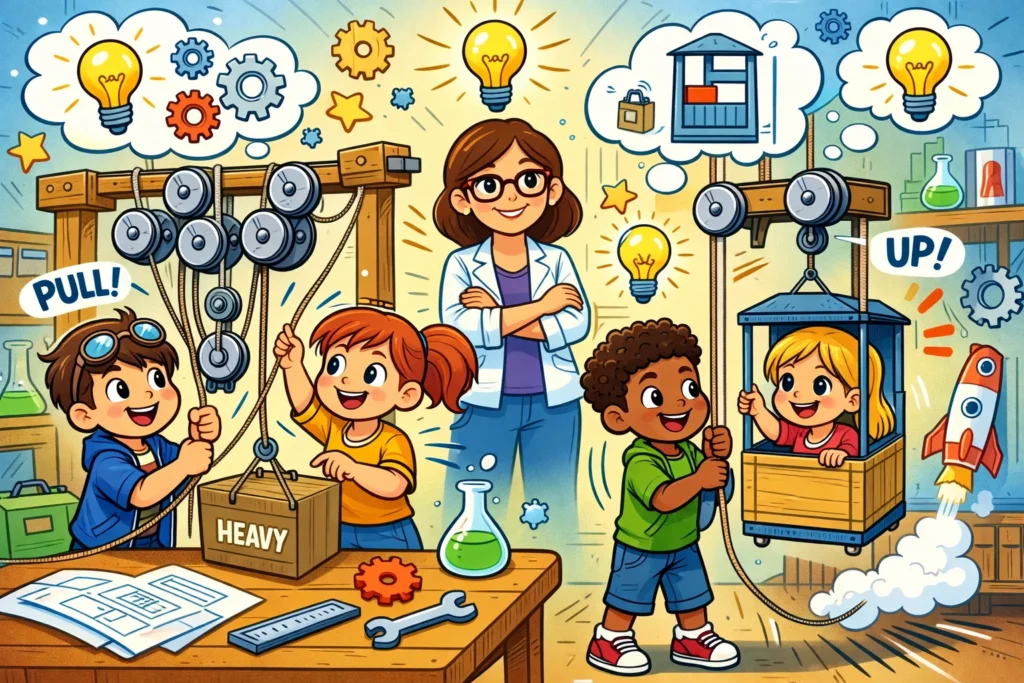
Who could lift the heaviest book? Challenge teams to create a compound pulley system using limited materials to lift a heavy dictionary.
Modify Load Weight and Materials
What happens if you use a thicker rope? Or a smaller pulley wheel? Testing these variables helps kids understand friction and efficiency.
Build Toy Elevator or Cargo Lift
Apply the knowledge to a functional project. Building a cardboard “skyscraper” with a working hoist to lift action figures is a classic and rewarding project.
Common Mistakes and Troubleshooting
Rope Slippage and Friction Problems
If the rope keeps falling off the pulley wheel, the groove may not be deep enough. Friction is the enemy of mechanical advantage. If the axle doesn’t spin, a system where the wheel does not turn becomes a high-friction slide.
Pulley Alignment Errors
The pulley system with a mechanical goal must be aligned. If the wheels are crooked, the rope will bind, increasing the force to lift the object unnecessarily.
Load Stability Issues
If the bucket tips and spills its load, the attachment point is likely too high or off-center. Pulleys work best when the center of gravity is directly below the hook.
Classroom and Home Learning Integration
STEM Curriculum Connections
These lifting systems connect to many educational standards, including:
- Physical Science: Forces and Motion.
- Engineering: Designing solutions to problems.
- Math: Ratios and measurements.
Group Work and Team Roles
Assign roles like “Safety Inspector” (checks knots), “Data Scientist” (records measurements), and “Lead Engineer” (oversees the build).
Assessment Ideas for Kids
Ask: “If you want to lift something even heavier, what would you change about your pulley system?” Their ability to suggest adding multiple pulleys shows a mastery of the concept.
Safety Guidelines for Pulley Activities
Safe Weight Limits for Kids
Never try to lift something that could cause injury if the rope snaps. Stick to small household items like water bottles, toys, or bags of beans.
Secure Attachment and Supervision
An adult should always check that the device is attached to something that won’t fall over. Pulleys are powerful enough to pull down a bookshelf if not properly anchored.
Preventing Finger and Rope Injuries
Remind kids: “Never wrap the end of the rope around your fingers.” If the load falls, it can cause a “rope burn” or pinch a finger in the pulley wheel.
Additional STEM Activities With Simple Machines
Levers and Inclined Planes Activities
These lifting wheels are just the beginning. Combine them with lever experiments or inclined plane activities.
Wheel and Axle Experiments
Since a pulley is a wheel, it’s a natural lead-in to studying cars, gears, and bicycles.
Engineering Games for Kids
Use “Simple Machine Scavenger Hunts” to find where pulleys are used in the kitchen (can openers) or garage.
Frequently Asked Questions About Pulley Challenges
While even toddlers enjoy using a pulley to move toys, the concept of mechanical advantage is best understood by kids aged 8 and up.
A fixed pulley is like a stationary hook – it changes direction. A movable pulley travels with the load – it reduces the force needed to lift it.
It allows humans to lift heavy loads that our muscles couldn’t handle alone. It’s why we can build skyscrapers and move giant ships.
Empty spools, clotheslines, and even a smooth door handle (in a pinch) can act like a pulley to teach the basics.

Take a short quiz to find out what your everyday choices say about your parenting style
When your child is curious about something new, what’s your instinct?
Take a short quiz to find out what your everyday choices say about your parenting style
“Can I download this app?” What happens next?
Take a short quiz to find out what your everyday choices say about your parenting style
When it comes to rules at home, which sounds most like you?
Take a short quiz to find out what your everyday choices say about your parenting style
If you could give your child one life skill today, what would you pick?
Take a short quiz to find out what your everyday choices say about your parenting style
Your child gets to choose what to watch. What would your ideal setup look like?
Take a short quiz to find out what your everyday choices say about your parenting style
Pick your parenting superpower ✨



