Error Analysis for Kids: Helping Students Learn from Experiment Mistakes

 Discover a Free Education Video App for Kids
Pastory uses AI to personalize educational video content based on your child’s interests and personality. Safe, engaging, and built for curious young minds. Sign up now to stay updated and enjoy early access with a free trial
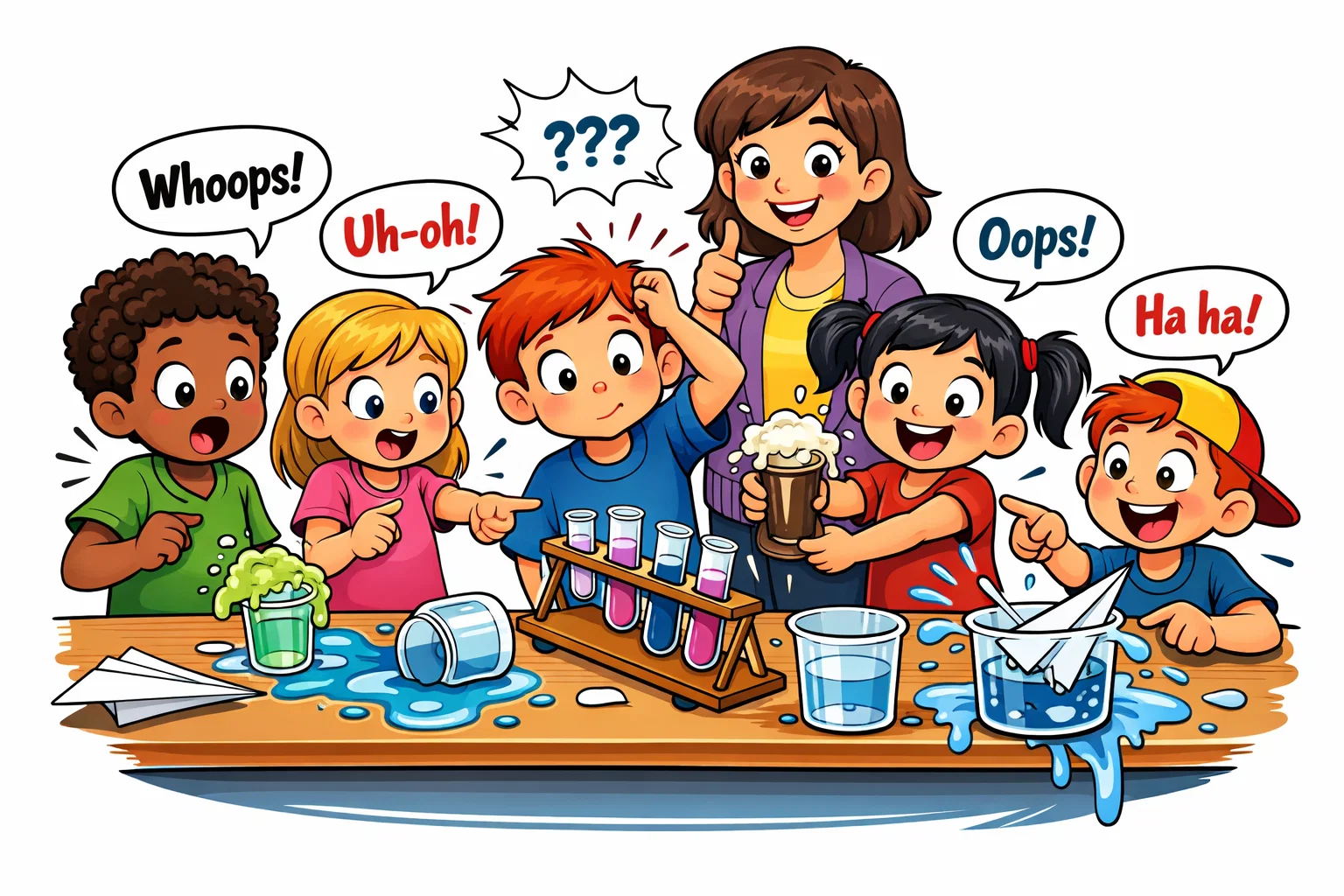
Mistakes are often seen as something to avoid, but in the world of science and discovery, they are actually secret doorways to learning. Mistake analysis is a fancy term for a very simple and exciting process: it’s being a “mistake detective.” When children try an experiment – like building a baking soda volcano or seeing which toy car slides fastest – and things don’t go as planned, the result review is the tool they use to figure out why. Instead of feeling discouraged, kids learn to look at their results, ask “What happened there?”, and try again with a new plan.
Teaching kids to use error analysis means shifting the focus from the final result to the journey of discovery. It’s about trial and retrial. When students learn to see a “fail” as just a data point, their curiosity grows.
This guide explores how to turn those “oops” moments into “aha!” moments, building a foundation for critical thinking that will serve them in the math classroom, the science lab, and throughout their lives.
Error Analysis Purpose for Kids Experiments
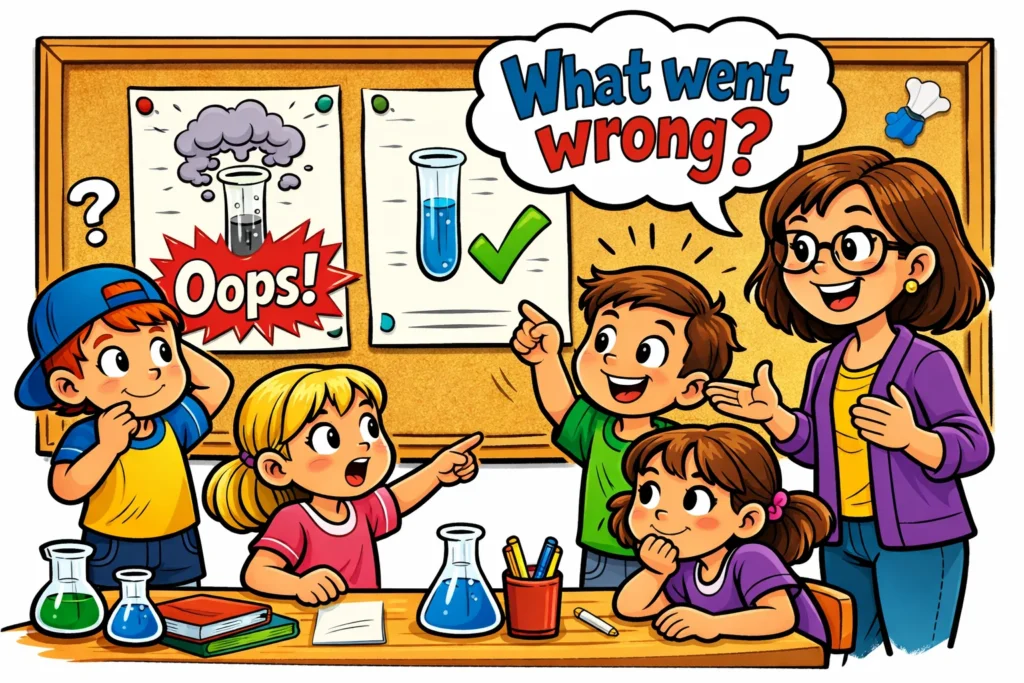
The primary purpose of teaching error analysis in math and science experiments at a young age is to foster a growth mindset. When children perform simple experiments at home or school, they are practicing how the world works. If a paper bridge collapses or a plant doesn’t grow, the purpose of analyzing a mistake isn’t to assign blame, but to understand the “why” behind the physical world.
By incorporating error analysis early on, we help kids realize that even the most famous scientists and mathematicians made common mistakes. This process transforms a negative experience (failure) into a puzzle. It encourages children to stay engaged with the math concept or scientific principle at hand rather than walking away in frustration.
Why Students Make Math and Experiment Mistakes
In the heat of the moment, children are often so excited to see the “big explosion” or the final result that they overlook the small details. Common mistakes usually fall into a few predictable categories:
- Rushed steps: Moving too fast and skipping a crucial instruction.
- Wrong measurements: Using a “big spoon” instead of a “tablespoon,” which changes the chemical reaction.
- Skipped actions: Forgetting to stir or not waiting long enough for a reaction to occur.
- Environmental factors: Doing a wind experiment right next to a fan or a sunny-day experiment in the shade.
How Teachers Use Error Analysis to Support Student Learning
Checking mistakes helps kids improve their results step-by-step. When students learn to pause and look at their work, they start to see the connection between their actions and the outcome. If a child is told exactly what they did wrong, they learn to follow instructions. But if they identify errors themselves, they learn the mechanics of the universe. This relearning happens naturally as they adjust their variables – adding more vinegar, folding the paper differently, or measuring more carefully – to see a different result.
Role of curiosity in experiment correction
Curiosity is the engine of experiment reflection. Instead of asking “Why did I break it?”, we encourage kids to ask, “I wonder what would happen if I changed this one thing?” This shift in language builds interest and motivation. When a child is curious about their math errors or experiment flops, they become investigators. Curiosity makes the “retry” feel like a game rather than a chore.
Benefits of Error Analysis for Young Learners
| Benefit Category | Impact on Child |
| Cognitive | Enhances conceptual understanding and logical reasoning. |
| Emotional | Builds resilience and reduces “perfectionist” anxiety. |
| Academic | Prepares them for complex multi-digit multiplication and long division later. |
Critical thinking growth through mistake review
When kids think critically, they aren’t just memorizing facts; they are evaluating evidence. By reviewing a mistake, children compare what they thought would happen with what actually happened. This is the heart of conceptual learning. They begin to categorize their slips: was this a careless slip (I just went too fast), or a conceptual mistake (I didn’t understand how the scale worked)?
Confidence building after experiment mistakes
There is a massive confidence boost that comes from fixing something yourself. When students analyze their own errors and then succeed on the second or third try, they develop “mastery goals.” They realize that their intelligence isn’t fixed – it grows with effort. This makes them feel safe trying new, harder activities because they know they have the tools to handle a “wrong” answer.
Skill development for future science activities
Early exposure to error analysis tasks prepares children for the rigors of formal education. Whether it’s a math problem in 3rd grade or a chemistry lab in high school, the ability to explain the problem source is a high-level skill. Students who can find errors in sample problems often retain correct methods longer than those who only practice correct problems.
Types of Math and Experiment Errors Students Make
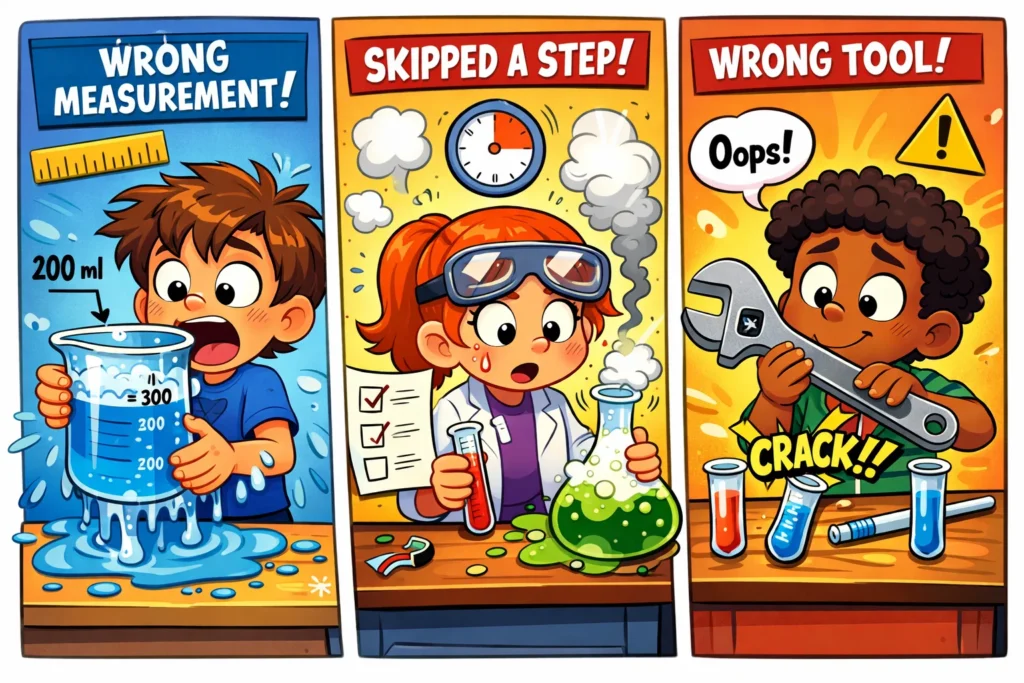
Understanding the difference between conceptual and computational (or procedural) errors helps adults guide kids more effectively.
Measurement and Calculation Math Errors
These are the most common mistakes students make. It might be misreading a ruler, not leveling off a measuring cup of flour, or starting a stopwatch a second too late. These are often computational miscalculations where the “math” of the experiment went slightly off. Teaching kids to double-check their numbers is a great way to help students develop precision.
Conceptual and Process Errors in Student Work
A process error occurs when the “recipe” isn’t followed. This includes:
- Adding liquid to dry ingredients in the wrong order.
- Skipping a step that seemed “unimportant” to the child.
- Rushing a cooling or heating phase.
These types of errors show a breakdown in the sequence of events, teaching kids the importance of logical flow.
Tool or material errors
Sometimes, it isn’t the child’s fault at all! A battery might be dead, a rubber band might be too old and brittle, or the “red food coloring” was actually oil-based and wouldn’t mix with water. Learning to identify issues in their materials helps kids understand that variables exist outside of their own actions.
Ways to Teach Error Analysis to Kids
Guided discussion after experiment results
Instead of saying, “You used too much water,” try asking, “What do you notice about how the mixture looks compared to the picture?” This encourages students to look for clues. In math classrooms, teachers often use guided discussion prompts to help students solve problems collectively. You can do the same at home by being a “thought partner” rather than a judge.
Visual comparison of expected and real results
Kids are visual learners. Use a worksheet or a simple drawing to map out the “Goal” vs. the “Reality.”
- Draw what you thought would happen.
- Draw what actually happened.
- Circle the part where it started to look different.
This makes result analysis a helpful visual habit.
Group conversation about experiment mistakes
If you have multiple kids or a classroom, working in pairs to find “the mystery mistake” can be very effective. Sharing mistakes without blame creates a culture where making mistakes is seen as a contribution to the group’s knowledge. “Leo’s tower fell because the base was too narrow – now we all know how to build wider bases!”
Simple Error Analysis Activities for Experiments
Water measurement experiment review
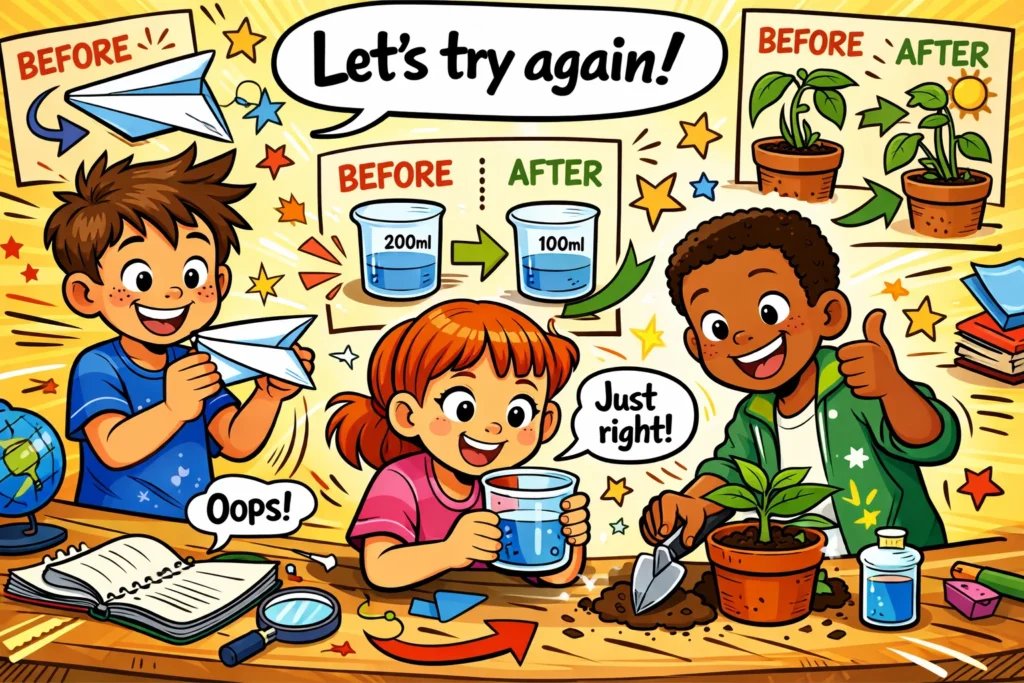
Give kids three different-sized containers and ask them to move “exactly one cup” of water between them. If they spill or the levels look different, it’s a perfect time to complete error analysis. Ask them to explain the error: “Did the water spill because the cup was too full, or because my hand shook?”
Paper airplane experiment correction
This is a classic teaching error analysis tool. If the plane nosedives, have the child identify errors in the wing symmetry.
- Step 1: Fly the plane.
- Step 2: Observe the flight path (e.g., “It veers left”).
- Step 3: Explain the error (e.g., “The left wing is folded lower than the right”).
- Step 4: Adjust and retry.
Plant growth observation errors
Plants take time, which makes errors students make here more about “data tracking.” If a plant dies, was it too much water, or not enough light? Using a simple worksheet to track daily water helps students to learn how to find the “breaking point” in a long-term project.
Ready-Made Error Analysis Tasks for Kids
To make this easier for parents and teachers, you can use structured error analysis tasks. These are often classroom-tested teaching ideas that save time and keep kids focused.
| Task Type | Description | Goal |
| Printable Error Cards | Cards showing a “broken” experiment. | Identify errors in the picture. |
| Before/After Sheets | A T-chart for “What I did” and “What I’ll fix.” | Deeper understanding of cause/effect. |
| Step-Check Lists | A list of steps to check off after the activity. | Reduce careless errors. |
Printable experiment error cards
You can create or find free addition error analysis cards (often used in math) and adapt them for science. Show a picture of a circuit that won’t light up because the battery is backward. Ask the child to “Find the Problem” before they start their own project.
Before and after experiment comparison sheets
These sheets help students to identify the specific moment a math mistake or scientific slip occurred. It provides a “paper trail” for their thoughts, which is vital for student understanding.
Creating Error-Friendly Experiment Environment
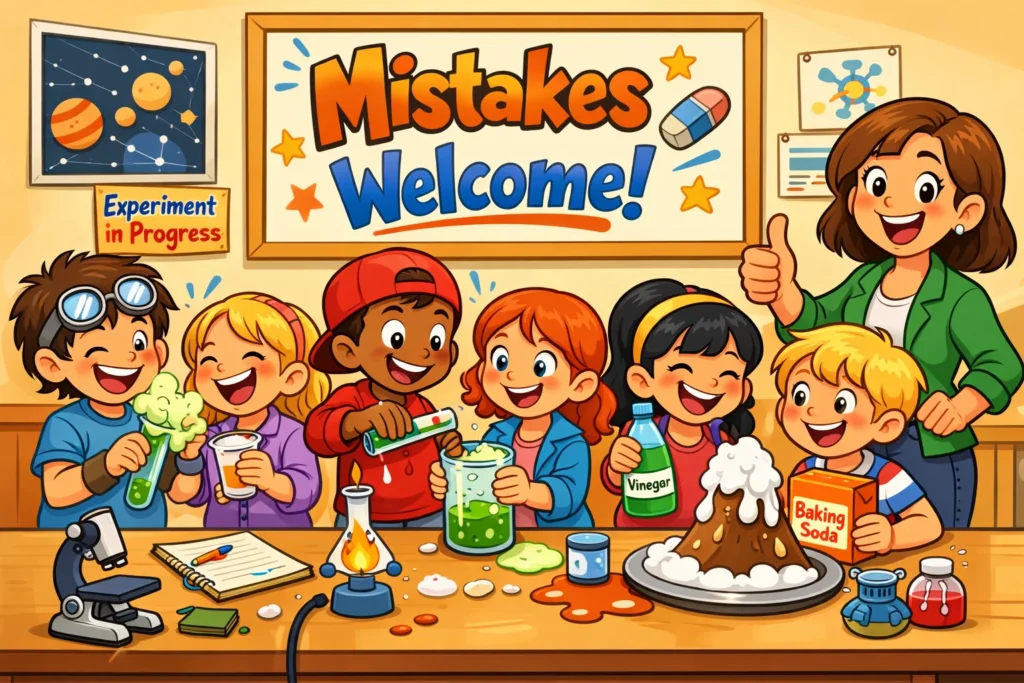
A “safe-to-fail” environment is crucial for brain development. When students are making mistakes, their brains are actually more active than when they are getting everything right.
The most important thing a teacher or parent can do is to de-stigmatize the ‘wrong answer.’ In math class, the person who finds the error often understands the concept better than the person who just followed the steps.
Mistake-safe experiment rules
- Retry is Always Allowed: Never stop at the first failure.
- No “Bad” Questions: If you don’t know why it failed, that’s the start of a new experiment.
- The “Fix-It” Focus: We focus on the solution, not the slip-up.
Language for positive mistake discussion
Use phrases that teach kids that error analysis is a good place to start.
- “That’s an interesting result! It’s different than we expected.”
- “Let’s look at your students’ work together and find the ‘glitch’.”
- “Which type of math or measurement should we check first?”
Error Analysis Across Experiment Types
Science experiments at home
Kitchen chemistry is a goldmine for errors that students can analyze. If a cake doesn’t rise, you can use error analysis to check if the baking powder has expired. This is a real-world way to practice skills often taught in the classroom.
Math experiments using objects
Error analysis in math doesn’t have to be on a worksheet. Use blocks to teach students about volume. If they try to fit 10 blocks into a space that only holds 8, they have to identify errors in their estimation. This builds conceptual understanding before they ever encounter multiplication or long division in a textbook.
Outdoor experiments for kids
Shadow tracking or wind-vane building often leads to math errors regarding time or direction. Teaching error analysis outdoors adds a layer of fun and movement, helping kids think critically while staying active.
Tips for Parents and Teachers
- Keep it fun: Treat error analysis like a detective game. Use a magnifying glass!
- Avoid pressure: If a child is frustrated, take a break. Error analysis can help, but not if the child is in tears.
- Track progress: Use a “Mistake Journal” to show how many things they’ve learned to fix over time.
Error Analysis as Experiment Habit
In the end, error analysis is more than just a technique for the math classroom; it is a life skill. By encouraging students to identify errors, we are teaching them that they have the power to fix their own problems. This builds a complete understanding of any math concept or scientific theory they encounter. When children learn to embrace making mistakes, they stop fearing the “wrong” answer and start loving the process of finding the right one.
FAQ
Children as young as 4 or 5 can begin simple error analysis with adult guidance. At this age, it’s about simple observations (e.g., “The water spilled because the cup was too full”). By ages 8-10, they can handle more computational and conceptual analysis independently.
Keep it short! For young kids, a 5-minute “detective talk” after an experiment is plenty. You want to maintain the excitement of the experiment without turning it into a long lecture.
Your role is the “Coach.” Resist the urge to fix it for them. Instead, provide the tools (like a step-by-step checklist) and ask the right questions to students to solve the mystery themselves.
Take a short quiz to find out what your everyday choices say about your parenting style
When your child is curious about something new, what’s your instinct?
Take a short quiz to find out what your everyday choices say about your parenting style
“Can I download this app?” What happens next?
Take a short quiz to find out what your everyday choices say about your parenting style
When it comes to rules at home, which sounds most like you?
Take a short quiz to find out what your everyday choices say about your parenting style
If you could give your child one life skill today, what would you pick?
Take a short quiz to find out what your everyday choices say about your parenting style
Your child gets to choose what to watch. What would your ideal setup look like?
Take a short quiz to find out what your everyday choices say about your parenting style
Pick your parenting superpower ✨