How to Introduce a New Baby to a Toddler Sibling at Home

 Discover a Free Education Video App for Kids
Pastory uses AI to personalize educational video content based on your child’s interests and personality. Safe, engaging, and built for curious young minds. Sign up now to stay updated and enjoy early access with a free trial

Bringing a new baby into the family is one of life’s most beautiful milestones, but for a young child, it can feel like their entire world has been turned upside down. While you are navigating the haze of the newborn stage, your toddler is experiencing a complex shift in their identity – moving from the “only child” or the “baby of the family” to the role of a big brother or sister.
The secret to a smooth transition isn’t found in a single “perfect” moment, but in the intentional steps you take before and after the baby arrives. By focusing on developmentally appropriate communication and maintaining a sense of security, you can help your older child feel like a valued part of the expanding family rather than a displaced bystander. This guide provides a comprehensive roadmap for introducing your new baby to the family while protecting the emotional well-being of your firstborn.
Bringing a New Baby Home on the First Day

The first day the new baby arrives sets the emotional thermostat for the household. Your toddler is incredibly sensitive to the energy in the room, so your primary goal is to keep the atmosphere low-pressure and predictable.
Preparing Home Environment Before Arrival
Before the baby comes, your home should undergo a subtle transformation. It is helpful to organize “calm zones” where your toddler can play without interruption from newborn cries or the hustle of feeding the baby.
- Organize Shared Spaces: Ensure the bassinet or changing station doesn’t completely take over the toddler’s primary play area.
- Predictability: Try to get all major furniture shifts (like moving the older child to a big-kid bed) done months in advance so they don’t associate the loss of their crib directly with the new sibling.
- The “Welcome” Station: Set up a basket of new, quiet activities (stickers, magnetic tiles) that only come out when you are busy with the newborn.
Timing First Meeting Between Newborn and Older Child
Timing is everything. Avoid introducing the new brother or sister when the toddler is hungry, nap-deprived, or overstimulated from a day at daycare.
The first meeting should ideally happen when the toddler is well-fed and rested. If they are having a meltdown, wait. The baby won’t remember the delay, but the toddler will feel the stress of a forced interaction.
First Impression Without Pressure
When you walk through the door, try to have the newborn in a bassinet or in someone else’s arms so your hands are free to hug your older child first. This reinforces that they are still your priority. Let them observe the new baby from a distance if they wish. Try not to rush greetings like, “Come say hi to your new sister!”. Instead, model relaxed behavior by sitting on the floor and letting their natural curiosity draw them in.
Preparing Toddler Before New Baby Arrives
Preparation is a marathon, not a sprint. Start the process early to allow the idea of sharing your time and space to sink in.
Explaining Baby Arrival in Simple Language
Use concrete, age-appropriate terms. A preschooler understands “The baby will come when the weather gets cold” better than “in three months.”
- Honesty: Explain that the newborn will cry, sleep a lot, and won’t be a playmate for a long time.
- Repetition: Keep the narrative consistent so the coming baby feels like a factual part of their future.
Using Books and Stories About Siblings
Bedtime stories are a powerful tool for social-emotional learning. Read books that depict the reality of multiple kids – including the parts where the older child feels frustrated.
Seeing characters navigate the arrival of the new baby helps normalize their own mixed emotions.
Practicing Gentle Touch and Baby Care
Use a doll to help them get used to the idea of a newborn.
- Gently touch: Show them how to stroke the doll’s head with “two fingers.”
- Safety Rules: Teach them that we always ask a parent before we hold the baby.
- Role Play: Let them practice “helping” by bringing the doll a diaper.
First Interaction Between Toddler and Newborn

When the moment finally comes for the first meeting, safety and supervision are the twin pillars of success.
Safe Ways Toddler Can Meet Newborn
A young child often lacks the motor control to hold a newborn securely. The safest way for a big brother or big sister to hold the baby is to have the toddler sit on a sofa, supported by pillows, while you place the baby in their lap – always keeping your hands inches away.
Words and Actions to Model During Introduction
Your language should focus on the newborn’s needs and the toddler’s strengths.
- “Look how she likes the sound of your voice.”
- “You are being so quiet and helpful; that makes the baby feel safe.”
- “You are the big brother/sister, and you can teach the baby so many things later.”
Managing Strong Emotional Reactions
It is normal for a child to react with tears, indifference, or even physical aggression. If your toddler is struggling to adjust at the moment, stay calm.
| Reaction | Parent Response |
| Withdrawal | “It’s okay to just watch. You can play with your trucks while I sit here.” |
| Aggression | “I can’t let you hit. We have to keep the baby safe. Let’s go jump outside.” |
| Over-excitement | “I love your energy! Let’s do a ‘quiet dance’ for the baby.” |
Daily Life with Newborn and Toddler
The real work begins after the novelty wears off. Maintaining a rhythm is the best way to help a child adjust to a new reality.
Adjusting Morning and Evening Routines
Try to keep the toddler’s bedtime and mealtime as identical to the “pre-baby” era as possible. If the newborn is sleeping through the night (or even if they aren’t), the older child still needs their 7:30 PM story time. Consistency provides a safety net during a time of flux.
Shared Activities Toddler Can Join
Include the older sibling in daily tasks so they don’t feel displaced.
- Bath time: Let the toddler “wash” the baby’s toes with a cloth.
- Feeding baby: Have the toddler sit nearby and read a book to you while you nurse or bottle-feed.
- Tummy time: Let the toddler lie on the floor next to the baby to show them how to lift their head.
Preventing Overstimulation and Meltdowns
A new baby around usually means more visitors and noise. Watch for signs of sensory overload in your toddler. If they start struggling to adjust to the noise, ensure they have a quiet space where the baby is not allowed to go.
Preventing Jealousy and Rivalry

Jealousy often reflects a strong attachment to you. It means they value your bond and fear losing it.
Protecting One-on-One Time with Toddler
The most effective way to help your older child is to schedule one-on-one time. Even 15 minutes of “Special Mommy/Daddy Time” where the baby is in another room can refill their emotional tank. During this time, let the toddler lead the play.
Avoiding Comparisons Between Children
Never compare the two. Avoid phrases like, “Why can’t you be quiet like the baby?” or “The baby is being so good, unlike you.” This breeds resentment toward the younger sibling before they can even crawl.
Responding to Regression or Acting Out
It is common for a toddler to start having diaper accidents or asking for a pacifier again. This is developmentally appropriate behavior. They see the newborn getting attention for being a baby and want to try it out.
Parenting Tip: Acknowledge the feeling. “Sometimes you wish you were the baby too, huh? It’s okay to want to be little. Let’s snuggle like you’re my baby for five minutes.”
Involving Toddler in Baby Care Safely
Involvement fosters a sense of “we” instead of “me vs. them.”
Age-Appropriate Helper Tasks
Give them jobs that help them feel important:
- Fetching a clean diaper.
- Choosing the baby’s outfit (let them pick between two options).
- Singing a song if the baby might be crying.
Building Sense of Importance and Belonging
Frequently use the phrase “our baby.” This helps the older child feel like a protector and co-owner of the family’s new joy. Celebrate their status as the “big” one who knows how the house works.
Clear Safety Boundaries Around Newborn
While involvement is great, caring for the baby must have boundaries.
- No picking up the baby without an adult.
- No toys in the bassinet.
- No “sharing” small toys that could be choking hazards.
Introducing Newborn Based on Toddler Age
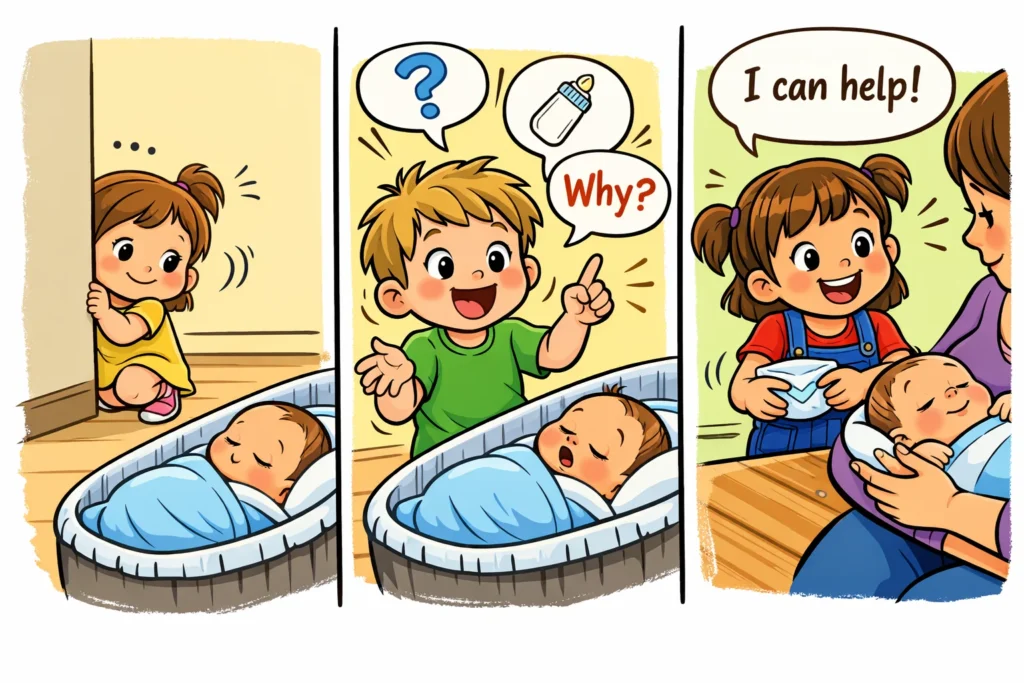
Every temperament and age group requires a different strategy.
Toddlers Age 1–2 Years
At this age, the toddler doesn’t fully understand the concept of a “sibling.” They notice something new that takes a lot of your time and attention.
- Focus: Sensory exploration and constant supervision.
- Action: Show them pictures of themselves as a newborn to help them bridge the gap.
Toddlers Age 2–4 Years
This is the “prime” age for separation anxiety and jealousy.
- Focus: Validation of feelings and pretend play.
- Action: Use dolls to act out “the baby is crying” and ask the toddler what we should do.
Toddlers Age 4–6 Years
Children this age have better impulse control and can engage in deeper conversations.
- Focus: Responsibility and “insider” status.
- Action: Explain why the baby is crying (e.g., “His tummy hurts”) to build empathy.
Common Mistakes During Newborn Introduction
- Forcing Affection Too Early: If you demand they “kiss the baby,” they may push back. Let the affection grow organically.
- Ignoring Toddler Emotional Signals: If they are acting out, they need attention. It’s a call for help, not bad behavior.
- Overpraising Toddler Only Around Baby: If you only say “Good job!” When they are helping with the newborn, they may feel their only value lies in their service to the baby’s needs.
After First Weeks Adjustment Period
The arrival of the new baby is a marathon. The first week might be great, but the third week – when the reality of the “forever” nature of the sibling sinks in – might be harder.
Tracking Progress Without Expectations
Adjustment is non-linear. Some days your older child will be a doting big brother; other days they will be struggling to adjust. This is normal. Look for overall trends of stability rather than daily perfection.
When to Seek Professional Support
Consider talking to a pediatrician or child therapist if you notice:
- Prolonged, intense aggression toward the baby.
- Severe sleep disturbances or loss of appetite in the older child.
- Withdrawal from activities they previously loved.
Frequently Asked Questions
The adjustment to a new sibling typically takes 3 to 6 months. By the time the baby arrives at the 6-month milestone and begins to sit up and interact, the bond usually strengthens significantly.
Immediately prioritize safety. Separate them calmly. Say, “I can’t let you hurt the baby. I’m going to put the baby in the crib so I can help you calm down.” Address the underlying feeling later when everyone is calm.
Yes, but only with full adult support. Sit them in a supportive nursing pillow or on a couch and stay within arm’s reach. This helps them feel positive about their new role.

Take a short quiz to find out what your everyday choices say about your parenting style
When your child is curious about something new, what’s your instinct?
Take a short quiz to find out what your everyday choices say about your parenting style
“Can I download this app?” What happens next?
Take a short quiz to find out what your everyday choices say about your parenting style
When it comes to rules at home, which sounds most like you?
Take a short quiz to find out what your everyday choices say about your parenting style
If you could give your child one life skill today, what would you pick?
Take a short quiz to find out what your everyday choices say about your parenting style
Your child gets to choose what to watch. What would your ideal setup look like?
Take a short quiz to find out what your everyday choices say about your parenting style
Pick your parenting superpower ✨