Humidity Experiment for Kids Using Psychrometer

 Discover a Free Education Video App for Kids
Pastory uses AI to personalize educational video content based on your child’s interests and personality. Safe, engaging, and built for curious young minds. Sign up now to stay updated and enjoy early access with a free trial
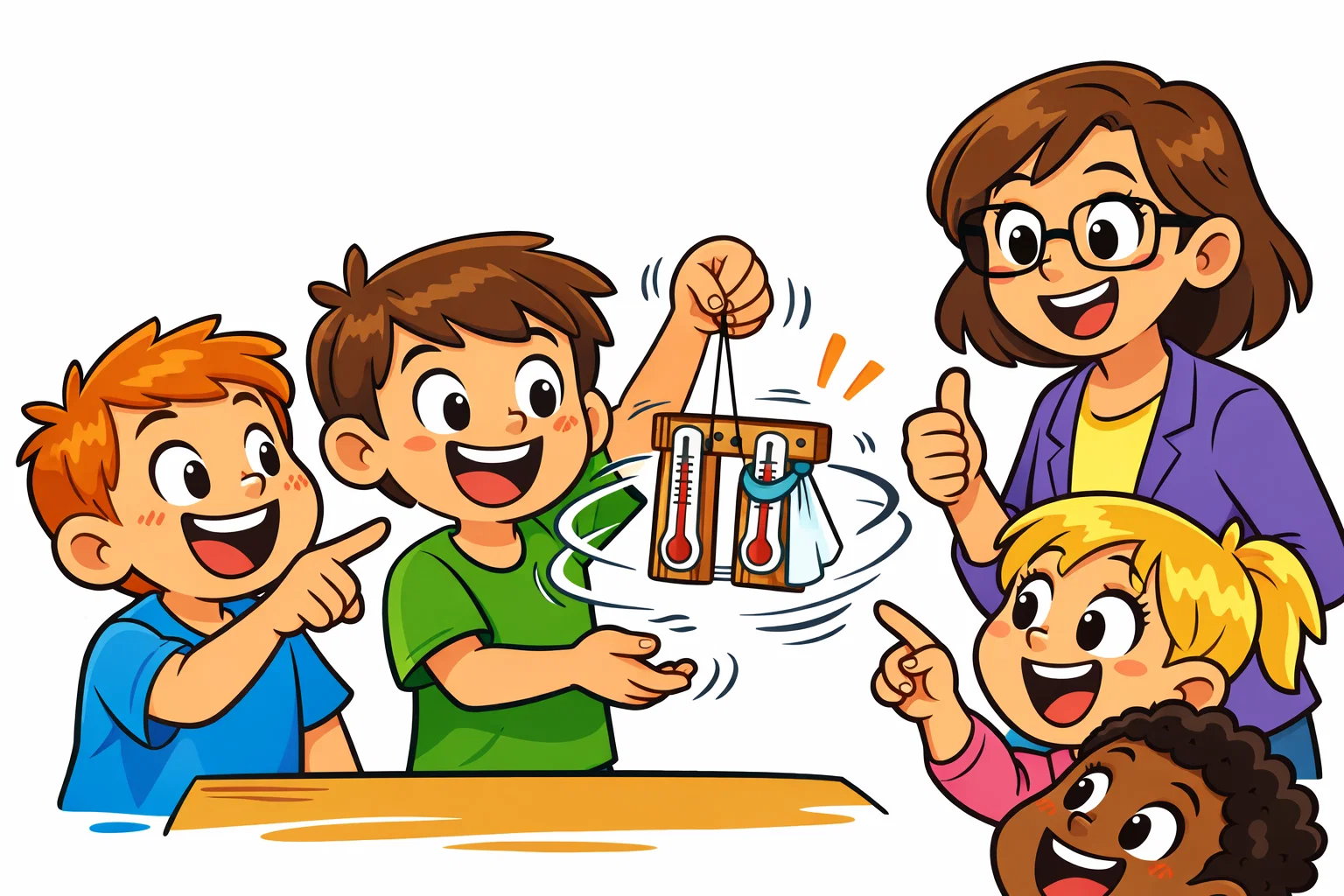
Measuring the invisible world around us is one of the most exciting ways to spark a child’s interest in STEM. While we can easily feel when the air is heavy and sticky on a summer day, teaching children how to quantify that sensation using a psychrometer turns a vague feeling into a concrete scientific observation. This experiment allows students to explore the relationship between temperature and humidity by building their own measurement tool, helping them understand how water vapor in the air affects daily life and global weather patterns.
By the end of this activity, your young scientists will not only know how to determine the relative humidity of their environment, but they will also grasp the fundamental physics of evaporation and thermal energy. Whether you are a parent looking for a robust science fair project idea or a teacher organizing a classroom science inquiry, this guide provides everything you need to measure humidity accurately and confidently.
Quick Overview
Experiment Snapshot
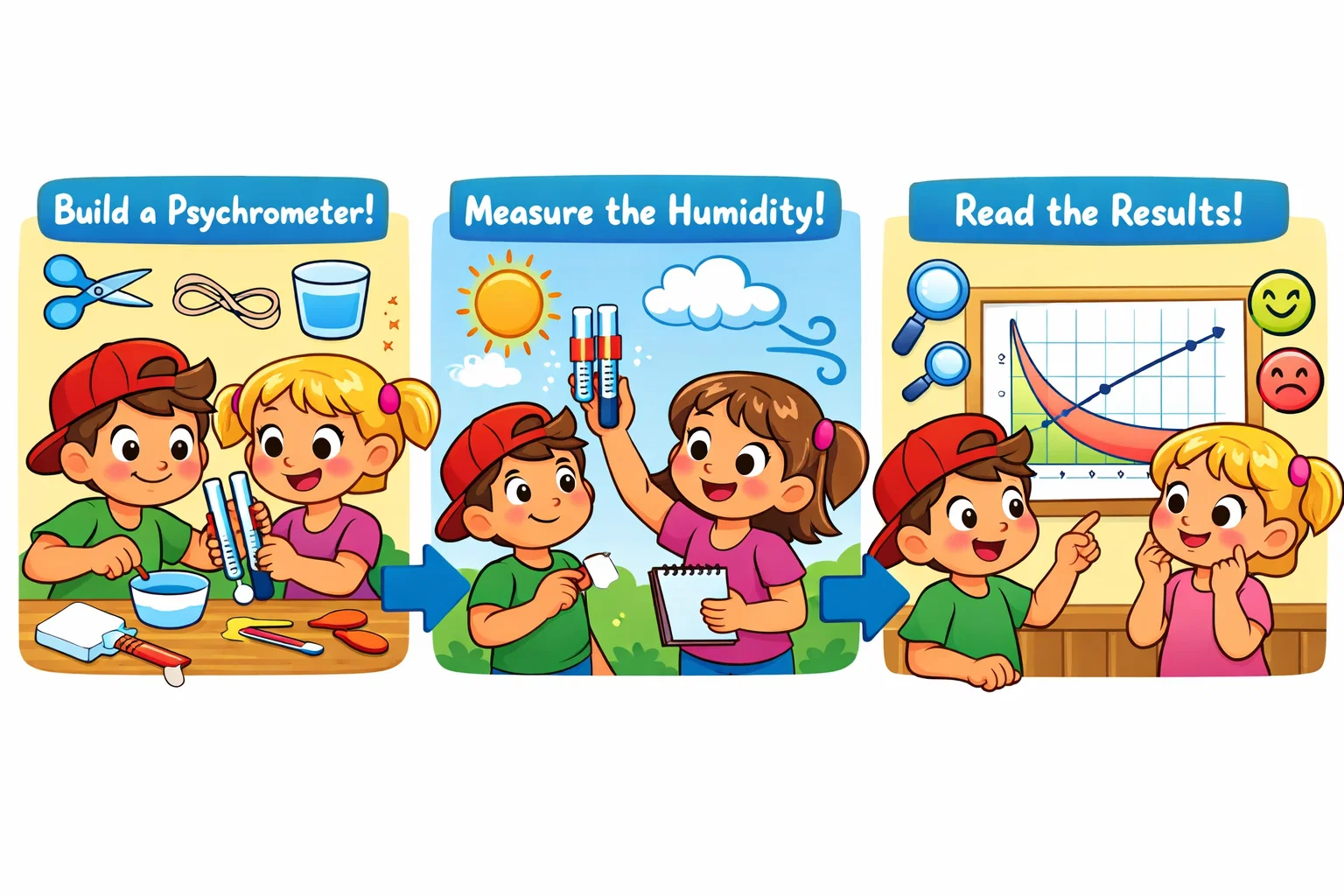
In this hands-on science experiment, children will construct a device called a psychrometer (specifically a sling psychrometer) to measure relative humidity. By using two thermometers—one kept dry and the other wrapped in a wet material—they will observe how evaporation cools the wet bulb. The difference between the dry bulb temperature and the wet-bulb temperature allows us to determine the relative humidity using a standardized relative humidity chart.
Time Requirements
- Preparation: 15 minutes
- Active Experimentation: 30–45 minutes
- Data Analysis: 15 minutes
- Total Time: Approximately 1 hour to 75 minutes.
Difficulty Level
- Level: Intermediate (Grades 4–8)
- Skills: Requires careful handling of thermometers, basic subtraction, and the ability to read a data table.
Science Connection
Weather And Atmosphere
The moisture in the air is a critical component of our atmospheric conditions. Atmospheric humidity refers to the amount of water vapor present in the air around us. Because warmer air can hold more water vapor at a given temperature than cooler air, scientists use the term relative humidity to describe the percentage of water vapor currently in the air compared to the maximum amount the air can hold at that current temperature.
Engineering Link
Engineers use psychrometers and other hygrometer variants to design HVAC systems. Humidity control is vital in buildings to prevent mold growth and ensure human comfort. Understanding how a wet-bulb thermometer works is the first step in learning how industrial cooling towers and humidifiers operate.
Real-World Relevance
Why does high humidity make us feel so much hotter? It’s because humidity reduces the rate at which sweat can evaporate from our skin. If the air is already full of water, our sweat can’t turn into water vapor, leaving us feeling damp and overheated. Conversely, low humidity in the winter can lead to dry skin and static electricity.
Learning Objectives

Skills Developed
- Observation: Noting the physical changes in the cotton balls and water levels.
- Data Collection: Recording accurate humidity readings over time.
- Mathematical Calculation: Calculating the wet-bulb depression (the difference between dry bulb and wet bulb).
Concepts Covered
- Evaporation as a cooling process.
- The difference between absolute humidity and relative humidity (conceptual level).
- The concept of the dew point—the temperature at which water vapor condenses back into liquid.
Experiment Outcomes
Students will be able to explain why the wet bulb temperature is always lower than the dry bulb (unless the air is 100% saturated with water vapor). They will also be able to measure how much moisture is in the air in different environments.
Educational Standards Alignment
NGSS Science Skills
- MS-ESS2-4: Develop a model to describe the cycling of water through Earth’s systems driven by energy from the sun and the force of gravity.
- Planning and Carrying Out Investigations: Students will collect data to serve as the basis for evidence.
Math Applications
| Skill | Application in Experiment |
| Subtraction | Finding the difference between the two thermometers. |
| Data Interpretation | Using a relative humidity chart to find a percentage. |
| Averaging | Taking multiple humidity readings and finding the mean. |
STEM Integration
This project integrates Science (meteorology), Technology (instrumentation), and Math (data analysis). It encourages students to think like meteorologists collecting weather data.
Materials List

Core Materials
- Two thermometers (identical, alcohol-based are safest for kids).
- A short piece of hollow cotton shoelace or thick cotton balls.
- A sturdy piece of cardboard or a wooden board (approx. 4×10 inches).
- A strong rubber band or packing tape.
- Distilled water (room temperature).
- A small piece of string (if making a sling psychrometer).
Optional Supplies
- Small fan (to simulate the “slinging” motion if you prefer a stationary setup).
- Empty plastic water bottle (to act as a water reservoir).
- Color-coded markers for graphing results.
Safety Notes
- Glass Safety: If using glass thermometers, ensure adult supervision. If a thermometer breaks, do not touch the liquid or glass.
- Movement: When using a sling psychrometer, ensure there is plenty of “swinging room” to avoid hitting objects or people.
Worksheets And Printables
Data Recording Sheet
Create a simple four-column table for your students:
- Trial Number/Location
- Dry Bulb Temperature (°C)
- Wet Bulb Temperature (°C)
- Temperature Difference (Dry – Wet)
Observation Worksheet
Include prompts such as:
- “What do you notice about the water on the cotton balls after 2 minutes?”
- “How does the air temperature feel to you (dry, humid, or neutral)?”
Results Summary Page (Optional Extension)
Ask students to graph their relative humidity findings compared to outdoor humidity reports from a local weather app to check for data accuracy.
Pre-Experiment Knowledge
Temperature Basics
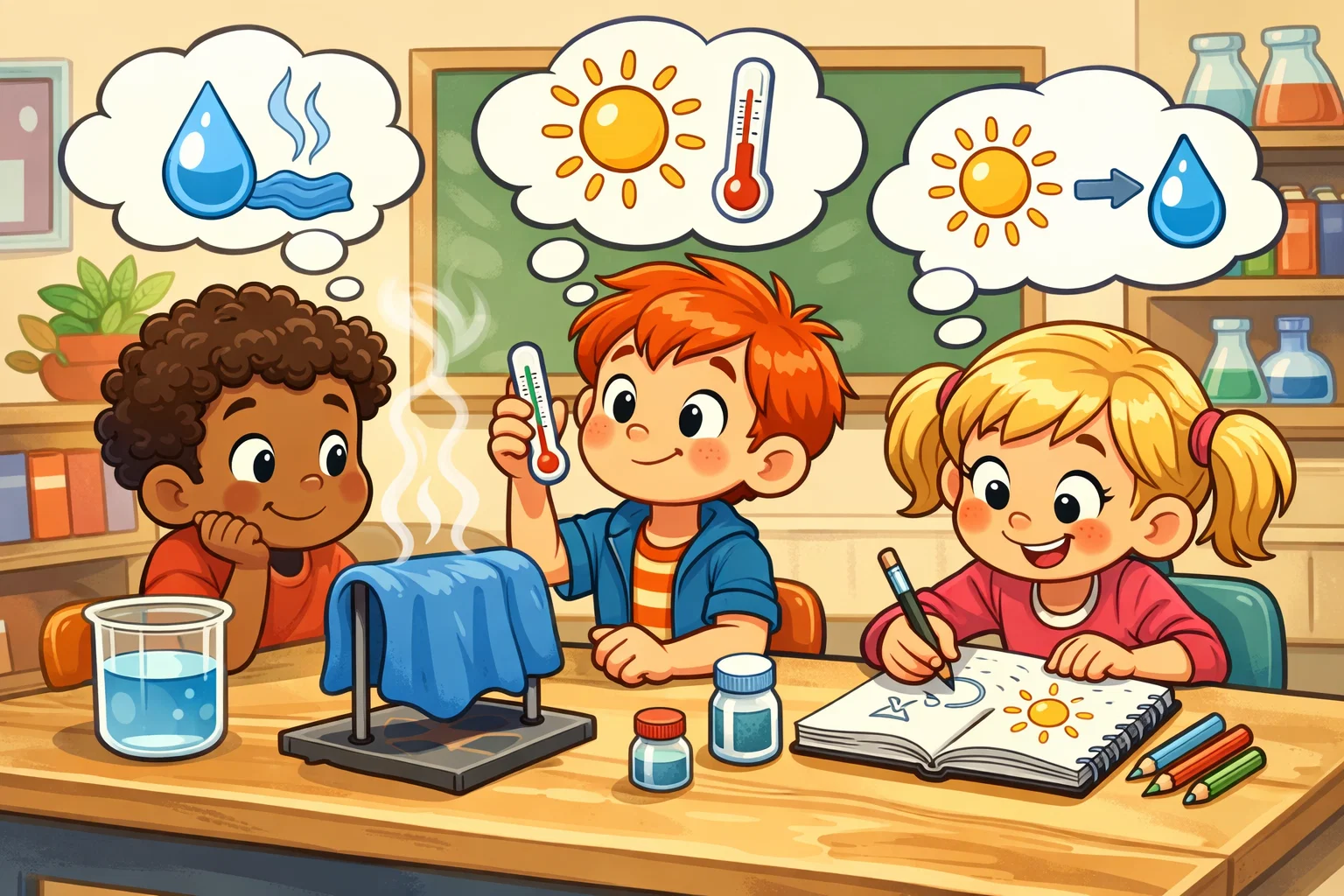
Before starting, ensure kids understand that air temperature is a measure of how fast air molecules are moving. High temperature means fast-moving molecules, while lower temperatures mean slower ones.
Evaporation Concept
Explain that evaporation is the process by which liquid water changes into water vapor in the air. This process requires energy (heat). When water leaves a surface, it takes some heat with it, which is why we feel cold when we get out of a swimming pool.
Measurement Tools
A thermometer measures the current temperature. A hygrometer is any tool used to measure humidity. A psychrometer is a specific type of hygrometer that uses two thermometers.
Introduction And Motivation
Why Measure Humidity
Humidity refers to the amount of water vapor in the air relative to what it can hold. It determines whether it will rain, how fast laundry dries, and even how well certain plants grow. In a science fair, demonstrating how to measure humidity shows an advanced understanding of the “invisible” variables in our environment.
Everyday Examples
- The “Mirror Fog”: When you shower, the air is already saturated, and water vapor condenses on the cool mirror.
- Sweaty Soda Cans: This happens when the moisture in the air hits a cold surface and reaches its dew point temperature.
Experiment Question
“How does the rate of evaporation on a wet-bulb thermometer change based on the amount of water vapor already in the air?”
Psychrometer Basics
What a Psychrometer Measures
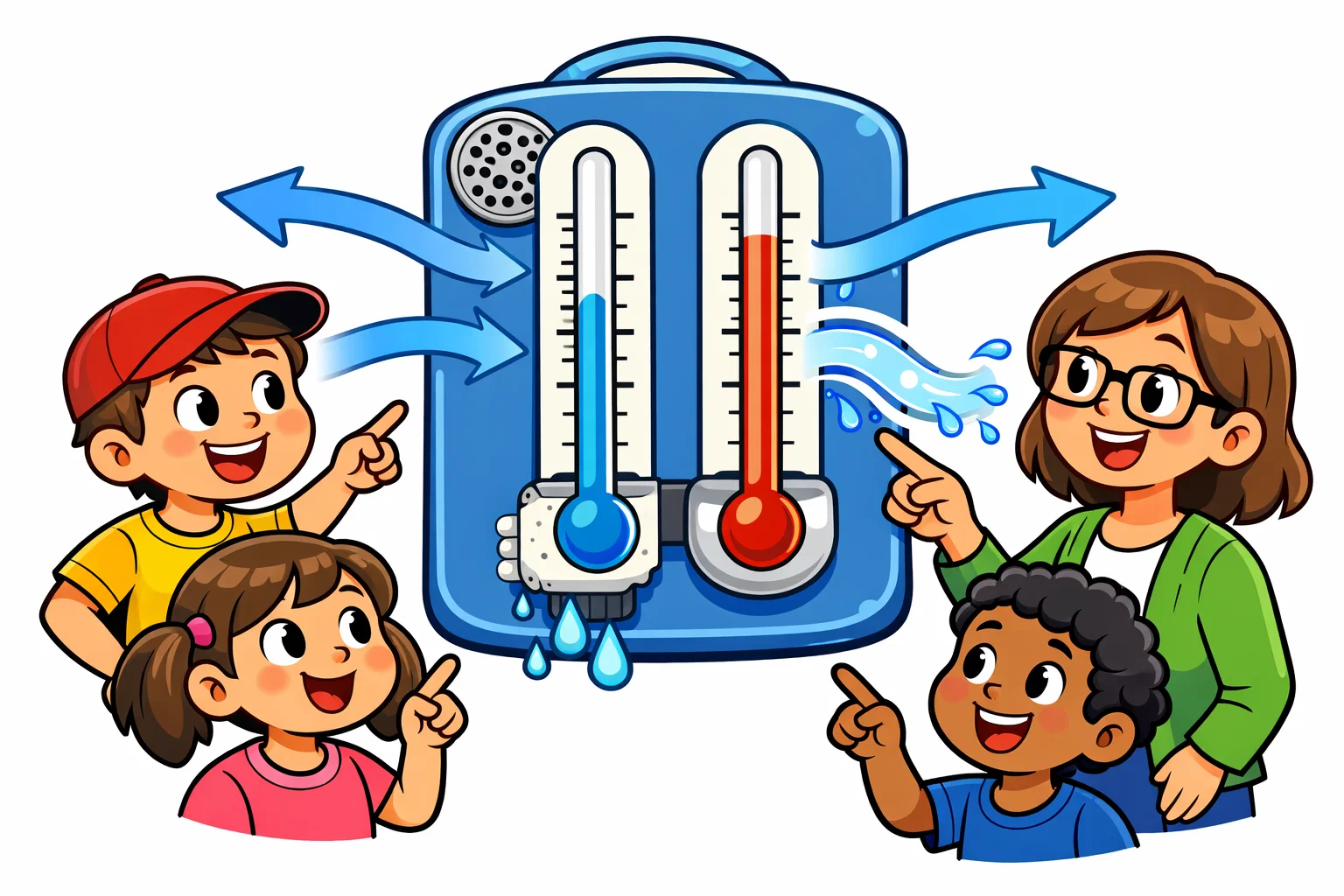
A psychrometer measures relative humidity—the percentage of water vapor in the air compared to the maximum amount the air can hold at that temperature.
Types Of Psychrometers
- Stationary Psychrometer: Uses a fan or natural breeze.
- Sling Psychrometer: Spun in the air to ensure the wet bulb is exposed to airflow.
Psychrometer Components
- Dry Bulb: Measures the actual air temperature.
- Wet Bulb: A thermometer covered in a wet wick.
- Wick: Usually cotton, which holds water and uses it for evaporation.
Step-By-Step Procedure
Preparing Psychrometer
- Mount two thermometers side-by-side on your cardboard base. Make sure the bulb of each thermometer is not touching the board directly (let them hang off the edge slightly or use spacers).
- Label one thermometer as “Dry Bulb” and the other as “Wet Bulb”.
- Take your cotton balls or shoelace and wrap them around the bulb of one thermometer. Secure it with a small rubber band.
Taking Measurements
- Dip the bulb of one thermometer (the one with the cotton) into room-temperature water. Ensure the wick is saturated but not dripping excessively.
- If you are using a sling psychrometer, attach a string to the top of your board and carefully whirl it in a circle for about 1 minute.
- If you are using a stationary model, place it in front of a fan for 2 minutes.
Recording Results
- Immediately read the wet bulb temperature first, then the dry bulb temperature.
- The wet-bulb temperature will always be lower than or equal to the dry-bulb temperature.
- Subtract the wet bulb from the dry bulb to find your “depression” value.
Experiment Variations
Indoor Vs Outdoor Testing
Check the indoor humidity (affected by air conditioning or heaters) versus the outdoor humidity. Usually, air conditioning reduces moisture in the air, leading to low humidity.
Time-of-Day Comparison
Take humidity readings at 8:00 AM, 12:00 PM, and 8:00 PM. You’ll likely find that as air temperature rises, relative humidity often drops, even if the absolute humidity stays the same.
Weather Condition Comparison
Perform the science experiment on a rainy day versus a sunny day. On a rainy day, the air is much more humid, and you will see a very small difference between your two thermometers.
Vocabulary And Key Terms
Humidity
The general term for water vapor in the air. It is the factor that makes the air feel heavy.
Relative Humidity
A ratio (expressed as a percentage) of how much water is in the air compared to how much it could hold at that temperature. 100% humidity means the air is saturated with water vapor.
Wet Bulb And Dry Bulb
The dry bulb is your baseline current temperature. The wet bulb reflects the temperature of a surface being cooled by evaporation.
Assessment And Evaluation
Observation Questions
- “Why did the wet bulb temperature stop dropping after a few minutes?”
- “If the two thermometers showed the same temperature, what would that tell you about the humidity in the air?”
Data Accuracy Check
Did you make sure the bulb was completely wet? If the wick dries out, the wet-bulb temperature will begin to rise back toward the dry-bulb temperature, giving an inaccurate percent humidity reading.
Experiment Reflection
How does high humidity affect your energy levels? Why might a scientist need to determine relative humidity when studying weather patterns?
Applications Of Psychrometer
Weather Forecasting
Meteorologists use psychrometers to calculate the dew point. If the dew point is high, it’s a sign that storms may be brewing.
Classroom Climate
Maintaining proper humidity levels in a classroom can help reduce the spread of viruses and keep students focused. Humidity plays a major role in how humans perceive comfort.
Science Careers
- Meteorologist: Studies atmospheric conditions.
- HVAC Technician: Uses humidity readings to fix air systems.
- Agricultural Scientist: Monitors moisture in the air to prevent crop disease.
Videos And Visual Guides
Demonstration Video
(Search for “How to use a sling psychrometer for kids” on YouTube to find visual aids that show the proper spinning technique.)
Diagram Explanation
Animation Suggestion
Look for animations showing water vapor condenses at the molecular level to help students visualize the dew point temperature.
Quiz And Knowledge Check
Multiple Choice Questions
What happens to the wet bulb temperature when evaporation occurs?
- A) It rises
- B) It stays the same
- C) It lowers
- Answer: C
When the air is 100% saturated, the difference between the two thermometers is:
- A) Very large
- B) Zero
- C) 10 degrees
- Answer: B
Challenge Task
Calculate the relative humidity if the dry bulb is 22°C and the wet bulb is 18°C using a relative humidity chart.
Group Discussion
“Why does a sling psychrometer need to be spun? What would happen if we just let it sit still?” (Hint: It ensures the wet bulb is consistently exposed to the air.)
References And Sources
Educational Websites
- NASA Climate Kids: Great for explaining atmospheric humidity.
- NOAA Education: Provides real-time weather data and humidity in the air maps.
Teacher Resources
- National Science Teaching Association (NSTA): Offers peer-reviewed science inquiry lessons.
- NGSS Hub: For deeper STEM integration ideas.
Further Reading
- The Weather Book by Jack Williams.
- The Kid’s Book of Weather Forecasting by Mark Breen.
User Tips And Teacher Notes
Common Mistakes
- Using Warm Water: Always use room-temperature water. If the water is too hot or cold, it will skew the initial temperature of the wet bulb.
- Touching the Bulbs: The heat from your hands will change the humidity readings. Only hold the device by the handle or the edges of the board.
Classroom Setup Advice
If doing this with a large group, provide “rotation stations.” Have one station measure relative humidity near a window, one near a heater, and one in a hallway to see how indoor humidity varies.
Adaptation For Ages
- Younger Kids (Ages 7-9): Focus on the “cooling” sensation of evaporation. Use the two thermometers to show that “wet feels colder.”
- Older Kids (Ages 10-14): Use the data to determine the relative humidity using the chart and discuss the dew point.
Related Weather Experiments
Temperature Experiments
Explore how different surfaces (asphalt vs. grass) retain heat differently under direct sunlight.
Air Pressure Activities
Build a simple barometer using a jar and a balloon to complement your psychrometer observations.
Water Cycle Experiments
Create a “cloud in a bottle” to see how water vapor condenses when pressure, temperature, and humidity change.
Take a short quiz to find out what your everyday choices say about your parenting style
When your child is curious about something new, what’s your instinct?
Take a short quiz to find out what your everyday choices say about your parenting style
“Can I download this app?” What happens next?
Take a short quiz to find out what your everyday choices say about your parenting style
When it comes to rules at home, which sounds most like you?
Take a short quiz to find out what your everyday choices say about your parenting style
If you could give your child one life skill today, what would you pick?
Take a short quiz to find out what your everyday choices say about your parenting style
Your child gets to choose what to watch. What would your ideal setup look like?
Take a short quiz to find out what your everyday choices say about your parenting style
Pick your parenting superpower ✨