Pendulum Experiments for Kids at Home

 Discover a Free Education Video App for Kids
Pastory uses AI to personalize educational video content based on your child’s interests and personality. Safe, engaging, and built for curious young minds. Sign up now to stay updated and enjoy early access with a free trial

Engaging in scientific discovery from the comfort of a living room or kitchen provides a unique foundation for cognitive development. When children observe the steady back and forth motion of a weighted object, they are not just playing; they are interacting with the fundamental laws of physics. Setting up a pendulum experiment is one of the most accessible ways to introduce concepts like gravity, momentum, and timekeeping. By using simple materials such as paper, tape, a cup, and a length of string, a household transforms into a mini-laboratory where complex patterns of motion become visible and measurable.
DIY Pendulum Science Projects

Salt Pendulum Painting Tutorial
Creating art through physics is a brilliant way to capture a child’s imagination. To start this project, follow these steps:
- Take a paper or plastic cup and poke a small hole in the bottom center.
- Secure a long string to the rim of the cup so it hangs evenly.
- Tape a large piece of dark construction paper to the floor directly beneath the pendulum’s path.
- Fill the cup with dry salt, holding the hole closed with a finger.
- Release it with a gentle swing to see the geometric patterns emerge.
Pumpkin Pendulum Fall Science Activity
Seasonal themes can make science feel more relevant and festive. Using a small, lightweight pumpkin as the bob—the weighted object at the end of the string—allows children to explore how different shapes interact with air. Ensure the stem is strong enough to hold the weight or use a mesh bag to secure the pumpkin. This experiment is particularly useful for observing how the larger surface area of a pumpkin might create more air resistance compared to a smooth metal washer.
Tick-Tock Timer Construction
Building a functional timer helps kids relate the science of a pendulum to the history of timekeeping. By adjusting the length of the string to exactly 99.4 centimeters, you can create a “seconds pendulum,” where each swing from one side to the other takes exactly one second. This project requires a stable support and a precise ruler to ensure the period is accurate enough to match a digital clock.
Paper Spinning Helicopters
While not a traditional pendulum, paper helicopters demonstrate related concepts of gravity and air resistance. By dropping these from a high point, children can compare the straight-line fall of a weight to the slowed, spinning descent caused by paper blades. This provides a perfect contrast to pendulum motion, showing how different designs can manipulate the force of gravity to change the speed and pattern of a fall.
Essential Pendulum Science Materials
Common Household Supplies
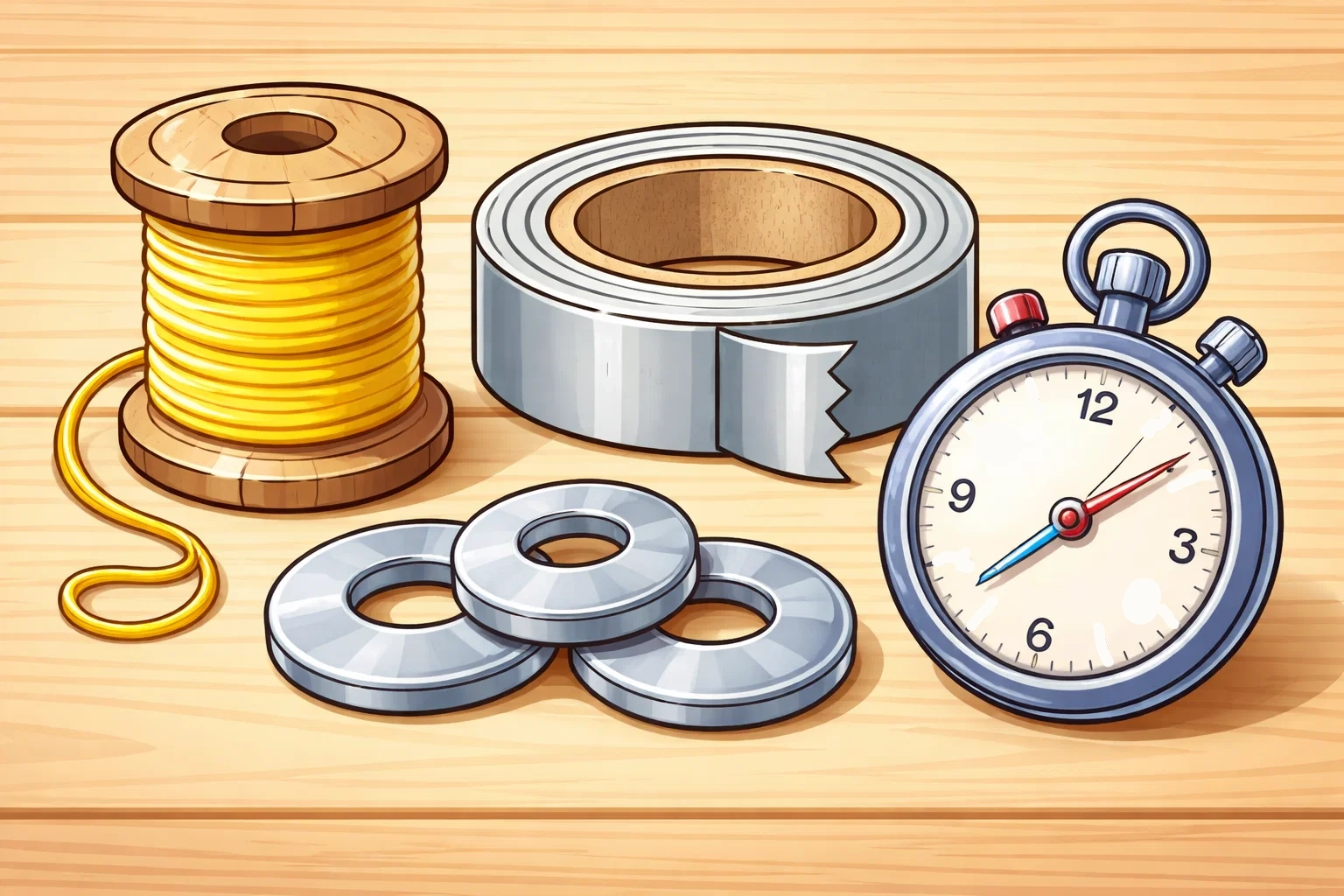
To begin your home experiments, gather the following essential items:
- Sturdy, non-stretchable string or thread
- Adhesive tape (masking or duct tape works best)
- Various weights (bobs) such as washers, nuts, or beads
- Measuring tape or a long ruler
- Stopwatch or smartphone timer
- Paper and markers for data logging
String and Weight Selection
The choice of string is critical; it should be lightweight and non-elastic. Fishing line or thin cotton thread works best because materials like yarn or rubber bands can stretch, which changes the length of the pendulum during the swing and ruins the accuracy of the data. For the bob, dense objects like metal washers, large nuts, or even a heavy wooden bead are ideal because they minimize the impact of air friction.
Support Structure Requirements
A pendulum needs a fixed, stable pivot point to work correctly. A common method is to tape a ruler or a sturdy stick to the edge of a table, allowing it to overhang. Placing a heavy textbook on the part of the ruler that sits on the table ensures that the support does not wobble. If the support shakes, it absorbs energy from the swing, making the results inconsistent.
Initial Pendulum Setup Guide
Creating Secure Anchor Point
A proper setup is the key to consistent data. Follow this checklist for a stable anchor:
- Ensure the ruler overhangs the table by at least 15-20 centimeters.
- Use a small piece of tape to secure the string at a single point to prevent sliding.
- Check that there is enough clearance from walls, table legs, and the floor.
- Confirm the pivot point remains perfectly still when the pendulum swings.
Adjusting String Length
When measuring the length of the pendulum, always measure from the pivot point (the edge of the ruler) to the center of the bob, not just to the top of it. This represents the center of mass, which is a vital detail for calculating the period correctly.
Measuring Release Angles
To keep the experiment scientifically valid, the release angle should be kept small—typically less than 15 to 30 degrees. If the angle is too wide, the motion becomes more complex and the standard formulas for calculating the swing time no longer apply accurately.
Experiment One: Impact of Weight
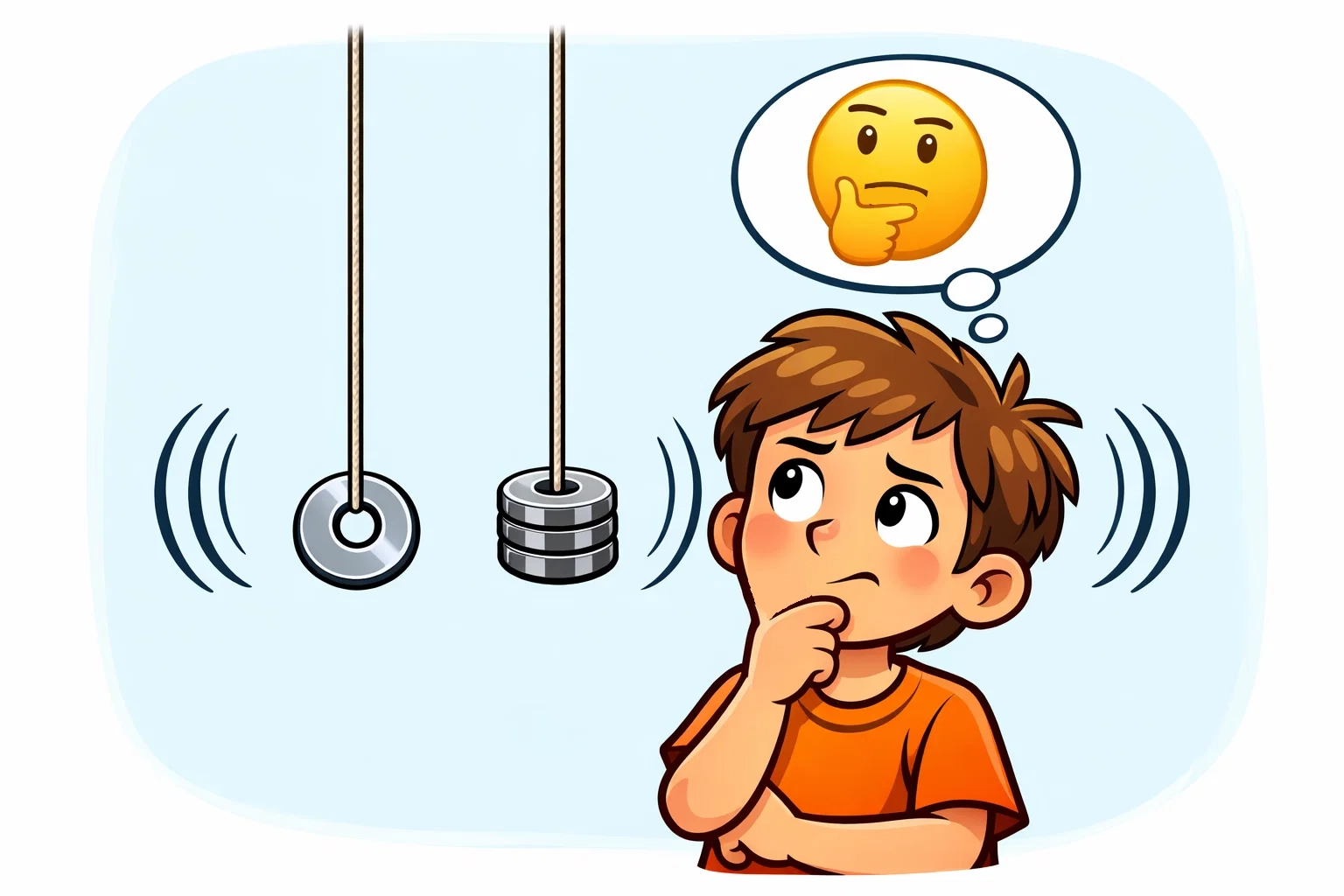
When conducting this experiment, the goal is to observe if a heavier object swings faster than a lighter one. By keeping the string length and release angle exactly the same, you can isolate mass as the only variable. In classical physics, gravity accelerates all objects at the same rate regardless of their weight, provided air resistance is negligible.
Testing Different Mass Loads
Follow this procedure to test the impact of weight:
- Attach one metal washer and time 10 swings.
- Add a second washer (doubling the mass) and repeat the timing.
- Add a third washer and repeat once more.
- Compare the average time per swing for each mass load.
Recording Oscillation Speed
Use the “10-Swing Rule” to gather data. Human reaction time usually ranges from 0.2 to 0.4 seconds, which can create a massive percentage of error in a single 2-second swing. To mitigate this, time ten full cycles and divide the total time by ten. This practice aligns with standard scientific protocols for reducing measurement uncertainty, as described in the Next Generation Science Standards (NGSS) guidelines for evidence-based investigation.
Comparing Heavy vs Light Objects
When comparing a heavy nut to a light plastic bead, the data should show that the period remains almost identical. This happens because, while gravity pulls harder on the heavy object, that same object has more inertia (resistance to moving), so the effects cancel each other out.
Experiment Two: Impact of Release Angle
Testing Small vs Large Swings
Compare a release from 10 degrees to one from 45 degrees. For small angles, the period stays remarkably consistent. This is known as the small-angle approximation, where the motion can be modeled as linear, which is critical for the accuracy of the standard period formula.
Measuring Arc Distance
While the time per swing stays the same, the distance traveled increases with a larger angle. This means the bob must travel faster during a wide swing to complete the trip in the same amount of time as a short swing.
Analyzing Gravity Effects
Gravity is the “motor” of the pendulum. While the mass doesn’t change the period, the strength of gravity does. Geographical studies indicate that gravity is not a universal constant; it is weaker at the equator (9.78 m/s2) and stronger at the poles (9.83 m/s2). A pendulum clock accurately calibrated for one latitude will experience a significant timekeeping error if moved to another.
Experiment Three: Impact of String Length

Comparing Long vs Short Strings
This is the most visible variable in pendulum science. A short string results in a very fast, frantic swing, while a long string creates a slow, majestic sweep.
Measuring Period Frequency
The relationship is defined by a specific equation: Period = 2 * pi * square_root(Length / gravity). This shows that to double the time of a swing, you actually have to make the string four times longer, not just twice as long.
Scientific Principles and Laws
| Variable | Definition | Impact on Swing |
| Gravity (g) | Force pulling bob down | Stronger gravity = Faster swing |
| Length (L) | Distance from pivot to mass | Longer string = Slower swing |
| Mass (m) | Weight of the bob | No impact on period |
| Amplitude | Angle of release | Minimal impact (at small angles) |
Galileos Law of Isochronism
Galileo Galilei discovered that the time a pendulum takes to swing remains constant regardless of the width of the swing. He famously observed this by watching a hanging lamp in a cathedral, using his own pulse to time the oscillations.
Conservation of Energy in Motion
At the highest point of the swing, the bob has maximum potential energy. As it drops, this is converted into kinetic energy (motion). In an ideal vacuum, this energy would cycle forever, but at home, damping occurs as energy is dissipated through friction and air resistance.
Real World Examples
Grandfather Clock Mechanisms
Traditional clocks use a pendulum to regulate time. Because the period is so consistent, a pendulum swinging back and forth can be used to move gears at a precise rate, keeping the clock accurate for days at a time.
Metronomes for Music Practice
Musicians use metronomes to keep a steady beat. Many mechanical metronomes are just inverted pendulums with a sliding weight that changes the “length” of the swing, thereby changing the tempo of the clicks.
Seismometers for Measuring Earthquakes
Early seismometers used large pendulums to detect ground movement. When the Earth shakes, the heavy bob stays still due to inertia, while the frame moves with the ground, allowing the motion to be recorded on a paper roll.
Foucault Pendulum and Earth Rotation
A Foucault pendulum is a very long pendulum that appears to change its direction over time. In reality, the pendulum stays on the same path, and it is the Earth rotating beneath it that causes the change, proving that our planet spins.
Safety Tips for Home Science
Safety is the foremost concern when handling small parts or strings. According to the American Academy of Pediatrics, choking on small weights like washers is a documented risk for young investigators.
Checklist for a Safe Lab Space
- Adult Supervision: Always have an adult present to assist with cutting and taping.
- Choking Hazard Prevention: Keep washers, nuts, and beads away from children under 3 years old.
- Secure Fastening: Double-check that all weights are tied tightly to prevent them from flying off.
- Clear Area: Make sure the swing path is clear of faces, pets, and fragile decorations.
Frequently Asked Questions
Why does pendulum eventually stop swinging?
Air resistance and friction at the pivot point gradually take energy away from the system. This is called damping. For a home pendulum, about 99% of energy loss is due to air friction.
Does weight of bob change swing time?
No. In a standard pendulum, the mass of the bob does not affect the period. Both light and heavy objects accelerate toward the center at the same rate due to gravity.
How does air resistance affect home experiments?
If you use a very light object with a large surface area (like a crumpled paper ball), air resistance will significantly slow it down. This is why dense objects like metal are preferred for accuracy.

Take a short quiz to find out what your everyday choices say about your parenting style
When your child is curious about something new, what’s your instinct?
Take a short quiz to find out what your everyday choices say about your parenting style
“Can I download this app?” What happens next?
Take a short quiz to find out what your everyday choices say about your parenting style
When it comes to rules at home, which sounds most like you?
Take a short quiz to find out what your everyday choices say about your parenting style
If you could give your child one life skill today, what would you pick?
Take a short quiz to find out what your everyday choices say about your parenting style
Your child gets to choose what to watch. What would your ideal setup look like?
Take a short quiz to find out what your everyday choices say about your parenting style
Pick your parenting superpower ✨