Potential and Kinetic Energy Experiments for Kids

 Discover a Free Education Video App for Kids
Pastory uses AI to personalize educational video content based on your child’s interests and personality. Safe, engaging, and built for curious young minds. Sign up now to stay updated and enjoy early access with a free trial
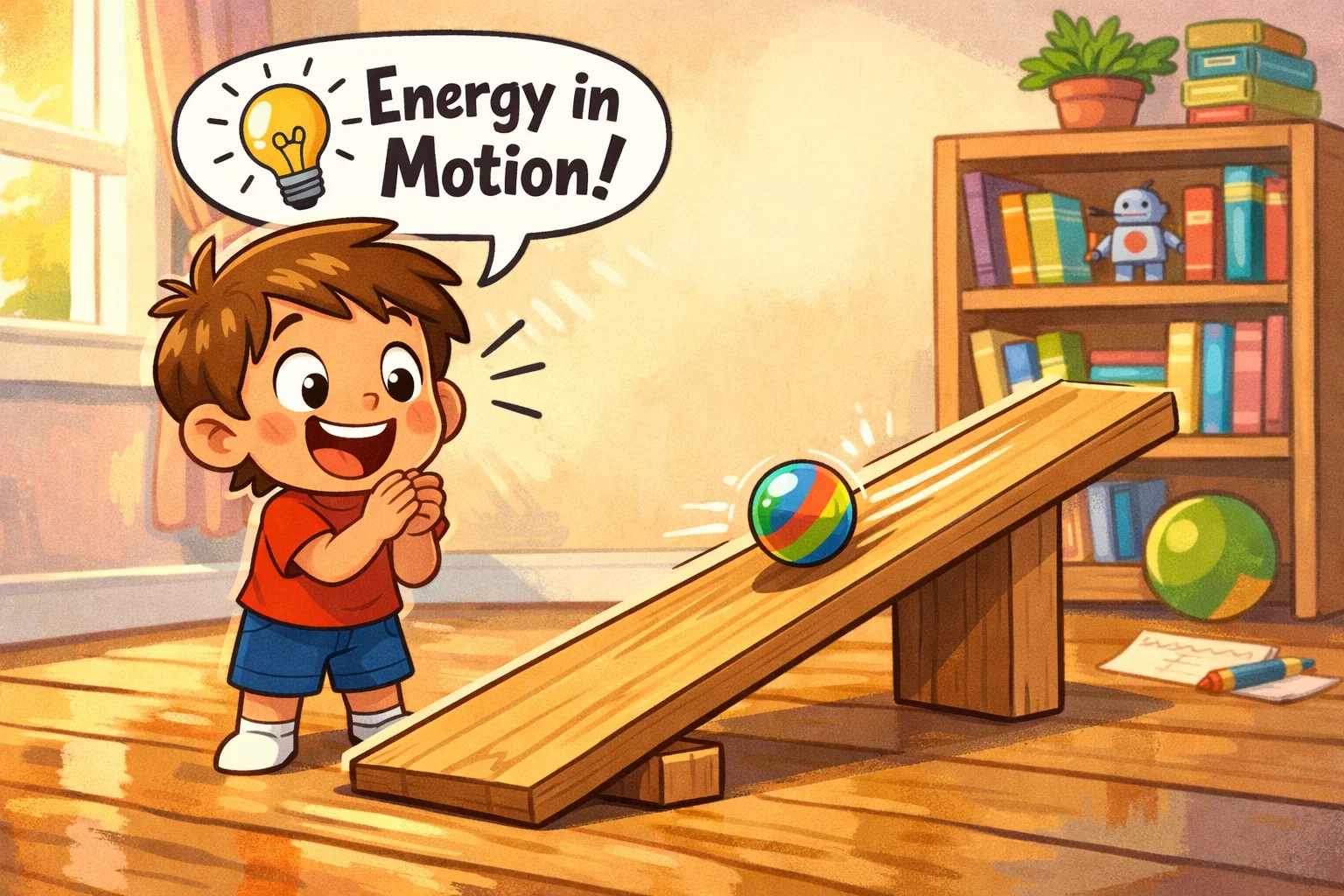
Teaching physics to young learners often requires a bridge between abstract equations and the physical world. By engaging in a science experiment, children can witness how invisible forces shape the environment around them. Whether it is a rolling ball or a stretching rubber band, these activities transform complex terminology into tangible experiences.
Core Physics Concepts for Young Learners

Before diving into the hands-on activities, it is essential to establish a foundation in mechanical energy. This theoretical architecture is built upon the classical laws of Newtonian mechanics and the principle of the conservation of energy. Within any isolated system, this capacity is neither created nor destroyed; it is only transformed from one modality to another. This fundamental law dictates that the total power of a system remains constant: Ei = Ef.
Defining Potential Energy
Potential power represents stored capacity waiting for a force to act upon it. It is often described as the status of position or condition. When a kid holds a ball at the top of a ramp, that ball possesses power simply because of where it is located.
Gravitational Potential Energy explained
During everyday exploration, families most frequently explore Gravitational Potential Energy (Ug). This is calculated using the mass of the object (m), the gravitational acceleration constant (g ≈ 9.81 m/s²), and the height (h) of the object relative to a reference point: Ug = mgh. The direct proportionality between height and this force is a key observational metric: doubling the height of a marble on a track generally doubles the distance it will travel, assuming minimal friction.
Elastic Potential Energy basics
Beyond gravity, Elastic Potential Energy (Us) is a critical component of catapult and rubber band car experiments. This power is stored in materials that can be stretched or compressed. It is governed by Hooke’s Law and the formula: Us = 1/2 kx², where k is the spring constant and x is the displacement. The quadratic nature of this relationship implies that small increases in the pull back of a launcher result in significantly larger outputs.
Defining Kinetic Energy
Kinetic power is the power of motion. Any object with mass that possesses velocity also possesses kinetic capacity. For most DIY experiments involving falling or rolling objects, the focus is on Translational Kinetic Energy (K): K = 1/2 mv². Because velocity is squared, the speed of an object has a much greater impact on its total momentum than its mass. This explains why faster collisions lead to drastically different outcomes, such as greater deformation in clay.
Key Differences between Kinetic and Potential Energy
The primary distinction lies in state: potential energy is “stored,” while kinetic capacity is “active.” Potential power depends on position or arrangement, whereas kinetic motion depends on travel and speed. In a pendulum, the power is 100% potential at the highest point and transforms into kinetic power as it reaches the bottom of the arc.
Kinetic and Potential Energy Experiments for Younger Kids

For younger children, the goal is to visualize energy transfer through simple, high-impact activities.
- Building simple models to show stored power.
- Observing how height changes speed.
- Testing different materials for elasticity.
- Measuring the distance of moving objects.
- Comparing weights and their impact on motion.
Popsicle Stick Chain Reaction
A domino-style chain reaction using popsicle sticks demonstrates elastic potential energy. By weaving the sticks together in a specific tension-based pattern, this force is stored in the wood. When the first stick is released, the potential power converts rapidly into kinetic energy, creating a spectacular “cobra weave” jump.
Balloon Rocket Races
Using a balloon, a piece of string, and a straw, you can demonstrate how compressed air acts as a force. As the air is released, the potential capacity of the stretched balloon pushes the straw along the string. This highlights the relationship between pressure and motion.
DIY Slingshot Launch
A simple slingshot made from a plastic cup and a balloon allows kids to explore how pulling back further (increasing x in the elastic formula) results in a faster launch speed. Using lightweight projectiles like cotton balls ensures safety while demonstrating storage.
Marble Ramp Racing
Using a simple ramp and a ball, children can measure how changing the height affects the distance a car or marble travels. This is the most direct way to observe gravitational potential power in action.
Classic Domino Effect
Setting up a domino chain is a lesson in the work-energy theorem. Each standing domino has potential capacity; a small force tips the first one, initiating a transfer of momentum through the entire line.
Pinwheel Spin Test
Blowing on a pinwheel or placing it in front of a fan shows how the kinetic power of moving air molecules can be transferred to a solid object, creating rotational motion.
Simple Pendulum Investigation
A weighted string tied to a fixed point allows kids to see the continuous cycle of transformation. As the weight swings, they can identify the moments of maximum potential and maximum kinetic energy.
The Science of Active Learning
Recent meta-analyses confirm active learning’s efficacy across STEM. A 2025 study found an effect size of 0.519 ± 0.049 SD on exam scores. Meanwhile, BLS projects STEM jobs growing 8.1% through 2034 — 3x faster than non-STEM (2.7%).gy and then discussing the transfer of power between objects or systems that take place.”
Advanced Energy Transformation Projects for Older Children

Older kids can handle more complex builds that require precise measurements and engineering at home.
- Designing cars with high-tension rubber bands.
- Calculating the potential force at different heights.
- Building functional water wheels.
- Testing wind resistance on vehicle designs.
- Using spring scales to measure power.
Rubber Band Powered Car Construction
This project uses a cardboard chassis, CD wheels, and rubber bands. The core challenge is overcoming wheel slippage. If wheels spin without moving, the CD edges must be covered with rubber bands to increase the coefficient of friction (μ) and maintain kinetic energy.
Roller Coaster Engineering Challenge
Using foam pipe insulation, children design tracks with loops. A key observation is that to successfully traverse a loop, the marble requires a minimum speed to maintain centripetal force. The starting height generally needs to be at least 2.5 times the radius of the loop to account for transformation and friction.
Water Wheel Energy Conversion
Building a water wheel allows children to see how the mass of falling water does work on the paddles. This demonstrates the conversion of gravitational potential power into rotational kinetic energy.
Wind Powered Vehicle Design
By creating sails or turbine blades for a small car, kids can investigate how the surface area affects the capacity captured from a moving air source.
Hand Crank Winch Mechanics
This activity demonstrates how mechanical advantage can be used to lift a mass. It introduces the concept of Power (P), which is the rate at which work is done (P = dW/dt).
Slope and Conservation of Energy Analysis
By using protractors to measure the angle of a ramp, kids can calculate the theoretical versus actual speed of a ball. Discrepancies lead to discussions about friction and non-mechanical loss.
Spring Scale Force Exploration
Using spring scales allows children to quantify the force required to move objects. They can observe how adding mass to a car increases the capacity needed to accelerate it, following Newton’s Second Law.
Real World Examples of Energy in Motion

Physics is not confined to the lab; it is visible in every playground and street.
- Swings moving through potential and kinetic stages.
- Bicycles gaining momentum on downhills.
- Skateboarders maintaining power in half-pipes.
- Arrows flying with released elastic force.
- Runners converting chemical power into motion.
Physics of Playground Swings
A swing is a giant pendulum. At the highest point, the rider has maximum potential energy. As they descend, this capacity converts to speed. To go higher, the rider must do work (by pumping their legs) to add power to the system.
Energy Lessons from Biking
Biking uphill requires significant work to increase gravitational potential power. Conversely, coasting downhill is a process of converting that stored force into kinetic power, where mass and gravity do the work for you.
Skateboarding Physics and Ramps
Skateboarders in a “half-pipe” are constantly transitioning between states of capacity. Their height at the rim of the pipe dictates the speed they will achieve at the bottom.
Archery and Bow Tension
A bow is a perfect example of elastic potential power. The work done to pull the string back is stored in the limbs of the bow. Upon release, this power is transferred to the arrow, converting it into translational kinetic power.
Safety Measures for Home Science
Safety is paramount in hands-on environments. Families should implement non-negotiable protocols.
- Mandatory adult supervision for all sharp tools.
- Safe zones for all projectile launches.
- Regular inspection of rubber bands for wear.
- Strict rules against pointing launchers at people.
- Organization of small parts to avoid hazards.
Adult Supervision Requirements
All experiments involving tools or high-velocity objects must be supervised by an adult. For projects like the roller coaster, an adult should handle the cutting of foam insulation with utility knives.
Eye Protection and Safe Launch Zones
Mandatory safety glasses should be worn for any experiment involving stored elastic capacity, such as catapults or rubber band cars. Establish clear “downrange” zones where no people are standing.
Proper Handling of Elastic Materials
Rubber bands can snap or cause projectiles to fly in unintended directions. Children should be taught to never point a loaded launcher at another person.
Small Parts and Choking Hazard Prevention
When working with marbles and small fasteners, ensure they are stored properly when not in use, especially in environments where younger siblings might be present.
Practical Tips for Teaching Physics to Children
Effective teaching involves making the invisible visible.
- Use slow-motion video to analyze motion.
- Encourage children to keep a science journal.
- Vary the materials used in ramp builds.
- Explain friction using different floor surfaces.
- Tie experiments to real-world technology.
Safety Precautions for Motion Experiments
Beyond physical safety, ensure “data safety” by running multiple trials. This helps children understand that one “failed” run is just another data point.
Using Household Items for Science Lab
You do not need expensive kits. Recycled cardboard, plastic spoons, and old CDs are excellent for building cars and catapults. This teaches children that science is accessible everywhere.
Visualizing Invisible Energy Forces
Use slow-motion video capture on smartphones. This allows children to see the moment a ball compresses during impact or the exact point where a roller coaster marble loses its grip on the track.
FAQ
Can an object have both potential and kinetic energy at once?
Yes. A plane flying high in the sky possesses gravitational potential energy due to its height and kinetic capacity due to its speed. In many systems, power is mid-transformation.
Why does a bouncing ball eventually stop moving?
The Law of Conservation of Energy states this is not lost, but it is transformed. Each time the ball hits the ground, some kinetic power turns into sound and thermal power (heat).
Does weight affect how much potential energy an object stores?
Yes. Because potential force is calculated as mgh, increasing the mass (m) directly increases the amount of power stored at a specific height.
How does friction impact energy transformation in experiments?
Friction acts as a non-conservative force that does work against the motion of the object, converting kinetic capacity into heat and slowing the object down.
What is the most common form of energy loss in these activities?
In practical activities, heat generated by friction and air resistance is the most common reason experiments do not reach their theoretical maximum height or speed.

Take a short quiz to find out what your everyday choices say about your parenting style
When your child is curious about something new, what’s your instinct?
Take a short quiz to find out what your everyday choices say about your parenting style
“Can I download this app?” What happens next?
Take a short quiz to find out what your everyday choices say about your parenting style
When it comes to rules at home, which sounds most like you?
Take a short quiz to find out what your everyday choices say about your parenting style
If you could give your child one life skill today, what would you pick?
Take a short quiz to find out what your everyday choices say about your parenting style
Your child gets to choose what to watch. What would your ideal setup look like?
Take a short quiz to find out what your everyday choices say about your parenting style
Pick your parenting superpower ✨