Best Simple Machines Experiments for Kids to Master Force and Engineering

 Discover a Free Education Video App for Kids
Pastory uses AI to personalize educational video content based on your child’s interests and personality. Safe, engaging, and built for curious young minds. Sign up now to stay updated and enjoy early access with a free trial

Explore Simple Machines for Kids
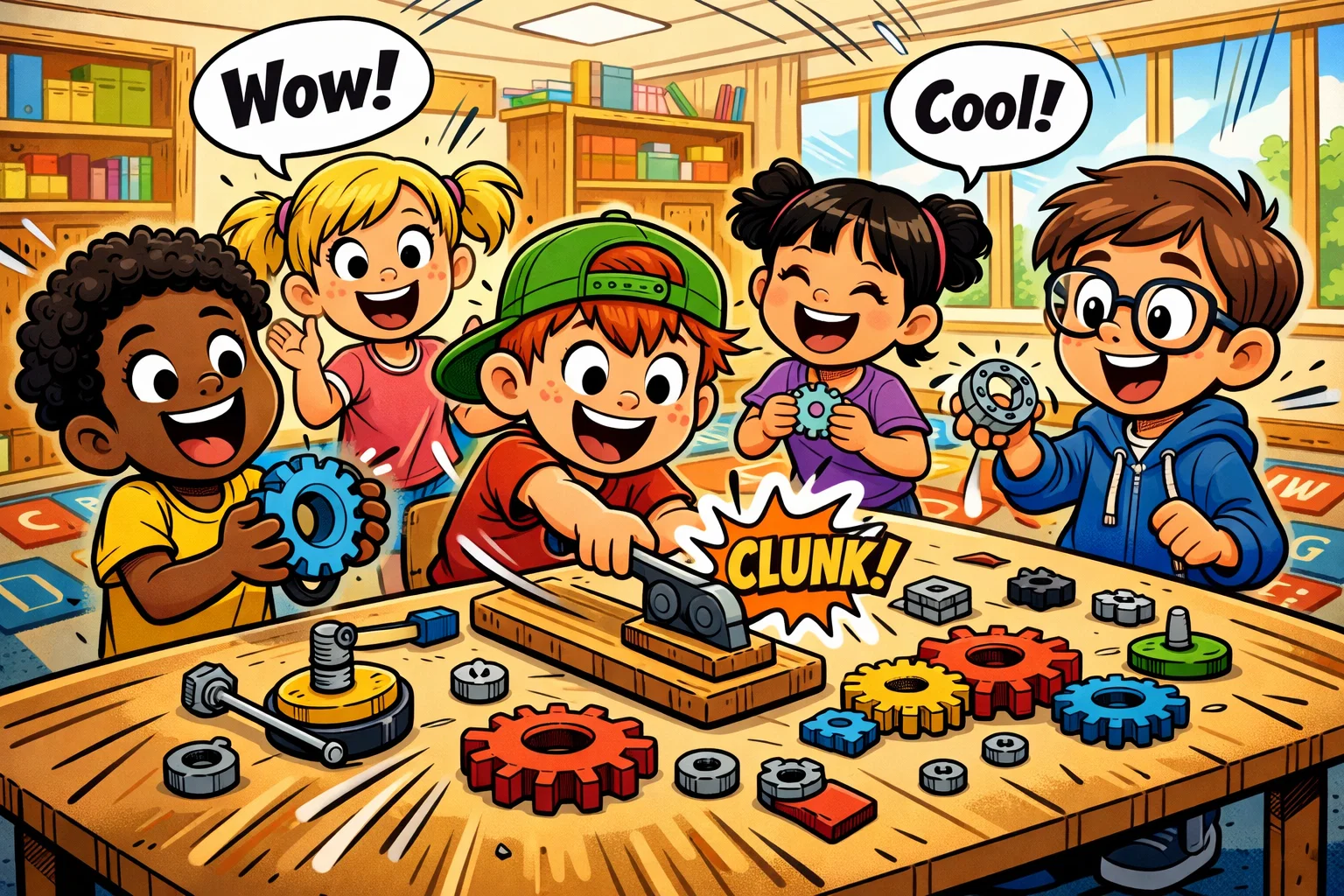
Simple machines are fundamental mechanical devices that change the direction or magnitude of a force. Unlike complex electronic gadgets, these tools use geometry and physical laws to perform work — moving an object over a distance — more efficiently. The six standard types include the lever, pulley, wheel and axle, inclined plane, wedge, and screw. These basic mechanisms serve as the primary building blocks for all modern technology and engineering.
Hands-On STEM Benefits
Direct physical engagement helps children build a concrete mental framework for scientific concepts. Educators like Maria Montessori and John Dewey emphasized “learning by doing,” noting that active play with physical materials demands thinking and results in natural learning. By testing ramps or levers, students move from passive observation to active investigation, developing the critical thinking skills necessary for future engineering challenges.
Making Work Easier
Simple machines provide a mechanical advantage by allowing a trade-off between force and distance. To lift a heavy load with less effort, that force must be applied over a longer distance. This is governed by the Law of Conservation of Energy and the principle of work, where work (W) equals force (F) multiplied by distance (d): W = F * d
No machine reduces the total work required; they simply redistribute the effort. Real-world efficiency is always below 100% due to friction.
Build Pulley System
Necessary Materials
To construct a functional simple pulley at home, gather the following:
- Two sturdy pencils or dowels
- A small cardboard box (like a cereal box)
- Thick twine or nylon rope
- A small plastic bucket or a yogurt container (the “load”)
- Tape and scissors
Building Process
- Cut two holes near the top of the cereal box on opposite sides to serve as a frame.
- Slide one pencil through the holes; this will act as the fixed axle.
- Loop the twine over the pencil.
- Attach one end of the twine to the handle of your yogurt container.
- Pull the other end of the twine downward to lift the container.
- To create a compound pulley, add a second pencil attached to the load itself and thread the rope through both.
Physics Laws and Principles
The pulley works by changing the direction of the force. Instead of lifting up, you pull down, using your body weight to assist. In a single fixed pulley, the Ideal Mechanical Advantage (IMA) is 1. However, when you add more rope segments (a movable pulley), the IMA increases based on the number of supporting rope segments. The formula for IMA in a frictionless system is the ratio of distances: IMA = d_input / d_output
Construct Balloon Powered Car
Necessary Materials
- A small rectangular cardboard box or plastic bottle
- Four bottle caps (wheels)
- Two wooden skewers (axles)
- Two plastic straws
- One large balloon and tape
Building Process
- Tape two straws across the bottom of the box, ensuring they are perfectly parallel.
- Thread the skewers through the straws.
- Attach the bottle caps to the ends of the skewers.
- Tape the neck of the balloon to a third straw.
- Tape that straw to the top of the car, ensuring the balloon hangs off the back.
- Blow into the straw to inflate the balloon, pinch it, and let go on a flat surface.
Physics Laws and Principles
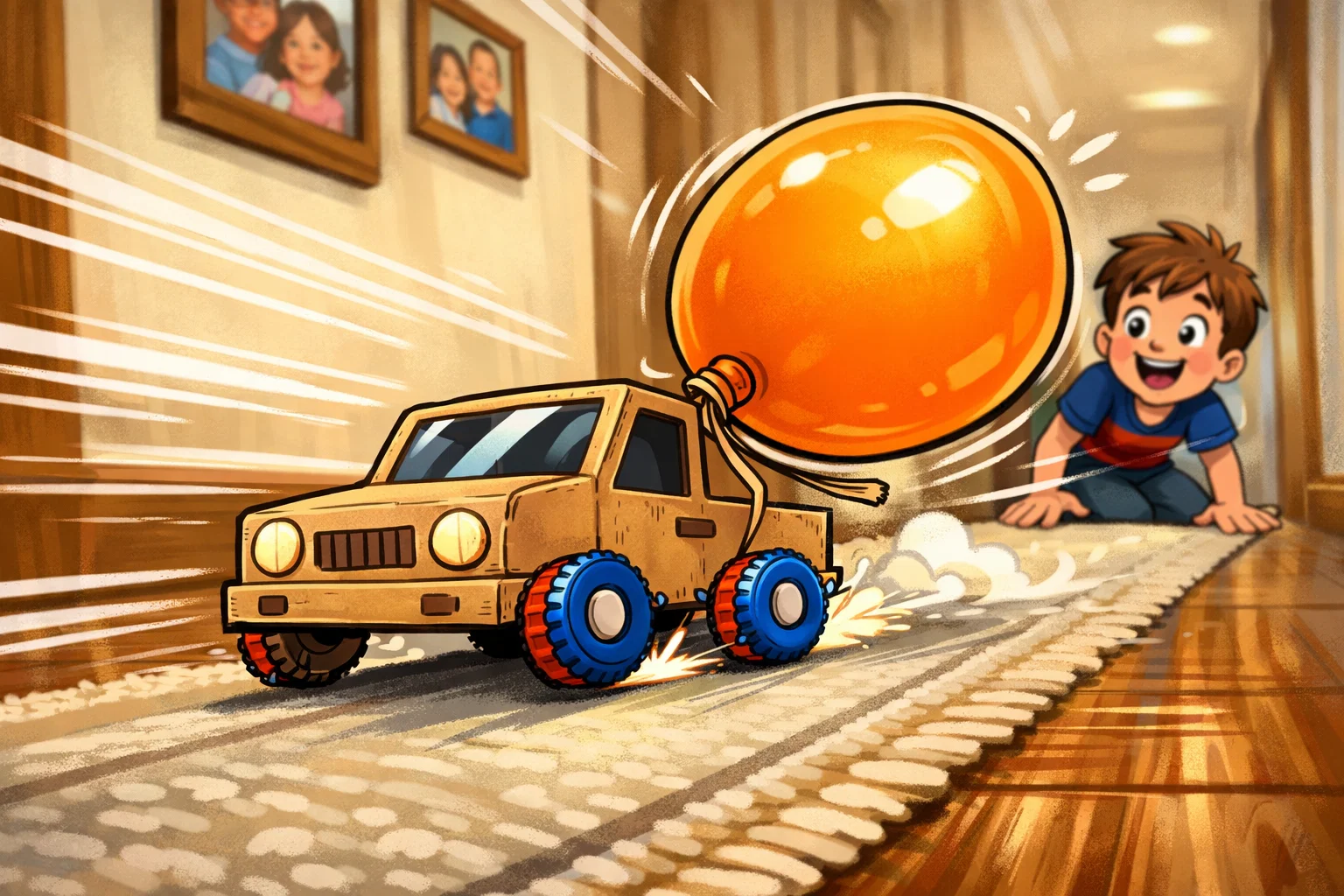
This experiment demonstrates the wheel and axle combined with Newton’s Third Law of Motion: for every action, there is an equal and opposite reaction. As the air escapes the balloon (action), it pushes the car forward (reaction). The wheel and axle reduce friction by allowing the car to roll rather than slide. The IMA of the wheel and axle is calculated by the ratio of the radius of the wheel (R) to the radius of the axle (r): IMA = R_wheel / r_axle
Create Archimedes Screw
Necessary Materials
- A length of PVC pipe (roughly 2 feet)
- Clear vinyl tubing
- Strong waterproof tape
- Two bowls (one filled with water or cereal)
Building Process
- Secure one end of the vinyl tubing to the bottom of the PVC pipe with tape.
- Wrap the tubing in a tight, consistent spiral all the way to the top of the pipe.
- Tape the other end of the tubing at the top.
- Place the bottom of the screw into the bowl of cereal at a 30-degree angle.
- Rotate the pipe steadily. The cereal should begin to “climb” the tube.
Physics Laws and Principles
The Archimedes screw is essentially an inclined plane wrapped around a cylinder. As the screw rotates, it creates small “pockets” that trap the material. Even though the screw is turning, the material inside stays relatively flat due to gravity, effectively sliding up the “ramp” created by the tubing. The IMA is defined by the rotational distance compared to the linear lift: IMA = (2 * pi * Radius) / Pitch
Assemble Paper Airplane Launcher
Necessary Materials
- Heavy cardboard base
- Two clothespins or binder clips
- A thick rubber band
- Glue or strong tape
- A paper airplane
Building Process
- Glue two clothespins to the cardboard base, spaced about 4 inches apart.
- Stretch a rubber band between the two pins.
- Pull the rubber band back and secure it with a central trigger (like a small notch in the cardboard).
- Place the paper airplane in front of the stretched band.
- Release the band to launch the plane.
Physics Laws and Principles
This launcher utilizes tension and elastic potential energy. By stretching the rubber band, you are doing work on it. When released, that stored energy is converted into kinetic energy, propelling the plane forward. This highlights the conservation of energy principle: energy is not created, only transformed from potential to kinetic states.
Design Marble Roller Coaster
Necessary Materials
- Foam pipe insulation (cut in half lengthwise to create tracks)
- Masking tape
- Marbles
- Furniture or boxes of various heights for supports
Building Process
- Tape the start of the foam track to a high point, like a table or shelf.
- Create a “hill” or a loop-the-loop by curving the foam and securing it with tape to the floor or wall.
- Ensure the track ends in a safe “catch” zone.
- Release a marble from the highest point and observe its progress.
Physics Laws and Principles
The roller coaster is a series of inclined planes. The marble gains potential energy at the top, which converts to kinetic energy as it descends. To complete a loop, the marble must have enough momentum to overcome the pull of gravity at the peak of the circle. Friction between the marble and the foam track will eventually slow it down, demonstrating why real coasters need a high initial drop.
Make Rubber Band Car
Necessary Materials
- CDs or large bottle caps (wheels)
- Corrugated cardboard (chassis)
- Wooden skewers
- A rubber band and a small hook (or paperclip)
Building Process
- Build a chassis with two parallel axles.
- Attach the rubber band to the front axle and a hook on the rear axle.
- Wind the rubber band around the rear axle by rotating the wheels backward.
- Place the car on the ground and release it.
Physics Laws and Principles
Similar to the airplane launcher, this car stores potential energy. As the rubber band unwinds, it exerts torque on the axle, turning the wheels. The effectiveness depends on the friction between the wheels and the floor; if the wheels are too smooth, they will spin in place without moving the car forward.
Research and Data Integration
While these experiments are engaging, their importance is supported by rigorous evidence from the University of Washington and the U.S. Bureau of Labor Statistics. An individual‑participant meta‑analysis led by Elli Theobald and colleagues at the University of Washington, published in the Proceedings of the National Academy of Sciences (PNAS), shows that high‑intensity active learning in undergraduate STEM courses:
- reduces achievement gaps on exams by 33% compared with traditional lecturing, and
- narrows gaps in course passing rates by 45%,
underscoring the impact of hands‑on instructional designs for underrepresented and at‑risk students. At the same time, projections from the U.S. Bureau of Labor Statistics indicate that STEM employment in the United States is expected to grow substantially faster than non‑STEM employment over the coming decade, highlighting the urgency of effective STEM preparation.
| Metric | Value (correct) | Significance (with sources) |
| STEM job growth | 8.1% (2024–2034) | U.S. BLS projects STEM employment to grow 8.1% from 2024 to 2034, compared with 2.7% for non‑STEM occupations, meaning STEM roles are growing roughly three times faster. |
| Non‑STEM job growth | 2.7% (2024–2034) | Non‑STEM employment is projected to grow 2.7% over the same period, so demand for STEM talent increases much more rapidly than for other fields. |
| Achievement gap reduction | 33% | Theobald et al. find that switching from traditional lecturing to active learning reduces achievement gaps in exam scores between underrepresented and overrepresented students by 33% on average. |
| Passing‑rate gap reduction | 45% | In the same meta‑analysis, active learning narrows gaps in course passing rates by 45%, indicating substantially better retention for students from minoritized and low‑income groups. |
Physics Experiments for Home or School

Race Objects Down Inclined Plane
An inclined plane is a flat surface tilted at an angle. It allows you to lift heavy loads by pushing them up a slope rather than lifting them vertically. Set up two ramps at different angles. Race a heavy ball and a light ball. You will observe that the slope angle affects the force required, but the speed is governed by gravity and the force-distance trade-off. IMA = Length of Slope / Height
Start With Simple Lever Experiment
A lever consists of a beam and a fulcrum (pivot). Using a 12-inch ruler and a hexagonal pencil, place the pencil at the 6-inch mark. Place a crayon box on one end and pennies on the other. Move the pencil to the 2-inch and 10-inch marks. You will see that moving the fulcrum closer to the load makes it much easier to lift, demonstrating the Law of the Lever (Torque balance). IMA = d_effort / d_load
Create Simple Machine Scavenger Hunt
Simple machines are everywhere. A common observation in second-grade classrooms is that students initially think machines must “run on electricity.” A scavenger hunt helps them identify a “wedge” in a doorstop or a “screw” in a jar lid. This shifts their perspective from “being strong” to using mechanical advantage to solve problems.
Build Rube Goldberg Machine
A Rube Goldberg machine uses a chain reaction of simple machines to complete a very simple task, like popping a balloon. This challenge encourages students to combine levers, pulleys, and ramps, teaching them how complex systems are just a collection of simple mechanisms working together.
Design and Build Carnival Attraction
Challenge kids to build a “Carnival” using what they’ve learned. A “Strength Tester” might use a lever, while a “Bucket Toss” could involve a catapult. This project-based approach increases STEM knowledge gains by an effect size of 1.26 compared to traditional methods.
FAQ Section
What materials are best for DIY physics projects?
Recycled materials are often superior for learning because they are easy to modify. Cardboard, plastic bottles, skewers, and rubber bands allow for rapid prototyping. For pulleys, ensure the “rope” is thick enough to avoid snagging, a common failure point in cereal box models.
Which simple machine is easiest for preschoolers to build?
The inclined plane (ramp) is the most intuitive. Simply propping up a board or a piece of cardboard allows toddlers to immediately see how gravity affects motion. The simple lever (seesaw) is also highly effective for this age group.
How do these mechanisms help in everyday life?
They are in almost everything we use. A zipper is a series of wedges; a doorknob is a wheel and axle; your teeth act as wedges to cut food. These tools reduce the physical strain on our bodies by magnifying our input force.
Where can I find household items for wedge experiments?
Look in the kitchen and the tool shed. Knives, axes, and even nails are wedges. For a safe kid-friendly experiment, use a cardboard triangle (at various angles) to push under a weighted toy car to see which angle lifts the car with the least effort.
Why is friction important when testing these models?
In theory (IMA), machines work perfectly. In reality, friction converts kinetic energy into heat. If a rubber band car won’t move, it may indicate that there is too much friction in the axle or not enough grip (friction) on the tires. Balancing these forces is a key engineering skill.

Take a short quiz to find out what your everyday choices say about your parenting style
When your child is curious about something new, what’s your instinct?
Take a short quiz to find out what your everyday choices say about your parenting style
“Can I download this app?” What happens next?
Take a short quiz to find out what your everyday choices say about your parenting style
When it comes to rules at home, which sounds most like you?
Take a short quiz to find out what your everyday choices say about your parenting style
If you could give your child one life skill today, what would you pick?
Take a short quiz to find out what your everyday choices say about your parenting style
Your child gets to choose what to watch. What would your ideal setup look like?
Take a short quiz to find out what your everyday choices say about your parenting style
Pick your parenting superpower ✨